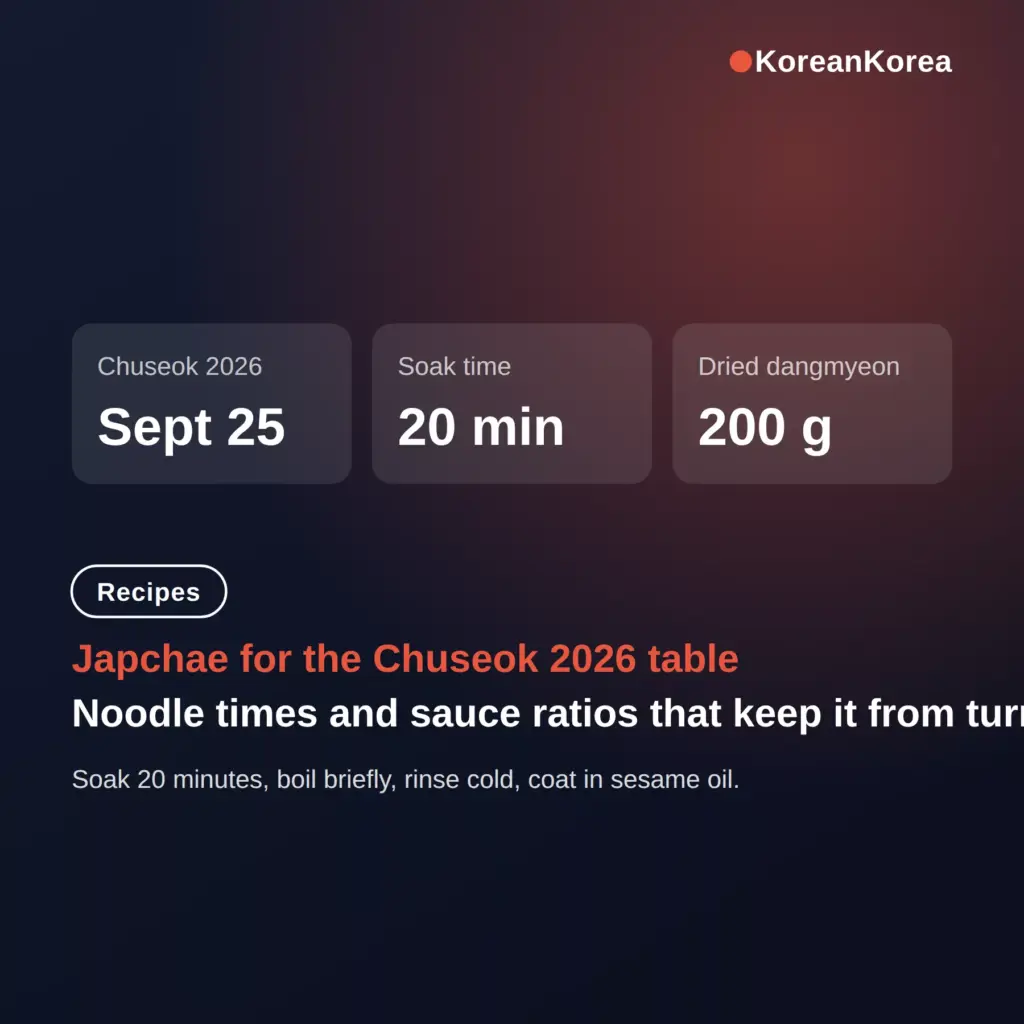
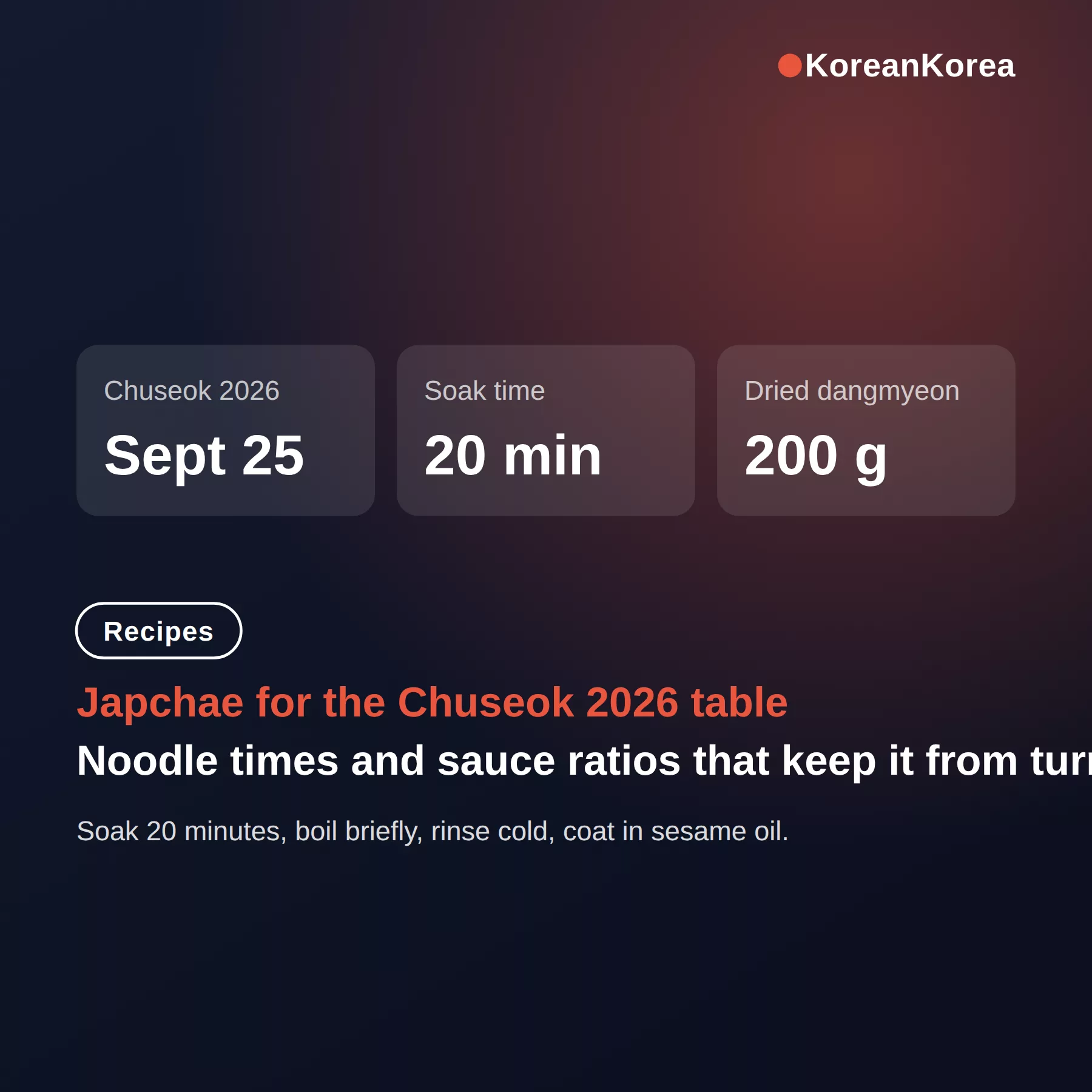
For Chuseok 2026 (September 25, holiday window September 24-26), make japchae with 200 g of dried dangmyeon for 4 servings — soak in warm water 20 minutes, boil briefly (one source says 7-8 minutes, another 3-5 minutes; stretch a strand and trust the bend, not the clock), rinse in cold water, and coat with sesame oil before saucing.
That sequence is what keeps sweet potato glass noodles chewy instead of mushy or clumped.
This post gives the full method, a metric ingredients table, two sauce ratios side by side, common mistakes, and storage for the holiday table.
Contents
- japchae recipe chuseok, noodle times that stop mush
- What japchae is and why Koreans make it for Chuseok
- Japchae ingredients for 4 servings (metric)
- The sauce ratio: Maangchi vs the Korean home-cook golden ratio
- Common mistakes that make japchae soggy or clumpy
- Make-ahead, storage, and reheating for the holiday table
japchae recipe chuseok, noodle times that stop mush
Soggy japchae is a noodle-handling problem, not a flavoring problem.
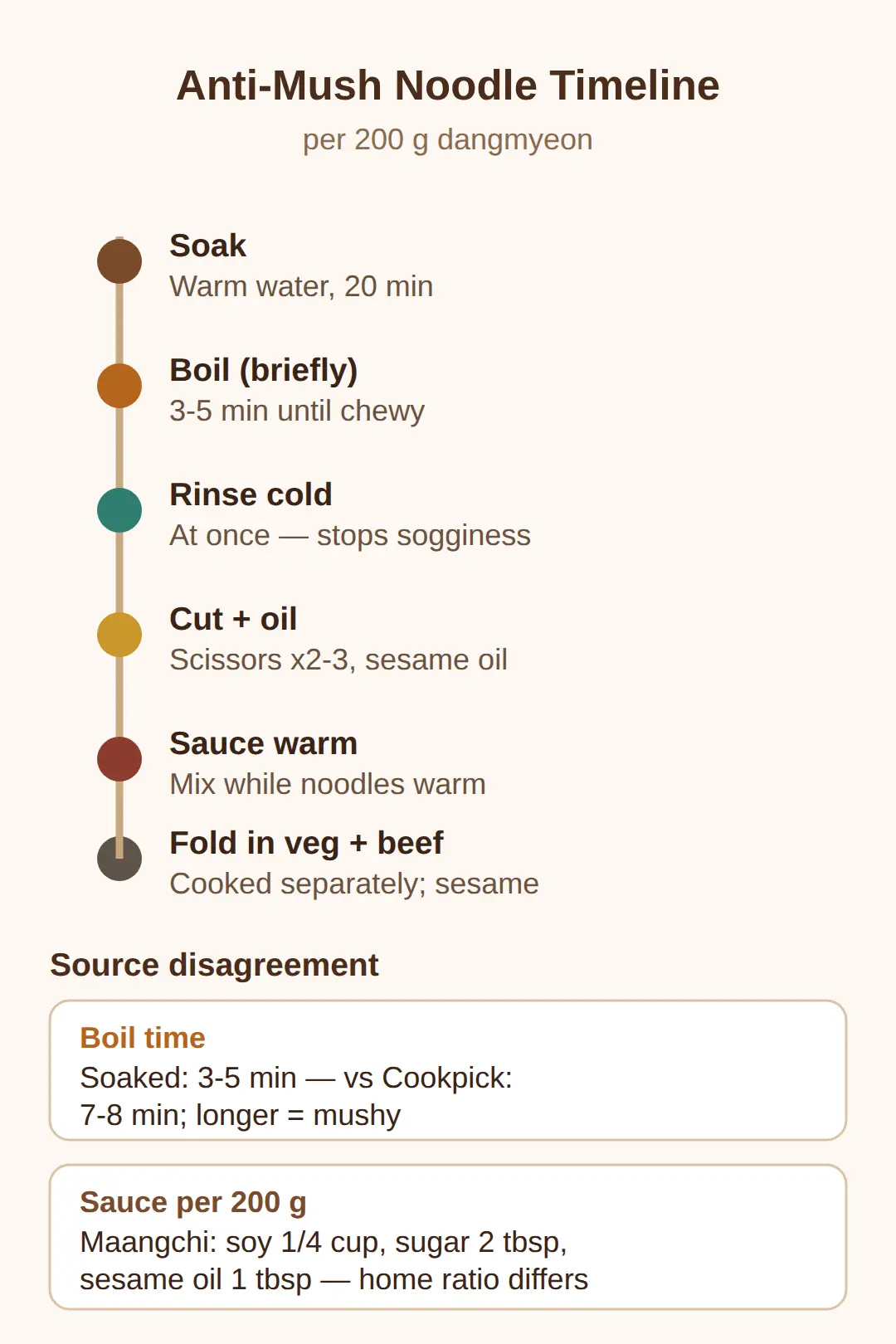
Soak, boil briefly, rinse cold, oil, sauce warm, and fold the vegetables in last — in that order.
| Step | What to do |
|---|---|
| Soak | 200 g dried dangmyeon in warm water for about 20 minutes, which shortens the boiling time and keeps the centers from staying hard |
| Boil | Briefly — one source says 3-5 minutes, another says 7-8 minutes and warns longer boiling makes noodles swell and turn soggy |
| Rinse | Drain and rinse immediately in cold water — leaving them warm causes sogginess |
| Cut and oil | Cut 2-3 times with kitchen scissors, then coat with sesame oil — that oil film is the standard anti-stick measure |
| Sauce | Mix the sauce in while the noodles are still warm so they absorb it evenly |
| Combine | Stir-fry the vegetables and beef separately, fold them in by hand, finish with toasted sesame seeds |
If your noodles are done, a stretched strand bends without snapping and looks translucent with a slight bounce at the center.
When reading any japchae recipe from outside Korea, the first thing to check is that soak-rinse-oil sequence, because that is where most soggy batches start.
| Soak dangmyeon in warm water | About 20 minutes |
|---|---|
| Boil soaked noodles | 3-5 minutes (one source) / 7-8 minutes (another) — go by the stretch test |
| Rinse after draining | Immediately, in cold water |
| Blanch spinach | About 30 seconds, then squeeze dry |
| Refrigerate leftovers | About 2-3 days, reheat in a pan |
What japchae is and why Koreans make it for Chuseok
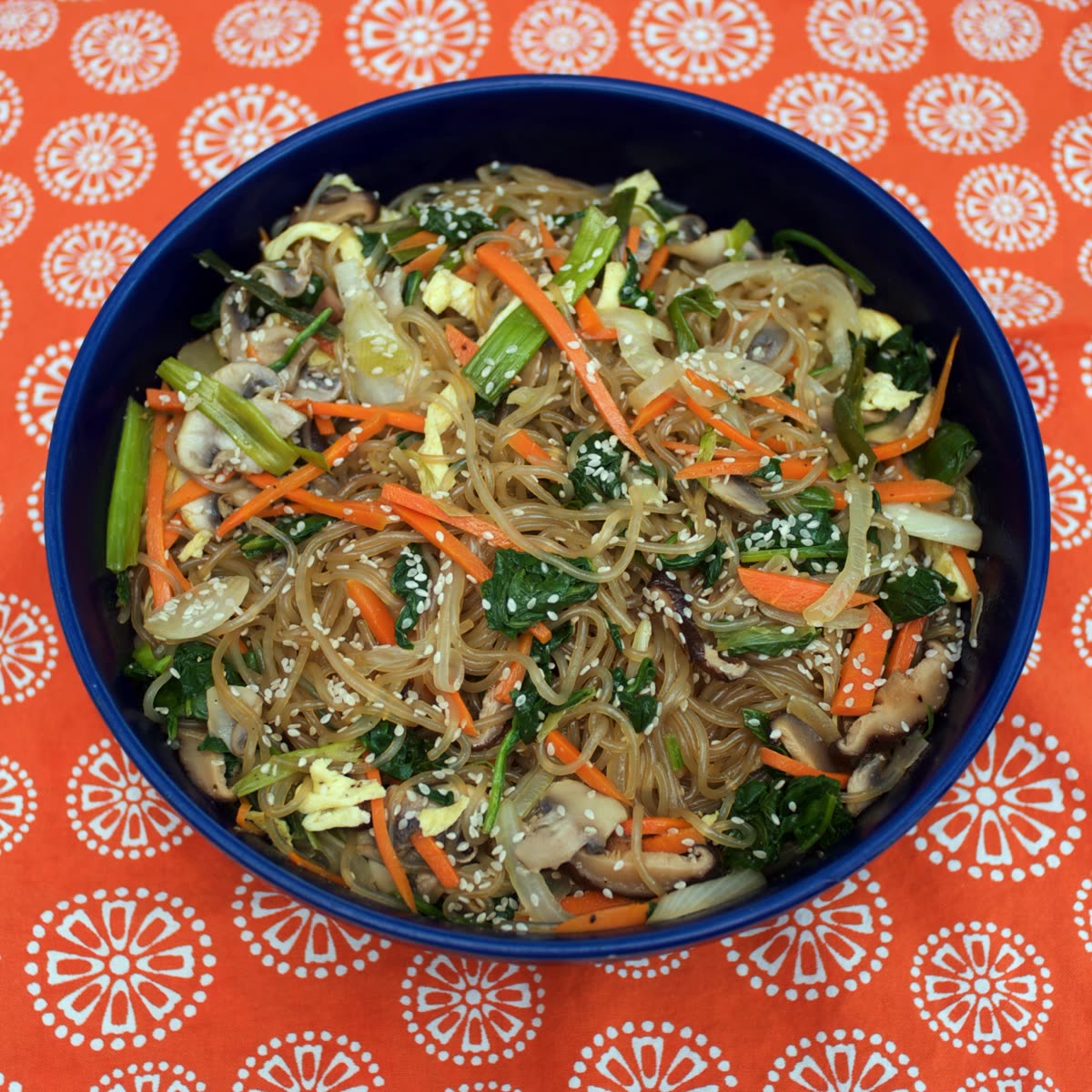
Japchae is a Korean dish of sweet potato glass noodles stir-fried with vegetables and sesame oil, and it is a standard dish on the Chuseok holiday table.
| Question | Answer |
|---|---|
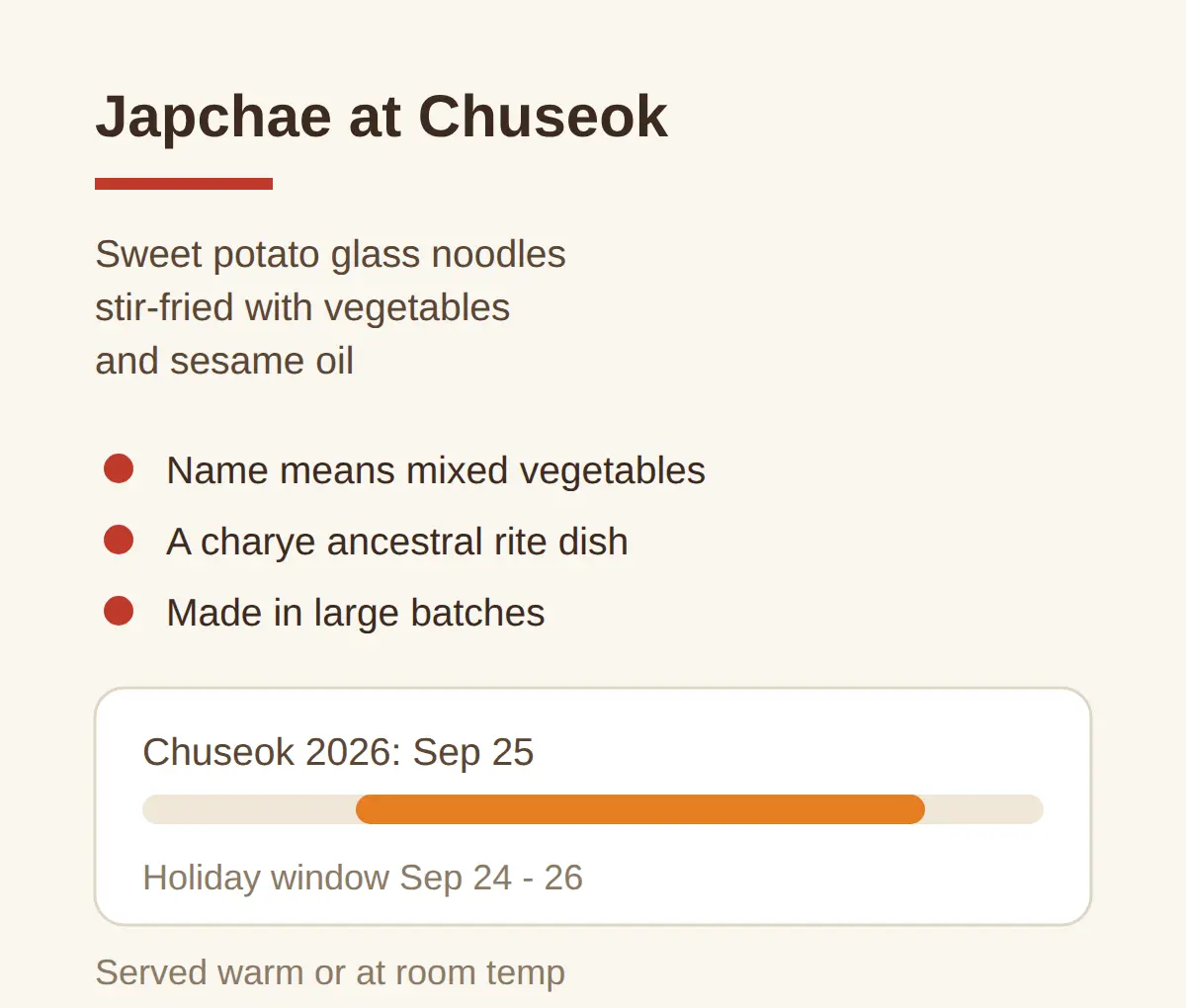
| What is japchae | Sweet potato glass noodles stir-fried with vegetables and sesame oil; the name means "mixed vegetables" |
| Why it is on the Chuseok table | It is a canonical charye (ancestral rite) and holiday feast dish, commonly made in large batches |
| When is Chuseok 2026 | September 25 (lunar August 15), with the holiday window running September 24-26 |
| Why it suits holiday tables | Served warm or at room temperature, so it can sit out through the day |
If you are cooking for a Korean-style holiday table, japchae is one of the dishes you can make ahead and leave at room temperature, unlike anything that needs to come straight off the stove.
👉 Samgyetang Recipe Without a Spring Chicken: Supermarket Substitutions That Work
Japchae ingredients for 4 servings (metric)
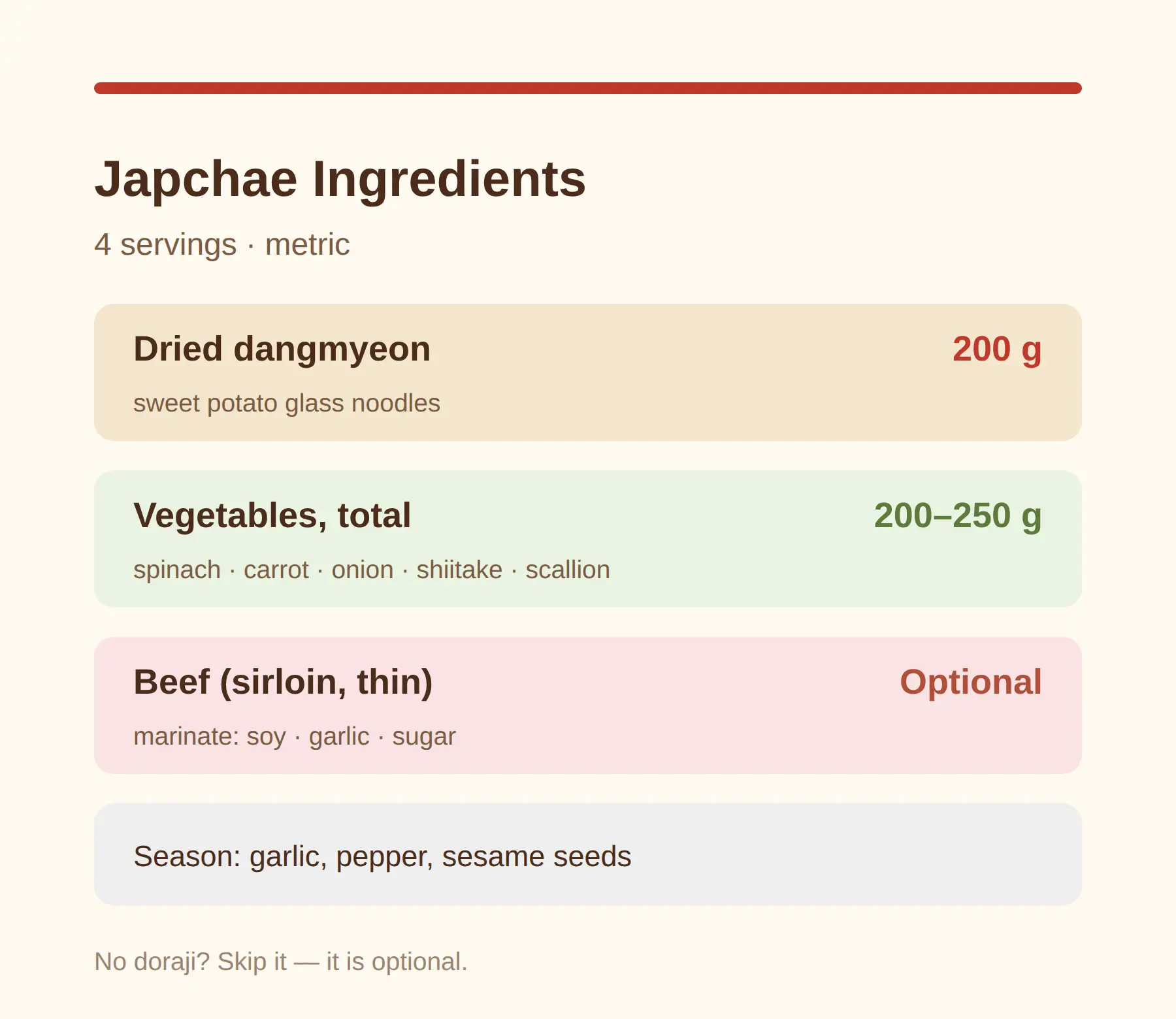
For 4 servings, plan on roughly 200 g of dried dangmyeon and 200-250 g of vegetables in total.
The vegetables are spinach, carrot, onion, shiitake mushroom, and scallion; thinly sliced sirloin is optional.
| Ingredient | Amount for 4 servings |
|---|---|
| Dried dangmyeon (sweet potato glass noodles) | About 200 g |
| Spinach, carrot, onion, shiitake, scallion | 200-250 g combined |
| Beef, thinly sliced sirloin | Optional; marinate briefly with soy, garlic, sugar |
| Soy sauce / sugar / sesame oil | See the sauce table below |
| Garlic, pepper, toasted sesame seeds | To season |
Doraji (bellflower root) is an optional vegetable that can be hard to find abroad, so treat it as a skip rather than a requirement.
These gram amounts are a commonly shared 4-serving proportion, and home cooks adjust the sugar in the sauce to taste.
If beef is unavailable where you are, omit it and add king oyster mushrooms; if you cannot find shiitake, the dish still works with the other four vegetables.
The sauce ratio: Maangchi vs the Korean home-cook golden ratio
Two different sauce ratios circulate, and they are different recipes rather than one reconciled standard.
For 200 g of dried dangmyeon, the widely shared Korean home-cook ratio is about 5 tbsp soy sauce, 3 tbsp sugar, and 3 tbsp sesame oil — roughly 11 tbsp of sauce in total for 4 servings.
| Source | Per 200 g noodles |
|---|---|
| Korean home-cook "golden ratio" (Cookpick) | 5 tbsp soy sauce, 3 tbsp sugar, 3 tbsp sesame oil, plus 1 tbsp minced garlic and pepper |
| Maangchi’s version | About 1/4 cup (4 tbsp) soy sauce, 2 tbsp sugar, 1 tbsp sesame oil per batch |
Maangchi’s exact tablespoon amounts were not re-verified from her primary recipe page, so treat hers as an approximate reference rather than a settled number.
The home-cook 5:3:3 figure is a widely shared blog standard, not an institutional recipe.
Pick one ratio and stick with it for the batch; if the finished dish tastes flat, adjust the sugar first, because that is the part home cooks routinely change to taste.
Common mistakes that make japchae soggy or clumpy
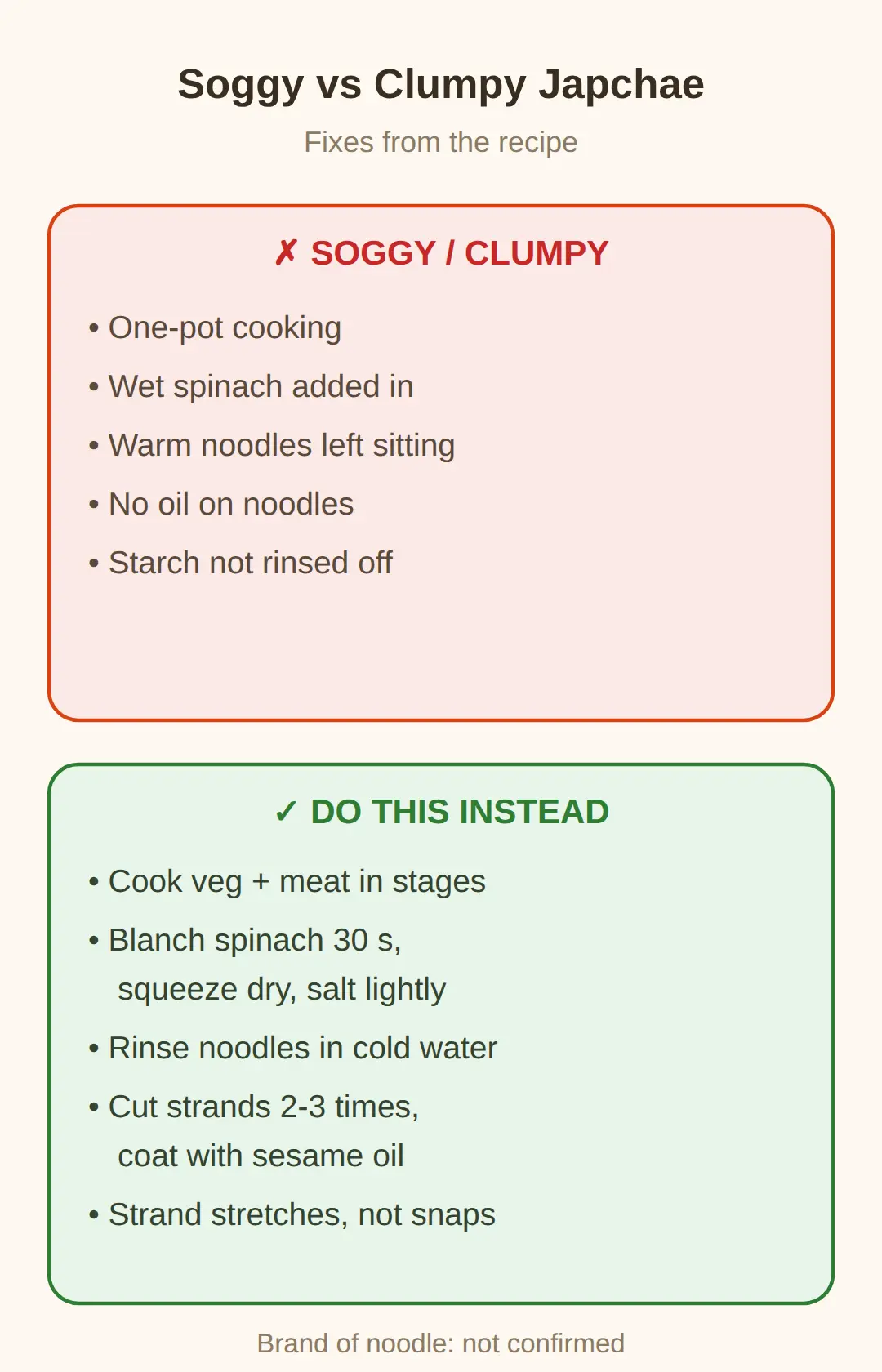
The most common cause of soggy japchae is cooking everything in one pot, where water released by high-moisture vegetables soaks the noodles.
Clumping, on the other hand, comes from excess surface starch and too little oil on the noodles.
- Cook the vegetables and meat separately or in stages, then combine with the noodles — do not save time by throwing everything in one pan.
- Blanch the spinach for about 30 seconds, squeeze it dry, and salt it lightly before combining; wet spinach releases water into the finished dish.
- Rinse the boiled noodles right away in cold water instead of letting them sit warm.
- Cut the cooked noodles 2-3 times with scissors and coat them in sesame oil so the strands stay separate.
- Check doneness by stretching a strand — it should bend and stretch without snapping, translucent with a slight bounce at the center.
Whether the noodle brand matters for clumping was not confirmed in any reliable source, so the soak-rinse-oil steps are the parts worth being strict about.
👉 Kimbap Recipe: 45 Minutes, One Mat, No Special Ingredients
Make-ahead, storage, and reheating for the holiday table
Japchae keeps about 2-3 days in the refrigerator and reheats in a pan with a splash of water or a little oil, not the microwave.
That makes it a practical make-ahead dish for a September 24-26 holiday window.
The microwave dries or hardens the strands and brings the clumping back, while a pan with a little water or oil loosens them again.
Japchae is served warm or at room temperature, which is why it suits large holiday tables — you can make it a day ahead and set it out without reheating strictly on the hour.
If you are cooking for a Chuseok table, sauce the noodles first while they are warm, coat them in sesame oil, and fold in the stir-fried vegetables and meat last — then make the batch a day early, because it holds 2-3 days refrigerated anyway.
For a vegetarian version, skip the beef and add king oyster mushrooms, and honey or oligosaccharide can replace the sugar.
If I were making this for a Chuseok table, I would sauce the noodles first while they are warm and coat them in sesame oil before anything else, because that order is what keeps a day-old batch from clumping.
👉 What japchae is and why Koreans make it for Chuseok
👉 Cookpick japchae recipe (Korean)
👉 My Korean Kitchen japchae guide
Related posts
📎 Tteokbokki Recipe: Why Broth Instead of Water Keeps It From Turning Gummy
📎 tteokguk recipe: easy rice cake soup with frozen tteok
📎 📅 다가오는 일정 — 발매·개봉·발표 캘린더
Sources
- Sept 25, 2026 confirmed in today’s feed (koreatimes.co.kr)
- Approx. 200 g dangmyeon + 200-250 g vegetables per 4 serving (mykoreankitchen.com)
- Korean golden-ratio sauce 5:3:3 tbsp for 200g noodles, 7-8 m (cookpick.kr)
Key points at a glance
- Check the noodles with the stretch test: a strand bends without snapping and stays translucent with a slight bounce at the center.
- Verify the soak-rinse-oil sequence before following any japchae recipe from outside Korea.
- Weigh 200 g dried dangmyeon for 4 servings before starting.
- Confirm the vegetables and meat were stir-fried separately, not in one pot.
- Plan to reheat in a pan with a splash of water, not the microwave.
- Set the dish out warm or at room temperature — it holds 2-3 days refrigerated.
FAQ
Q. How do I keep japchae noodles from getting mushy?
Soak them in warm water about 20 minutes, boil only briefly, rinse right away in cold water, and coat with sesame oil before saucing.
Q. How long do I boil dangmyeon for japchae?
Sources disagree — one says 3-5 minutes for soaked noodles, another says 7-8 minutes only. Judge by the stretch test: the strand should stretch without snapping and look translucent.
Q. Why is my japchae clumping together?
Clumping comes from excess surface starch and not enough oil. Cut the cooked noodles 2-3 times with scissors and coat them with sesame oil before mixing in the sauce.
Q. Can I make japchae a day before Chuseok?
Yes — it keeps about 2-3 days refrigerated, and it is served warm or at room temperature. Reheat in a pan with a splash of water rather than the microwave.
Q. What can I substitute for beef in japchae?
Omit the beef and add king oyster mushrooms for a vegetarian version; doraji (bellflower root) is optional and can be left out.
Chuseok 2026 falls on September 25, with the holiday running September 24-26 — pick up dangmyeon, spinach, and shiitake a day or two ahead, since the finished dish holds 2-3 days in the refrigerator.
#japchae #japchaerecipe #Chuseok #Koreanglassnoodles #dangmyeon #Koreanholidayfood #Koreanrecipes
📅Upcoming Dates — 이번 주 16 · D-day 'The Scandal' global Netflix release전체 보기 →