Homemade tteokbokki fails in two predictable ways: the rice cakes stay hard or turn gummy, and the sauce comes out too sweet or too flat.
Both problems come from handling, not luck.
This guide covers the broth, the thawing step, and what to substitute when Korean groceries are out of reach.
Contents
- Why homemade tteokbokki turns gummy
- The broth that carries the flavor
- Failure point 1: freezer-hard rice cakes
- Failure point 2: gochujang brands and sweetness
- Substitutions when Korean ingredients are hard to find
- Common beginner mistakes, in one place
Why homemade tteokbokki turns gummy
Tteokbokki is chewy rice cakes simmered in a gochujang sauce, and in Korea it is not a niche dish — a live listing tracks more than 4,600 tteokbokki restaurants nationwide, with at least 21 franchise brands running on it alone.
That scale means the classic version has been standardized for decades, and the official reference from the Korean Food Foundation lists the same core set: garaetteok rice cakes, a gochujang-based sauce, fish cakes, and optional boiled eggs or scallions.
The two texture failures beginners hit abroad come from the same root.
Starch released during simmering thickens the sauce, and once the rice cakes overcook past soft-and-floating, that starch turns the whole pot gummy.
The fix is controlling water, heat, and timing — which is what the rest of this guide does.
| Hard outside, gummy inside | Rice cakes went in frozen or cold, without soaking |
|---|---|
| Sauce tastes flat and starchy | Plain water replaced the anchovy-kelp broth |
| Too sweet or too mild | Gochujang brands differ in sweetness; the amount was fixed, not tasted |
| Chewy turned to mush | Simmering continued past the point the rice cakes float and soften |
The broth that carries the flavor
The sauce base is not water.
Korean recipe sources use a standard soup stock of dried anchovies and dashima (kelp), simmered for about 10 minutes before anything else goes in.
Rice cakes release starch as they cook, and that starch needs a flavored liquid underneath it, or the sauce lands flat no matter how much gochujang goes in.
Make the broth first, strain it, and build the sauce on top of it.
Failure point 1: freezer-hard rice cakes
Fresh and vacuum-packed garaetteok do not keep at room temperature, and freezing is the correct storage if they will not be used within a few days.
The mistake is cooking them straight from the freezer or fridge.
Hardened rice cakes need to be thawed and soaked in warm water for 10 to 20 minutes first, or they cook unevenly — gummy on the outside, hard in the center.
Doneness is easy to check: the cakes are ready when they fully float and feel soft to the bite.
Stop simmering there.
Every extra minute past that point pushes the texture from chewy toward gummy.
Failure point 2: gochujang brands and sweetness
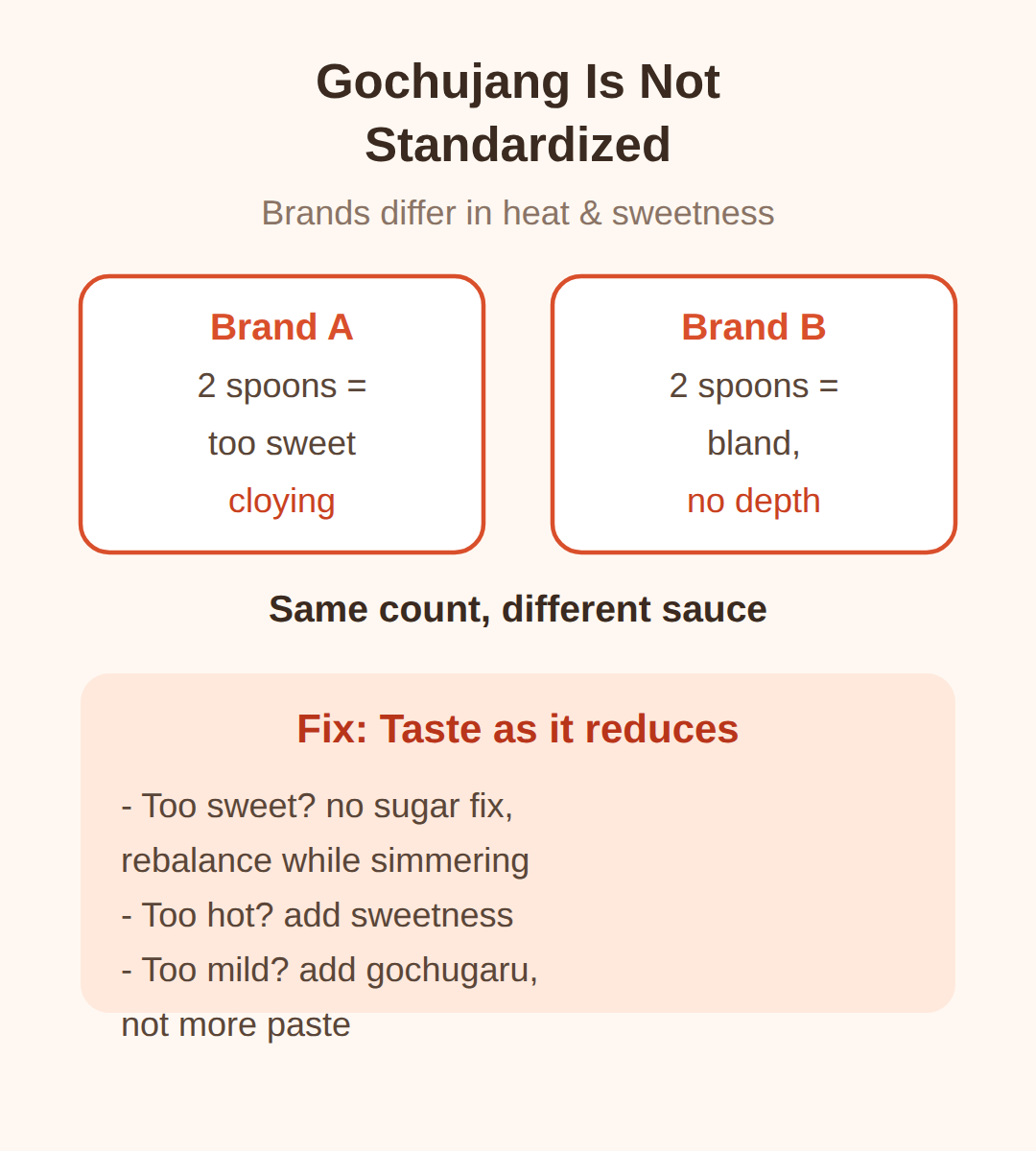
Gochujang is not a standardized product.
Spiciness and sweetness vary noticeably between Korean brands, so a fixed spoon count that worked in one recipe can produce a sauce that is cloying or bland with another jar.
Recipes from established Korean-cooking sources advise tasting the sauce as it reduces and adjusting with sugar or corn syrup, rather than trusting a fixed amount.
The same rule applies to heat: if a brand runs hotter than expected, sweetness balances it; if it runs mild, add gochugaru rather than more paste.
Substitutions when Korean ingredients are hard to find
The ingredient most often missing abroad is fresh garaetteok.
Dried rice cakes are the common stand-in, and they simply need a longer soak before cooking.
Non-Korean rice cakes also work, but each type changes cooking time and texture, so watch the float-and-soften cue instead of the clock.
Eomuk (fish cake) is a common add-in rather than a requirement — it cuts into pieces and simmers directly in the sauce, and leaving it out is fine.
Common beginner mistakes, in one place
Cooking rice cakes straight from the freezer or fridge is the first, and a 10-to-20-minute warm-water soak fixes it.
Replacing the anchovy-kelp broth with plain water is the second.
The third is simmering past the point where the cakes float and soften, which trades chewiness for gumminess.
The fourth is locking in a gochujang amount without tasting, which breaks as soon as the brand changes.
Related posts
📎 Samgyetang Recipe Without a Spring Chicken: Supermarket Substitutions That Work
📎 Kimbap Recipe: 45 Minutes, One Mat, No Special Ingredients
Sources
- official_dish_reference (hansik.or.kr)
- rice_cake_handling (koreanbapsang.com)
- recipe_authority_pattern (maangchi.com)
Storage and reheating
- Leftover tteokbokki thickens as it sits, because the rice cakes keep releasing starch in the sauce.
- Reheat on the stove with a splash of water to loosen the sauce, rather than dry in a microwave.
- Unused rice cakes keep better frozen than refrigerated; thaw and soak in warm water before the next batch.
FAQ
Q. Should the recipe be adjusted for frozen rice cakes?
The steps stay the same — only the prep changes. Frozen or refrigerated garaetteok needs thawing and a 10–20 minute soak in warm water before it goes into the sauce.
Q. Can regular rice cakes replace garaetteok?
Yes, but expect a different texture and cooking time. Non-Korean rice cakes vary in density, so rely on the float-and-soften test instead of a fixed simmer time.
Q. How much sugar or corn syrup should go into the sauce?
There is no fixed amount that works across gochujang brands, because sweetness varies between them. Taste the sauce while it simmers and add sweetener a small spoon at a time.
The Korean Food Foundation’s hansik.or.kr hosts the official tteokbokki recipe and dish background in English, and it is the best page to check the classic ingredient list against.
Cover photo: HK Korean food product 農心集團 Nong Shim Shrimp Snack spicy 28-May-2013 by Pamoa2553 — CC BY-SA 3.0
#tteokbokkirecipe #tteokbokki #garaetteok #gochujang #Koreanricecakes #spicyricecakes #Koreanfood #easyKoreanrecipes
📅Upcoming Dates — 이번 주 4 · D-day Changdeokgung Moonlight Tour start (Sept 10–Oct 17, 30,000 K전체 보기 →