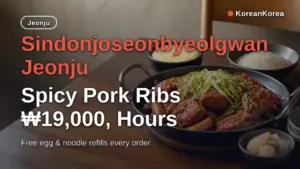
To read Korean prices, times, addresses and menus you need about 60 words, not the whole language. Prices are in won (원) and big amounts are grouped by 10,000 (만), so 15,000원 is 만 오천 원 and a sign saying 1.5만 means 15,000 won. Times on signs are usually on the 24-hour clock, dates are written year.month.day, and addresses go from the largest area to the smallest: city, district, road, building number.
Key facts — koreankorea.com free Korean course
- Korean banknotes come in 1,000, 5,000, 10,000 and 50,000 won, and coins in 10, 50, 100 and 500 won.
- Korean counts large numbers in units of 10,000 (만), so a price of 1.5만 means 15,000 won.
- Korean dates are written year, month, day: 2026.10.09 is 9 October 2026.
- South Korean road-name addresses run from the largest area to the smallest: city, district, road and building number.
Money and prices
Korean banknotes are 1,000, 5,000, 10,000 and 50,000 won; coins are 10, 50, 100 and 500 won. Because Korean counts in units of 10,000 (만), shops and menus often write prices in 만: 1만원 = 10,000 won, 1.5만 = 15,000 won, 3만원대 = in the 30,000s. 천 is 1,000, so 8천원 is 8,000 won.
| Korean | Romanization | Meaning |
|---|---|---|
| ▶ 원 | won | won (₩) — the currency |
| ▶ 천 원 | cheon won | 1,000 won |
| ▶ 만 원 | man won | 10,000 won |
| ▶ 만 오천 원 | man ocheon won | 15,000 won |
| ▶ 오만 원 | oman won | 50,000 won |
| ▶ 가격 | gagyeok | price |
| ▶ 할인 | harin | discount |
| ▶ 품절 | pumjeol | sold out |
| ▶ 계산 | gyesan | paying the bill |
| ▶ 카드 | kadeu | card |
| ▶ 현금 | hyeongeum | cash |
Opening hours and days
Opening hours are usually written on the 24-hour clock (11:00~22:00). Many restaurants close between lunch and dinner — the sign says 브레이크타임 with the hours. Days of the week are often shortened to one syllable in brackets, e.g. 매주 (월) 휴무 = closed every Monday.
| Korean | Romanization | Meaning |
|---|---|---|
| ▶ 영업시간 | yeongeopsigan | opening hours |
| ▶ 영업중 | yeongeopjung | open now |
| ▶ 준비중 | junbijung | not open yet / preparing |
| ▶ 오전 | ojeon | a.m. |
| ▶ 오후 | ohu | p.m. |
| ▶ 브레이크타임 | beureikeutaim | break time (closed between lunch and dinner) |
| ▶ 라스트오더 | raseuteuodeo | last order |
| ▶ 휴무 | humu | closed (day off) |
| ▶ 정기휴무 | jeonggihyumu | regular closing day |
| ▶ 연중무휴 | yeonjungmuhyu | open every day of the year |
| ▶ 24시 | isipsa si | open 24 hours |
| Short form | Romanization | Day |
|---|---|---|
| ▶ (월) | wol | Mon |
| ▶ (화) | hwa | Tue |
| ▶ (수) | su | Wed |
| ▶ (목) | mok | Thu |
| ▶ (금) | geum | Fri |
| ▶ (토) | to | Sat |
| ▶ (일) | il | Sun |
Dates
Korean dates go year → month → day: 2026.10.09 or 2026년 10월 9일 means 9 October 2026. Tickets and receipts often shorten the year: 26.10.09. Expiry dates on food use the same order.
Addresses
South Korea uses road-name addresses (도로명주소): the road name plus the building number, written from the biggest area to the smallest. Seoul City Hall is 서울특별시 중구 세종대로 110 — Seoul, Jung-gu (district), Sejong-daero (boulevard), building 110. In English the order is reversed: 110 Sejong-daero, Jung-gu, Seoul. Taxi drivers and map apps work best with the Korean address, so copy it as it is.
| Korean | Romanization | Meaning |
|---|---|---|
| ▶ 특별시 | teukbyeolsi | special city (Seoul) |
| ▶ 광역시 | gwangyeoksi | metropolitan city (Busan, Daegu …) |
| ▶ 도 | do | province |
| ▶ 시 | si | city |
| ▶ 구 | gu | district |
| ▶ 군 | gun | county |
| ▶ 동 | dong | neighbourhood |
| ▶ 대로 | daero | boulevard (widest roads) |
| ▶ 로 | ro | road |
| ▶ 길 | gil | street (smaller road) |
| ▶ 층 | cheung | floor |
| ▶ 지하 | jiha | basement (B) |
| ▶ 호 | ho | unit / room number |
| ▶ 우편번호 | upyeonbeonho | postal code (5 digits) |
Menus
Barbecue restaurants usually price meat per portion (1인분) and many ask for at least two portions. Rice is often not included with stews or meat — order 공기밥. Side dishes (반찬) come free and are refilled on request; at many places water and refills are self-service.
| Korean | Romanization | Meaning |
|---|---|---|
| ▶ 메뉴 | menyu | menu |
| ▶ 인분 | inbun | portion (per person) — meat is often ordered by 인분 |
| ▶ 2인분 이상 | iinbun isang | minimum two portions |
| ▶ 공기밥 | gonggibap | bowl of rice (often ordered separately) |
| ▶ 반찬 | banchan | side dishes (usually free refills) |
| ▶ 추가 | chuga | extra / add-on |
| ▶ 사리 | sari | extra noodles added to a stew |
| ▶ 곱빼기 | gopppaegi | large size |
| ▶ 순한맛 | sunhanmat | mild |
| ▶ 매운맛 | maeunmat | spicy |
| ▶ 포장 | pojang | takeaway |
| ▶ 셀프 | selpeu | self-service (e.g. water) |
| ▶ 시가 | siga | market price |
| ▶ 무한리필 | muhallipil | all-you-can-eat refills |
Cooking words in dish names
Dish names are usually main ingredient + cooking style: 돼지갈비 + 구이 = grilled pork ribs, 김치 + 찌개 = kimchi stew, 해물 + 파전 = seafood and green onion pancake.
| Korean | Romanization | Meaning |
|---|---|---|
| ▶ 구이 | gui | grilled |
| ▶ 볶음 | bokkeum | stir-fried |
| ▶ 찜 | jjim | steamed or braised |
| ▶ 조림 | jorim | simmered in soy sauce |
| ▶ 찌개 | jjigae | stew |
| ▶ 국 / 탕 | guk / tang | soup |
| ▶ 전 | jeon | savoury pancake |
| ▶ 튀김 | twigim | deep-fried |
| ▶ 무침 | muchim | seasoned (mixed with sauce) |
| ▶ 회 | hoe | raw fish |
| ▶ 비빔 | bibim | mixed (as in bibimbap) |
Signs you will see everywhere
| Korean | Romanization | Meaning |
|---|---|---|
| ▶ 입구 | ipgu | entrance |
| ▶ 출구 | chulgu | exit |
| ▶ 당기세요 | danggiseyo | pull |
| ▶ 미세요 | miseyo | push |
| ▶ 화장실 | hwajangsil | restroom |
| ▶ 남 / 여 | nam / yeo | men / women |
| ▶ 금연 | geumyeon | no smoking |
| ▶ 출입금지 | churipgeumji | no entry |
More on numbers: Korean numbers 1–100. To read every letter on these signs: the Korean alphabet chart.
This page is part of our free Korean course — Stage 1: Hangul · Stage 2: Beginner · Stage 3: Intermediate · Stage 4: Advanced.
FAQ
What does 만원 mean?
만 is 10,000, so 만원 (man won) is 10,000 won. Prices written as 1.5만 or 1만5천 both mean 15,000 won.
How do I read a Korean address?
Korean road-name addresses run from the largest area to the smallest: city or province, district (구), road (로, 대로 or 길) and building number. 서울특별시 중구 세종대로 110 is 110 Sejong-daero, Jung-gu, Seoul.
What does 브레이크타임 mean on a restaurant door?
It means break time: the restaurant is closed between lunch and dinner during the hours shown, usually somewhere between 15:00 and 17:00.
What does 인분 mean on a Korean menu?
인분 means a portion for one person. Korean barbecue is ordered by 인분, and many places ask for at least two portions (2인분 이상).
How are dates written in Korea?
Year, month, day: 2026.10.09 or 2026년 10월 9일 is 9 October 2026.
Romanization: Revised Romanization of Korean. ▶ sounds use your browser’s Korean voice.
How this page was made: built automatically from the official public data cited here and refreshed when the data changes; the site operator reviews the page and its sources. Last updated 2026-10-09. Editorial policy