Tourists can exchange money in Korea at airport counters, banks, certified booths and convenience-store kiosks; bring your passport (licensed money changers check ID and kiosks scan it), expect a US$2,000 daily limit at kiosks, and declare anything over US$10,000.
For most tourists the easiest option is an exchange service center at the airport, because counters at Incheon Terminal 1 run around the clock.
Banks usually offer the best rates but close at 16:00 on weekdays, so the right choice depends on where you are and what time it is.
This guide sorts the options by situation and covers the passport, limit and re-exchange rules you will actually meet.
Key facts — As of 2026-10-20
- Most Korean banks are open 09:00-16:00 on weekdays (Korea Tourism Organization, 2023-03-27), and banks usually offer the best exchange rates for travelers (Visit Seoul).
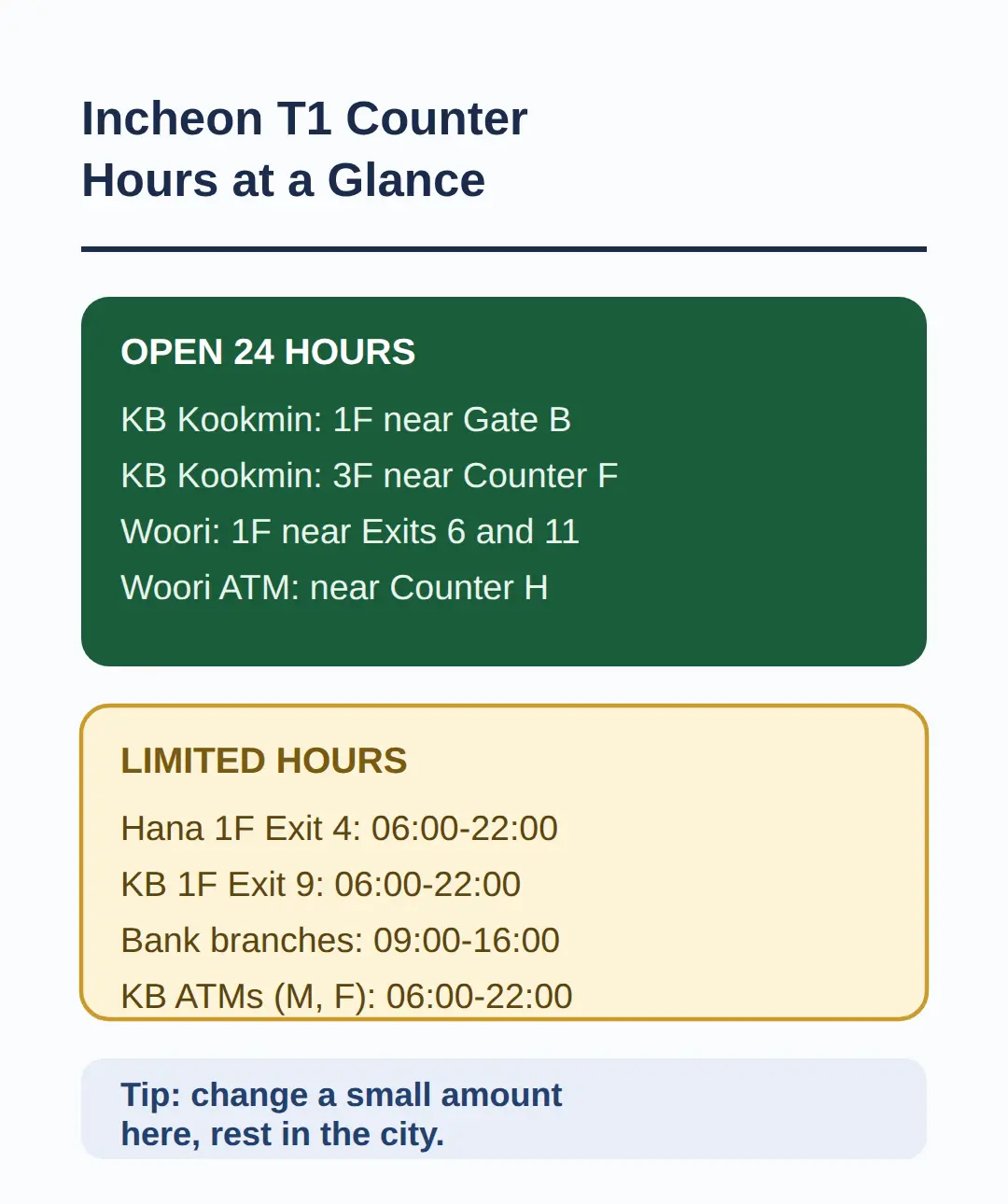
- Incheon Terminal 1 has 24-hour exchange counters: KB Kookmin on 1F arrivals near B and 3F near check-in F, and Woori on 1F near exits 6 and 11; other counters run 06:00-22:00.
How to Exchange Money in Korea: Your Options as a Tourist
| Just landed at Incheon Terminal 1 | Exchange service centers — KB Kookmin and Woori counters run 24 hours, other counters 06:00-22:00 |
|---|---|
| Weekday before 16:00, in the city | A bank — usually the best exchange rates |
| Evening or weekend, small amount | Certified booth (open outside bank hours) or a CU/emart24 kiosk in Seoul |
| Just need cash at night | A Global ATM — typically open until 23:00, many 24 hours |
| Leaving Korea with leftover won | Re-exchange up to what you exchanged since your latest entry — bring the receipts |
Tourists can exchange currency at banks or authorized exchange service centers; licensed money changers must check your identity with an ID such as a passport, and kiosks scan it, so bring your passport.
The rules that shape every option: unmanned exchange machines handle up to US$2,000 per person per day, and licensed money changers can buy or sell up to US$2,000 per person per day without a sales application or purchase certificate.
Carrying more than US$10,000 equivalent into Korea must be declared on the traveller declaration form — no certificate is issued after you leave the arrivals area.
When a bank buys foreign currency from you it issues a purchase certificate; keep it, because it decides how much won you can change back when you leave.
When I look at any exchange option, the first thing I check is whether it is government-certified — Visit Seoul advises looking for the "Certified" sign and avoiding uncertified booths.
Incheon Airport Counters: Which Ones Are Open 24 Hours?
Incheon Terminal 1 has 24-hour exchange counters: KB Kookmin on 1F arrivals near B and 3F near check-in F, and Woori on 1F near exits 6 and 11.
Other counters, including Hana Bank at 1F exit 4 and KB at 1F exit 9, run 06:00-22:00, and full bank branches inside the terminal keep normal 09:00-16:00 hours.
Foreign-currency ATMs are also available: KB machines near check-in M and F (06:00-22:00) and a Woori machine near check-in H that runs 24 hours.
For most tourists the airport counter is the easiest first stop — change a small amount on arrival, then use a bank or certified booth in the city for the rest.
Exchanging in the City: Banks, Booths and Kiosks
Banks usually offer the best exchange rates for travelers, and most are open 09:00-16:00 on weekdays.
After banks close, government-certified exchange booths operate outside regular banking hours; hours vary by booth, so check before you go.
Look for a sign with the word "Certified" and currency symbols, and avoid uncertified booths.
To find a bank branch, a money changer or an airport counter near you, use the exchange map on our won converter page — tap "Nearest to me" and open the place in Naver Map for directions.
If you are in the city on a weekday morning, a bank usually gets you the best rate; in the evening or on a weekend, a certified booth takes over.
ATMs With a Foreign Card: Which Ones Work?
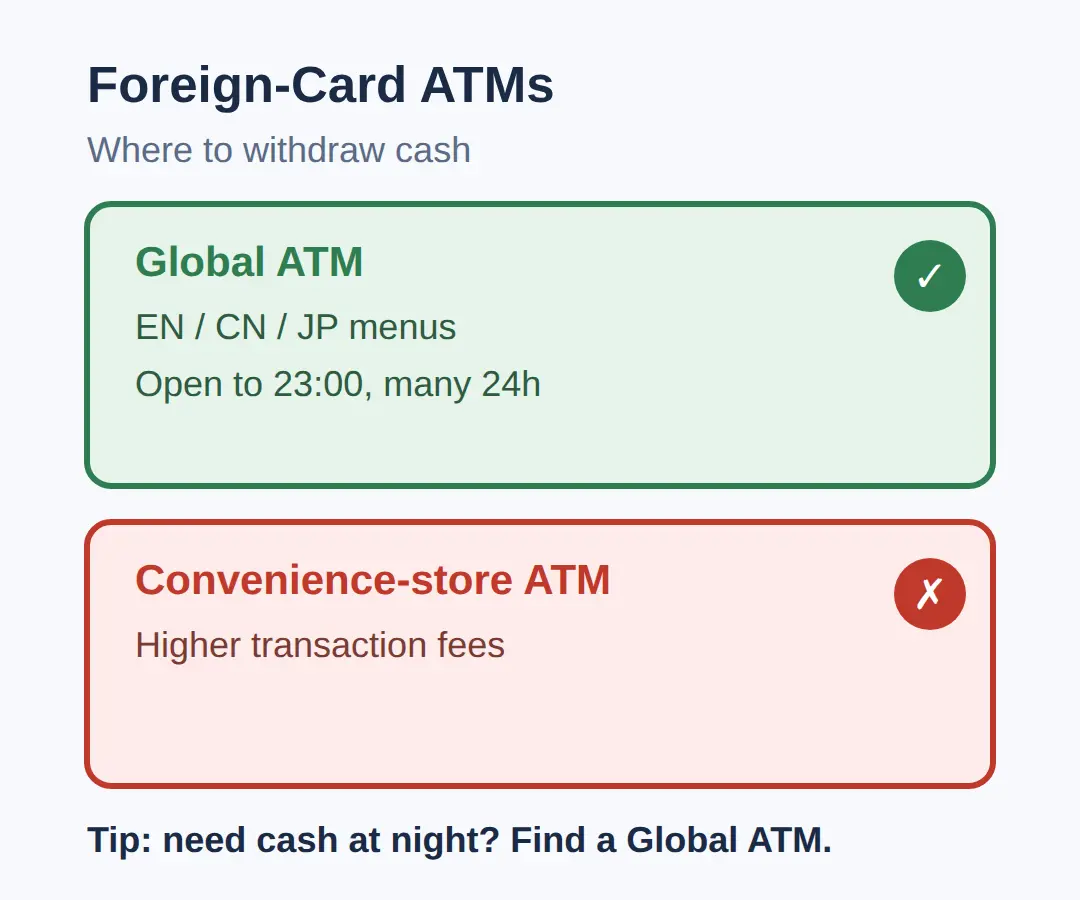
Look for ATMs with a "Global" sign or international card-network logos — they offer English, Chinese and Japanese menus and typically run until 23:00, with many open 24 hours.
Convenience-store ATMs often charge higher transaction fees, so they cost more for the same withdrawal.
If you only need cash at night, find a Global ATM rather than the one inside the nearest convenience store.
WOWPASS, Credit Cards and What Still Needs Cash
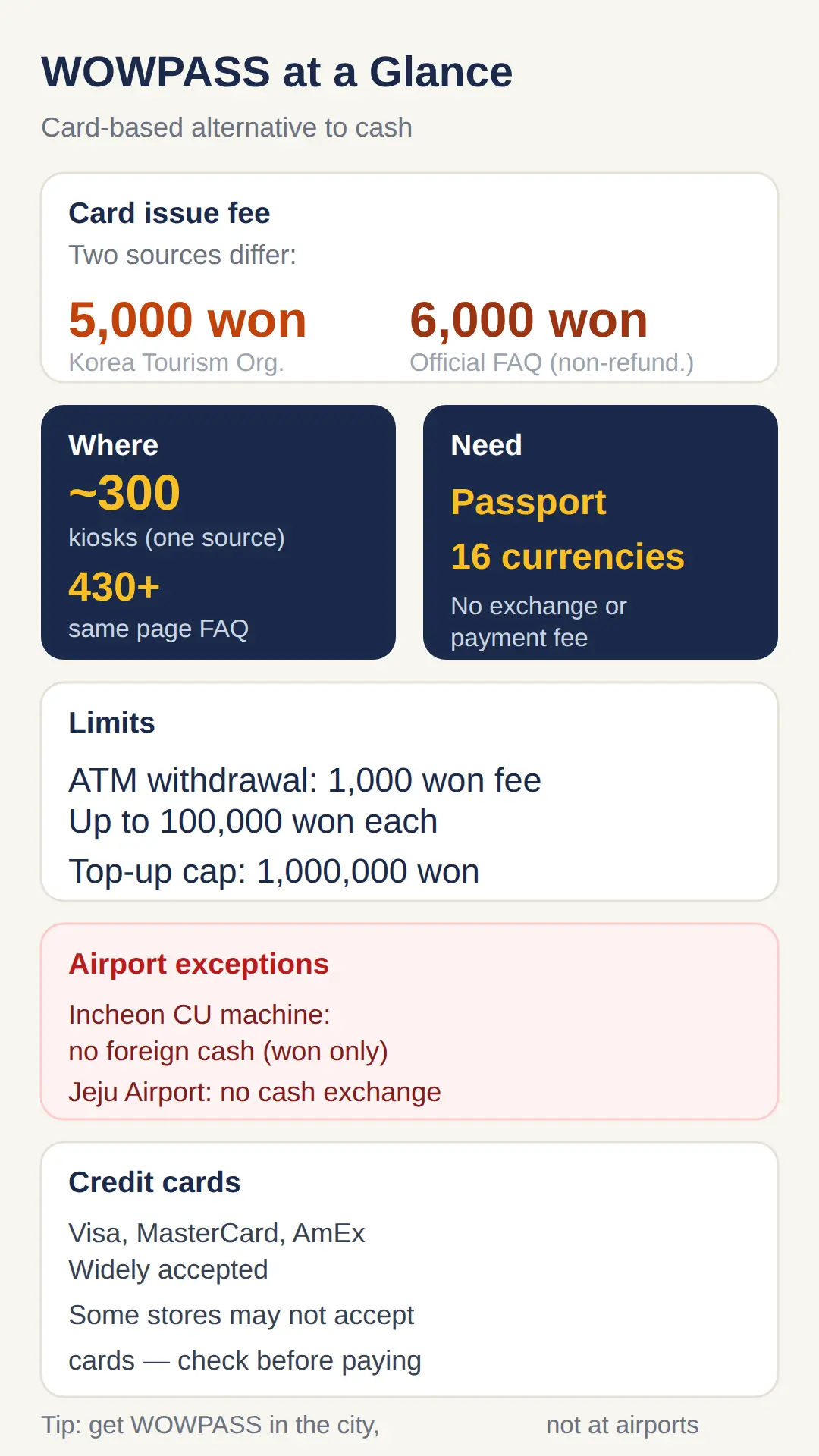
WOWPASS works as a card-based alternative, but the card issue fee is stated differently by two official sources: 5,000 won (Korea Tourism Organization, Aug 2026) vs 6,000 won non-refundable (WOWPASS official FAQ).
The card needs a passport, and kiosks (about 300 per one source, 430+ per the same page’s FAQ) exchange 16 currencies onto the card with no exchange or payment fee.
ATM withdrawal costs 1,000 won up to 100,000 won each, and top-up is capped at 1,000,000 won at a time.
Know the airport exceptions: at the Incheon Airport CU machine you cannot exchange foreign cash (won only), and at Jeju Airport cash exchange is not available.
Credit cards (Visa, MasterCard, American Express) are widely accepted, but some stores may not take them, so check before you pay.
If you want a card instead of cash, WOWPASS works, but plan to get it in the city rather than counting on airport or Jeju machines.
Leaving Korea: Re-exchange Rules and Customs Limits
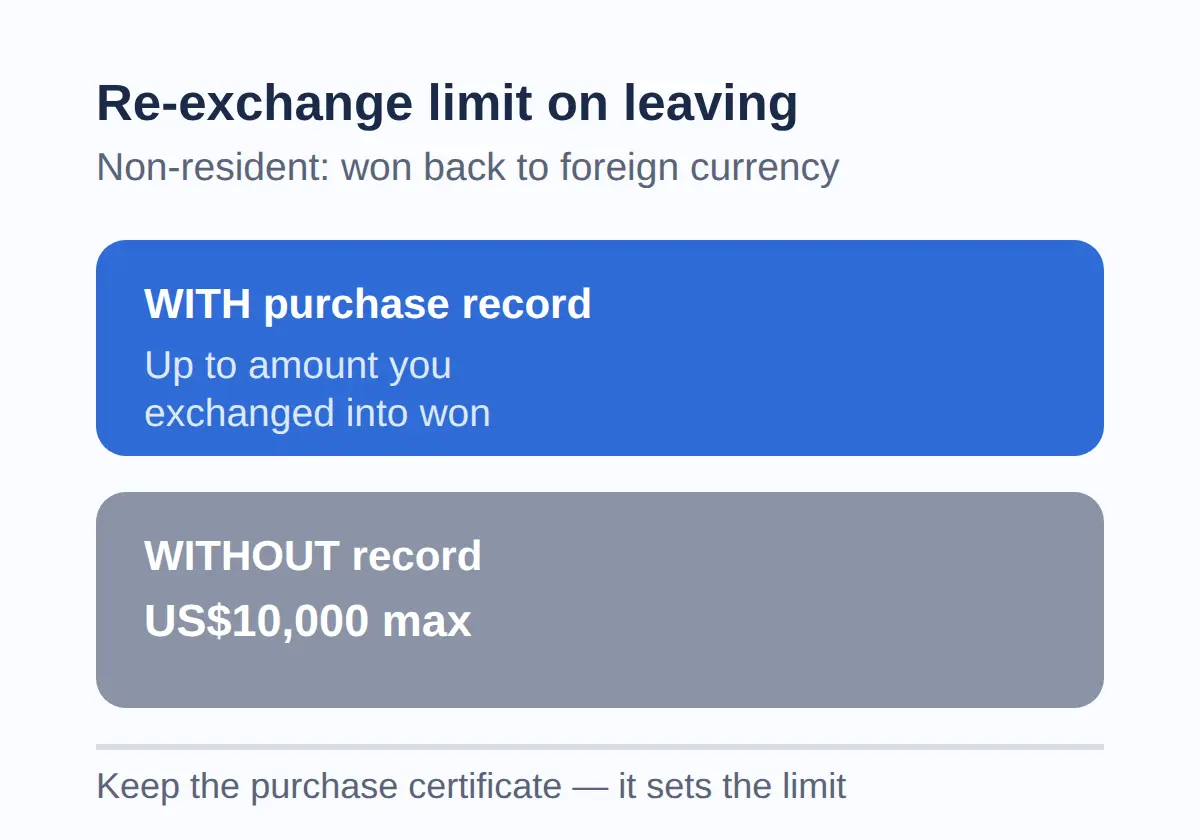
On leaving, a non-resident can re-exchange won back into foreign currency up to the amount exchanged into won since their latest entry, plus won withdrawn in Korea with a foreign-issued credit or debit card; without such a record the limit is US$10,000.
The receipt is what unlocks the higher limit: when a bank buys foreign currency from a non-resident it issues a purchase certificate, so keep it.
On the way out, amounts up to US$10,000 need no declaration, and taking out no more than you declared on entry needs no new declaration — but carry the certificate.
Undeclared amounts up to US$30,000 face an administrative fine, and above US$30,000 the penalty is up to 1 year in prison or a fine up to 100 million won.
If you plan to change a large amount, declare it on the way in and keep every receipt; that is what lets you take unspent money home.
If it were me, I would change only a small amount at the Incheon T1 counter, because the KB and Woori desks there are open 24 hours and I can top up later at a bank or certified booth where the rates are usually better.
The first thing I check before leaving is that every purchase receipt is saved, since that paper is what decides how much won I can change back at the airport.
👉 Live won converter and exchange map
👉 Seoul ATMs that take foreign cards
👉 How much cash for 5 days in Korea
👉 What you can bring into Korea (customs)
👉 Incheon Airport terminal guide
Related posts
📎 apple pay korea subway
📎 📅 Upcoming Dates — Release & Event Calendar
Sources
- KTO/VisitSeoul guides: banks, certified booths, kiosks, pass (english.visitkorea.or.kr)
- english.visitseoul.net
- english.visitkorea.or.kr
Quick summary: which option fits your situation
- Just landed: use an Incheon T1 exchange counter (KB Kookmin and Woori run 24 hours), then switch to a bank or certified booth in the city for the rest — banks usually have the best rates.
- Carry your passport — licensed money changers check ID and kiosks scan it — and remember that kiosks and licensed money changers cap at US$2,000 per person per day without certificates.
- Keep every exchange receipt: it lets you re-exchange leftover won above the US$10,000 no-record limit when leaving, and declare anything over US$10,000 on entry — the certificate is not issued after you leave the arrivals area.
FAQ
Q. Do I need a passport to exchange money in Korea?
Bring it. Licensed money changers must check your identity with an ID such as a passport, exchange kiosks scan it, and WOWPASS needs one; when a bank buys foreign currency from you it issues a purchase certificate — keep it for re-exchange.
Q. Are airport exchange counters open 24 hours at Incheon?
At Terminal 1, KB Kookmin (1F arrivals near B, 3F near check-in F) and Woori (1F near exits 6 and 11) run 24 hours; other counters operate 06:00-22:00.
Q. Can I exchange money at a convenience store kiosk in Korea?
A few CU and emart24 stores in Seoul have exchange kiosks — CU takes 15 currencies and emart24 takes 16 with an ID scan, and unmanned machines are limited to US$2,000 per person per day.
Q. Can I exchange leftover won back to my currency when leaving Korea?
Yes — up to the amount you exchanged into won since your latest entry plus foreign-card ATM withdrawals if you kept the receipts, or up to US$10,000 without a record.
Check live rates and find the nearest counter on our won converter and exchange map: koreankorea.com/korean-won-converter/
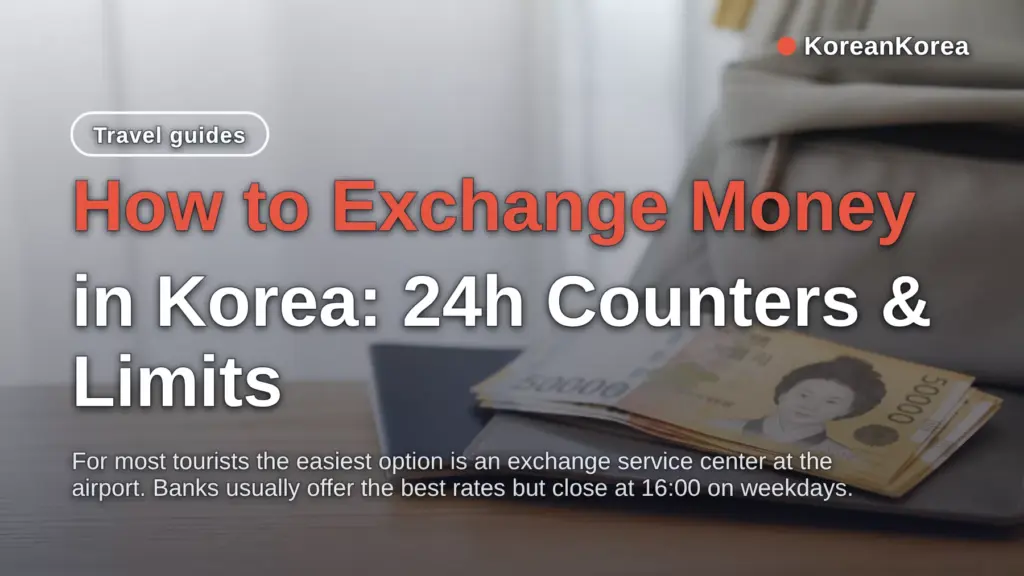
Cover photo: AI-generated illustration (korean won banknotes) — AI-generated image, illustrative only
#howtoexchangemoneyinkorea #koreatravelmoney #incheonairportexchange #wowpass #koreaatmforeigncard #koreacustomsdeclaration
📅Upcoming Schedule — this week 1 · D-7 Godsoi lineup removed from menus after 2026-11-09See all →Last updated 2026-10-20. Editorial policy