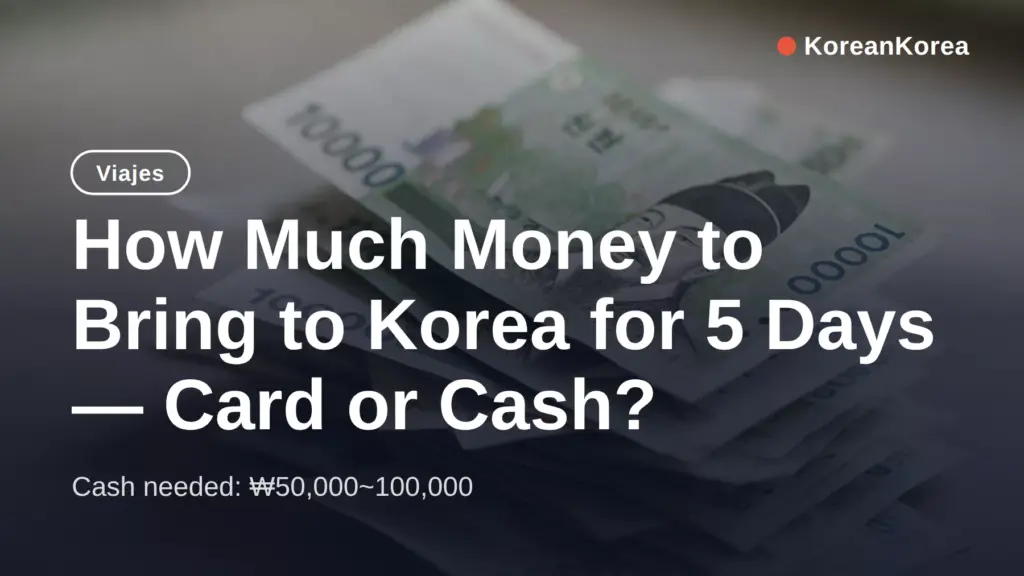
For a 5-day trip to Korea, ₩50,000–100,000 (about US$35–70) in cash is enough, because Visa and Mastercard are accepted at nearly all merchants nationwide.
That means you do not need to exchange a big stack of won before you fly.
This post covers where cash is still required, what a 5-day budget looks like, and how to get won without paying extra fees.
How Much Money to Bring to Korea for 5 Days?
| Backpacker | ₩60,000–90,000 (~US$40–60) — hostel, street food, subway only |
|---|---|
| Mid-range | ₩130,000–200,000 (~US$85–130) — hotels, sit-down meals, some taxis |
| Comfortable | US$1,400+ per week (excl. flights) — 4-star hotels, paid attractions daily |
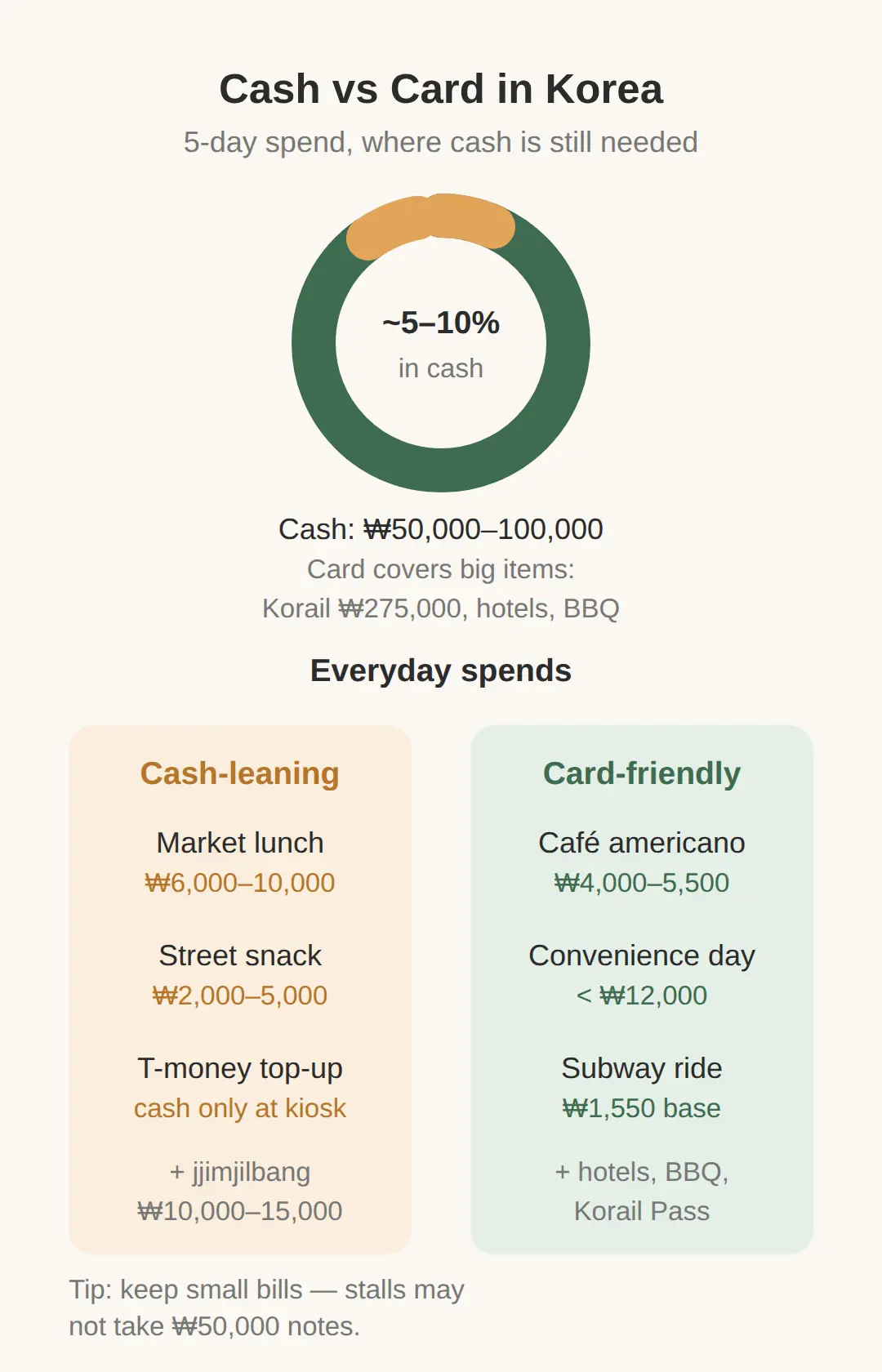
₩50,000–100,000 (about US$35–70) in cash covers 5 days in Korea, and everything else goes on a card.
Visa and Mastercard are accepted at nearly all merchants nationwide, from department stores down to street stalls with card readers (2026 guide data).
Cash still matters in exactly three places: traditional markets, street food stalls (pojangmacha), and topping up your T-money card.
That is roughly 5–10% of what a 5-day trip actually costs — the rest is card money.
The first thing I check when planning a low-cash trip is where cash is the only option, because that short list decides the whole amount.
If you hate carrying cash at all, bring the lower end (₩50,000) and top up from a convenience store ATM if you run short.
Where Cash Is Still Required in Korea
The concrete cash spots are T-money top-ups, traditional markets, pojangmacha tents, a few small restaurants, and jjimjilbang entry.
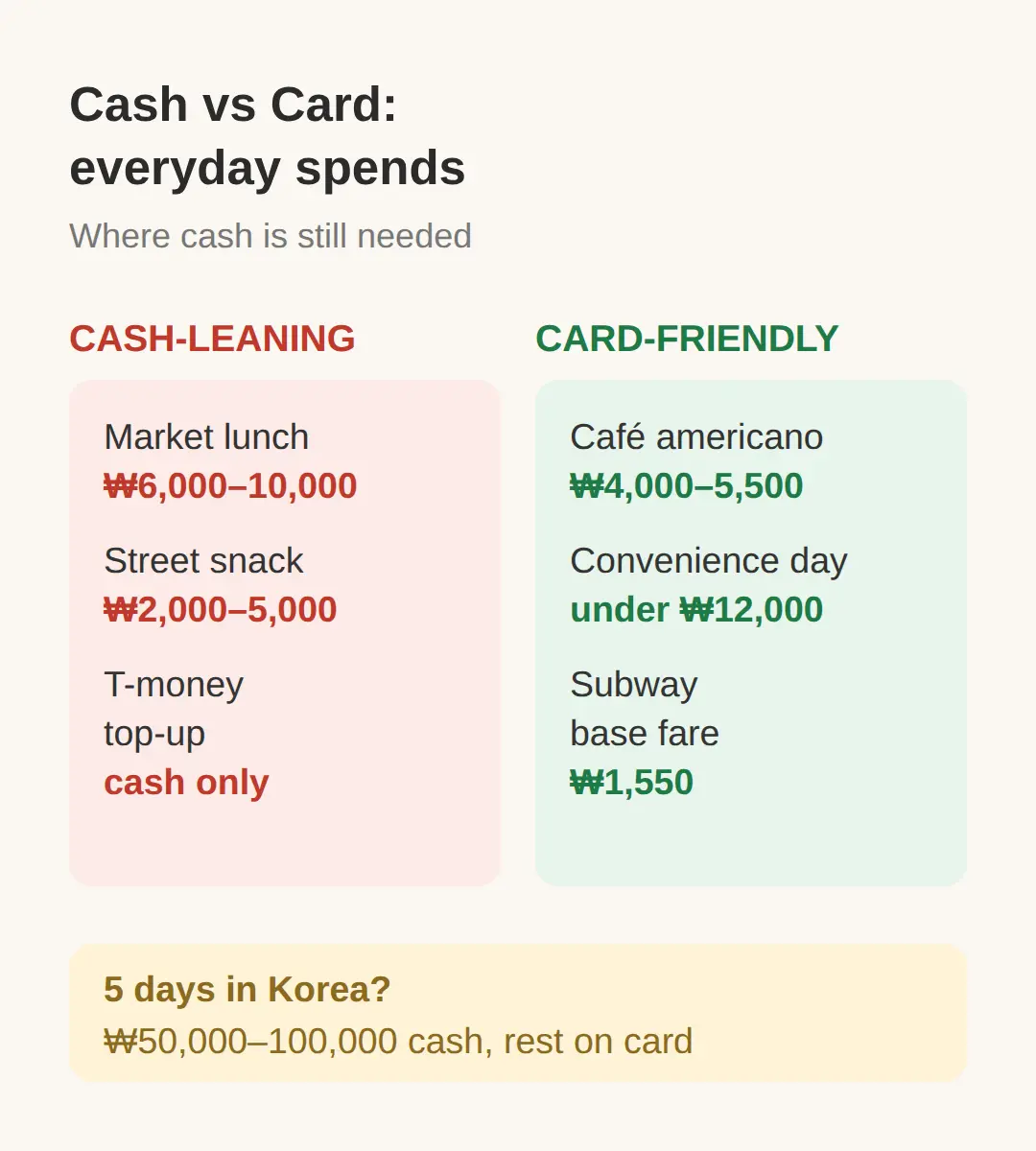
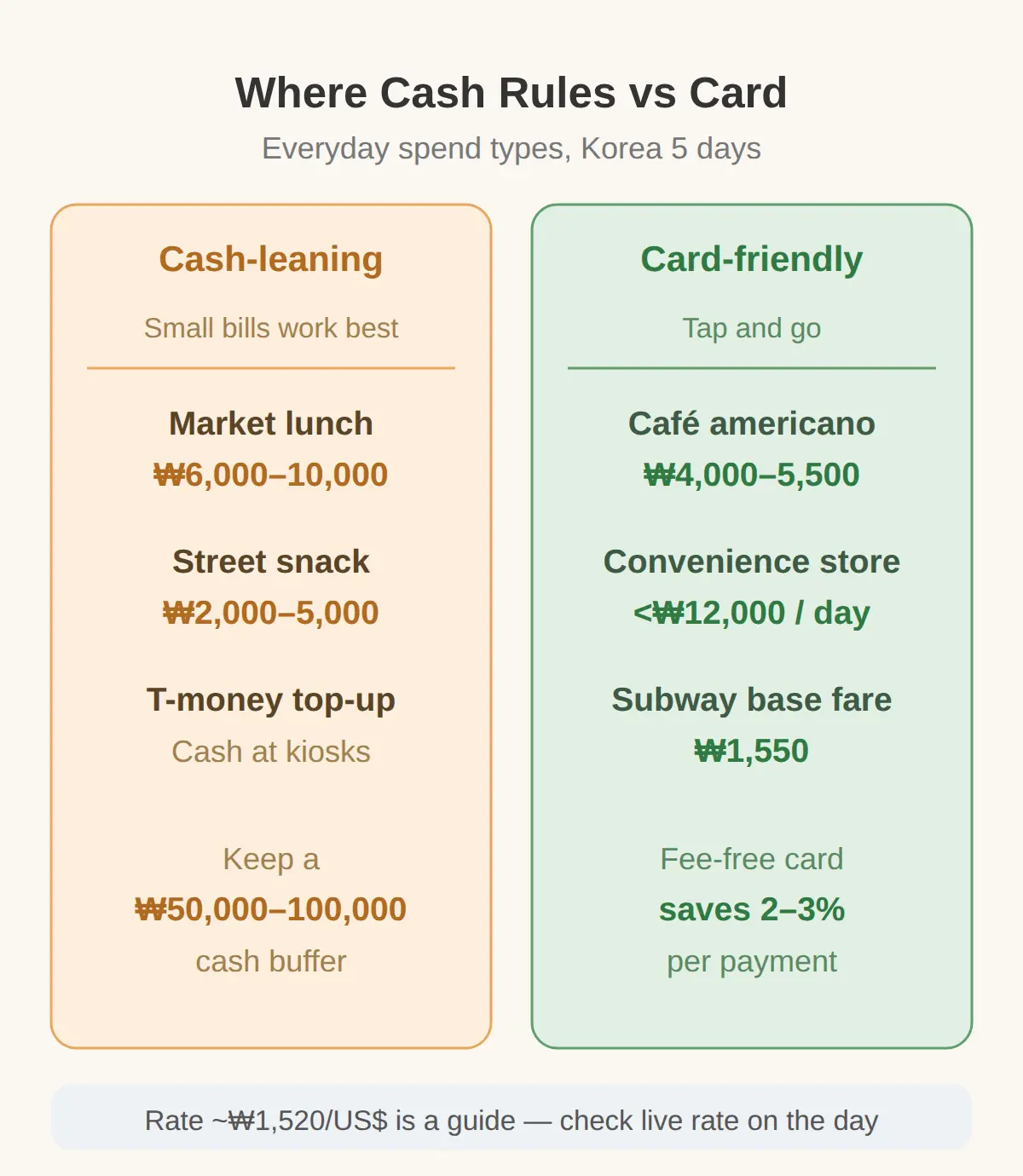
A T-money card costs about ₩3,000–4,000 and must be charged with cash at convenience stores or station kiosks — the one purchase you cannot make by card.
Market lunches at Gwangjang or Namdaemun run ₩6,000–10,000, and street snacks ₩2,000–5,000, mostly cash-friendly.
Jjimjilbang (Korean bathhouse) entry is ₩10,000–15,000, where cash is still handy.
Keep your cash as small bills, because market stalls rarely handle a 50,000-won note smoothly.
If your plan is mostly cafes and department stores, you will touch cash only on the day you buy and charge your T-money card.
Do I Need Cash in Korea? What Cards Cover
No — cards cover nearly everything, and there is no tipping in Korea: the price shown is the price paid.
Visa and Mastercard work at nearly all merchants nationwide (2026 guide consensus), and tap water is free and safe to refill, so small daily spends shrink further.
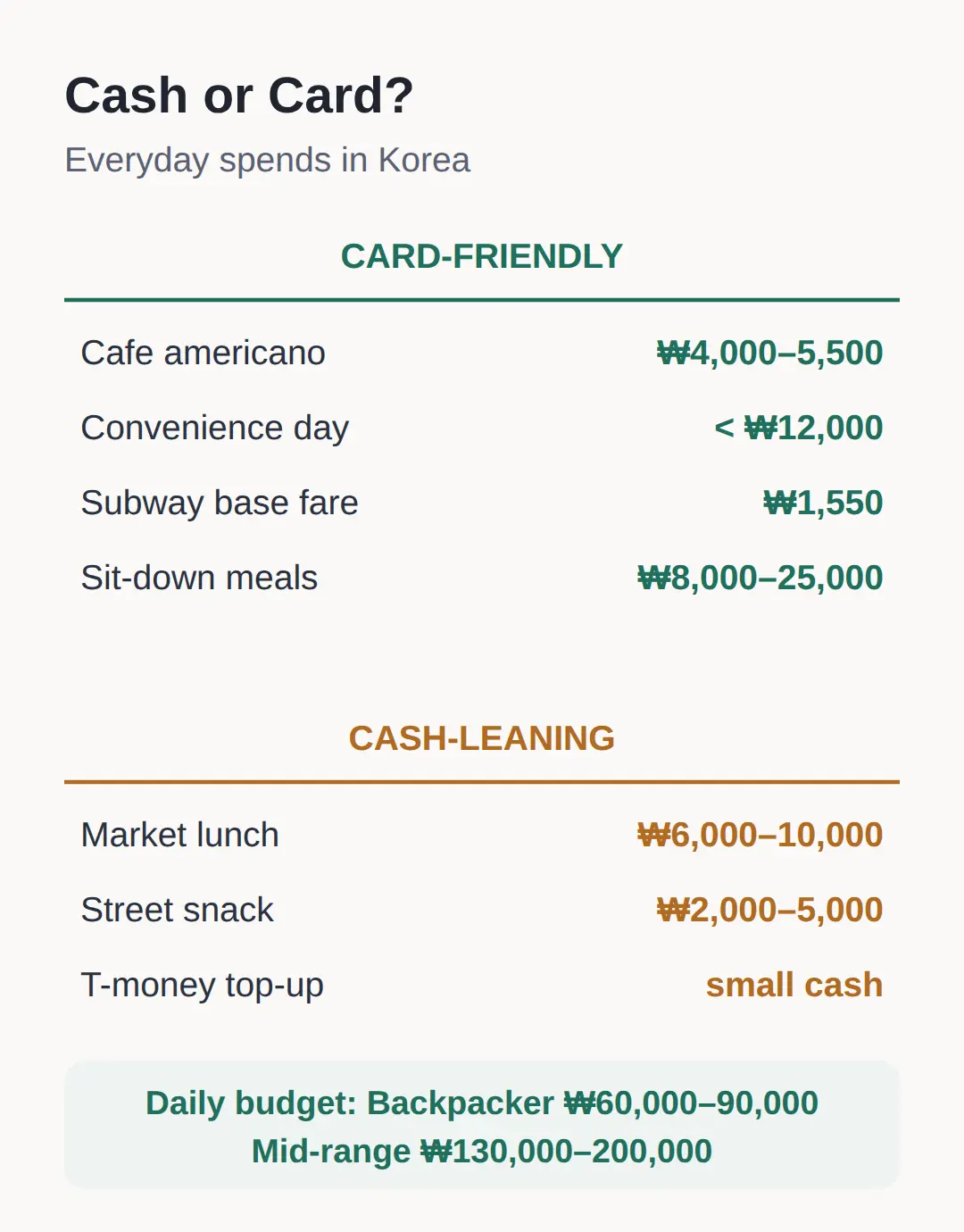
Everyday card-friendly prices: café americano ₩4,000–5,500, neighborhood meals (kalguksu, bibimbap, gukbap) ₩8,000–12,000, Korean BBQ ₩15,000–25,000 per person, and a full convenience-store day under ₩12,000.
The split is simple: sit-down restaurants and chains take cards, while market stalls and pojangmacha lean cash.
If your card has no foreign transaction fee, you can go a whole day in Seoul without touching a single bill.
Daily Budget for 5 Days in Korea
A mid-range traveler spends ₩130,000–200,000 (~US$85–130) per day excluding intercity trains, and a backpacker ₩60,000–90,000 (~US$40–60).
Food is ₩20,000–30,000 per day on street food and convenience stores, or ₩40,000–60,000 with sit-down meals.
City transport adds only ₩4,000–7,000 per day on top of the ₩1,550 Seoul subway base fare, with free subway–bus transfers within the time limit.
Lodging is the big variable: hostel dorms ₩25,000–45,000, guesthouse private rooms ₩45,000–70,000, solid 3-star hotels ₩80,000–140,000, and 4-star+ ₩180,000–350,000+ per night.
If you are visiting in October or November, book lodging early — prices rise in autumn foliage season, so a slightly bigger buffer helps.
How to Get Korean Won: Exchange, ATM and Card Fees
You do not need to exchange much in advance — carry the ₩50,000–100,000 buffer and use a fee-free card for everything else.
Here is how to get won and pay for the rest of the trip:
| Step | What to do |
|---|---|
| 1 | Bring a small amount of cash for markets and T-money top-ups. |
| 2 | Use a ‘Global’-marked ATM in a convenience store if you need more won — foreign cards work there. |
| 3 | Pay with a fee-free travel card (Wise, Revolut, or a no-foreign-fee credit card), which saves 2–3% on every payment versus a standard card. |
The exchange rate quoted in guides, around ₩1,520 per US dollar, is a moving reference only — check the live rate on the day you convert.
On an almost fully card-paid trip, a 2–3% fee saving on every payment adds up to more than any exchange-counter trick.
I would exchange about ₩100,000 in small bills and put everything else on a fee-free card, because with Global ATMs in convenience stores, running out of cash is not a risk worth prepaying for.
Big-Ticket Items to Put on Card, Not Cash
Every large trip cost in Korea is card money — the Korail Pass runs from ₩131,000 (2-day) to ₩275,000 (5-day) for adults.
Other card-sized costs: N Seoul Tower observatory about ₩21,000, Lotte World about ₩62,000, a weekly eSIM around ₩15,000, and hanbok rental ₩15,000–25,000 — which also gets you free palace entry (Gyeongbokgung is ₩3,000 otherwise).
One booking warning: the Korail Talk app often rejects foreign-issued cards with no clear error, so sort out train tickets or buy a Korail Pass through a tourist platform before you fly.
This is why the cash answer stays small — the expensive lines in your budget were never cash lines.
If your 5 days include a Busan or Gyeongju leg, the pass decision matters more to your budget than your cash stack does.
Related posts
📎 Seoul — everything we know
📎 📅 다가오는 일정 — 발매·개봉·발표 캘린더
Sources
- ₩50,000–100,000 cash is enough for 5 days; card accepted nea (breezekorea.com)
- Backpacker ₩60–90k/day, mid-range ₩130–200k/day; convenience (koreabytrain.com)
- T-money card ₩3,000–4,000 must be cash-charged at convenienc (touristsinsider.com)
Korea 5-Day Cash Plan, Summarized
- Carry ₩50,000–100,000 in small bills for traditional markets, pojangmacha and T-money top-ups.
- Visa and Mastercard work at nearly all merchants nationwide — the displayed price is the final price, since there is no tipping culture.
- T-money is not linked to your bank card — charge it with cash at a convenience store or station kiosk.
- A fee-free travel card (Wise, Revolut, or a no-foreign-fee credit card) saves 2–3% on every payment.
- If you run short, use a ‘Global’-marked ATM in a convenience store — foreign cards work there.
FAQ
Q. How much money should I bring to Korea for 5 days?
₩50,000–100,000 (about US$35–70) in cash is enough for 5 days, because cards cover nearly all merchants — cash is only for markets, street stalls and T-money top-ups.
Q. Do I need cash in Korea at all?
Yes, a small amount: traditional markets, pojangmacha street stalls, some small restaurants and T-money charging are the spots where cash is still needed.
Q. How do I charge a T-money card?
Charge it with cash at a convenience store or a station kiosk — T-money is separate from your bank card and cannot be topped up by card.
Q. Is tipping expected in Korea?
No. There is no tipping culture — the displayed price is the final price, and water at restaurants is free.
Q. Which travel card saves the most on fees in Korea?
A fee-free travel card such as Wise, Revolut or a no-foreign-fee credit card saves 2–3% on every payment compared with a standard card.
Autumn foliage season (October–November 2026) pushes lodging prices up — lock in rooms and check the live exchange rate before you fly.
Cover photo: AI-generated illustration (korean won banknotes) — AI-generated image, illustrative only
#koreatravelbudget #cashinkorea #t-moneycard #seoultripcost #koreamoneytips
📅Upcoming Schedule — this week 23 · D-1 Autumn season = post-summer brightening demand window (UV drSee all →