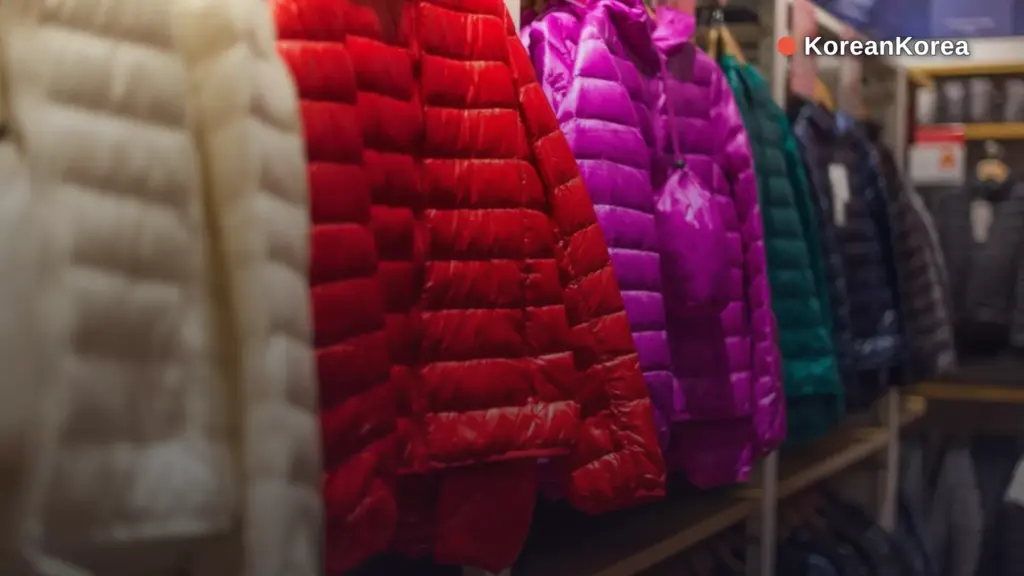
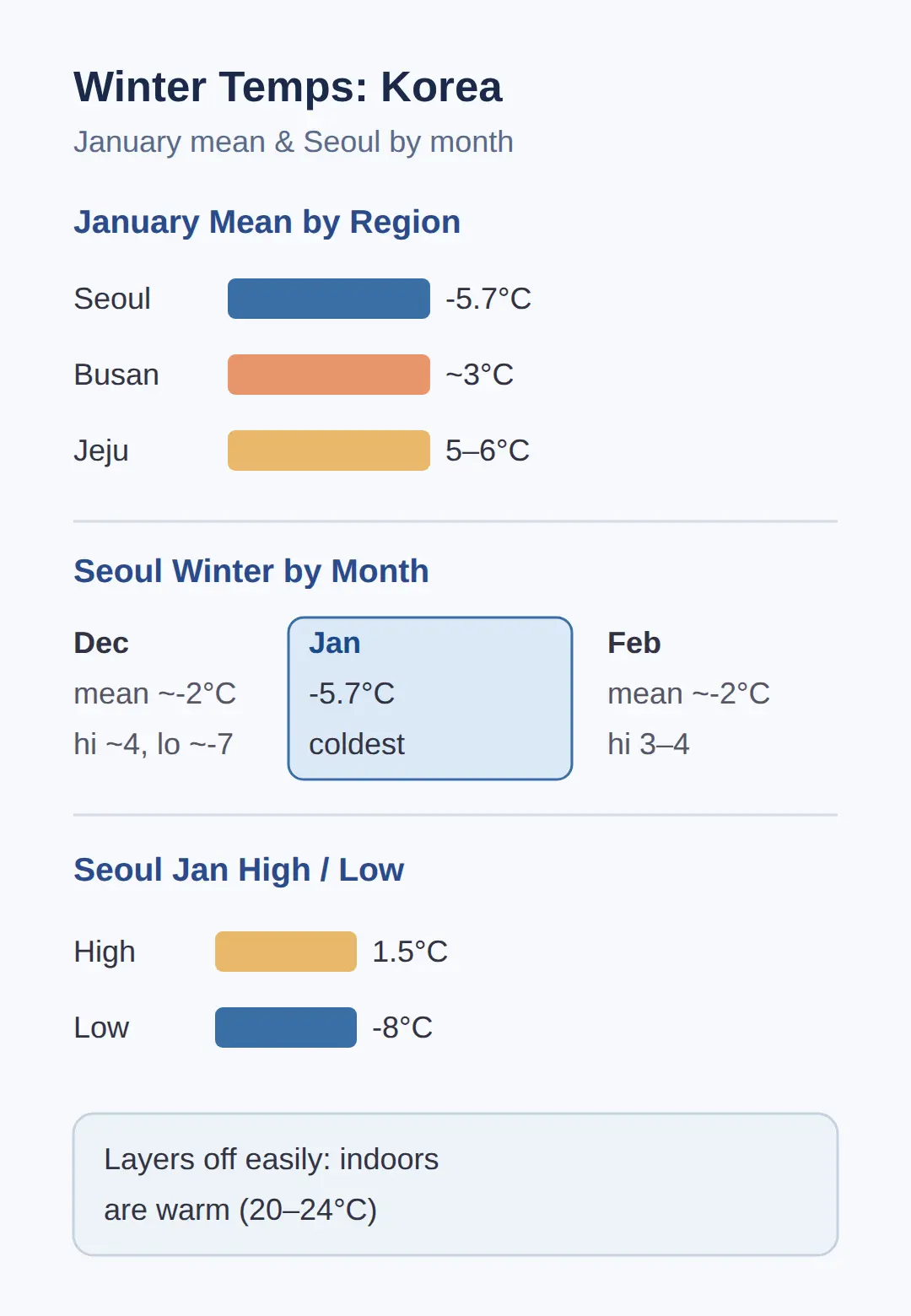
Dress for Korean winter in three layers: thermal innerwear, a knit or fleece, and a windproof padded outer jacket. Seoul’s January mean is about -5.7°C, with night lows down to about -8°C.
That means one coat alone leaves you cold outside, while heated interiors make you sweat indoors — so your layers must come off easily.
This guide covers month-by-month and city-by-city temperatures, where to buy winter gear locally, and what not to pack.
The standard formula for Korean winter dressing is a thermal base layer, a fleece or knit sweater, and a windproof padded outer jacket — three layers you can shed indoors.
By Seoul’s January climate normals, the mean temperature is about -5.7°C, with daytime highs around 1.5°C and night lows around -8°C (Korea Meteorological Administration climate data).
Throughout winter, your hands, ears, and neck are constantly exposed, so gloves, a beanie, a scarf, and a warm mask are essentials, not extras.
Exposed hands and ears are the usual first-time visitor mistake.
| Month (Seoul) | Mean temp |
|---|---|
| December | about -2°C |
| January | about -5.7°C |
| February | about -2°C |
January is the coldest month, while December and February average close to -2°C but still drop below freezing at night.
| Month (Seoul) | Mean temp | High / Low | What it feels like |
|---|---|---|---|
| December | about -2°C | about 4°C / about -7°C | Chilly but manageable; ski season starts around mid-December |
| January | about -5.7°C | about 1.5°C / about -8°C | Coldest month; cold-wave alerts possible |
| February | about -2°C | 3–4°C / below freezing at night | Milder than January but still cold at night |
During cold waves, the Korea Meteorological Administration issues alerts when the morning low stays below -15°C, and Seoul’s perceived temperature can fall to around -15°C or lower with wind chill.
If you travel in January or February, dress for the feels-like temperature, not the forecast morning low.
No.
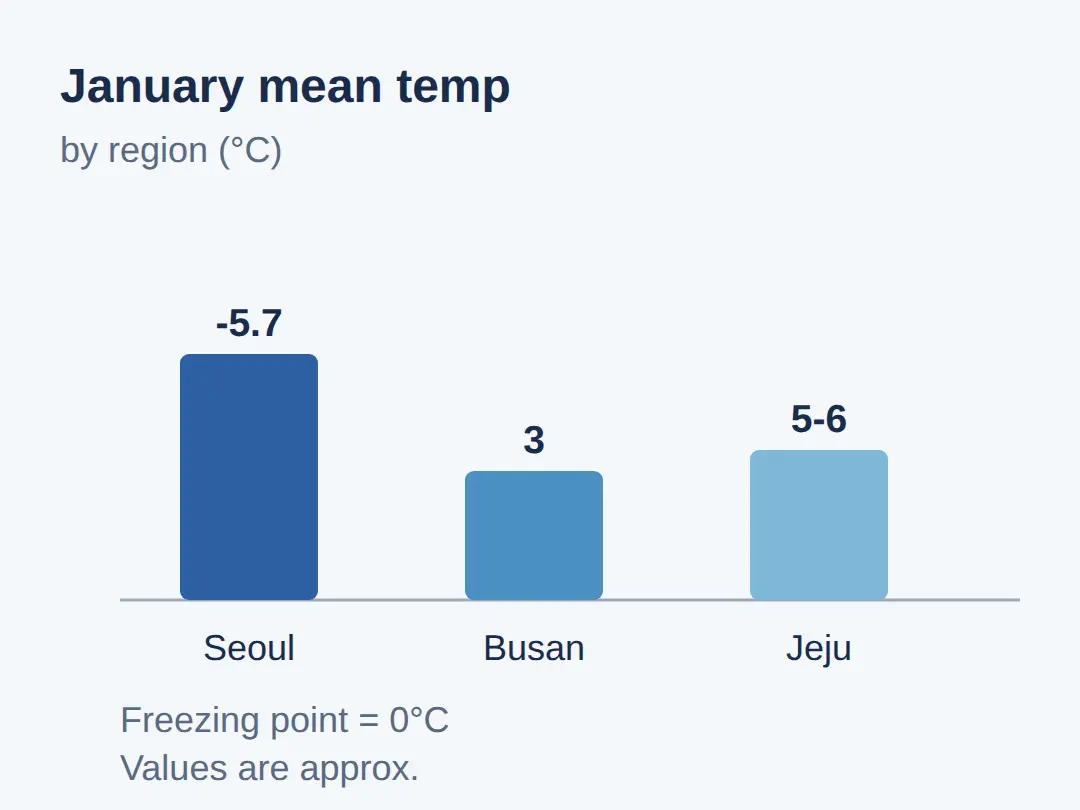
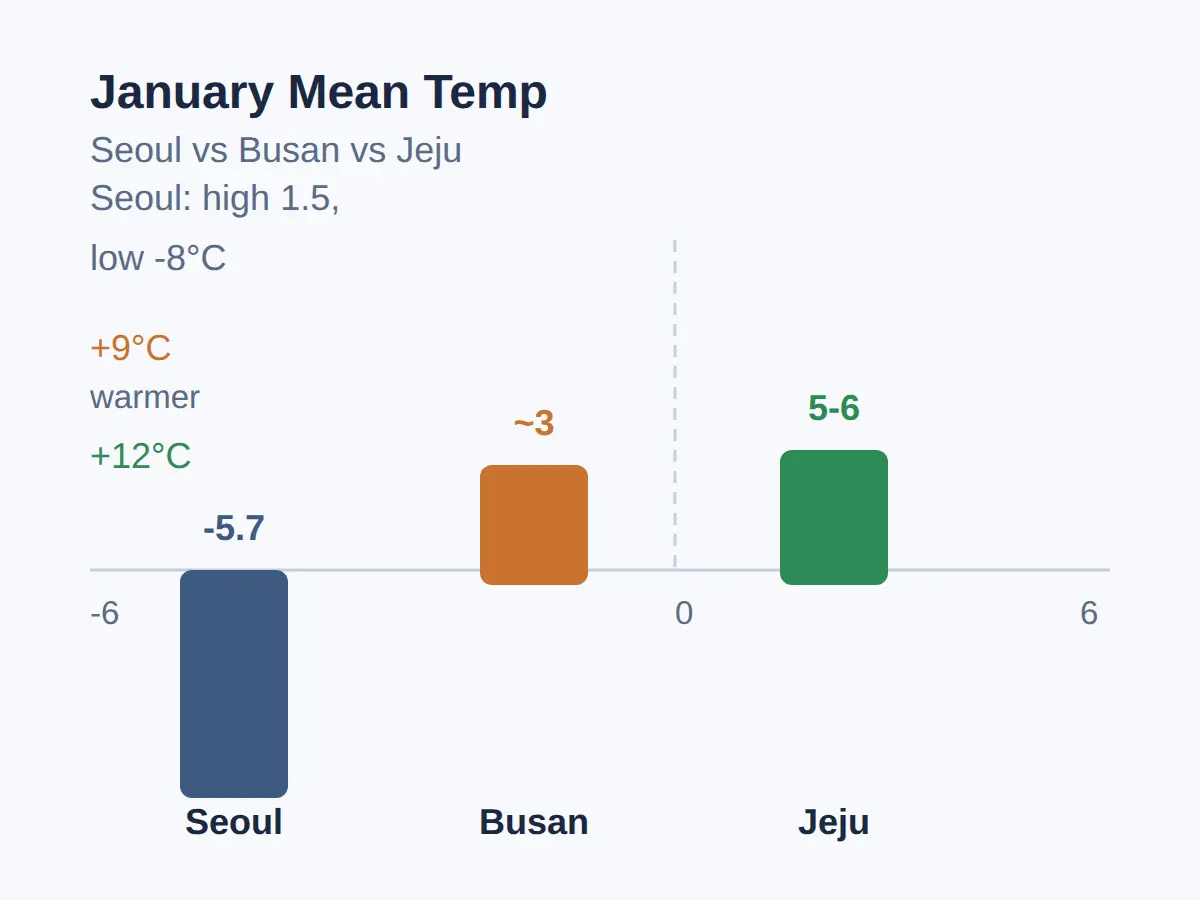
Busan’s January mean is around 3°C and Jeju’s around 5–6°C, roughly 9°C and 12°C warmer than Seoul.
Because of this temperature gap, a Seoul-based packing list can feel like overkill if your trip is limited to the southern cities or the island.
However, most international flights and KTX routes connect through Seoul, so you should still pack at least one warm outer layer for the coldest city on your route.
If you are staying only in Busan or Jeju, pack light; if Seoul is on your itinerary, bring the full package.
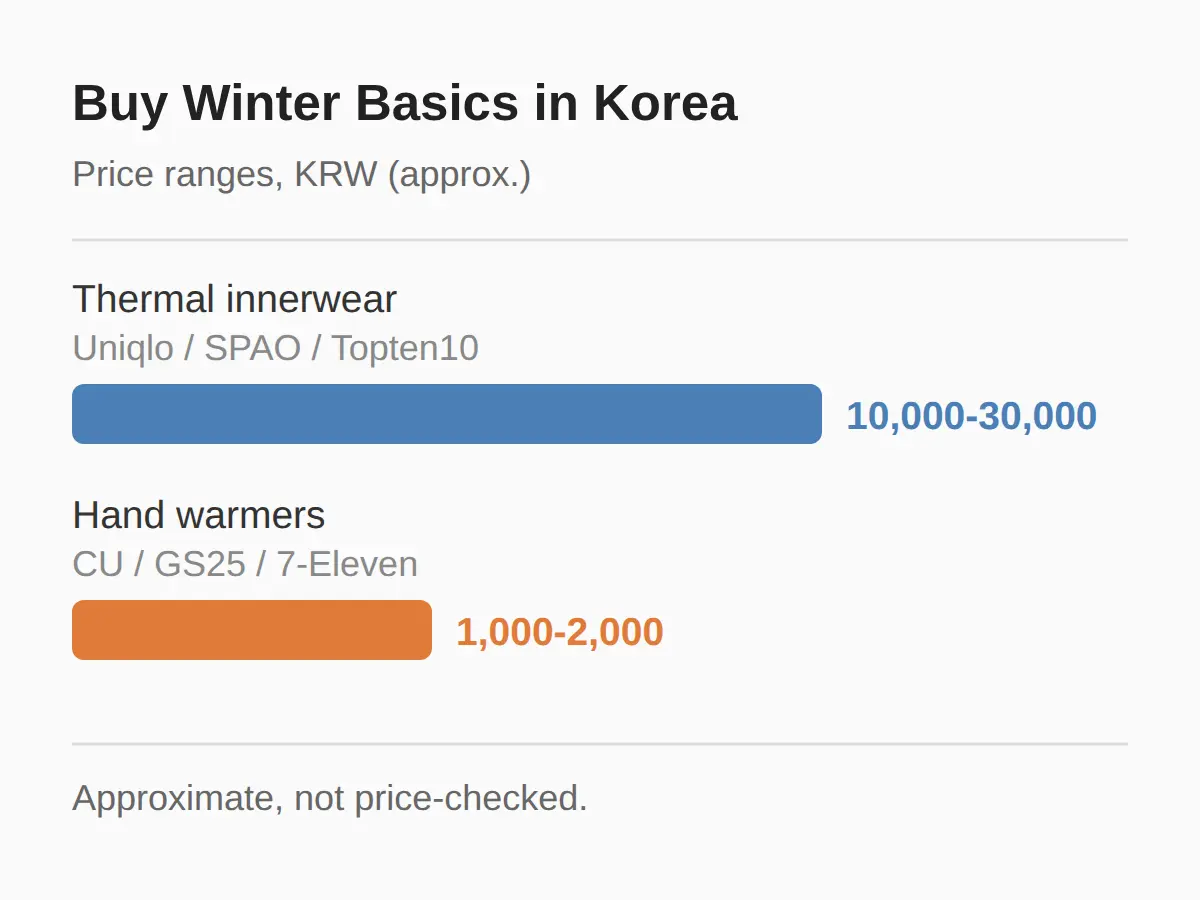
Thermal innerwear can be bought locally at Uniqlo (Heattech Extra Warm), SPAO, and Topten10 for roughly ₩10,000–30,000 per item.
Down jackets are the single most common Korean winter outerwear, and Korean outdoor brands such as Eider, The North Face Korea, and Discovery Expedition dominate, sold at department stores and outlet malls.
Olive Young and Innisfree stock heavier winter creams and are the standard stop for buying skincare on arrival.
Convenience stores sell disposable pocket hand warmers, but check the exact price and varieties in the store.
If you want to pack light, the safest plan is to bring one or two thermal base layers and buy the down jacket locally.
Avoid the typical first-timer mistake of one thick coat over one warm layer.
Korean indoor spaces are heated to roughly 20–24°C in winter, and buses and the subway even have heated seats.
For this reason, your outer layer should come off easily, which also means heavy sweaters are less useful than you would expect because interiors run warm.
January’s freeze-thaw cycles make Seoul’s sidewalks icy, so wear waterproof shoes with grippy soles instead of fashion sneakers with flat soles.
If you are going skiing, you do not need to bring gear.
Resorts like Vivaldi Park, Yongpyong, and Elysian Gangchon rent full ski wear on site.
Three basics: ondol, dry indoor air, and the 2027 Seollal (Lunar New Year) shopping cutoff.
Restaurants, guesthouses, and temples use traditional ondol heated floors as standard, so bring socks you are happy to sit on the floor in.
Because of indoor heating, the air becomes very dry, so lip balm and hand cream are necessities rather than cosmetics.
If your trip overlaps Seollal (Lunar New Year), buy your winter gear before the holiday, since many shops close or run reduced hours around it.
Subway stations and trains are well heated and mostly underground, so city sightseeing keeps you out of the worst cold.
If I were packing, I’d bring only the layers and buy the down jacket after arriving — local brands are cheaper on the ground and the fit is what locals actually wear.
👉 KMA climate data on Seoul January normals and winter dates
👉 Visit Korea guide to winter layering, ondol heating, and ski season rentals
👉 Uniqlo Korea’s Heattech Extra Warm line for thermal innerwear
👉 Olive Young’s global store for winter skincare shopping on arrival
Related posts
📎 Seoul — everything we know
📎 📅 Upcoming Dates — Release & Event Calendar
Sources
- Busan ~3°C, Jeju ~5–6°C January mean (data.kma.go.kr)
- Alert issued when morning low stays below -15°C (kma.go.kr)
- Feb 6, 2027 — to confirm against official calendar (english.visitkorea.or.kr)
Quick packing tips
- Don’t make the mistake of one thick coat over one inner layer. Interiors are strongly heated, so a removable outer layer is the key item.
- Don’t wear fashion sneakers in January. Wear waterproof shoes with grippy soles — sidewalks can be icy.
- Bring only your thermal innerwear and buy the down jacket locally. Korean brands dominate the market, and innerwear runs about ₩10,000–30,000 per item.
FAQ
Q. What do Koreans actually layer in winter?
The standard formula is thermal innerwear, a sweater or fleece, and a windproof padded outer layer that comes off easily indoors. Down jackets are the single most common Korean winter outerwear.
Q. Is Seoul colder than Busan in winter?
Yes. Seoul’s January mean is about -5.7°C, while Busan’s January mean is around 3°C — about 9°C warmer.
Q. Where can I buy winter clothes in Korea?
Uniqlo, SPAO, and Topten10 sell thermal innerwear for roughly ₩10,000–30,000 per item, down jackets are available at department stores and outlets, and winter skincare is a standard buy at Olive Young.
Q. What do I absolutely need for a first winter trip to Korea?
Thermal innerwear, a removable padded outer layer, plus gloves, a beanie, a scarf, and a warm mask. Also bring shoes with grippy soles — January sidewalks can be icy.
Q. Do shops close during Seollal?
The Lunar New Year holiday (Seollal) typically falls in late January or early February, and many shops and restaurants close or run reduced hours around it, so finish your winter-gear shopping before the holiday period.
Check Seoul’s forecast feels-like temperature a day before your trip and adjust your layers accordingly.
Cover photo: Untitled — CC0 1.0
#Koreawinterpacking #Seoulwinter #3-layersystem #BusanvsSeoultemperature #whattowearinKorea
📅Upcoming Schedule — D-10 MAMA 2026 ceremony (exact date/venue not yet confirmed in thSee all →Last updated 2026-11-18. Editorial policy