A standard taxi in Korea starts at ₩4,800 for the first 1.6 km in Seoul, and an Incheon Airport-to-downtown ride typically runs ₩60,000–75,000 on the meter before tolls.
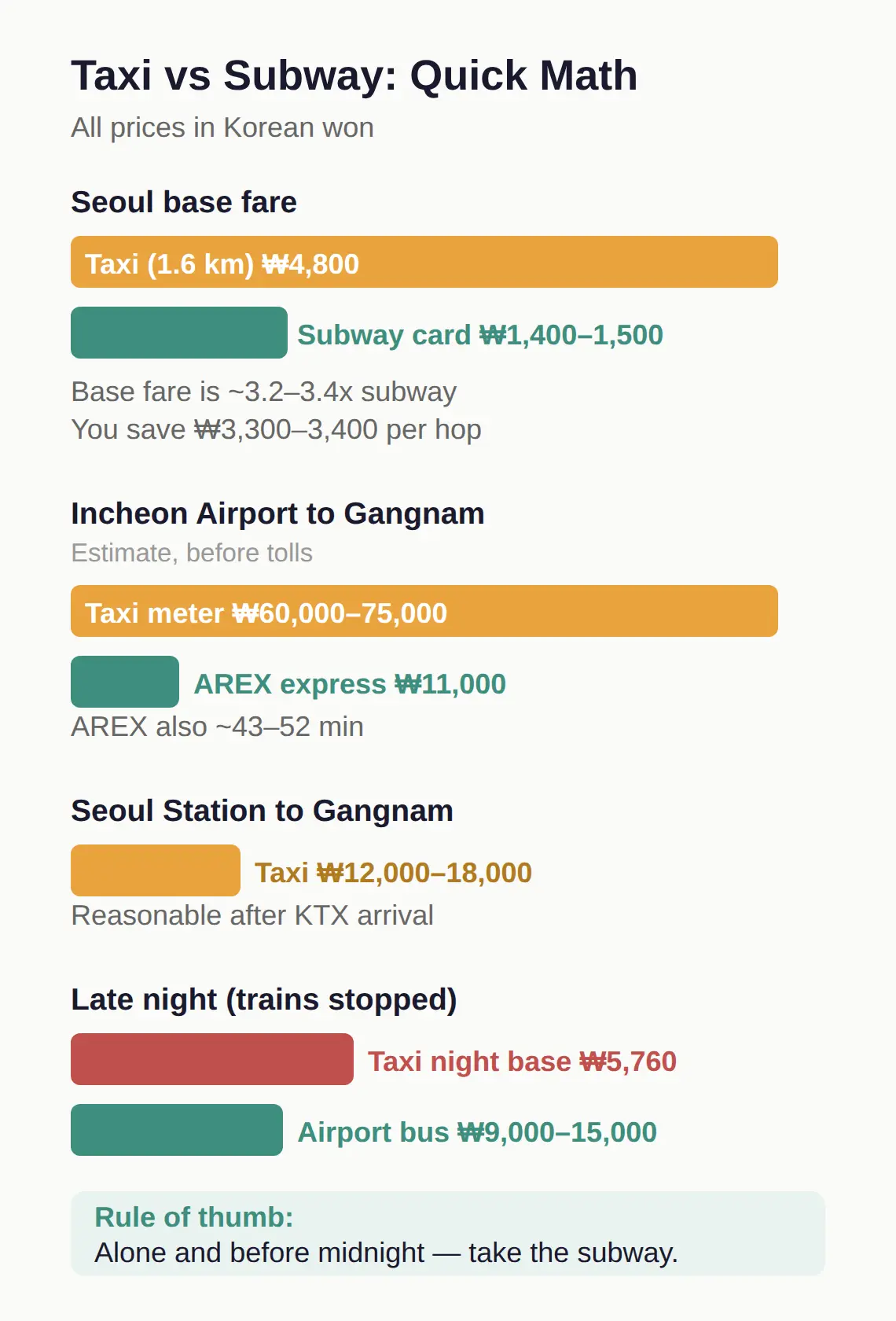
For most airport arrivals the AREX train at ₩11,000 beats the taxi, while inside the city the subway base of ₩1,400–1,500 is about a third of a taxi’s start.
This page lists the current base fare for each city, how the meter climbs after that, the night rate, and when a taxi or the subway is the better call.
Key facts — As of 2026-11-14
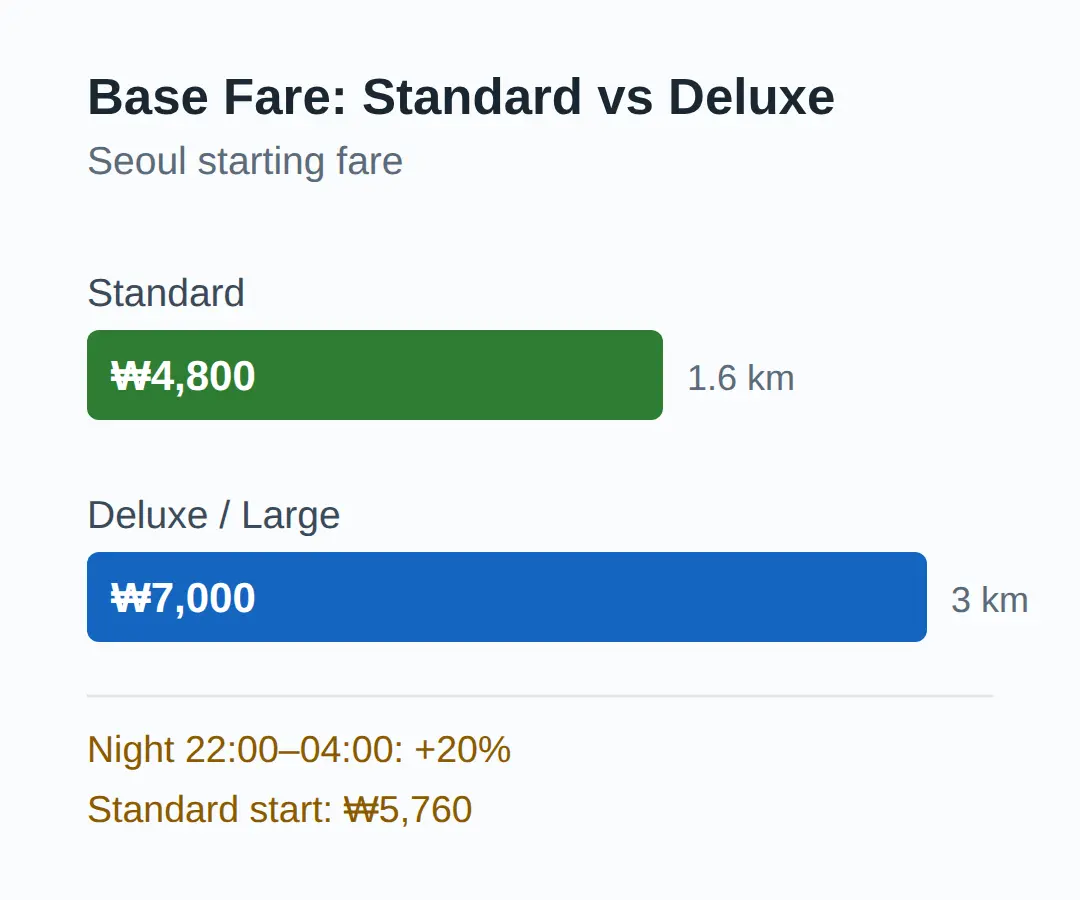
- A standard Seoul taxi base fare is ₩4,800 for the first 1.6 km, in effect since 2023-02-01 and unchanged as of the 2026-10-31 fare-table check.
- Per the 2026-10-31 OneConnect fare tables, Daejeon and Jeju standard taxis start at ₩4,300 — ₩500 (~10%) below Seoul’s ₩4,800.
- The AREX express train from Incheon Airport Terminal 1 to Seoul Station costs ₩11,000 one-way and takes about 43-52 minutes, versus a taxi meter that typically shows ₩60,000-75,000 to Gangnam before tolls (per fare-estimate tools).
How Much Is a Taxi in South Korea Right Now?
| Seoul (incl. Gwangmyeong, Wirye) | ₩4,800 for the first 1.6 km |
|---|---|
| Incheon (excl. Ganghwa, Ongjin) | ₩4,800 for the first 1.6 km |
| Daegu | ₩4,500 for the first 1.7 km |
| Ulsan | ₩4,500 for the first 2 km |
| Daejeon | ₩4,300 for the first 1.8 km |
| Jeju | ₩4,300 for the first 2 km |
| City | Base fare | Included distance | Effective |
|---|---|---|---|
| Seoul | ₩4,800 | 1.6 km | 2023-02-01 |
| Incheon | ₩4,800 | 1.6 km | 2023-07-01 |
| Daegu | ₩4,500 | 1.7 km | 2025-02-22 |
| Ulsan | ₩4,500 | 2 km | 2025-03-10 |
| Daejeon | ₩4,300 | 1.8 km | 2026-03-16 |
| Jeju | ₩4,300 | 2 km | 2024-07-01 |
Seoul and Incheon match at ₩4,800, so keep each city’s own figure instead of assuming one national number.
Jeju’s rate is the oldest of the published tables, effective 2024-07-01, so it is worth checking a local sign on arrival.
If you ride in Gwangmyeong or Wirye, the Seoul fare applies; Incheon city area excludes Ganghwa and Ongjin.
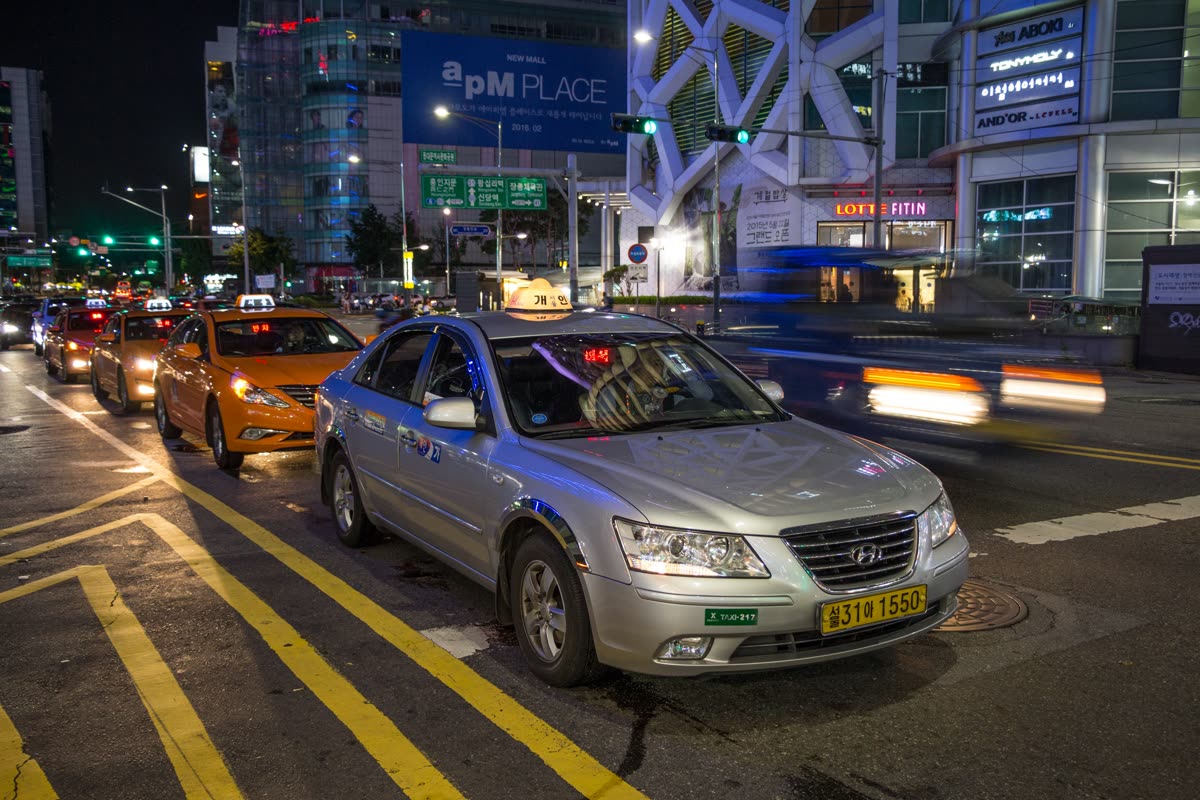
How Does the Meter Run After the Base Fare?
The published fare tables state the fare accrues on distance or time, so a crawl through Gangnam traffic still moves the meter.
There is no tipping in Korean taxis — official tourism guidance says to pay exactly the meter amount, and the meter issues a receipt automatically.
If you are out after 22:00, budget about ₩1,000 more before the meter even starts, and expect the usual night-traffic time rate on top.
How Much Is a Taxi from Incheon Airport to Seoul?
A metered taxi from Incheon Airport to Gangnam typically shows ₩60,000–75,000 before tolls, per fare-estimate tools — treat that as a ballpark, not an official figure.
For rides the train cannot cover — very early pickups or transfers after midnight — a booked private transfer (such as a service taking WhatsApp bookings with PayPal payment) is priced per quote, not by meter, and International Taxi offers fixed-price rides from the airports with English-speaking drivers you can book online in advance.
If you land in the daytime, the AREX express is the standard answer; the meter range is several times its fare, and tolls go on top of the taxi number.
If the expressway toll on airport taxi rides matters to your budget, that amount is not confirmed on an official page — ask the driver or estimate tool before you commit.
Kakao T: Does Calling a Taxi Change the Fare?
Booking through the Kakao T app shows the estimated fare in Tmap’s pre-ride estimator before the car comes, so you see the ballpark before you commit.
Kakao T’s tourist-facing pages list card registration, Kakao Pay, Naver Pay and cash on arrival as payment options, and Seoul taxis broadly accept T-money or Cashbee transit cards, credit cards, and cash.
An app or phone dispatch can add a surcharge shown before you confirm the booking, and airport calls through the app’s separate intercity option may carry an extra — the exact amounts are not published on a primary page, so check the figure the app shows you.
Standard guidance for travelers: Seoul taxis almost all take cards, so carrying cash is a fallback rather than a requirement.
If the app shows a call fee on a short city ride, compare with hailing at the curb — the meter itself does not change either way.
When Is the Subway Cheaper Than a Taxi?
For short daytime hops the subway wins: the Seoul subway card base fare of ₩1,400–1,500 is roughly one-third of the ₩4,800 taxi base, so switching saves about ₩3,300–3,400 per minimum ride.
For a typical Seoul Station-to-Gangnam run after arriving by KTX, fare-estimate tools commonly show around ₩12,000–18,000 depending on traffic — a community-reported pattern, not an official figure.
A taxi wins when you are a group sharing one car, when it is late at night and trains have stopped, or when you are carrying luggage across the airport route.
To check a specific pair of points, ODsay routes bus and subway options fastest-first, and Kakao Mobility’s car routing returns distance, duration, taxi fare and tolls side by side.
If two or more of you split a taxi on a short ride, the per-person cost can approach the subway fare — but alone and awake, the subway is the cheaper call almost every time.
If I land at Incheon in the daytime, I take the AREX express — ₩11,000 and about 43–52 minutes beats a meter that can run past ₩60,000 before tolls.
The first thing I check before hailing is the time of day: alone and before midnight, I take the subway; after the trains stop, the taxi fare is simply the price of getting home.
👉 City-by-city taxi base fares and the meter rules, published on OneConnect’s official fare table
👉 A KRW/USD taxi fare calculator plus private airport pickup quotes via KriMind
👉 AREX express fares and travel times between Incheon Airport and Seoul Station
👉 Late-night airport limousine bus routes and prices from Incheon Airport
Related posts
📎 Seoul — everything we know
📎 📅 Upcoming Dates — Release & Event Calendar
Sources
- 7-city official notice table, data 2026-10-31 2nd edition (oneconnect.co.kr)
- KriMind 24/7 WhatsApp, PayPal after confirmation, airport/ho (krimind.com)
- odsay_find_transit_route ranks bus/subway/intercity-train ro (github.com)
When to Pick Which
- Short city hop, 1–2 km, daytime: take the subway — the taxi base alone is about 3.2–3.4× the subway base fare, saving roughly ₩3,300–3,400 per ride.
- Before a late-night ride, check the Seoul city page for the exact 20% surcharge window — the meter starts near ₩5,760 once it applies.
- Group of 5–10 with luggage: a large/jumbo taxi starts at ₩7,000 and covers the first 3 km — ₩2,200 more than standard but 1.4 km of extra free distance, often beating two standard taxis.
FAQ
Q. How much is a taxi from Incheon Airport to Seoul?
A metered ride to Gangnam typically lands around ₩60,000–75,000 before tolls per fare-estimate tools, while the AREX express to Seoul Station is ₩11,000 in about 43–52 minutes.
Q. Do I tip taxi drivers in Korea?
No — official tourism guidance says there is no tipping and you pay exactly the meter amount, which issues a receipt automatically.
Q. Is there a night surcharge on Korean taxis?
In Seoul, a 20% night surcharge raises the effective base fare to ₩5,760; check the Seoul city ordinance page for the exact night hours before planning around it.
Q. Is the subway cheaper than a taxi in Seoul?
For one or two people on a short daytime ride, yes — the subway base of ₩1,400–1,500 is about a third of the ₩4,800 taxi start, so you save roughly ₩3,300–3,400 per minimum ride.
Dates to watch: Daejeon’s ₩4,300 rate took effect 2026-03-16 and is the newest national change; Seoul’s ₩4,800 has held since 2023-02-01. Estimates are exactly that — every published fare table is an official notice, and the vehicle’s meter is the final number.
Figures in this post are as of November 14, 2026 (fare tables checked 2026-10-31).
Cover photo: Seoul taxis 01 by Ilya Plekhanov — CC BY-SA 4.0
#Koreatravel #taxifares #Seoultransport #IncheonAirport #KakaoT #subwayvstaxi
📅Upcoming Schedule — D-10 MAMA 2026 ceremony (exact date/venue not yet confirmed in thSee all →Last updated 2026-11-15. Editorial policy