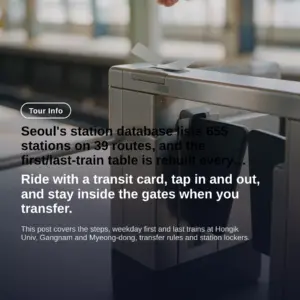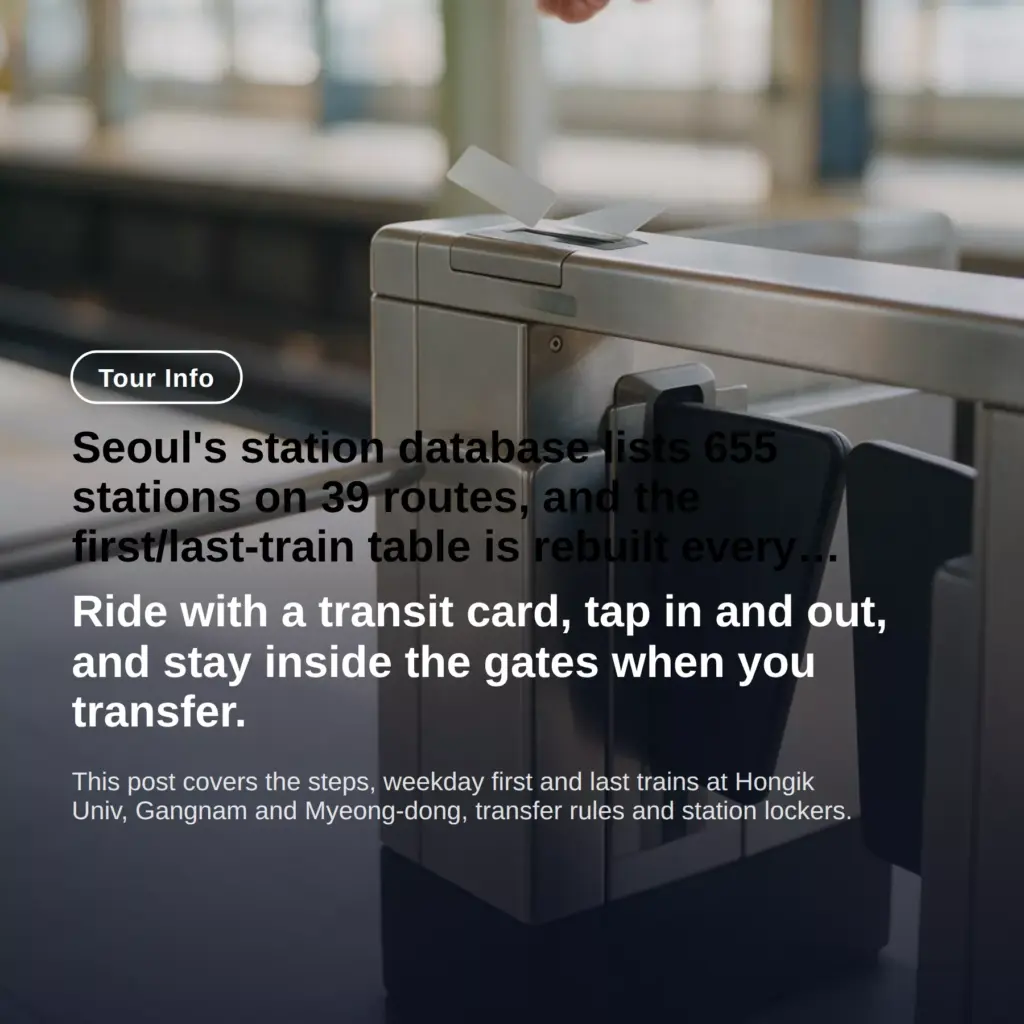
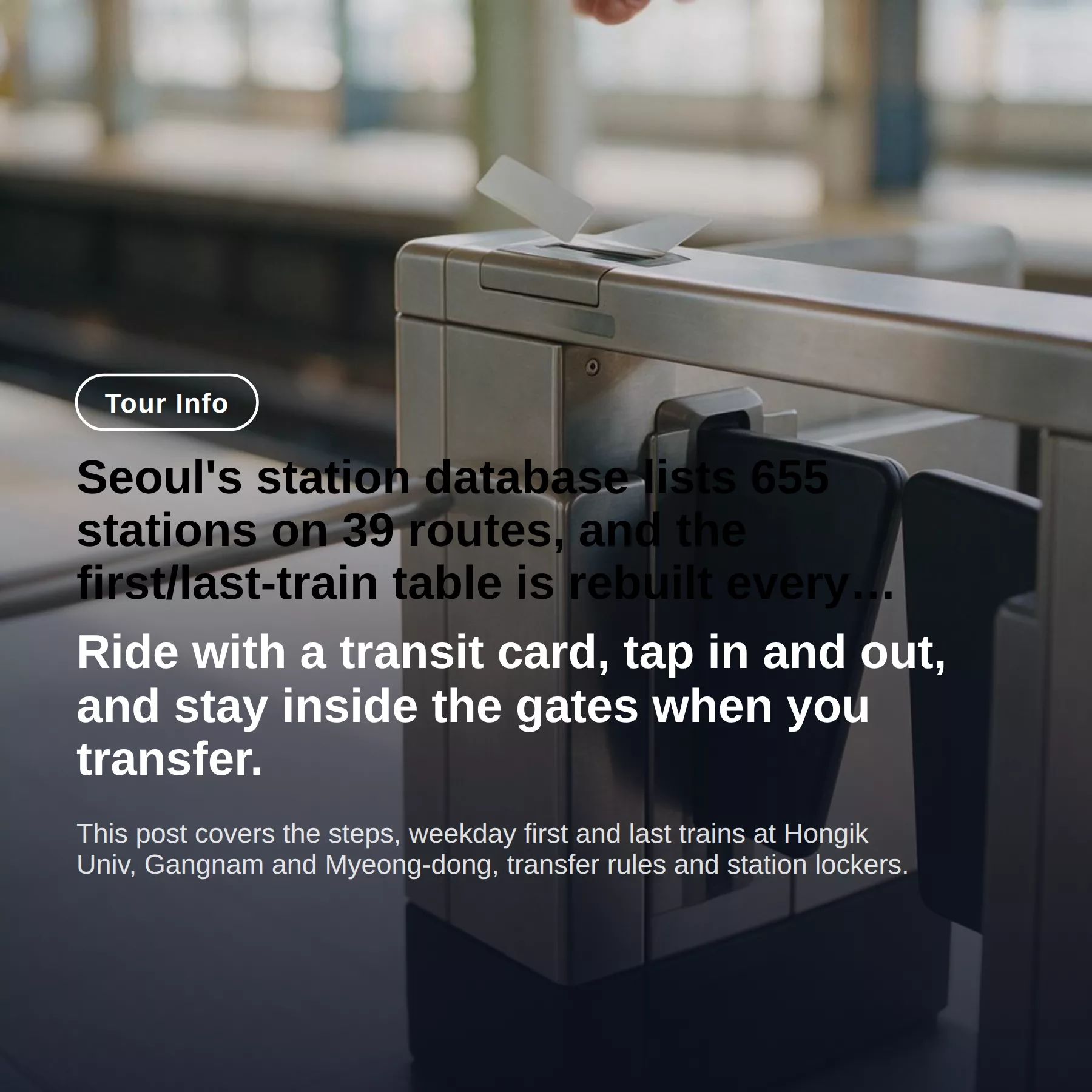
Buy or load a transit card, tap it at the gate on entry and again on exit, transfer without leaving the gates, and check the first and last train times for your direction.
The numbers in this post come from the Seoul Metro first/last-train table read on September 20, 2026, which is refreshed daily.
The sections below cover the tap-in steps, the T-money card, how to tell which train you are boarding, weekday last trains at the stations tourists use most, transfer rules and luggage lockers.
Contents
- Seoul subway guide: tap in, read the terminus, catch the last train
- T-money card: buy it and load it before you tap
- Which train am I on? Read the terminus, not the color
- First and last trains at the stations tourists use
- Transferring without re-tapping keeps your fare continuous
- Locker prices start at 2,200 KRW, with 337 banks open 05:00–01:00
Seoul subway guide: tap in, read the terminus, catch the last train
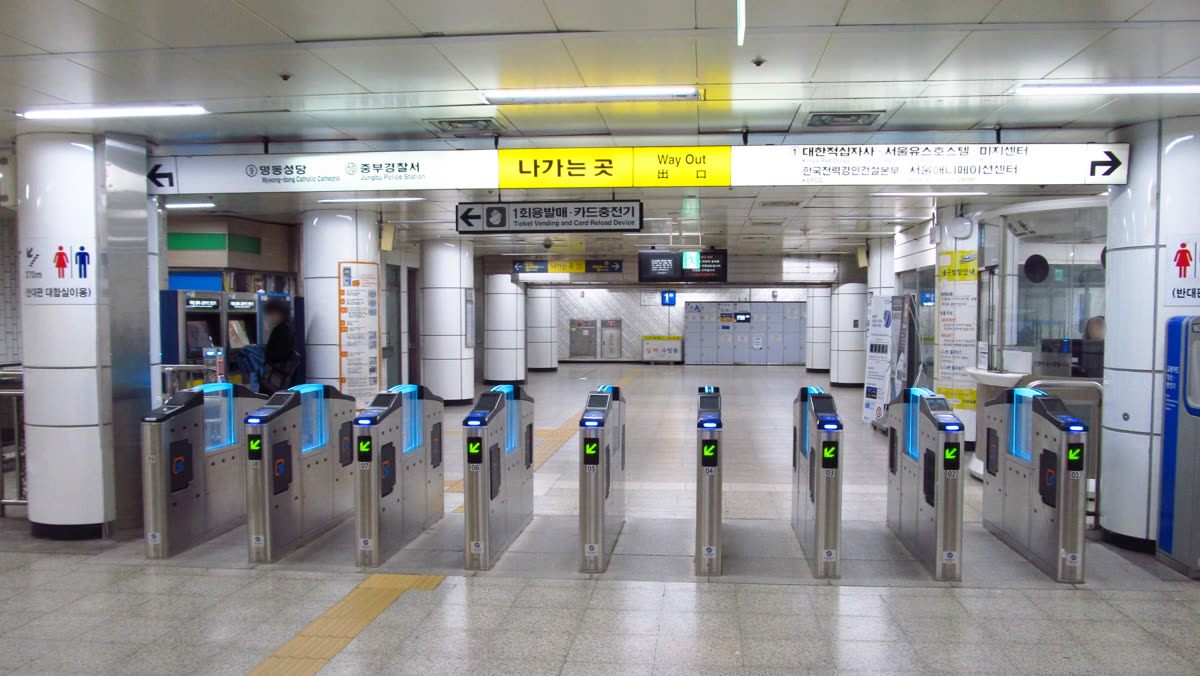
Get a transit card, tap it at the gate on entry, ride, and tap it again on exit.
Riders tap a transit card at the gate on entry and again on exit, and transfers within the network are made without leaving the gates (2026-09-20).
Seoul’s official station database lists 655 stations on 39 route names — Line 1 to 9, AREX, Gyeongui-Jungang, Suin-Bundang, Shinbundang, Ui-Sinseol, Sillim and more.
The steps are:
- Get a transit card such as T-money and load it with cash value.
- Tap the card on the reader at the entry gate and keep it until the exit gate.
- If your route changes lines, follow the transfer signs without going through an exit gate.
- At the exit gate, tap the card again — the fare is charged for the whole trip at that point.
If you are landing at Incheon or riding a premium line like AREX, card acceptance on that specific route is worth checking at the gate before you commit.
| Station | Line 2, toward Euljiro 1(il)ga |
|---|---|
| Station | Line 2, toward Sindorim |
| Station | Line 4, toward Hansung Univ |
| Station | Line 4, toward Seoul Station |
| Station | Line 2, toward Seoul National Univ |
| Station | Line 2, toward Samseong |
T-money card: buy it and load it before you tap
T-money is the rechargeable transit card tourists use for the Seoul subway, and you need value loaded on it before tapping in.
The exact purchase price of the card and the current base subway fare were not confirmed in the 2026-09-20 sources, so the first thing to check at the station or convenience store is the price of the card itself and the minimum top-up amount.
Cards can be topped up at machines inside stations.
If you plan several subway trips in a day, load enough for the whole day so you are not hunting for a machine between rides.
Which train am I on? Read the terminus, not the color
Trains on the same line are identified by the terminus they head towards, not by a single direction.
Line 2, for example, runs both towards Euljiro 1(il)ga and towards Sindorim, so confirm the terminus on the platform sign before boarding (2026-09-20).
- Check the route in a navigation app first.
- On the platform, match the terminus on the sign to the terminus in your route.
- Board, and re-check the terminus at transfer platforms — the same platform can serve both directions.
For routing, Naver Map and Kakao Map are the local-standard apps for Seoul subway directions; Google Maps is weaker for transit detail in Korea (2026-09-20).
First and last trains at the stations tourists use
Weekday last trains leave Hongik Univ Line 2 at 24:49 toward Euljiro 1(il)ga and 24:50 toward Sindorim, per the Seoul Metro data read on 2026-09-20.
| Station | Direction (toward terminus) | First train (weekday) | Last train (weekday) |
|---|---|---|---|
| Hongik Univ | Line 2, toward Euljiro 1(il)ga | 05:30 | 24:49 |
| Hongik Univ | Line 2, toward Sindorim | 05:30 | 24:50 |
| Gangnam | Line 2, toward Seoul National Univ | 05:36 | 24:46 |
| Gangnam | Line 2, toward Samseong | 05:44 | 24:54 |
| Myeong-dong | Line 4, toward Hansung Univ | 05:33 | 24:50 |
| Myeong-dong | Line 4, toward Seoul Station | 05:43 | 24:57 |
The two directions are not identical, so the terminus matters even at the last train: toward Samseong the last train runs 8 minutes later (24:54) than toward Seoul National Univ (24:46), and toward Seoul Station it runs 7 minutes later (24:57) than toward Hansung Univ (24:50).
Transferring without re-tapping keeps your fare continuous
Transfers between Seoul subway lines happen without leaving the gates, so the fare stays continuous for the whole trip.
Tap in once at your entry gate, follow the transfer signs, and tap out only at your final exit gate (2026-09-20).
Re-tapping a card at a transfer gate can end the trip and start a new fare, so the safe rule is to treat every gate that is not your final exit as a pass-through.
The exact re-entry penalty rule needs a primary source; what matters for the reader is the habit — walk through transfer passages, not exit gates.
If a transfer sign splits toward several lines, the line names and colors on the overhead signs lead you to the right platform without passing any fare gate.
Locker prices start at 2,200 KRW, with 337 banks open 05:00–01:00
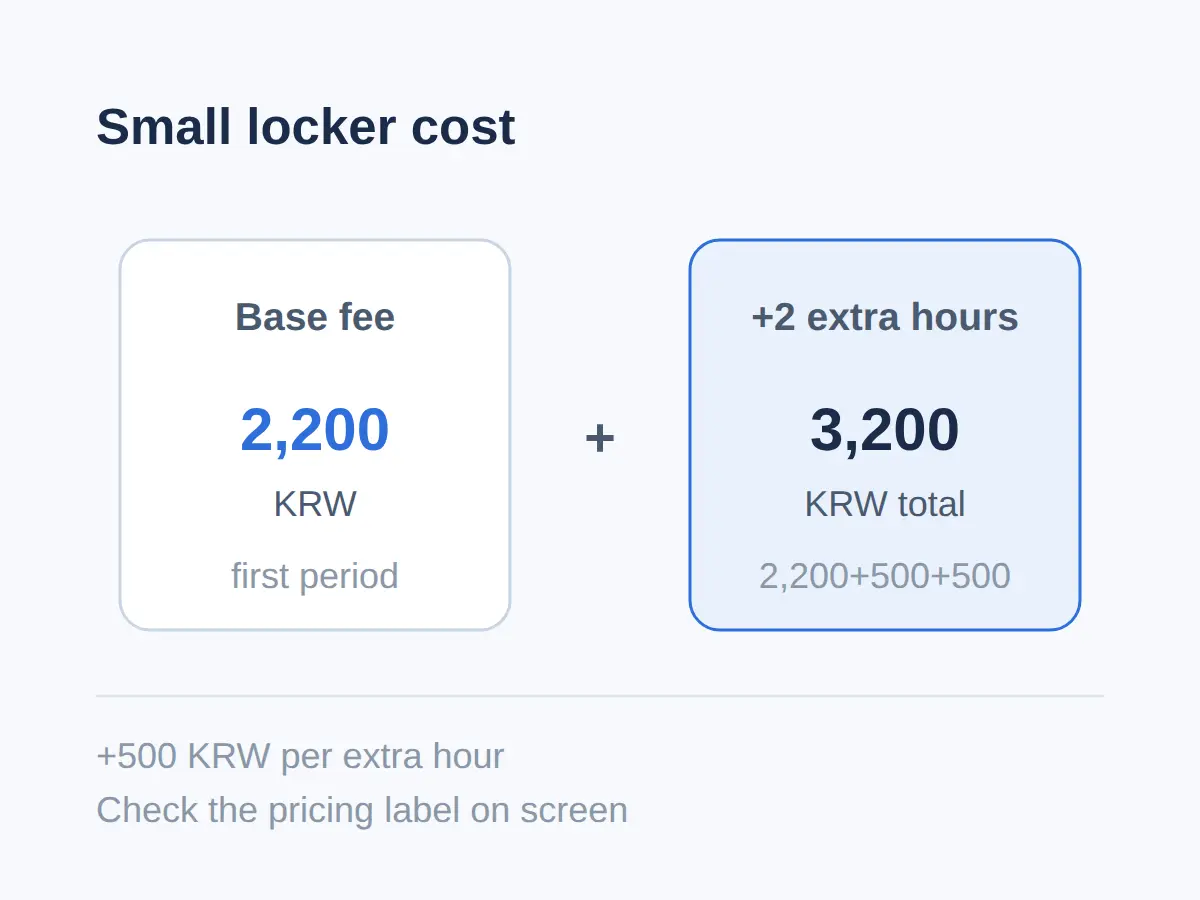
Seoul Metro data as of 2026-09-20 lists 337 locker banks at 232 stations, open weekdays 05:00–01:00, with a small locker starting at a 2,200 KRW base fee plus 500 KRW per extra hour.
That averages about 1.45 locker banks per station, so most stations you will use have at least one.
The base fee covers the first period and each extra hour adds 500 KRW, so 2,200 KRW + 500 KRW + 500 KRW = 3,200 KRW for a small locker with 2 extra hours.
Whether the extra fee runs per hour or per a different time period needs confirmation against the primary locker page, so check the pricing label on the locker screen before paying.
Weekend and holiday locker hours were not confirmed; the 05:00–01:00 weekday window is the sourced value.
Only the small-locker price line was confirmed, so larger locker sizes and their fees should be read off the locker unit at the station.
If I were cutting it close on the last train, I would first check the terminus on the platform sign and drop my bag in a locker near the exit gate, because a locker on the wrong side of the paid area costs a re-tap and a new fare.
👉 Seoul subway map and live station pages
👉 Seoul subway luggage lockers
👉 Korean subway guide for foreigners
Related posts
📎 Seoul — everything we know
📎 📅 다가오는 일정 — 발매·개봉·발표 캘린더
Sources
- Naver Map preferred over Google Maps for Seoul transit direc (blog.namanecard.com)
- Barrier-free mobility MCP: elevator/accessible-restroom data (github.com)
- Subway congestion MCP: Lines 1–8 per-train crowding for next (github.com)
What to check next
- September 20, 2026 — Seoul Metro first/last-train table and station master read for this post; the live table is refreshed daily, so re-check times on the morning you ride.
- This post’s numbers are as of September 20, 2026.
- Weekday first and last trains at Hongik Univ, Gangnam and Myeong-dong differ by direction, so check the terminus, not just the line number.
- Stay inside the paid area until your final exit — re-tapping at a transfer gate can end the trip and start a new fare.
- 337 locker banks at 232 stations run weekdays 05:00–01:00, and a small locker starts at a 2,200 KRW base fee plus 500 KRW per extra hour.
FAQ
Q. How do I use the subway in Seoul as a tourist?
Buy or load a T-money transit card, tap it at the gate on entry, ride, transfer without leaving the gates, and tap again on exit. Seoul’s station database covers 655 stations on 39 route names (2026-09-20).
Q. What time is the last train from Hongdae or Gangnam?
Per the Seoul Metro data read on 2026-09-20, weekday Line 2 last trains leave Hongik Univ at 24:49 toward Euljiro 1(il)ga and 24:50 toward Sindorim, and Gangnam at 24:46 toward Seoul National Univ and 24:54 toward Samseong.
Q. Are there lockers in Seoul subway stations?
Yes — Seoul Metro data as of 2026-09-20 lists 337 locker banks at 232 stations, open weekdays 05:00–01:00, with a small locker starting at a 2,200 KRW base fee plus 500 KRW per extra hour.
Q. Do I tap my card again when transferring Seoul subway lines?
No — transfers within the network happen without leaving the gates, so the fare stays continuous; tap only at your entry gate and your final exit gate. Re-tapping at a transfer gate can end the trip and start a new fare, though the exact penalty rule needs a primary source.
Q. What fare does the Seoul subway cost in 2026?
The current base subway fare and T-money card purchase price were not confirmed in the 2026-09-20 sources; check the fare posted at the station gate or the official fare page before you ride.
Check the live first/last-train table for your station the morning you travel — 29 tourist-heavy stations have next-train times rebuilt daily from Seoul Metro data.
Cover photo: AI-generated illustration (subway ticket gate) — AI-generated image, illustrative only
#seoulsubway #t-moneycard #lasttrain #subwaylockers #seoultraveltips #koreatransit
📅Upcoming Dates — 이번 주 18 · D-3 Final two episodes drop on Disney+/Hulu전체 보기 →