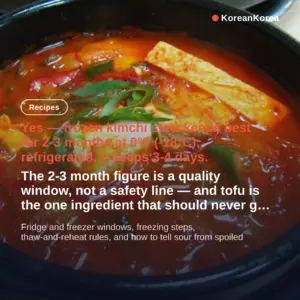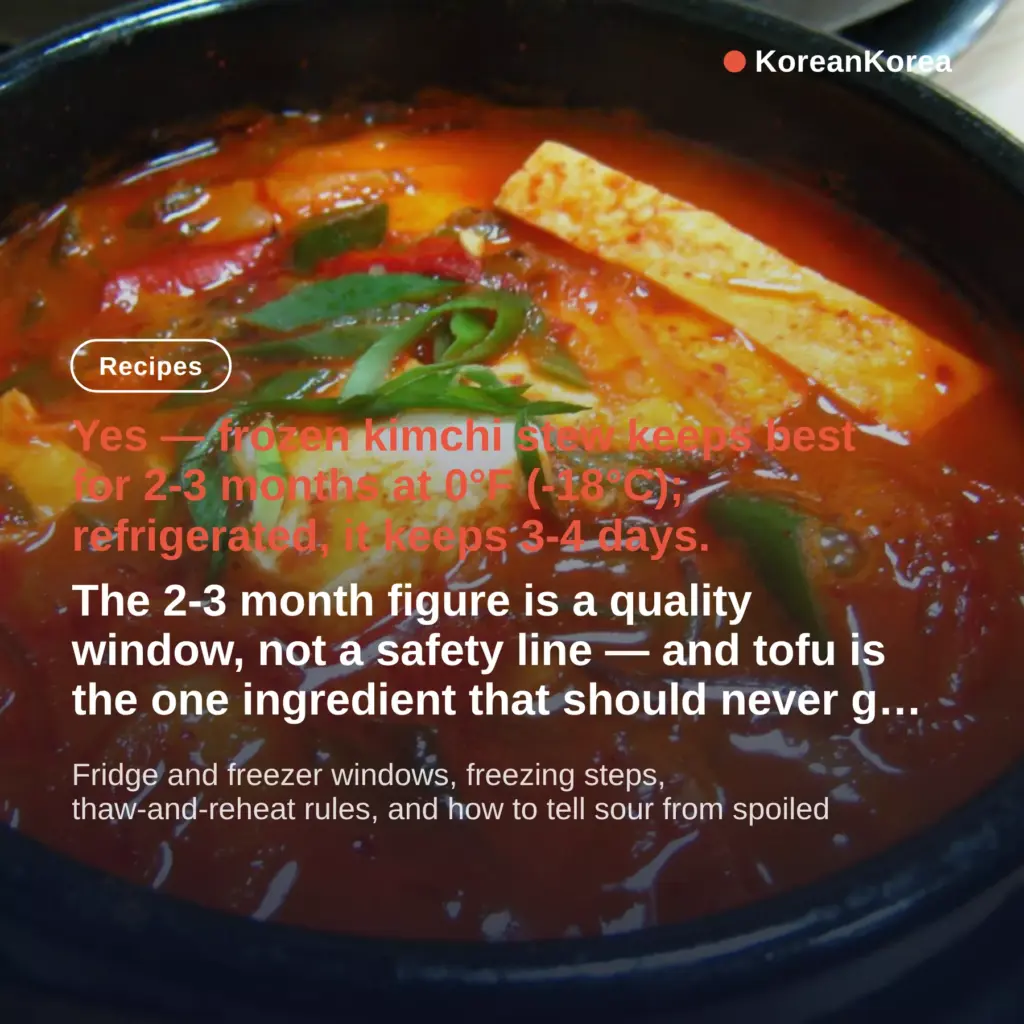
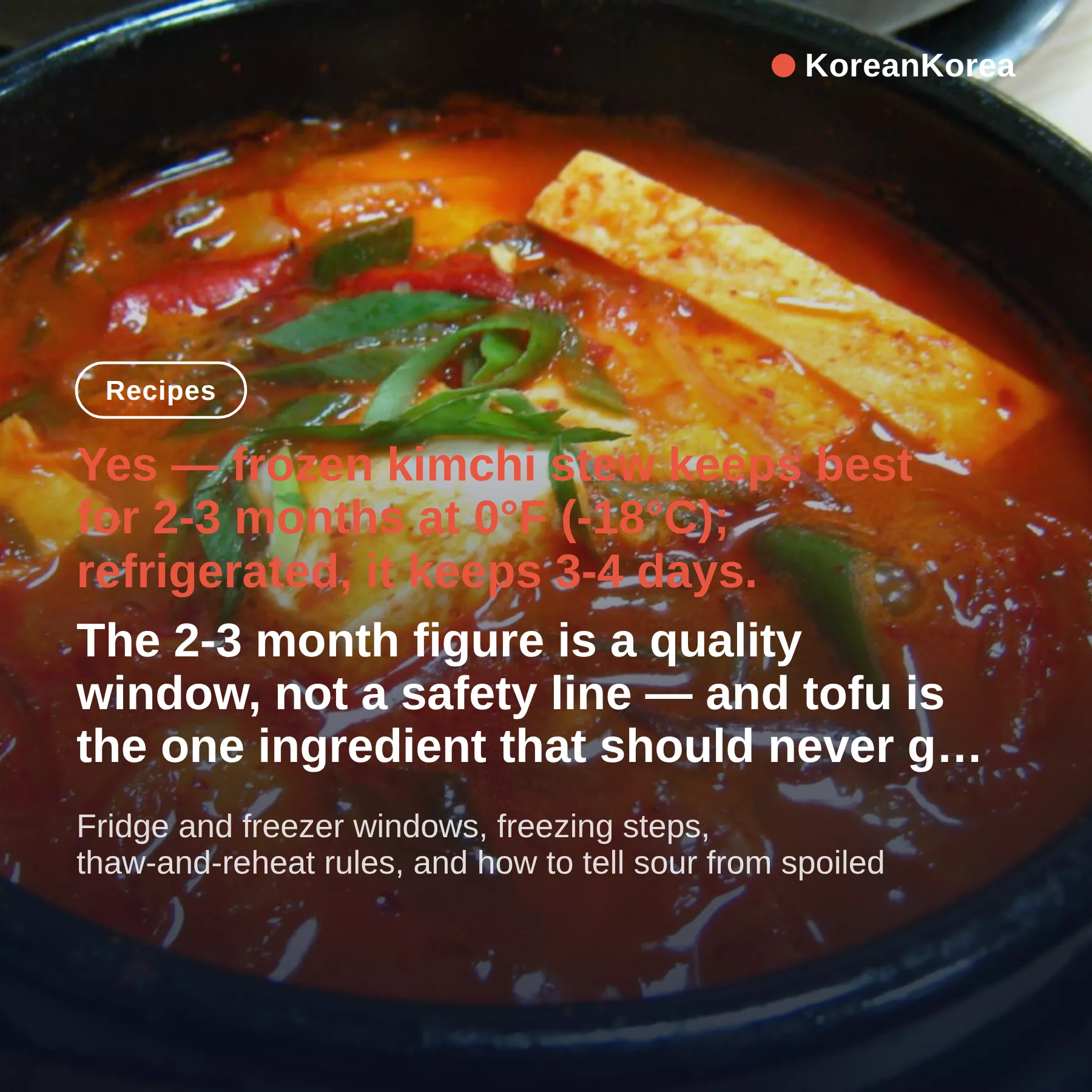
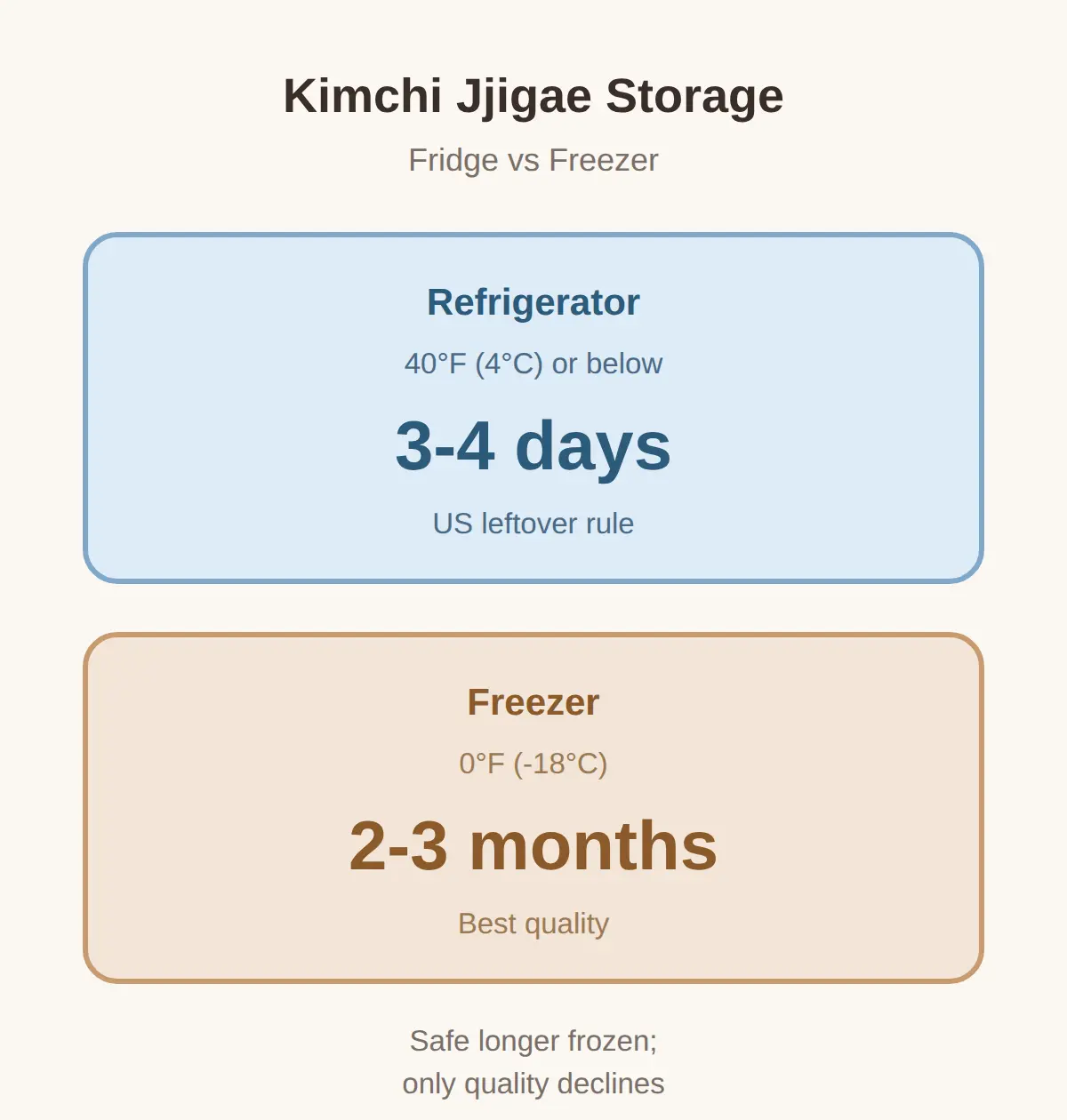
Cooked kimchi jjigae freezes well — 2-3 months at 0°F (-18°C) for best quality, and it stays safe frozen indefinitely.
In the refrigerator at 40°F (4°C) or below, the safer number is 3-4 days because the stew contains cooked pork.
That difference decides what to do with tonight’s leftover pot: eat it within 3-4 days, or freeze the extra now rather than gambling on day 5.
This post covers the fridge vs freezer numbers, how to freeze so the texture survives, how to thaw and reheat, when sourness is normal, and what to do with leftover kimchi and rice.
Contents
- Can I freeze kimchi stew? Yes, 2-3 months — here’s what changes
- How long does kimchi jjigae last in the fridge?
- How to freeze kimchi jjigae without ruining the texture
- How to thaw and reheat frozen kimchi jjigae
- Why kimchi jjigae tastes more sour every day — and when it has gone bad
- Can I freeze leftover kimchi too?
Can I freeze kimchi stew? Yes, 2-3 months — here’s what changes
Yes — kimchi jjigae freezes for 2-3 months at 0°F (-18°C) with best quality, and frozen food stays safe indefinitely; only texture and flavor decline after that.
Freezing buys roughly 18-30x more time than the fridge: about 90 days against 3-5 days.
Broth and thinly sliced pork are the ingredients that freeze well.
Tofu, potatoes, and green onions do not, so the method in the next sections matters more than the calendar.
If the pot will outlast day 3, freeze it on cooking day — the fridge cannot hold the window open past 3-4 days.
| Refrigerator — leftover stew with pork | 3-4 days at 40°F (4°C) or below |
|---|---|
| Freezer — leftover stew | 2-3 months for best quality at 0°F (-18°C); safe indefinitely |
| Cooked rice served with the stew | 3-4 days refrigerated; up to 1 month frozen, in separate portions |
| Frozen raw kimchi (for cooking) | Cut to bite size, 2-3 spoonfuls of brine per bag, flat packs |
| Reheat target | 165°F (74°C) internal — bring the broth to a rolling boil |
How long does kimchi jjigae last in the fridge?
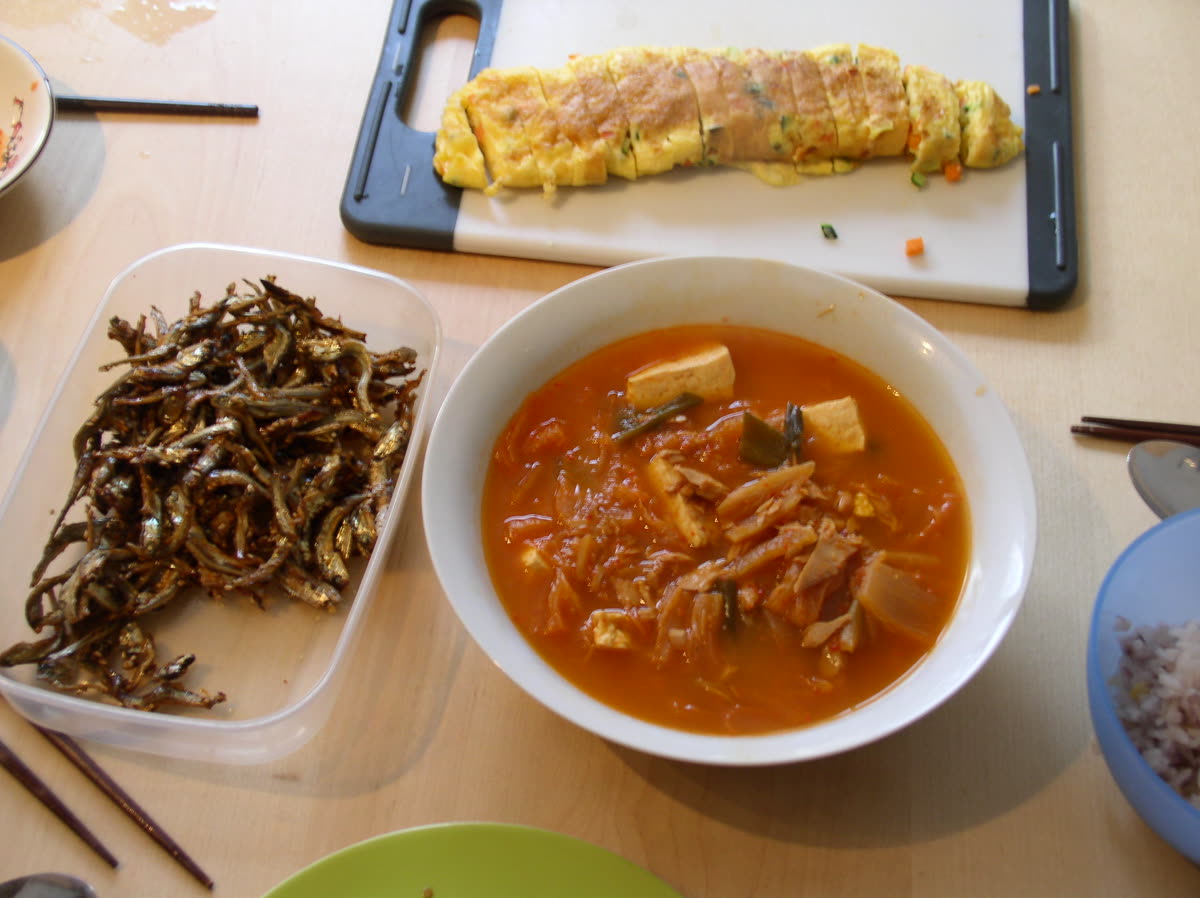
Cooked kimchi jjigae keeps 3-4 days refrigerated at 40°F (4°C) or below, because the cooked pork in it falls under the meat-stew leftover rule.
A looser 4-5 day refrigerated figure circulates for Korean brothy dishes like yukgaejang.
That reference suits pure vegetable broths; a stew with meat follows the tighter number.
One more pull in the other direction: the live kimchi base keeps fermenting in the fridge, so the sourness climbs every day regardless of the calendar.
If day 3-4 is already past, the freezer is the move — refrigerated storage offers no extension beyond 4 days for a pork stew.
How to freeze kimchi jjigae without ruining the texture
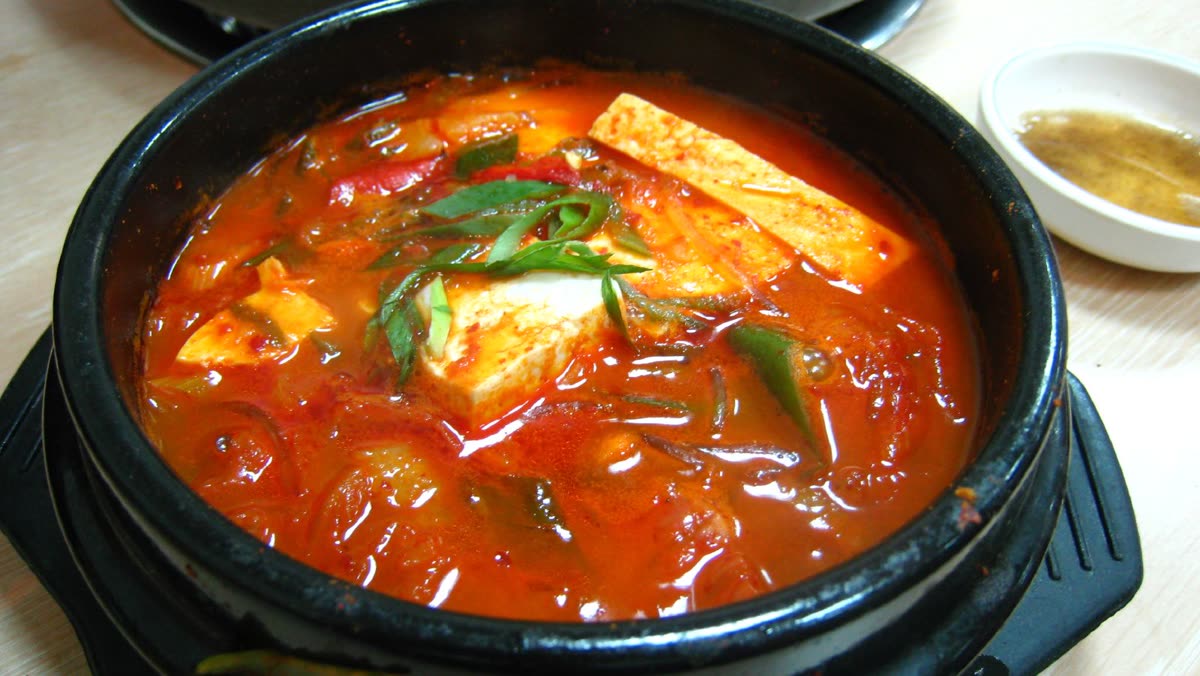
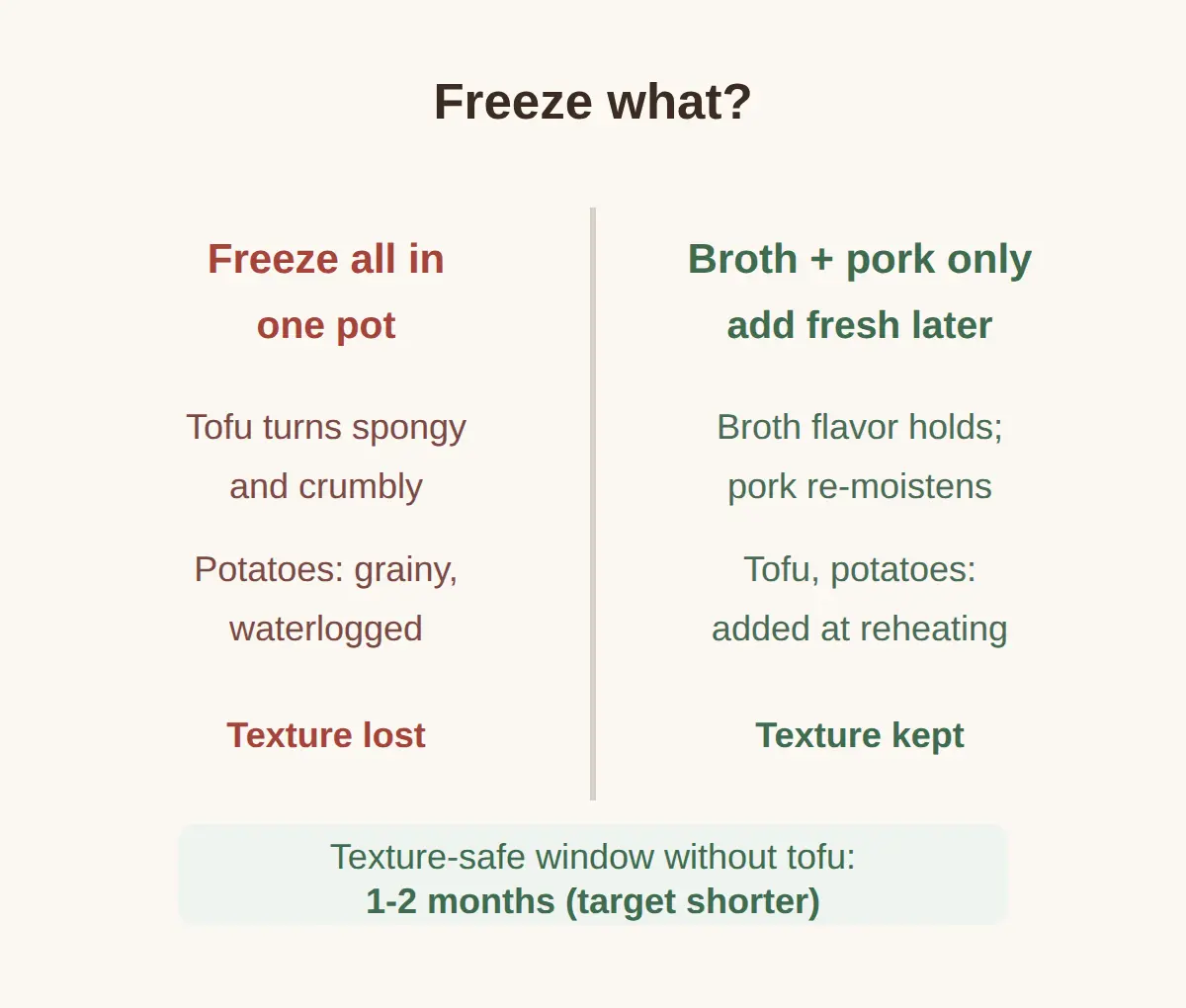
Freeze the broth and pork only, leave tofu and potatoes out, and add them fresh when reheating — that is the method that keeps the dish’s signature textures.
Tofu turns spongy and crumbly after a freeze-thaw cycle, and potatoes come out grainy and waterlogged; the flavor holds, the soft textures do not.
Thinly sliced pork dries slightly but the reheated broth re-moistens it.
- Cool the stew and refrigerate or freeze it within 2 hours of cooking — divide it into shallow, small containers so it cools fast.
- Portion into single-serving airtight containers or flat freezer bags, leaving 1-2 cm of headspace for the broth to expand.
- Shallow, wide containers or flat bags thaw and reheat faster and more evenly than one deep block.
- Add freshly cut tofu and fresh potatoes to the pot when reheating, not before freezing.
Cookbook sources suggest freezing broth and solids in two separate containers, and cite 1-2 months as the texture-safe window for stew frozen without tofu — recipe sources vary between 1 and 3 months, so treat the shorter figure as the texture target.
If it were my pot, the check would come before portioning: whatever tofu or potatoes went in comes back out of the portion headed for the freezer.
How to thaw and reheat frozen kimchi jjigae
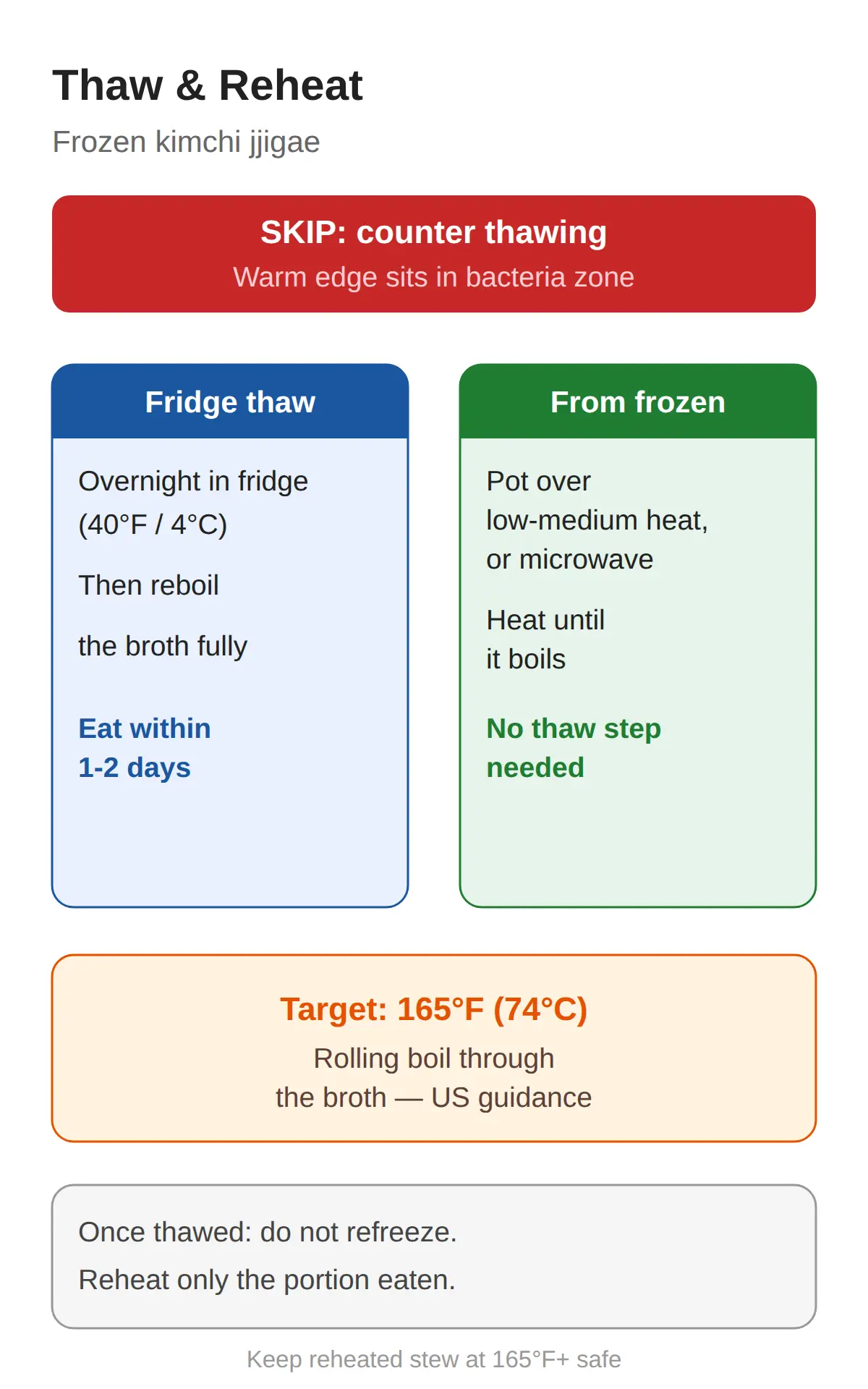
Thaw overnight in the refrigerator and reboil, or reheat straight from frozen over low-medium heat — room-temperature thawing is the one method to skip.
The warm outer layer of a counter-thawing pot sits in the bacteria growth zone while the center is still frozen; the fridge avoids it, and cooking from frozen avoids it entirely.
- Move a flat bag or shallow container to the fridge the night before, then bring the broth to a rolling boil.
- From frozen, set the block in a pot over low-medium heat, or microwave it, and heat until it boils.
- Heat to 165°F (74°C) internal temperature — for a stew, that means a rolling boil through the broth.
- Reheat only the portion being eaten.
Once thawed, the stew should not go back into the freezer; keep it refrigerated and eat it within 1-2 days.
Leftovers, including kimchi jjigae, should be reheated to an internal temperature of 165°F (74°C) under US reheating guidance.
Why kimchi jjigae tastes more sour every day — and when it has gone bad
Daily souring is normal: the kimchi base is still alive and keeps fermenting even after cooking, and kimchi jjigae is traditionally built on well-fermented, sour kimchi anyway.
Some cooks freeze stew on purpose because freezing and thawing breaks the kimchi fibers down further and releases more savory depth into the broth — a thawed pot can taste deeper than a day-old one.
Discard the stew instead of reboiling it if there is a putrid smell rather than a sour kimchi smell, slimy broth, visible mold, or bubbles in a sealed refrigerated container.
A day-3 pot that smells sharper than day 1 is on schedule; a pot that smells wrong in a way sourness does not explain is not.
Can I freeze leftover kimchi too?
Yes, but only for cooking — freeze leftover kimchi in flat packs for jjigae, jjim, bokkeum, or jeon, because ice crystals rupture the cabbage and it will not serve as a fresh side dish after thawing.
Cut it to bite size first, divide into 1-2 serving portions of about 200-300 g, and add 2-3 spoonfuls of kimchi juice to each bag — the brine coats the cabbage, prevents freezer burn, and doubles as a flavor base for the next stew.
Press each bag flat, remove the air, and freeze in thin blocks so it stacks and thaws evenly.
The frozen block can drop straight into boiling broth without thawing; for stir-fry, thaw it slowly in the fridge overnight.
Aged kimchi freezes best for stew — freezing and thawing breaks its fibers down further and pushes more flavor into the broth, which is a quality gain in the pot and a loss on the table.
Rice served alongside follows its own rule: 3-4 days refrigerated and up to 1 month frozen, in separate portions — never frozen inside the stew.
One strained idea from the same pot: kimchi brine frozen in an ice-cube tray, one cube per serving, works as a base for kimchi-mari noodle soup or bibim-guksu seasoning.
If it were me, I would freeze the broth and pork in flat 400-500 g bags — those two carry the dish, and adding tofu and potatoes fresh at reheating keeps the textures that freezing ruins.
That is also why I never freeze the whole pot in one block: flat single-portion bags thaw faster and let me reheat exactly what I eat.
Related posts
Sources
- Do not refreeze; use within 1-2 days of thawing (umamicart.com)
- 300 g aged kimchi, 200 g pork, 500 ml water, doenjang/saewuj (cookpick.kr)
- Fridge 2-3 days; freeze without tofu, add fresh tofu on rehe (dlfgh4567.tistory.com)
Summary
- Freezer 2-3 months is a quality window, not a safety line — a 4-month-old stew is safe but worse.
- Check what is in the pot before portioning: tofu and potatoes come out, broth and pork go in flat bags.
- Thaw in the fridge overnight or cook from frozen — never on the counter.
- Reheat once, to a rolling boil, and refreeze nothing.
- More sour by day 3-4 is fermentation at work; putrid smell, slime, mold, or bubbles mean discard.
FAQ
Q. Can I freeze kimchi stew?
Yes. At 0°F (-18°C) it keeps best quality for 2-3 months and stays safe indefinitely — the limit is texture and flavor, not safety.
Q. How long does kimchi jjigae last in the fridge?
3-4 days at 40°F (4°C) or below, under the US leftover guideline for meat-containing stews.
Q. Can I freeze kimchi soup the same way?
The same fridge and freezer figures apply to broth-based stews generally; use the same rules for a thinner kimchi soup.
Q. Can I freeze kimchi paste?
Freezing raw kimchi for cooking is standard — flat 200-300 g packs with brine — but a sealed jar of kimchi paste in the fridge is its own storage question; no primary-source figure for it was found in this search pass.
Q. Can I freeze kimchi jjigae with tofu in it?
It is safe, but the tofu turns spongy and crumbly after thawing. Freeze the broth and pork without it and cut fresh tofu in when reheating.
Kimchi jjigae is traditionally made with well-fermented, sour kimchi — a pot that has been sitting in the fridge for a week of kimchi is, by Korean cooking logic, the better stew base.
Cover photo: File:Korean stew-Kimchi jjigae-01.jpg by by miyagawa — CC BY-SA 2.0
#kimchijjigae #canifreezekimchistew #kimchistewstorage #freezingleftovers #koreanfoodstorage
📅Upcoming Dates — 이번 주 18 · D-3 Final two episodes drop on Disney+/Hulu전체 보기 →