Pork neck bones can replace backbone in gamjatang, and the stew tastes better the next day because its gelatin-rich broth and sturdy vegetables hold up to refrigeration and reheating.
That means the two ingredients overseas cooks worry about most have workable answers before you start.
This post covers the backbone substitute, the small-batch recipe with amounts and times, a restaurant-style 2 kg batch, storage limits, and the leftover-broth fried rice.
Contents
- Gamjatang recipe: what to use instead of pork backbone
- Why gamjatang tastes better the next day
- Gamjatang recipe, small batch: ingredients and steps
- Scaling up: the restaurant-style 2 kg bone batch
- Substitutions when you cook gamjatang outside Korea
- Storage, reheating, and the leftover-broth fried rice
Gamjatang recipe: what to use instead of pork backbone
Pork neck bones (mokppye) replace backbone in gamjatang, and the substitution has a historical basis.
Gyeonggi-style sadaek gamjatang was made with neck bones and no potato at all, and traditional Korean recipes list neck bones or other pork bones as an acceptable variation on the standard cut, pork backbone (deungppye).
At Korean grocery stores in the US, the cut is sold under the English labels ‘pork neck bones’ or ‘pork spine’.
When I see a gamjatang recipe written abroad, the first thing I check is whether it tells me where to actually get pork backbone — and what to do if the only option is a bag of ‘pork neck bones’ at H Mart.
The ratios do not change with neck bones.
Keep the siraegi-to-bone ratio at 200 g dried radish greens per 1 kg of bones — roughly 1:5 by weight — and keep the potatoes at 3 medium (about 400 g) per 600 g to 1 kg of bones, cut into large quarters.
One caution: US market stock for 2026 has not been verified, so check the meat counter before you build the rest of the shopping list.
| Cannot find pork backbone (deungppye) | Use pork neck bones — sold as ‘pork neck bones’ or ‘pork spine’ at Korean markets like H Mart |
|---|---|
| Cannot find ground perilla (deulkkae) powder | Skip it rather than substitute — do not use sesame powder |
| Need it fast on a weeknight | Pressure cooker 20 min (40 min total) instead of regular pot 30 min (60 min total) |
| Made a big pot and want it to last | Refrigerate 4-5 days or freeze in single-meal portions up to 3 months |
| Deciding whether to buy boneless gamjatang | Avoid pre-picked boneless versions — whole bones in the pot is the quality test |
| Leftover broth at the bottom of the pot | Stir in 2 bowls of rice with picked meat and mashed potato, finish with seaweed flakes and sesame oil |
Why gamjatang tastes better the next day
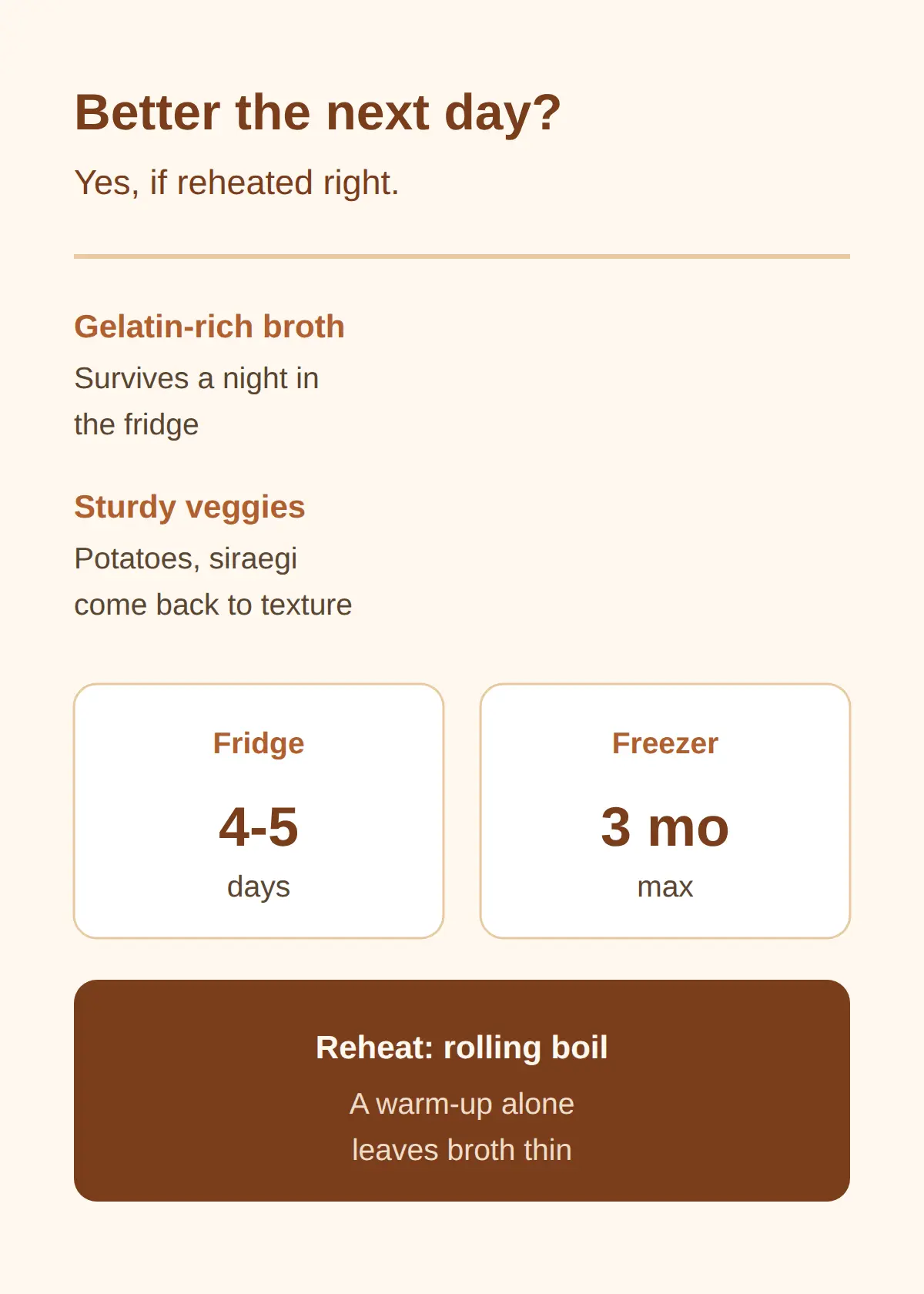
Gamjatang reheats well because its cloudy, gelatin-rich broth and its sturdy vegetables — potatoes and siraegi — tolerate refrigeration and come back to texture when boiled again.
| Question | Answer |
|---|---|
| Why does it keep well? | Soup-style dishes with sturdy vegetables and gelatin-rich bone broth tolerate refrigeration and reheat well |
| Fridge life | 4-5 days |
| Freezer life | Up to 3 months |
| How to reheat | Bring to a rolling boil, not just a warm-up |
This comes from guidance written for Korean soups in the same family; it is the structure behind the ‘tastes better next day’ claim, not a tested gamjatang-only result.
The broth itself has body comparable to paitan ramen stock, and that gelatin-rich body is what survives a night in the fridge.
Reheating is the step that decides whether the claim holds for you.
Boil the pot again to a rolling boil rather than just warming it, and the broth texture comes back — warmed-only reheating leaves it thinner.
If you plan a make-ahead meal, cook the pot a day early, refrigerate it, and boil it fully on serving day.
Gamjatang recipe, small batch: ingredients and steps
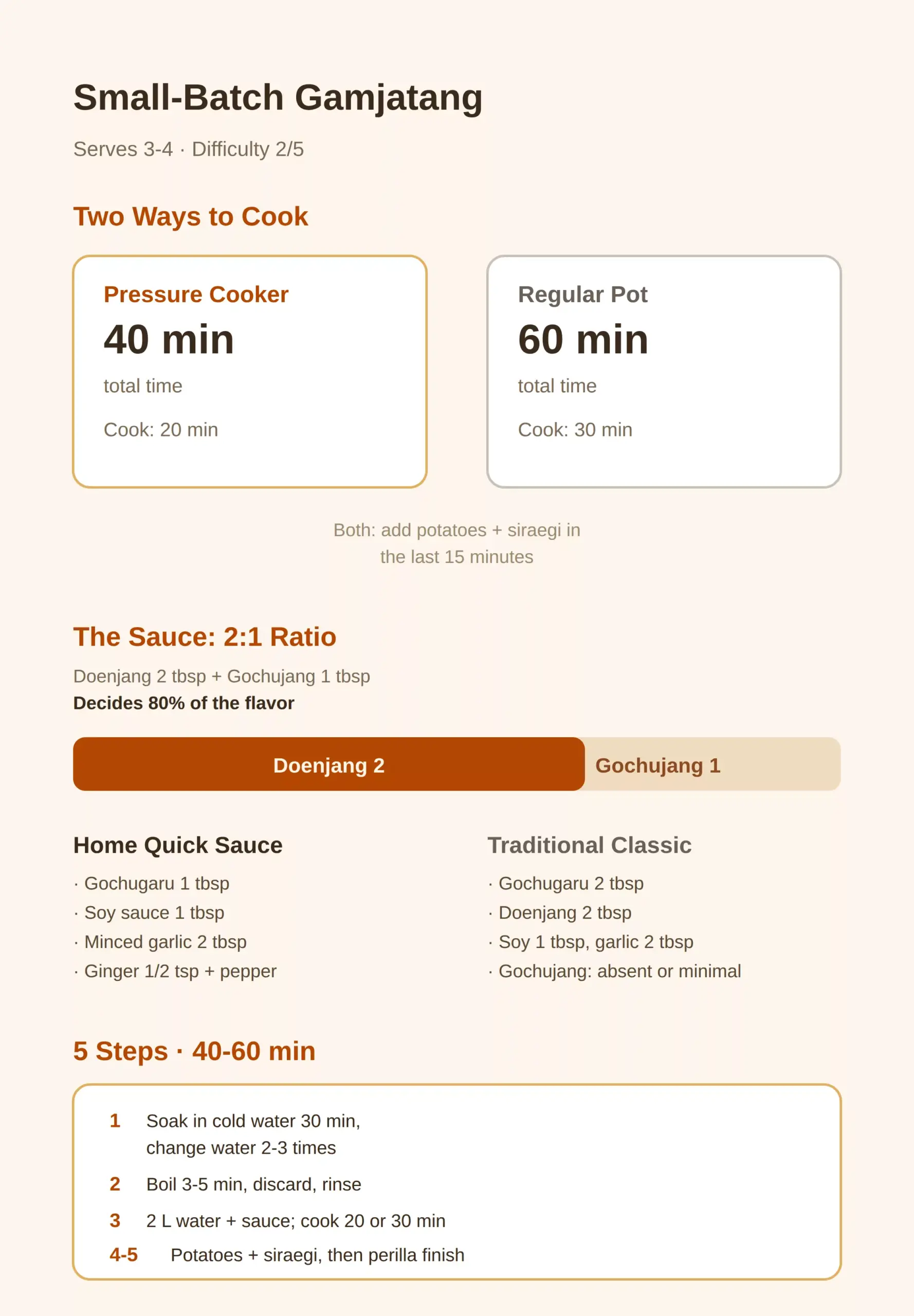
The small-batch recipe serves 3-4 with a sauce of doenjang 2 tbsp + gochujang 1 tbsp (2:1) that decides 80% of the flavor, and finishes in 40 min with a pressure cooker or 60 min with a regular pot.
Total time is 40 minutes or 60 minutes depending on the pot, and the difficulty is rated 2 out of 5.
Ingredients: 1 kg pork backbone, 3 medium potatoes cut into large quarters, 200 g siraegi (or outer cabbage leaves), 1 scallion, 5 perilla leaves, 2 Cheongyang peppers, and 2 L water.
For the sauce: doenjang 2 tbsp, gochujang 1 tbsp, gochugaru 1 tbsp, soy sauce 1 tbsp, minced garlic 2 tbsp, ground ginger 1/2 tsp, and pepper.
- Soak the backbone in cold water for 30 minutes, changing the water 2-3 times — overnight if you can.
- Boil the bones for 3-5 minutes, discard that water, and rinse under running water.
- Return the bones to the pot with 2 L water and the sauce; cook 20 minutes in a pressure cooker or 30 minutes in a regular pot.
- Add the potatoes and siraegi in the last 15 minutes; test the potatoes with a chopstick.
- Finish at the very end with perilla powder, fresh perilla leaves, and black pepper.
The two Cheongyang peppers are the main heat dial besides gochugaru — add more for a spicier broth.
If the soak and blanching feel like the skippable parts, they are the opposite: a clean broth before any seasoning is what separates real gamjatang from a murky pork boil.
If the pressure cooker route fits your weeknight, use it — both routes add potatoes and siraegi in the last 15 minutes either way.
Scaling up: the restaurant-style 2 kg bone batch
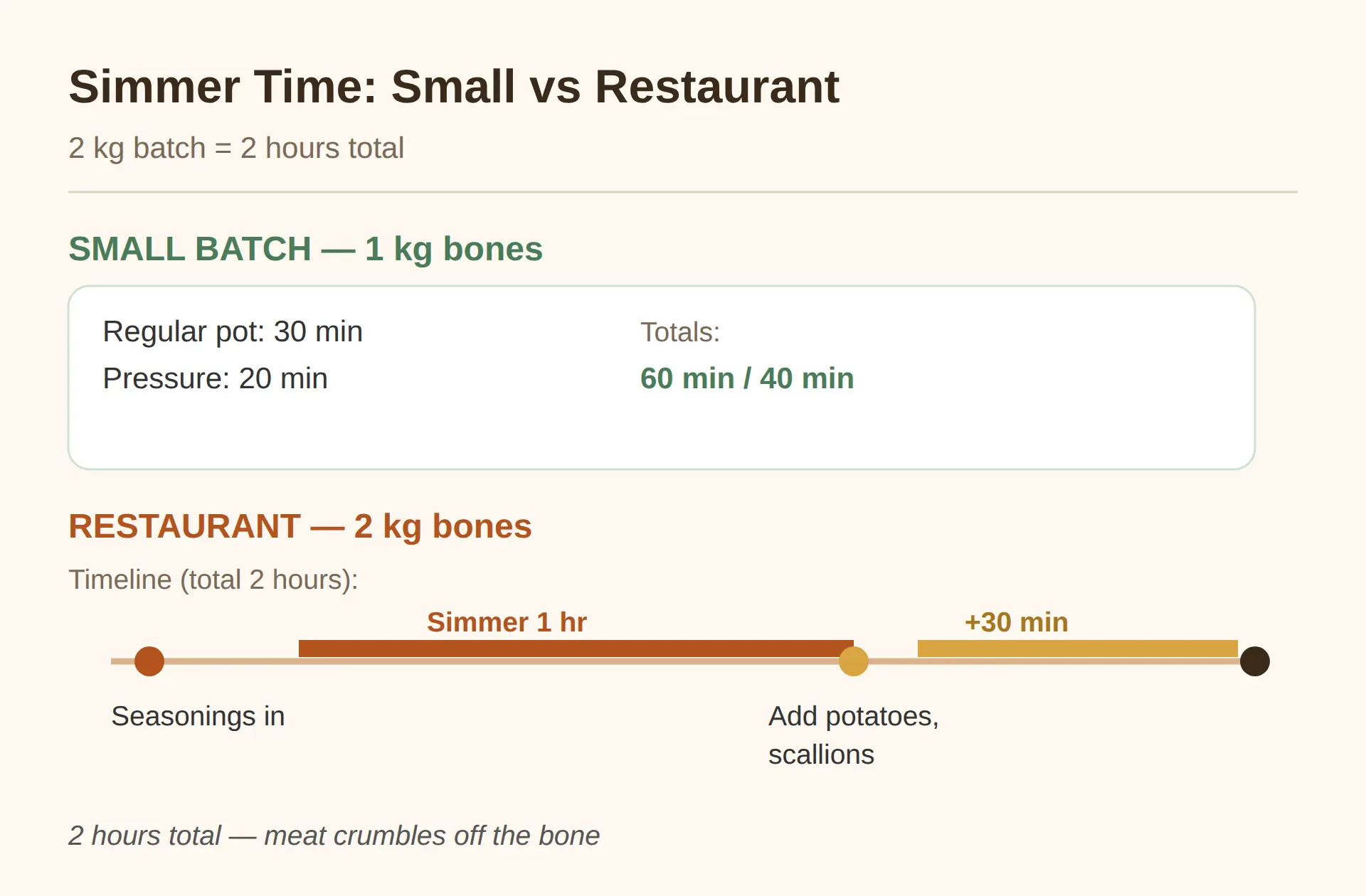
For a restaurant-style 2 kg bone batch, simmer 1 hour after the seasonings go in, add potatoes and scallions, then boil 30 minutes more — 2 hours total until the meat crumbles off the bone.
The 2 kg of pork backbone soaks in cold water for 2 hours with the water changed halfway, and serves 4.
| Item | Small batch (1 kg bones) | Restaurant batch (2 kg bones) |
|---|---|---|
| Pork backbone | 1 kg | 2 kg |
| Simmer time | 30 min in a regular pot (60 min total) or 20 min pressure (40 min total) | 1 hour simmer + 30 min after potatoes, 2 hours total |
| Gochujang | 1 tbsp | 2 tbsp |
| Doenjang | 2 tbsp | 5 tbsp |
| Gochugaru | 1 tbsp | 5 tbsp |
| Minced garlic | 2 tbsp | 2 tbsp |
| Soy sauce | 1 tbsp | 3 tbsp dark soy sauce |
| Perilla leaves | 5 | 30 sliced |
| Ground perilla seed powder | Optional but defining | 5 tbsp |
| Serves | 3-4 | 4 |
The restaurant method blends radish, onion, Cheongyang chili, 1 green onion, and 500 ml of water until smooth, then adds the puree to the pot before simmering.
The finish also adds anchovy fish sauce 3 tbsp, beef dasida 1 tbsp, MSG 0.5 tbsp, and black pepper.
Use the large batch when you are cooking for four or meal-prepping, and the small batch for a weeknight pot for 3-4.
If the ground perilla seed powder is unavailable, this is where the amounts matter less — the small-batch recipes list it as optional but defining, and recipes differ on whether to use a fixed amount.
Substitutions when you cook gamjatang outside Korea
Perilla powder has no confirmed substitute — skip it rather than replace it, and do not swap in sesame powder.
Recipes list ground perilla (deulkkae) as optional but defining: it rounds the pork fat and adds the nutty body that marks the dish.
For readers who want a dosing reference anyway, the standard Korean recipe for a similar soup pot uses 30 g (6 tbsp) of ground perilla seed powder per pot.
Doenjang is non-negotiable — its fermented depth is what balances the pork fat, and gochujang stays subtle so the broth does not get heavy.
Japanese miso is explicitly on the avoid list for this reason.
Also avoid versions sweetened with syrup, and versions that omit the leafy greens entirely.
Siraegi, the dried radish greens, substitutes with outer cabbage leaves.
Whether perilla powder is on the shelf at your local Korean market has not been verified for 2026 — the H Mart note on pork backbone is the general one, and freshness varies by store.
If the market stocks only sesame powder, leave the powder out and note it to whoever eats the pot.
Storage, reheating, and the leftover-broth fried rice
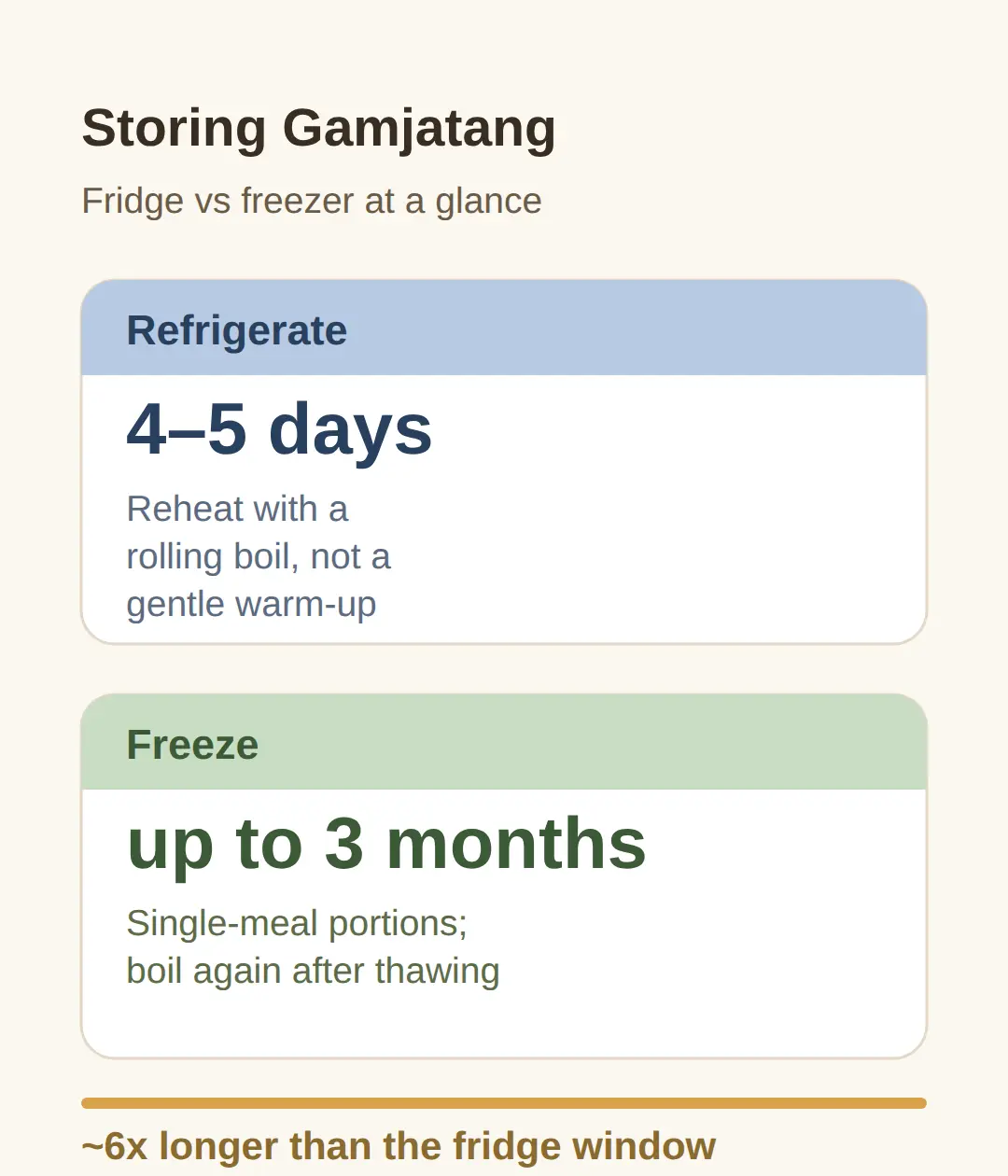
Gamjatang keeps 4-5 days in the fridge and up to 3 months frozen — and thawed portions should be boiled again, not just warmed, to restore the broth’s texture.
The 3-month freezer figure is about 6 times the fridge window (90 days vs 4-5 days).
One caveat to weigh: these limits are inferred from guidance for yukgaejang, a soup in the same family, not from gamjatang-specific testing.
Freeze in single-meal portions so you can boil one serving at a time without defrosting the whole pot.
If you are reheating the refrigerated pot, bring it to a rolling boil for the broth texture, not a gentle warm-up.
The last bowl is the fried rice: stir 2 bowls of rice into the remaining broth with the picked bone meat and mashed potato over medium heat, then finish with seaweed flakes and perilla or sesame oil.
The oil finish belongs only to this fried-rice step — it is not part of the base soup.
When you order or cook gamjatang, judge it by whole bones in the pot with the meat picked off at the table; a pre-picked boneless version is a red flag.
If I could only do one thing well, I would spend the effort on the boil: I would always bring the pot back to a rolling boil instead of warming it gently, because that single step is what decides whether the broth comes back.
What I check first in any version, mine or a restaurant’s, is whole bones in the pot — that is where the gelatin-rich broth comes from.
👉 yukgaejang: the same soup family, with the storage guidance this post borrows
👉 the small-batch golden-ratio recipe this post adapts
👉 the restaurant-style 2 kg batch method
Related posts
Sources
- Doenjang:gochujang = 2:1, plus gochugaru, soy, garlic, ginge (cookpick.kr)
- slow_simmer_variant (app.samsungfood.com)
- doenjang_central_seasoning (marcwiner.com)
Five rules that decide the pot
- The soak and blanch decide the broth: 30 minutes minimum with 2-3 water changes, or overnight, then a 3-5 minute blanch and rinse before any seasoning goes in.
- Do not replace doenjang with miso — the fermented depth balancing the pork fat is the center of the seasoning.
- Before you shop, check two items: ground perilla (deulkkae) powder, listed as optional but defining with no confirmed substitute, and dried radish greens (siraegi) at 200 g per 1 kg bones.
- Keep the ratios: 200 g siraegi per 1 kg bones, 3 medium potatoes per 600 g-1 kg bones, cut into large quarters.
- Reheat to a rolling boil, never just warmed — that is what restores the gelatin-rich broth’s texture.
FAQ
Q. What can I use instead of pork backbone for gamjatang?
Pork neck bones (mokppye) work — Gyeonggi-style sadaek gamjatang used neck bones with no potato at all, so the substitution is historically rooted. At Korean markets like H Mart, look for ‘pork neck bones’ or ‘pork spine’.
Q. Why does gamjatang taste better the next day?
The gelatin-rich bone broth has body comparable to paitan ramen stock, and the sturdy vegetables (potatoes, siraegi) hold their texture in the fridge. Reheated to a rolling boil, the broth comes back.
Q. How long does gamjatang last in the fridge?
4-5 days refrigerated, or up to 3 months frozen in single-meal portions. These figures are inferred from yukgaejang soup guidance applied to gamjatang, not gamjatang-specific testing.
Q. Can I use miso instead of doenjang in gamjatang?
No — miso is explicitly on the avoid list. Doenjang’s fermented depth balancing the pork fat is the center of gamjatang’s seasoning.
Q. Is boneless gamjatang okay?
Avoid pre-picked boneless versions. Good gamjatang is judged by whole bones served in the pot, with the meat picked off at the table.
No date-specific follow-up applies here — the storage limits and cook times above are the numbers to keep on hand.
Cover photo: Watercress and pork bone soup by Alpha from Melbourne, Australia — CC BY-SA 2.0
#gamjatangrecipe #porkbonesoup #Koreanstew #porkneckbones #siraegisubstitute #Koreanfoodabroad
📅Upcoming Dates — 이번 주 19 · D-2 Final two episodes drop on Disney+/Hulu전체 보기 →