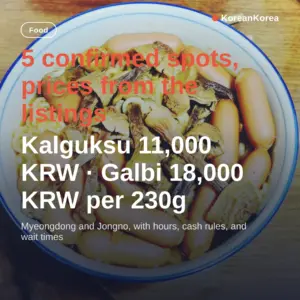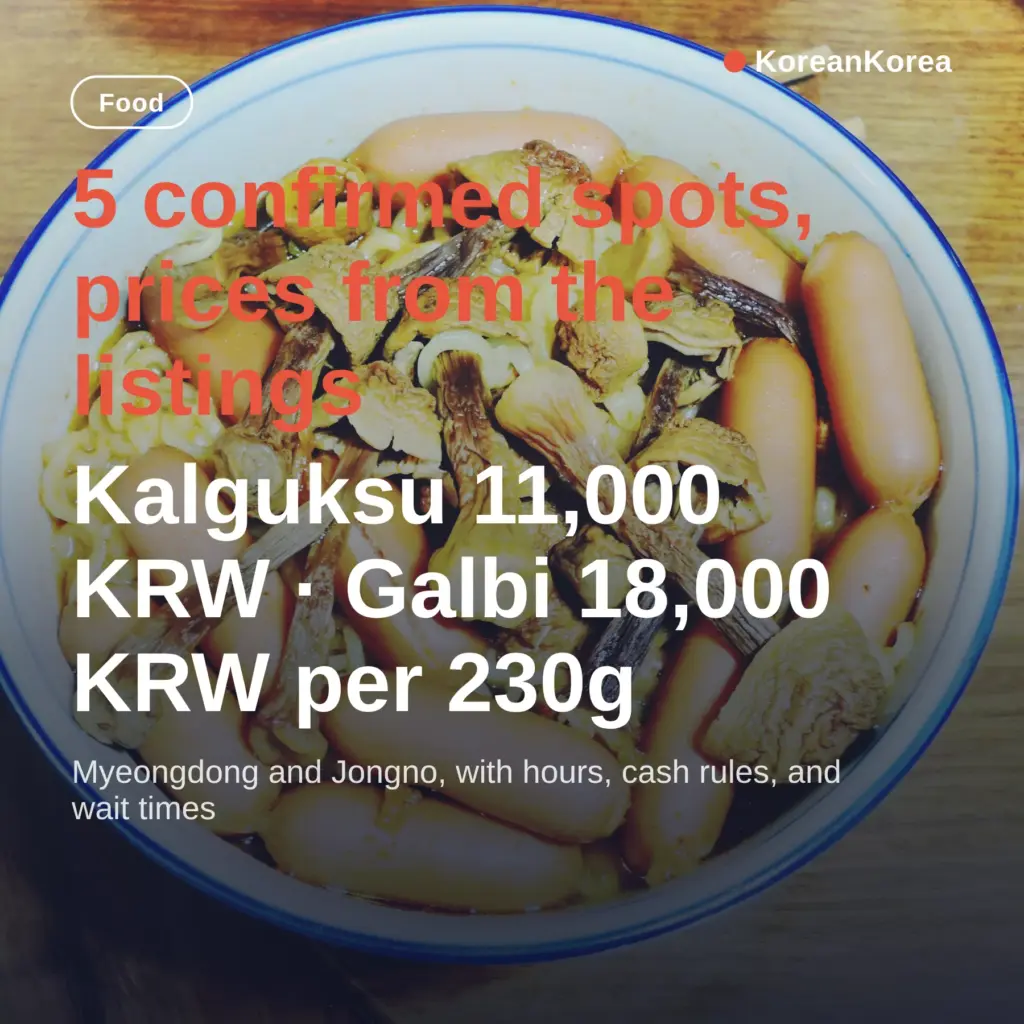
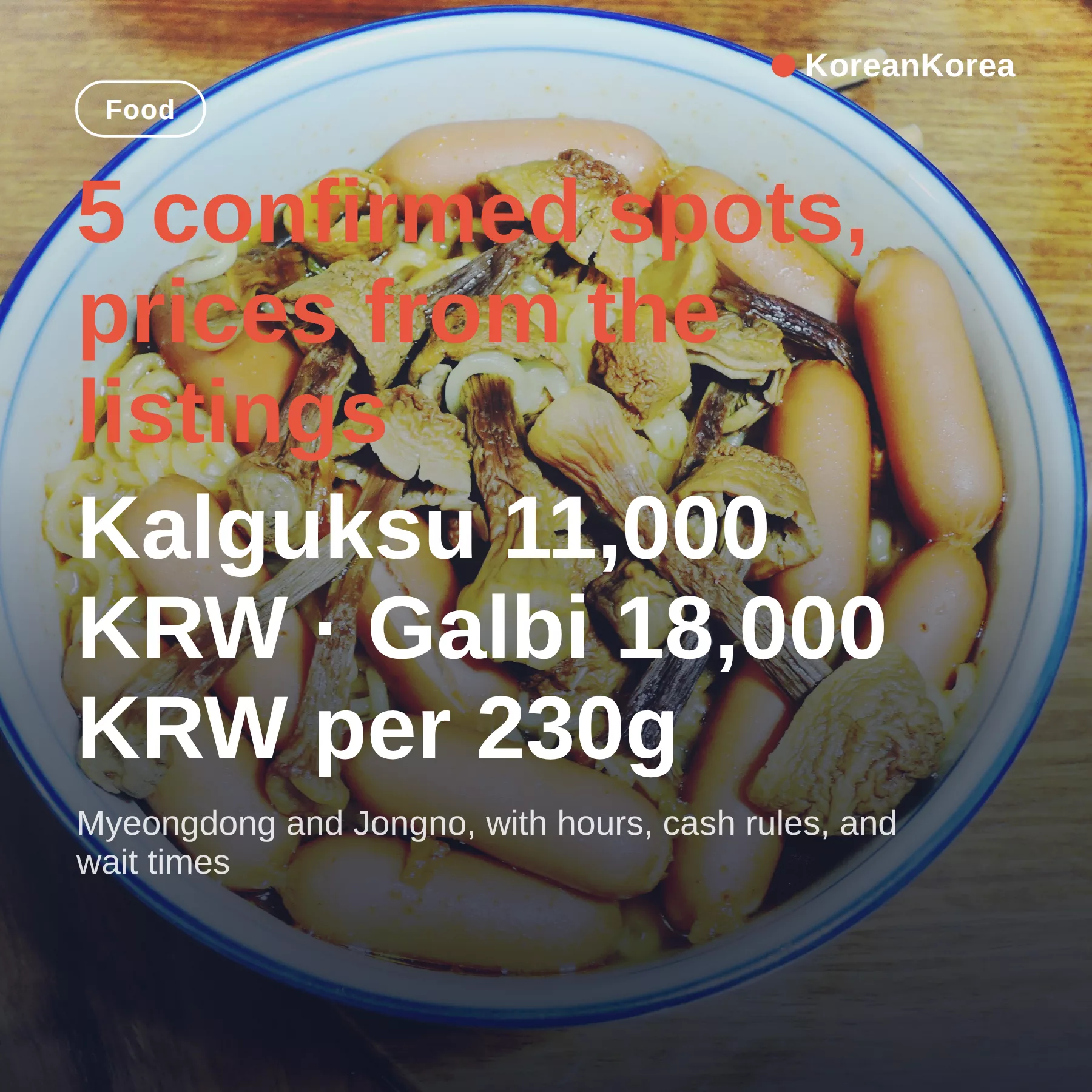
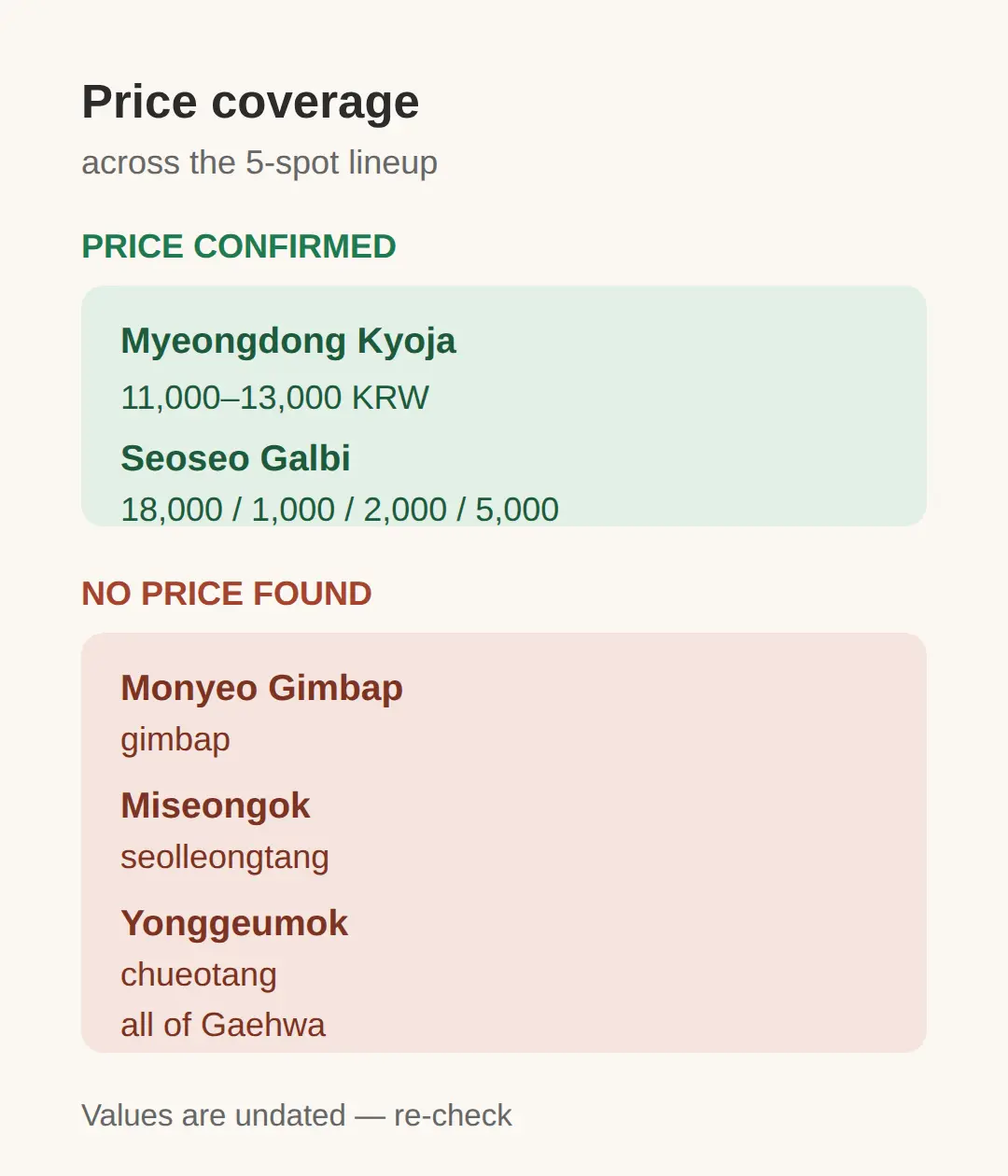
The cheapest confirmed sit-down dish here is Myeongdong Kyoja kalguksu at 11,000 KRW, and the priciest is marinated galbi at 18,000 KRW per 230g serving at Seoseo Galbi.
Every price and hour below comes from a listing, not a dated announcement, so treat each number as current-as-of-the-listing and re-check on the day.
This post gives the dish list, the store-by-store details, and the time windows where you skip the wait.
Contents
- Must eat restaurants in seoul: five spots, kalguksu at 11,000 KRW and galbi at 18,000 KRW
- Myeongdong Kyoja: kalguksu 11,000 KRW and how to skip the line
- Seolleongtang since 1966, unseasoned broth and cash only
- 18,000 KRW buys 230g of galbi — but only if you stand to eat it
- Gwangjang Market gimbap and a 1932 loach soup house
- Before you go: hours to re-check, cash, and the October window
Must eat restaurants in seoul: five spots, kalguksu at 11,000 KRW and galbi at 18,000 KRW
Five spots have confirmed details: Myeongdong Kyoja for kalguksu, Seoseo Galbi for standing-room galbi, Miseongok for seolleongtang, Monyeo Gimbap at Gwangjang Market, and Yonggeumok for loach soup.
The kalguksu at Myeongdong Kyoja is listed at 11,000 KRW and mandu at 13,000 KRW, while Seoseo Galbi charges 18,000 KRW per 230g serving of marinated galbi on its listing.
That works out to a full meal of roughly 21,000 KRW for one person at Seoseo Galbi (galbi plus rice and kimchi) and about 24,000 KRW for two to share kalguksu and mandu at Myeongdong Kyoja.
If budget decides first, start at Myeongdong Kyoja; if the meal itself is the point, Seoseo Galbi is the step up.
| Myeongdong Kyoja (kalguksu) | 11,000 |
|---|---|
| Myeongdong Kyoja (mandu) | 13,000 |
| Seoseo Galbi (marinated galbi, 230g per person) | 18,000 |
| Seoseo Galbi (hatban rice) | 1,000 |
| Seoseo Galbi (pack kimchi / beer) | 2,000 / 5,000 |
| Miseongok (seolleongtang) | Price not in the listing |
| Monyeo Gimbap (Gwangjang Market) | Price not in the listing |
Myeongdong Kyoja: kalguksu 11,000 KRW and how to skip the line
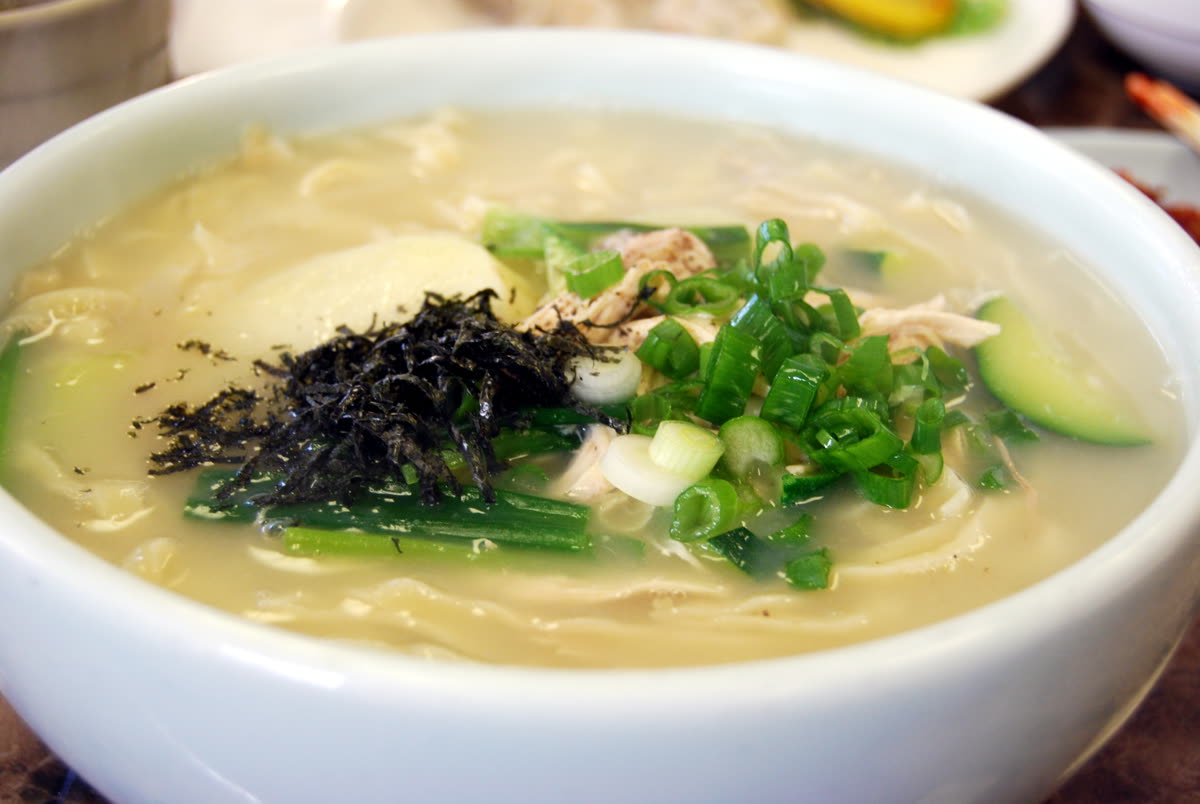
Kalguksu (knife-cut noodle soup) is listed at 11,000 KRW, mandu at 13,000 KRW, and bibim guksu also 11,000 KRW on the Siksin listing, with hours 10:30–21:00 daily.
The store is a kalguksu and dumpling specialist: broth-rich noodles boiled through rather than chewy, and bite-sized dumplings with thin skin and juicy filling.
Groups of 5–6 or more get guided to a separate annex section and seated easily, while small parties queue downstairs, and rice refills are unlimited.
If you are a group of five or more, ask for the group section on arrival; if you are alone or a couple, expect the downstairs line and time your visit off-peak.
Seolleongtang since 1966, unseasoned broth and cash only
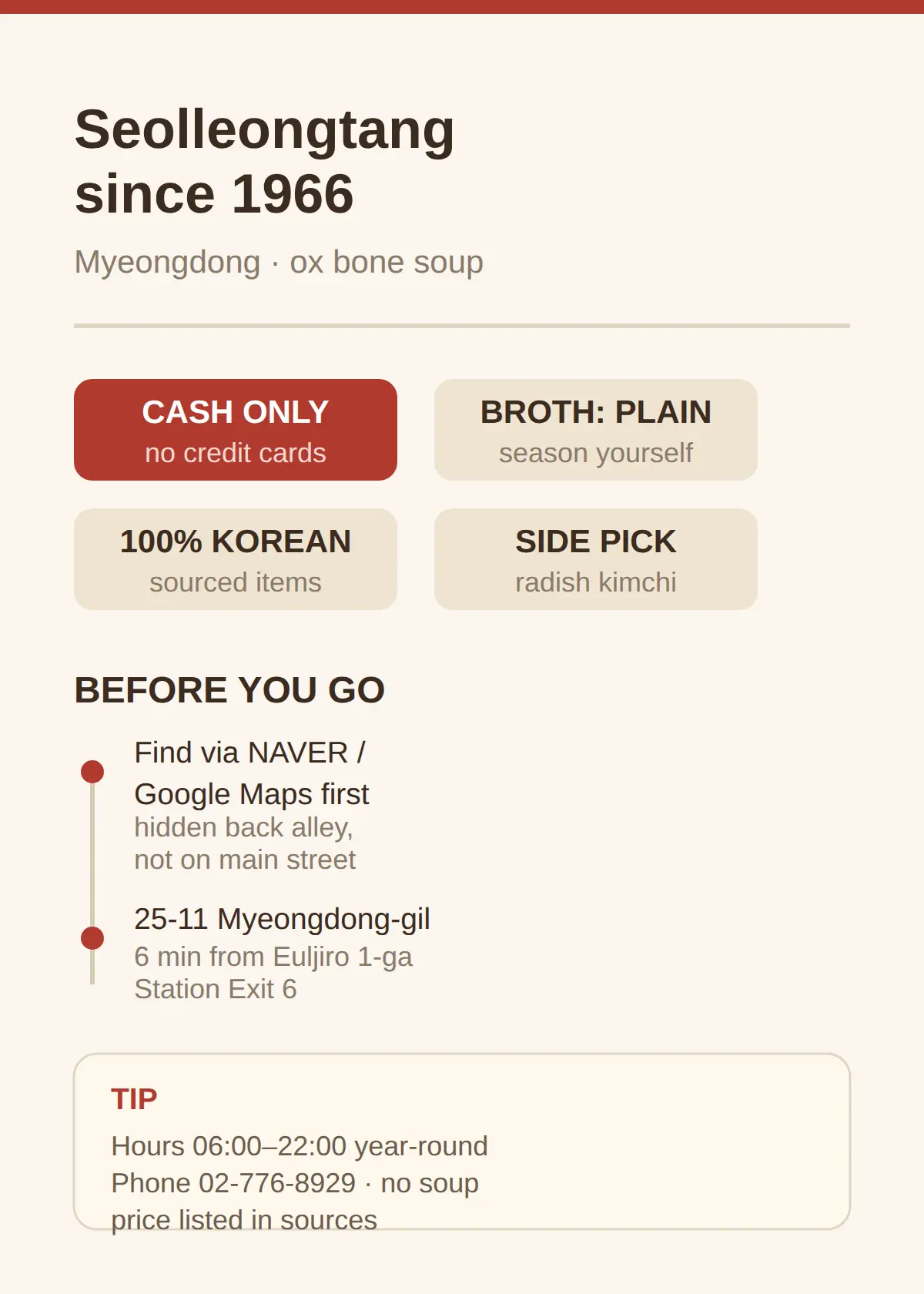
Miseongok is a seolleongtang (ox bone soup) house in Myeongdong operating since 1966, and it accepts no credit cards.
The broth uses 100 percent Korean-sourced ingredients and arrives unseasoned, with salt and pepper on the table so you season it yourself; the kimchi, especially the radish kimchi, is the side reviewers single out.
The entrance is hidden in a back alley and not visible from the main street, so search NAVER or Google Maps before you go (25-11 Myeongdong-gil, 6 minutes from Euljiro 1-ga Station Exit 6; listed hours 06:00–22:00 year-round; phone 02-776-8929).
If you carry no cash in Myeongdong, withdraw first or pick another spot — the soup itself is on the menu, but its price was not in the sources for this post.
18,000 KRW buys 230g of galbi — but only if you stand to eat it
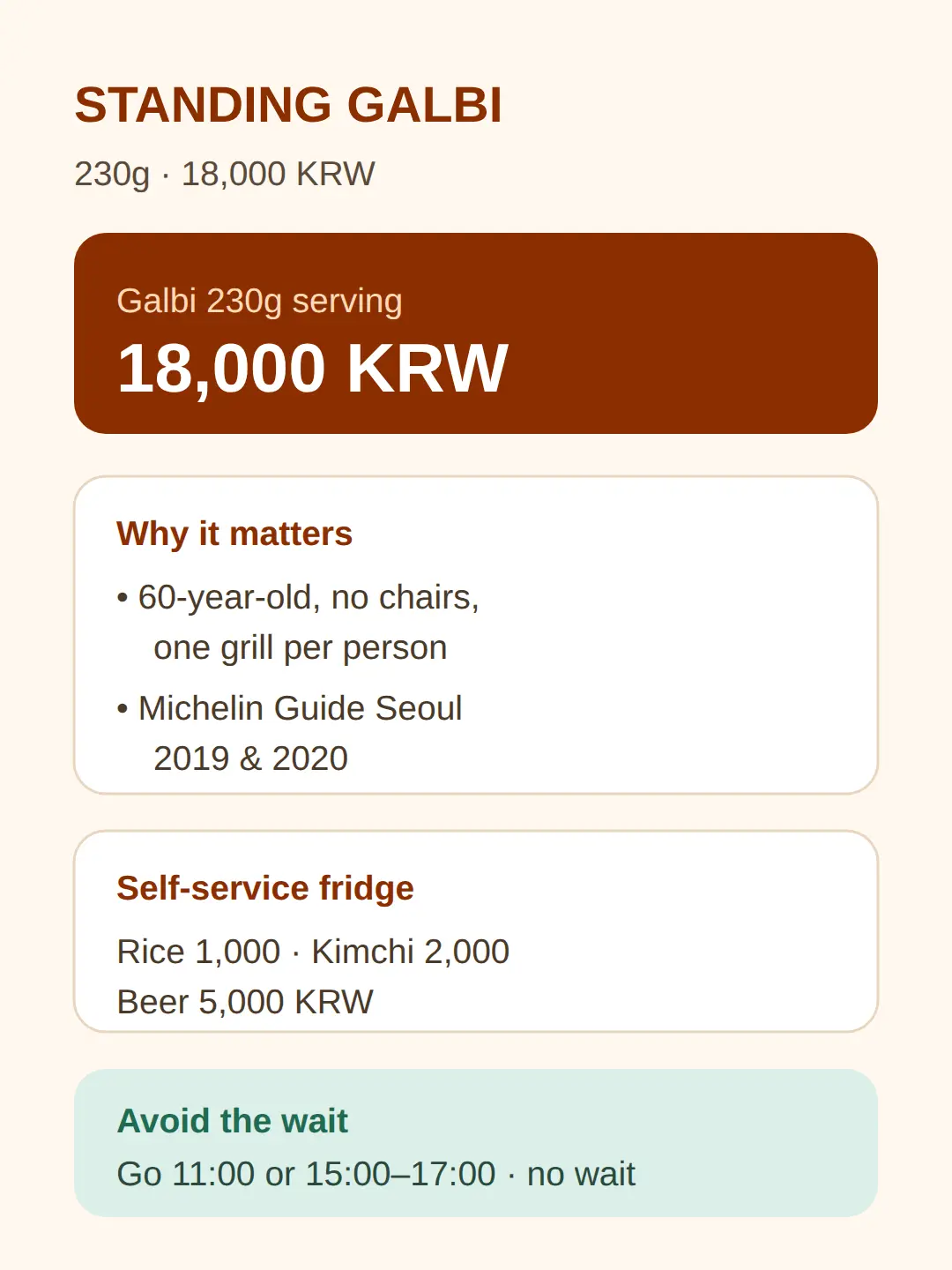
Marinated galbi costs 18,000 KRW per 230g serving, and the rule of the house is one grill per person, ordered by headcount.
It is a 60-year-old standing (no chairs) galbi joint with a single menu, listed in the Michelin Guide Seoul 2019 and 2020; the meat is Korean beef bone-in galbi blended with imported shoulder, grilled on a drum, and dipped alternately in warm garlic sauce and sweet-savory soy.
Rice (hatban 1,000 KRW), pack kimchi (2,000 KRW), and beer (5,000 KRW) sit in a self-service fridge, you pay once after the meal, and outside food is allowed.
The blue door sits one block inside from Myeongdong main street behind the Apple Store, and first-timers miss it — 1 minute from Euljiro 1-ga Station Exit 6, no parking.
If your only free window is a weekday 18:00–21:00, expect a 30–60 minute wait; go at the 11:00 opening or 15:00–17:00 instead and the wait is nearly zero.
Gwangjang Market gimbap and a 1932 loach soup house
Monyeo Gimbap is the original gimbap of Gwangjang Market — carrot and danmuji pickle only, eaten dipped in mustard (gyeoja) sauce — and Yonggeumok, opened in 1932, is Seoul’s third-oldest restaurant and a Michelin Bib Gourmand loach soup house.
Monyeo Gimbap has rolled gimbap for over 40 years and runs two locations: one at the market edge, one in the center, with the first 99 meters from Jongno 5-ga Station Exit 7 (403-23 Dongho-ro; listed hours 09:00–21:00, closed public holidays; 02-2273-8330).
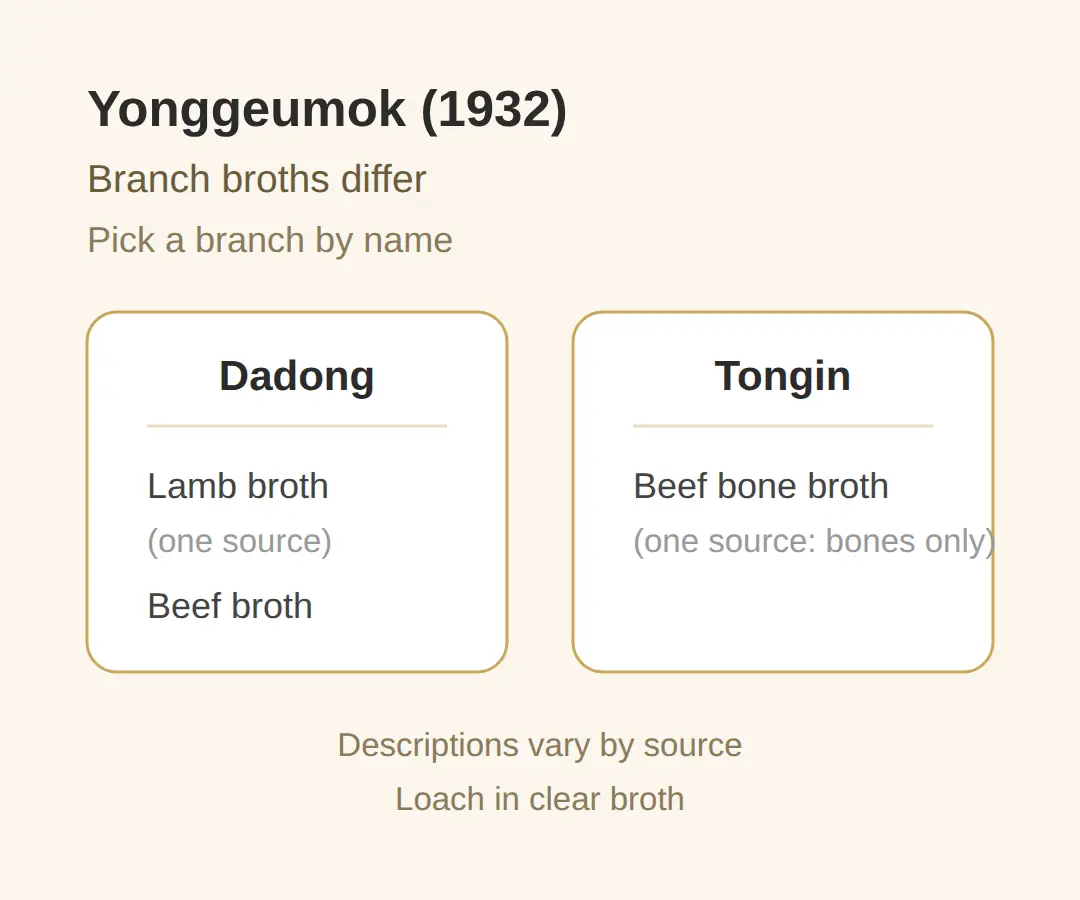
Yonggeumok serves Seoul-style chueotang — whole soft-boned loach, not paste, in clear beef broth with tofu, mushrooms, and noodles — and predates Miseongok by 34 years (1932 versus 1966, so 94 and 60 years running as of 2026); it has two branches, Dadong and Tongin, and sources describe their broths differently, so pick a branch by name rather than trusting one merged description.
If you want a market snack rather than a full meal, Monyeo Gimbap is the stop; if you want history with the meal, Yonggeumok or Miseongok — and note neither spot’s soup price appears in the listings here.
Before you go: hours to re-check, cash, and the October window
Re-verify every price and hour on the day you visit, because all of them come from listings without a date on this pass.
- Check the price and hours on NAVER or Google Maps the morning of your visit — the listing values here (kalguksu 11,000 KRW, galbi 18,000 KRW, all opening hours) are undated.
- Bring cash for Miseongok — no credit cards.
- Do not plan on parking — only Seoseo Galbi states it explicitly (none), and none of the others has confirmed parking.
- Save the map pin in advance for Miseongok and Seoseo Galbi — both entrances are easy to miss from the main street.
Around October 1, 2026, the autumn travel peak after the Chuseok holiday is expected to push Seoul restaurant searches, so locking in weekday off-peak slots (Seoseo Galbi at 11:00 or 15:00–17:00) matters more that week.
If a trip is close, pick the two Myeongdong spots plus Gwangjang Market as a single-day route — all are within short subway walks of each other.
If it were my call, I would go to Seoseo Galbi at 11:00 on a weekday first — the price per 230g is fixed either way, and the turnover is about 30 minutes at lunch, so the early slot is the only wait I can actually control.
And the first thing I check before any of these is the opening hour on the listing that morning, because every hour in this post is undated.
Related posts
📎 Seoul — everything we know
📎 📅 다가오는 일정 — 발매·개봉·발표 캘린더
Sources
- Monyeo Gimbap: carrot+danmuji filling, mustard sauce, daily (korean.visitseoul.net)
- Galbi 18,000 KRW per 230g; 11:00-24:00; wait patterns by tim (awesomble.com)
- 3rd-gen Chinese, 52-5 Namdaemun-ro, closed Sat weeks 1-4, un (korean.visitseoul.net)
Which spot fits which trip
- Confirm the kalguksu 11,000 KRW price on NAVER or Google Maps the morning you go — listing values here are undated.
- Groups of 5–6 at Myeongdong Kyoja get seated in a separate annex section, so bigger parties may actually skip the longest line.
- Aim for Seoseo Galbi at 11:00 opening or 15:00–17:00 on a weekday; 18:00–21:00 means a 30–60 minute wait.
- Carry cash for Miseongok — no credit cards accepted, and the broth is self-seasoned with table salt and pepper.
- Pair history with the meal: Yonggeumok opened in 1932, Miseongok in 1966.
FAQ
Q. How much does a meal at the must eat restaurants in Seoul on this list cost?
Confirmed dishes run from 11,000 KRW (Myeongdong Kyoja kalguksu) to 18,000 KRW per 230g serving (Seoseo Galbi). Gimbap at Monyeo Gimbap and the soups at Miseongok and Yonggeumok have no price in the listings checked.
Q. Is Seoseo Galbi worth the wait in Myeongdong?
The wait depends on the clock: weekday 18:00–21:00 means 30–60 minutes, while the 11:00 opening and 15:00–17:00 have nearly none. Going at opening is the easy answer.
Q. Do Myeongdong restaurants take credit cards?
Myeongdong Kyoja and Seoseo Galbi listings do not flag card problems, but Miseongok accepts no credit cards at all — cash only.
Q. What is the oldest must eat restaurant in Seoul on this list?
Yonggeumok, opened in 1932 and run by the same family for three generations — 34 years older than Miseongok, which dates to 1966.
Q. Where is Monyeo Gimbap at Gwangjang Market?
It has two locations: one at the edge of the market and one in the center. The first is 99 meters from Jongno 5-ga Station Line 1, Exit 7, at 403-23 Dongho-ro, Jongno-gu.
Mark October 1, 2026 on the calendar — the post-Chuseok autumn travel peak is expected to push Seoul restaurant searches, so plan weekday off-peak visits first.
Cover photo: Korean noodle soup with mushroom and sausages by Apeach316 — CC BY-SA 2.0
#musteatrestaurantsinseoul #seoulfood #myeongdong #gwangjangmarket #kalguksu #seolleongtang #koreanbbq
📅Upcoming Dates — 이번 주 19 · D-2 Final two episodes drop on Disney+/Hulu전체 보기 →