

Ganjang gejang — raw crab soaked in boiled-then-cooled soy sauce — keeps 1-2 weeks in the fridge if the crab stays fully submerged, and it tastes best within the first 3-5 days.
Contents
- Ganjang gejang recipe: shelf life of 1-2 weeks, best in 3-5 days
- Re-boiling the soy marinade: when and how
- The recipe: 2:1 ratio, ingredients, and steps for a first-timer
- Is raw soy-marinated crab safe? Vibrio, freezing, and what boiling does
- Which crab to buy and what it costs
- How to eat it, store leftovers, and where it came from
Ganjang gejang recipe: shelf life of 1-2 weeks, best in 3-5 days
Refrigerated ganjang gejang keeps 1-2 weeks with the crab fully submerged in the soy marinade.
One recipe source puts the best-eating window shorter, at 3-5 days from the day it is made.
The 1-2 week figure is a safety limit, not a flavor one.
The first ripening takes 1-2 days in the fridge, the flavor deepens further at day 3-4, and then quality falls before safety does.
So the honest answer is two numbers: aim for the 3-5 day window for taste, and treat 2 weeks as the ceiling.
When a recipe gives a fridge life, I check whether it also says the re-boil step — that is where home cooks outside Korea get burned.
If you plan to keep it past a week, the re-boil below is what makes that possible.
| Day 0 | Clean and dry the crab, pack it belly-up, pour fully cooled marinade until it is submerged, refrigerate |
|---|---|
| Day 1-2 | First ripening done — it is edible; you can also re-boil the marinade, cool it, and pour it back |
| Day 3-4 | The flavor deepens further; the traditional method serves it only after about 2 weeks |
| Day 3-5 | Conservative best-quality window ends |
| Up to day 14 | Safe refrigerated limit if the crab stays submerged and the marinade was re-boiled |
Re-boiling the soy marinade: when and how
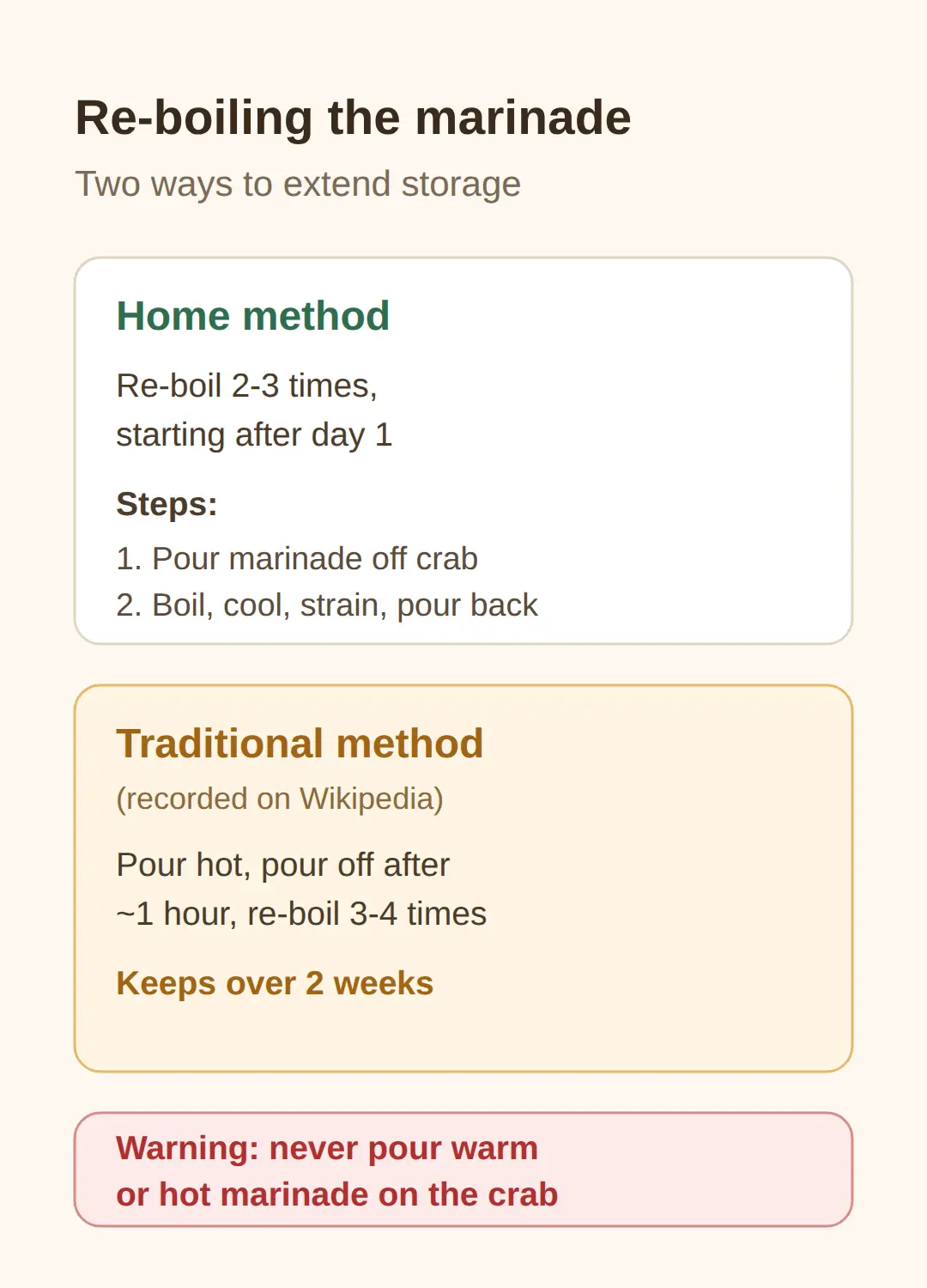
You can re-boil the soy marinade to extend storage past 2 weeks, and yes — cool it completely before it touches the crab again.
After the first day, pour the marinade off the crab and leave the crab in the container.
Boil the marinade, let it cool completely, strain it, and pour it back.
Repeat 2-3 times.
A traditional method, recorded on Wikipedia’s gejang page, works differently: pour the marinade on hot, pour it off after about 1 hour, re-boil, and re-pour — 3-4 times in total.
With that boiling method the gejang keeps over 2 weeks.
One warning above all the rest: never pour warm or hot marinade on the crab.
The flesh cooks and loses the chewy texture that is the whole point.
The recipe: 2:1 ratio, ingredients, and steps for a first-timer
The working ratio is 2 parts soy sauce to 1 part water, and two independent recipes land on exactly that.
Baek Jong-won’s style is 2 cups soy sauce to 1 cup water for 2 crabs; a home-cook volume version uses 800ml water, 400ml soy, and 200ml sugar for 5 crabs.
For 2 crabs, you need soy sauce 2 cups, water 1 cup, cheongju (rice wine) 1/2 cup, sugar 3 tbsp, 1 green onion, 5 garlic cloves, 1 knob of ginger, 2 cheongyang chilies, and half an onion.
If you simmer apple, onion, or jujube into the brine, cut the added sugar to roughly half (about 100-150ml per 800ml water).
Use a commercial brewed soy sauce (jin ganjang) rather than home-fermented one.
Steps:
- Scrub the crabs with a brush under cold running water, lift the belly flap to clean inside, and remove the sand pouch and gills without bursting the pouch.
- Pat the crabs fully dry with paper towel — drying is the step that cuts the fishy smell.
- Simmer the marinade on medium heat for about 1 hour, then strain it through a fine sieve for a clear brine.
- Let the marinade cool completely.
- Pack the crabs belly-up in an airtight container so the marinade reaches everywhere.
- Pour the cooled, strained marinade until the crabs are fully submerged, and refrigerate.
Is raw soy-marinated crab safe? Vibrio, freezing, and what boiling does
Soy-marinating alone does not fully kill Vibrio bacteria in raw crab, so boil the marinade and add freezing, rinsing, and acid on top.
Boiling the soy sauce before marinating does four jobs: sterilization, removing the fishy smell, deepening the flavor, and extending shelf life.
Raw soy sauce poured straight on risks bacterial growth.
The full safety stack from Korean sources is freeze or keep it cold to stop Vibrio growth, rinse the crab in fresh water, and add a bit of lemon or vinegar.
Many specialty shops now use flash-frozen (seon-dong) crab for exactly this reason, and it is an acceptable choice at home too.
Note the limit: these sources are Korean, not US-style food-safety guidance for raw seafood.
If you are pregnant, elderly, or immunocompromised, apply the stricter rule you would for any raw-marinated seafood.
Which crab to buy and what it costs
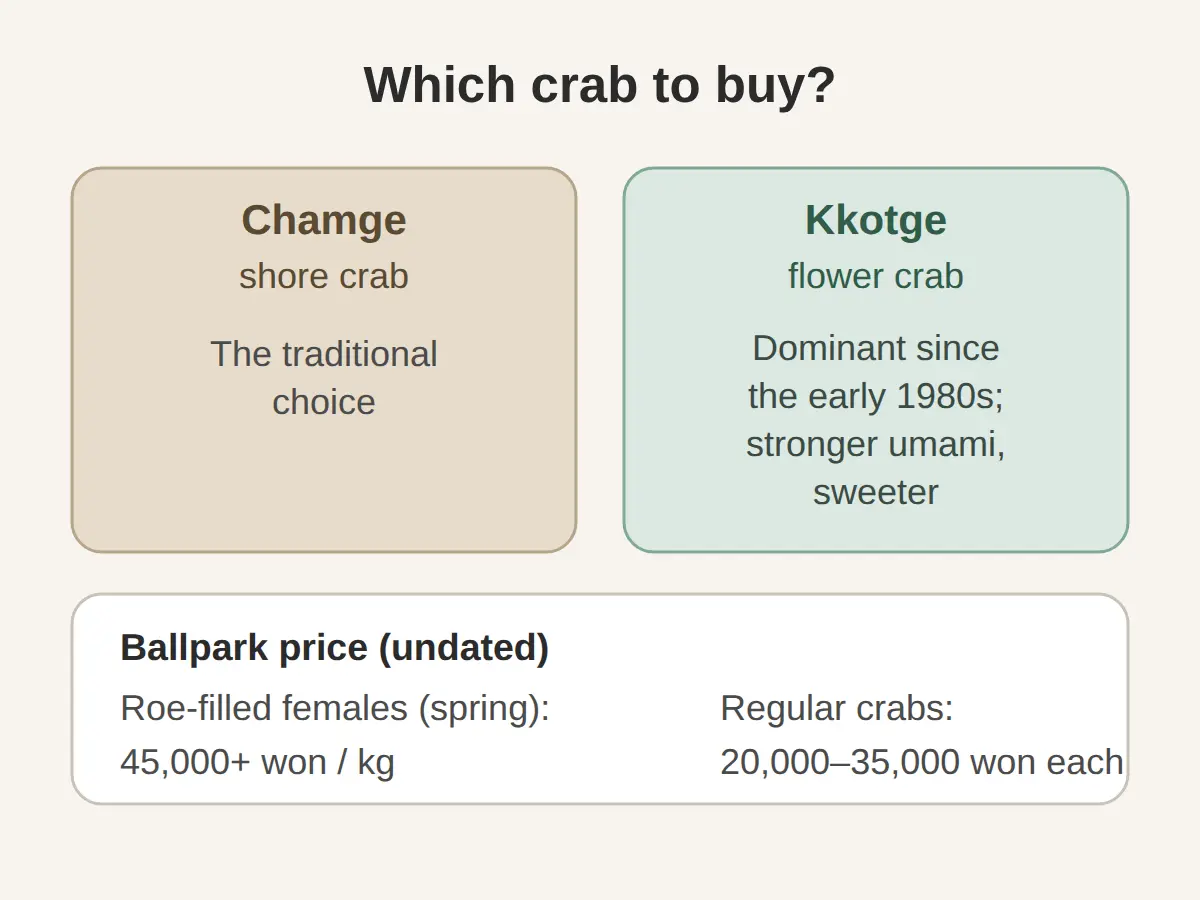
Traditionally ganjang gejang uses chamge (the shore crab), but today most versions use kkotge (flower crab), which has stronger savory depth and sweetness.
The switch happened in the early-to-mid 1980s, when freshwater crab habitats shrank through land reclamation and dams and parasite concerns grew — so it was pushed by supply and safety, not only taste.
Stone crab and blue crab are also used.
For the roe, look for female crabs and press the belly flap (baetjjakji): a firm feel means a full, meaty crab.
On price, the figures circulating on Korean community wikis — spring roe-filled females quoted at 45,000+ won per kilogram and regular crabs around 20,000-35,000 won each — are undated, so read them as a ballpark rather than a current quote.
Check a live market listing or a Korean grocery the week you buy.
How to eat it, store leftovers, and where it came from
Serve it cold over hot rice: mix the roe and innards into the shell with rice plus a spoon of the marinade, and finish with sesame oil, sesame seeds, or a seaweed wrap.
When you eat a whole crab, lift out the sand pocket inside the shell carefully without bursting it — bursting it ruins the taste.
Take only what you will eat out of the container and keep the rest submerged.
Leftovers can be portioned and frozen, then thawed in the fridge; the sources do not give a verified day count for freezer storage, so I would not plan on more than a few weeks.
The dish goes back centuries: a late-17th-century cookbook records crab pickled in liquor lees with salt, and a Joseon-era cookbook lists alcohol, vinegar-paste, and boiled-salt-water methods — the spicier gochugaru version only appeared after the Korean War.
👉 the original ganjang gejang entry on Namuwiki with history and ratios
👉 a step-by-step ganjang gejang recipe with the 2:1 soy sauce ratio
👉 another ganjang gejang recipe with simmering times and eating tips
Related posts
Sources
- Namuwiki: 4:2:1 ratio, Vibrio safety stack, seon-dong crab p (namu.wiki)
- Full method with 1-2 week fridge life and re-boil rule (cook (cookpick.kr)
- FoodCraft recipe: 1-hour simmer, 48h ripening, 3-5 day best (foodcraft.app)
Reader situations: what to do in each case
- Eat it within 3-5 days of making — that is the best-quality window even though the safe maximum is longer.
- To last past 2 weeks: pour off the marinade alone, boil it again, cool it completely, and pour it back; repeat 2-3 times.
- Wait until the boiled marinade is completely cooled before pouring, or the crab flesh cooks and the texture is gone.
- Boiling the marinade plus freezing, a fresh-water rinse, and a little lemon or vinegar covers the Vibrio risk that soy marinating alone does not.
- Flash-frozen (seon-dong) crab is fine when live crab is unavailable; avoid crab that has been dead for hours.
- Remove the sand pocket inside the shell carefully without bursting it — bursting it ruins the taste.
- Use cheongyang chili sparingly or skip it — too much ruins the soy sauce flavor.
FAQ
Q. How long does ganjang gejang keep in the fridge?
1-2 weeks refrigerated if the crab stays fully submerged, with best quality in the first 3-5 days.
Q. Can I re-boil the soy marinade to store ganjang gejang longer?
Yes — pour the marinade off, boil it, cool it completely, and pour it back; this is the stated method for storage past 2 weeks.
Q. Why boil the soy sauce before marinating raw crab?
It sterilizes the sauce, removes the fishy smell, deepens flavor, and extends shelf life.
Q. Is it safe to eat raw soy-marinated crab? What about Vibrio?
Soy marinating alone does not fully kill Vibrio — the standard stack is boiling the marinade plus freezing or cold storage, rinsing in fresh water, and a little acid like lemon or vinegar.
Q. What ratio of soy sauce to water should I use for ganjang gejang?
2 parts soy sauce to 1 part water — both Baek-style cups (2:1) and the home volume version (400ml soy to 800ml water) land on the same ratio.
Korean Food Foundation recipes for more classic dishes
Cover photo: Ganjang-gejang by Jens Ohlig — CC BY-SA 2.0
#ganjanggejang #koreanrecipe #rawcrab #soymarinatedcrab #koreanfood #bapdoduk #ricethief #koreancookingathome
📅Upcoming Dates — 이번 주 19 · D-2 Final two episodes drop on Disney+/Hulu전체 보기 →