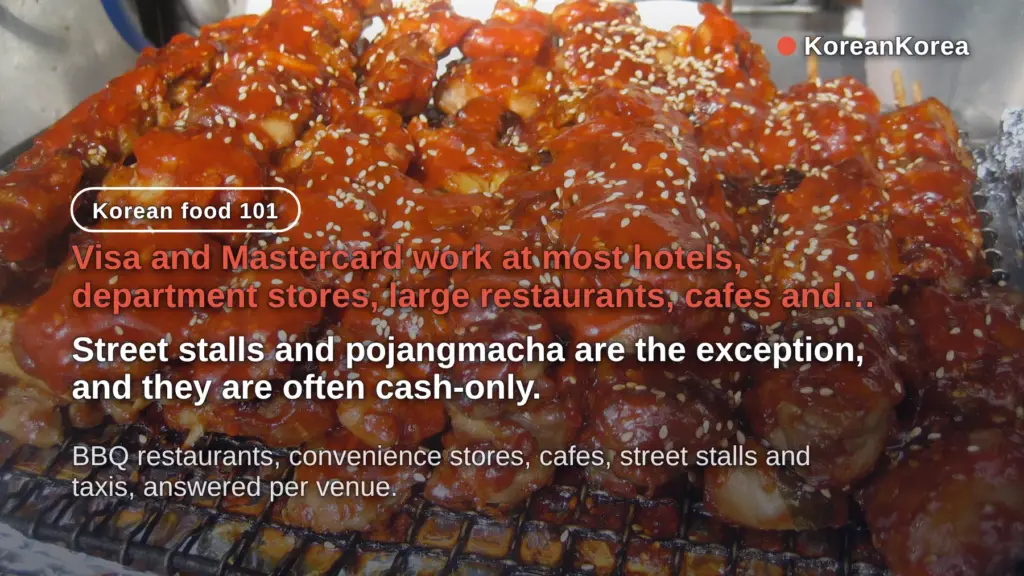
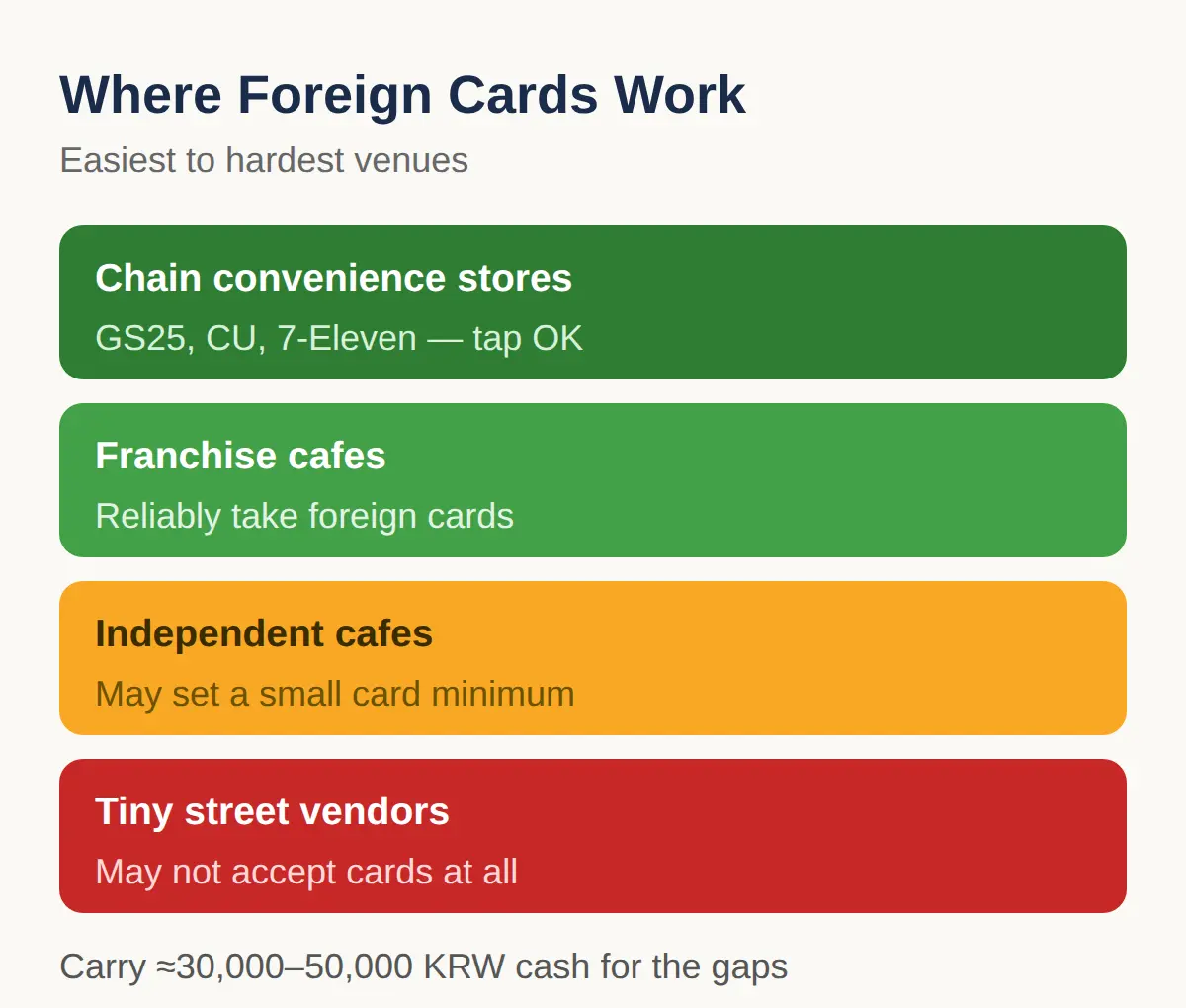
Credit and debit cards with Visa or Mastercard are accepted at most hotels, department stores, large restaurants, cafes and chain convenience stores in Korea as of 2026.
Street stalls and pojangmacha are the exception — they are frequently cash-only, so a short trip needs both a card and a small amount of won.
This post answers where foreign cards work by venue type, how the BBQ 2-serving rule and the table call button change ordering, how much cash to carry, and what to fall back on when a card is turned away.
Can You Pay With a Foreign Card in Korea? The Short Answer
| Hotel, department store | Yes |
|---|---|
| Large restaurant, Korean BBQ | Yes — expect the 2-servings-per-meat minimum |
| Franchise cafe, chain convenience store (GS25, CU, 7-Eleven) | Yes — tap to pay |
| Independent cafe | Usually yes — a small card minimum is possible |
| Traditional market stall | Mixed — assume cash first |
| Street stall, pojangmacha | Often cash-only — pay per skewer or dish |
Yes — cards with Visa or Mastercard are accepted at most hotels, department stores, large restaurants, cafes and chain convenience stores in Korea, according to 2026 first-timer food guides.
Street stalls and pojangmacha are the opposite case, and they are frequently cash-only.
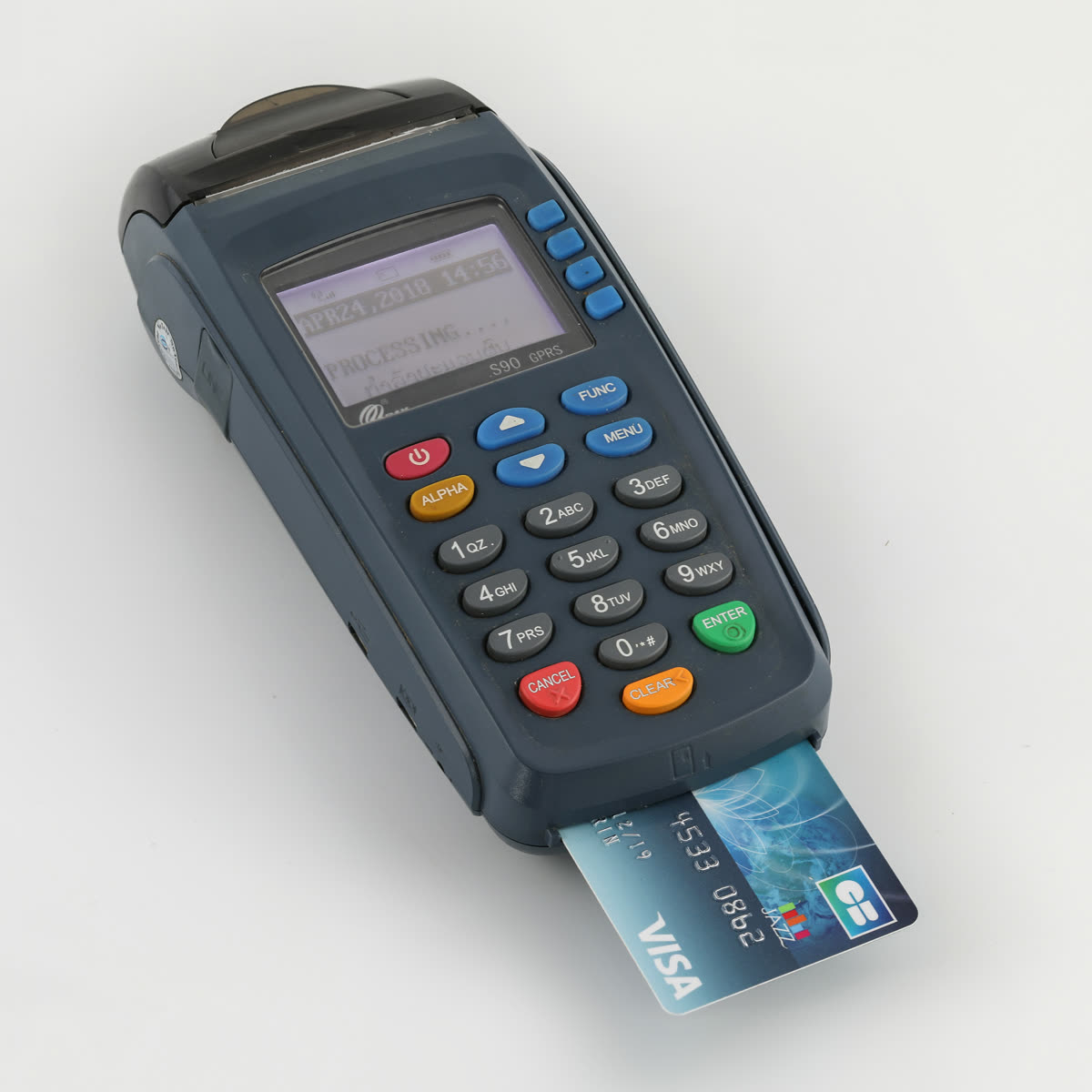
Korean card terminals support IC chip insertion and contactless tap, so an internationally enabled card is all you need at a working terminal.
A card issued only for domestic use in your home country is the one that fails here, so check that yours carries the Visa, Mastercard or Amex mark.
There is no legal minimum card charge in Korea, and stores may not refuse a card below an amount — a tiny vendor may simply not take cards at all.
Before each meal, I check what kind of place it is — chain store, BBQ restaurant or market stall — because that decides card or cash more than the card itself.
If the day includes a market or street food, carry cash for it and use the card everywhere else.
Ordering at Korean BBQ: Card Yes, 2 Servings Minimum
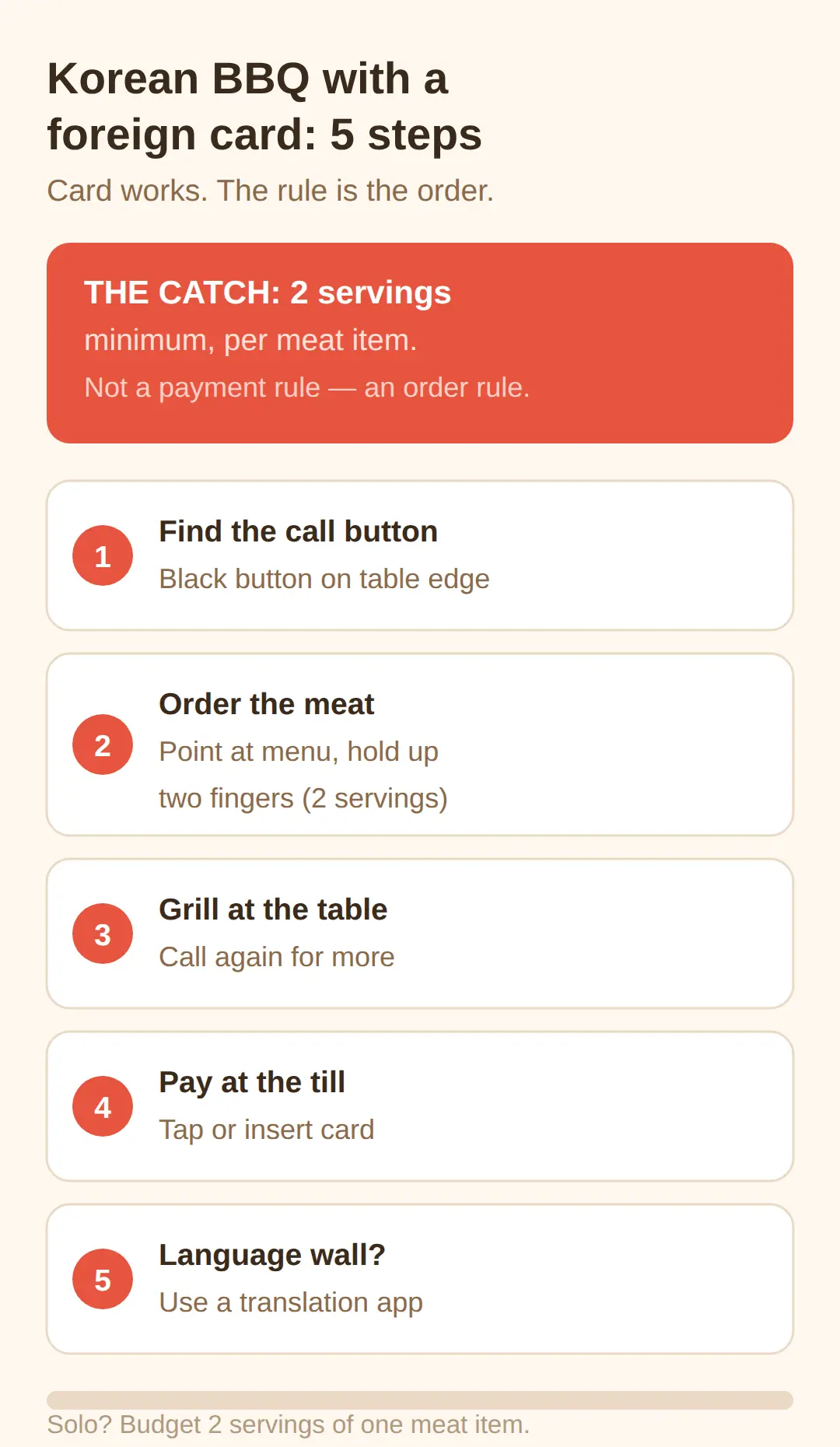
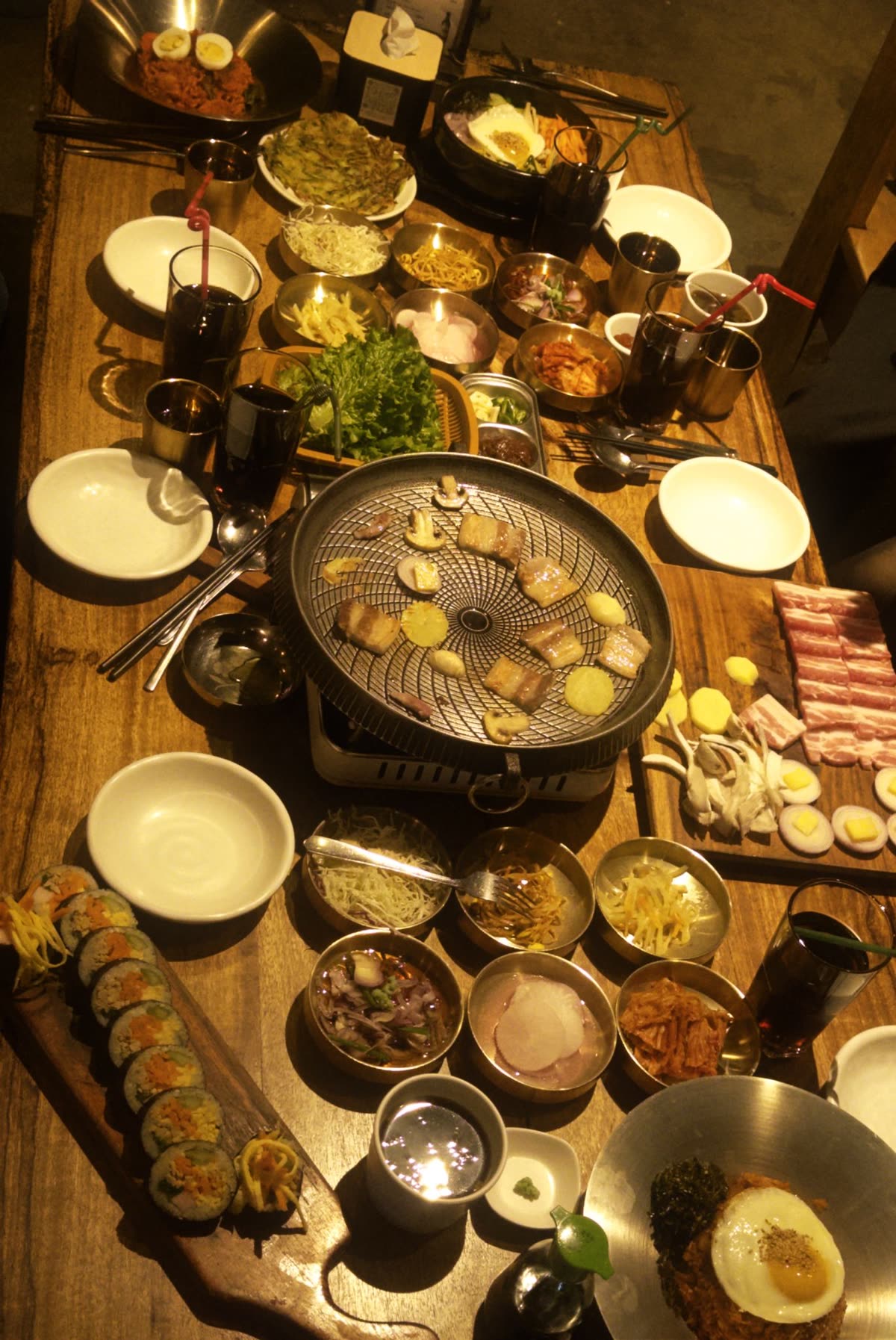
Your foreign card works at Korean BBQ restaurants, but the order rule is the thing that catches visitors.
| Question | Answer |
|---|---|
| Does the card work? | Yes — Visa/Mastercard are accepted; the card is not the problem |
| What’s the catch? | Many Korean BBQ restaurants enforce a 2-servings-minimum order rule (per meat item) |
| What is one serving? | One serving (il-in-bun) is sized for one person; the minimum applies per meat item you order |
| How do you order? | Most restaurants use a table call button; menus and ordering are often Korean-first |
| If language becomes a wall? | A translation app at the till is a realistic fallback |
That minimum is an ordering rule, not a payment rule, so paying by card is not the problem — the grill order is.
- Sit down and find the black call button on the table edge.
- Press it, then point at the meat on the menu and hold up two fingers for the 2-serving minimum.
- Grill at the table; press the call button again for more meat, rice or drinks.
- At the till, show the bill and tap or insert your Visa or Mastercard.
- If communication stalls at the till, open a translation app and let the staff read or type into it.
If your group is one person, budget for two servings of one meat item or pick a place with single-portion stews instead.
Do Korean Street Food Stalls Take Cards?
Most street stalls and pojangmacha are cash-only, and traditional market stalls are mixed — some now take cards through QR codes or small card readers, but cash remains the safest assumption.
At a pojangmacha you often pay per piece: point at the skewer or dish, and the amount is settled for each item rather than on one bill.
A declined card at a small stall is a documented situation in 2026 guides — the cash-only pojangmacha till and the small market stall are the two places where a foreign card gets turned away.
That is why the carry rule is small cash in tens of thousands of won, set aside specifically for markets, street food and small eateries.
Two fallbacks cover the cash-only case.
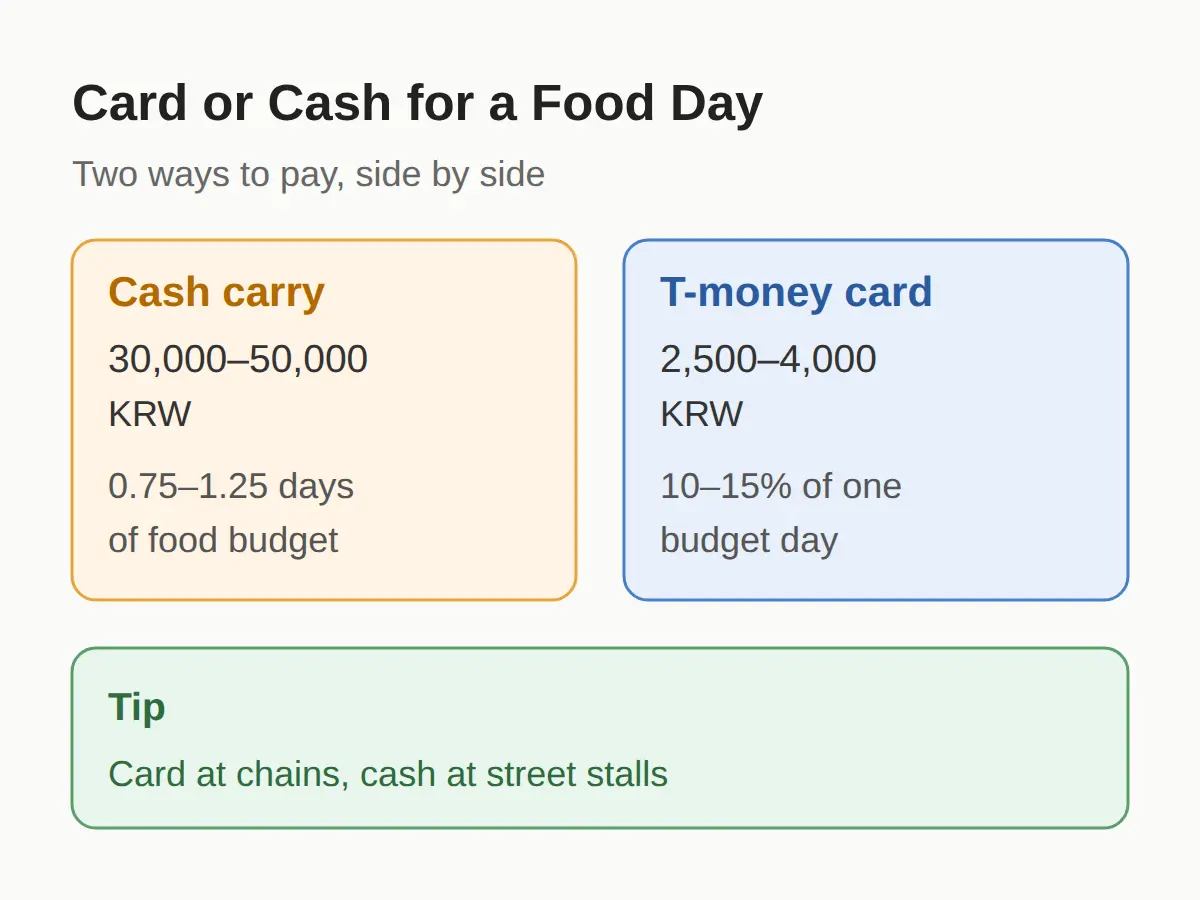
A T-money card, bought at a convenience store or the airport for 2,500–4,000 KRW, works for subway and bus rides and for some purchases, so it can cover small items when a stall is cash-only.
Global ATMs at bank branches, convenience stores and the airport issue KRW to foreign cards, and that is the standard way to get cash mid-trip.
I would carry about 30,000–50,000 won in cash for market days and rely on my card everywhere else, topping up at a Global ATM in a convenience store when it runs low — that covers the cash-only stalls without turning every purchase into a cash hunt.
Convenience Stores and Cafes: The Easiest Places to Pay
GS25, CU, 7-Eleven and other chain convenience stores accept foreign contactless cards with the standard terminal flow, so tapping your card is the easiest payment you will make in Korea.
Cafe and franchise coffee chains are the same — 2026 guides list them as reliably taking foreign cards.
Independent cafes are the one cafe exception: they may set a small card minimum or prefer cash.
The exact minimum amounts per venue were not confirmed in 2026 sources, so a few thousand won in cash covers that case.
Some franchise restaurants and cafes use self-service kiosks, but whether those kiosks accept foreign cards was not confirmed from primary sources — the staffed counter is the safe choice.
If a purchase is under a few thousand won, a chain convenience store is the venue where your card is least likely to be a problem.
Apple Pay in Korea and How Much Cash to Carry
Apple Pay in Korea works only through Hyundai Card, and most other foreign wallets do not work for in-store payment, per 2026 guides.
So plan the trip around a physical card plus cash, not around a phone wallet.
The wallet landscape changes fast, and a current late-2026 list of which wallet services work in-store was not confirmed from a primary page — check with your own card issuer before departure.
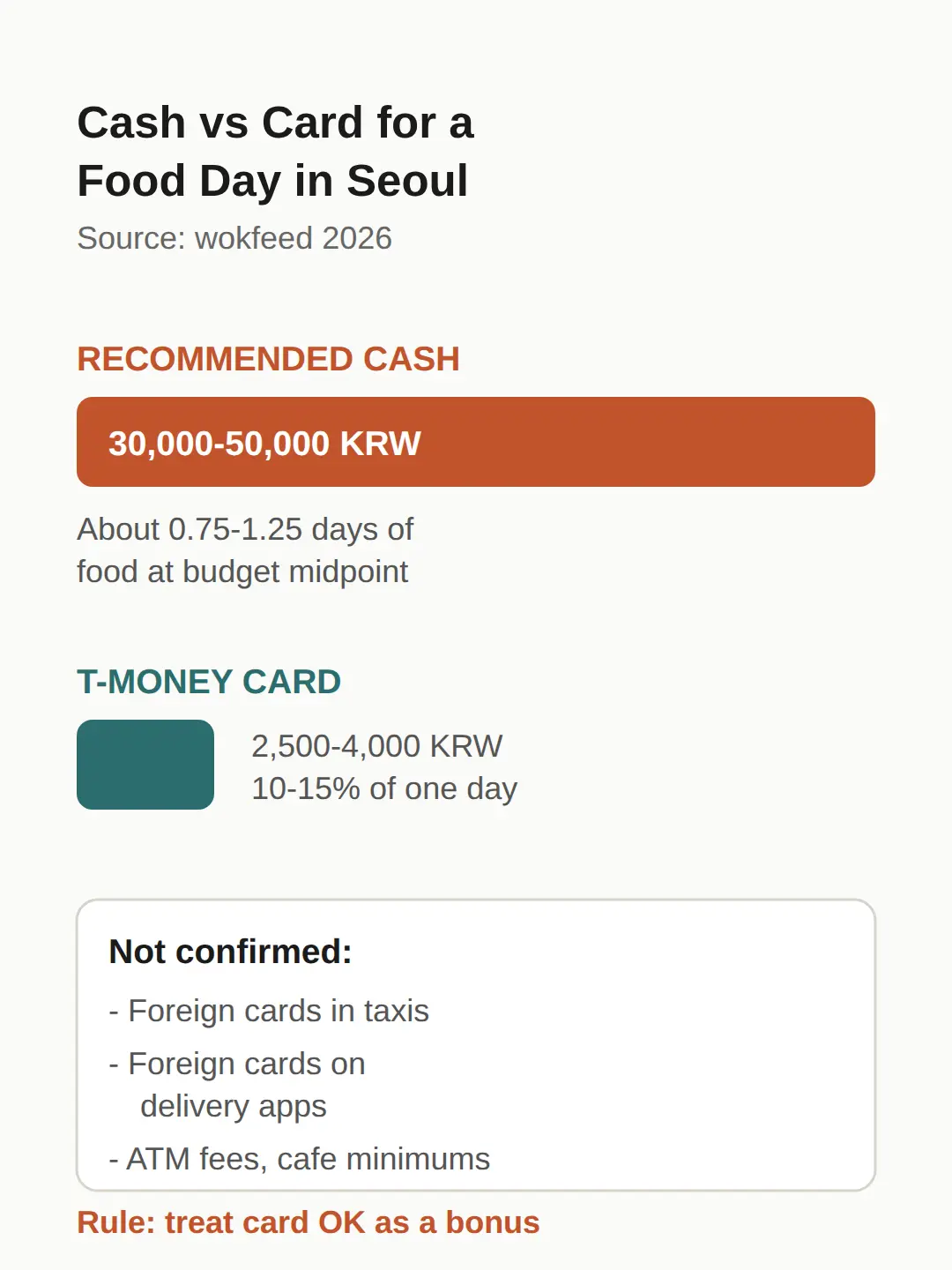
What is settled is the cash amount: 2026 first-timer guides recommend tens of thousands of won, about 30,000–50,000 KRW, for markets, street food and small eateries.
By the 2026 first-timer budget bands, that cash covers roughly 0.75–1.25 days of food at the budget-band midpoint, so one ATM withdrawal early in the trip is enough for the cash-only situations.
A T-money card at 2,500–4,000 KRW is about 10–15% of one budget-band food day, which makes it a cheap second fallback rather than a wallet replacement.
Taxis, Delivery Apps and What Was Not Confirmed
Most Seoul taxis carry card terminals, but whether foreign-issued cards are reliably accepted in taxis was not confirmed in 2026 source materials — if a taxi ride matters, ask before getting in or keep cash ready.
Takeout and delivery app orders for foreign visitors are in the same state: whether your foreign card works on delivery apps could not be verified, so plan to pay in person at the restaurant or store.
Also left out because no primary source confirmed it: the exact card minimum at independent cafes, the share of card-taking vendors in specific markets like Gwangjang or Mangwon, and ATM operator fees for foreign cards.
For all three, the practical move is the same — carry the 30,000–50,000 won cash band and treat every card acceptance outside chains as a pleasant surprise.
Related posts
📎 📅 Upcoming Dates — Release & Event Calendar
Sources
- Most Seoul taxis carry terminals; foreign-card acceptance no (wokfeed.com)
- 2026 guides document BBQ 2-serving minimum, convenience stor (naru365.com)
- post_structure (contents.premium.naver.com)
What to Take Away
- Chains and large restaurants: card, no hesitation.
- Markets and pojangmacha: cash first — carry 30,000–50,000 won.
- T-money card at 2,500–4,000 KRW is the small-purchase fallback.
- Apple Pay works only via Hyundai Card; do not build the trip on phone wallets.
- The BBQ 2-serving minimum is an order rule, not a payment rule.
FAQ
Q. Can I use my credit card in Korean restaurants?
Yes at large restaurants and Korean BBQ places — Visa and Mastercard are accepted there. Small eateries and market stalls are the cash-risk venues.
Q. Do Korean street food stalls take cards?
Pojangmacha and most street stalls are frequently cash-only, and traditional market stalls are mixed. Assume cash and pay per skewer or dish by pointing at what you want.
Q. How much cash should I carry in Korea for food?
2026 first-timer guides recommend tens of thousands of won — about 30,000–50,000 KRW — for markets, street food and small eateries, which is roughly one day of budget eating.
Q. Can I use Apple Pay in Korea?
Apple Pay in Korea works only through Hyundai Card, and most other foreign wallets do not work for in-store payment. Carry a physical card as the default.
Q. How much is a typical meal in South Korea?
2026 first-timer guides give daily food budget bands from budget through mid-range; for the cash-only venues, the 30,000–50,000 KRW carry band covers about a day of budget eating.
none
Cover photo: Korean street food-chicken by john wilbanks — CC BY-SA 2.0
#koreatravel #paymentinkorea #foreigncardkorea #koreanstreetfood #t-moneycard #koreanbbq #koreamoneytips
📅Upcoming Schedule — this week 2 · D-2 Hangul DaySee all →