The price ranges in this guide come from the 2026 brief anchor set rather than confirmed primary sources, so treat every figure here as a starting point to sanity-check on site.
That puts the floor of a one-day, three-meal food budget at ₩10,000, with the BBQ night deciding how high it goes.
This post answers what a typical meal costs, whether food in Korea is actually cheap, and how to keep the daily number down.
How Much Should You Budget for Food in Korea Per Day?
| Convenience store meal (samgak gimbap, dosirak, onigiri) | ₩1,300–5,500 per item; a full store meal under ₩8,000 |
|---|---|
| Street food lunch (tteokbokki, hotteok, gimbap) | from about ₩3,000 per item |
| Korean BBQ dinner | up to about ₩30,000 |
| Daily minimum, 3 meals | ₩10,000 |
Plan at least ₩10,000 per day for three meals in Korea, based on 2026 anchor prices.
| Meal slot | Typical option | Price range |
|---|---|---|
| Breakfast | Convenience store meal | under ₩8,000 for a full store meal |
| Lunch | Street food (tteokbokki, hotteok, gimbap) | from about ₩3,000 per item |
| Dinner | Korean BBQ | up to about ₩30,000 per person |
| Daily floor | Three meals without BBQ | ₩10,000 |
The per-meal ranges meet in the middle, which is why ₩10,000 works as a floor.
The one thing that can push a day past ₩10,000 is Korean BBQ, which runs up to about ₩30,000 per person.
If your itinerary has a BBQ night, budget that day around the ₩30,000 dinner and hold the other two meals at store prices.
On days without BBQ, ₩10,000 is a realistic floor rather than a stretch goal.
How Much Is a Typical Meal in South Korea?
The typical price depends on which of the three meals you are buying, and each sits in its own band.
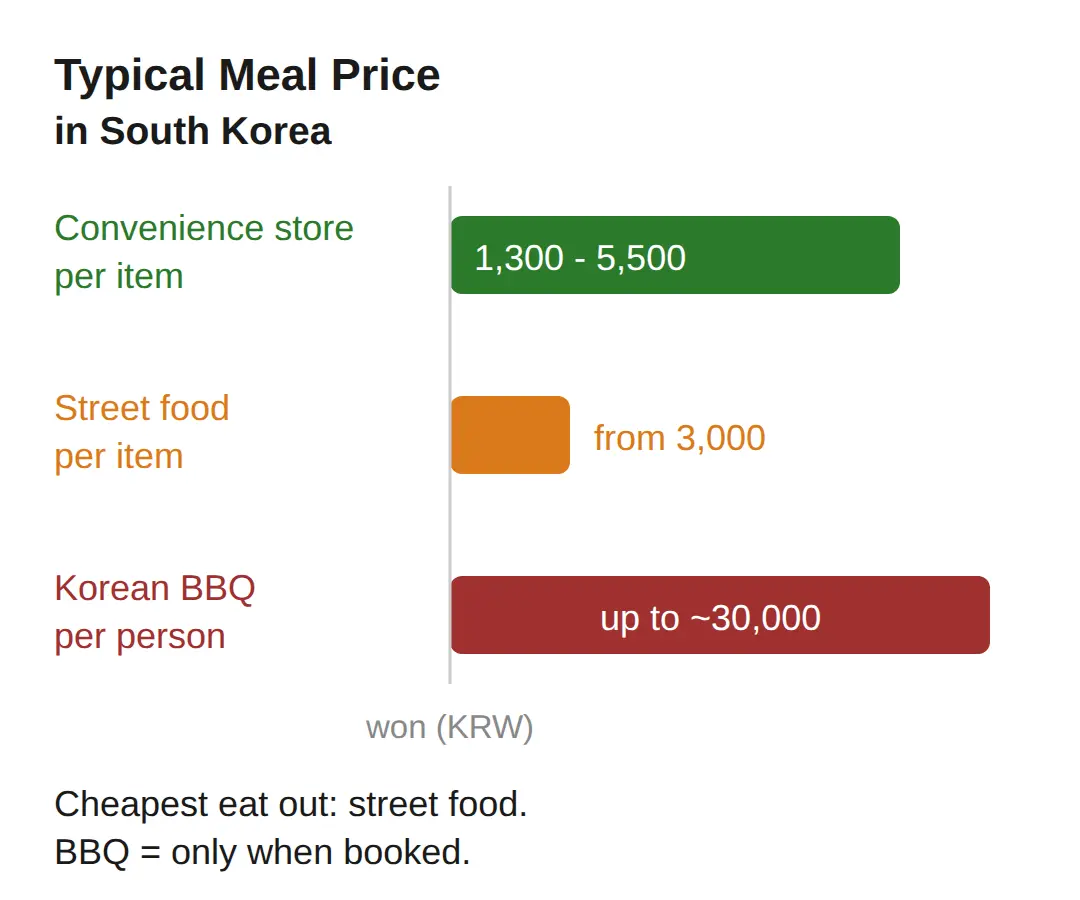
Convenience store items — samgak gimbap, dosirak, onigiri — sell for ₩1,300–5,500 each, so a complete store meal can stay under ₩8,000.
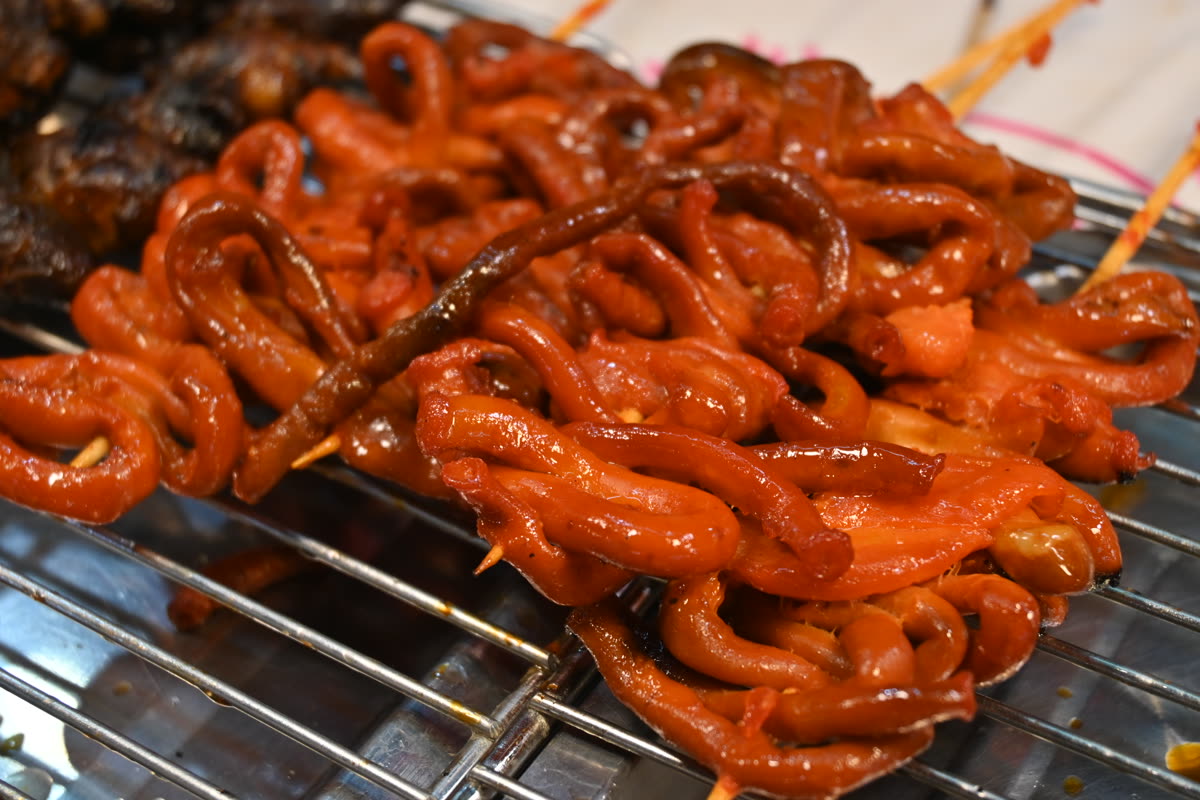
Street food items such as tteokbokki, hotteok, and gimbap start around ₩3,000 per item, which makes a street-food lunch the cheapest way to eat out.
A Korean BBQ dinner is the top of the range at up to about ₩30,000 per person.
If you are pricing a day, take the store band for breakfast, the ₩3,000 band for lunch, and the BBQ figure only for the evening you actually book one.
Is Food Cheap in Korea?
Yes at the bottom of the range, no at the top: a ₩3,000 street-food lunch is cheap, and a ₩30,000 BBQ dinner is not.
The gap between those two anchors is the whole answer, so what you eat matters more than where you are.
Two habits inflate the total quickly.
And a BBQ dinner costs as much as several days of store meals, so it is the single line that decides whether a week stays cheap.
If you want Korea to stay cheap, keep most meals at street-food and store prices and treat BBQ as the one planned splurge.
Do You Tip at Korean Restaurants?
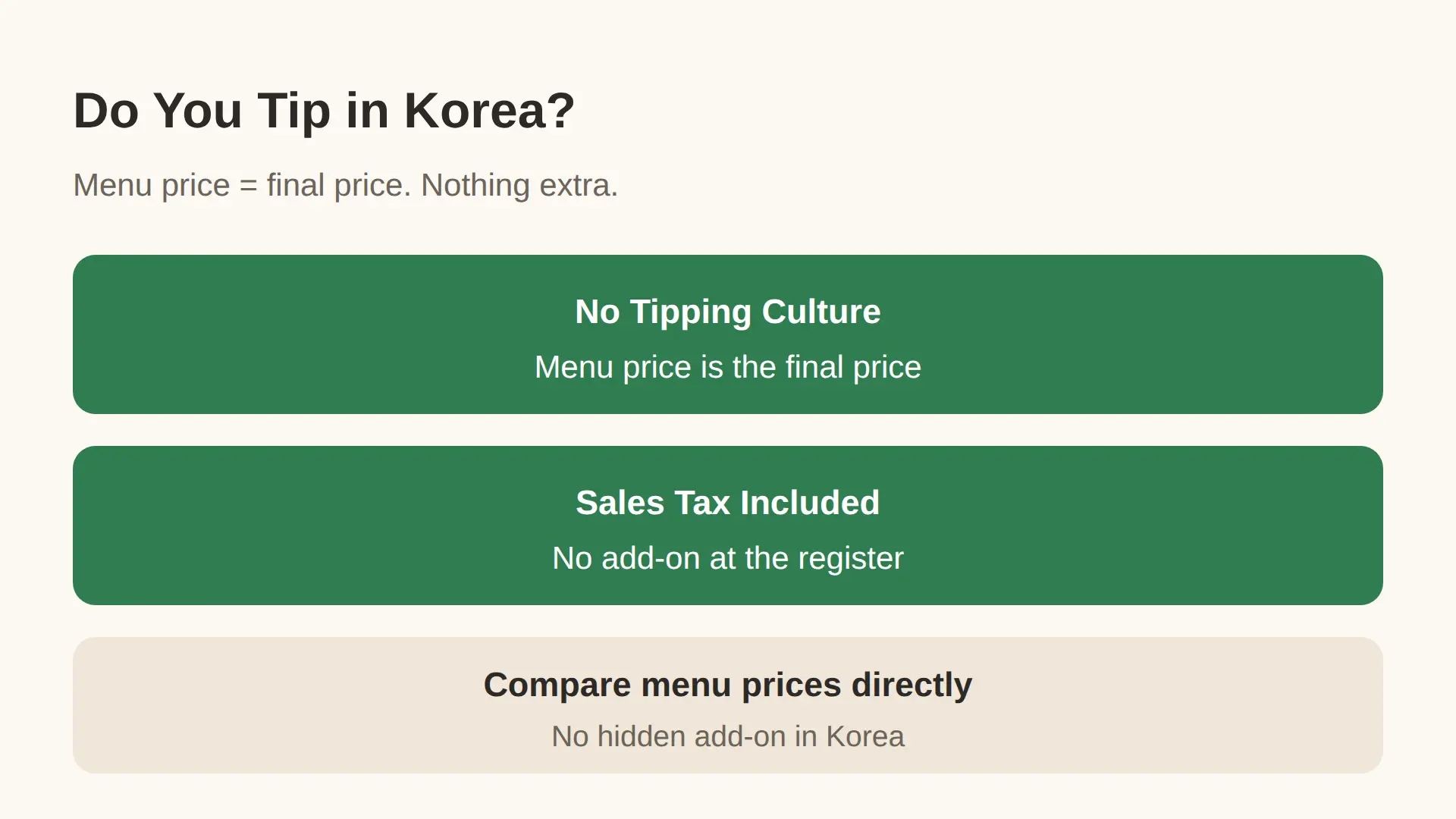
No — Korean restaurant prices are final, with no tipping culture and sales tax already included in the menu price.
| Item | In Korea | What it means for your budget |
|---|---|---|
| Tipping | No tipping culture | The menu price is the final price |
| Sales tax | Already included in the menu price | No add-on at the register |
| Menu price = what you pay | Yes | Compare Korean menu prices directly to your home city |
The number on the menu is the number you pay at the register, so you do not need to add anything for tax or service.
This makes budgeting simpler than in countries where a tip and tax change the total after you sit down.
If you are comparing menu prices to your home city, compare them directly, because there is no hidden add-on in Korea.
How Do You Cut the Cost by Cooking Your Own Meals?
If your accommodation has a kitchen, plan a weekly grocery list by headcount and budget before you arrive, because that is a common traveler pattern for self-catering stays.
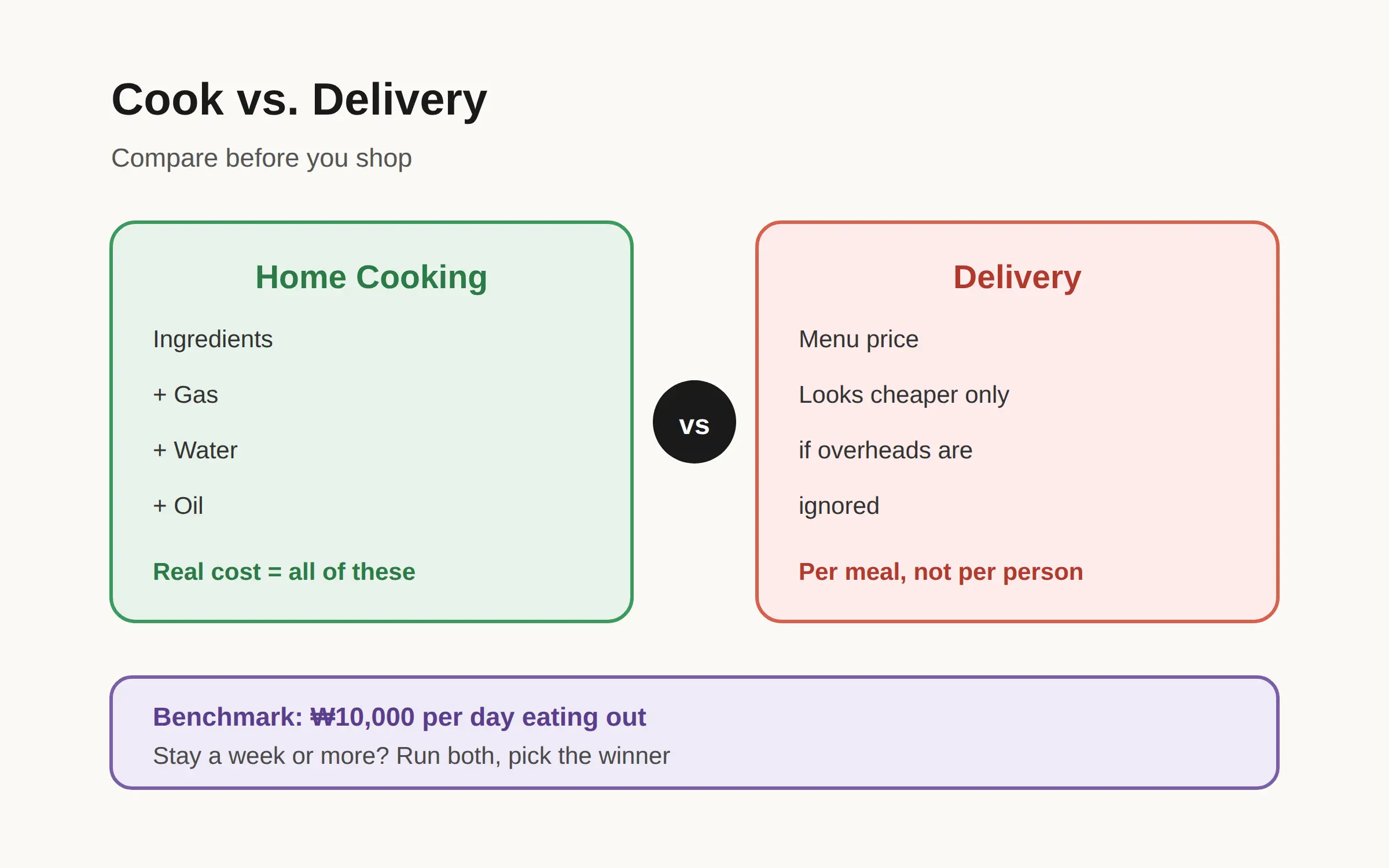
One way to price it is CostMyMeal, a Korean calculator that compares home-cooked and delivery costs across 24 marts in 8 countries, with no signup or upload needed.
The tool shows a detail worth knowing: cooking adds gas, water, and oil costs on top of ingredients, so delivery looks cheaper per meal only when those overheads are ignored.
It also calculates cost per 100 kcal and cost per gram of protein, and lets you set a per-serving budget goal with a minimum protein target, then returns a verdict plus a shopping list.
If you are staying a week or more with cooking access, run the numbers against a ₩10,000-a-day restaurant budget and see which side wins for your headcount.
Traveling in October? What Changes for Your Food Budget
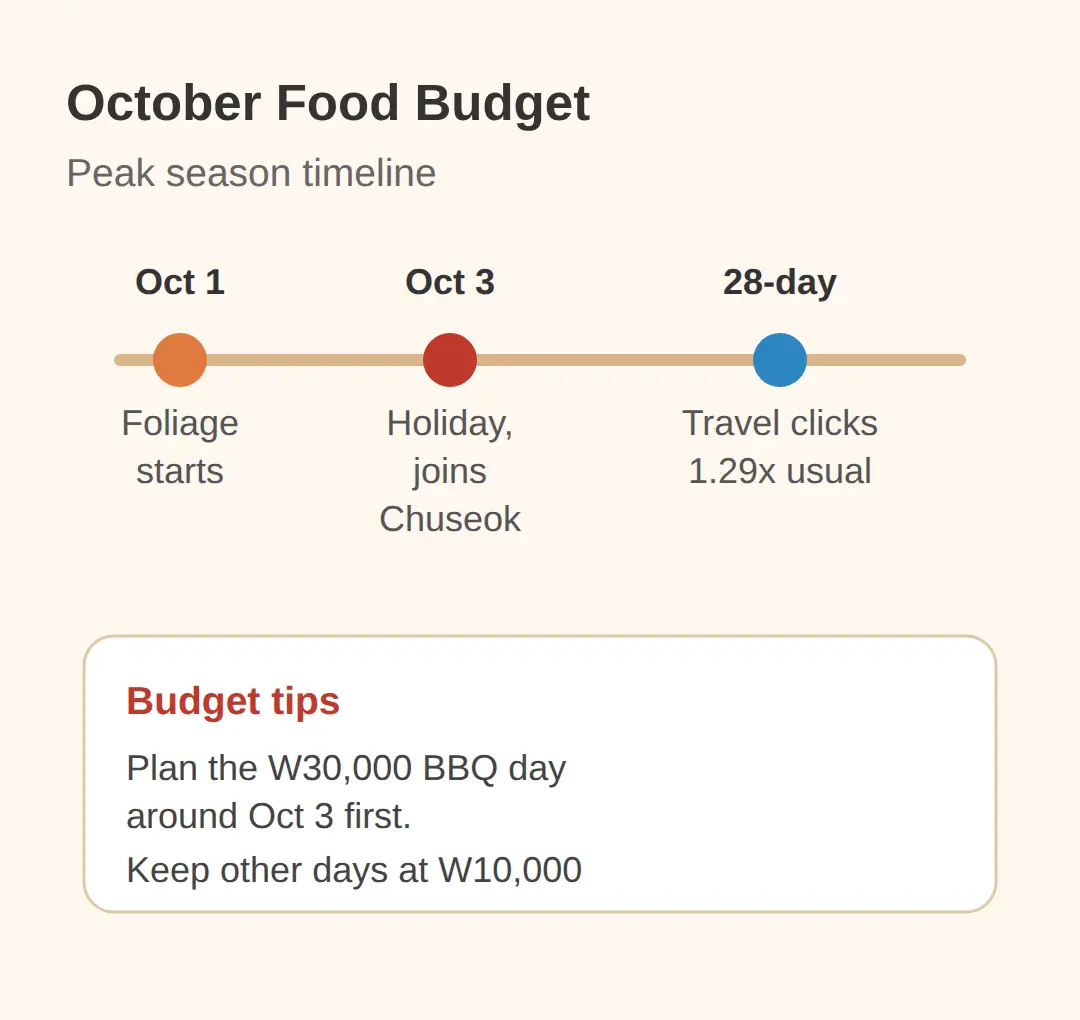
October is Korea’s peak travel window — fall foliage season peaks in October, and October 3 is Gaecheonjeol, which falls near the Chuseok holiday stretch.
Koreankorea’s own 28-day data shows travel-page clicks running 1.29 times the usual rate in this window, so prices and queues around popular food spots tend to be at their year-end heights.
Your budget numbers do not change, but demand does: around the October 3 holiday, budgeting the ₩30,000 BBQ day first and keeping other days at store-and-street prices matters more than usual.
If you are landing in early October, lock the splurge meals now and leave the cheap meals flexible.
If I were building this budget, I would check the actual BBQ menu prices on site first and research how much prices swing by region, because unverified numbers are the fastest way to blow the ₩10,000 floor.
Related posts
📎 📅 Upcoming Dates — Release & Event Calendar
Sources
- kr-tour CTR 1.29x, autocomplete anchor phrases (koreankorea.com)
- Korea prices are 2026-Q2 averages, last updated 2026-06-30, (costmymeal.com)
- Headcount + budget + meals → meal plan and grocery list is a (how-toai.com)
Daily Budget at a Glance
- Daily minimum for three meals: ₩10,000, from 2026 anchor prices.
- BBQ day budget: plan around ₩30,000 for the dinner before adding the other two meals.
- Store meals: samgak gimbap, dosirak, and onigiri run ₩1,300–5,500 per item, a full meal under ₩8,000.
- Street food: from about ₩3,000 per item (tteokbokki, hotteok, gimbap).
- At the register: no tip, no added tax — menu price is the final price.
FAQ
Q. How much is a typical meal in South Korea?
It depends on the meal: convenience store items run ₩1,300–5,500 each (a full store meal under ₩8,000), street food starts around ₩3,000 per item, and Korean BBQ runs up to about ₩30,000 per person — all on 2026 anchor prices.
Q. Is food cheap in Korea?
At the bottom of the range, yes — a ₩3,000 street-food lunch is cheap. A ₩30,000 BBQ dinner is not, so your food budget depends on how often you book a grill table.
Q. How much should I budget per day for food in Korea?
Start from ₩10,000 per day for three meals, and raise that day’s budget if a Korean BBQ dinner is on the itinerary.
Q. Do you tip at restaurants in Korea?
No. Restaurant prices in Korea are final — there is no tipping culture and sales tax is already included in the menu price.
Dates to note for an October trip: fall foliage hits peak season in October, and the Chuseok holiday stretch around Gaecheonjeol on October 3 drives the year’s peak travel-search window.
Prices in this post are based on the 2026 anchor price set for this guide, so treat them as ballpark figures to sanity-check on site.
Cover photo: Korean street food-chicken by john wilbanks — CC BY-SA 2.0
#koreafoodbudget #koreanstreetfoodprice #koreanbbqcost #koreatravelbudget2026 #conveniencestoremealskorea
📅Upcoming Schedule — this week 4 · D-day Series launch at stores nationwide + 25% NH Nonghyup card diSee all →