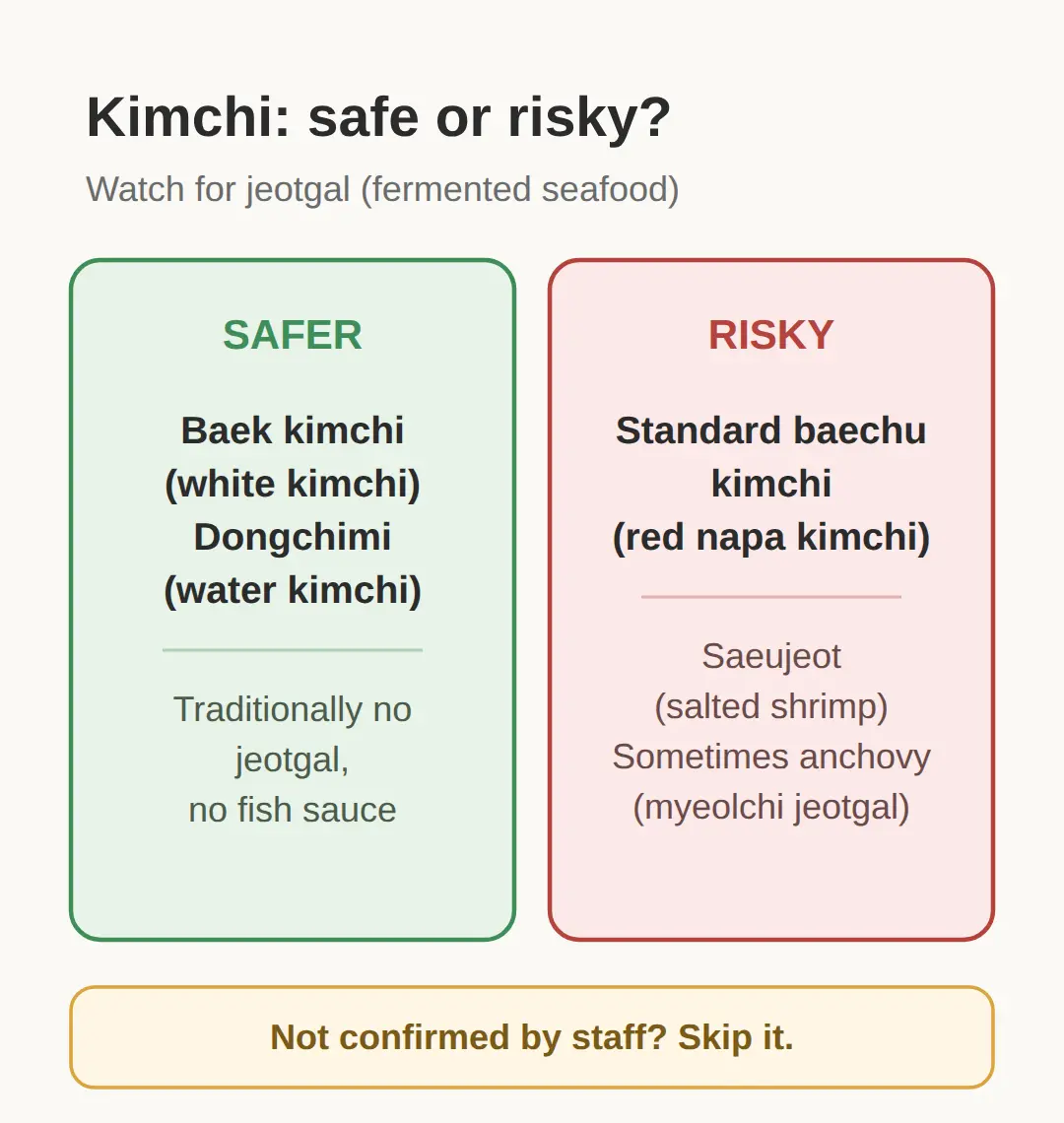
Standard napa kimchi (baechu kimchi) is usually not halal, because the seasoning paste almost always contains saeujeot — salted shrimp.
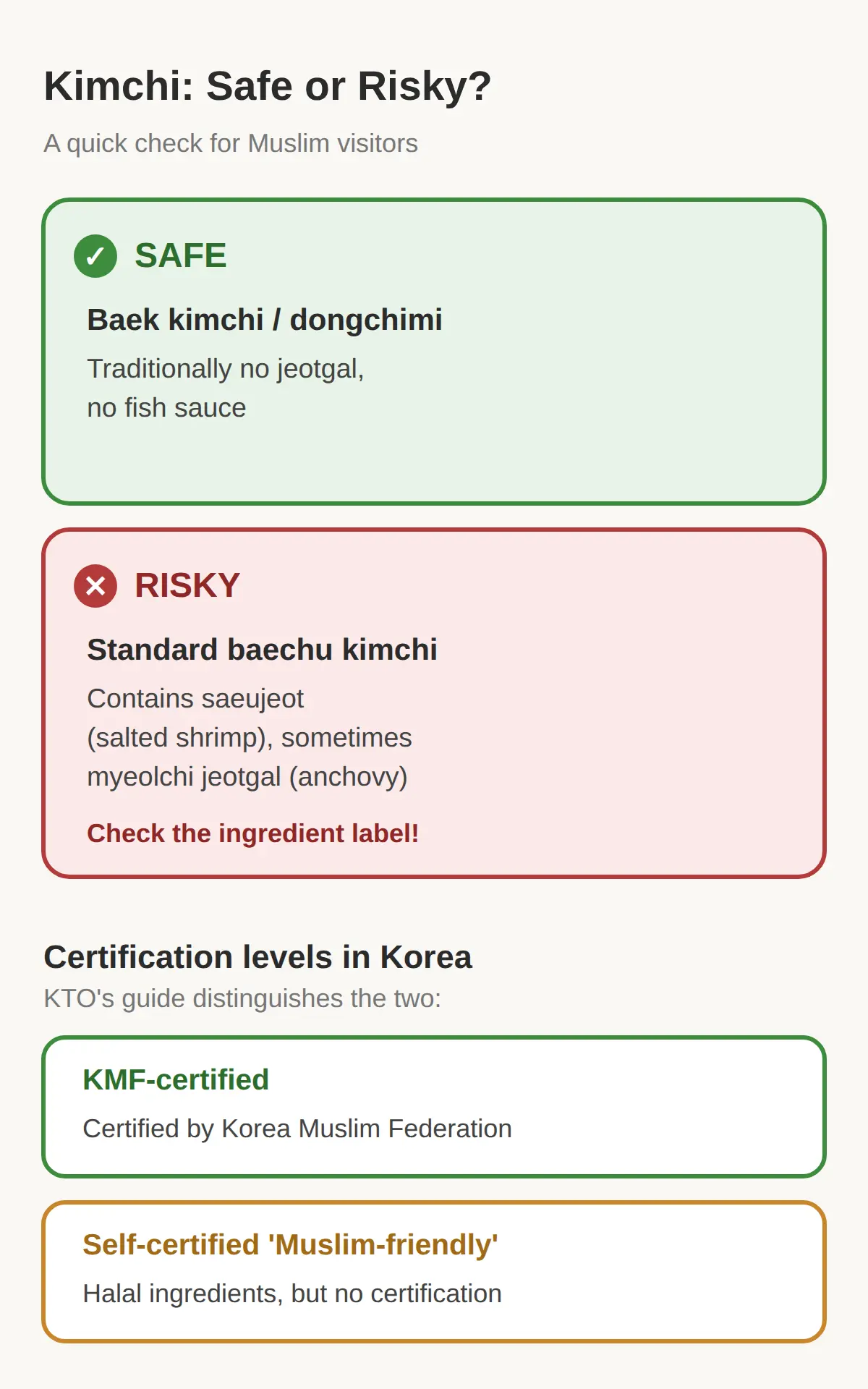
That means the free side-dish kimchi at an ordinary Korean restaurant is one you skip, while white kimchi (baek kimchi) and water kimchi (dongchimi) are traditionally made without any salted seafood.
This post answers what to check, what to order instead, and where certified halal food sits in Seoul.
Is Kimchi Halal in Korea? The Short Answer
| Baek kimchi (white kimchi) | Traditionally made without jeotgal or fish sauce — safe when the maker confirms it |
|---|---|
| Dongchimi (water kimchi) | Traditionally jeotgal-free — safe when the maker confirms it |
| Standard baechu kimchi | Almost always contains saeujeot (salted shrimp) — skip unless certified |
| Kimchi jjigae, kimchijeon | Avoid at ordinary restaurants — pork and jeotgal-based kimchi, shared griddles |
| Steamed rice, danmuji (yellow pickled radish) | Reliably safe staples |
| Grilled meat | Safe only if certified halal or halal-slaughtered |
Standard baechu kimchi in Korea is commonly seasoned with saeujeot (salted shrimp) and sometimes myeolchi jeotgal (anchovy), so it is not halal by default.
Saeujeot supplies the savory depth that fermented seafood gives the paste, and restaurants often add it without mentioning it.
Fermentation itself is not the problem — kimchi is lacto-fermented, which raises no halal issue; the issue is the added seafood and, rarely, alcohol-based seasonings.
Baek kimchi (white kimchi) and dongchimi (water kimchi) are traditionally made without jeotgal or fish sauce.
That makes 2 of the 3 commonly eaten kimchi types workable for Muslim diners — but only when the maker or restaurant confirms the batch.
If the kimchi on your table is the standard red napa kind and nobody can confirm otherwise, treat it as off-limits.
When I pick up any kimchi, the first thing I look at is whether the label or the staff can rule out jeotgal — everything else in the decision follows from that.
How To Check Kimchi Before You Eat or Buy It
The check takes three steps, and the decisive one differs by where you are.
At a mart, the packaging settles it; at a restaurant, the staff’s answer settles it.
- Read the label first — look for a halal mark (JAKIM or KMF) or scan the Korean ingredients for jeotgal (salted seafood) or anchovy fish sauce.
- At a restaurant, ask whether the kimchi contains saeujeot or jeotgal — English may not work at small places, so keep a written or translated phrase ready.
- If no one can give a clear answer, skip the kimchi and order dishes cooked to order instead.
Supermarket kimchi from brands like CJ, Jongga, and Dongwon lists jeotgal on the ingredient label in Korean, so the label is the decisive check for a mart purchase.
A halal mark on the front is faster than reading the full list, because certified export brands display it directly.
If the staff cannot answer ‘does the kimchi contain jeotgal?’, that silence is itself the answer — eat without it.
 — How To Check Kimchi Before You Eat or Buy It](https://koreankorea.com/wp-content/uploads/2026/09/is-kimchi-halal-in-korea-2026-02.jpg)
What Can Muslims Eat in Korea?
Plain steamed rice and danmuji (yellow pickled radish, the vinegar-based kind) are the reliably safe staples, and jeotgal-free side dishes round out a meal.
Grilled meat is safe only when the restaurant uses certified halal or halal-slaughtered meat.
So a workable default order is rice, danmuji, a cooked-to-order dish, and certified grilled meat.
The kimchi risk does not stop at the side dish.
Kimchi jjigae (kimchi stew) at ordinary restaurants usually contains non-halal pork and the same jeotgal-based kimchi, so it is off-limits unless the place is certified.
Kimchijeon (kimchi pancake) uses the same standard kimchi and is often cooked on griddles shared with pork menus.
Even vegetable stews such as doenjang jjigae may carry small amounts of standard kimchi or meat broth, so the ‘does this contain kimchi?’ question extends past kimchi itself.
Do not assume the free side-dish kimchi is safe — restaurants add saeujeot without mentioning it, because it supplies the savory depth.
Where To Find Halal Food in Seoul
The streets around Seoul Central Mosque on Usadan-ro in Itaewon (Yongsan-gu) hold the largest cluster of KMF-certified halal restaurants in Korea, with halal butchers on the same blocks.
Seoul Central Mosque is the navigation landmark — search for it and the restaurant cluster sits around it.
Smaller clusters exist near Jongno, and there are certified spots in cities like Gwangju and Busan.
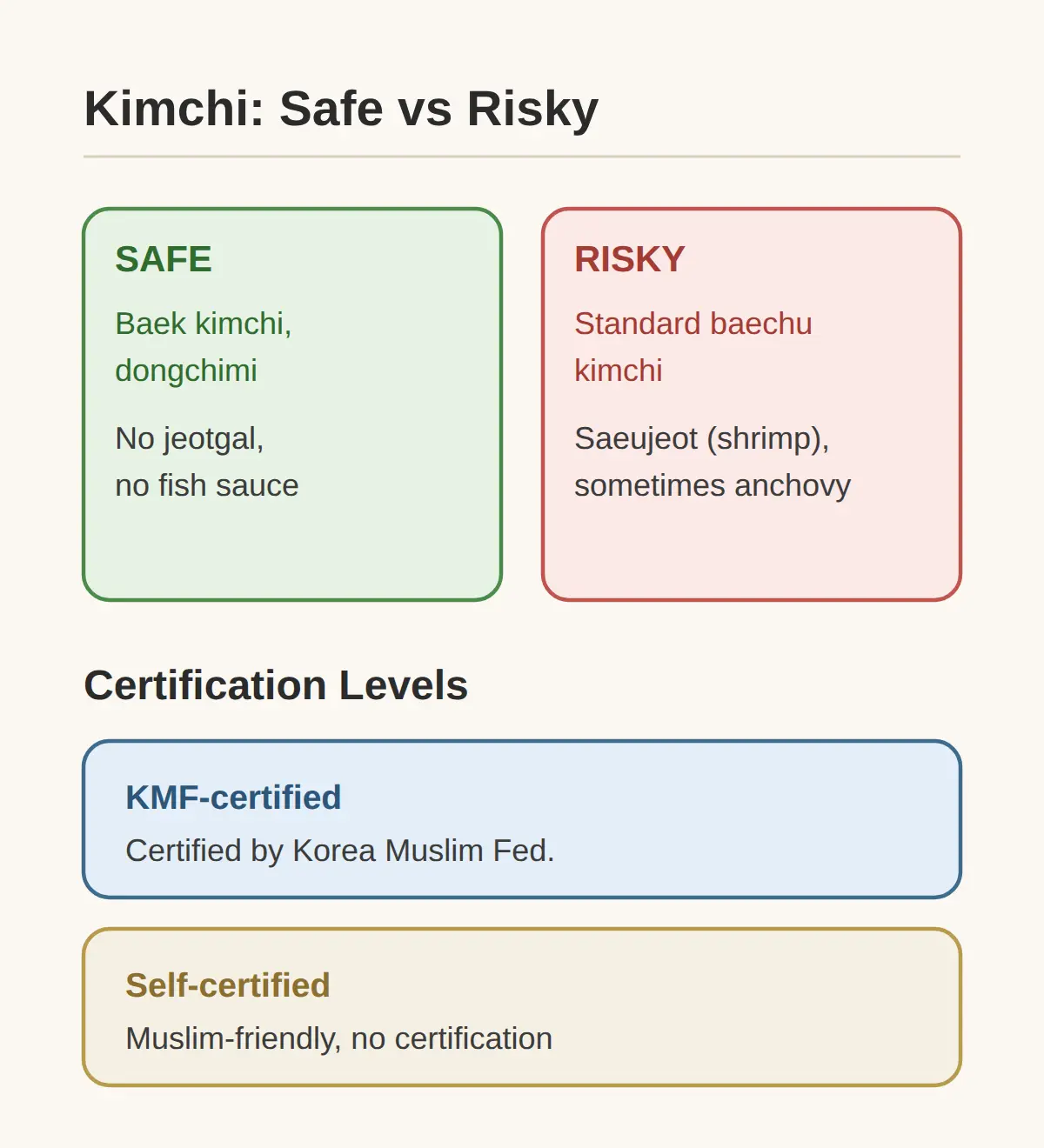
Two official sources cover what no single post can: the Korea Muslim Federation (KMF, kmf.or.kr) publishes its certified establishments and foods on its site, and the Korea Tourism Organization runs a Muslim-friendly guide on english.visitkorea.or.kr.
KMF certifies halal products and restaurants; a KTO ‘Muslim-friendly’ listing means halal ingredients were used but no certification was given.
Those are different levels, so do not treat a Muslim-friendly listing as equal to KMF certification.
Check both lists before your trip rather than hoping a random neighborhood restaurant qualifies.

Buying Kimchi at a Mart or Cooking at a Guesthouse
For meals you cook yourself, certified kimchi plus certified meat covers most of what a guesthouse kitchen needs.
Ordinary marts carry the certified export brands in the refrigerated kimchi section.
Jongga (Daesang) baechu kimchi carries JAKIM (Malaysia) halal certification, making it one of the easiest store-bought kimchi options for Muslim visitors in Korea.
That certification is for the export line, so verify the mark on the actual package you pick up rather than assuming every Jongga tub on the shelf carries it.
For the rest of the shelf, the ingredient label is the check: jeotgal or anchovy fish sauce in the list means the tub is not for you.
If I could not get a clear answer about a restaurant’s kimchi, I would eat without it — rice, danmuji, and certified grilled meat cover a full meal — and I would buy JAKIM-certified Jongga kimchi at a mart for guesthouse cooking.
Traveling Outside Seoul — Busan, Jeju, and the Fall Season
Outside Seoul the certified options thin out, so plan around KTO’s Muslim-friendly list instead of assuming halal food is nearby.
This matters most for Busan and Jeju itineraries, where certified restaurants are scattered rather than clustered.
Build each day’s dinner around a listed place, and let markets and convenience-store runs fill in the rest only with packaged items you have label-checked.
Inbound travel to Korea is rising into the autumn 2026 peak season, which is exactly when this question comes up.
If I were headed to Busan or Jeju, I would plan around KTO’s Muslim-friendly list in advance rather than expecting to find certified food on the street.
Related posts
📎 Seoul — everything we know
📎 📅 Upcoming Dates — Release & Event Calendar
Sources
- Recent (6-month window) dedicated sources were scarce — most (koreankorea.com)
- Rising inbound demand into autumn 2026 peak season (koreatimes.co.kr)
- No primary-source confirmation found for 2026 halal kimchi a (kmf.or.kr)
One-Glance Guide: Your Situation, Your Move
- Free side-dish kimchi arrives at an ordinary restaurant → Skip it unless the place is KMF-certified or confirms a jeotgal-free batch.
- Baek kimchi or dongchimi → Only eat them after the maker or server confirms they are jeotgal-free.
- Supermarket kimchi → Look for a halal mark (JAKIM/KMF) first; otherwise scan the label for jeotgal or anchovy fish sauce.
- Hot stews and pancakes at ordinary restaurants → Kimchi jjigae and kimchijeon usually contain non-halal pork and jeotgal kimchi, so pass.
- Staff cannot answer the jeotgal question → Order plain rice, danmuji, and a dish cooked to order with certified meat.
- Outside Seoul → Head to the Itaewon/Usadan-ro area first; certified options in Busan and Jeju are fewer, so plan around them.
FAQ
Q. Is kimchi halal?
Standard baechu kimchi usually is not — it is seasoned with saeujeot (salted shrimp). Baek kimchi and dongchimi are traditionally jeotgal-free, so they work when the maker confirms it.
Q. Is kimchi halal in Korea?
The same answer applies: ordinary restaurant kimchi almost always contains salted seafood, so skip it unless the restaurant is halal-certified or confirms otherwise.
Q. What can Muslims eat in Korea?
Steamed rice, danmuji (yellow pickled radish), jeotgal-free sides, and certified grilled meat are the safe staples; kimchi jjigae and kimchijeon at ordinary restaurants are off-limits.
Q. Where are halal restaurants in Seoul?
The largest KMF-certified cluster sits around Seoul Central Mosque on Usadan-ro in Itaewon; check KMF’s official list and KTO’s Muslim-friendly guide before you go.
Q. Is there store-bought halal kimchi in Korea?
Yes — Jongga (Daesang) baechu kimchi carries JAKIM (Malaysia) certification for its export line, so look for the mark on the package in the refrigerated kimchi section.
No closing event date applies — this is an evergreen question. Worth a calendar note: check KMF’s certified list and KTO’s Muslim-friendly guide the day before each city on your trip.
Cover photo: 제주시 도두항 03 by ChongDae — CC BY-SA 4.0
#kimchi #halalfoodKorea #muslimtravelKorea #Seoulfoodguide #Koreanfood101
📅Upcoming Schedule — this week 4 · D-day Series launch at stores nationwide + 25% NH Nonghyup card diSee all →