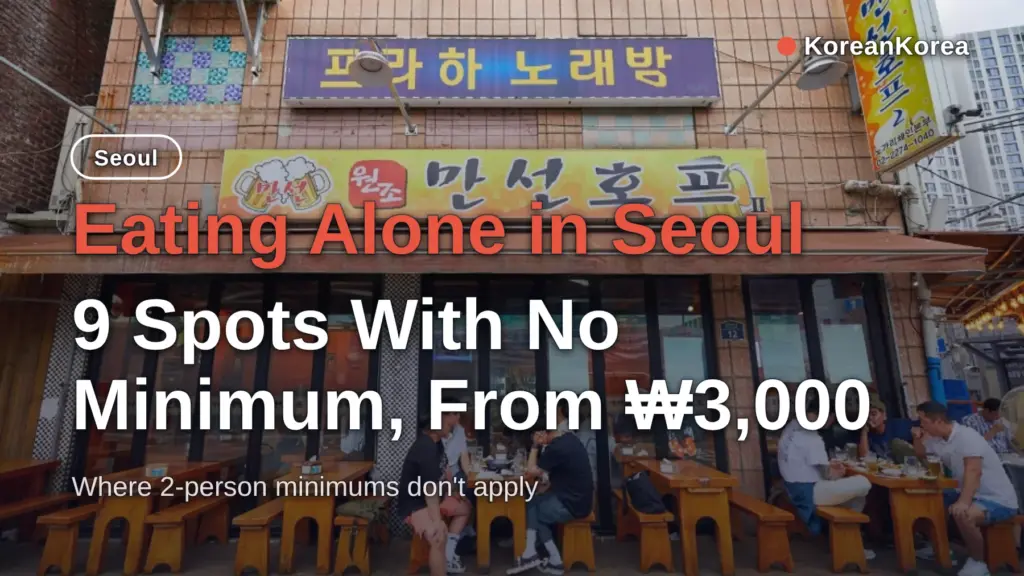
In Seoul, nine spot types let you eat alone with no 2-serving minimum — gimbap starts at ₩3,000, gukbap runs about ₩9,000, and jjigae ₩7,000–9,000.
Korean BBQ, dakgalbi, seafood stew and jokbal are the ones that often require 2 people, so knowing which is which saves a rejected order.
This post lists the nine types with prices, the dishes to skip, and where to go late or without Korean.
Where To Eat Alone in Seoul With No 2-Serving Minimum
| Gimbap roll at bunsik or chain spots | ₩3,000–4,500 (one roll ₩3,500–5,500) |
|---|---|
| Gukbap (soup with rice) | about ₩9,000 |
| Jjigae (stew), rice refills included | ₩7,000–9,000 |
| Ramyeon at a noodle shop | ₩4,000–6,000 |
| Department-store food court meal | ₩8,000–15,000 |
| Convenience-store combo | ₩5,000–7,000 |
| Soondae gukbap | ₩8,000–10,000 |
Nine spot types take solo diners with no minimum order, and the cheapest of them starts at ₩3,000.
The list: gimbap and bunsik joints, gukbap counters, noodle shops, jjigae spots, food courts, convenience stores, market stalls, samgyetang restaurants and late-night chains.
The constraint you are solving is Korean BBQ — many grill places set a 2-serving minimum order, which is why solo travellers get stuck.
Based on the Wokfeed 2026 Korea food guide, gimbap runs ₩3,000–4,500 a roll and soup with rice (gukbap) about ₩9,000 — both with no minimum order for solo diners.
Soondae gukbap shops seat one person at the counter for ₩8,000–10,000.
Bunsik joints and gimbap chains are listed as the easiest solo-dining option in Korea, and noodle shops are just as comfortable.
If you want the cheapest possible solo meal, a gimbap chain or a convenience-store combo (triangle gimbap plus instant noodles, ₩2,000–4,000) is the floor.
When planning solo meals in Seoul, I first check the portion structure — whether the dish is sized for one person or comes with a 2-serving minimum — because that one question decides most of the list.
Which Dishes To Skip When Eating Alone in Korea
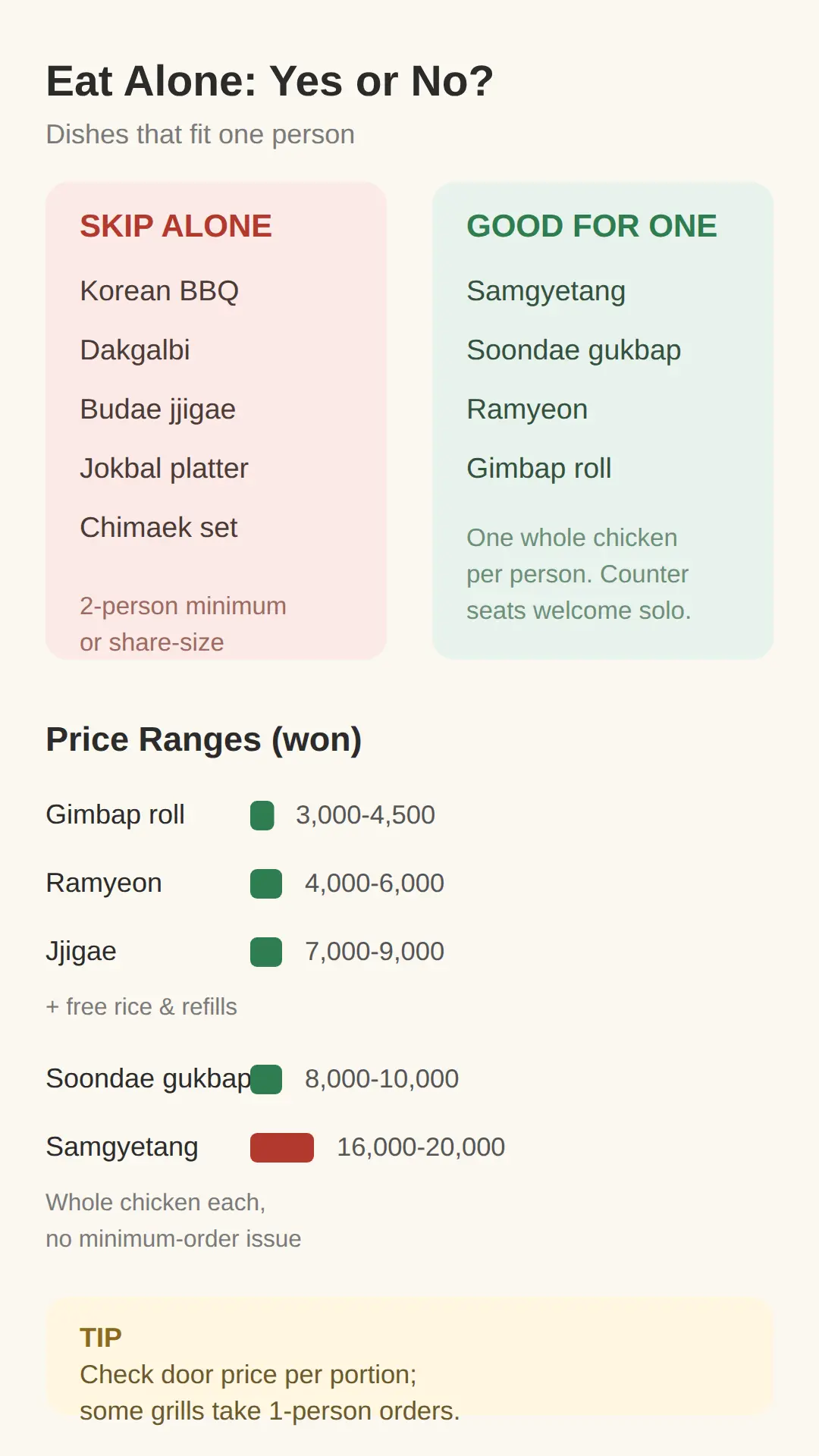
Korean BBQ, dakgalbi, seafood stew, budae jjigae for 2, jokbal platters and chimaek sets are the dishes that usually do not work for one.
The reason is portion structure, not a rule against solo diners — these come sized for groups, or the minimum order is 2 servings.
Samgyetang is the exception among the big dishes: one whole chicken per person, roughly ₩16,000–20,000, so there is no minimum-order problem.
A few Seoul grill spots do market single-diner tables or 1-person grills, but most BBQ remains a 2-serving minimum, and per-portion prices vary widely by chain.
Check the price per portion on the door before you sit down, because whether a specific branch takes true 1-person orders varies.
Do not walk into a random BBQ place expecting to order for one.
If you want the BBQ experience without a companion, look for the small number of spots that advertise 1-person grills — and treat samgyetang as the reliable one-person alternative instead.
How Much Does a Solo Meal Cost in Seoul?
A gukbap runs about ₩9,000 against a ₩3,000 gimbap roll, so even between these two counter types the spread reaches ₩6,000 — three times the cheapest option.
A jjigae costs about ₩4,000–5,000 more than a gimbap roll, but it is a full hot meal with free refills.
Department-store food courts land in the middle at ₩8,000–15,000.
| Spot type | Price range |
|---|---|
| Gimbap (chain, one roll) | ₩3,000–4,500 |
| Convenience-store meal (gimbap + instant noodles) | ₩2,000–4,000 |
| Ramyeon at a noodle shop | ₩4,000–6,000 |
| Tteokbokki at a bunsik spot | ₩4,000–6,000 |
| Jjigae (stew) with rice refills | ₩7,000–9,000 |
| Gukbap (soup with rice) | about ₩9,000 |
| Sundubu jjigae | ₩8,000–10,000 |
| Bibimbap (casual restaurant) | ₩8,000–12,000 |
| Department-store food court meal | ₩8,000–15,000 |
Casual jjigae spots in Seoul charge ₩7,000–9,000 for a stew and include free refills of rice and banchan, so one stew is a complete meal on its own.
Over a full day, a solo traveller can eat three meals for ₩15,000–25,000 using these spot types.
If you want a hot, sit-down meal that fills you up, gukbap or jjigae is the pick — if you are stretching a budget, the gimbap and convenience-store end of the table is where you eat.
Is It Weird To Eat Alone in Seoul? (Honbap)
No — eating alone, called honbap in Korean, is widespread in Seoul, and counter seats and one-person tables are common.
Noodle shops, gukbap counters and food courts are built around single seating, so you will not be the exception.
| Question | Evidence |
|---|---|
| Is honbap normal in Korea? | Solo dining (‘honbap’) is now widespread; counters and one-person seats are common in noodle shops and food courts |
| Where is single seating the default? | Noodle shops (myeonjip), gukbap counters, and mall/department-store food courts (Lotte, Shinsegae, COEX-style) with tray service and single seats |
| Do I need a reservation? | Counter-service spots need none — walk in, order, eat and leave within 20–30 minutes |
| How do 2026 food guides treat it? | Honbap is covered as a normal way to eat, not a curiosity |
In 2026 food guides, honbap is covered as a normal way to eat, not a curiosity.
Food courts at department stores and malls use tray service and single seats, so there is no table-sharing awkwardness.
Department-store food courts serve a full solo meal for ₩8,000–15,000 with tray service and no table sharing.
If you feel awkward sitting alone, start at a mall food court where one-person seating is the default, then move on to counter-style gukbap and bunsik spots.
Where To Eat Alone in Seoul at Night or Without Korean
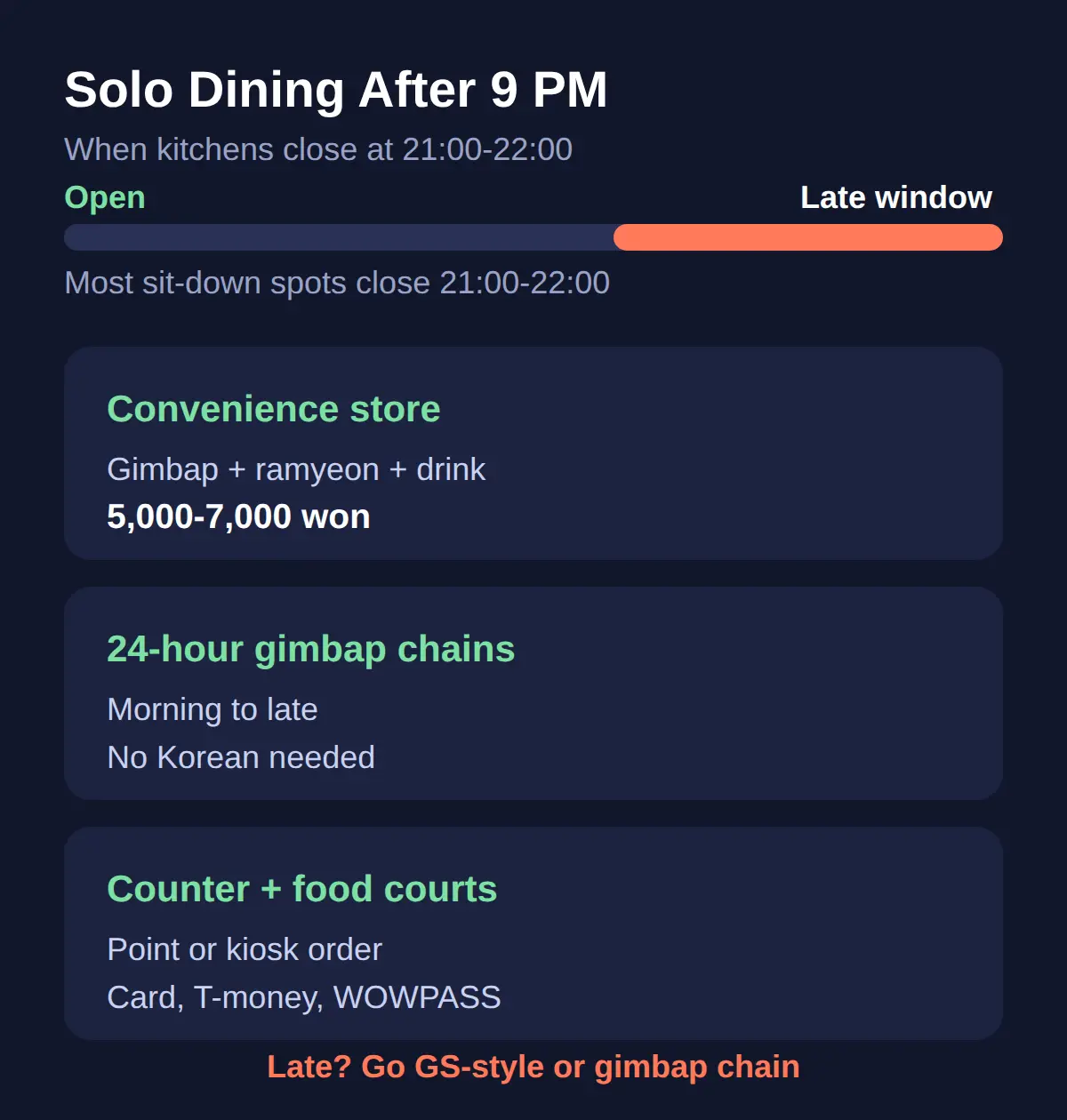
Late at night, convenience stores and 24-hour gimbap chains are the default, because most restaurants close between 21:00 and 22:00.
Chains such as gimbap franchises run from morning to late, so they cover both the early and the late end of your day.
Convenience-store combos (triangle gimbap plus ramyeon plus a drink, ₩5,000–7,000) come with hot-water self-service and seating corners.
Payment is rarely a problem: nearly all of these spot types — chains, food courts, convenience stores — accept international credit cards and T-money or WOWPASS.
The densest areas for walk-in solo dining are Myeongdong, Hongdae, Sinchon and Jongno, where cheap counter dining sits within five minutes of the station.
No Korean is needed at counter spots and food courts — you point at the menu or order at a kiosk.
If it is late and restaurants are closing, head to a convenience store or a gimbap chain rather than hunting for a sit-down kitchen.
Solo Meals by Neighborhood: Myeongdong and Hongdae
Myeongdong and Hongdae are the two densest areas for solo eating — street stalls, bunsik chains and food courts all sit within one block.
Myeongdong street food is priced per item: hotteok ₩2,000–3,000, skewers ₩3,000–5,000, egg bread ₩2,000–3,000, with zero minimum.
Traditional market stalls (Gwangjang, Mangwon style) serve single portions of bindaetteok ₩5,000–7,000 and mayak gimbap ₩3,000–5,000 at stand-up counters.
If you cannot decide what to eat, a food hall or market gives you single portions of several dishes in one visit — a good fit for an indecisive solo traveller.
Whether market stalls with shared tables seat a solo diner at a shared table is not confirmed here, so the stand-up counter style is the safe assumption.
Most of these spots are subway-adjacent, so no driving is needed.
If I were picking my first solo meal in Seoul, I would head straight to a gukbap counter — ₩9,000, no reservation, and I would already be eating within ten minutes of walking in.
Grazing street food item by item is the more fun option, but for a first night the one-bowl certainty of gukbap beats deciding between five stalls.
Related posts
📎 Seoul — everything we know
📎 📅 Upcoming Dates — Release & Event Calendar
Sources
- Gukbap ₩9,000, gimbap ₩3,000–4,500, jjigae ₩7,000–9,000 conf (wokfeed.com)
- Most BBQ is 2-serving minimum; isolated single-grill spots e (thegirlwithabigbag.com)
- Mall/market food courts cited as comfortable solo options (coreadesk.com)
Quick Summary: Eating Alone in Seoul
- Check the price table first: the cheapest options (gimbap ₩3,000–4,500, convenience-store combo ₩5,000–7,000) sit at one end, sit-down jjigae ₩7,000–9,000 at the other.
- Before walking in, check for 2-serving minimums — most Korean BBQ, dakgalbi, seafood stew and jokbal spots fail this test.
- Head for one-person dishes: samgyetang (one whole chicken per person, ~₩16,000–20,000), soondae gukbap ₩8,000–10,000, ramyeon ₩4,000–6,000.
- If honbap feels awkward, start at a mall food court (₩8,000–15,000, single seats, tray service) and work up to counter gukbap.
- Late or early? Gimbap chains run morning to late and take solo walk-ins with no reservation.
FAQ
Q. Can I eat alone at Korean BBQ places, or do they require 2 people?
Most Korean BBQ places have a 2-serving minimum. A small number of Seoul spots market 1-person grills, but this varies by branch and per-portion prices vary widely — check the price on the door before you sit.
Q. Is it weird to eat alone in Seoul restaurants?
No. Solo dining (honbap) is widespread in Korea, and counter seats and one-person tables are common at noodle shops, gukbap counters and food courts.
Q. Which store types can I eat at alone with no minimum order?
Nine types: bunsik and gimbap joints, gukbap counters, noodle shops, jjigae spots, food courts, convenience stores, market stalls, samgyetang restaurants and late-night gimbap chains.
Q. What does a solo meal cost in Seoul?
From ₩3,000 for gimbap to about ₩9,000 for gukbap, with food courts at ₩8,000–15,000. Three meals a day run ₩15,000–25,000.
Q. Where can I eat alone in Seoul late at night?
Convenience stores and gimbap chains, which run from morning to late. Most restaurants close between 21:00 and 22:00.
Next: what to eat in Korea if you cannot eat spicy food.
Cover photo: Euljiro Nogari Alley (을지로 노가리골목) by Korea Tourism Organization — KOGL Type 1 (attribution)
#seoul #solotravel #honbap #koreanfood #solodining #seoulprices
📅Upcoming Schedule — this week 2 · D-2 Hangul DaySee all →