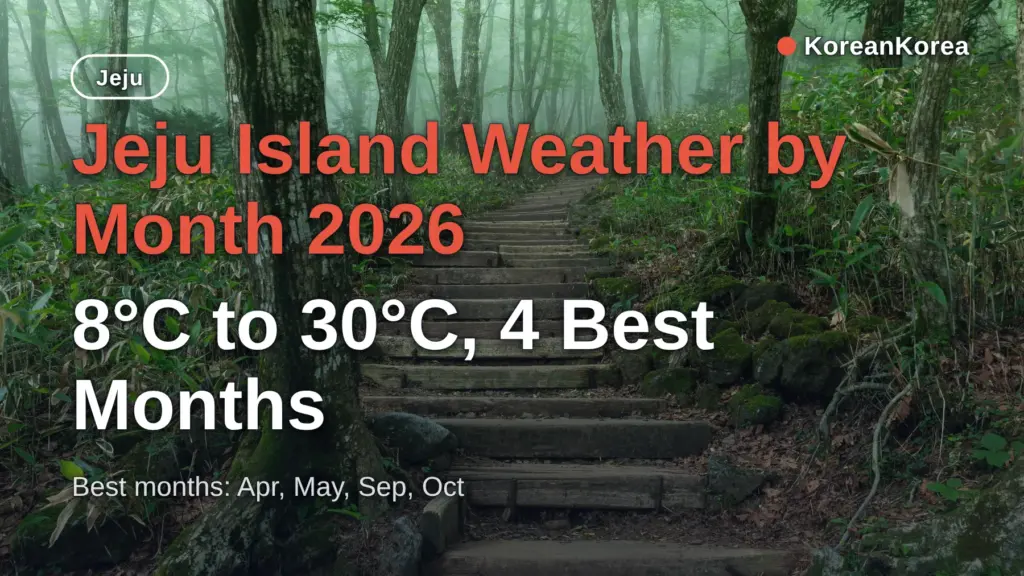
April, May, September and October are the best months to visit Jeju Island for weather.
Two independent monthly climate sources rank these four months as the best of the year, and May alone averages 22°C by day and 15°C by night.
This post covers the monthly temperature chart, when Hallasan trails close for snow, which summer months to avoid, and what to pack by month.
Jeju Island Yearly Weather: When Should You Visit? The Short Answer
| January | 8 / 3 |
|---|---|
| February | 9 / 4 |
| March | 13 / 7 |
| April | 12–20 |
| May | 22 / 15 |
| June | 25 / 19 |
| July | 29 / 24 — full monsoon season, extreme humidity, heavy rain. Pack an umbrella, quick-dry shoes, and a light cardigan for air-conditioning. |
Two independent monthly climate sources list the same four months as the best of the year, so the answer does not depend on a single guide.
| Month | Avg high/low | Why it makes the cut |
|---|---|---|
| April | 12–20°C (spring range) | Mild weather, canola fields peak in March–April |
| May | 22°C/15°C | Described as the most comfortable travel month of the year |
| September | 26°C/21°C | Summer days, autumn nights, low rainfall — but typhoons still possible |
| October | 21°C/16°C | Golden autumn month with silvergrass in bloom |
Only 4 of 12 months make the cut — a third of the year — so your dates matter more here than on many other islands.
If you want the best all-round weather and do not mind peak-season crowds, pick from those four months, with May first.
Jeju Island Weather by Month: Temperature Chart
Jeju’s average high runs from 8°C in January to 30°C in August — a 22°C swing across the year.
| Month | Avg high/low | Notes |
|---|---|---|
| January | 8°C/3°C | Strong winds, possible heavy snow |
| February | 9°C/4°C | Still cold, volatile late-winter weather |
| March | 13°C/7°C | Cold snaps (‘flower-spring chill’) mixed with spring winds |
| June | 25°C/19°C | Hydrangeas in bloom, monsoon starts late June |
| July | 29°C/24°C | Full monsoon with extreme humidity |
| August | 30°C/25°C | Peak heat, start of typhoon season |
| October | 21°C/16°C | Golden autumn month with silvergrass in bloom |
| November | 16°C/10°C | Early winter, quite cold when windy |
| December | 10°C/5°C | Proper winter begins, Hallasan rime-frost season |
Winter is milder than Seoul at roughly 0–8°C, but January and February still sit at 8°C/3°C and 9°C/4°C.
If you want warmth without the monsoon, June and late September are the shoulder picks — but check the typhoon notes below first.
When Do Hallasan Trails Close for Snow?
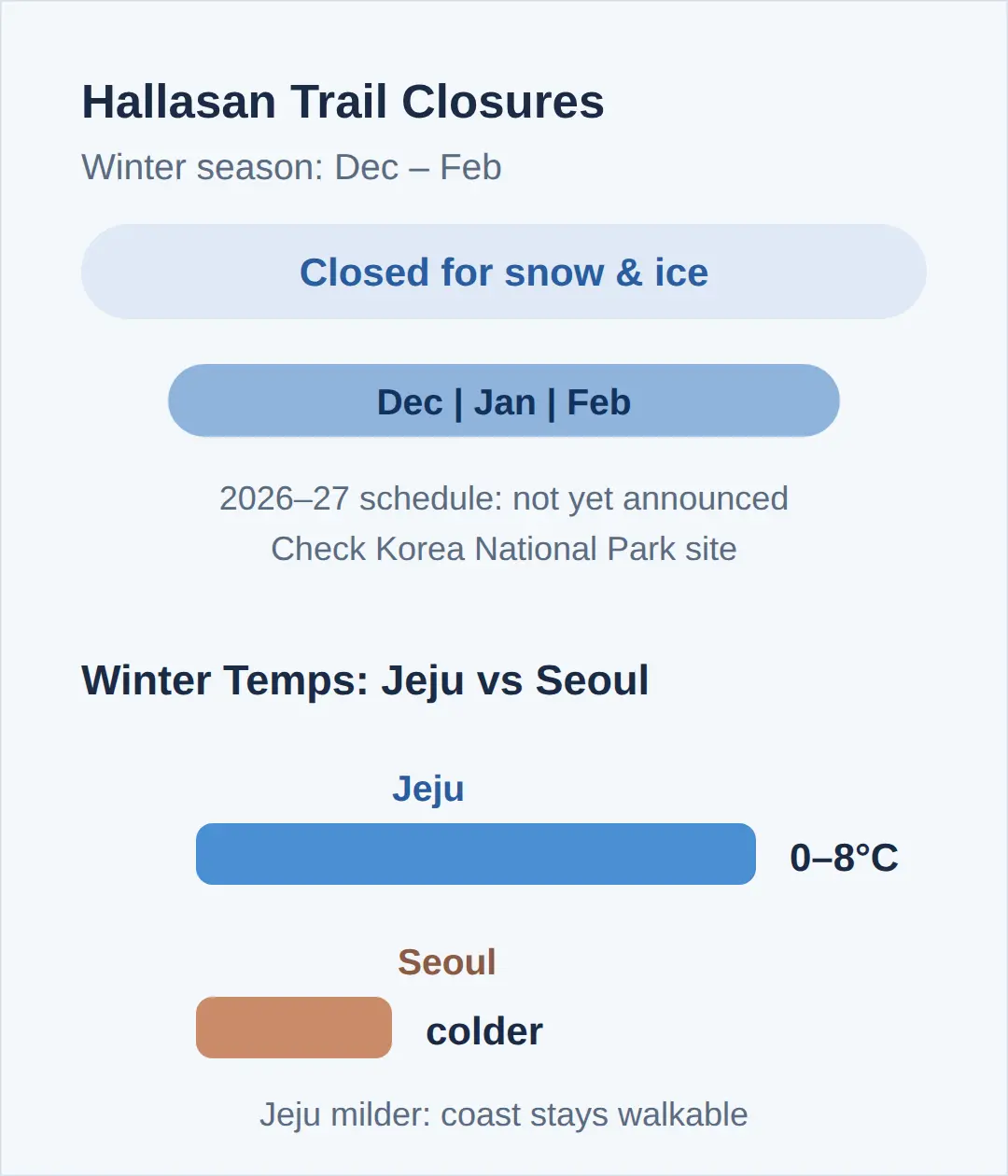
Some Hallasan trails close during winter (December through February) for snow and ice.
December marks the start of proper winter on Jeju, with 10°C/5°C temperatures and rime frost season on the mountain.
Jeju itself stays milder than Seoul in winter at roughly 0–8°C, so the city and coast stay walkable even when the summit does not.
If you plan a winter hike, check the Korea National Park service page for the trail you want before booking — the specific 2026–27 closure schedule has not been announced yet.
If Hallasan is the main reason for your trip, go in spring or autumn; if you only want the coast and cafes, winter works fine.

Typhoon and Monsoon Season: Which Summer Months to Avoid
The monsoon starts in late June, so early June is the safer summer window.
July is full monsoon at 29°C/24°C with extreme humidity and heavy rain.
August brings peak heat at 30°C/25°C and the start of typhoon season, and typhoon risk stays concentrated from late August through September.
Early June, at 25°C/19°C with hydrangeas in bloom, is the one summer stretch that avoids both the monsoon and the typhoon peak.
If a beach trip is the goal, August has the only sea temperature suited to swimming at about 26°C — but keep an eye on typhoon warnings from late August on.
If you can move dates, shift a July trip to early June or hold it to October.

What to Pack for Jeju, Month by Month
If I were booking, I’d pick May for comfort or October for dry weather — October is the clearest, least rainy month of the year.
I’d pack for the colder month first and add one light layer for the warmer days when a trip crosses two months.
I’d also put a windproof layer above a thicker one in winter, because strong winds are a January constant.
| Month | What to pack |
|---|---|
| January | Long padding, heat packs, windproof jacket |
| February | Winter outerwear, muffler, warm shoes |
| March | Light padding, trench coat, layered clothing for cold snaps |
| April | Cardigan, windbreaker, thin long sleeves |
| May | Short sleeves plus light outerwear for the large day–night range |
| June | Summer clothes, linen shirt, dehumidified accommodation |
| July | Crocs, umbrella, cardigan for air-conditioning |
| August | Heavy sunscreen, hat, sunglasses for peak UV |
| September | Short sleeves mixed with a light jacket |
| October | Autumn outerwear, windbreaker, sweatshirt |
| November | Light padding, thick jacket |
| December | Winter outerwear — same tier as February, plus rime frost on Hallasan |
👉 a monthly Jeju clothing guide
👉 Jeju weather guide for first-time visitors
👉 Jeju escape and typhoon season notes
👉 Jeju first-timers guide with Hallasan trail info
👉 Jeju Island monthly weather overview
Related posts
📎 📅 Upcoming Dates — Release & Event Calendar
Sources
- April-May and September-October are the best months (faroway.ai)
- Seasonal summaries (monsoon July, typhoons Aug-Sep, camellia (jeju-escape.com)
- Some Hallasan trails close for snow in winter (koreadaddy.com)
Which Month Fits Your Trip?
- Best all-round weather: April, May, September or October — both climate sources agree, and May is the most comfortable single month.
- Want to swim: go in August — the sea sits around 26°C, the only swimmable month — but watch typhoon warnings from late August.
- Want summer without the monsoon: aim for early June, before the monsoon begins in late June.
- Want to hike Hallasan in winter: check the official Korea National Park page first, since some trails close December–February for snow and ice.
- If choosing freely: May for comfort or October for dry, clear days — and hold a winter Hallasan plan until the park page lists that season’s closures.
FAQ
Q. Which months are best to visit Jeju Island for weather?
April, May, September and October, per two independent monthly climate sources — May (22°C/15°C) is described as the most comfortable travel month of the year.
Q. Can you climb Hallasan in winter, and do trails close for snow?
Some trails close during December–February for snow and ice. The specific 2026–27 closure schedule has not been announced, so check the Korea National Park page for your trail before booking.
Q. Is it okay to visit Jeju in July during the monsoon?
July is full monsoon at 29°C/24°C with extreme humidity and heavy rain. If summer is your only window, early June is safer — the monsoon starts in late June.
Q. Is Jeju warmer than Seoul in winter?
Yes — Jeju winters run milder than Seoul’s at roughly 0–8°C, though strong winds can make it feel colder than the numbers suggest.
Checking flights next? See our guide to getting to Jeju Island and what the ferry and flight routes cost.
Cover photo: Wooden staircase steps in the forest of Hallasan Park Eorimok Trail at dusk on Jeju Island in South Korea by Basile Morin — CC BY-SA 4.0
#Jeju #JejuIslandweather #besttimetovisitJeju #Hallasan #Jejumonsoon #Koreatravel
📅Upcoming Schedule — this week 2 · D-2 Hangul DaySee all →