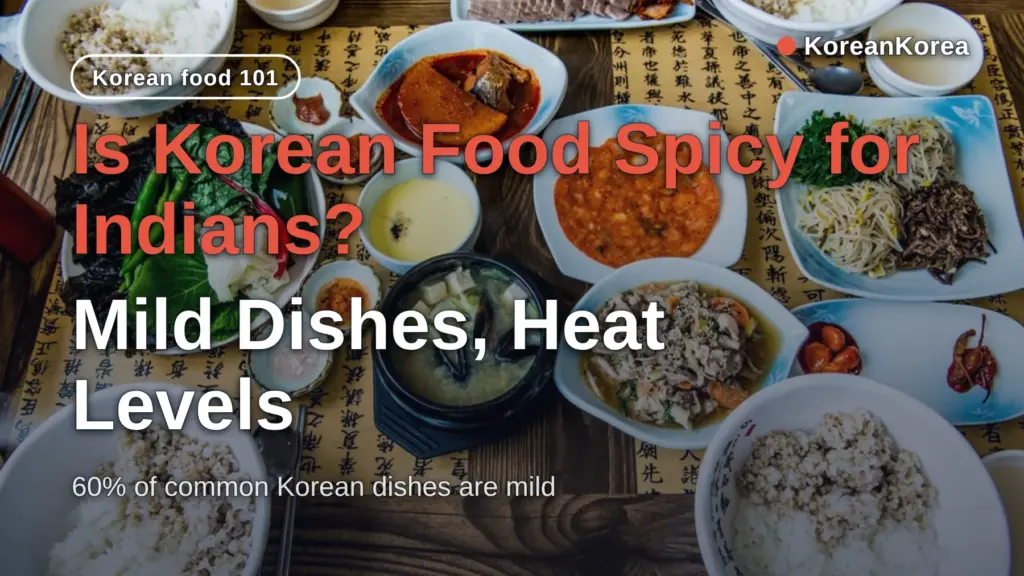
For most Indians, Korean food is milder than home: a 2026 tourist dish tally puts roughly 6 in 10 commonly ordered Korean dishes at non-spicy or mild.
Everyday Korean heat comes from gochugaru chili flakes, which measure 4,000-10,000 SHU — below the cayenne-band chili powder used across Indian cooking.
This post maps Korean spice levels to Indian regional baselines, lists the mild dishes, and shows which orders you can control and which hot items actually test an Indian palate.
Is Korean Food Spicy for Indians? The Short Answer
| Level 0-1 (non-spicy or mild) | Gimbap, gyeranjjim (steamed egg), samgyetang, kongguksu, bindaetteok, galbitang, janchi guksu, bulgogi, doenjang jjigae |
|---|---|
| Level 2-3 (hot) | Tteokbokki, kimchi jjigae, kimchi itself, buldak (fire chicken), yukgaejang, cheongyang-pepper dishes |
| What it means for an Indian diner | Only the bottom row carries real heat; most of a Korean menu sits at level 0-1 |
Mostly no for everyday dishes.
On KoreaLocally’s 2026 tourist spice scale, roughly 6 in 10 commonly ordered Korean dishes are non-spicy or mild, and level 0-1 goes to gimbap, samgyetang, galbitang and bulgogi.
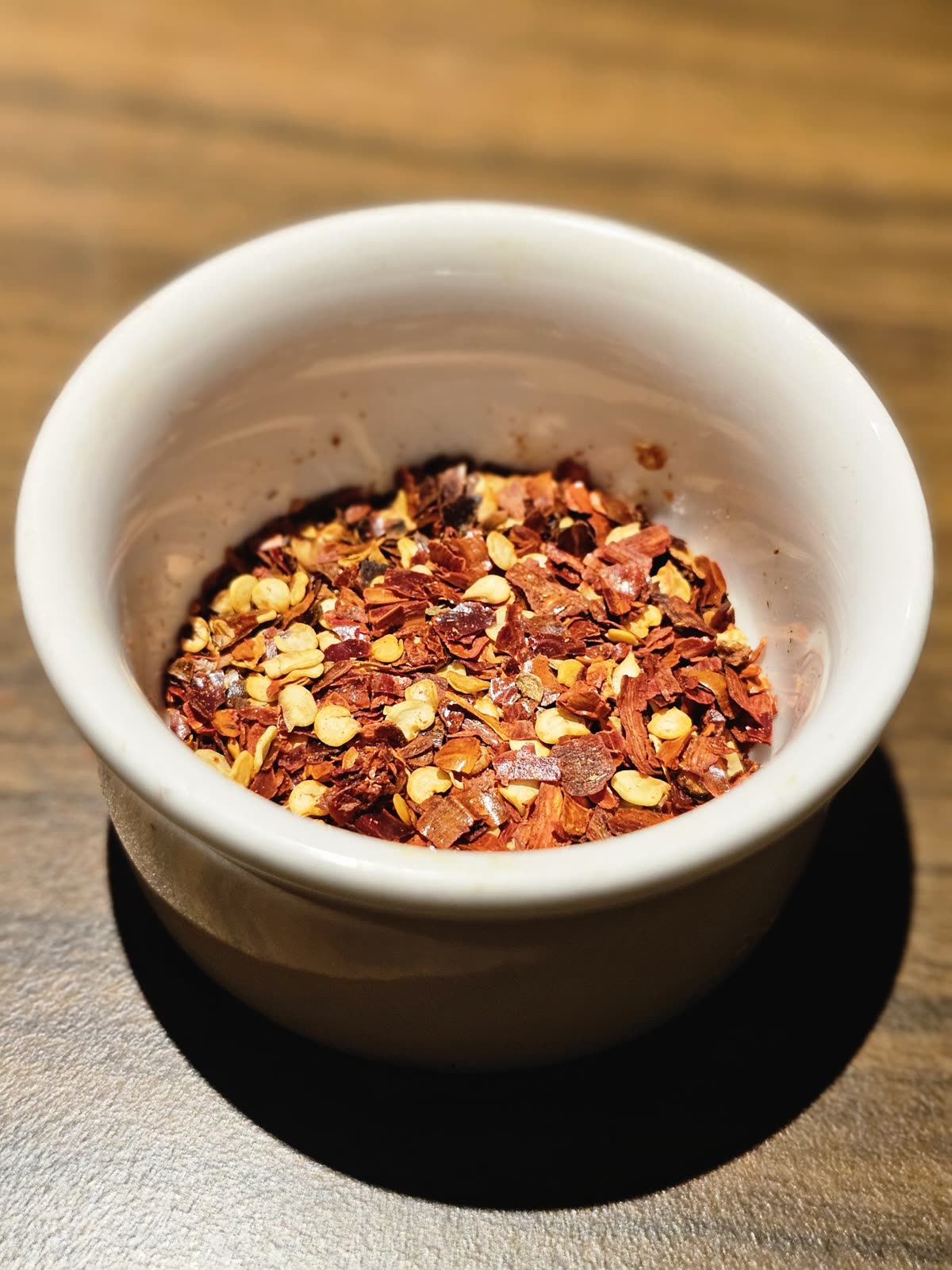
Korean heat comes almost entirely from gochugaru and gochujang, which measure roughly 4,000-10,000 SHU — below cayenne at 30,000-50,000 SHU, the band typical Indian chili powder sits in.
There is no single ‘Indian’ baseline to compare against.
Gujarati and many North Indian home styles are mild, while Andhra, Rajasthani and Goan vindaloo cooking rank among the hottest in India, so the honest answer splits by your home region.
If your daily food is a mild North Indian or Gujarati style, Korean everyday dishes will feel easy and only tteokbokki and kimchi jjigae need care.
If you grew up on Andhra or vindaloo heat, everyday Korean dishes will taste mild and you will need to order the hot end on purpose.
Korean Spice Levels 0-3 Mapped to Indian Regional Heat
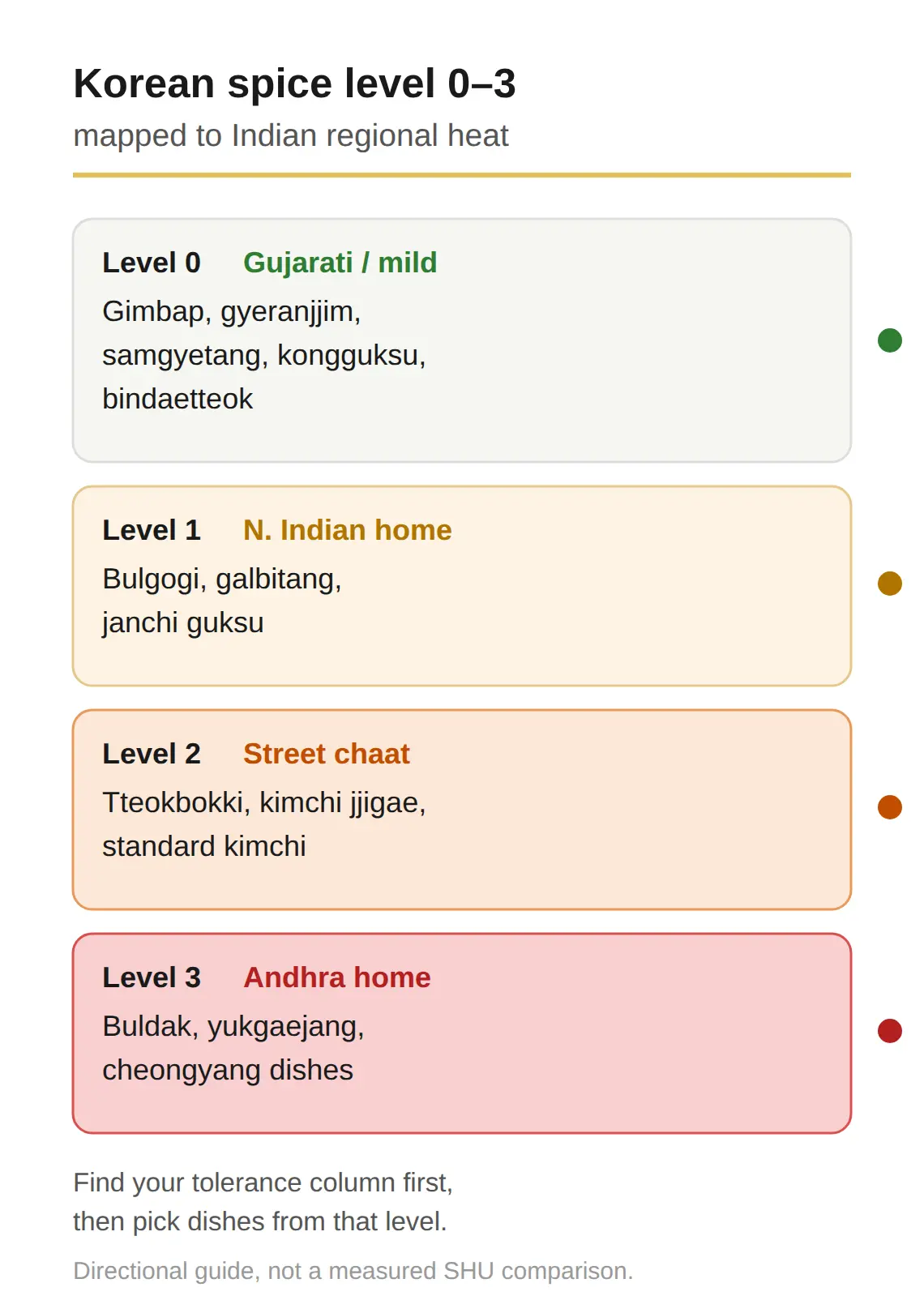
KoreaLocally rates each dish on a 0-3 scale for tourists, and the three levels line up cleanly against three Indian regional baselines.
No 2026 source does this mapping, so the alignment is assembled here from the Korean dish ratings plus Indian cuisine baselines — treat the alignment as directional, not a measured SHU comparison.
India, not Korea, is the world’s largest producer and exporter of dried chilli per APEDA data, so Indian readers arrive with a daily-trained heat baseline that most tourists do not have.
Use the levels to place yourself first, then pick dishes from the column that matches your tolerance.
| KoreaLocally level | Example dishes | Rough Indian baseline |
|---|---|---|
| 0 | Gimbap, gyeranjjim, samgyetang, kongguksu, bindaetteok | Gujarati and mild North Indian home food |
| 1 | Bulgogi, galbitang, janchi guksu | Everyday North Indian home cooking |
| 2 | Tteokbokki, kimchi jjigae, standard kimchi | City street-chaat heat |
| 3 | Buldak, yukgaejang, cheongyang-pepper dishes | Andhra home-style heat |
Korean Dishes That Are Actually Mild for Indian Palates
The reliably mild set covers a full day of eating: samgyetang (ginseng chicken soup), galbitang, seolleongtang, gimbap, bindaetteok, hotteok, jjajangmyeon, baek kimchi and doenjang jjigae.
Doenjang jjigae, the soybean-paste stew, sits at level 0-1 — it is the everyday swap for kimchi jjigae, which sits at 2-3.
Gimbap and jajangmyeon are non-spicy defaults on almost every menu, meaning two of the cheapest and most widespread meals in Korea carry no chili at all.
If you are vegetarian, skip the meat-based half of that list (samgyetang, galbitang, seolleongtang).
The mild vegetarian overlap is plain gimbap, japchae, bindaetteok and pajeon — this cross-list is the part most existing guides miss.
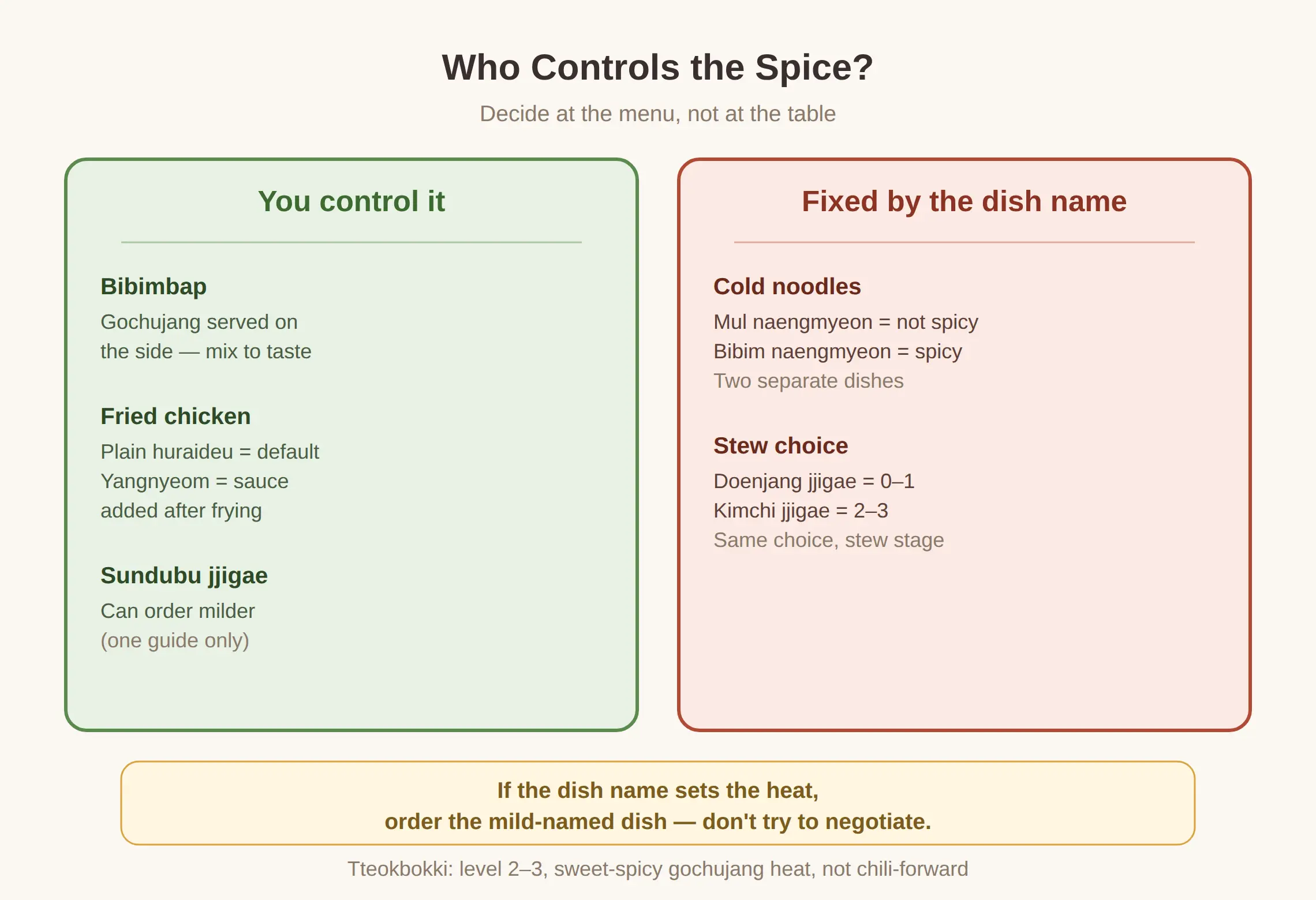
For a full meal where every burn level is chosen rather than a surprise, order bibimbap with gochujang on the side plus doenjang jjigae instead of kimchi jjigae.
Dishes Where You Control the Spice — and Where You Can’t
Some orders let you set the heat; others are fixed by the dish itself, so the choice happens at the menu, not at the table.
The split below matters most when a menu has no spice labels.
The fixed ones are decided by dish name: mul naengmyeon is the non-spicy cold noodle and the spicy version is a separate dish (bibim naengmyeon), and doenjang jjigae (0-1) versus kimchi jjigae (2-3) is the same choice at the stew stage.
Tteokbokki sits at level 2-3 but its heat is gochujang sweet-spicy rather than chili-forward, which is why guides still call it a medium first-timer test.
Spice-controlled orders | Spice-fixed orders — | — Bibimbap — gochujang served on the side, so heat is fully user-controlled | Mul naengmyeon (non-spicy) vs bibim naengmyeon (spicy) — two different dishes Korean fried chicken — plain huraideu is the default; yangnyeom is a sweet-spicy sauce coating added after frying | Doenjang jjigae (level 0-1) vs kimchi jjigae (level 2-3)
When a dish name decides the heat, order the mild-named dish instead of trying to negotiate a spicy one down.
How to Order Non-Spicy Food in Korea (and the Hidden Risks)
When a menu has no spice labels, ask staff for ‘an mapge’ (not spicy) — KoreaDesk’s guide for first-time visitors explicitly tells travelers to request mild versions of soups and stews this way.
Follow it with these steps.
- Ask for ‘an mapge’ (not spicy) when nothing on the menu is marked.
- Take one small bite of each banchan (side dish) before loading your plate — many, like namul and braised dishes, look mild but carry gochugaru.
- Choose baek kimchi (white kimchi, no chili) or dongchimi (water kimchi) instead of standard kimchi if you want zero heat with your meal.
- Pick street food from the mild set: hotteok (sweet pancake), gyeran-ppang (egg bread), plain tornado potato, or eomuk fish cake with broth you can taste first.
- If something runs hot, sikhye (sweet rice drink) or convenience-store milk is the practical cooler, since Korean dishes rarely come with a raita-style dairy side.
The same dish name does not guarantee the same heat: standard napa kimchi varies by region and maker, so one harmless kimchi at lunch does not promise the same at dinner.
When Korean Food Does Beat Indian Heat: Buldak and the Hot End
Korean food’s reputation for extreme spice comes from challenge foods, not daily meals.
The standout is Samyang’s Buldak (fire chicken) instant line, which third-party tests and widely cited figures place well above everyday Korean restaurant heat — that instant-noodle outlier, not a stew, is what most people know as ‘spicy Korean food.’
The everyday numbers tell the real story.
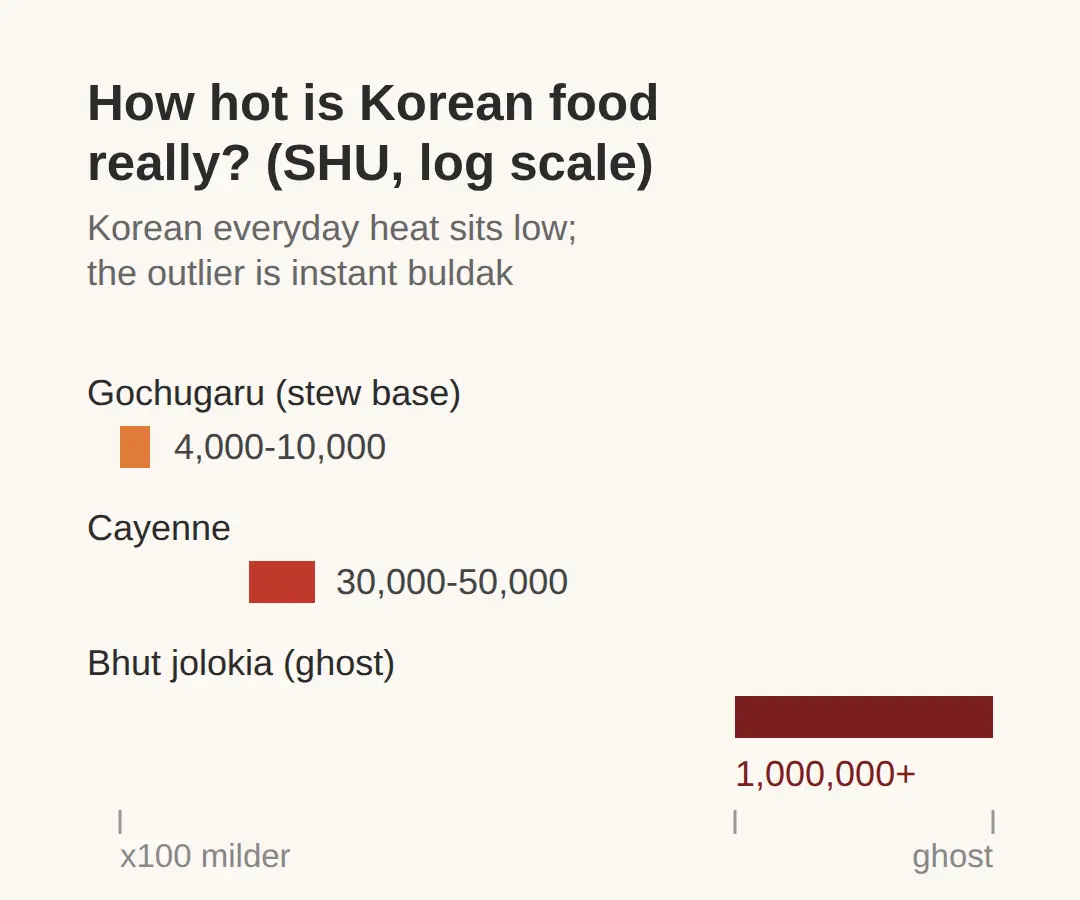
Gochugaru, the base heat of most Korean stews, measures roughly 4,000-10,000 SHU — below cayenne (30,000-50,000 SHU) and roughly 100x milder than bhut jolokia, the Northeast Indian ghost pepper certified above 1,000,000 SHU by Guinness World Records.
Even Korea’s level-3 dishes are described by one 2026 guide as roughly Andhra home-style heat rather than phaal.
If you tolerate heat and want to actually test yourself in Korea, order deliberately from the hot end: buldak stir-fry, extra-spicy or roe-mayak tteokbokki variants, jjambong (spicy seafood noodle soup), or dishes with cho gochujang (vinegared chili paste).
Everyone else can eat comfortably for a week without touching any of them.
If I were eating with someone from a mild-Indian-heat background, I’d keep level-3 dishes as a shared dare rather than a solo order, because a full bowl of jjambong is the kind of heat that ends the meal for them.
What I’d check first at the table is the gochugaru-based stews, not the instant-noodle shelf — that is where the everyday heat actually sits.
Related posts
📎 📅 Upcoming Dates — Release & Event Calendar
Sources
- No recent direct Korea-vs-India heat comparison source exist (korealocally.com)
- Temple cuisine is vegetarian and chili-light (koreatravellab.com)
- One guide says heat is negotiable; single source (coreadesk.com)
The One-Line Answer by Situation
- Mild Indian home eater (Gujarati, many North Indian styles) → everyday Korean food is easy; watch tteokbokki and kimchi jjigae only.
- Used to daily heat? Level-2 dishes will feel mild to you — scan the menu for level-3 picks like jjambong, yukgaejang or buldak stir-fry before ordering.
- Vegetarian traveler → rely on plain gimbap, japchae, bindaetteok and pajeon, not the meat-based mild stews.
- First-time visitor at an unlabeled menu → say ‘an mapge’, or pick a spice-controlled order like bibimbap or plain fried chicken.
- Worried about side dishes → taste one small bite of banchan first; pick baek kimchi or dongchimi if standard kimchi burns.
FAQ
Q. Is Korean food spicy for Indians overall?
Mostly no. About 6 in 10 commonly ordered Korean dishes are non-spicy or mild on KoreaLocally’s 2026 tourist scale, and everyday Korean heat (gochugaru, 4,000-10,000 SHU) sits below cayenne-band Indian chili powder.
Q. Which Korean dishes are actually mild for Indian palates?
Samgyetang, galbitang, seolleongtang, gimbap, bindaetteok, hotteok, jjajangmyeon, baek kimchi and doenjang jjigae. Vegetarians should use plain gimbap, japchae, bindaetteok and pajeon instead.
Q. Is gochujang hotter than Indian chili powder?
No. Gochugaru and gochujang are commonly referenced at roughly 4,000-10,000 SHU, below cayenne at 30,000-50,000 SHU, the band typical Indian red chili powder sits in. Treat the range as a widely repeated reference, not a certified figure.
Q. How do I ask for non-spicy food in Korea?
Ask staff for ‘an mapge’ (not spicy), or choose dishes where the mild version is the default — mul naengmyeon, plain huraideu fried chicken, bibimbap with gochujang on the side.
Q. Is buldak hotter than typical Indian dishes?
Buldak instant products are the outlier in Korean food and sit well above everyday Korean restaurant heat; even Korea’s level-3 dishes are described as roughly Andhra home-style heat, not phaal-level.
Check the 0-3 dish table before your first meal in Korea, then keep the mild list handy for the days you want zero risk.
Cover photo: Free Korean cuisine set table — CC0 1.0
#Koreanfood #spicelevels #Indiantravelers #mildKoreandishes #tteokbokki #gochujang #Koreatraveltips
📅Upcoming Schedule — this week 21 · D-day Global rollout / overseas restock of September launches typiSee all →