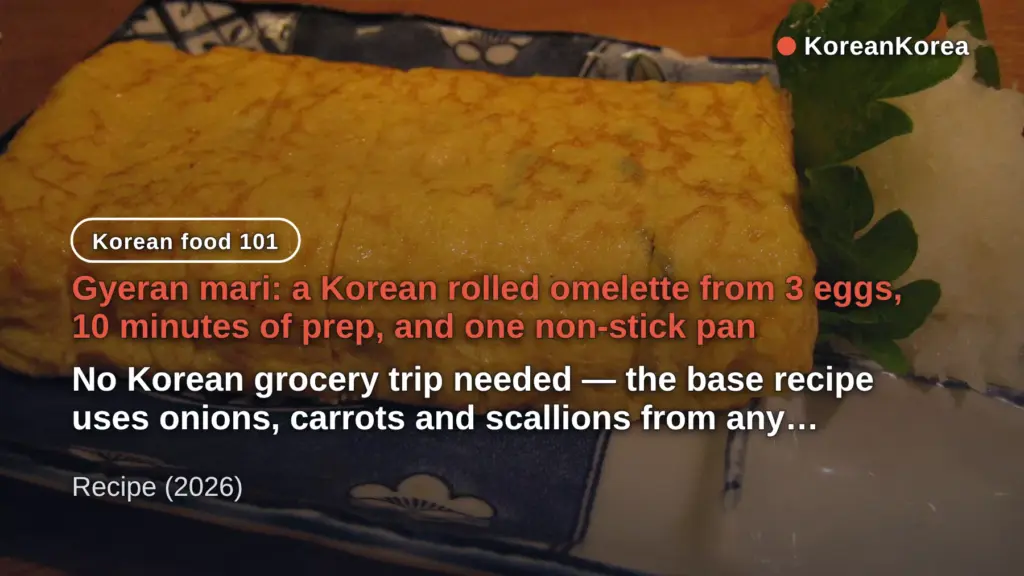
Gyeran mari (계란말이, Korean rolled omelette) is made from 3 eggs, chopped scallion and carrot, cooked in 2-3 thin layers in a non-stick pan over medium-low heat — about 15 minutes total, serving 2.
Every base ingredient is a standard supermarket item outside Korea, so you can make it without a Korean grocery trip.
This post has the full step list, an ingredients table with metric amounts, substitutes, the seaweed version, and fixes for a roll that breaks or stays runny.
Key facts — As of 2026-10-03
- The Korean Bapsang 3-egg version serves 2 in about 15 minutes total — 10 minutes prep and 5 minutes cook in a 9-10 inch non-stick pan.
How to Make a Korean Rolled Omelette at Home
| Eggs | 3 large eggs (about 150 g) |
|---|---|
| Scallion | 1-1.5 tbsp finely chopped (about 5-7 g) |
| Carrot | 1-1.5 tbsp finely chopped (about 8-10 g) |
| Salt | About 1/8 tsp |
| Black pepper | A pinch |
| Oil | 1 tsp vegetable oil for the pan |
| Prep | 10 minutes (approx.) | Cook: 5 minutes (approx.) | Total: 15 minutes |
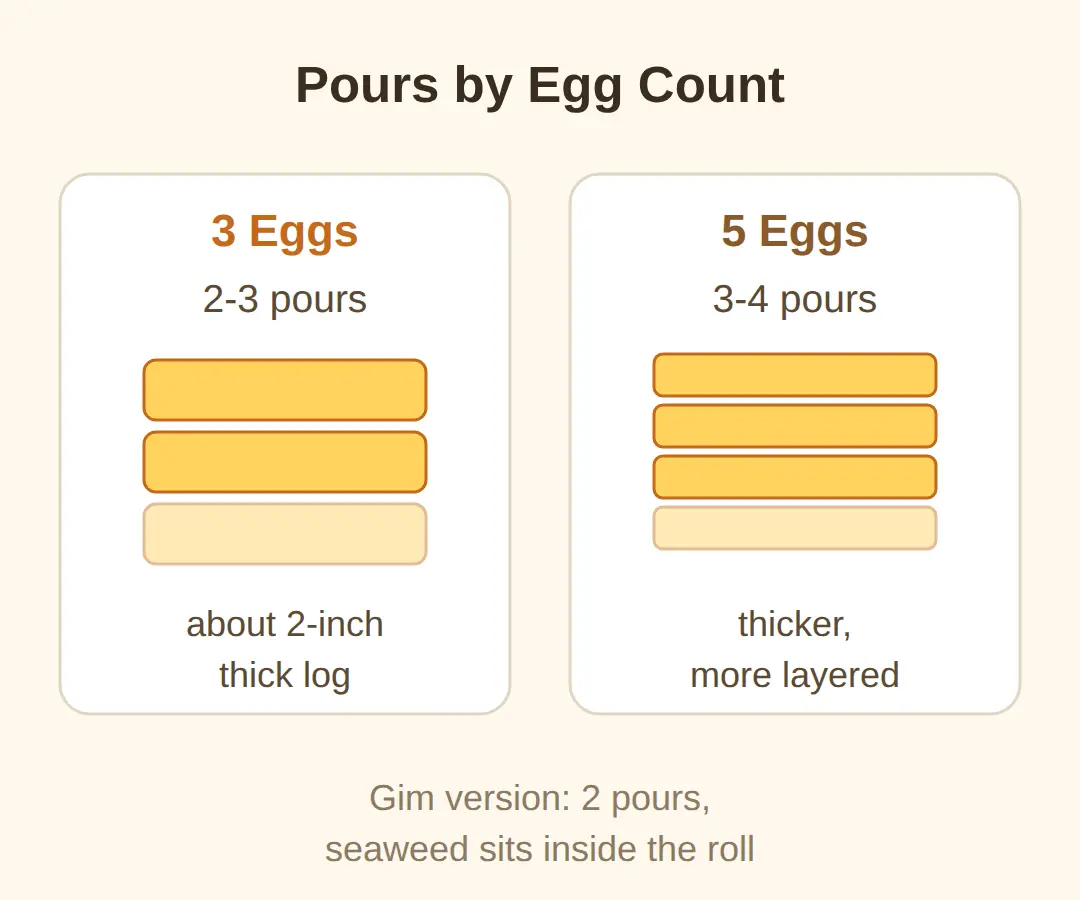
Pour the egg mixture in 2-3 thin layers into a preheated 9-10 inch non-stick pan over medium-low heat, rolling after each layer.
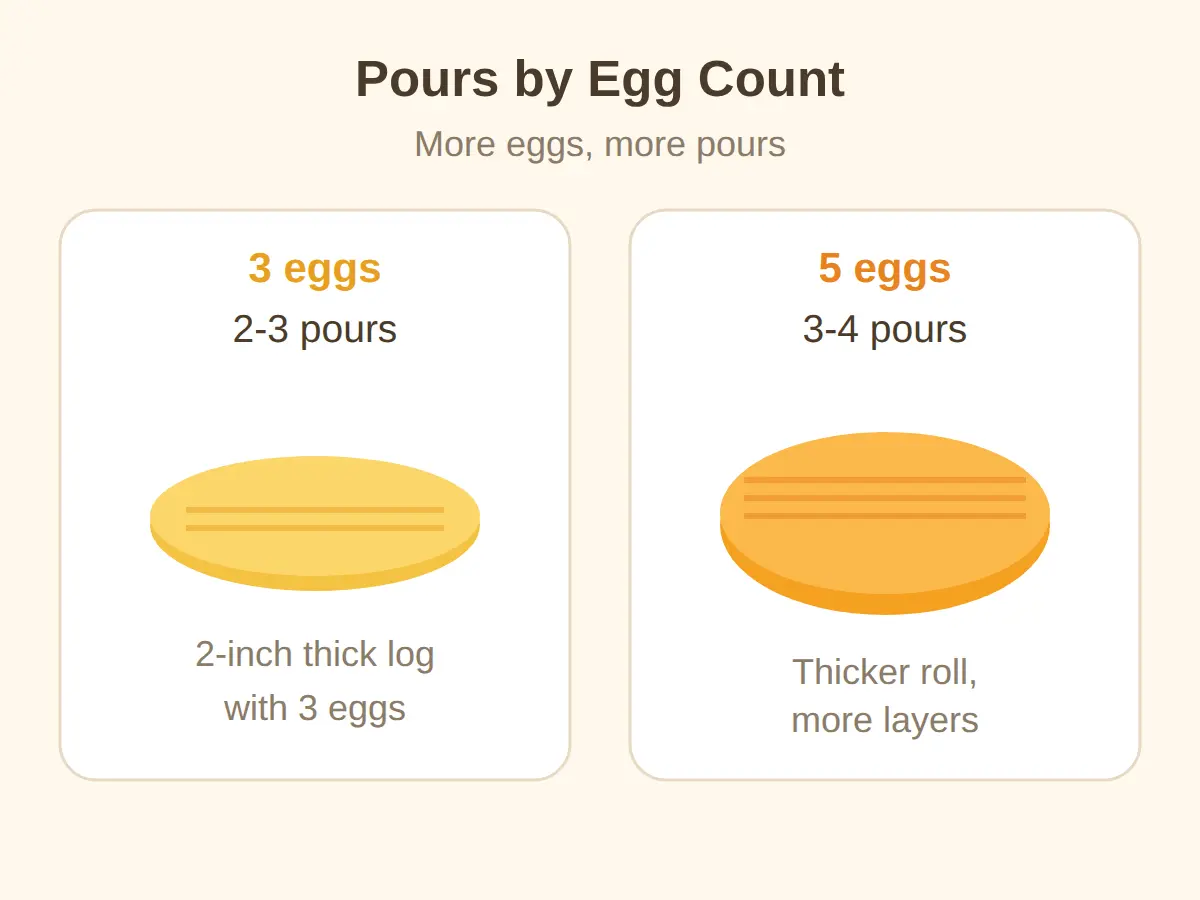
A 3-egg log is built from 2-3 pours, and each layer cooks 1-2 minutes until the bottom sets but the top is still slightly runny.
| Step | Action |
|---|---|
| 1 | Beat the eggs until yolks and whites are fully blended, with no visible strings of whites left. |
| 2 | Stir in salt, pepper, and the chopped scallion and carrot. |
| 3 | Set a 9-10 inch non-stick pan over medium-low heat; it is ready when it feels hot with your hand 2-3 inches above the bottom. |
| 4 | Wipe a thin film of oil evenly over the pan with a paper towel. |
| 5 | Pour a thin layer of egg and tilt the pan to coat it evenly. |
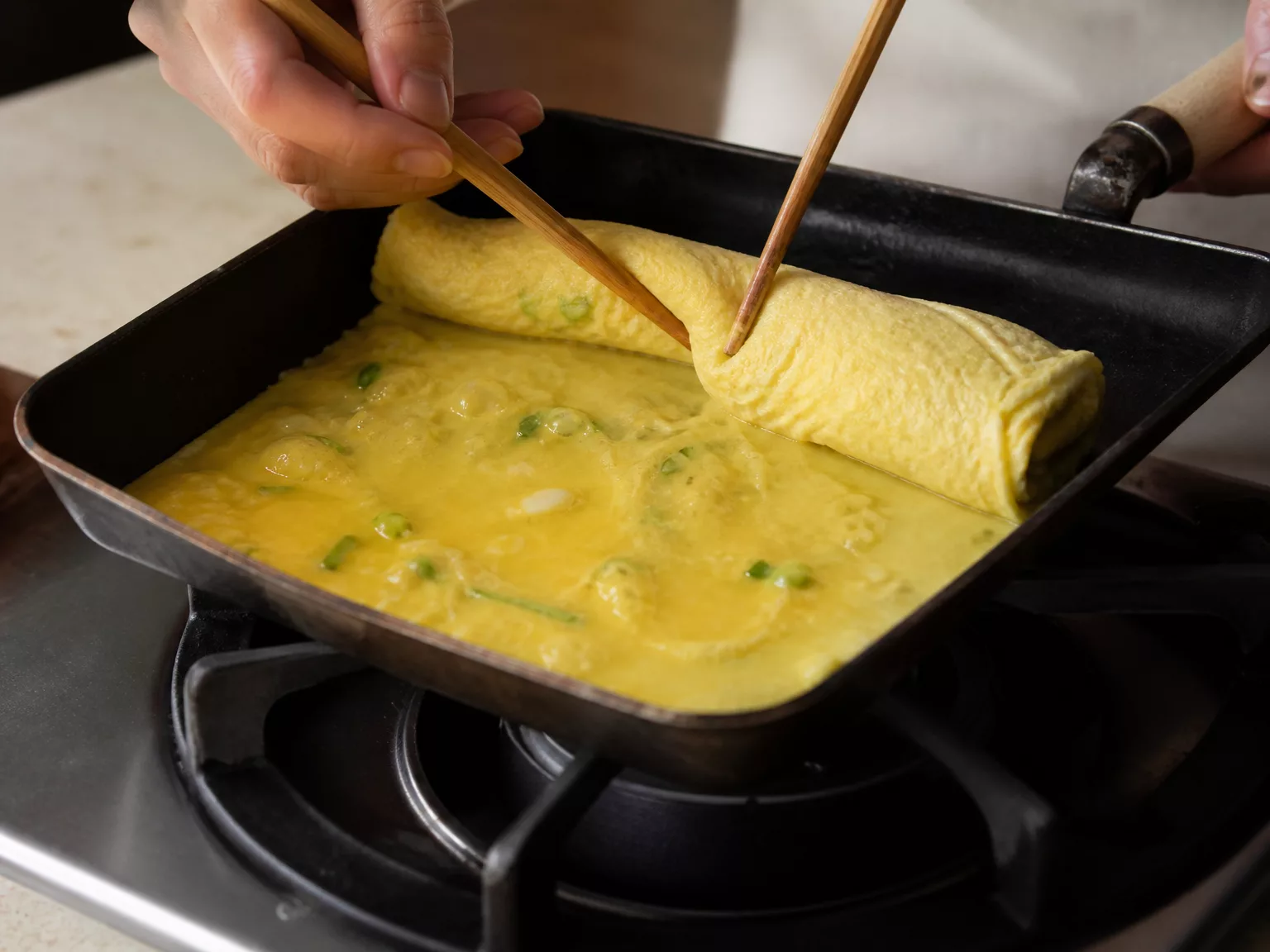
| 6 | When the egg is set but still slightly wet on top, roll it up from one end using a spatula, a spoon, or chopsticks in both hands. |
| 7 | Pull the roll to one side, oil the empty space, and pour the next portion so it runs under the roll. |
| 8 | Repeat 2-3 times for 3 eggs, until all the egg is used. |
| 9 | Reduce the heat to low and turn the roll so all 4 sides brown evenly, about 3-4 minutes. |
| 10 | Cool about 5 minutes, then cut crosswise into 1/2 to 1-inch thick slices. |
If you want thicker rolls, use a smaller skillet; a small pan makes the log thicker with the same number of eggs.
Ingredients
Main
- 3 large (about 150 g) Eggs — beaten until fully blended
- 1–1.5 tbsp (5–7 g) Scallion (파) — finely chopped
- 1–1.5 tbsp (8–10 g) Carrot (당근) — finely chopped
- 1 tsp Vegetable oil — wiped in a thin film over the pan
Sauce & seasoning
- about 1/8 tsp Salt
- a pinch Black pepper
Amounts are the ones used in this recipe; where the recipe gives no amount, adjust to taste.
Gyeran Mari Ingredients: Metric Amounts, Serves 2
Korean Bapsang’s 3-egg list uses about 1/8 tsp salt and serves 2 in 15 minutes.
Maangchi’s 4-egg list uses 1 tsp kosher salt, half a minced onion, and optional bell peppers, so it makes a bigger, onion-forward roll.
| Item | Korean Bapsang (3 eggs) | Maangchi (4 eggs) |
|---|---|---|
| Eggs | 3 large (about 150 g) | 4 large |
| Main vegetable | 1-1.5 tbsp scallion + 1-1.5 tbsp carrot (5-7 g + 8-10 g) | 1/2 medium onion, minced |
| Optional vegetable | — | 1 tbsp each minced green and red bell pepper (or carrot) |
| Salt | About 1/8 tsp | 1 tsp kosher salt |
| Pepper | Pinch of black pepper | 1/4 tsp ground black or white pepper |
| Serves | 2 | Larger roll, more servings |
Both versions use a medium or large non-stick skillet.
What Can I Use Instead of Korean Ingredients?
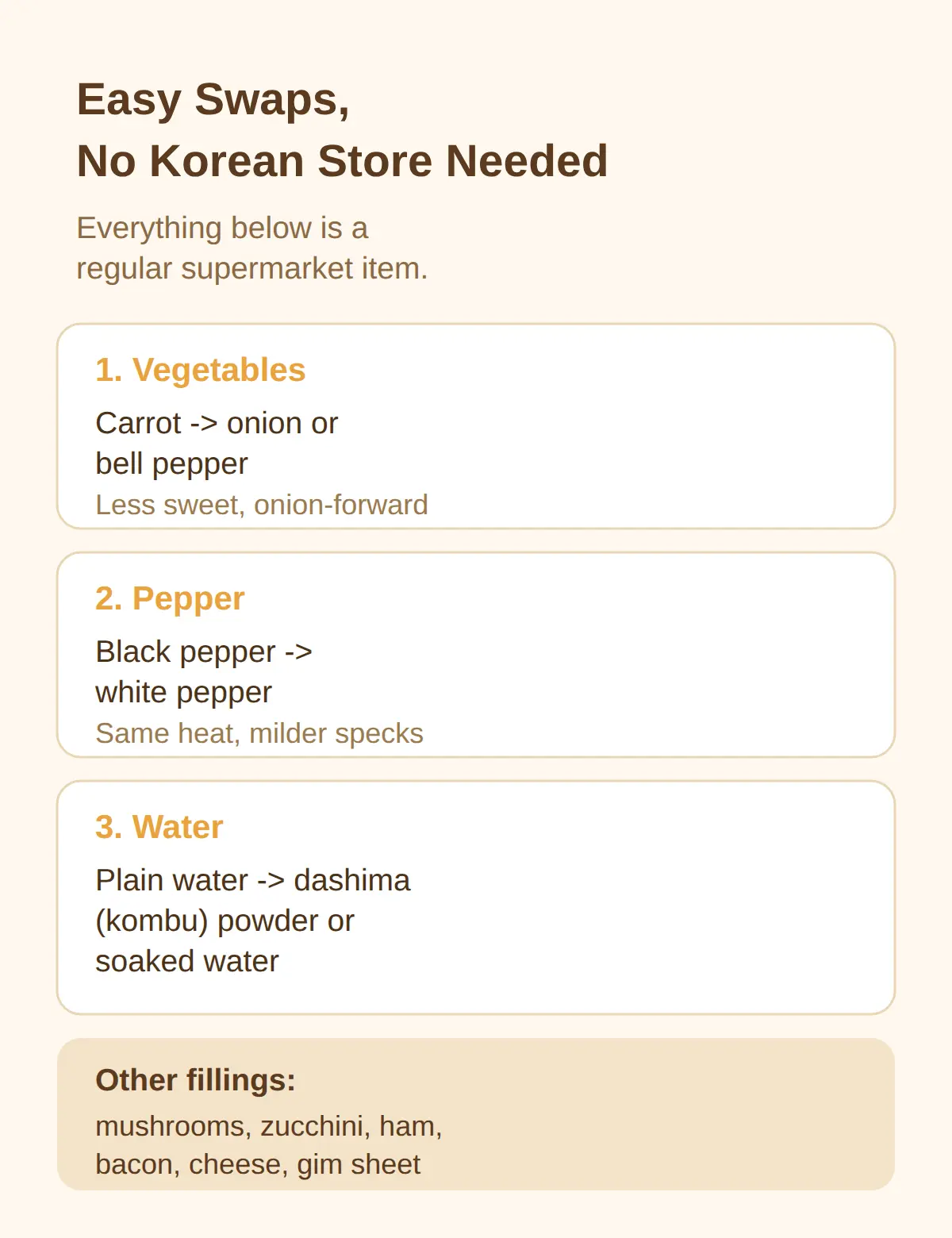
For the base recipe you need nothing Korean at all — onion, bell pepper, carrot, and scallion are all regular supermarket items.
| Instead of | Use | What changes in taste |
|---|---|---|
| Carrot | Onion or bell pepper | Onion-forward, less sweet filling |
| Black pepper | White pepper | Same heat, milder specks |
| The usual scallion and carrot | Mushrooms, zucchini, garlic chives, ham, bacon, cheese, or a gim sheet | Filling changes flavor and color |
| Plain water to thin the eggs | Dashima (kombu) powder or dashima-soaked water | Adds umami depth without extra salt |
Many recipes also season the egg with 1-2 tsp cooking wine (mirin), a little sugar, or dashes of fish sauce, though amounts vary widely between recipes — treat these as optional.
A widely used upgrade is dashima (kombu) powder or soaking dashima in water and using that to thin the eggs, which adds savory depth without extra salt.
If I were making this abroad, I would start with Maangchi’s onion base because every ingredient is at the regular supermarket, then add gim from a Korean grocery later if I want the seaweed version.
One limit to keep in mind: too many fillings make the egg mixture hard to roll up, so pick one or two, not five.
How Do I Make the Seaweed (Gim) Version?
The gim version needs only 2 pours instead of 2-3, because the seaweed sheet sits inside the roll.
The layering order is published, not guesswork: pour 2/3 of the egg mix, lay 1 full sheet of gim on the half-set egg, then pour the remaining 1/3 over it and roll once.
A little of the egg mixture acts as glue to hold the sheet in place, and for extra layers you can add a half sheet on the final pour.
Steps:
- Beat and season the egg mixture as in the base recipe.
- Pour 2/3 of the mixture into the oiled pan over medium-low heat.
- When the egg is half set, lay 1 full sheet of gim on top.
- Brush or drizzle a little of the leftover egg over the gim as glue.
- Pour the remaining 1/3 of egg over the gim.
- When set but still wet on top, roll it all up in one turn.
- Brown all 4 sides on low for 3-4 minutes, cool 5 minutes, and slice.
If gim is hard to find, the plain vegetable version still works — gim changes the flavor and the look, not the technique.
Steps at a glance
-
1Beat and season the egg mixture as in the base recipe.
-
2Pour 2/3 of the mixture into the oiled pan over medium-low heat.🔥 medium-low heat
-
3When the egg is half set, lay 1 full sheet of gim on top.
-
4Brush or drizzle a little of the leftover egg over the gim as glue.
-
5Pour the remaining 1/3 of egg over the gim.
-
 AI-generated photo
What it should look like — AI-generated image of this step, made from the recipe text — not a photo of our kitchen. 6When set but still wet on top, roll it all up in one turn. -
7Brown all 4 sides on low for 3-4 minutes, cool 5 minutes, and slice.⏱ 3-4 minutes
Why Does My Egg Roll Break or Stay Runny Inside?
High heat is the main mistake — it makes tough eggs that break when folded, and too little cooking leaves the roll runny inside.
Keep the heat at medium-low to low the whole time, and lift the pan away from the burner if the bottom starts browning.
Each thin layer needs 1-2 minutes so the bottom sets while the top stays slightly wet, which is what lets the layers bond when you roll.
Overloading fillings is the second failure: too many vegetables make the mixture hard to roll and the roll falls apart at the fold.
A 3-egg log comes out about 2 inches thick in a 9-10 inch pan; if your log is much thinner and breaks, check that you used 2-3 pours rather than one thick pour.
| Symptom | Cause | Fix |
|---|---|---|
| Tough, breaks when folded | Heat too high | Medium-low to low; lift the pan off the burner if it browns |
| Runny inside | Layers undercooked | 1-2 minutes per layer before rolling |
| Hard to roll, falls apart | Too many fillings | One or two finely chopped vegetables only |
| Thin, fragile roll | Pan too large for the egg count | Use a 9-10 inch pan for 3 eggs, or 5 eggs for 3-4 pours |
If the roll is already cooked but ragged, a gimbap mat helps press it back into a neat rectangle before slicing.
What Is Gyeran Mari and When Do Koreans Eat It?
Gyeran mari is a Korean-style rolled omelette served as a side dish with any meal, not only breakfast.
It is one of the most common Korean lunchbox (dosirak) side dishes, because it looks good, goes well with rice, and stays fluffy-looking for hours in the box.
It also shows up as a standard side (banchan) at Korean BBQ restaurants, and street vendors sell a giant log version sliced to order.
It is salted on purpose, because it is meant to be eaten with rice — if you serve it as a snack on its own, cut the salt.
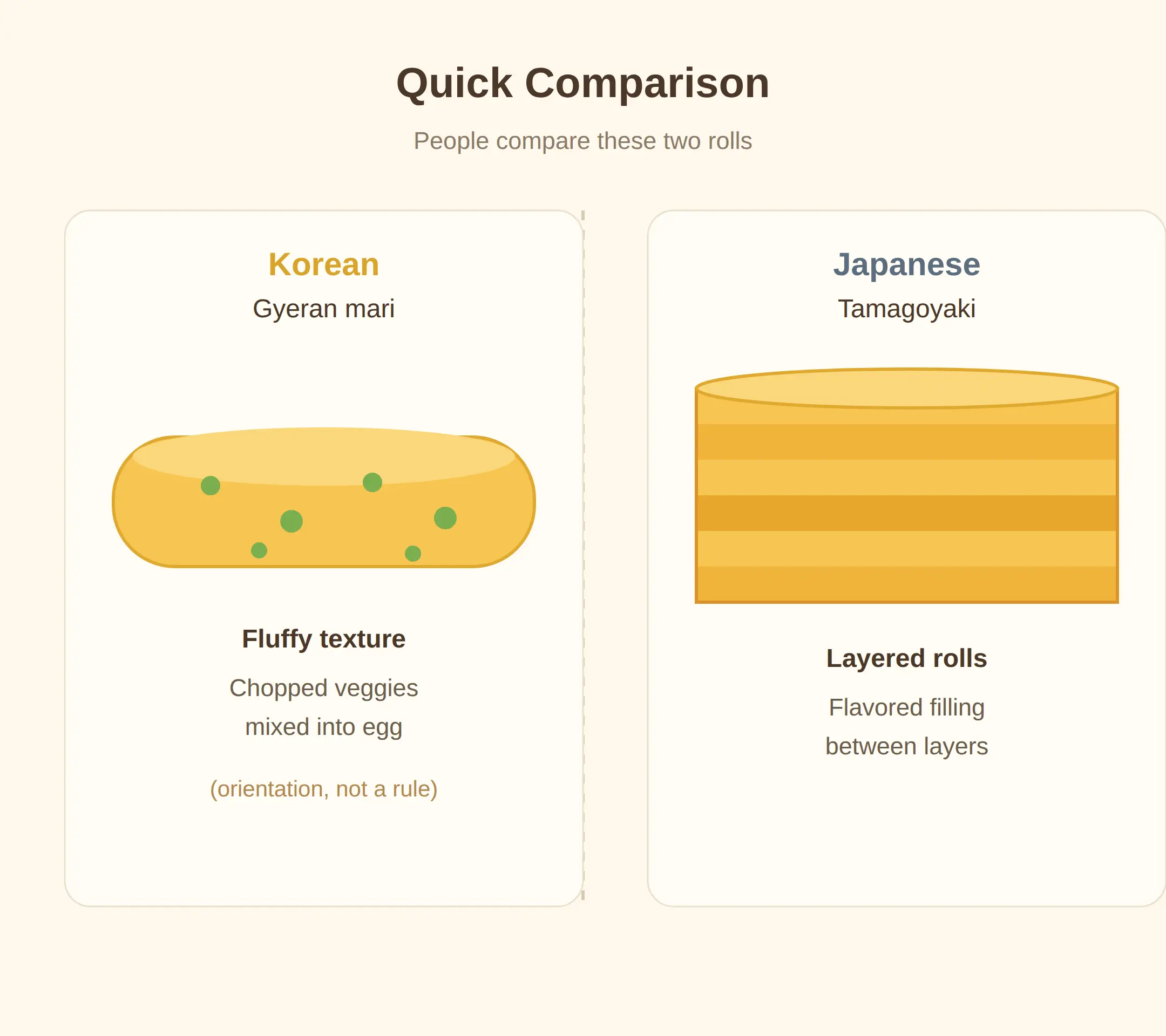
Gyeran mari is the Korean counterpart to Japanese tamagoyaki: the Korean version is typically fluffier, with chopped vegetables mixed into the egg, while tamagoyaki is layered as a flavored filling.
This is a comparison people make in recipes, not a published standard, so use it as orientation rather than a rule.
Per Maangchi, the omelette keeps 2-3 days in the fridge, and you can eat it cold or reheat it in the microwave.
Related posts
📎 📅 Upcoming Dates — Release & Event Calendar
Sources
- Korean Bapsang: 3 eggs, scallion+carrot, medium-low heat, 2- (koreanbapsang.com)
- Seaweed version ratios: 2/3 egg mix + 1 sheet gim, then 1/2 (koreanbapsang.com)
Quick Summary Before You Cook
- Pour count scales to egg count: 3 eggs = 2-3 pours (about a 2-inch log); 5 eggs = 3-4 pours for thicker rolls. These are guidelines, not rules.
- Medium-low heat the whole way, and lift the pan off the burner if the bottom browns.
- One or two finely chopped vegetables — too many fillings break the roll.
- It is salted to be eaten with rice; reduce the salt if serving it alone.
- Keeps 2-3 days in the fridge; eat cold or microwave.
FAQ
Q. How do I make a Korean rolled omelette at home?
Beat 3 eggs with no visible strings of whites, stir in salt, pepper, and chopped vegetables, then pour the mixture in 2-3 thin layers into a non-stick pan over medium-low heat, rolling after each layer. Total time is about 15 minutes for 2 servings.
Q. What can I use instead of Korean ingredients?
Onion, mushrooms, zucchini, bell pepper, garlic chives, ham, bacon, cheese, or gim all work as fillings — the base vegetables (onion, carrot, scallion) are standard supermarket items outside Korea.
Q. Why does my Korean rolled omelette break or stay runny inside?
High heat makes tough eggs that break when folded, and undercooking leaves the roll runny inside. Keep the heat at medium-low to low and cook each thin layer 1-2 minutes before rolling; also avoid overloading the egg with fillings.
Q. How do I make the seaweed (gim) version?
Pour 2/3 of the egg mix, lay 1 full sheet of gim on the half-set egg, pour the remaining 1/3 over it, and roll once. Use a half sheet on the final pour for extra layers.
Q. How long does gyeran mari keep, and how do I reheat it?
It keeps 2-3 days in the fridge, and the recipes say you can eat it cold or reheat it in the microwave — neither recipe compares reheated quality with eating it cold.
Tag this one: a 3-egg batch on Sunday keeps a lunchbox covered for the first half of the week.
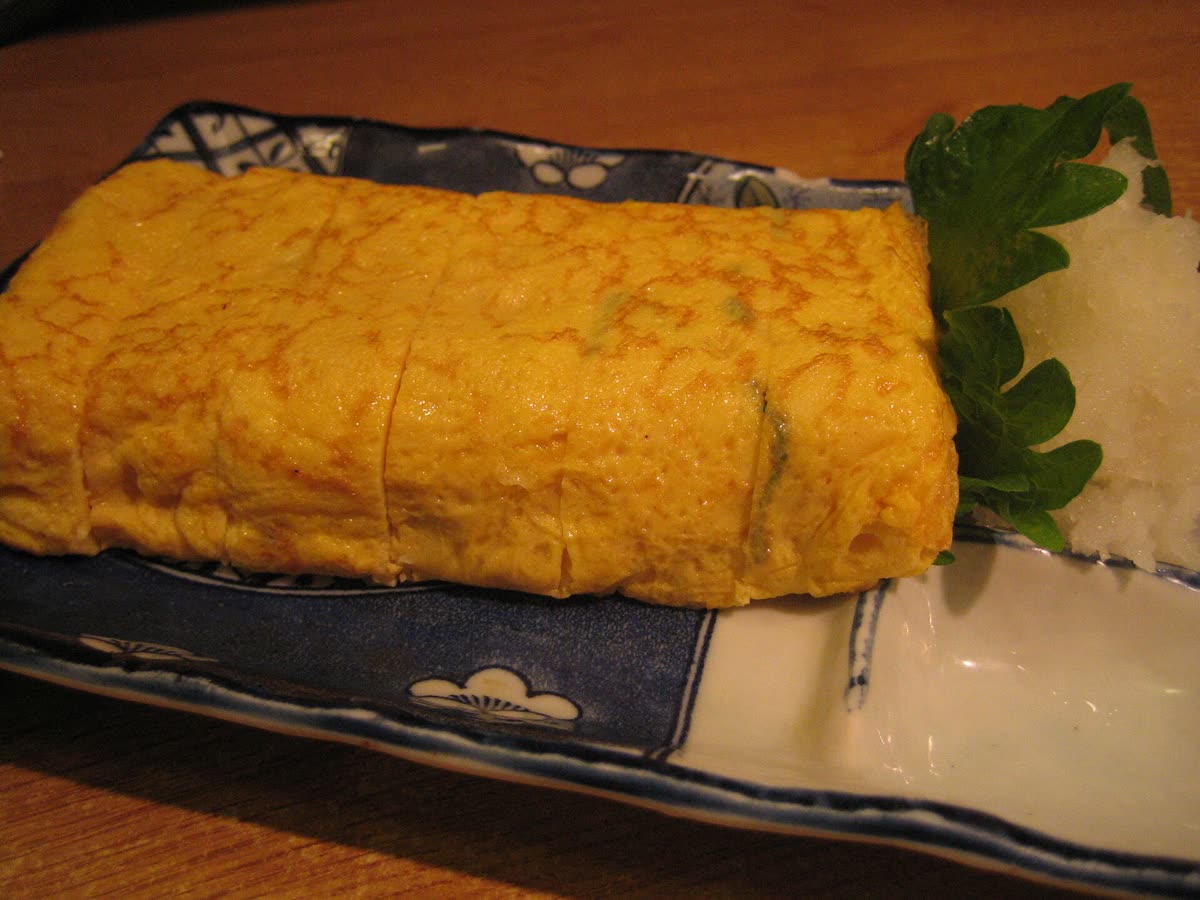
Cover photo: Tamago yaki by ayustety in Tokyo by ayustety from Tokyo — CC BY-SA 2.0
#koreanrolledomelette #gyeranmari #koreanrecipes #banchan #eggrecipes #lunchbox
📅Upcoming Schedule — this week 2 · D-2 Hangul DaySee all →