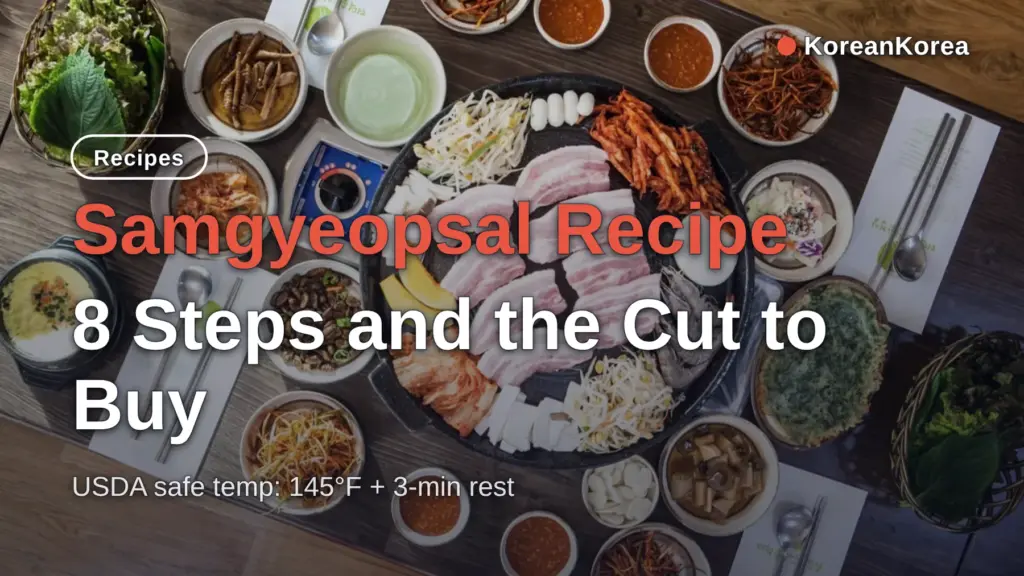
Samgyeopsal is grilled pork belly, and at home it takes one heavy pan: slices about 5-7 mm thick, no marinade, no oil, 2-3 minutes per side.
Everything around it — the wrap, the dip, the sides — you can build with supermarket and Asian-grocery items, and the three ingredients people worry about all have workable substitutes.
This post gives the ingredients table, an 8-step method, the exact cut to ask for when there is no Korean butcher, and oven and air fryer times.
Key facts — As of 2026-10-03
- USDA FSIS lists 145°F (63°C) with a 3-minute rest as the safe internal temperature for fresh pork whole cuts — no pink required, unlike the older 160°F guidance.
- Raw belly freezes well for 2-3 months if sliced and separated with parchment, so one bulk buy covers roughly 8-10 grill nights.
Samgyeopsal Recipe: the 8 Steps to Grill Pork Belly at Home
| Fresh, uncured pork belly (skin off) | 800 g (about 200 g per person) |
|---|---|
| Lettuce leaves (or red-leaf, green-leaf) | 2 heads, leaves separated |
| Perilla leaves (kkaennip) — optional | 20-30 leaves |
| Ssamjang paste (or the substitute below) | about 100 g |
| Toasted sesame oil + fine salt (classic dip) | 4 tbsp oil, 1 tsp fine salt |
| Garlic | 2 heads (1 whole for grilling, 2-3 cloves minced for paste) |
| Ripened (sour) kimchi, for the pan | about 200 g if available — optional |
Samgyeopsal means three-layer flesh, and the belly’s alternating layers of fat and meat are the whole point of the dish.
Traditional samgyeopsal uses no marinade: the belly is grilled plain, then seasoned at the table with salt, pepper and dipping sauce.
Salting before the pan draws out moisture, so hold the salt until the surface has browned.
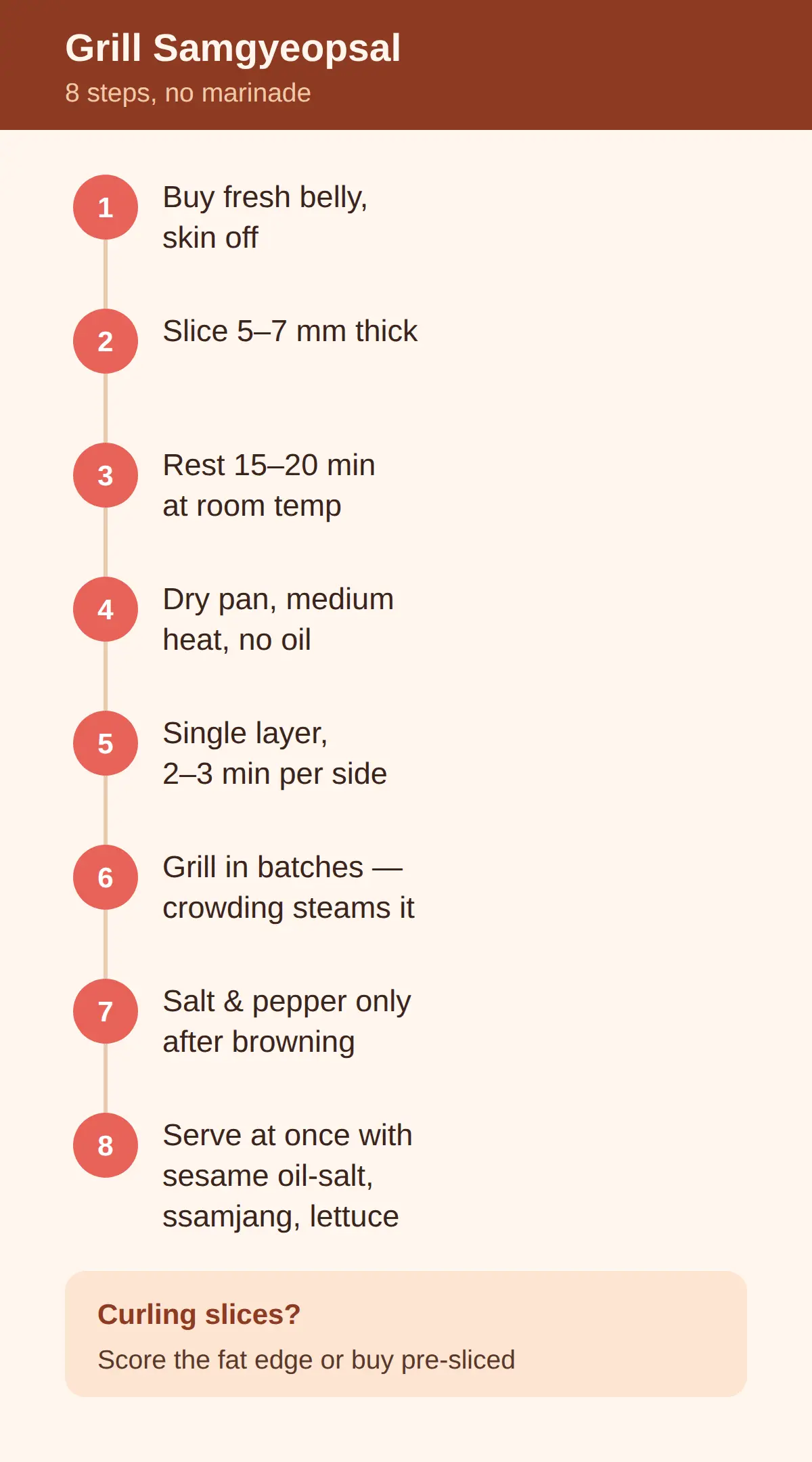
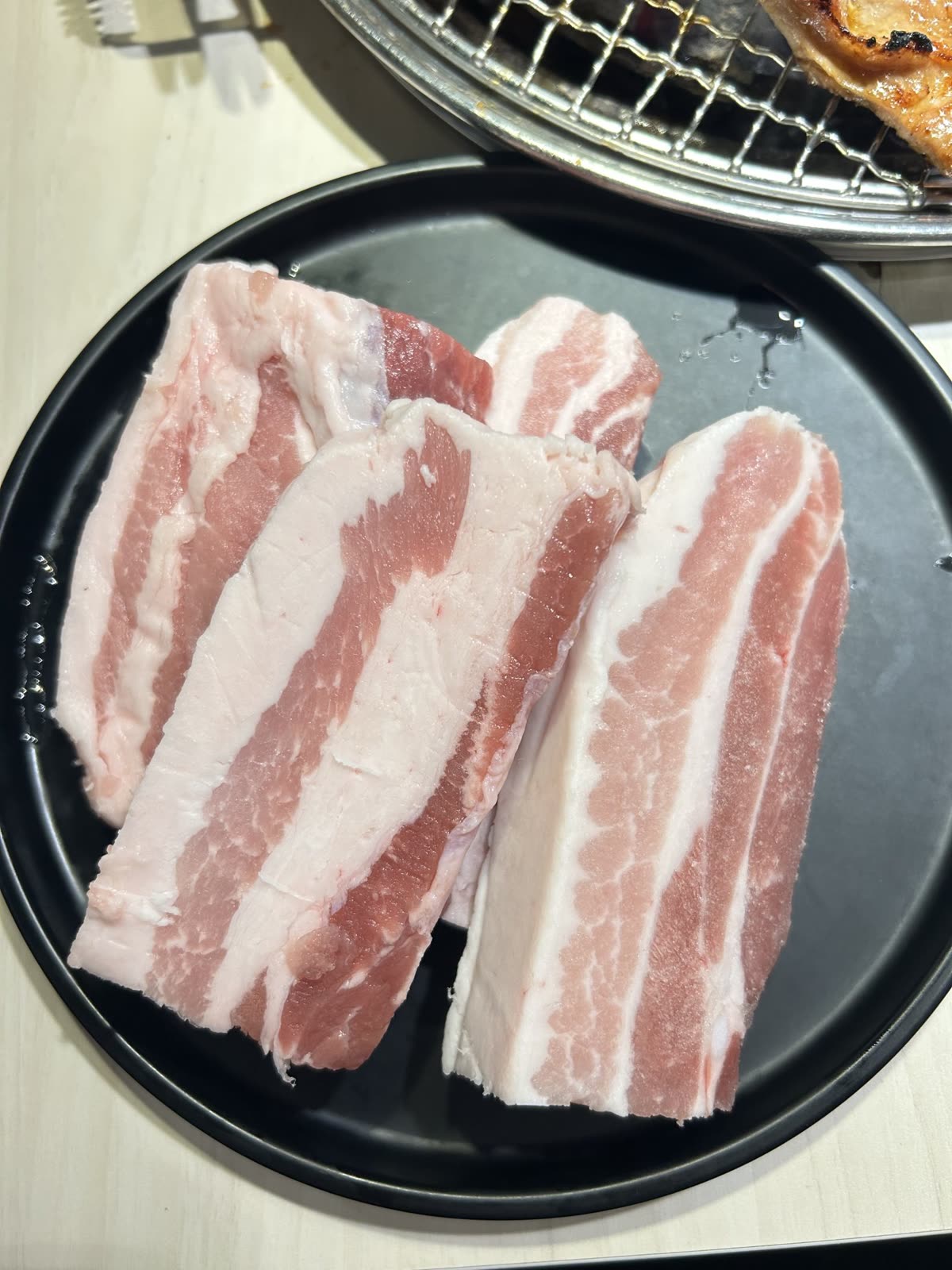
- Buy fresh, uncured pork belly with the skin off.
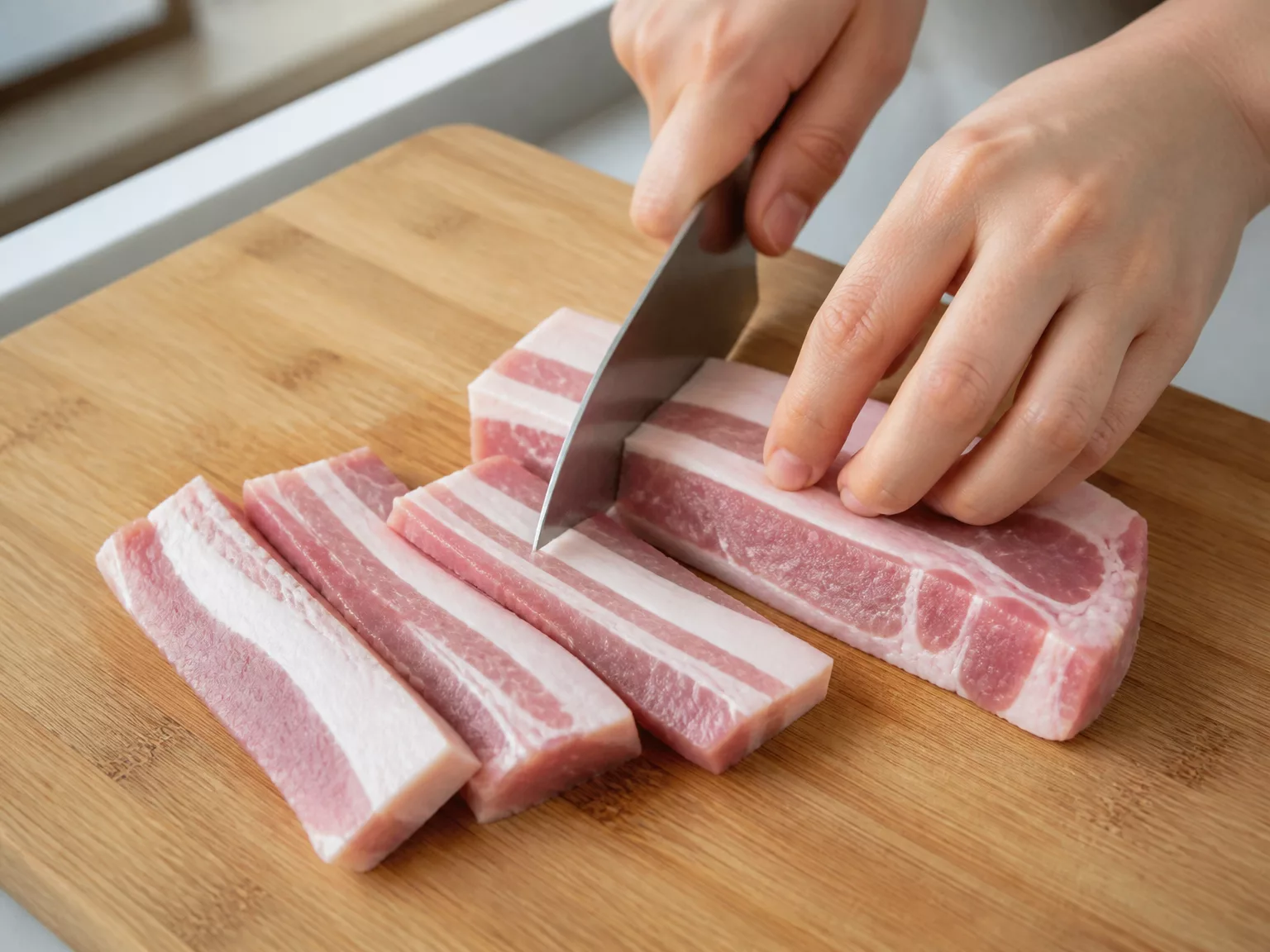
- Slice about 5-7 mm thick — thick enough to stay juicy on high heat.
- If the meat is straight from the fridge, rest it 15-20 minutes at room temperature so it cooks evenly.
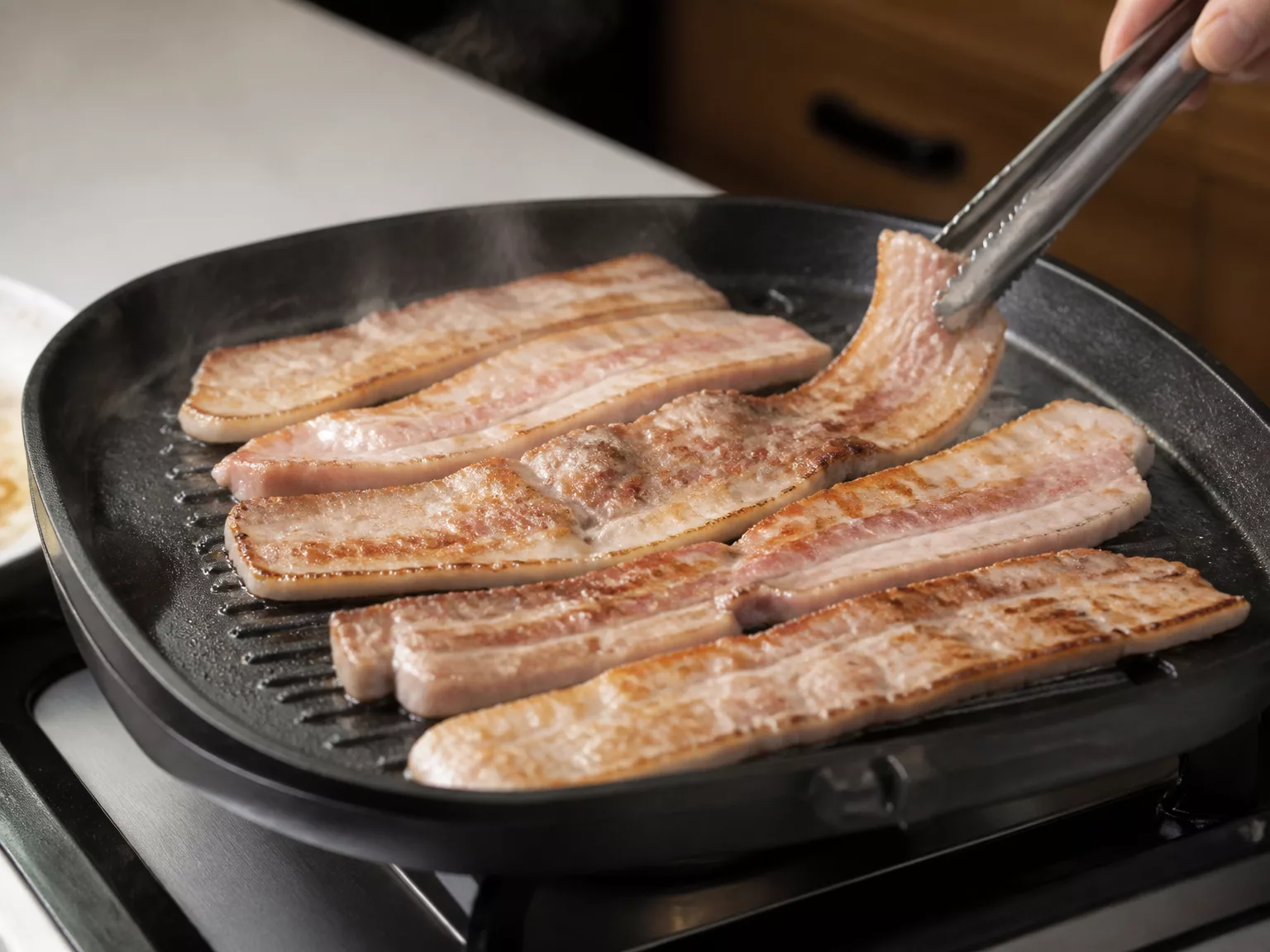
- Heat a dry cast-iron or heavy pan over medium heat — no oil, the fat renders on its own.
- Lay slices in a single layer and grill 2-3 minutes per side, about 4-6 minutes total.
- Work in batches; a crowded pan steams the meat instead of browning it.
- Season lightly with salt and pepper only after both sides are browned.
- Serve right away with sesame oil-salt, ssamjang and lettuce for wrapping.
If the fat edge makes the slices curl up, score it in a few places or buy pre-sliced — flat slices keep full contact with the pan.
Ingredients
Main
- 800 g fresh, uncured pork belly (skin off) — about 200 g per person; slice 5-7 mm thick
- 2 heads lettuce leaves — leaves separated, for wrapping
- 20-30 leaves perilla leaves (kkaennip) — the traditional second leaf for ssam
- about 200 g ripened (sour) kimchi — for the pan, fried in the rendered fat
Sauce & seasoning
- about 100 g ssamjang paste
- 4 tbsp toasted sesame oil — classic dip with fine salt
- 1 tsp fine salt — for the sesame oil-salt dip
- 2 heads garlic — 1 whole for grilling, 2-3 cloves minced for the paste
Amounts are the ones used in this recipe; where the recipe gives no amount, adjust to taste.
Steps at a glance
-
1Buy fresh, uncured pork belly with the skin off.
-
 AI-generated photo
What it should look like — AI-generated image of this step, made from the recipe text — not a photo of our kitchen. 2Slice about 5-7 mm thick🔥 high heat -
3If the meat is straight from the fridge, rest it 15-20 minutes at…⏱ 15-20 minutes
-
4Heat a dry cast-iron or heavy pan over medium heat🔥 medium heat
-
 AI-generated photo
What it should look like — AI-generated image of this step, made from the recipe text — not a photo of our kitchen. 5Lay slices in a single layer and grill 2-3 minutes per side, about…⏱ 2-3 minutes -
6Work in batches
-
7Season lightly with salt and pepper only after both sides are browned.
-
8Serve right away with sesame oil-salt, ssamjang and lettuce for…
What to Buy When There Is No Korean Butcher
Ask any butcher or Asian grocery for fresh pork belly, skin off, uncured — that is the whole requirement.
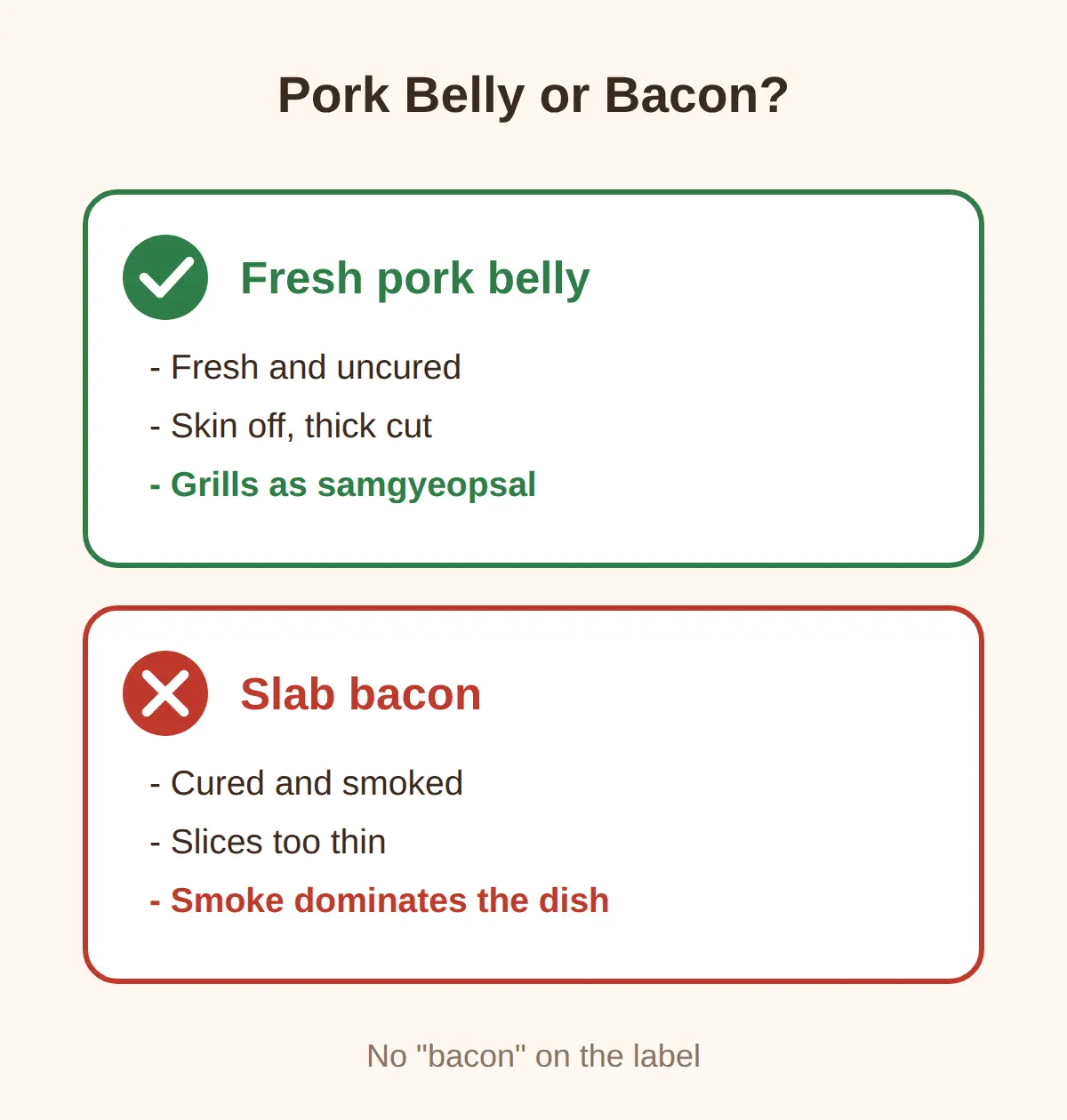
The slab bacon on the same shelf is the number one trap: it is cured and smoked, the slices are cut too thin, and the smoke and cure take over the dish.
If the label says bacon anywhere, it is the wrong cut.
A typical Korean BBQ portion is about 200 g of raw belly per person, roughly 4-5 thick slices.
Since raw belly freezes well for 2-3 months when sliced and separated with parchment, one bulk buy covers about 8-10 grill nights at once a week.
Fresh pork belly vs. smoked bacon: fresh, uncured, skin off grills into samgyeopsal as intended.
Slab bacon is cured and smoked with slices too thin — the smoke and cure dominate, and the dish stops being samgyeopsal.
Dip, Ssamjang and Wrap Substitutes
The classic dip is toasted sesame oil with fine salt and optional cracked pepper — nothing to substitute there, both are in any supermarket.
Ssamjang is a mixed paste of doenjang (soybean paste), gochujang, minced garlic, chopped scallion, sesame oil and toasted sesame seeds.
If you cannot find it, miso paste stirred with sesame oil, a little chili flakes or gochugaru and minced garlic lands close in taste.
For wrapping, lettuce is the base and perilla leaf (kkaennip) is the traditional second leaf.
Shiso leaves are the closest substitute, and large basil leaves work less ideally — all three sit in the same Asian-grocery chillers as ssamjang.
Build each ssam the same way: a piece of pork on the leaf, a dab of ssamjang, a slice of raw or grilled garlic, wrap in one bite.
The standard side for the sesame-oil-salt dip is pajeori — shredded scallion tossed with gochugaru, soy sauce and vinegar — which cuts through the richness of the fat.
What to Grill Alongside the Pork
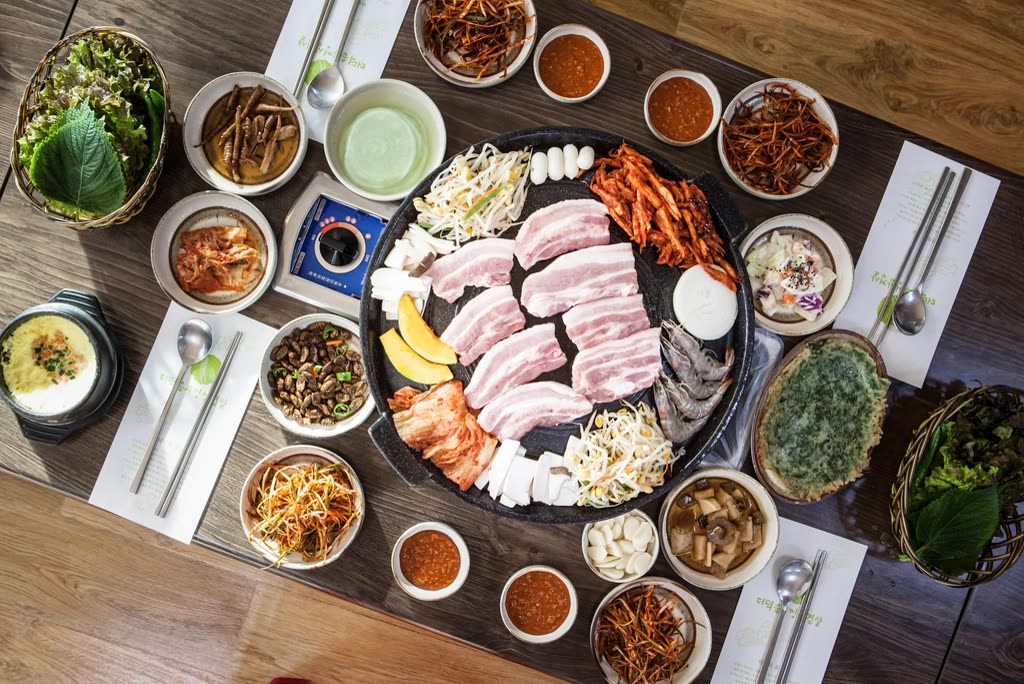
The default pan partners are ripened (sour) kimchi, whole peeled garlic cloves, sliced onion and mushrooms such as oyster or king oyster.
The order matters: cook the plain belly first, then add the vegetables and kimchi to the same pan so they fry in the rendered fat.
That is the order the fat was rendered for, and skipping it wastes the pan.
Grilled kimchi on the same hot pan is the default pairing in Korean BBQ, not an optional extra.
Whole garlic cloves get flipped until golden and soft — a standard side, not a garnish.
A shared pot of doenjang-jjigae (soybean paste stew) or kimchi-jjigae is the standard full-meal accompaniment if you want one.
If your pan is smoking and the outside is burning while the center is raw, start on medium heat and save the hard sear for the end.
If you have no grill but want the whole spread, the broiler and air fryer handle the pork, and a second pan can take the kimchi and vegetables.
Oven and Air Fryer Versions
No pan is needed: a broiler on a rack gets close to the grill result.
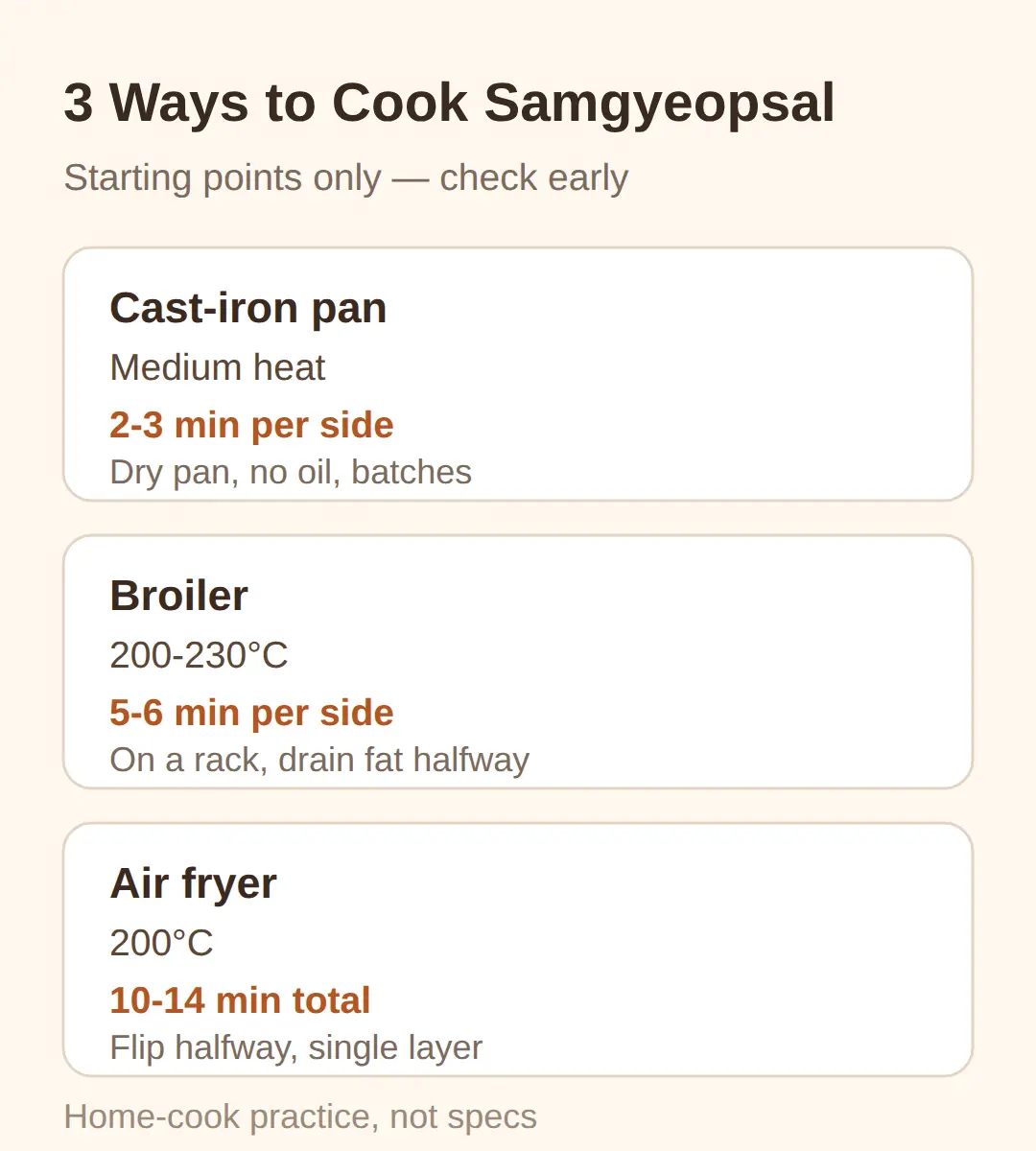
Broil at about 200-230°C for 5-6 minutes per side, draining the fat halfway through — the rack keeps the meat out of its own rendered fat so it crisps instead of braises.
Air fryer home cooks use 200°C for about 10-14 minutes total, flipping halfway, in single-layer batches; times vary by model, so check at the low end the first round.
| Method | Heat | Time | Note |
|---|---|---|---|
| Cast-iron pan | Medium | 2-3 min per side | Dry pan, no oil, batches |
| Broiler | 200-230°C | 5-6 min per side | On a rack, drain fat halfway |
| Air fryer | 200°C | 10-14 min total | Flip halfway, single-layer batches |
Air fryer and broiler timing comes from home-cook practice rather than manufacturer specifications, so treat them as starting points.
Pan slices are done when both sides are deeply browned and no pink remains in the center.
Done Temperature, Storage and Two Variations
The USDA’s food safety branch lists 145°F (63°C) with a 3-minute rest as the safe internal temperature for fresh pork whole cuts — no pink required, unlike the older 160°F guidance.
Pink is okay at that temperature, so judge by thermometer and browning rather than color alone.
Cooked leftovers keep about 3 days refrigerated in an airtight container, and they re-sear in a hot pan better than they microwave.
Raw belly freezes well for 2-3 months if sliced and separated with parchment, and the slices grill fine from partially thawed with little loss.
Two variations use the same cut.
Samgyeopsal-kimchi-bokkeum: chop and fry the belly, then stir-fry with aged kimchi and a spoonful of gochugaru and sugar.
Bossam-style: simmer the belly in water with garlic, ginger and doenjang, slice thin, and serve wrapped with kimchi and ssamjang.
If I were cooking this at home, I’d grill the plain belly first and then fry ripened kimchi and whole garlic cloves in the rendered fat — that order keeps the pork browning instead of steaming.
One date worth noting if you are in Korea: March 3 is informally Samgyeopsal Day — three 3s in the date — and pork industry groups run promotions that day.
Where to eat samgyeopsal in Korea (삼겹살)
- BBQ Yul Seoul — Seoul
Restaurants from official tourism listings (city and national tourism organizations) that list samgyeopsal as a signature dish — our guides to each, not a ranking.
Related posts
📎 📅 Upcoming Dates — Release & Event Calendar
Sources
- Sour kimchi grilled in pork fat is the default pairing (en.wikipedia.org)
- Bacon is cured+smoked; fresh uncured pork belly is the corre (en.wikipedia.org)
- 200°C, ~10-14 min, flip halfway (home-cook videos) (youtube.com)
Summary: The Six Things That Decide the Dish
- Look for fresh belly with the skin off — any pack labelled bacon is cured and smoked, so put it back.
- Slice about 5-7 mm and rest cold meat 15-20 minutes before the pan.
- Medium heat first, hard sear at the end; single layer, work in batches.
- Salt after browning, not before — early salt pulls moisture out.
- Cook the belly plain first, then kimchi, garlic and vegetables in the rendered fat; 145°F (63°C) with a 3-minute rest is the USDA safe temperature for fresh pork.
FAQ
Q. What cut do I buy if there’s no Korean butcher?
Fresh pork belly, skin off, uncured — from any butcher or Asian grocery. Slab bacon is cured and smoked with slices too thin, so it is not a good substitute.
Q. How long do I grill samgyeopsal slices on a pan?
About 2-3 minutes per side over medium heat in a dry pan, about 4-6 minutes total, done when both sides are deeply browned.
Q. What if I can’t find ssamjang or perilla leaves?
Mix miso paste with sesame oil, a little chili flakes and minced garlic for the paste; use shiso or large basil leaves for wrapping.
Q. Can I do samgyeopsal in an air fryer or oven?
Yes — broil at 200-230°C for 5-6 minutes per side on a rack, or air-fry at 200°C for 10-14 minutes total, flipping halfway, in batches.
Q. Is USDA 145°F safe enough for pork belly?
For fresh pork whole cuts, the USDA food safety branch lists 145°F (63°C) with a 3-minute rest as the safe minimum internal temperature; pink at that temperature is fine.
FAQ
Cover photo: Grilled pork belly bbq — CC0 1.0
#samgyeopsal #koreanbbq #porkbelly #koreanrecipe #grilledpork
📅Upcoming Schedule — this week 2 · D-2 Hangul DaySee all →