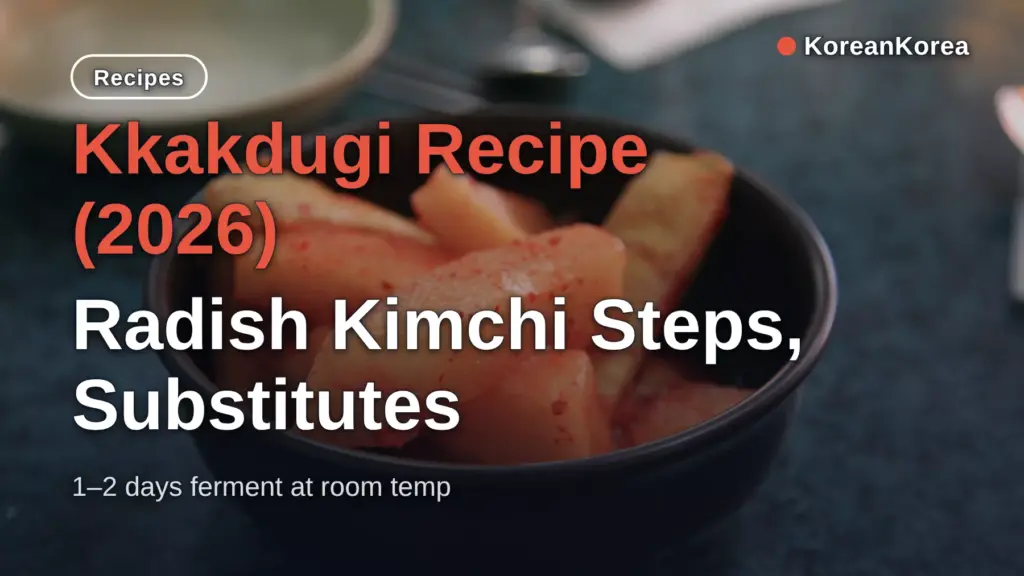
Kkakdugi is cubed radish kimchi: 1 kg of radish, salted for 30-60 minutes, coated in a gochugaru seasoning and fermented 1-2 days at room temperature before refrigerating.
Key facts — As of 2026-10-01
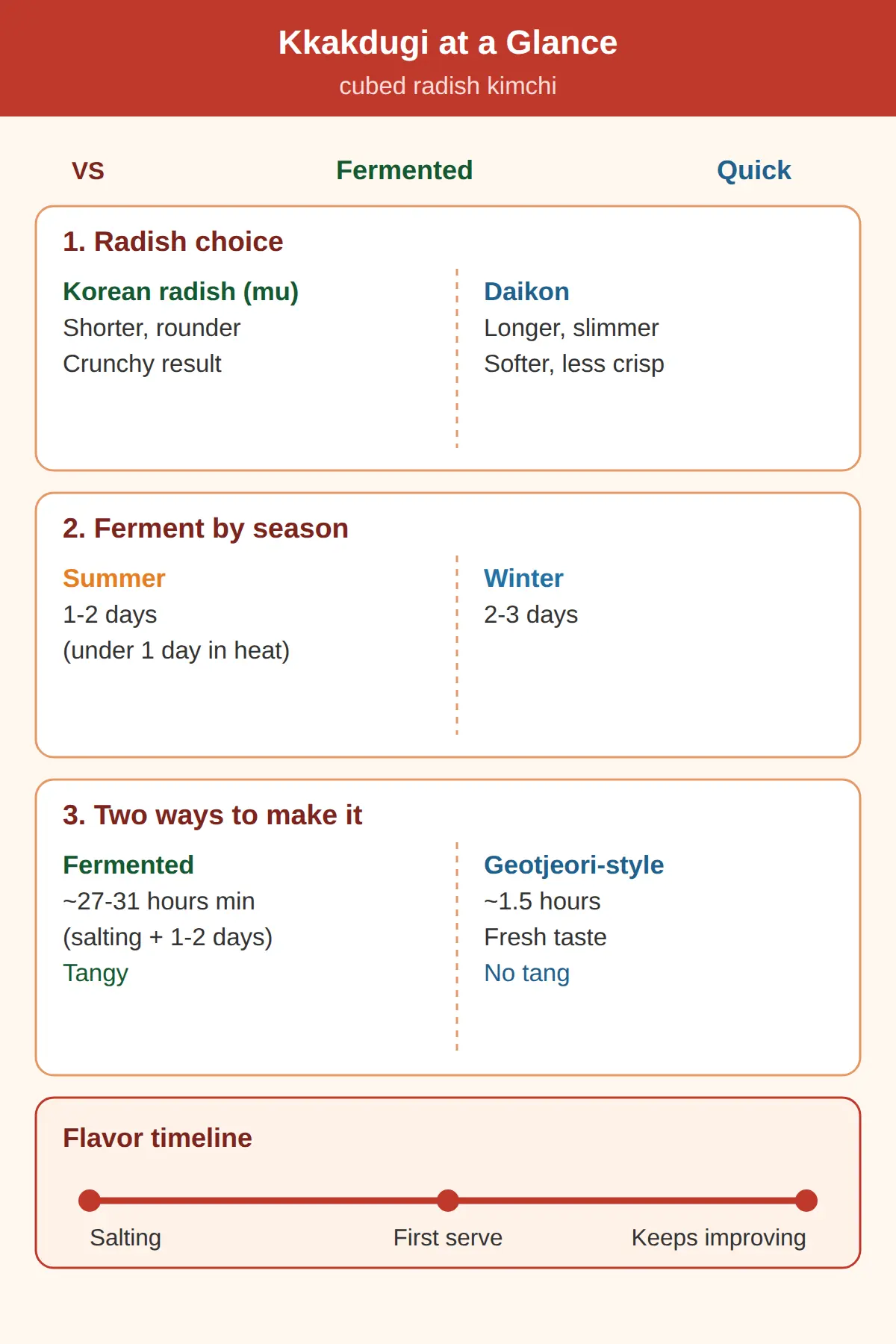
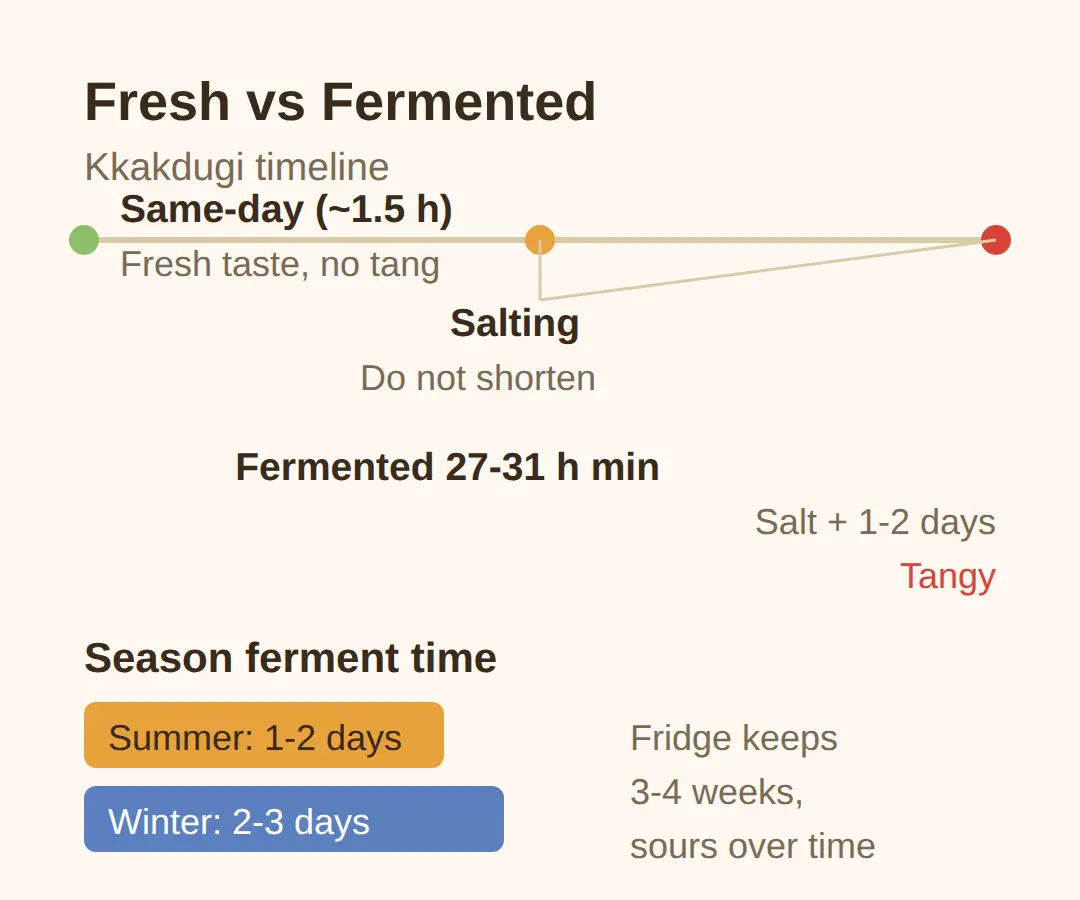
- Kkakdugi needs a minimum of about 27-31 hours from start to fermented serving: 30-60 minutes salting plus 1-2 days at room temperature in summer, or 2-3 days in winter.
Kkakdugi Is Cubed Radish Kimchi — Here Is the Short Answer
| Korean radish (mu) or daikon | 1 kg, cut into about 2 cm cubes |
|---|---|
| Coarse sea salt | 1 tbsp (about 15-18 g) — or 2 tsp fine salt |
| Gochugaru (Korean chili flakes) | 2-4 tbsp, adjusted to taste |
| Minced garlic | 1 tbsp |
| Grated ginger | 0.5-1 tsp, optional |
| Sugar | 1-2 tsp (or about 1 tbsp maesil extract) |
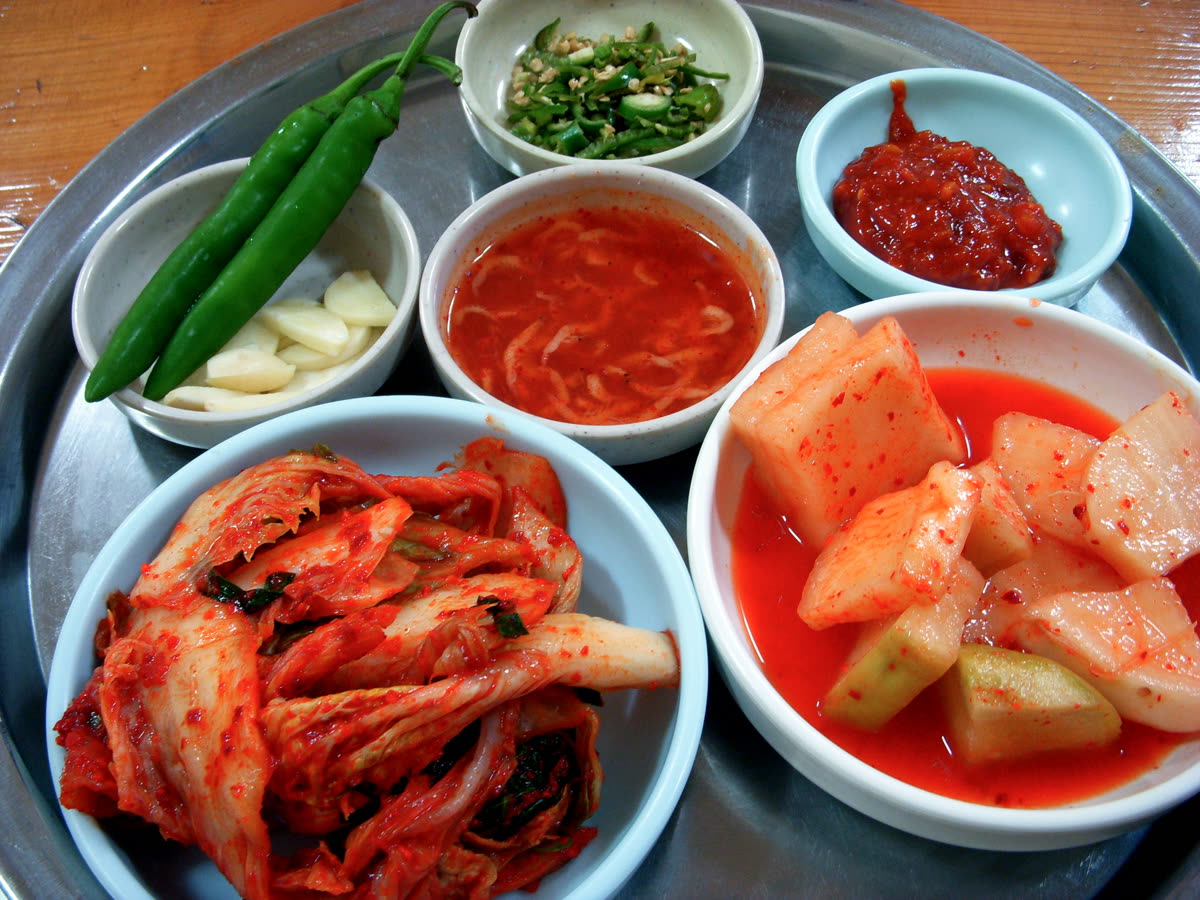
Kkakdugi is a cubed radish kimchi made by fermenting diced radish in a gochugaru-based seasoning.
Koreans serve it as a side dish (banchan) with stews, braised dishes and grilled meats, and it is the classic pairing for seolleongtang, the ox-bone soup.
From salting to first fermented serving, plan on a minimum of about 27-31 hours: 30-60 minutes of salting plus 1-2 days at room temperature in warm weather, or 2-3 days in winter.
That total comes from standard home recipes, and the flavor keeps improving for several more days in the fridge.
If you need it today, most recipes allow a same-day "geotjeori-style" version eaten in about 1.5 hours — fresh, but without the tang.
The fermented version is what most people mean by kkakdugi, so decide which one you are aiming for before you start.
Ingredients
Main
- 1 kg Korean radish (mu) — cut into about 2 cm cubes
- 1 tbsp coarse sea salt
Sauce & seasoning
- 2-4 tbsp gochugaru (Korean chili flakes)
- 1 tbsp minced garlic
- 1-2 tsp sugar
- 2-3 tbsp fish sauce
- 2-4 tbsp water
- scallions — chopped
Amounts are the ones used in this recipe; where the recipe gives no amount, adjust to taste.
Kkakdugi Recipe: Step by Step
One kilogram of radish makes roughly 6-8 side-dish servings.
| Item | Amount |
|---|---|
| Radish | 1 kg, cut into ~2 cm cubes |
| Coarse salt | 1 tbsp |
| Gochugaru | 2-4 tbsp |
| Minced garlic | 1 tbsp (some recipes use up to 1-2 tsp) |
| Grated ginger | optional, small amount |
| Sugar | 1-2 tsp (or grated Korean pear) |
| Water | 2-4 tbsp |
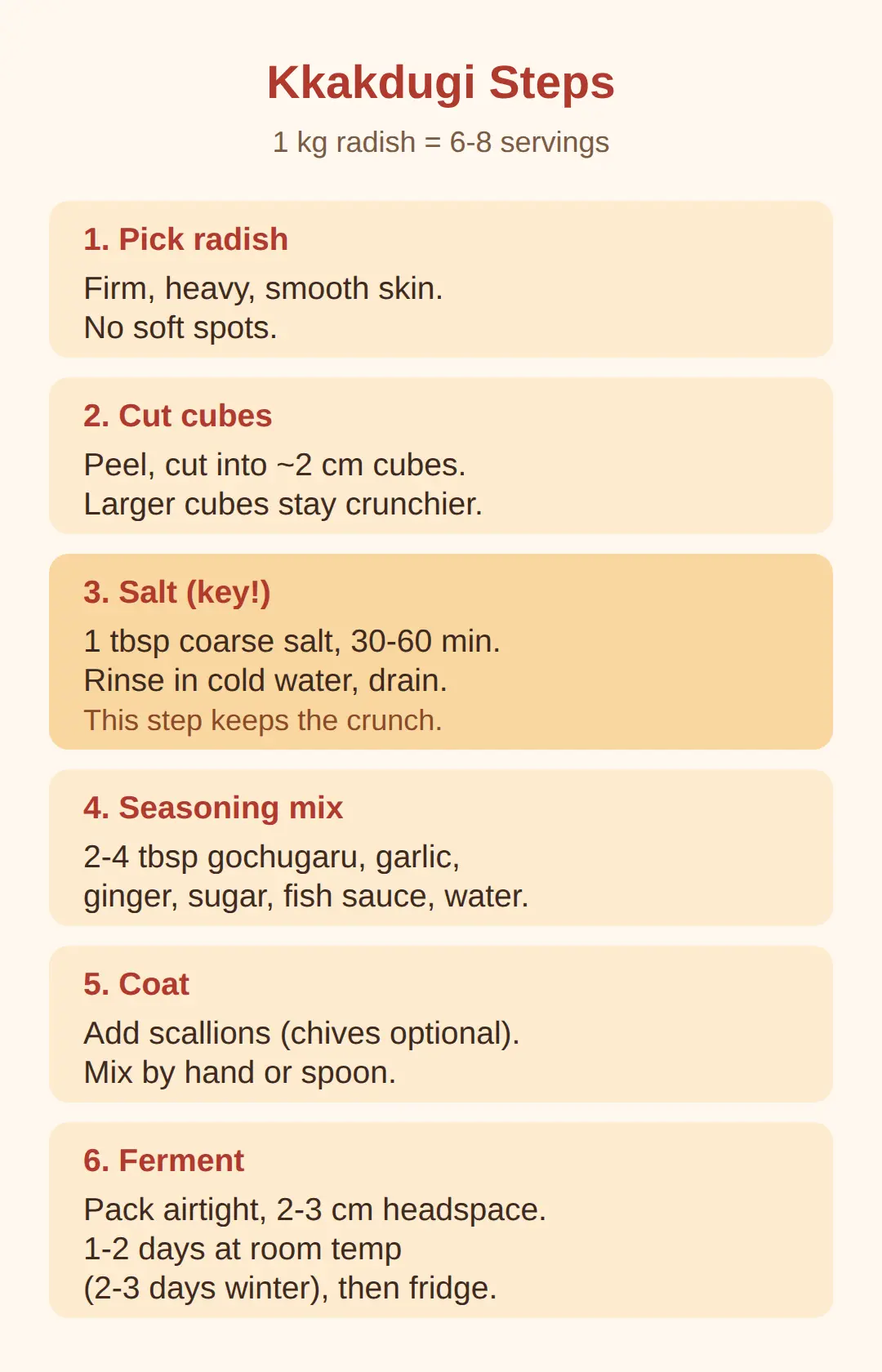
- Pick a firm, heavy radish with smooth skin and no soft spots — hollow or rubbery radish turns soft during fermentation.
- Peel and cut into ~2 cm cubes; larger cubes stay crunchier.
- Toss with 1 tbsp coarse salt for 30-60 minutes, then rinse once in cold water and drain well.
- Mix the seasoning: gochugaru, garlic, ginger, sugar, fish sauce, and water so the flakes coat evenly.
- Add chopped scallions (and optional chives), then coat the cubes by hand or spoon.
- Pack into an airtight container with 2-3 cm headspace and ferment 1-2 days at room temperature (2-3 days in winter), then refrigerate.
The first thing to check in any kkakdugi recipe is whether the salting step runs 30-60 minutes with a rinse afterward — that step decides whether the radish stays crunchy.
If your kitchen is very warm, skip the room-temperature stage almost entirely and go straight to the fridge.
Steps at a glance
-
1Pick a firm, heavy radish with smooth skin and no soft spots
-
2Peel and cut into ~2 cm cubes
-
3Toss with 1 tbsp coarse salt for 30-60 minutes, then rinse once in…⏱ 30-60 minutes
-
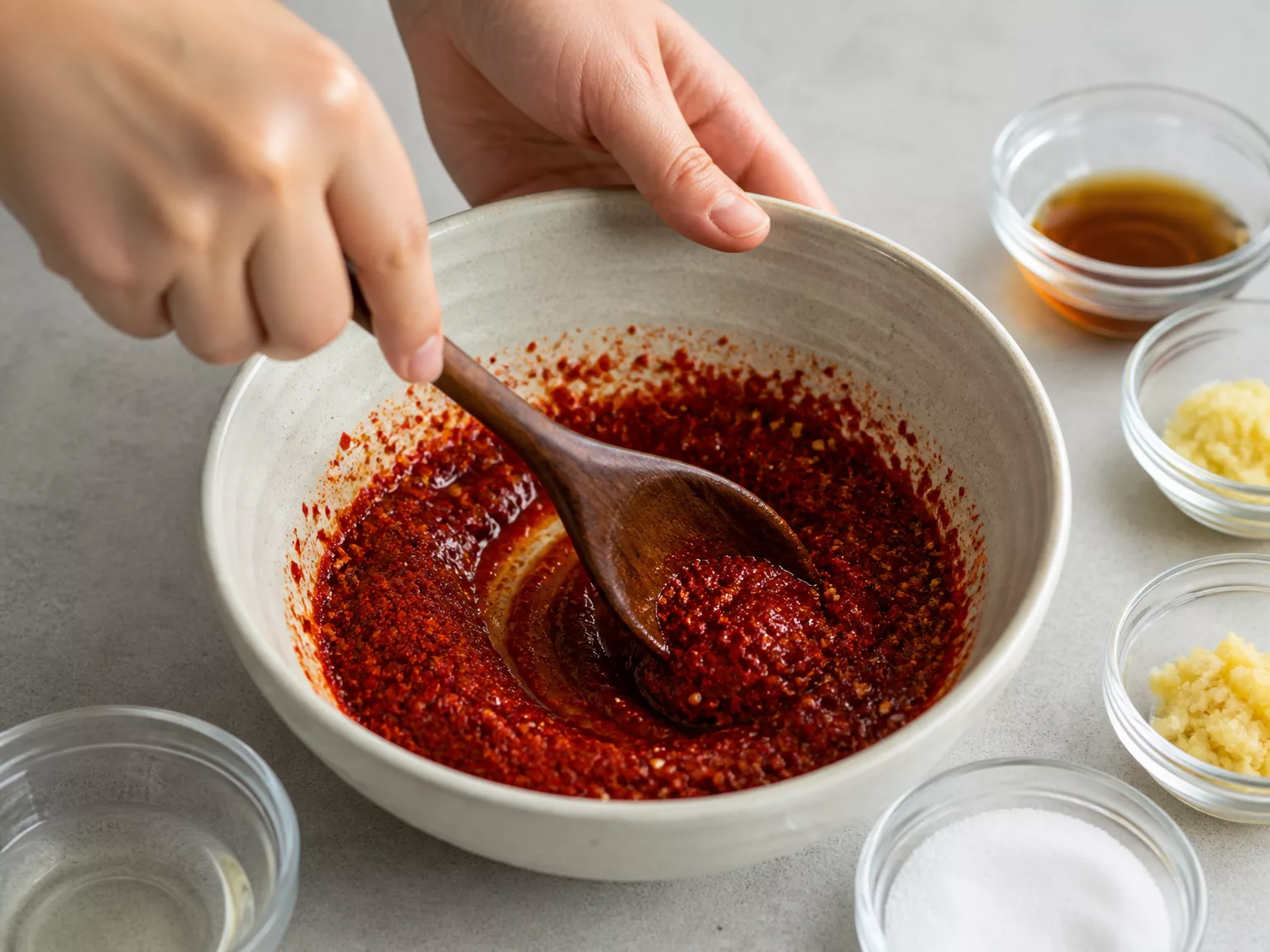 AI-generated photo
What it should look like — AI-generated image of this step, made from the recipe text — not a photo of our kitchen. 4Mix the seasoning: gochugaru, garlic, ginger, sugar, fish sauce, and… -
5Add chopped scallions (and optional chives), then coat the cubes by…
-
6Pack into an airtight container with 2-3 cm headspace and ferment 1-2…
Can You Use Daikon Instead of Korean Radish?
Yes — daikon is an accepted substitute, and it is the practical choice outside Korea because Western supermarkets stock it widely.
Cut daikon into slightly larger cubes, about 2-2.5 cm, since it holds up better when cut bigger.
Korean mu is shorter and rounder than daikon, with a wider white-to-green section, and daikon turns out slightly softer and less crisp.
Winter radish (November-February) is the sweetest and densest, so that is the season for the crunchiest batch.
If crispness matters most to you, buy the heaviest, firmest daikon on the shelf and keep the peel on part of the batch; if only daikon is available, that is still close to what kkakdugi is meant to be.
Substitutions for Ingredients You Cannot Find Abroad
Most ingredients in kkakdugi have a workable stand-in, with a change in taste you should expect.
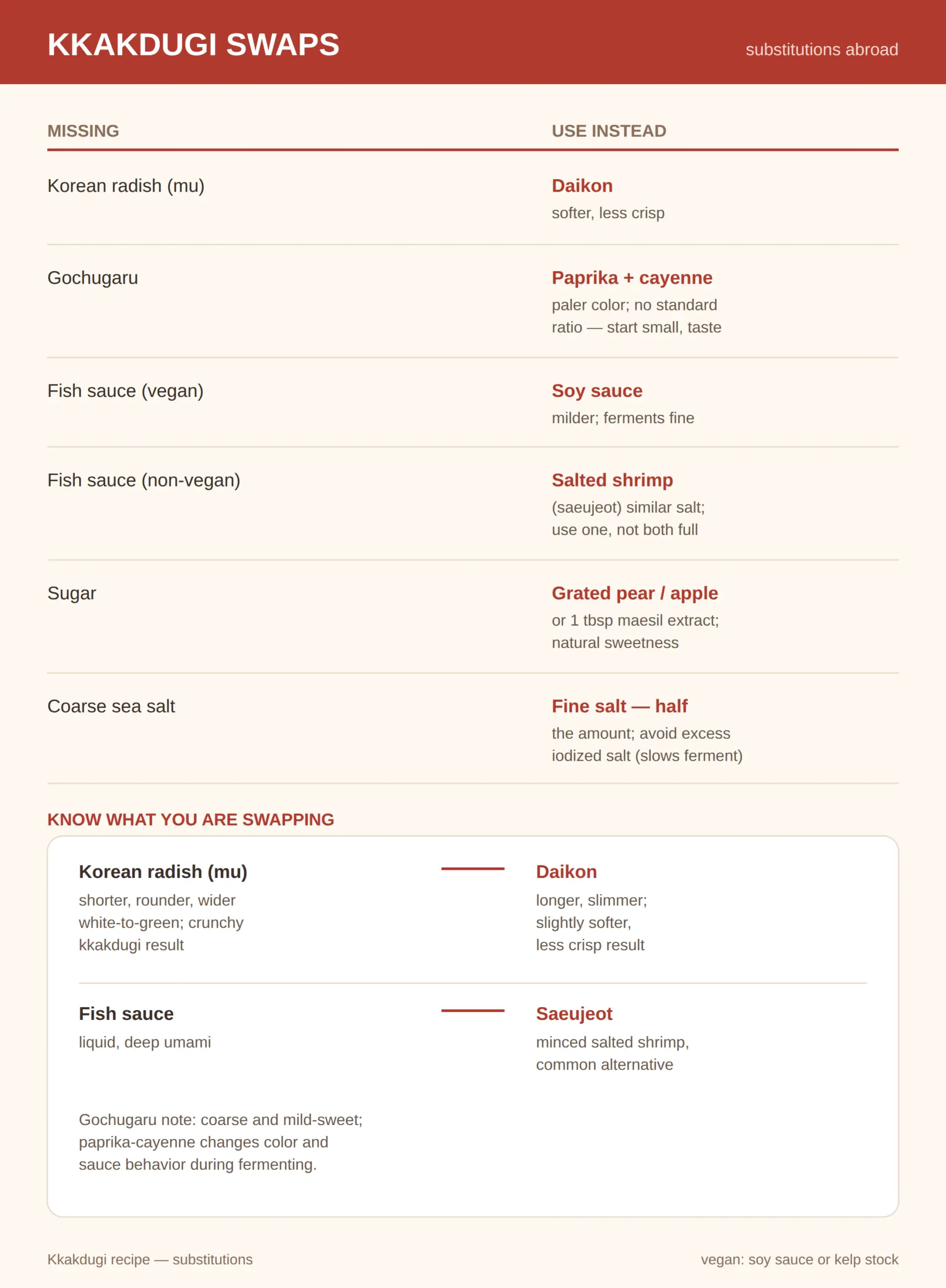
The table below shows each swap and what it does.
| Missing ingredient | Substitute | What changes |
|---|---|---|
| Korean radish (mu) | Daikon | Slightly softer, less crisp |
| Gochugaru | Paprika plus a small amount of cayenne | Paler color; no standard ratio — start small and taste |
| Fish sauce | Soy sauce or vegan fish sauce | Milder depth; vegan version ferments fine |
| Fish sauce (non-vegan) | Minced salted shrimp (saeujeot) | Similar saltiness; use either one, not both at full amount |
| Sugar | Grated Korean pear or apple, or about 1 tbsp maesil extract | More natural sweetness, softer ferment flavor |
| Coarse sea salt | Fine salt at about half the amount | Avoid excess iodized table salt — it can slow fermentation |
For gochugaru, keep in mind the real thing is coarse and mild-sweet; a paprika-cayenne mix changes both color and how the sauce behaves during fermenting.
If you are vegan, soy sauce or kelp stock replaces fish sauce and the result is simply milder.
Why Is My Kkakdugi Watery or Soft?
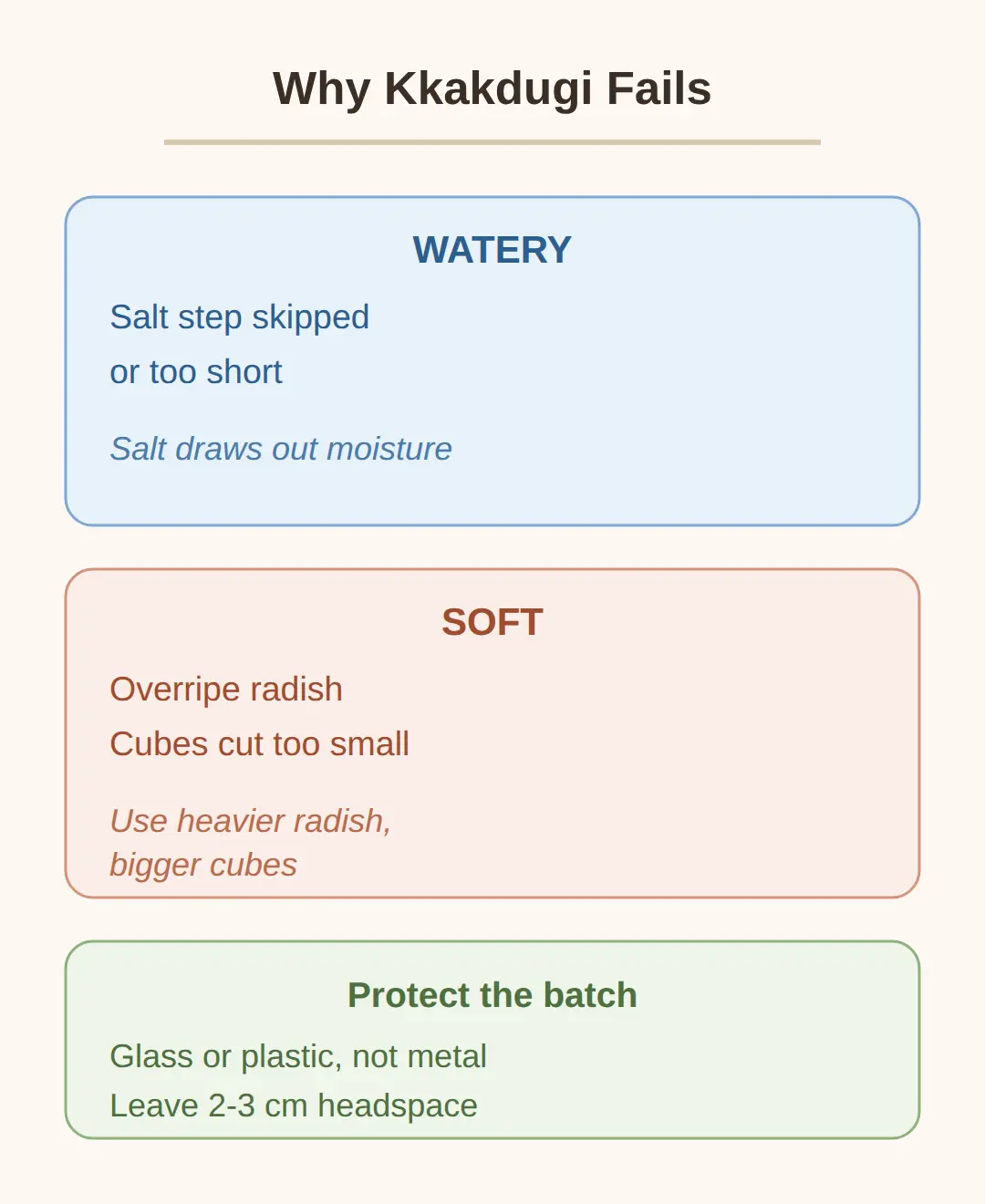
Watery kkakdugi almost always traces back to a skipped or shortened salting step — salt draws out moisture so the cubes stay crunchy instead of leaking it into the jar.
Soft kkakdugi comes from the other end: an overripe, hollow radish, or cubes cut too small.
Two more habits protect the batch.
Mix and store in glass or plastic, not a bare metal bowl — metal causes off flavors and discoloration while it ferments.
Leave 2-3 cm of headspace in the container, because fermenting produces gas and rising liquid.
If your last batch came out watery, check the salt-and-rinse step before blaming anything else; if it came out soft, buy a heavier radish and cut bigger cubes next time.
How Long Kkakdugi Keeps — and What to Do With Old Batch
Refrigerated kkakdugi keeps well for about 3-4 weeks and grows more sour over time.
Recipes commonly cite anywhere from 3 weeks to 2 months, so taste is the real clock, not the calendar.
Older, sour batches stop being a side dish and become an ingredient: kkakdugi-guk (radish kimchi soup) and kimchi fried rice are the standard uses.
Some home cooks also freeze a spoonful of fermented kimchi as a starter to shorten the fermenting of a new batch.
Judge readiness the way recipes describe it: bubbles and a tangy smell mean it is fermenting, and tasting decides when it is sour enough for you.
If I were making a smaller batch, I would scale down to 1-2 tsp gochugaru and adjust after the first taste, since the salt and seasoning ratios matter more than the exact chili amount.
What I check first is the salting step — it is the one stage I would not shorten, because it is what keeps the cubes crunchy.
Related posts
📎 📅 Upcoming Dates — Release & Event Calendar
Sources
Kkakdugi Variations and What to Eat It With
- Mul-kkakdugi uses the same cube cut but a tangy dongchimi-style brine instead of a dry chili coating — it is non-spicy and served with liquid.
- Yeolmu kkakdugi is the young-summer-radish version, and chopped chives (or cilantro, in some recipes) add crunch and color.
- Serve kkakdugi with seolleongtang — it is widely considered the best side for that soup — or alongside stews and grilled meats.
- Accounts trace kkakdugi to the late Joseon dynasty, linked to a pickled radish dish in the household of the Grand Heir; the exact year is not confirmed.
- Scale a smaller batch as roughly 1-2 tsp gochugaru per 250 g radish and taste before adding more — the 2-4 tbsp per kg range is too wide to use blindly.
FAQ
Q. How do I make kkakdugi if I can’t find Korean radish?
Use daikon, cut into 2-2.5 cm cubes. It turns out slightly softer and less crisp than Korean mu, but it is the accepted substitute.
Q. Can I skip the fish sauce to make vegan kkakdugi?
Yes. Soy sauce, vegan fish sauce or kelp stock replaces it; the flavor is milder and it still ferments fine.
Q. What can I use instead of gochugaru?
Paprika plus a small amount of cayenne works, but there is no standard ratio and the color and sauce texture will differ — start small and taste.
Q. How many days does kkakdugi need to ferment, and how do I know it’s ready?
1-2 days at room temperature in summer, 2-3 days in winter, then refrigerate. Bubbles and a tangy smell mean it is ready to taste.
Q. How long does kkakdugi last in the fridge?
About 3-4 weeks, growing more sour over time; use older batches for kkakdugi-guk soup or fried rice.
Kkakdugi is one of the easier kimchis to start with — no whole-cabbage packing, and one container does it.
Cover photo: Korea-Sokcho-Kkakdugi-Radish kimchi-01 by by Junho Jung at Flickr from South Korea — CC BY-SA 3.0
#kkakdugi #koreanradishkimchi #koreanbanchan #daikon #kimchirecipe
📅Upcoming Schedule — this week 2 · D-2 Hangul DaySee all →