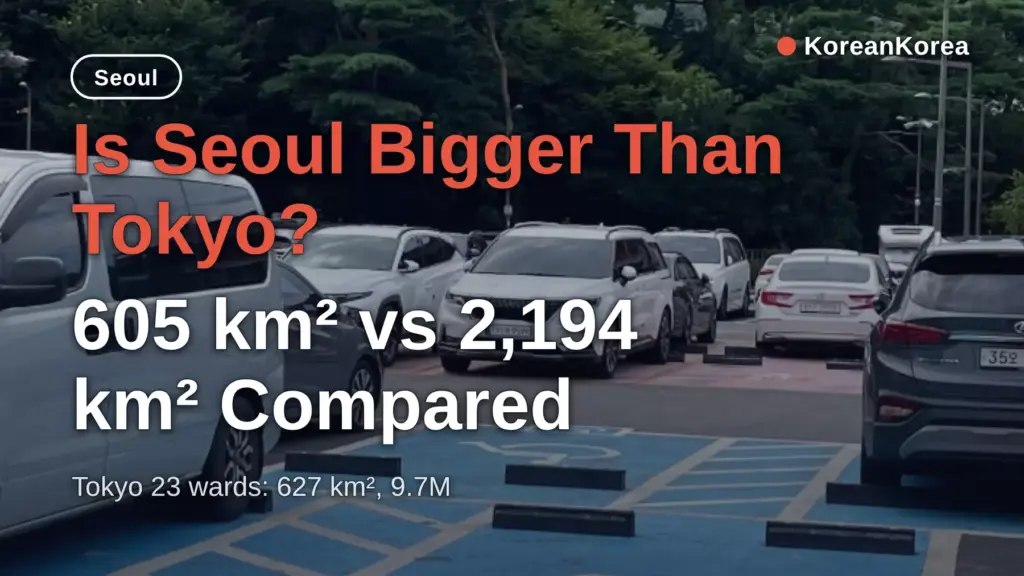
No — Tokyo is bigger by any common measure: 2,194 km² and about 14.0 million people against Seoul’s 605.25 km² and about 9.3 million.
For you, the trap is the definitions: the headline gap vanishes almost completely once you compare Seoul with Tokyo’s 23 central wards instead of the whole prefecture.
This post gives the numbers under each definition — city proper, 23 wards, and metro area — and shows where each comparison flips.
Key facts — As of 2026-10-07
- Seoul city proper is 605.25 km² with about 9.3 million residents (2024 statistics) — down from its 1990 peak of about 10.97 million.
- Tokyo Metropolis (Tokyo-to) covers 2,194 km² and about 14.0 million people (Tokyo Metropolitan Government, 2024), roughly 3.6× Seoul’s area.
- Tokyo’s 23 special wards (627.4 km², ~9.7 million) and Seoul (605.25 km², ~9.3 million) are nearly the same city size — the big gap comes from the prefecture’s islands and western Tama cities.
Is Seoul Bigger Than Tokyo? The Short Answer
| Area | Seoul 605.25 km² (233 sq mi) | Tokyo Metropolis 2,194 km² (847 sq mi) | 23 wards 627.4 km² |
|---|---|
| Population | Seoul ~9.3 million (2024) | Tokyo Metropolis ~14.0 million (2024 estimate) | 23 wards ~9.7 million |
| Area gap | Metropolis is ~3.6× Seoul | 23 wards are only ~22 km² (~3.7%) larger than Seoul |
| Population gap | Metropolis ~1.5× Seoul | 23 wards roughly the same as Seoul |
| Density (city proper) | Seoul ~15,400 per km² vs Tokyo Metropolis ~6,400 per km² |
| Administrative level | Seoul: one city, 25 districts (gu) | Tokyo-to: prefecture — 23 special wards + 26 cities, 5 towns, 8 villages |
No.
Seoul city proper is 605.25 km² with about 9.3 million residents (2024 statistics), while Tokyo Metropolis covers 2,194 km² with about 14.0 million people (Tokyo Metropolitan Government, 2024).
On area that is roughly 3.6× (2,194 ÷ 605.25 ≈ 3.62) and on population roughly 1.5× (14.0 ÷ 9.3 ≈ 1.51).
But the two numbers do not measure the same kind of thing — Tokyo-to is a prefecture, not a single city.
Seoul is one city with 25 districts (gu); Tokyo Metropolis bundles 23 special wards with 26 cities, 5 towns and 8 villages.
If you want the one-line answer for a quiz, say Tokyo; if you want to know which city feels bigger on the ground, read the next section.
When a size number looks too big, the first thing I check is what the boundary actually covers — a city, a ward group, or a whole prefecture with islands in it.
Tokyo 23 Wards vs Seoul: The Fair Comparison
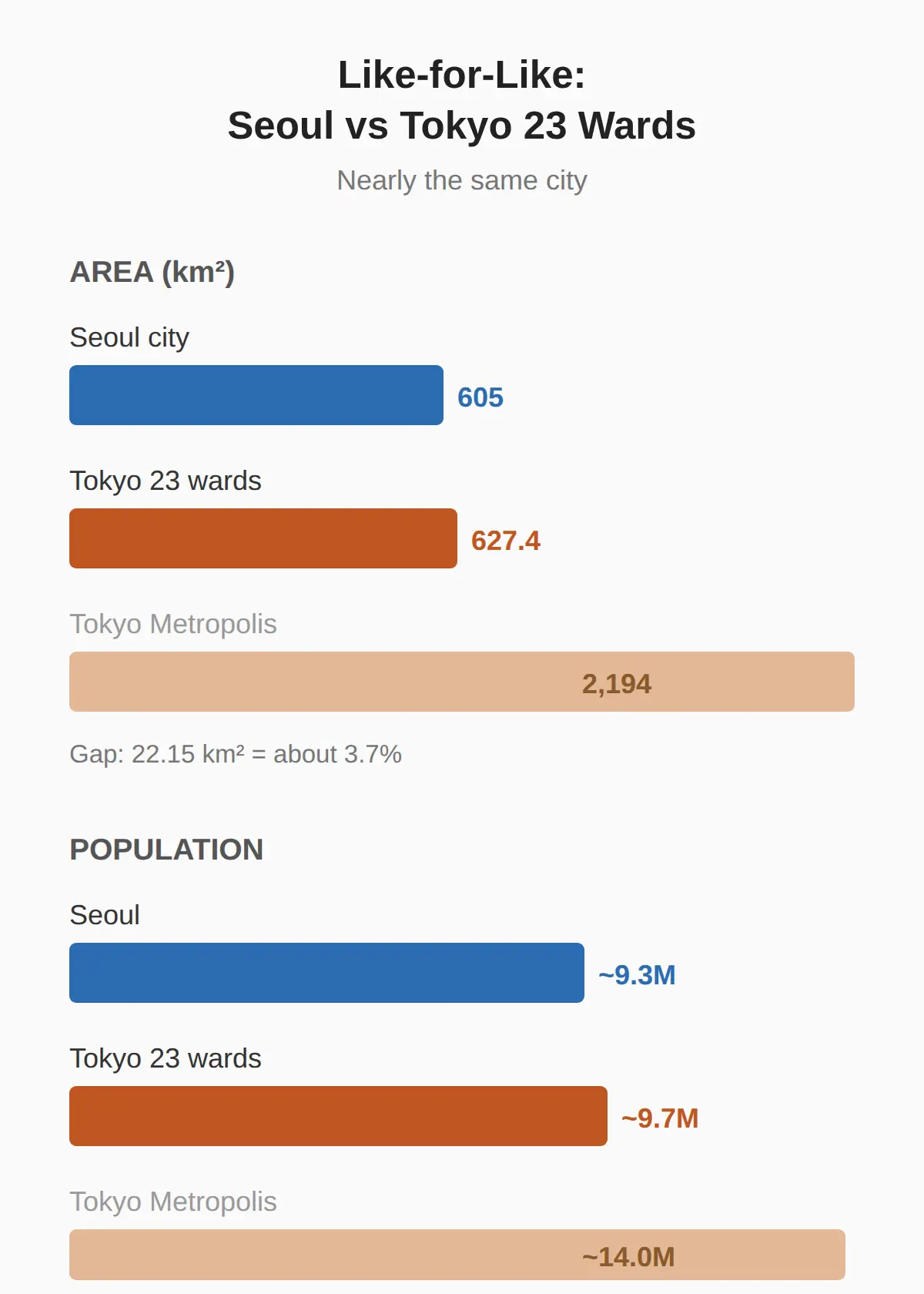
Compared like for like, Seoul and Tokyo’s 23 special wards are nearly the same city — 605 km² / ~9.3 million against 627.4 km² / ~9.7 million.
The area difference is only 627.4 − 605.25 = 22.15 km², about 3.7%, and the population gap is under half a million.
So the ‘Tokyo is 3.6× bigger’ gap comes almost entirely from the prefecture’s outlying territory, not from the part you would walk around as a visitor.
The 23 wards also gain roughly 3 million people during the day from commuting, so their daytime population exceeds their resident population (approximate figure, Tokyo Metropolitan Government survey).
If your question is really ‘which downtown is bigger’, Seoul and central Tokyo are effectively a tie; the big Tokyo numbers answer a different question.
Why Tokyo’s Area Number Is 2,194 km²
Tokyo’s 2,194 km² is large because Tokyo-to is a prefecture-level jurisdiction, not a single city.
Much of that land is not the urban Tokyo you picture: the Izu and Ogasawara islands add roughly 400 km² of ocean-separated territory about 1,000 km south, and the western Nishi-Tama and Okutama side is hilly forest rather than contiguous city.
Subtracting the island territory gives roughly 2,194 − 400 ≈ 1,794 km², still about 3× Seoul’s area — but that remainder includes the Tama cities, which function as separate suburban cities.
Seoul, by contrast, is a single compact city of 25 districts, so its 605.25 km² is all continuous city.
This also explains the density reversal: Seoul packs about 15,400 people per km² against the Metropolis’s roughly 6,400 per km² — about 2.4× denser, because Seoul’s denominator is one city while Tokyo’s covers a small province.
Metro vs Metro: Greater Tokyo vs the Seoul Capital Area
If you compare whole metropolitan regions, Tokyo still wins but the gap narrows: Greater Tokyo has about 37 million people (the largest metro area in the world; UN estimate 37.7 million) against about 26 million in the Seoul Capital Area.
That is roughly 1.42× (37 ÷ 26), closer than the 1.5× gap at city level.
The Seoul Capital Area is Seoul plus Incheon plus Gyeonggi Province — the region most visitors experience as one continuous urban spread around the capital.
Greater Tokyo is built the same way: the 23 wards plus Yokohama, Kawasaki, Saitama, Chiba and surrounding prefectures.
Whichever metro figure a source uses, the ranking stays the same — Tokyo first — though the exact numbers vary by who counts as being in the metro area.
Why Seoul Is Shrinking While Tokyo Grows
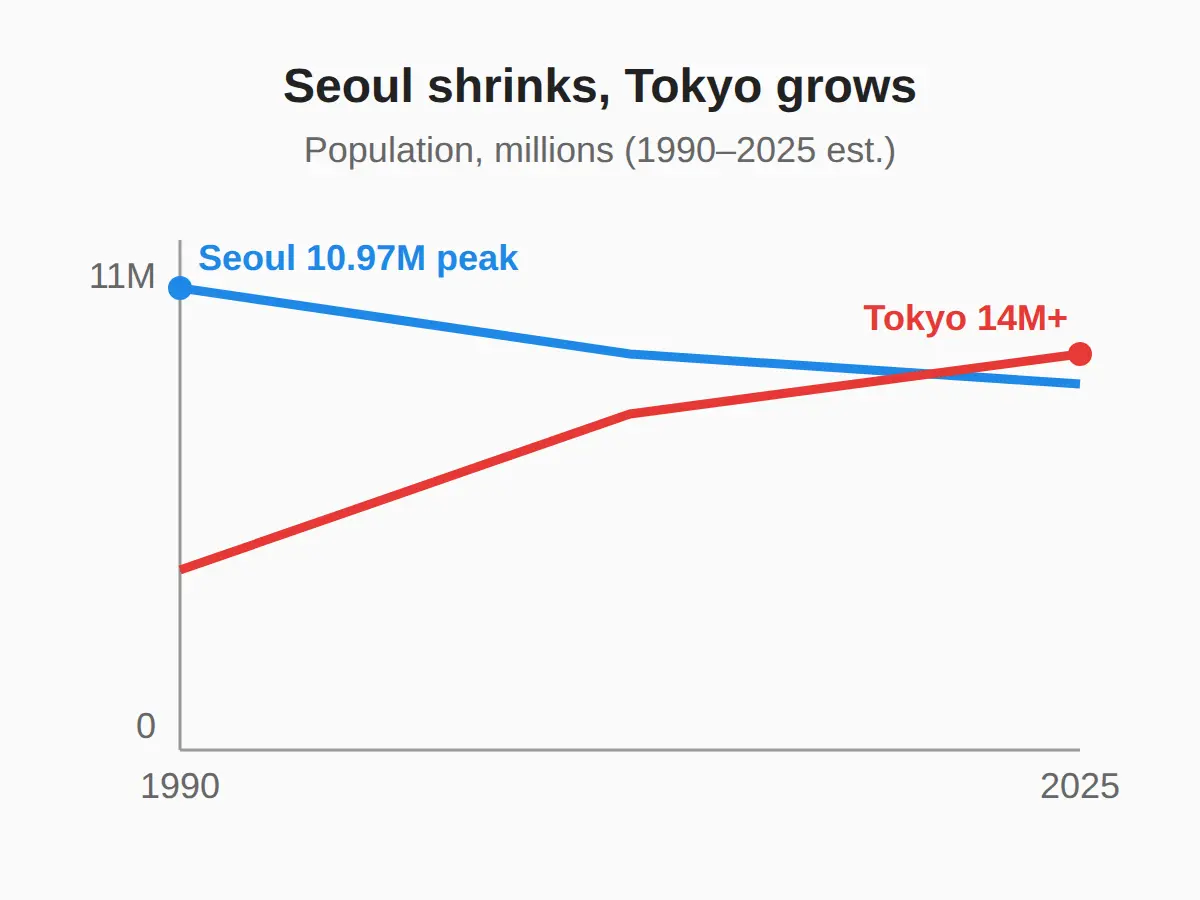
Seoul peaked at about 10.97 million residents in 1990 and has declined since, while Tokyo Metropolis kept growing past 14 million.
Seoul now holds roughly 18% of South Korea’s ~51.6 million people; Tokyo Metropolis holds roughly 11% of Japan’s population — but the wider Tokyo metro region holds about a third of Japan’s.
The population figures here are 2024–2025 estimates and have not been re-verified against Korea Statistics or the Japan Statistics Bureau primary tables, so re-check before quoting them as current counts.
For your trip-planning purposes this changes little: both capitals are dense, transit-rich cities of similar walking scale.
If you are deciding how many days to give each city, the 23-ward comparison is the honest yardstick — plan Seoul and central Tokyo as cities of the same order of size.
Related posts
📎 Seoul — everything we know
📎 📅 Upcoming Dates — Release & Event Calendar
Sources
- Declining trend confirmed; exact 2026 figure not confirmed f (en.wikipedia.org)
- Islands + mountainous west make much of 2,194 km² non-urban (en.wikipedia.org)
- 627.4 km², ~9.7M — flips the like-for-like comparison (en.wikipedia.org)
Summary — which numbers to use
- City vs prefecture is the only honest headline: Seoul 605.25 km² / ~9.3M against Tokyo Metropolis 2,194 km² / ~14.0M — Tokyo bigger on both.
- Like-for-like city scale is Seoul vs the 23 wards: 605 vs 627.4 km², ~9.3M vs ~9.7M — nearly a tie.
- Metro level: Greater Tokyo ~37M vs Seoul Capital Area ~26M — Tokyo by about 1.4×.
FAQ
Q. Is Seoul bigger than Tokyo?
No. City proper, Seoul is 605.25 km² with about 9.3 million people versus Tokyo Metropolis at 2,194 km² and about 14.0 million — Tokyo is bigger on both counts (2024 figures).
Q. Which city is bigger population wise, Seoul or Tokyo?
Tokyo, by about 1.5× at city level (14.0M vs 9.3M) and by about 1.4× at metro level (37M vs 26M).
Q. How big are Tokyo’s 23 wards compared with Seoul?
The 23 special wards cover 627.4 km² with about 9.7 million people — only about 3.7% larger in area than Seoul’s 605.25 km², with a similar population.
Q. What is the population of the Seoul Capital Area?
About 26 million, counting Seoul, Incheon and Gyeonggi Province together — the metro region most visitors experience as one continuous city.
Q. Why does Tokyo look bigger than Seoul if Seoul is denser?
Because Tokyo-to is a prefecture: its 2,194 km² includes remote islands, mountains and separate Tama cities, while Seoul’s 605.25 km² is one compact city — so Seoul is about 2.4× denser per km².
Planning a trip to Korea next? See whether Seoul is bigger than New York, and the Seoul vs Tokyo day-count guide.
Cover photo: Jingwansa Temple (Seoul) [진관사(서울)] by Korea Tourism Organization — KOGL Type 1 (attribution)
#seoulvstokyo #citysizecomparison #seoulpopulation #tokyo23wards #greatertokyo #seoulcapitalarea
📅Upcoming Schedule — this week 3 · D-day documentary 'Always Lalisa' global theatrical release (Oct 1See all →Last updated 2026-10-12. Editorial policy