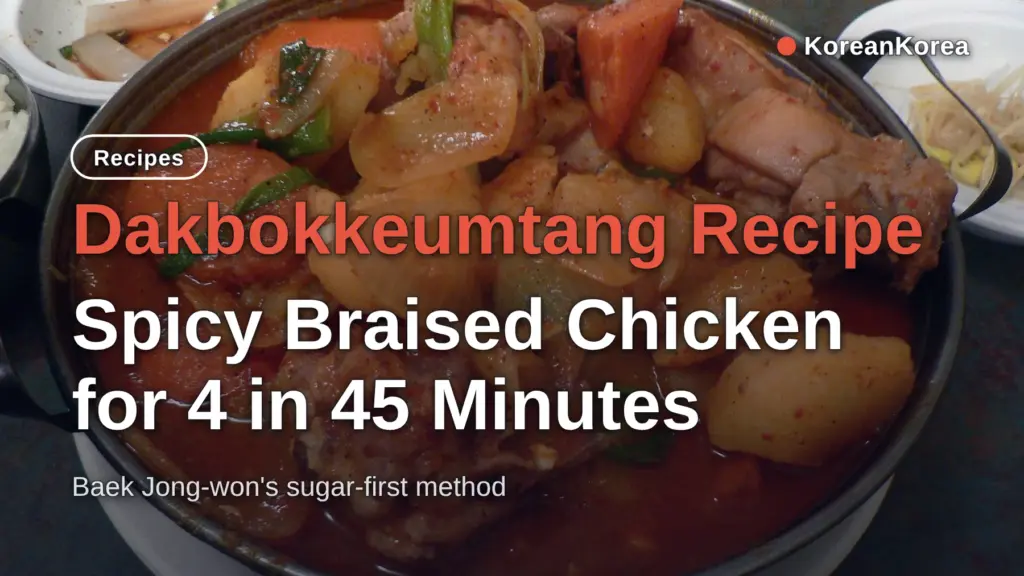
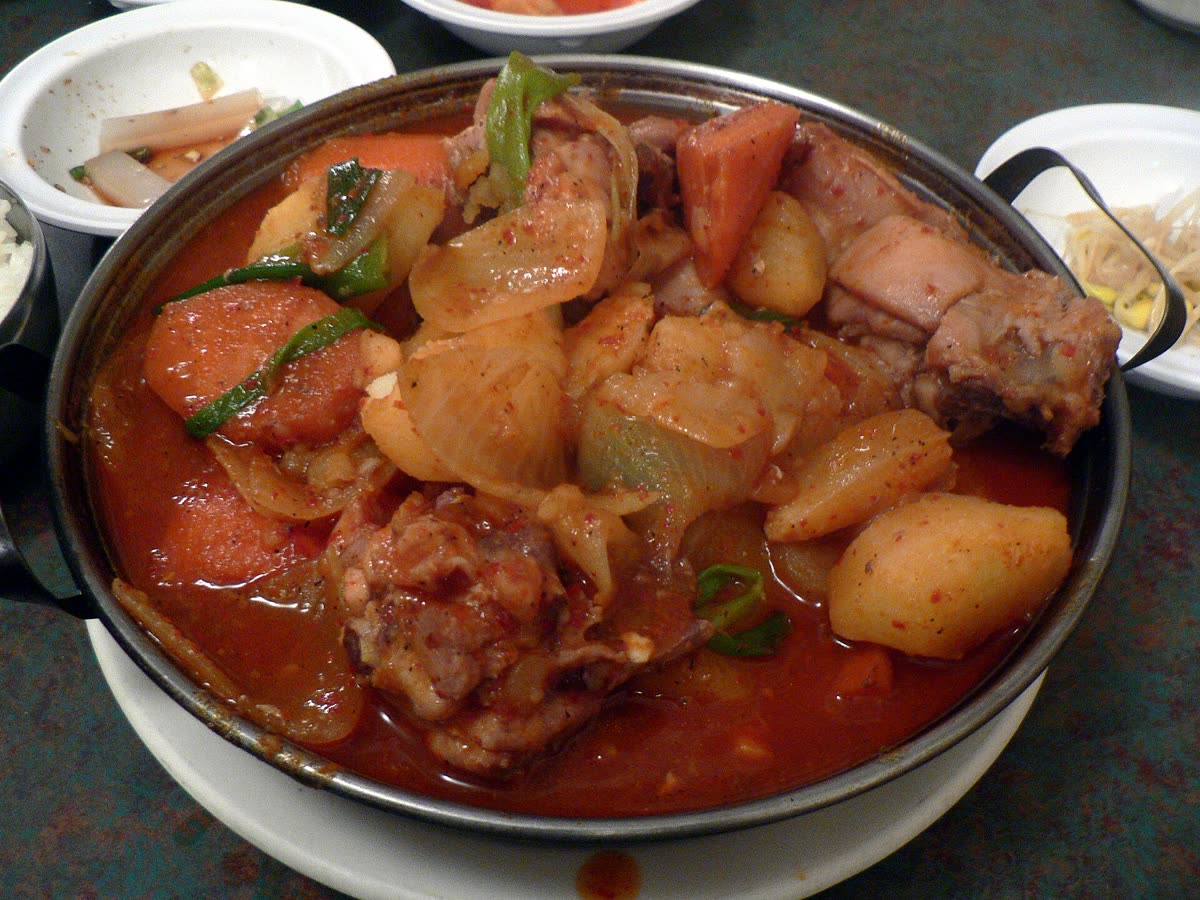
Dakbokkeumtang is chopped chicken braised about 45 minutes in a gochugaru-gochujang sauce with potatoes — 4 servings from one pot.
Key facts — As of 2026-10-01
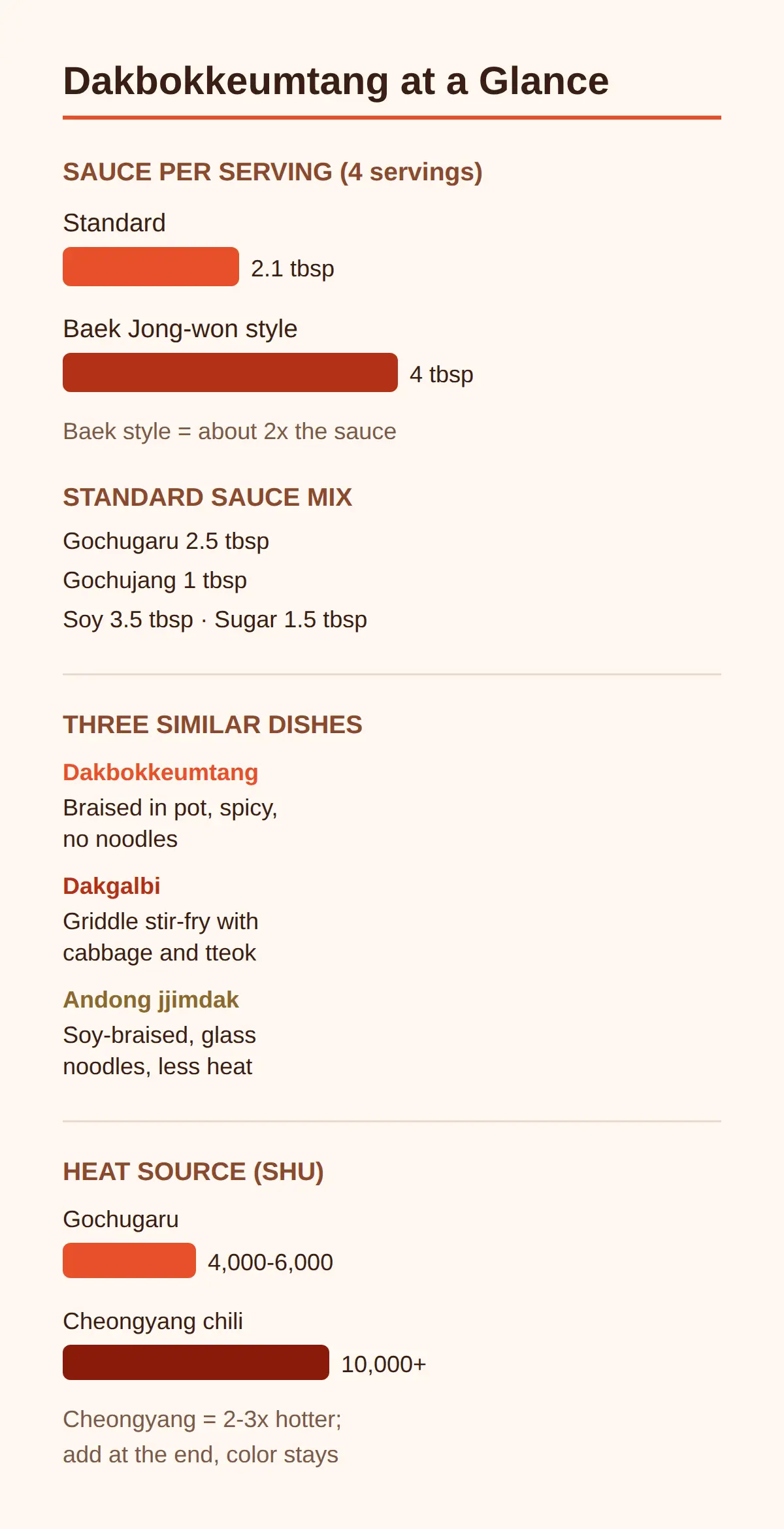
- A standard dakbokkeumtang recipe yields 4 servings in about 45 minutes total, built on a sauce of gochugaru 2.5 tbsp, gochujang 1 tbsp, soy sauce 3.5 tbsp, sugar 1.5 tbsp, garlic 1 tbsp and ginger 1 tsp (Korean recipe facts, this post’s fact sheet).
- Cheongyang chili runs roughly 2-3x hotter than gochugaru (about 10,000+ SHU vs about 4,000-6,000 SHU), so halving the gochugaru and adding 0.5 tbsp extra sugar keeps the sweet-spicy balance for milder palates (fact sheet, spice adjustment).
Dakbokkeumtang Recipe Basics: What the Dish Is, and Why It Is Also Called Dakdoritang
| Chicken (bone-in, chopped) | ~700 g (or 1 kg bone-in thighs) |
|---|---|
| Water | 450 ml |
| Potatoes, cut into large quarters | 2 (about 300 g) |
| Carrot | 1/2, cut large |
| Onion | 1, cut thick |
| Gochugaru (Korean chili flakes) | 2.5 tbsp |
| Gochujang (Korean chili paste) | 1 tbsp (wait: 1 tbsp) |
Dakbokkeumtang is spicy braised chicken: chopped chicken simmered in a gochugaru-gochujang sauce with potatoes until the sauce turns thick and glossy.
The same dish is widely known as dakdoritang, and both names are used for it.
Koreans eat it as a family main dish or as food to share over drinks, and the sweet-spicy broth with soft potato is the part people look for.
Plain rice and kkakdugi (cubed radish kimchi) are the classic pairings, and the thick leftover sauce is commonly mixed into rice at the end.
When reading a recipe for this dish from outside Korea, the two Korean chili ingredients decide everything — whether they are stocked at the local supermarket, and what stands in when they are not.
Ingredients
Main
- about 700 g bone-in chopped chicken
- 450 ml water
- 2 (about 300 g) potatoes — regular starchy, not sweet potato; cut into large quarters, corners trimmed
- 1/2 carrot — cut large
- 1 onion — cut thick
Sauce & seasoning
- 2.5 tbsp gochugaru (Korean chili flakes)
- 1 tbsp gochujang (Korean chili paste)
- 3.5 tbsp soy sauce (jin ganjang) — dark, not thin soup-style
- 1.5 tbsp sugar
- 1 tbsp garlic — minced
- 1 tsp ginger — minced
To finish
- green onion and cheongyang chili — sliced on the bias, added at the end
- to finish sesame oil and sesame seeds
Amounts are the ones used in this recipe; where the recipe gives no amount, adjust to taste.
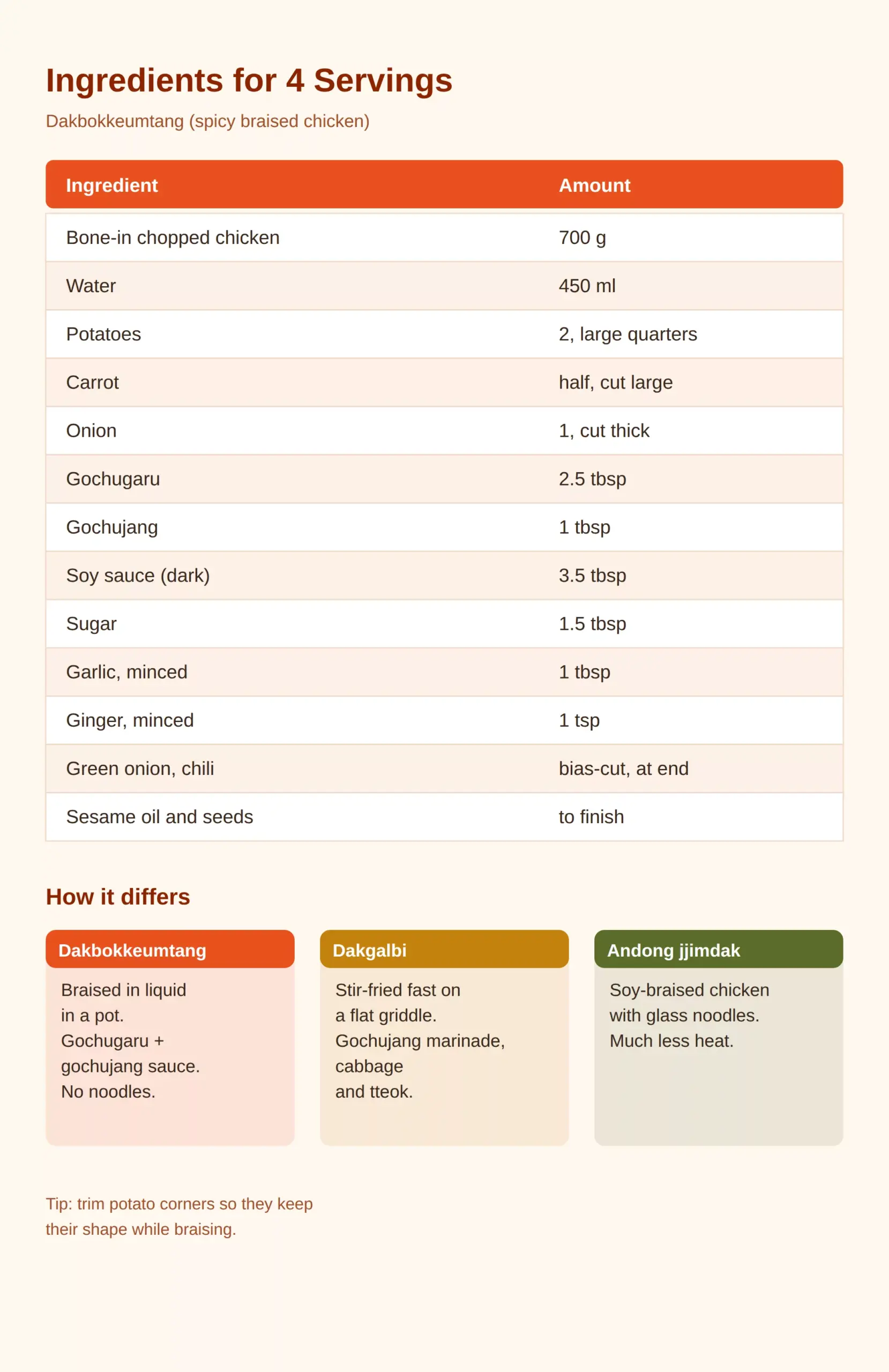
Dakbokkeumtang Ingredients for 4 Servings
| Ingredient | Amount for 4 servings |
|---|---|
| Bone-in chopped chicken | about 700 g |
| Water | 450 ml |
| Potatoes (regular starchy, not sweet potato) | 2, cut into large quarters, corners trimmed |
| Carrot | half, cut large |
| Onion | 1, cut thick |
| Gochugaru | 2.5 tbsp |
| Gochujang | 1 tbsp |
| Soy sauce (dark jin ganjang, not thin soup-style) | 3.5 tbsp |
| Sugar | 1.5 tbsp |
| Garlic (minced) | 1 tbsp |
| Ginger (minced) | 1 tsp |
| Green onion and cheongyang chili | sliced on the bias, added at the end |
| Sesame oil and sesame seeds | to finish |
How To Make Dakbokkeumtang — Steps and Timing
A standard batch yields 4 servings in about 45 minutes total, and the sauce works best when it is mixed before it meets the heat.
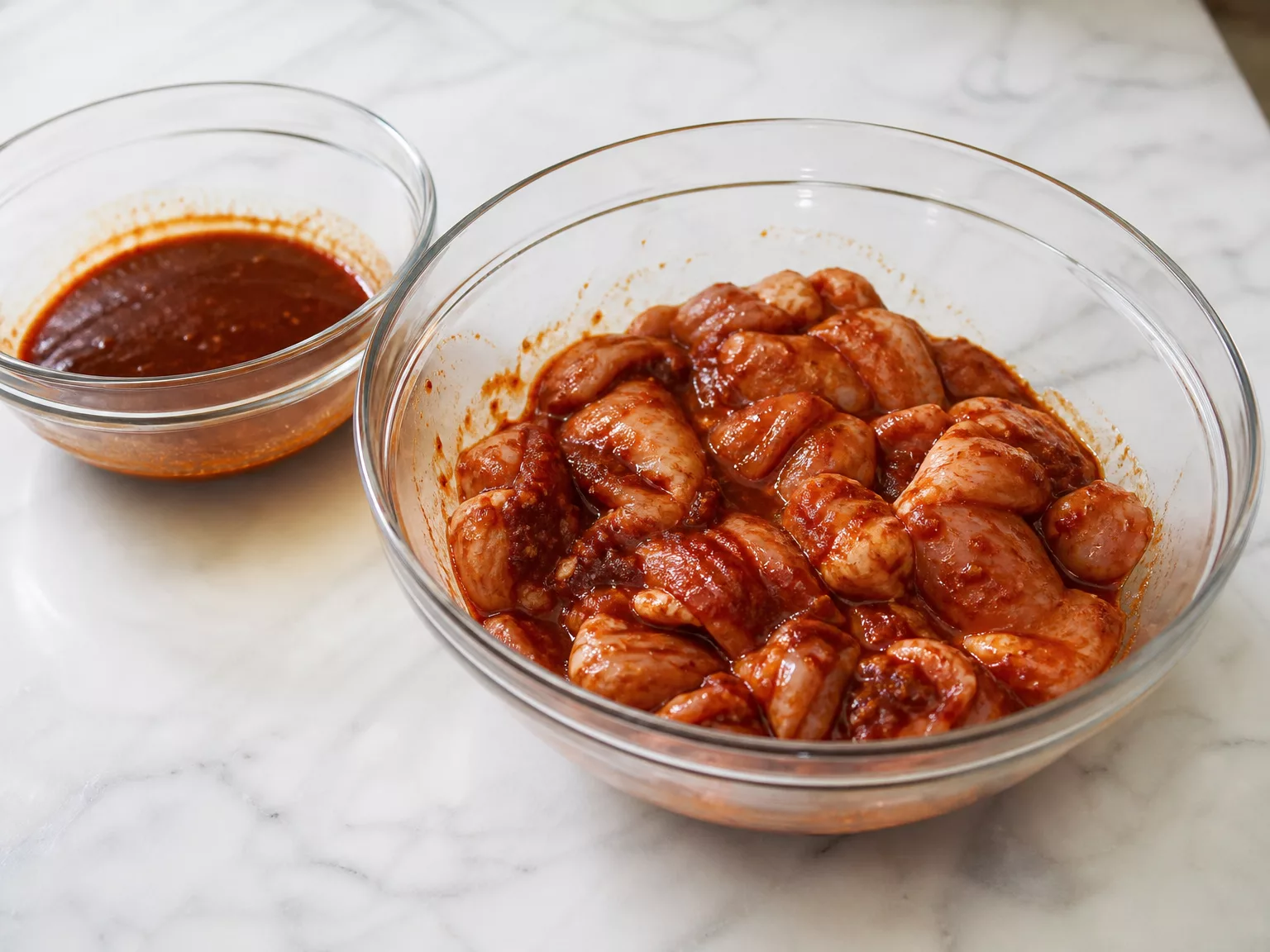
Marinating the chicken in the sauce for about 10 minutes first is a documented step that lets the seasoning soak in deeper.
- Mix the sauce ingredients together, coat the chopped chicken in it, and rest about 10 minutes.
- Add the chicken, sauce and 450 ml water to the pot and bring to a hard boil.
- Add the potato and carrot, cover, and simmer on medium heat for 15 minutes, ladling broth over the chicken now and then.
- Add the thick-cut onion and cook 5 minutes more, still covered.
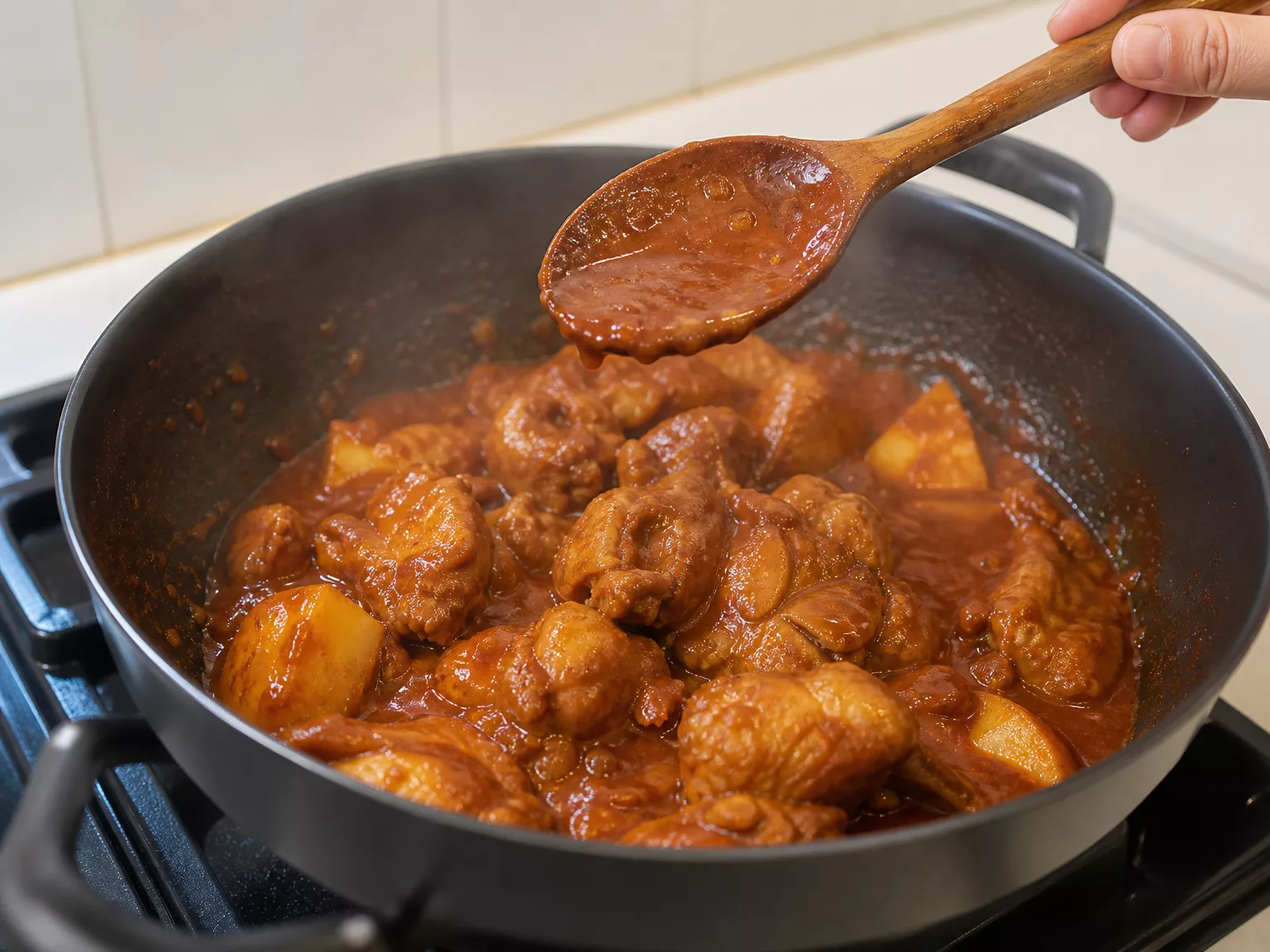
- Take the lid off and reduce the sauce uncovered until it coats the back of a spoon and looks glossy.
- Add sliced green onion and chili and cook just 2-3 minutes until wilted, then finish with sesame oil and sesame seeds.
The chicken is done when it pulls off the bone easily, the potato is fork-tender, and the sauce just coats a spoon dragged through it.
Steps at a glance
-
 AI-generated photo
What it should look like — AI-generated image of this step, made from the recipe text — not a photo of our kitchen. 1Mix the sauce ingredients together, coat the chopped chicken in it,…⏱ ~10 minutes -
2Add the chicken, sauce and 450 ml water to the pot and bring to a…🔥 boil
-
3Add the potato and carrot, cover, and simmer on medium heat for 15…⏱ 15 minutes🔥 simmer
-
4Add the thick-cut onion and cook 5 minutes more, still covered.⏱ 5 minutes
-
 AI-generated photo
What it should look like — AI-generated image of this step, made from the recipe text — not a photo of our kitchen. 5Take the lid off and reduce the sauce uncovered -
6Add sliced green onion and chili and cook just 2-3 minutes⏱ 2-3 minutes
Can You Make It Without Gochugaru or Gochujang?
Gochugaru and gochujang are both shelf-stable and widely stocked in the international aisle of regular supermarkets in most Western countries, so check there before substituting.
One documented gochugaru stand-in is 2 parts mild paprika plus 1 part cayenne to approximate the color and heat.
Substitute ratios differ between recipes, so mix a small batch first and adjust to taste.
Gochujang is harder to replace cleanly, and recipes that suggest workarounds do not agree on a single ratio.
Both ingredients are cheap and keep for months in the fridge after opening, so if the dish will be cooked more than once, buying them is the simpler path.
Four Home Styles, and How the Sauce Changes Per Serving
Korean home recipes cluster into four styles: Baek Jong-won’s balanced sweet-spicy version, a marinate-first style for deeper seasoning, a soy-based mild version with less chili, and an extra-spicy version built on cheongyang chili.
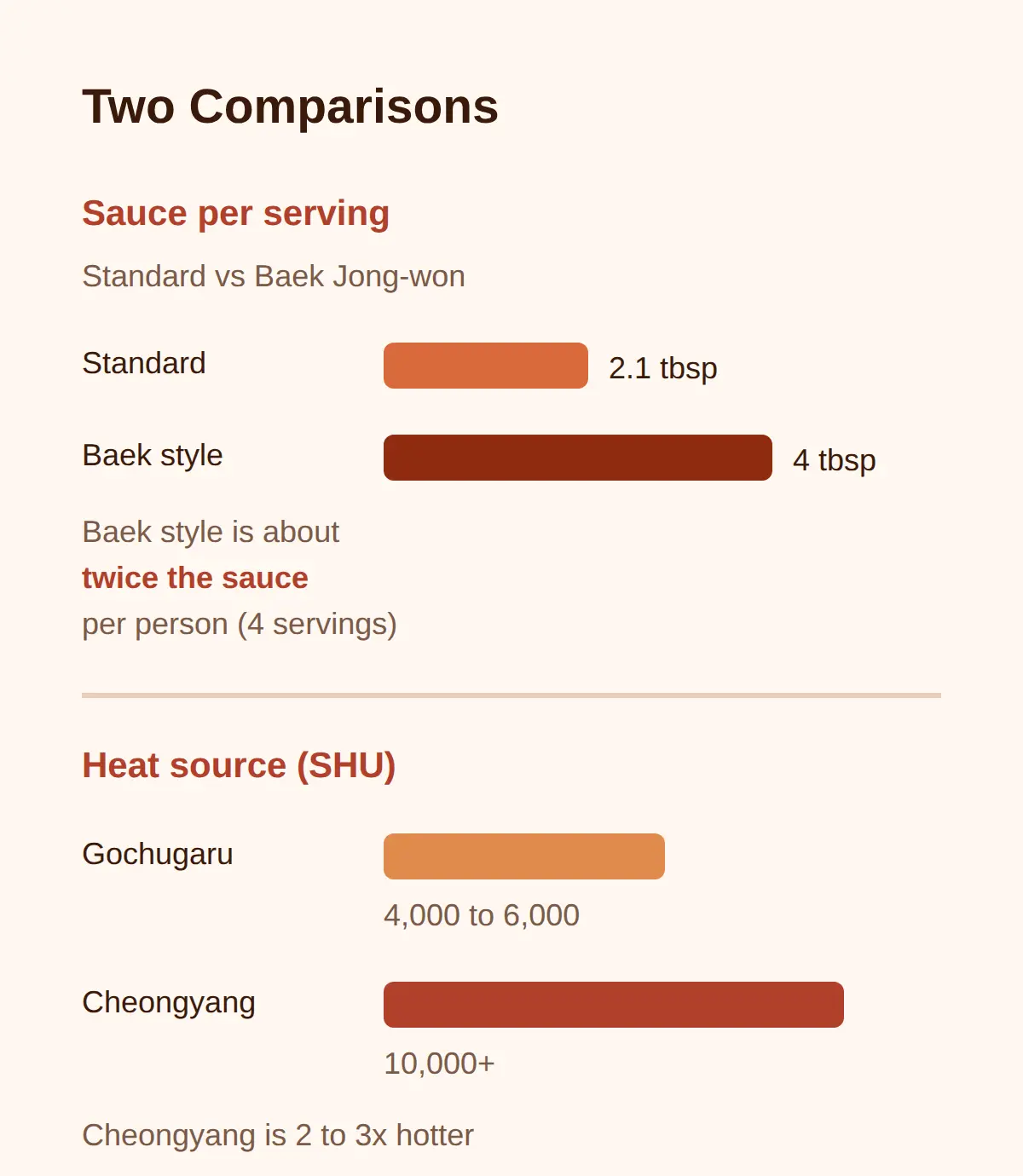
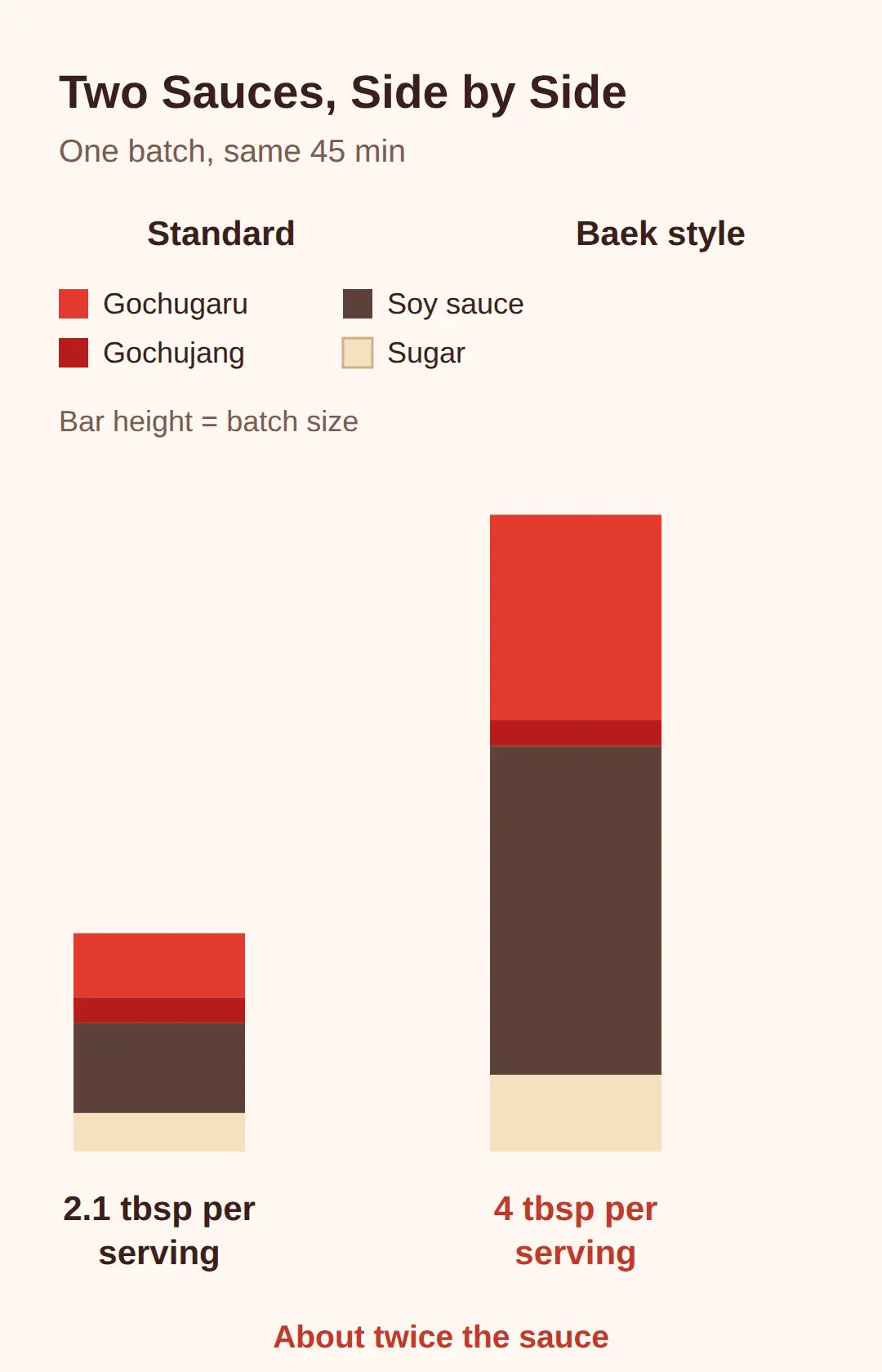
The sauce quantity is the biggest difference between styles: the standard batch works out to about 2.1 tbsp of sauce per serving, while the Baek Jong-won style (coarse gochugaru 1/2 cup, fine gochugaru 1 tbsp, soy about 4/5 cup, sugar 3 tbsp) works out to about 4 tbsp per serving — roughly twice the sauce per person.
Baek Jong-won’s method also blanches the chicken first for a cleaner broth, boils it with sugar first so sweetness soaks into the meat, and adds the chili powders mid-cook instead of at the start.
Total time does not change between styles — both are listed at about 45 minutes, so the choice is about sauce depth, not schedule.
One more caution that applies to every style: adding gochugaru to a boiling pot early or scalding it over direct high heat can turn the sauce bitter and dull its color, so mix it in before heat or add it mid-cook.
How Spicy Is It, and How Do You Control the Heat?
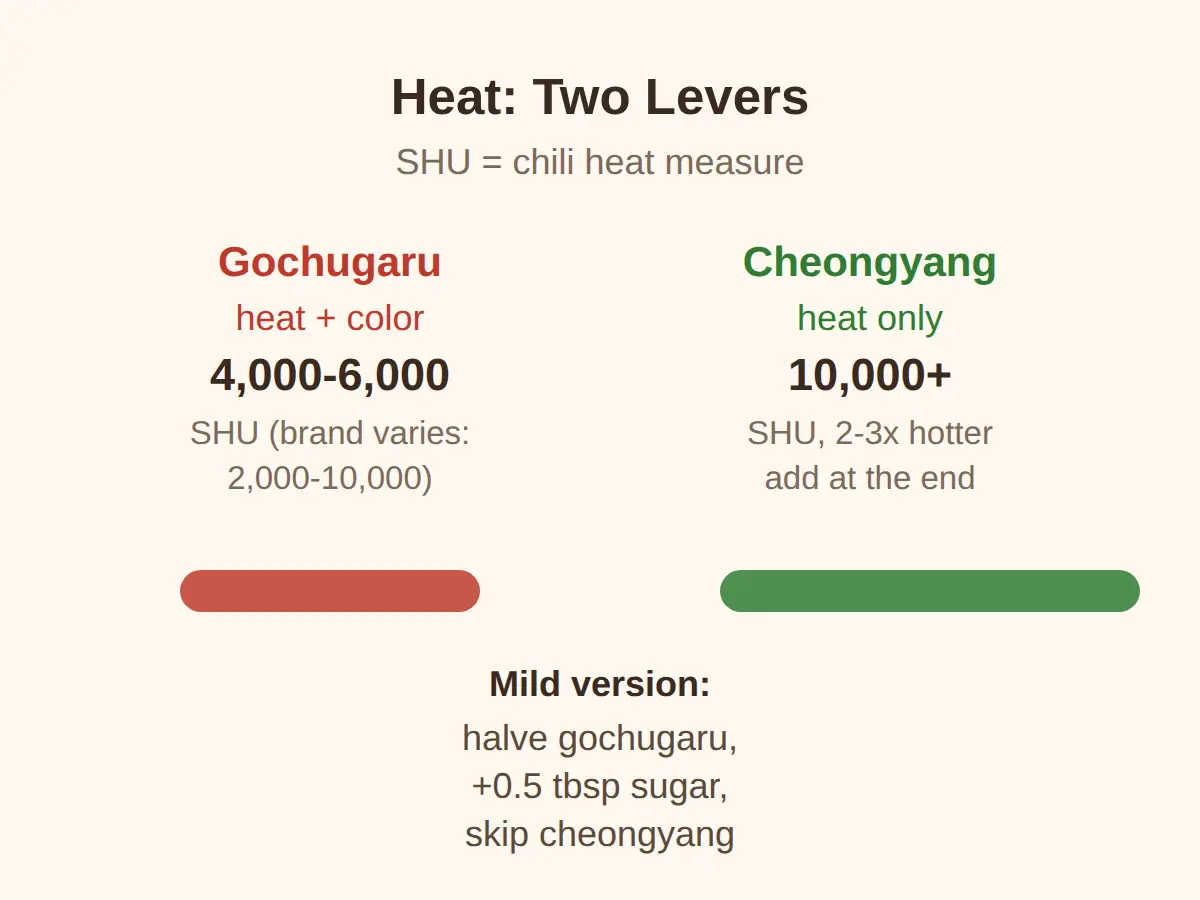
The heat is controlled by two independent levers: gochugaru controls both heat and color, while cheongyang chili controls heat only.
Typical gochugaru runs about 4,000-6,000 SHU (a measure of chili heat) but varies widely by brand, roughly 2,000-10,000; cheongyang chili runs about 10,000+ SHU, roughly 2-3 times hotter.
To serve kids or mild palates, halve the gochugaru and add 0.5 tbsp extra sugar to keep the sweet-spicy balance, and treat the cheongyang chili as an optional garnish only.
Adding cheongyang chili at the end raises the heat without changing the sauce color much, which is how extra-spicy versions are built.
Green onion and the fresh chilies go in for the last 2-3 minutes only — cooking them longer kills their aroma.
If I could not find gochugaru or gochujang, I would still cook it with a mix of mild paprika powder for color and a spoon of sriracha or chili-garlic sauce for heat — I check the substitute’s sugar content first, because the sweet-spicy balance is what this braise depends on.
The first thing I look at when dialing the heat down is the cheongyang chili: dropping it keeps the sauce’s color and flavor while cutting most of the burn.
Related posts
📎 📅 Upcoming Dates — Release & Event Calendar
Sources
- Estimate 500-600 kcal/serving; no primary nutrition page (cookpick.kr)
- Cut potatoes large, trim edges, add mid-braise (recipio.kr)
- Anchoring-asset principle for consistency (gyuha.com)
Which Version Should You Cook?
- If gochugaru is on the shelf, follow the standard sequence in the steps section — it is the shortest path to the documented result.
- If the table has kids or mild palates, halve the gochugaru and add 0.5 tbsp extra sugar; skip the cheongyang chili.
- If you want the thick, spoon-coating sauce people associate with the dish, the Baek Jong-won style uses about twice the sauce per serving at the same 45-minute total.
- If the potatoes keep breaking apart, cut them into large quarters, trim the corners, and use starchy potatoes rather than sweet potato.
- If cooking it tonight without Korean ingredients is the only option, mix a small test batch of the paprika-cayenne stand-in first and adjust to taste.
FAQ
Q. Is dakdoritang the same dish as dakbokkeumtang?
Yes — both names are used for the same spicy braised chicken, so a recipe under either name works.
Q. How do you make dakbokkeumtang mild for kids?
Halve the gochugaru and add 0.5 tbsp extra sugar, and leave the cheongyang chili out or add it only to adult portions at the end.
Q. How do I keep the potatoes from falling apart?
Cut them into large quarters, trim the corner edges, and use regular starchy potatoes — not sweet potato.
Q. Can I make dakbokkeumtang without gochugaru?
One documented stand-in is 2 parts mild paprika plus 1 part cayenne; recipes disagree on exact ratios, so adjust a small test batch to taste.
Q. How long does dakbokkeumtang keep in the fridge?
Korean recipe sites commonly suggest 3-4 days refrigerated in an airtight container, though no primary source verified this figure for this post.
Sources: Cookpick, Recipio (Baek Jong-won recipe), Maangchi, My Korean Kitchen, Korean Bapsang — linked in the text.
Cover photo: Korean.food-Dakbokemtang-01 by stuart_spivack (a flickr user) — CC BY-SA 2.0
#dakbokkeumtang #dakdoritang #koreanchickenrecipe #gochujang #gochugarusubstitute
📅Upcoming Schedule — this week 2 · D-2 Hangul DaySee all →