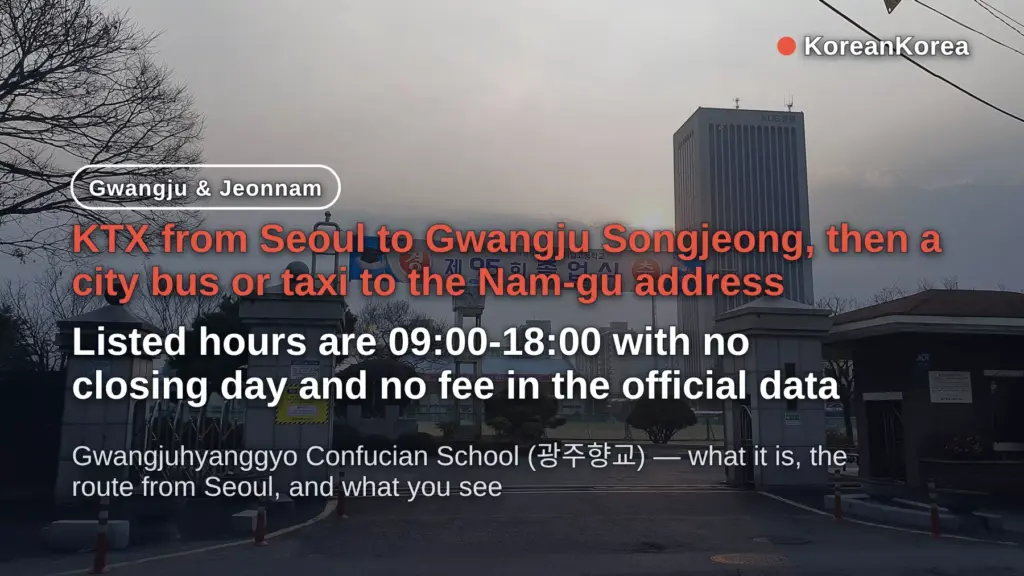
Gwangjuhyanggyo Confucian School in Nam-gu, Gwangju is listed by the Korea Tourism Organization as open 09:00-18:00, with no closing day and no fee in its official data.
That makes it an easy add-on if you are already in central Gwangju, but it is a compact site, not a half-day destination.
This post covers the route from Seoul, hours and the fee question, what you actually see, how long to allow, and the programs the site hosts.
Key facts — As of 2026-10-02
- Gwangjuhyanggyo Confucian School (광주향교) at 5 Jungang-ro 107beon-gil, Nam-gu, Gwangju, is listed by the Korea Tourism Organization as open 09:00-18:00 with parking available (KTO English data, checked 2026-10-03).
- The school was founded in 1398 per two academic sources (encykorea.aks.ac.kr, dh.aks.ac.kr), while the hyanggyo’s own site gives 1393.
- Daeseongjeon, the shrine hall, is a 3-bay by 3-bay gable-roof hall enshrining the Five Sages, Song dynasty sages, and Korea’s 18 sages, and the site was designated Gwangju Metropolitan City Tangible Cultural Heritage No. 9 on 1985-02-25.
Gwangjuhyanggyo Confucian School From Seoul: The Route In Short
| Address | 5 Jungang-ro 107beon-gil, Nam-gu, Gwangju (postal code 61636) |
|---|---|
| Phone | +82-62-672-7008 |
| Hours | 09:00-18:00 |
| Closed days | None listed in the KTO data |
| Admission | No fee listed in the KTO data or on the hyanggyo’s own site |
| Parking | Available (size and cost not stated) |
| Heritage status | Gwangju Metropolitan City Tangible Cultural Heritage No. 9, designated February 25, 1985 |
Take a KTX from Seoul toward Gwangju Songjeong station, then a city bus or taxi to 5 Jungang-ro 107beon-gil in Nam-gu.
That is the whole trip: one train, one short final leg into central Gwangju. [koreankorea.com] lists today’s Seoul-Gwangju and Seoul-Mokpo trains, so check times there the day you travel.
The school sits on Jungang-ro in Nam-gu, next to Gwangju Park, which is central enough that a taxi stays cheap.
Bus route numbers from Gwangju Songjeong station could not be confirmed in a recent source, so use a map app on the day rather than copying a route number from an older post.
Gwangju Songjeong is the safe station to aim for; the alternative stops on the Mokpo line were not verified for this site.
If you are doing Gwangju as a day trip from Seoul, I would lock in the KTX first and treat the hyanggyo as a stop you slot in around Gwangju Park, not the other way around.
Getting there — Gwangjuhyanggyo Confucian School
- Seoul → Gwangju by train: fastest 1h 36m, from ₩37,800, 56 trains a day, first 05:08 · last 22:55 · timetable
- Seoul → Gwangju by express bus: fastest 3h 20m, from ₩22,700, 72 buses a day, first 05:30 · last 23:50 · timetable
- Last leg: about 12.4 km from Gwangju Songjeong Station — roughly 14 min by taxi or car without traffic; local buses also run (check the stop sign or a map app)
- Map: Naver Map · Kakao Map · Google Maps
Calculated by koreankorea.com from the national train and express-bus timetables, OpenStreetMap road distance. Plan your own route
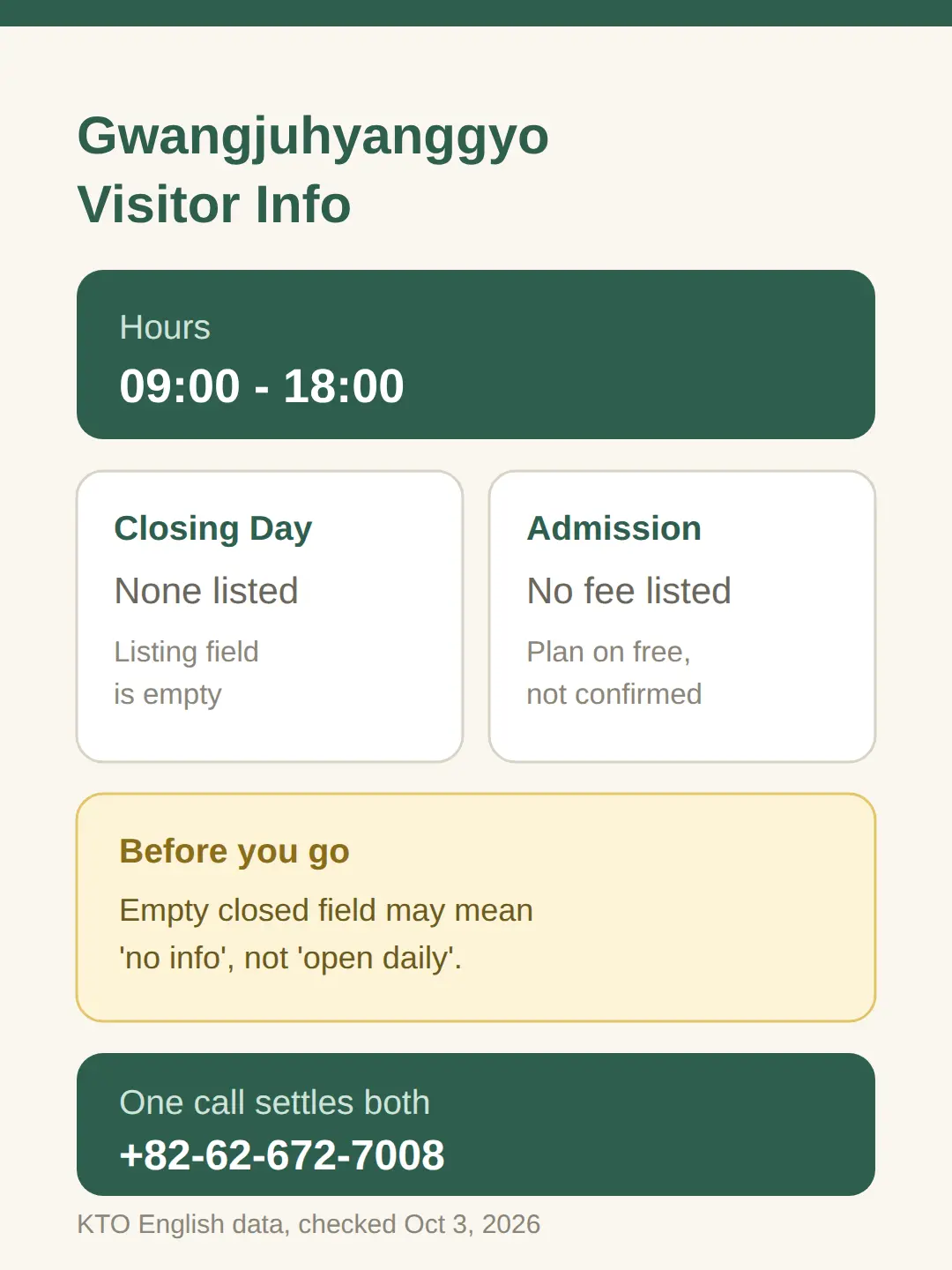
Hours, Closing Days And Admission Fee
The Korea Tourism Organization’s English listing gives the hours as 09:00-18:00 (KTO English data, checked October 3, 2026).
No weekly closing day appears in the listing, and the hyanggyo’s own site states none either.
No admission fee is listed on the KTO data or the hyanggyo’s own site — so plan on free entry, but note that ‘no fee listed’ is not the same as a confirmed ‘free’.
Two gaps are worth knowing before you go.
The empty ‘closed’ field on a tourism listing can mean ‘no information’ rather than ‘open every day’, and weekend or holiday hour variations are not published.
One call settles both: +82-62-672-7008.
If you are building a tight day-trip schedule around fixed train times, make that call the day before — a site that closes without notice would cost you an hour of a short visit.
What It Is And What You See On Site
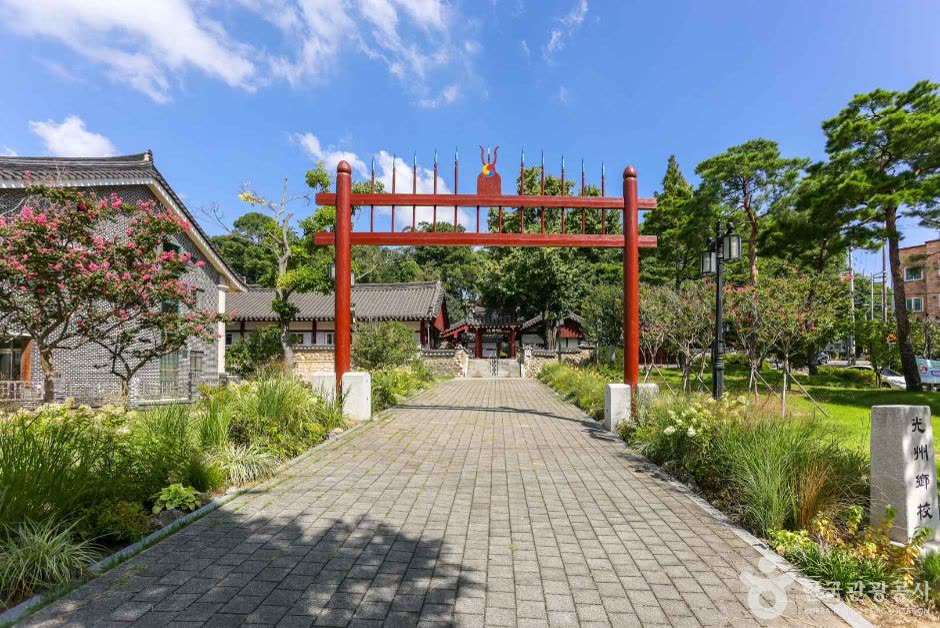
Gwangjuhyanggyo is a hyanggyo — a Joseon-era public Confucian school and shrine — founded in 1398 at the foot of Jangwonbong Peak on Mt.
Mudeung.
The hyanggyo’s own site dates the founding to the Taeseong era (1393–1398), so the founding year is given within a range of about five years depending on the source.
This post uses 1398, the date two independent sources agree on.
In plain terms, a hyanggyo was a local public school that both taught students and held rites for Confucian sages — roughly a national secondary school of its era.
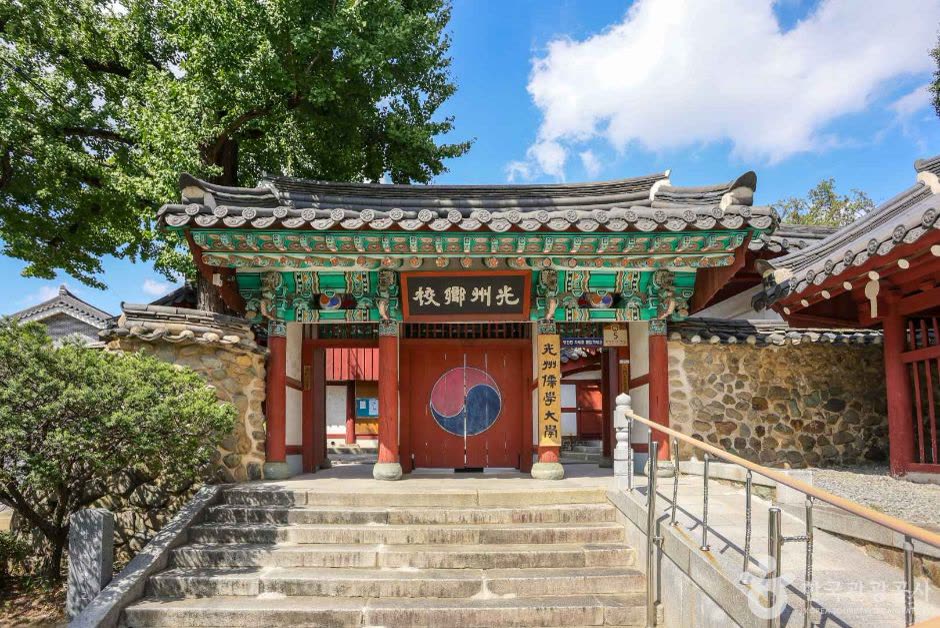
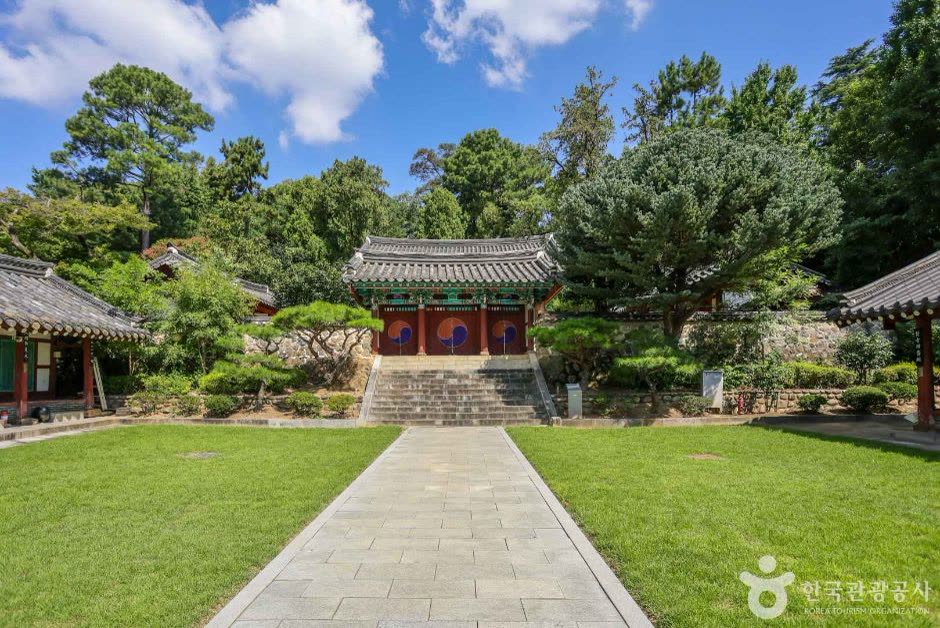
The layout follows the jeonhak-hu-myo arrangement: the lecture hall Myeongnyundang at the front and the shrine Daeseongjeon behind it.
Daeseongjeon is a 3-bay by 3-bay gable-roof hall that enshrines the tablets of the Five Sages, Song dynasty sages, and Korea’s 18 sages, and Myeongnyundang is a larger 6-bay hall with a plain wooden floor.
Around them stand the east and west dormitories, corridor shrines, the inner and outer gates, and a stele pavilion.
The original buildings burned in the 1597 Japanese invasion and were rebuilt in 1600 by magistrate Lee Sang-gil; the lecture hall and dormitories burned again in 1841 and were rebuilt within about a month in 1843 using government rice.
History-focused visitors get the most out of the front-to-back layout itself — lecture hall first, shrine behind — which is the defining structure of a hyanggyo.
How Long To Allow And What Is Nearby
Plan the hyanggyo as a short stop, not a destination: it is a compact single-courtyard site you walk front to back.
The travel wiki’s assessment of 30-60 minutes for most visitors matches the site’s size, so an under-hour budget is realistic.
Because it is one courtyard with a handful of buildings, there is no second wing or annex to extend your visit.
Gwangju Park sits directly adjacent, and the location on Jungang-ro puts you in central Gwangju with good access to the rest of the city.
That pairing is the practical move: the park fills the rest of the hour, and central Nam-gu keeps food and transport close.
If your Gwangju time is short, I would pair the hyanggyo with Gwangju Park next door and keep the whole block under two hours — that is the visit this site can support.
Rites, Experiences And Seasonal Highlights
The site still functions as a Confucian culture center.
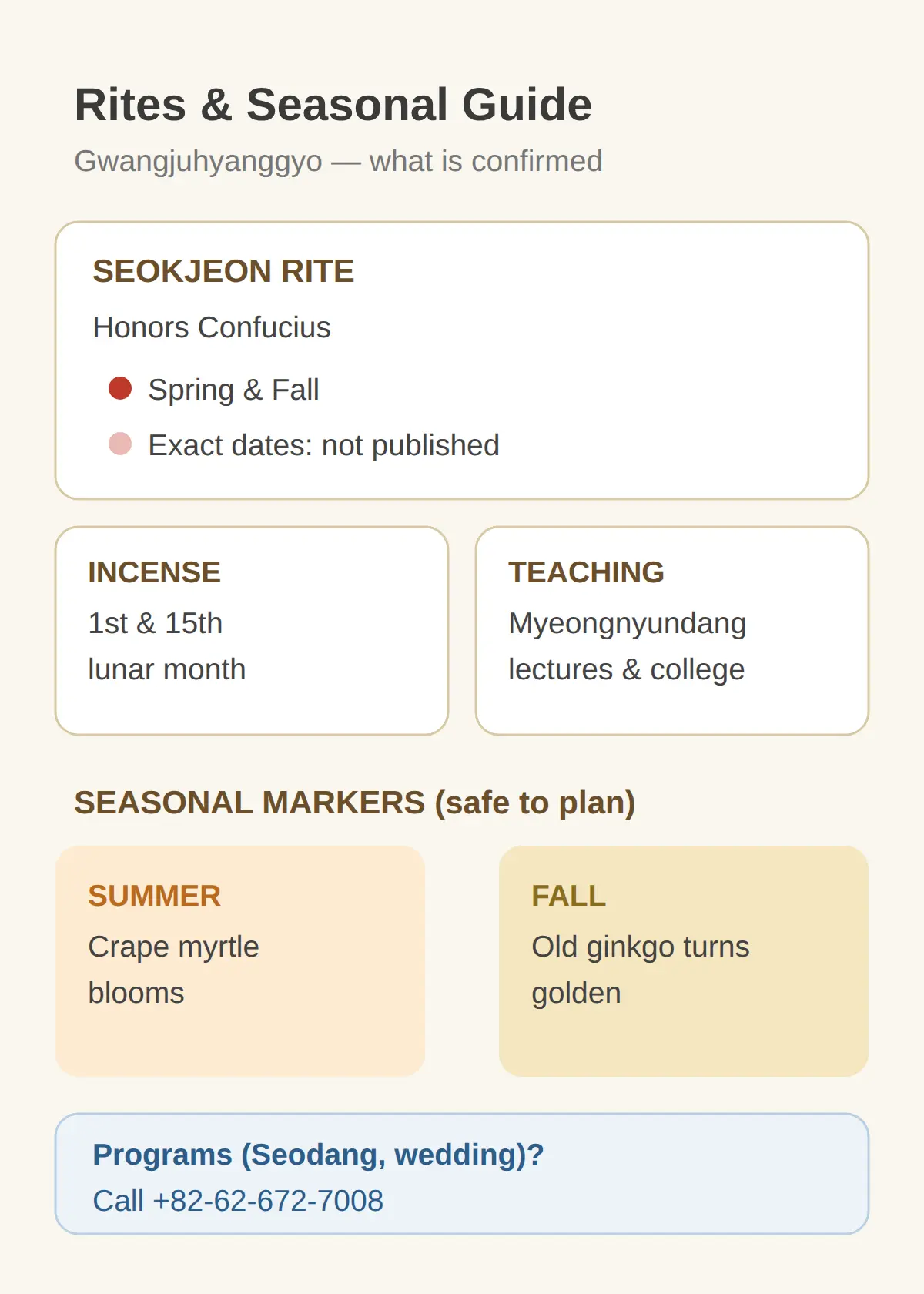
The Seokjeon rite honoring Confucius is held in spring and fall, incense is offered on the 1st and 15th of each lunar month, and the teaching role continues through academy lectures at Myeongnyundang and a two-year Gwangju Confucian College.
The KTO listing also names Seodang (traditional school) experiences and traditional weddings as visitor programs.
For timing, the KTO description gives the reliable seasonal markers: crape myrtle blooms in summer, and the old ginkgo tree turns golden in fall against the hanok roofs.
The Seokjeon rite is confirmed for spring and fall in general, but exact dates for the current year are not published in the sources checked, and the Seodang and wedding programs have no published schedule, price, or confirmation that foreign visitors can join.
If one of the programs is the reason you would come, call +82-62-672-7008 for the current schedule — the seasonal flower timing is safe to plan around, the ceremony dates are not.
One Warning: There Are Two Gwangjuhyanggyo
Make sure your map is pointed at the Nam-gu, Gwangju site — a different Gwangjuhyanggyo exists in Hansan-dong, Hanam, Gyeonggi-do.
The Gyeonggi one is a separate designated monument, and the two share the same name because both were the Confucian school of a place historically called Gwangju.
This trips up searchers because ‘Gwangju’ as a historical name covered a wider area than today’s Gwangju Metropolitan City.
Checking the address for ‘Jungang-ro 107beon-gil, Nam-gu’ is the fastest way to confirm you have the right one.
If your itinerary is built around Gwangju city or the Jeonnam region, the Nam-gu site is yours; the Hanam site is a different trip on the east side of Seoul.
👉 KTX from Seoul to every city, including Gwangju Songjeong and Mokpo
👉 Korea Tourism Organization English listing (content 3454503)
👉 Encyclopedia of Korean local culture — Gwangjuhyanggyo entry
👉 The hyanggyo’s own history page
👉 Gwangju regional culture encyclopedia entry
Related posts
📎 Seoul — everything we know
📎 📅 Upcoming Dates — Release & Event Calendar
Sources
- Encyclopedia entry: buildings, steles, archives, rituals (encykorea.aks.ac.kr)
- KTO English listing 09:00-18:00, closed —, parking available (api.visitkorea.or.kr)
- 1985 designation, 1398 founding, 1488 move, 1600 rebuild (hyanggyo.co.kr)
Summary: The Short Answers
- Route from Seoul: KTX to Gwangju Songjeong, then city bus or taxi to 5 Jungang-ro 107beon-gil, Nam-gu — check a map app for the bus, route numbers are not confirmed.
- Hours: 09:00-18:00 per the KTO listing, with no closing day and no fee listed; confirm both at +82-62-672-7008 before a tight schedule.
- Budget under an hour for the hyanggyo itself and pair it with Gwangju Park next door.
- Check the address says Nam-gu, Gwangju — there is a same-named site in Hanam, Gyeonggi-do.
FAQ
Q. How do I get to Gwangjuhyanggyo Confucian School from Seoul?
Take a KTX from Seoul to Gwangju Songjeong station, then a city bus or taxi to 5 Jungang-ro 107beon-gil in Nam-gu. Check train times on koreankorea.com and use a map app for the final bus leg, since route numbers are not confirmed in recent sources.
Q. When is Gwangjuhyanggyo open and is there a fee?
The KTO listing gives 09:00-18:00 with no closing day and no fee listed, checked October 3, 2026. Because ‘no fee listed’ is not the same as confirmed free entry and weekend hours are not published, call +82-62-672-7008 to confirm both.
Q. How much time should I allow for Gwangjuhyanggyo?
It is a compact single-courtyard site, so a short stop is enough — the widely cited estimate is 30-60 minutes. Pair it with Gwangju Park, which sits directly adjacent.
Q. Can I see a ceremony or join a program at Gwangjuhyanggyo?
The Seokjeon rite honoring Confucius is held in spring and fall, and the KTO lists Seodang experiences and traditional weddings as programs. Exact rite dates and program schedules, prices, and foreign-visitor eligibility are not published — ask at +82-62-672-7008.
Q. Which Gwangjuhyanggyo is the one in Gwangju city?
The one at 5 Jungang-ro 107beon-gil, Nam-gu, Gwangju. A different school with the same name stands in Hansan-dong, Hanam, Gyeonggi-do.
Trains from Seoul to Gwangju and Mokpo, checked daily: https://koreankorea.com/ktx-and-trains-from-seoul-all-cities/ · More Gwangju and Jeonnam guides: https://koreankorea.com/korea-travel-by-region/
Cover photo: 광주일고 by 기여자 — CC BY-SA 4.0
#Gwangjuhyanggyo #Gwangju #Jeonnam #Confucianschool #KTXfromSeoul #Koreaheritage
📅Upcoming Schedule — this week 3 · D-1 documentary 'Always Lalisa' global theatrical release (Oct 1See all →Last updated 2026-10-07. Editorial policy