
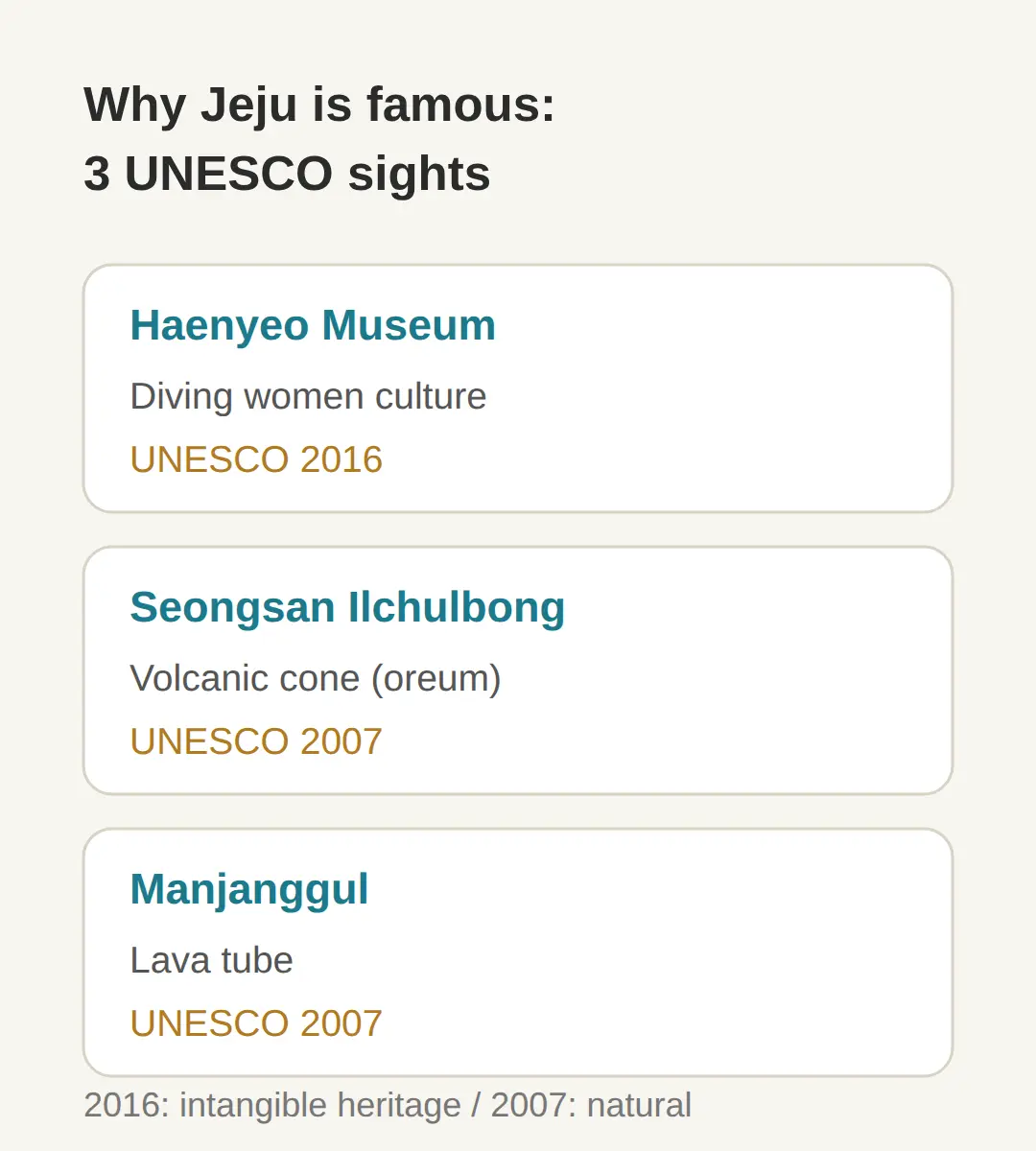
Jeju is famous for three things you can visit in one trip: the haenyeo diving women, the Seongsan Ilchulbong volcanic cone, and the Manjanggul lava tube.
The three admission fees add up to KRW 10,100 (1,100 + 5,000 + 4,000), which is less than a taxi fare across Jeju City.
This post gives the fee for each sight, how long each one takes, what to see inside, and how to fit all three into a 2-night, 3-day plan.
Key facts — As of 2026-10-10
- Based on 2026 travel-guide prices, the three signature sights — Haenyeo Museum (KRW 1,100), Seongsan Ilchulbong (KRW 5,000), Manjanggul (KRW 4,000) — total KRW 10,100.
- Seongsan Ilchulbong’s main stairway trail takes roughly 25–30 minutes each way, so about 50–60 minutes up and down.
- Manjanggul’s largest lava column stands 7.6 m tall, inside a cave that stays 11–13°C year-round.
What Is Jeju Island Famous For? Haenyeo, Seongsan, and Lava Tubes
| Haenyeo Museum | KRW 1,100 |
|---|---|
| Seongsan Ilchulbong | KRW 5,000 |
| Manjanggul | KRW 4,000 |
| All three | KRW 10,100 |
Jeju is famous for the haenyeo diving women, oreum volcanic cones, and lava-tube geology — these are the three recurring answers in recent English guides about the island.
Each of the three maps to a sight you can walk into: the haenyeo story at the Haenyeo Museum, the cone at Seongsan Ilchulbong, and the tube at Manjanggul.
The haenyeo culture was inscribed on UNESCO’s list of intangible cultural heritage in 2016, so it is the human half of the island’s fame.
The other two sit under the Jeju Volcanic Island and Lava Tubes UNESCO Natural World Heritage listing from 2007, which covers Seongsan Ilchulbong and the lava tubes including Manjanggul.
If you are picking what to see on a first visit, these three are the choices that carry the island’s UNESCO recognitions.
How Much Do the Three Sights Cost?
Based on 2026 travel-guide prices, the three signature sights total KRW 10,100.
| Sight | Admission fee |
|---|---|
| Haenyeo Museum | KRW 1,100 |
| Seongsan Ilchulbong | KRW 5,000 |
| Manjanggul | KRW 4,000 |
These values come from travel-guide sources dated to the start of 2026, so confirm each fee on the official Jeju or Korea Tourism Organization pages before you budget to the won.
The Haenyeo Museum is the cheapest of the three, at roughly a quarter of Seongsan’s fee.
Seongsan Ilchulbong costs 1.25 times what Manjanggul does.
If you only fit one paid sight into half a day, Seongsan gives you the climb for KRW 5,000, and if you want the cheapest meaningful stop, the Haenyeo Museum at KRW 1,100 is that stop.
How Long Does Each Sight Take?
Seongsan Ilchulbong’s main stairway trail takes roughly 25–30 minutes each way, so about 50–60 minutes up and down.
Budget a full hour plus queue time at the ticket window, because the climb time is only the walking part.
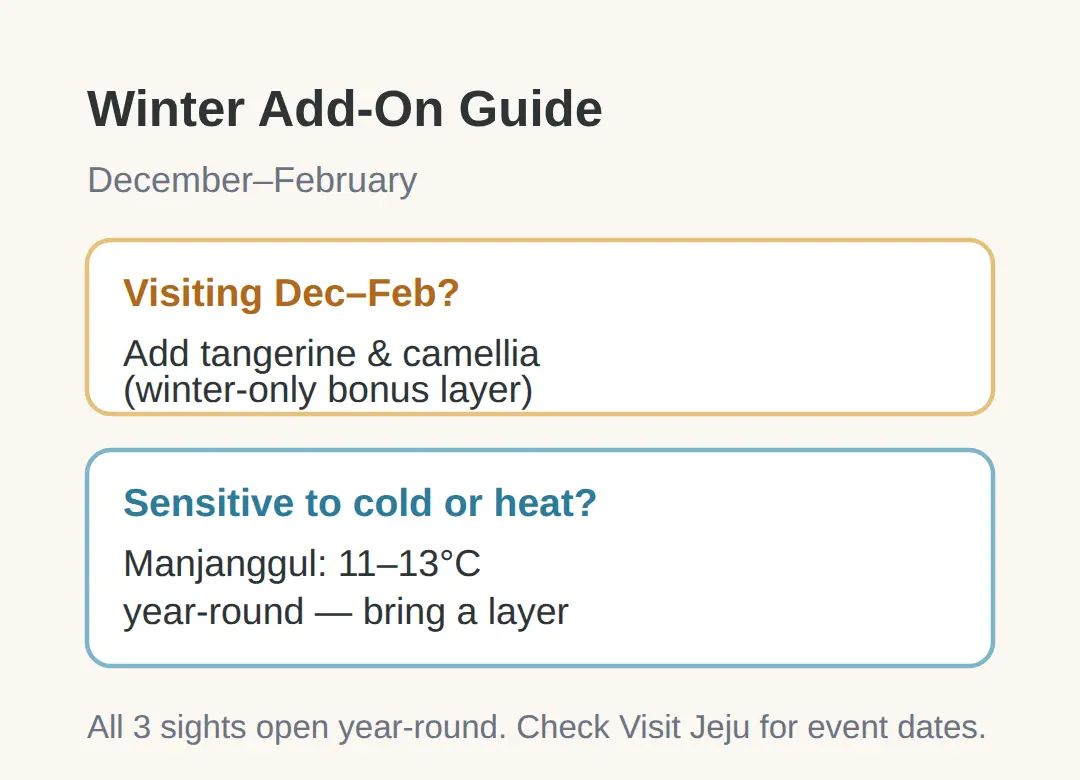
Manjanggul takes about 40–60 minutes inside, and the cave stays at 11–13°C year-round, so bring a layer even in summer.
The Haenyeo Museum visit is the shortest of the three and pairs with the waterfront next to it.
If your day is tight, one sight per half day is a realistic pace, and Seongsan plus Seopjikoji in the same east-side area also fit one day together.
What Do You See Inside Each Sight?
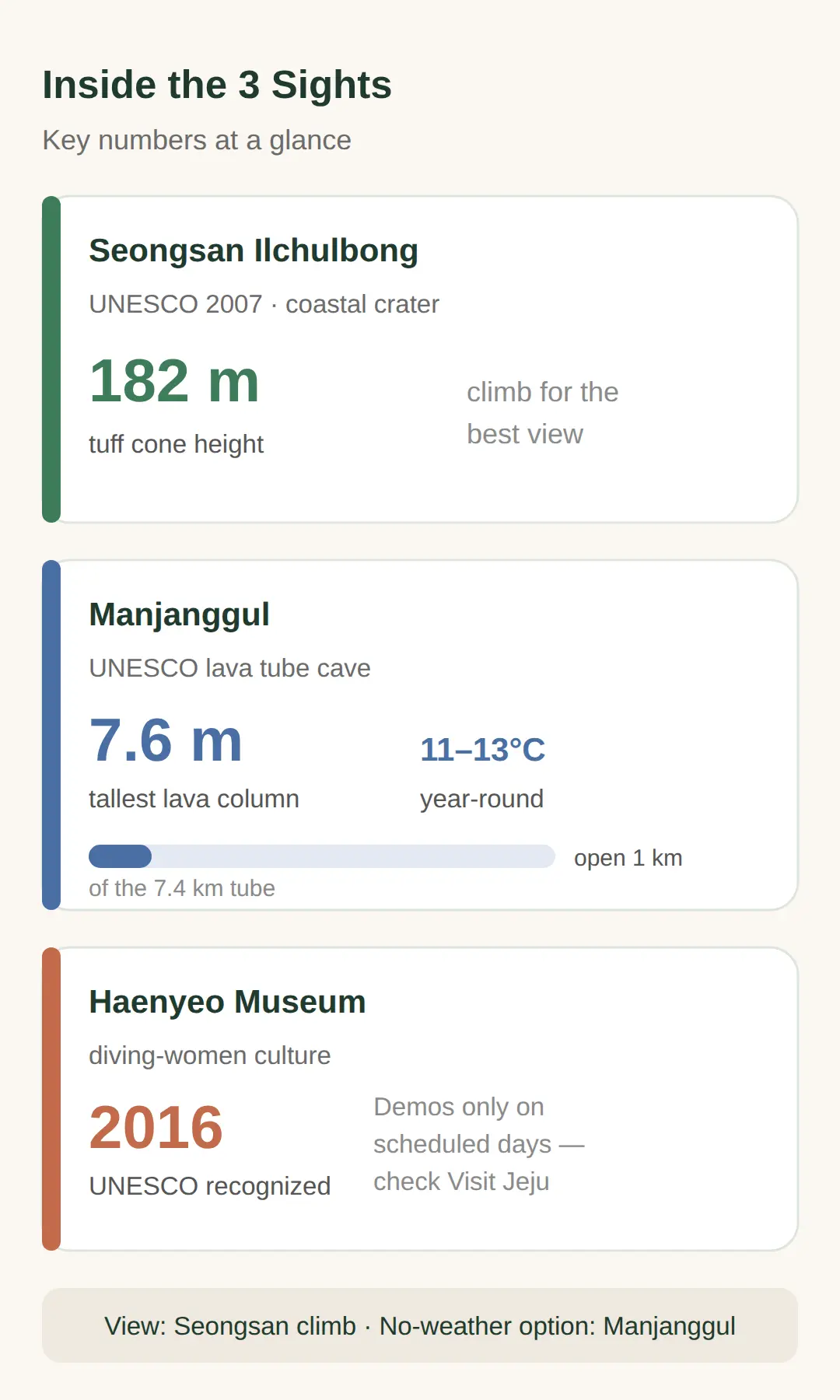
Seongsan Ilchulbong is a 182-meter tuff cone, a volcanic crater that rises from the coast and is part of the 2007 UNESCO World Heritage listing.
Manjanggul’s largest lava column stands 7.6 m tall, inside a cave that stays 11–13°C year-round.
The cave belongs to the same UNESCO lava tube listing, and the open section covers about 1 km of the 7.4 km tube.
The Haenyeo Museum explains the diving-women culture recognized by UNESCO in 2016, and diving demonstrations near the waterfront happen only on scheduled days — check the Visit Jeju page for the schedule before planning your day around a show.
If you want the single most quotable view, Seongsan is the climb; if you want geology up close without weather exposure, Manjanggul is the underground option.
Where Should You Stay for a Three-Sight Trip?
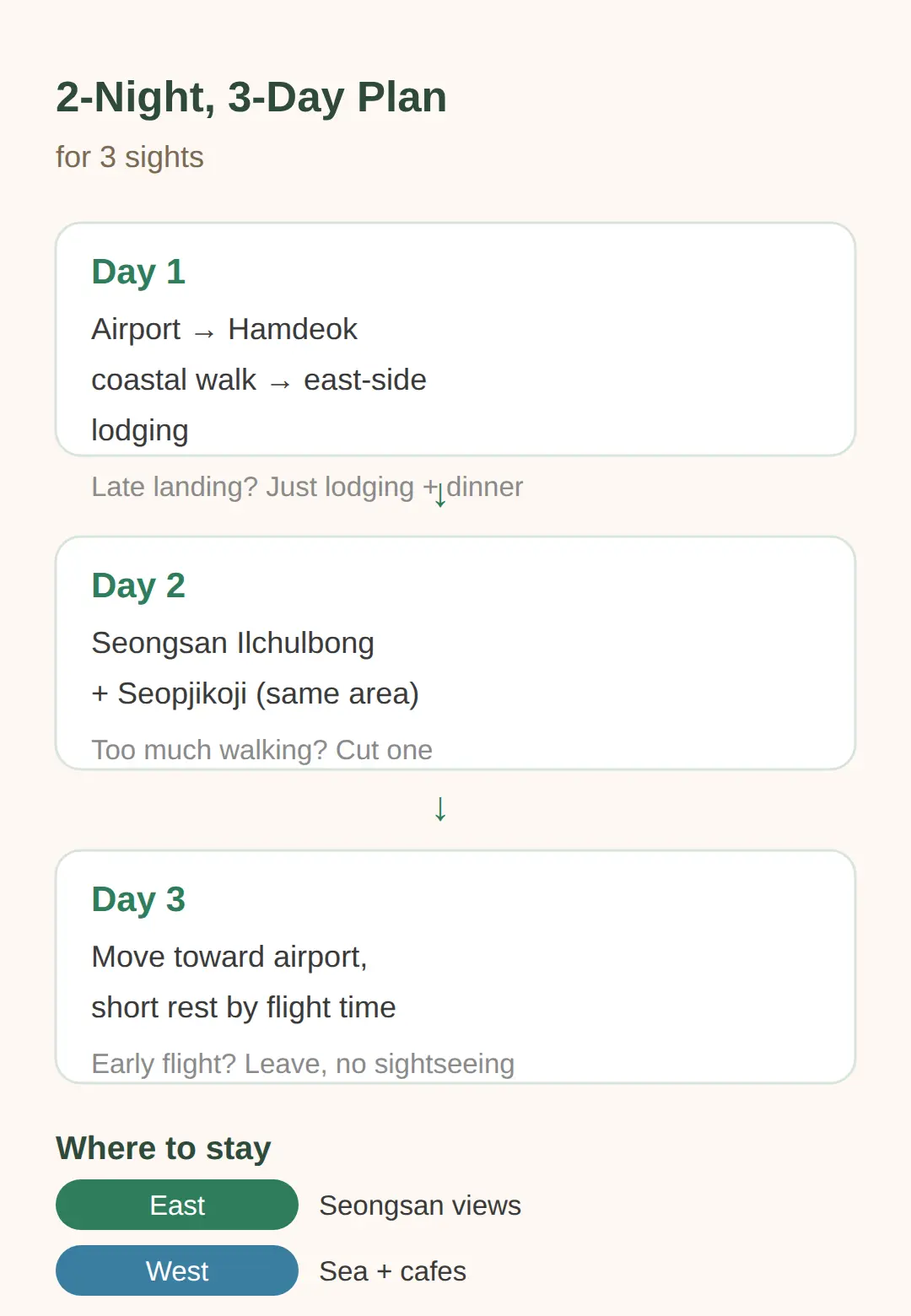
A standard 2-night, 3-day plan works for all three sights.
Day 1 goes from the airport to the Hamdeok coastal walk and ends at east-side lodging; if you land in the late afternoon, keep it to lodging and dinner.
Day 2 is the Seongsan Ilchulbong area and Seopjikoji — both are in the same east-side area, so if walking both is a burden, cut one.
For lodging, the rule from recent itineraries is east for Seongsan scenery and coastal walks, west (Aewol and Hyeopjae) for sea and cafe time, and Seogwipo for town strolls.
Day 3 is a move toward the airport with a short rest matched to your flight time, and if you have an early flight, leave without sightseeing.
What Can You Add in Winter (December–February)?
December through February is tangerine and camellia season, and it pairs naturally with the three-sight itinerary.
Winter event dates for the season have not been confirmed — check the Visit Jeju page closer to your travel month for what is running.
If you are choosing between months, the three sights above stay visitable year-round, while the tangerine and camellia layer is the winter-only bonus.
I would put the Haenyeo Museum on a day when a diving demonstration is scheduled near the waterfront, because the song and dive performances are what make the small fee feel worth it; I would keep it out of a tight afternoon since the schedule is not guaranteed.
👉 Seongsan Ilchulbong climb and hours
👉 UNESCO World Heritage listing
Related posts
📎 📅 Upcoming Dates — Release & Event Calendar
Sources
- Inscribed 2016 (ich.unesco.org)
- seongsan_climb_time (visitjeju.net)
- Hours not confirmed from primary page (visitjeju.net)
Quick Answers
- Want all three signature sights? Budget KRW 10,100 total — 1,100 + 5,000 + 4,000 — and re-check each fee on official pages on the day.
- Sensitive to cold or heat? Manjanggul stays 11–13°C year-round, so pack a layer for the cave even in summer.
- First visit with a rental car? East-side lodging covers Seongsan and Seopjikoji in one day; keep the Haenyeo Museum for whichever day a demonstration is scheduled.
FAQ
Q. Is Jeju Island famous for haenyeo?
Yes. The Culture of Jeju Haenyeo was inscribed on UNESCO’s list of intangible cultural heritage in 2016, and the Haenyeo Museum covers it for KRW 1,100 (2026 guide price).
Q. What are the 3 things Jeju is famous for?
The haenyeo diving women, oreum volcanic cones (with Seongsan Ilchulbong as the climbable one), and lava-tube geology — Manjanggul is the tube you can walk through.
Q. How much does it cost to see Seongsan Ilchulbong and Manjanggul?
Seongsan Ilchulbong is KRW 5,000 and Manjanggul is KRW 4,000 in 2026 guide prices, so the two together are KRW 9,000.
Q. How long does the Seongsan Ilchulbong climb take?
The main stairway trail takes roughly 25–30 minutes each way, so about 50–60 minutes round trip plus ticket-queue time.
Dates to note: December–February is tangerine and camellia season on Jeju, and haenyeo demonstrations near the museum waterfront run on scheduled days only — check the Visit Jeju page for both before your trip. The numbers in this post are as of October 10, 2026.
Cover photo: Anjwa 02 by Hercules.kor — CC BY-SA 4.0
#jejuisland #seongsanilchulbong #manjanggul #haenyeomuseum #jejuitinerary
📅Upcoming Schedule — this week 3 · D-1 documentary 'Always Lalisa' global theatrical release (Oct 1See all →Last updated 2026-10-11. Editorial policy