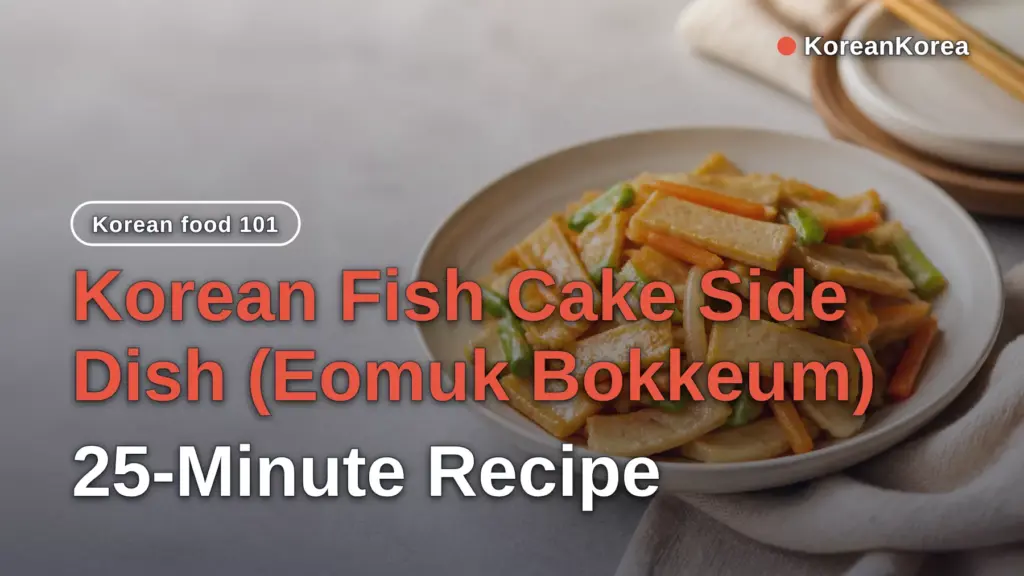
This Korean fish cake side dish, eomuk bokkeum, comes together in about 25 minutes: sliced fish cakes stir-fried with onion, carrot, and green onion in a sweet-savory soy glaze, yielding 3–4 banchan servings. Below you’ll find the sauce ratio, numbered steps, ingredient swaps for cooks outside Korea, the mistakes that make it soggy, and how to store it — it keeps 3–4 days cold, which is why it’s a standard lunchbox filler.
Korean Fish Cake Side Dish: What Eomuk Bokkeum Is and When Koreans Eat It
| Fish cake base | 150–200g sheets, cut into triangles or strips |
|---|---|
| Vegetables | Half an onion, a small carrot, 2 green onions |
| Sauce | 2 tbsp soy sauce, 1 tbsp sugar or corn syrup, 1 tsp garlic |
| Finish | 1 tsp sesame oil, sesame seeds |
| Time | ~10 min prep + ~10–15 min cook |
| Servings | 3–4 banchan servings per batch |
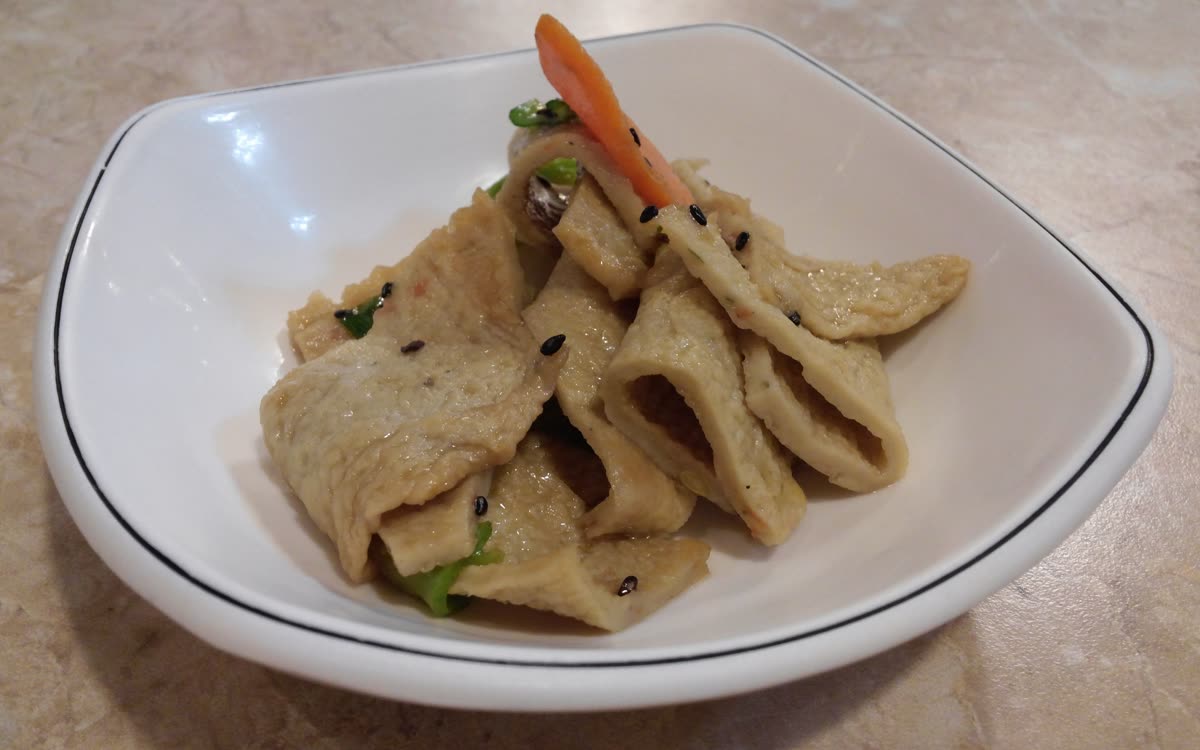
Eomuk bokkeum is fish cake slices stir-fried with onion, carrot, and green onion in a sweet-savory soy glaze — a 25-minute dish yielding 3–4 banchan servings per 200g pack.
Eomuk (also sold as odeng) is ground white fish mixed with starch and pressed into sheets or tubes, sold refrigerated or frozen.
Korean households eat it as a banchan side dish with rice, as a cold lunchbox filler, as drinking food, and in hot broth as winter street food.
It is classified as a stir-fried banchan rather than a stew, so the pan you use matters less than the heat: high heat and a quick fry keep the cakes chewy instead of watery.
Ingredients
Main
- 150–200g Fish cake sheets (eomuk) — cut into triangles or strips
- ½ medium Onion
- ⅙–⅕ small Carrot — thin slices or fine strips
- 2 stalks Green onion — cut 3–4cm
- 1–2 tsp Neutral oil — vegetable or canola
Sauce & seasoning
- 2 tbsp Soy sauce
- 1 tbsp Sugar or corn syrup
- 1 tsp Minced garlic
To finish
- 1 tsp Sesame oil — finishing drizzle
- 1 tsp Sesame seeds
Amounts are the ones used in this recipe; where the recipe gives no amount, adjust to taste.
How to Make It, Step by Step
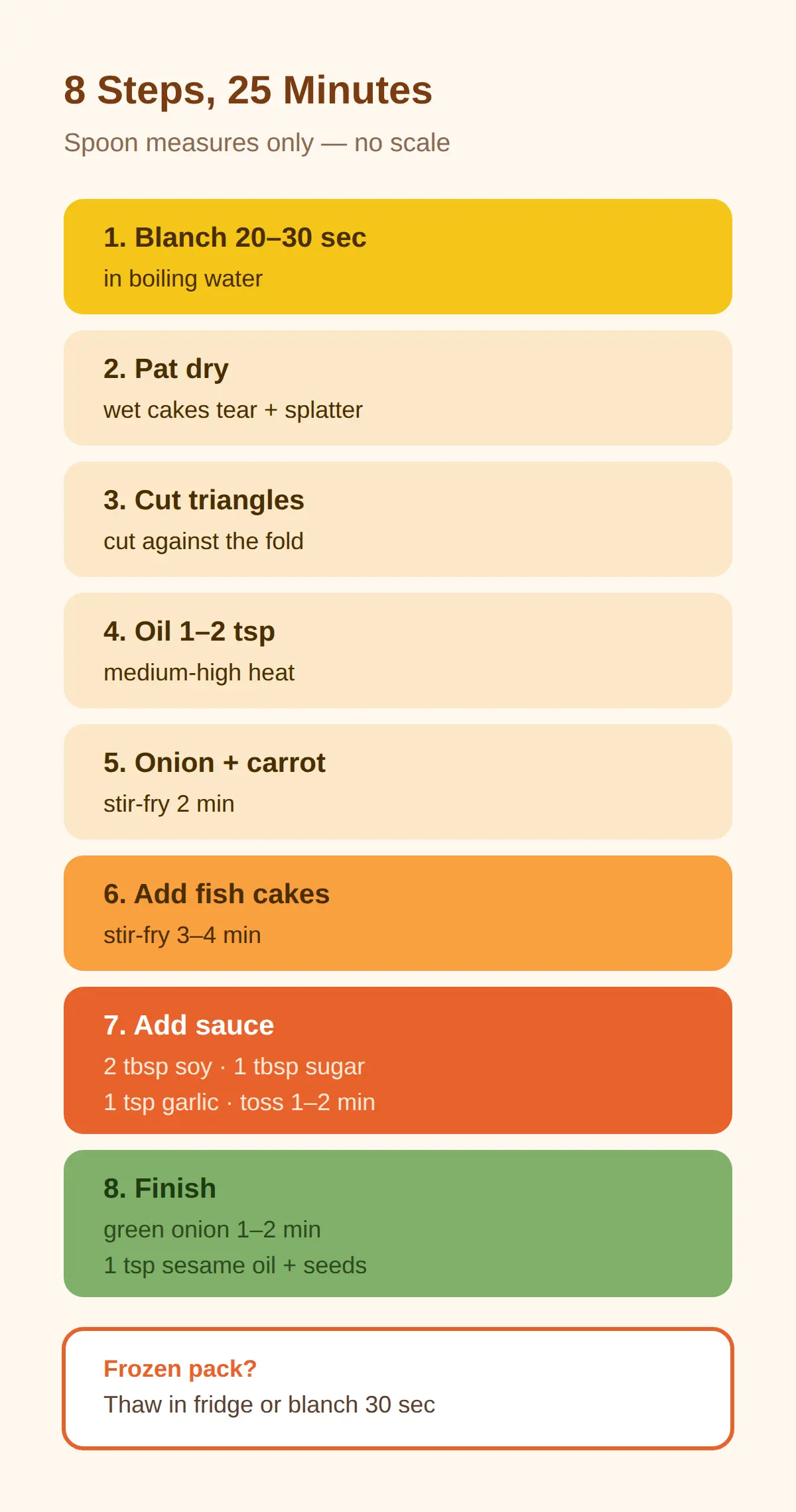
The method is: blanch, pat dry, cut, stir-fry the vegetables, add fish cakes, add the sauce, finish with green onion and sesame oil.
A first-timer can follow the numbered steps below without a scale — spoon measures only.
- Bring a small pot of water to a boil and blanch the fish cake sheets 20–30 seconds to remove freezer odor, excess oil, and some salt.
- Drain and pat the sheets dry — cutting while wet tears the cakes and makes them splatter in the pan.
- Cut the sheets into triangles or strips, cutting against the fold so they stay flat and even.
- Heat 1–2 tsp of neutral oil (vegetable or canola) in a pan over medium-high heat.
- Stir-fry the onion and carrot about 2 minutes until they soften at the edges.
- Add the fish cakes and stir-fry 3–4 minutes until the edges brown slightly.
- Pour in the sauce (2 tbsp soy sauce, 1 tbsp sugar or corn syrup, 1 tsp garlic) and toss 1–2 minutes until glossy.
- Add the green onion in the last 1–2 minutes so it stays bright green with a slight crunch, then finish with 1 tsp sesame oil and sesame seeds.
If your pack is frozen, thaw it in the fridge overnight or blanch it straight from frozen for 30 seconds; frying from frozen turns it rubbery and watery.
Steps at a glance
-
1Bring a small pot of water to a boil and blanch the fish cake sheets…⏱ 20–30 seconds🔥 boil
-
2Drain and pat the sheets dry
-
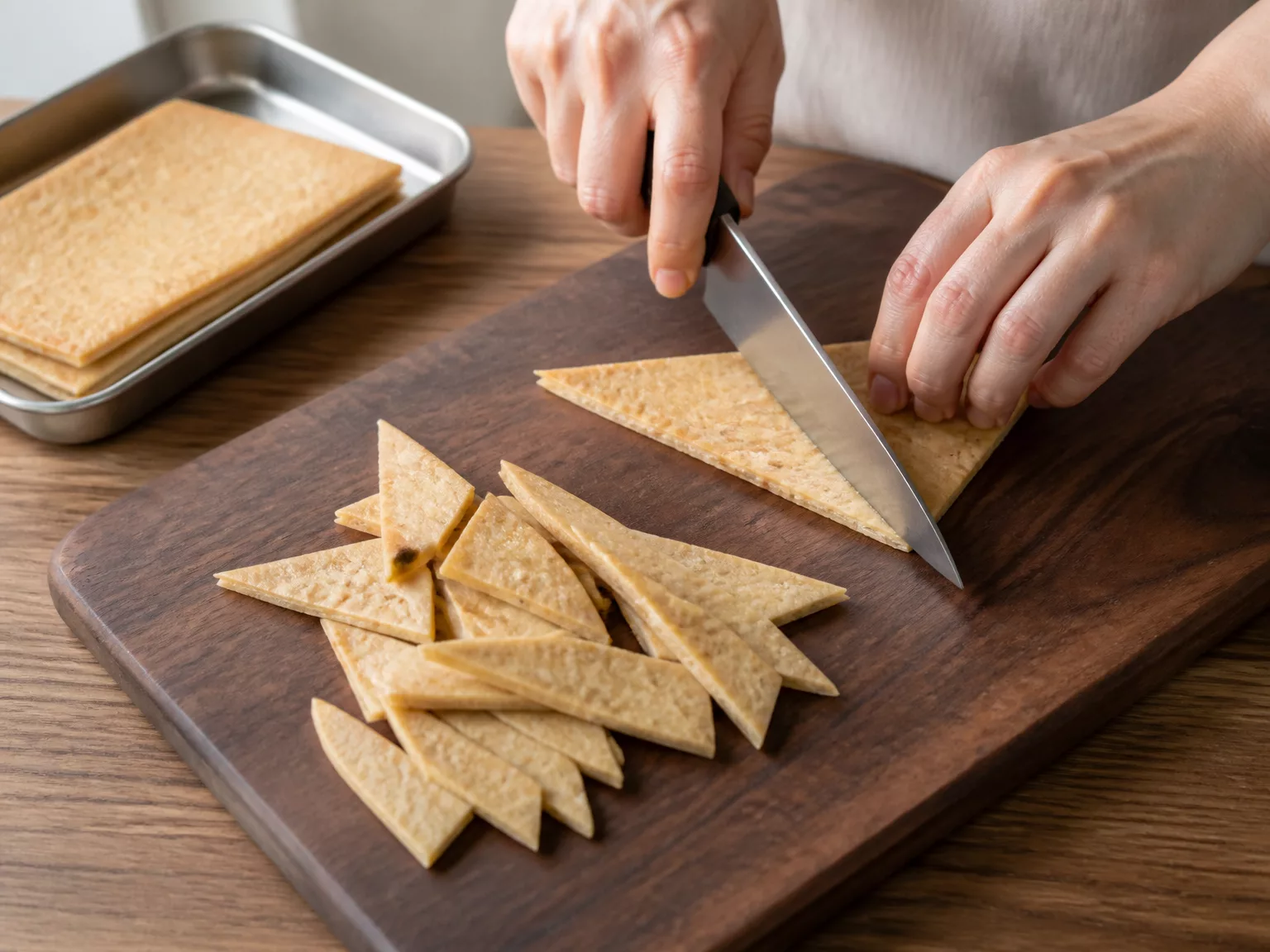 AI-generated photo
What it should look like — AI-generated image of this step, made from the recipe text — not a photo of our kitchen. 3Cut the sheets into triangles or strips, cutting against the fold so… -
4Heat 1–2 tsp of neutral oil (vegetable or canola) in a pan over…🔥 medium-high heat
-
5Stir-fry the onion and carrot about 2 minutes⏱ ~2 minutes
-
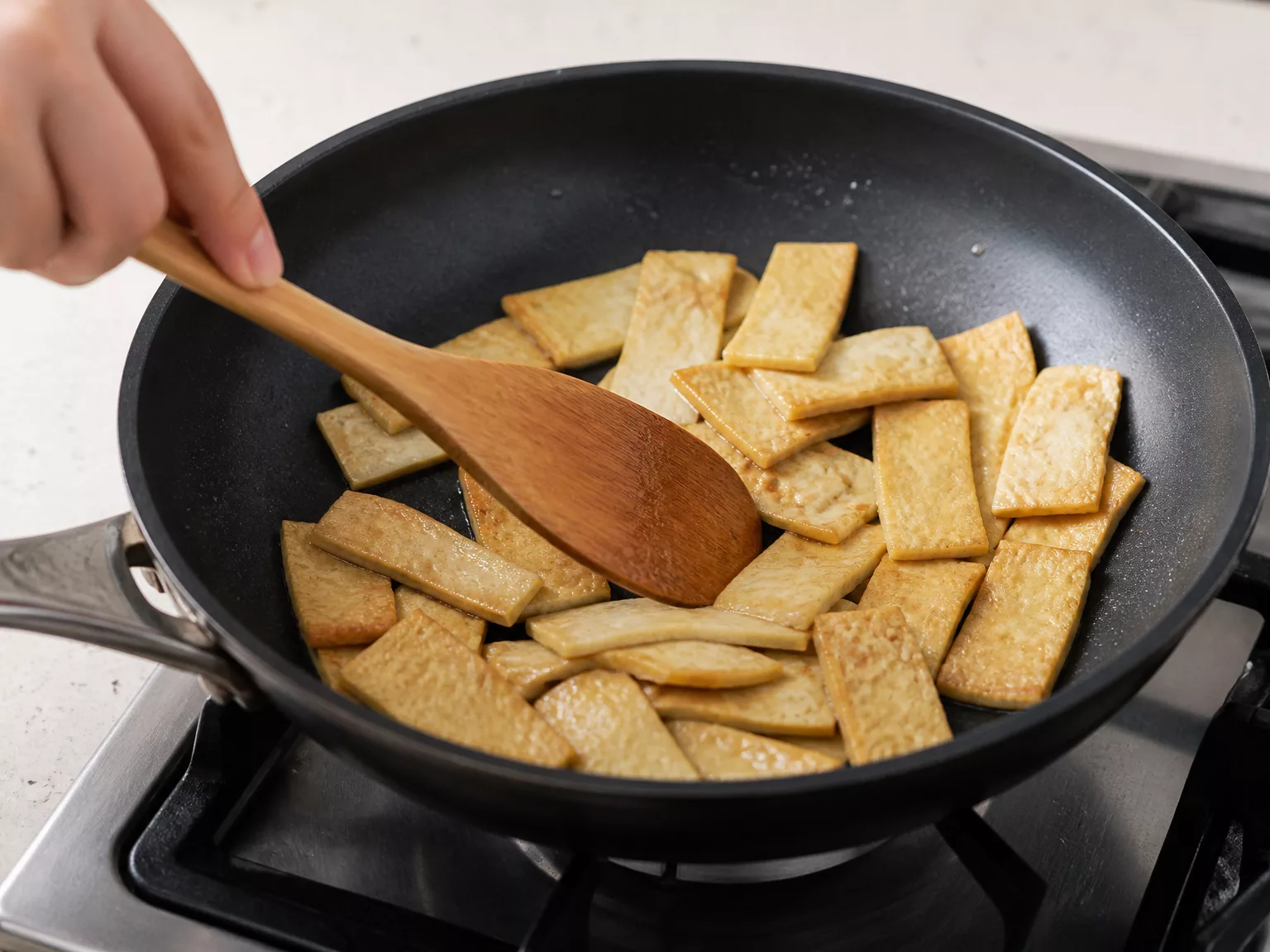 AI-generated photo
What it should look like — AI-generated image of this step, made from the recipe text — not a photo of our kitchen. 6Add the fish cakes and stir-fry 3–4 minutes⏱ 3–4 minutes -
7Pour in the sauce (2 tbsp soy sauce, 1 tbsp sugar or corn syrup, 1…⏱ 1–2 minutes
-
8Add the green onion in the last 1–2 minutes so it stays bright green…⏱ 1–2 minutes
Ingredients and Amounts for 3–4 Servings
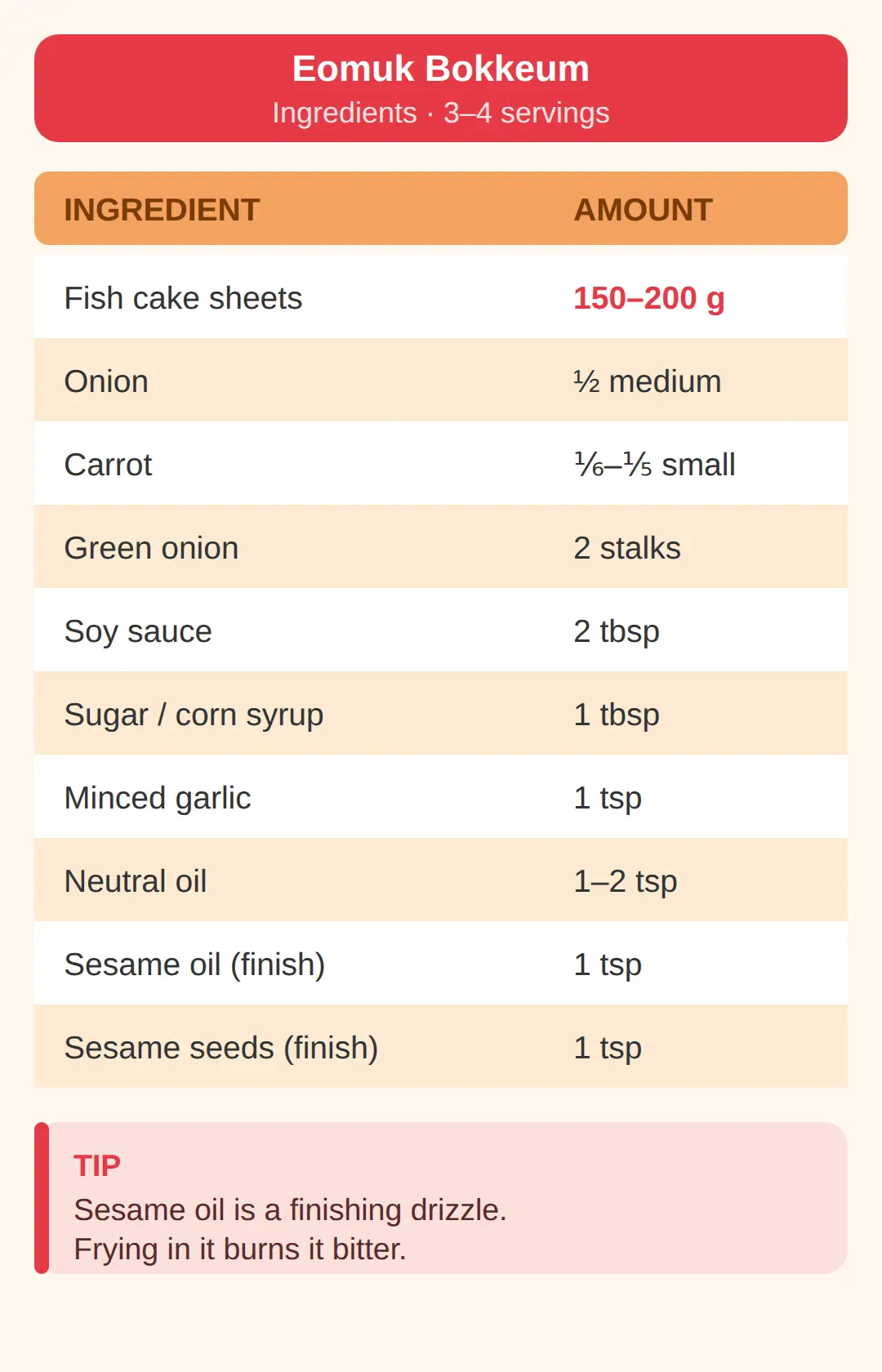
A standard batch uses about 200g of fish cake sheets and one onion, one small carrot, and two green onions, with a sauce of 2 tbsp soy sauce, 1 tbsp sugar or corn syrup, and 1 tsp garlic.
| Ingredient | Amount for 3–4 servings |
|---|---|
| Fish cake sheets (eomuk) | 150–200g |
| Onion | ½ medium |
| Carrot | ⅙–⅕ small (thin slices or fine strips) |
| Green onion | 2 stalks, cut 3–4cm |
| Soy sauce | 2 tbsp |
| Sugar or corn syrup | 1 tbsp |
| Minced garlic | 1 tsp |
| Neutral oil | 1–2 tsp |
| Sesame oil | 1 tsp (finish) |
| Sesame seeds | 1 tsp (finish) |
Sesame oil is a finishing drizzle, not the frying oil — frying in it burns it bitter.
What to Use If You Can’t Find Korean Ingredients
The sauce and aromatics swap cleanly; the fish cake itself is the only ingredient with a real constraint, because Korean fish cakes contain wheat starch and are not gluten-free.
| If you can’t find | Use instead | What changes |
|---|---|---|
| Corn syrup (mulyeot) | Sugar or honey, 1:1 | Same sweetness and shine — the syrup only adds sweetness and gloss |
| Onion | 2–3 scallion stalks (white parts) or cabbage slivers | Slightly sharper aroma; cabbage adds bulk without sweetness |
| Anchovy-kelp broth | Plain water + pinch of dashida or 1 tsp fish sauce | Marginally less depth; hardly noticeable in a stir-fry |
| Korean fish cake sheets | Any neutral white-fish sheet cake (Japanese kamaboko or fish balls) | Texture differs slightly; flat sheets work best |
Where Korean ‘gasi eomuk’ (shaped fish cake with wheels) is specified for stews, flat sheets work fine for bokkeum — the shapes exist to hold broth, not to be stir-fried.
Any neutral white-fish sheet-style fish cake is the closest non-Korean stand-in.
If you are gluten-free, skip this dish rather than swapping the sauce: the wheat starch is in the fish cake itself, so a gluten-free sauce does not fix it.
Mistakes That Make It Soggy (and How to Fix Them)
The most common failure is a watery, soggy batch, and it comes from three things: overcrowding the pan, adding the sauce too early, and frying from frozen.
Overcrowding or early sauce releases water instead of letting it evaporate — high heat and a quick fry keep the banchan chewy.
Wet cakes splatter and tear when cut, so pat them dry after blanching.
Frozen cakes turn rubbery and watery when cooked straight, so thaw in the fridge or blanch 30 seconds first.
Fix by cooking in two batches if your pan is small, keeping the heat at medium-high, and holding the sauce back until the fish cakes have already browned at the edges.
Eomuk is also relatively high in sodium, so the 20–30 second blanch before saucing draws out surface oil and some salt — if you skip it, reduce the soy sauce slightly.
Variations, Storage, and What to Serve It With
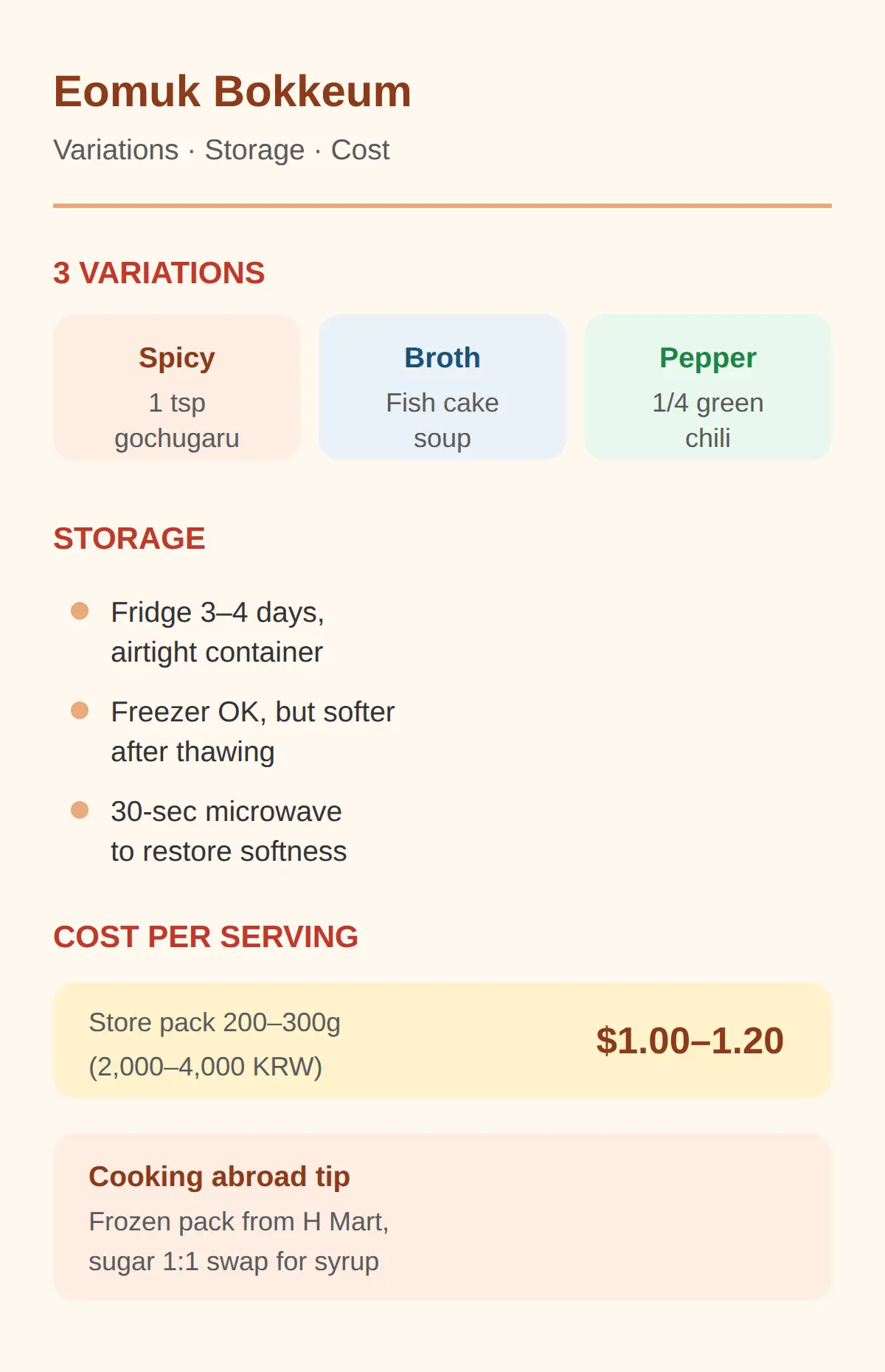
Three standard variations cover it: a spicy version with 1 tsp gochugaru or a little gochujang added to the sauce, a broth version where the same fish cakes go into eomuk-guk (fish cake soup, the winter street-food form), and a pepper version with a quarter green chili or black pepper even in the non-spicy soy base.
Leftovers keep refrigerated 3–4 days in an airtight container, and freezer storage is possible but the texture softens after thawing.
The dish is commonly eaten cold straight from the fridge; a 30-second microwave reheat or a quick pan toss restores softness.
In Korea it is a cheap everyday banchan commonly paired with kimchi jjigae or doenjang soup.
Home versions are among the cheapest banchan you can make — Korean supermarket packs of 200–300g typically run about 2,000–4,000 KRW, and one serving works out to roughly $1.00–1.20 at overseas prices.
If I were cooking this abroad, I’d buy the frozen pack at H Mart, blanch and pat it dry, and use sugar instead of hunting for corn syrup — it’s the same 1:1 swap and the dish costs about a dollar a serving, far less than take-out banchan.
Related posts
📎 📅 Upcoming Dates — Release & Event Calendar
Sources
- street skewer approx KRW 1,000–2,000 (no 6-month primary sou (en.wikipedia.org)
- wheat_starch_note (en.wikipedia.org)
- budget_per_batch (hmart.com)
Quick Reference: Sauce, Time, Servings
- Sauce ratio: 2 tbsp soy sauce : 1 tbsp sugar or corn syrup : 1 tsp garlic per 150–200g fish cake.
- Blanch the sheets 20–30 seconds and pat dry — skipping this leaves freezer smell, oil, and salt.
- Fry on medium-high heat, sauce last, green onion in the final 1–2 minutes.
- Refrigerate 3–4 days in an airtight container; eat cold or reheat 30 seconds.
- Gluten note: Korean fish cakes contain wheat starch — this dish is not gluten-free.
FAQ
Q. What is eomuk bokkeum?
Eomuk bokkeum is Korean fish cake slices stir-fried with onion, carrot, and green onion in a sweet-savory soy sauce glaze — a 25-minute banchan yielding 3–4 servings per 200g pack.
Q. Can I substitute corn syrup (mulyeot) in eomuk bokkeum?
Yes — replace it 1:1 with sugar or honey. The syrup only adds sweetness and shine, and sugar does the same job in the same amount.
Q. What can I use instead of Korean fish cakes?
Any neutral white-fish sheet-style cake works, such as Japanese kamaboko or fish balls. The texture differs slightly, and flat sheets work better than shaped ‘gasi eomuk’ pieces.
Q. Is Korean fish cake gluten-free?
No — Korean fish cakes contain wheat starch in the cake itself, so the dish is not gluten-free, and swapping the sauce does not change that.
Q. How long does stir-fried fish cake keep in the fridge?
It keeps 3–4 days refrigerated in an airtight container and is commonly eaten cold; a 30-second microwave reheat or quick pan toss restores softness.
Try it this week: pick up a frozen pack of eomuk on your next grocery run and make a batch — it keeps 3–4 days, so lunchboxes are covered.
Cover photo: AI-generated illustration (fish cake stir) — AI-generated image, illustrative only
#koreanfishcakesidedish #eomukbokkeum #eomukbokkeumrecipe #stir-friedfishcake #koreanbanchan #fishcakestirfry #koreansidedishrecipe #dosirakbanchan
📅Upcoming Schedule — this week 4 · D-day Hangul DaySee all →How this article was made: written with AI assistance from the official and public sources cited here, checked automatically against those sources, and reviewed by the site operator after publishing. Last updated 2026-10-09. Editorial policy