Yes — a traveler with diabetes can eat Korean food in Korea: grilled fish, soybean-paste stew, and kimchi-jjigae are safe orders, while sugar-marinated bulgogi and tteokbokki are the ones to skip or limit.
For you, that means a full Korean meal is still on the table — the method is to choose the right dishes, swap the rice, and ask before ordering.
This post lists the dishes with a verdict table, the white-vs-brown rice glycemic index numbers, and the Korean phrases that work at the counter.
Key facts — As of 2026-10-09
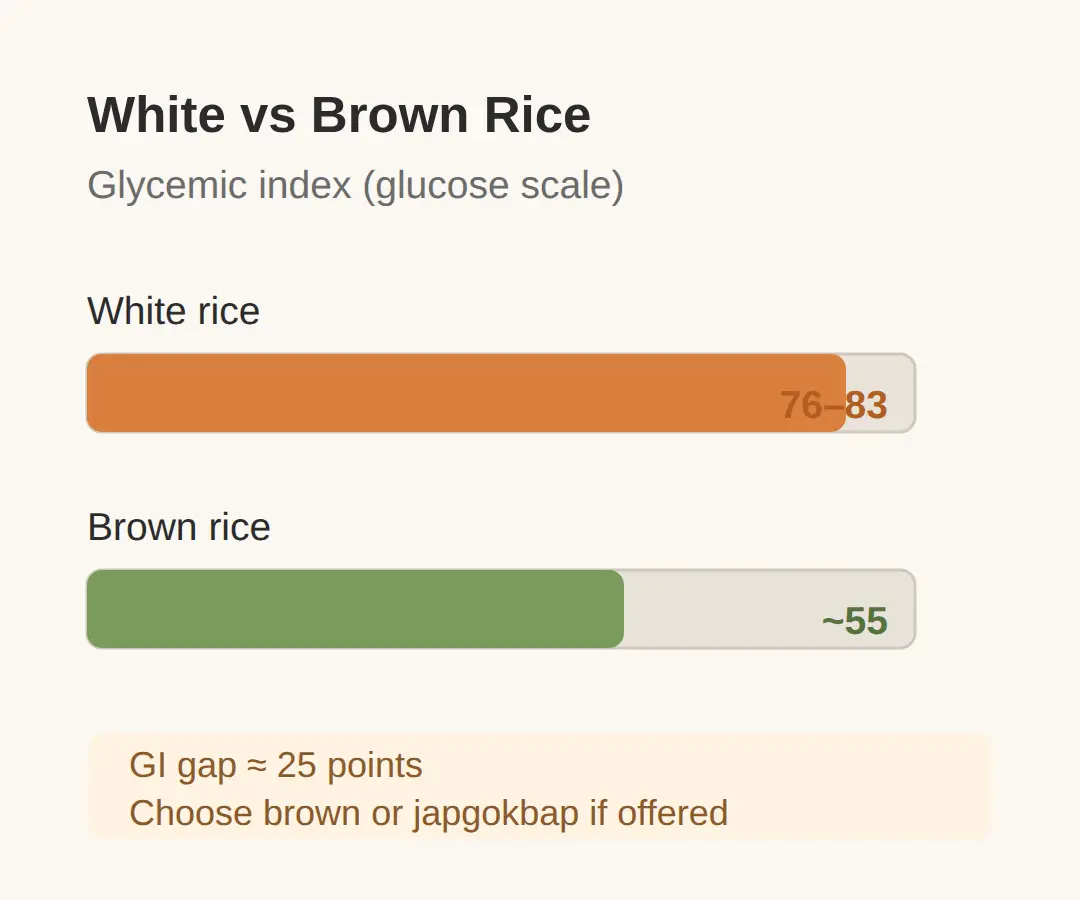
- Per the Korean Nutrition Society’s GI tables, cooked white rice in Korea runs GI 76–83 while cooked brown rice is about 55 — a swap worth roughly 25 points.
- Everyday single-serve Korean meals — kimchi-jjigae, doenjang-jjigae, gimbap, guksu — commonly cost KRW 8,000–18,000 as of 2026, so three restaurant meals a day runs about KRW 24,000–54,000.
Is Korean Food Healthy for Diabetics? The Short Answer
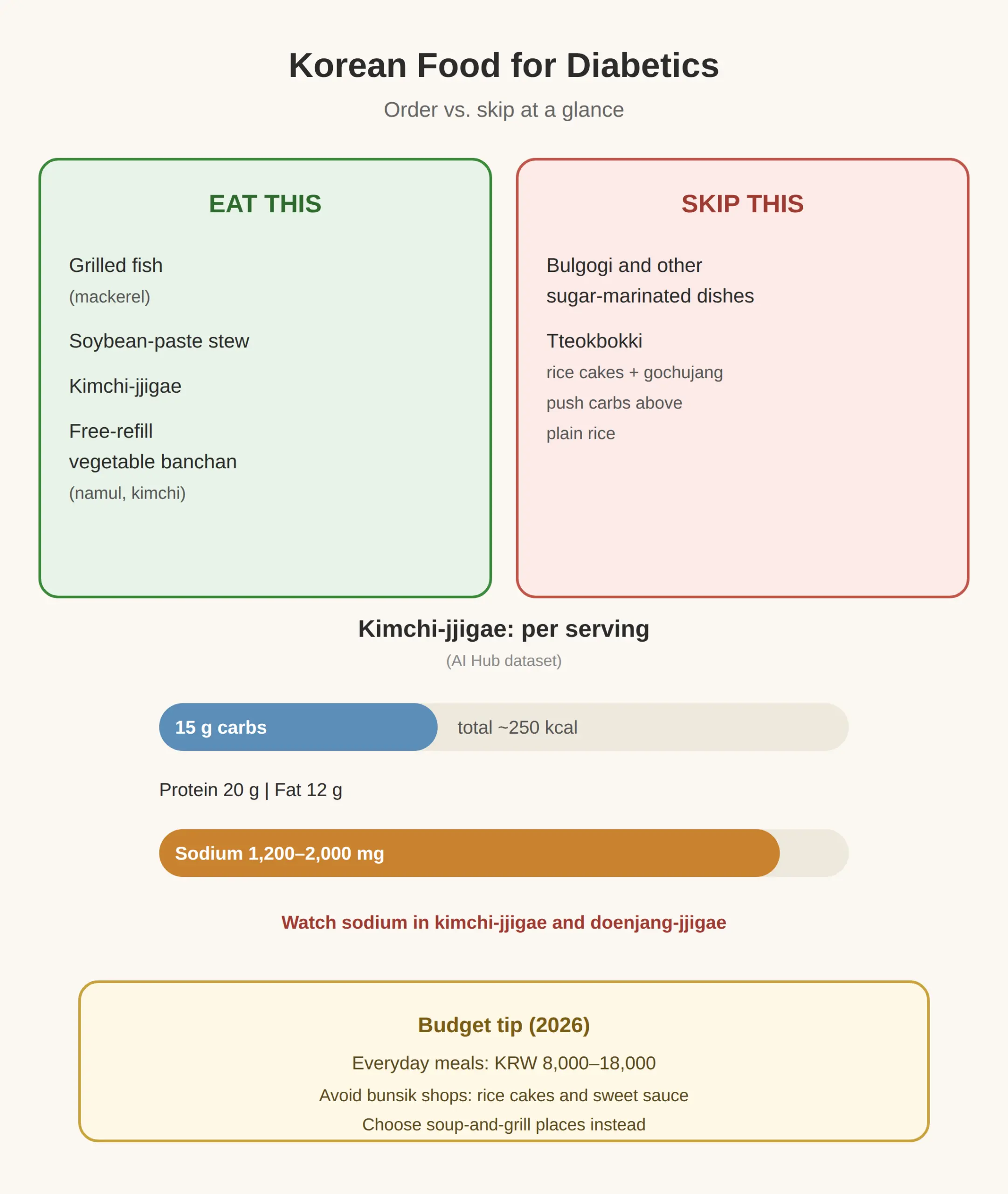
| Grilled mackerel (gogui) | Eat — plain protein, no marinade sugar |
|---|---|
| Doenjang-jjigae (soybean-paste stew) | Eat — anchovy/kelp stock, not starch |
| Kimchi-jjigae (kimchi stew) | Eat — about 250 kcal and 15 g carbs per labeled serving |
| Bulgogi | Skip or limit — the marinade is sugar |
| Galbi and other marinated grills | Skip or limit — same marinade issue |
| Tteokbokki | Skip — pressed rice cakes plus gochujang sauce load carbs above plain rice |
Yes — order grilled or stewed dishes, swap the rice, and treat marinated foods as off-limits.
Everyday Korean meals such as kimchi-jjigae, doenjang-jjigae, gimbap, and guksu generally cost KRW 8,000–18,000, so this is also a budget-friendly way to eat.
The one place to steer away from is bunsik (snack-food) shops, where the menu is built on rice cakes and sweet sauce; soup-and-grill places give you far less sugar-heavy starch.
When I look at a Korean menu with blood sugar in mind, the first thing I check is what is in the sauce or broth — marinade means sugar, so asking beats guessing.
6 Dishes to Order or Skip, and Why
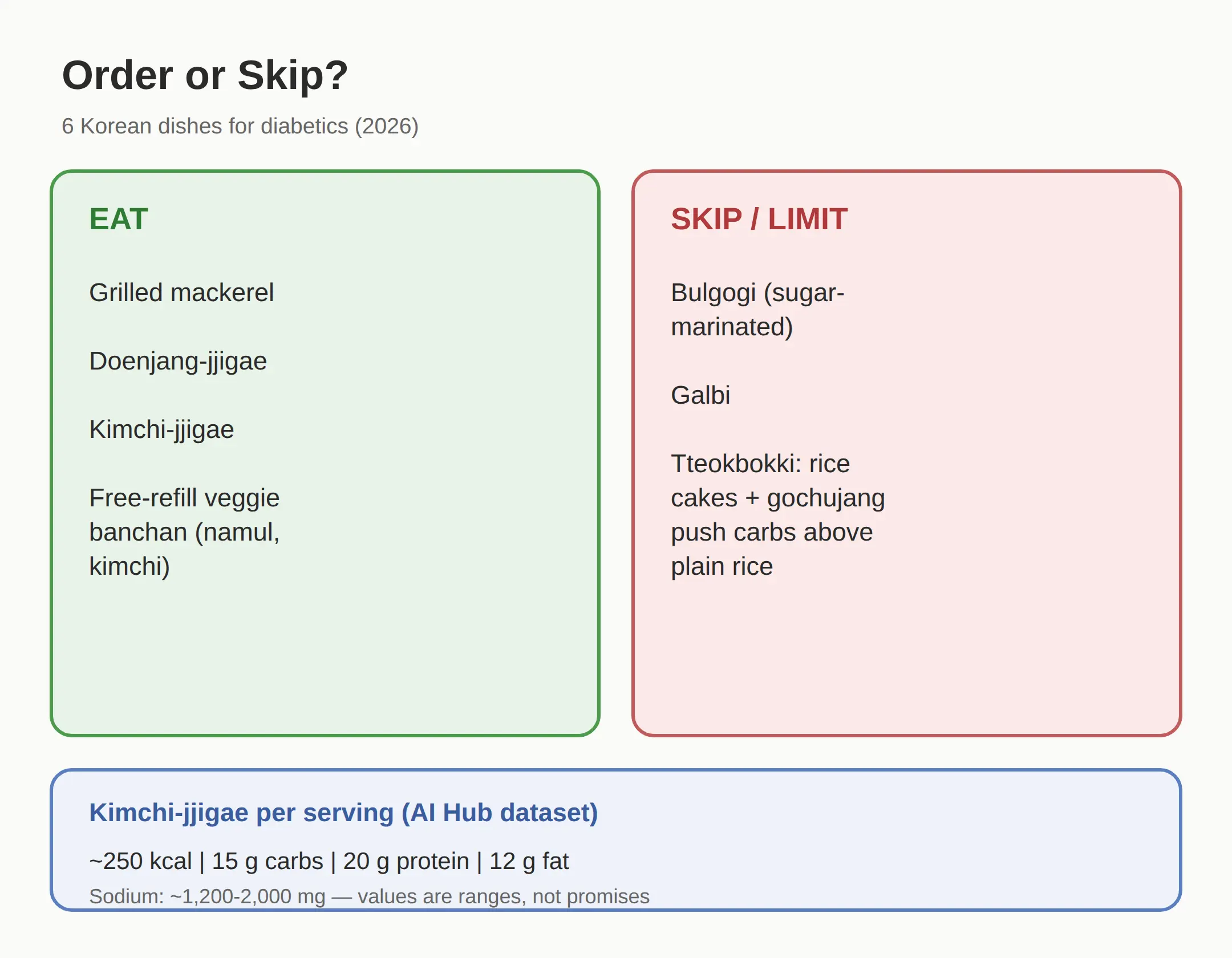
Grilled mackerel, doenjang-jjigae, and kimchi-jjigae are the eat-side anchors; bulgogi, galbi, and tteokbokki are the skip-or-limit side.
The kimchi-jjigae numbers come from the AI Hub Korean food dataset’s labeled serving — about 250 kcal, 15 g carbs, 20 g protein, and 12 g fat — but restaurant plates are not in any official database, so treat per-serving values as ranges, not promises.
Exact grams of added sugar in a bulgogi marinade vary by restaurant recipe, so no per-serving sugar number is quoted here.
If you want a stew but cannot see what is in the broth, ask whether the stock is anchovy or kelp based before you order.
White Rice vs Brown Rice: The GI Numbers
Cooked white rice in Korea runs a glycemic index of about 76–83, while cooked brown rice (hyeonmi-bap) sits at about 55.
Those figures come from Korean Nutrition Society glycemic index estimation tables referenced to glucose, and different sources place white rice anywhere in the 73–84 band, so quote a range rather than one number.
The swap is worth roughly 25 GI points (about 80 − about 55), and many Korean restaurants offer a multigrain rice option (japgokbap) that does the same job.
If the restaurant offers japgokbap or brown rice, take it; if only white rice is available, cut the portion instead.
How to Order Low-Sugar Korean Food: Phrases That Work
The workable strategy is to ask before ordering — the same ask-first approach that works for restricted diets in general.
Use these phrases at the counter or table:
| Situation | What to say or do |
|---|---|
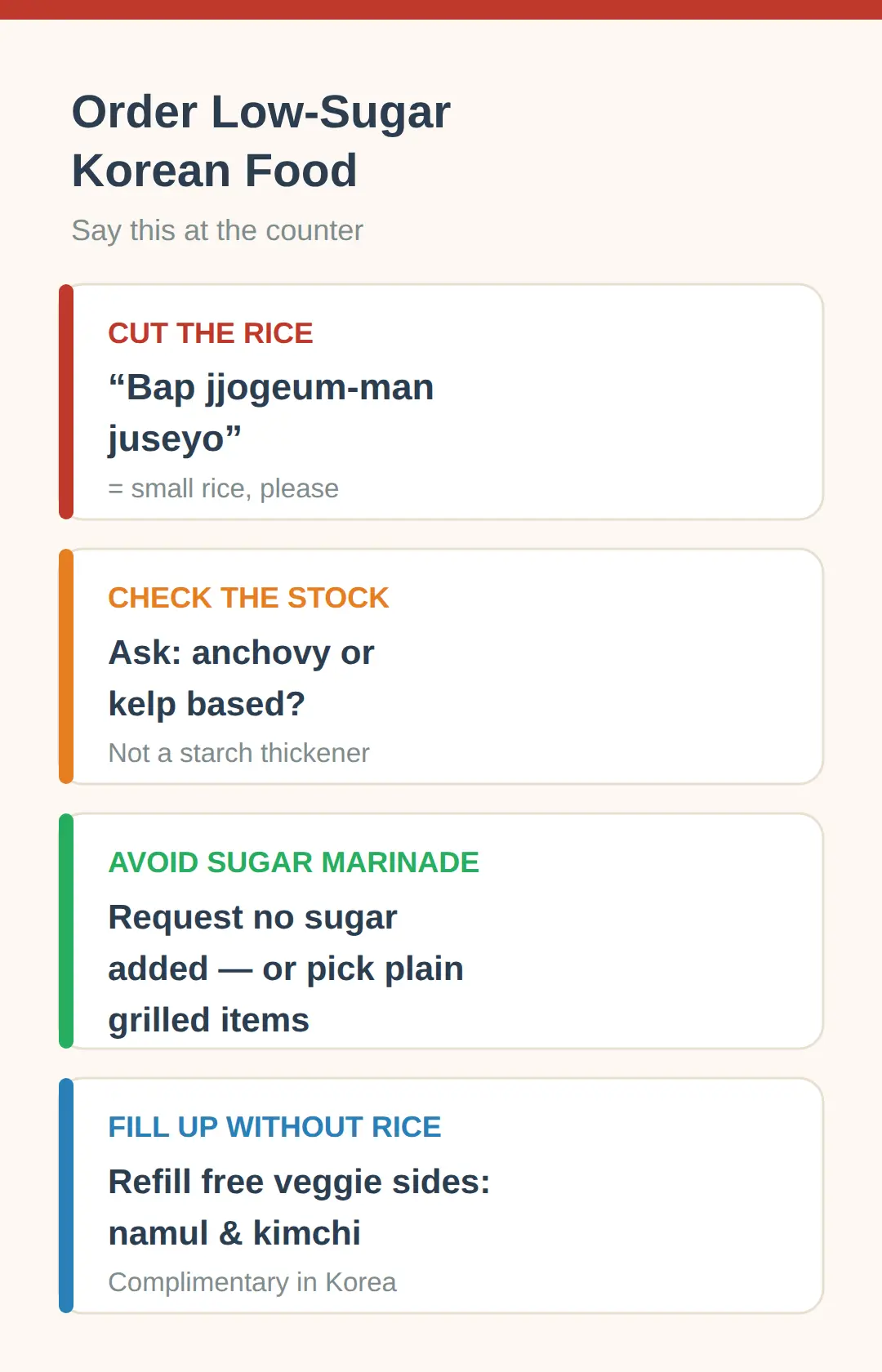
| Cutting the white-rice portion | "Bap jjogeum-man juseyo" — small rice, please |
| Checking the stew stock | Ask whether it is anchovy/kelp based — Korean stew stock is usually anchovy/kelp, not a starch thickener |
| Avoiding sugar in marinade | Request dishes with no sugar-added marinade, or choose plain grilled items instead |
| Filling up without rice | Refill the free vegetable sides (namul, kimchi) instead of the rice — they are complimentary in Korea |
If you cannot speak Korean, pointing at a grilled-fish or stew menu photo and gesturing "small" at the rice also gets the message across.
Checking Nutrition on the Spot: Labels and Databases
Packaged foods in Korean convenience stores such as CU, GS25, and 7-Eleven carry required nutrition labels — energy, carbohydrate, sugars, and sodium — so you can check exact values without asking anyone.
For restaurant foods, Korea’s Ministry of Food and Drug Safety runs an open food nutrition database searchable by food name, maker, and category, reporting values per 100 g serving (an apple sample reads 52 kcal and 0.3 g protein).
The database is an API service, and free public web access without a key is not confirmed, so plan on the convenience-store labels as your on-the-spot check.
Between meals, a labeled packaged snack at a convenience store is the easiest item to verify — restaurant plates cannot be checked the same way.
What to Watch Besides Sugar: Sodium and the Free Refills
Free banchan refills are not nutritionally free — count them in your carbohydrate and sodium budget, because refills are unlimited and automatic in Korea.
Kimchi is fermented cabbage or radish, low in carbohydrate and calories per serving, but sodium is the flagged nutrient in the official composition data.
Stews tend to run high in sodium, which matters if you also watch blood pressure, and per-serving values vary widely by restaurant.
A final caution: no food treats or cures diabetes — for anything beyond meal selection, consult a specialist before your trip.
If it were my order, I would take the grilled fish or the soybean-paste stew with a small multigrain rice — the GI stays low and the sodium is easier to keep in check.
The first thing I look at on any Korean menu is not the mains but the rice option, because that swap moves the whole meal’s glycemic load.
Related posts
📎 📅 Upcoming Dates — Release & Event Calendar
Sources
- github.com
- gi_values_korea (github.com)
- Exact kcal claims forbidden; range-based hedged guidance onl (xippaz.tistory.com)
Three things to carry
- Steer toward soup-and-grill restaurants, not bunsik snack bars — the menu structure alone removes most sugar-heavy starch.
- Before you sit down, decide your two backup dishes — grilled fish and soybean-paste stew are on almost every Korean menu, so you will never be stuck without a safe choice.
- Budget KRW 8,000–18,000 per meal — about KRW 24,000–54,000 a day for three restaurant meals as of 2026.
- After ordering, check the free banchan refills against your sodium limit for the day — refills are automatic, not optional.
FAQ
Q. Is Korean food healthy for diabetics?
Much of it can be — grilled fish, soybean-paste stew, and vegetable sides fit a low-sugar meal, while marinated meats and tteokbokki are the items to limit.
Q. Can diabetics eat Korean food daily?
Yes, if you keep the pattern: protein-and-stew mains, small or multigrain rice, no sugar marinades — three such meals cost about KRW 24,000–54,000 a day.
Q. What is the GI of white vs brown rice in Korea?
Per Korean Nutrition Society GI estimation tables, cooked white rice runs about 76–83 and cooked brown rice about 55 — a swap worth roughly 25 points.
Q. How do I ask for less rice and no sugar marinade in Korean?
Say "bap jjogeum-man juseyo" for a small rice portion, and ask whether the stew stock is anchovy or kelp based before ordering.
Travelers with diabetes in Korea can use these ordering phrases at their first restaurant meal.
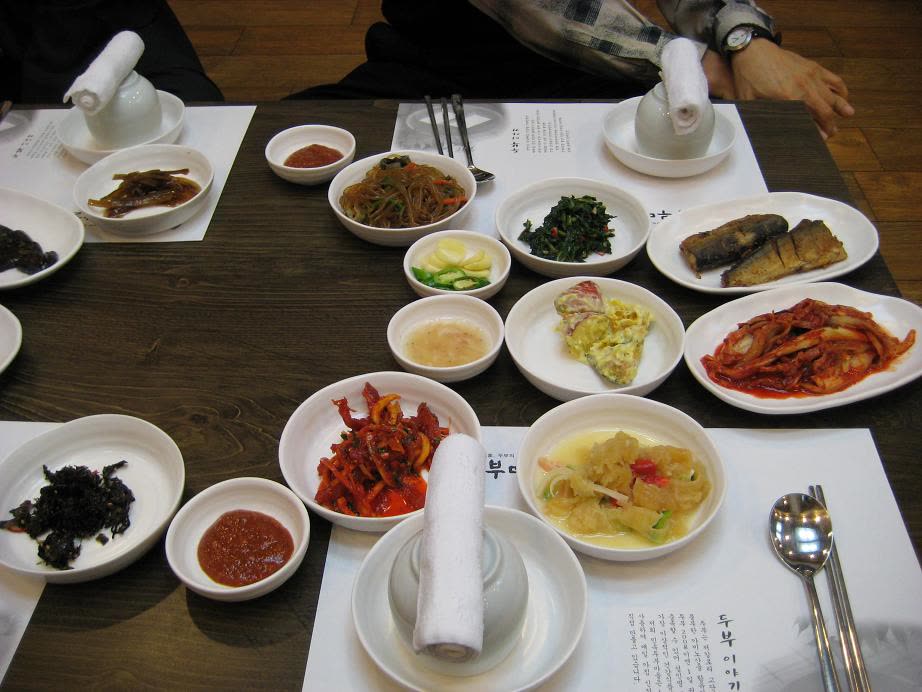
Cover photo: Korean cuisine-Jjigae and bancahn by ayustety — CC BY-SA 2.0
#koreanfoodfordiabetics #lowsugarkoreanfood #koreanricegi #koreatraveltips #diabetictravelfood
📅Upcoming Schedule — this week 3 · D-1 documentary 'Always Lalisa' global theatrical release (Oct 1See all →Last updated 2026-10-11. Editorial policy