
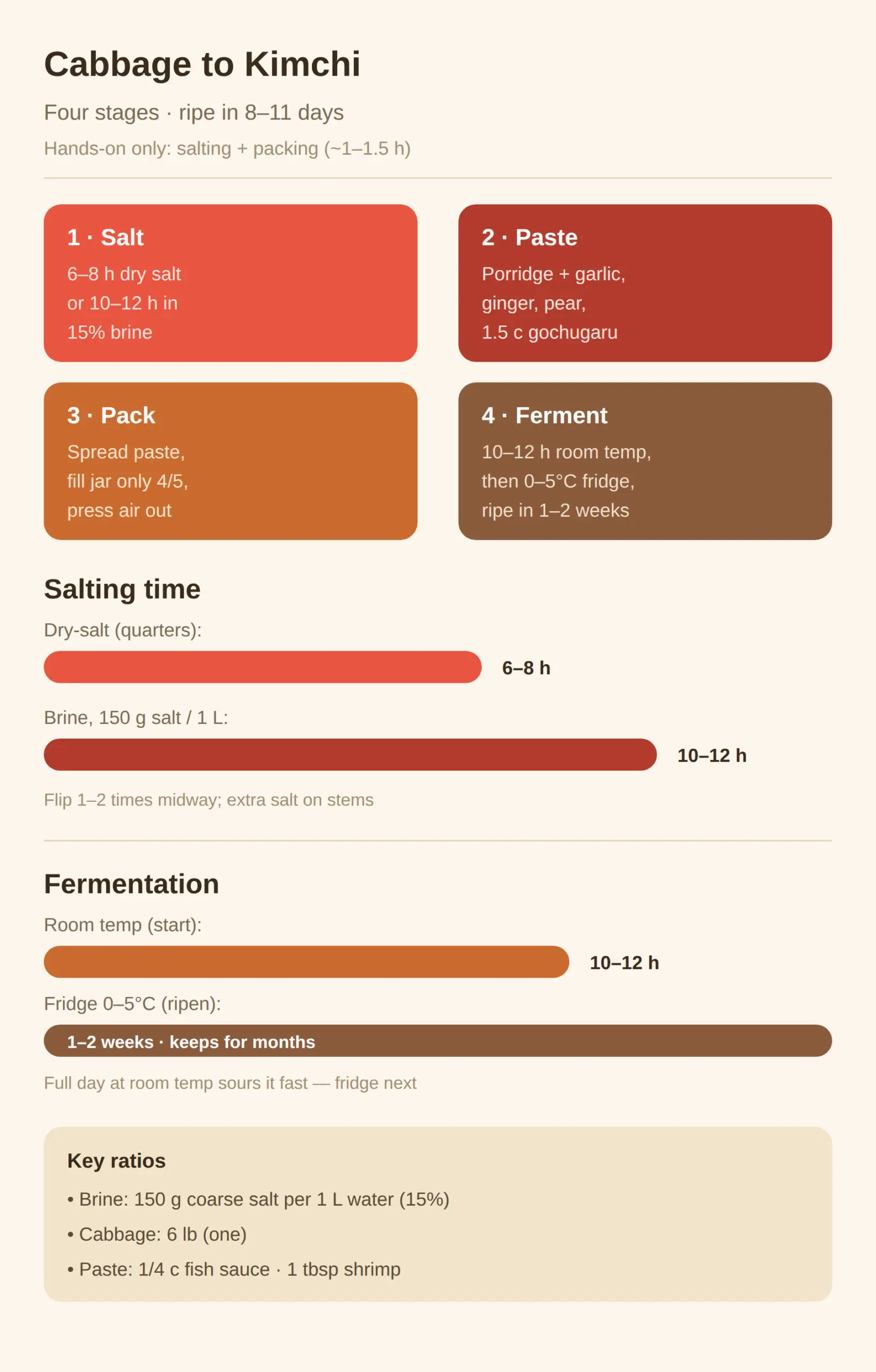
A 6 lb napa cabbage kimchi takes about 8–11 days from salting to a ripe jar: 6–8 hours salting, 10–12 hours at room temperature, then 1–2 weeks of fridge ripening at 0–5°C.
Key facts — As of 2026-09-27
- The salting brine is 15%: 1.5 kg coarse sea salt dissolved in 10 L of water (150 g per liter) — that ratio comes from standard Korean recipe guides (primary: true).
- Per 6 lb (about one cabbage) of salted cabbage, the seasoning paste uses 1.5 cups gochugaru, 1/4 cup anchovy fish sauce, 1 tbsp salted shrimp, 1 tbsp plum extract, and 1/3 cup beef broth (primary: true).
- Total time from salting to ripe kimchi is about 8-11 days: 6-8 hours salting, 10-12 hours at room temperature, then 1-2 weeks of fridge ripening at 0-5°C (primary: true).
Kimchi Recipe: The Steps From Start to a Ripe Jar
| Day 1, hour 0 | Salt the cabbage: 6–8 hours dry-salted, or 10–12 hours submerged in 15% brine (150 g coarse sea salt per 1 L water); flip midway |
|---|---|
| Day 1, evening | Rinse, cook and cool the porridge, blend the paste, pack the jar 4/5 full, leave 10–12 hours at room temperature |
| Day 2 | Move the jar to the fridge (0–5°C) |
| Day 8–11 | Kimchi is ripe and ready to eat; it keeps for months refrigerated |
One cabbage (about 6 lb) becomes kimchi in four stages: salting, paste, packing, and fermenting.
The only two steps that need your hands are salting and packing, and together they take about 1–1.5 hours.
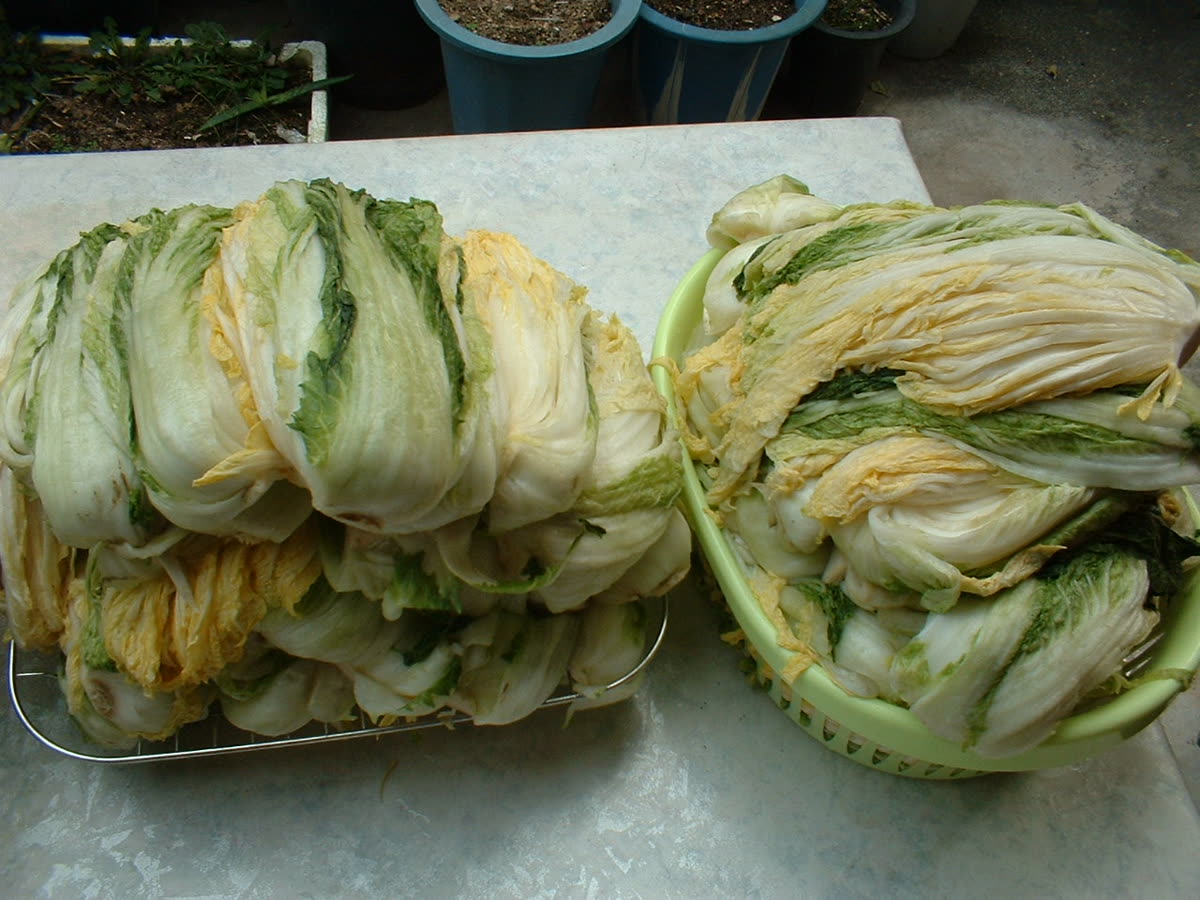
- Quarter the cabbage (or chop it into bite-size pieces for mak kimchi) and salt it: 6–8 hours, flipping 1–2 times midway, with extra salt on the thick stems — or submerge it in 15% brine (150 g coarse sea salt per 1 L water) for 10–12 hours, flipping halfway.
- Cook the porridge: 2 cups water + 1/4 cup flour (rice or wheat) stirred over medium-low heat 1–2 minutes until thick, then cool it fully.
- Blend garlic (6–8 cloves), a thumb-size piece of ginger, onion, and 1/4 Asian pear with a ladle of the cooled porridge.
- Mix in 1.5 cups gochugaru (Korean red pepper flakes), 1/4 cup anchovy fish sauce, 1 tbsp salted shrimp (saeujeot), 1 tbsp plum extract, and 1/3 cup beef broth.
- Spread the paste between each leaf, wrap with the outermost leaf, and pack tightly into a jar, pressing the air out; fill the jar only about 4/5 full.
- Leave the jar 10–12 hours at room temperature, then refrigerate at 0–5°C; it is ripe in about 1–2 weeks and keeps for months.
The salting brine is 15%: 1.5 kg coarse sea salt dissolved in 10 L of water (150 g per liter) — that ratio comes from standard Korean recipe guides.
Do not leave the packed jar at room temperature a full day; 10–12 hours is enough to start fermentation, and then it goes straight into the fridge.
Ingredients
Main
- 1 (about 6 lb) napa cabbage
- 150 g per 1 L water coarse sea salt (cheonilgum) — 15% brine, or dry-salt 6–8 hours
- daikon — julienned
- carrot — julienned
- 4–5 stalks green onion
Sauce & seasoning
- 1.5 cups gochugaru (Korean red pepper flakes) — mix fine + coarse grind
- 1/4 cup anchovy fish sauce
- 1 tbsp salted shrimp (saeujeot)
- 1 tbsp plum extract (maesil cheong)
- 1/3 cup beef broth
- 1/4 pear Asian pear — blended
- 6–8 cloves garlic
- thumb-size piece ginger
- onion
- 1/4 cup flour (rice or wheat) — cooked with water into a porridge
- 2 cups water — for the porridge
Amounts are the ones used in this recipe; where the recipe gives no amount, adjust to taste.
Steps at a glance
-
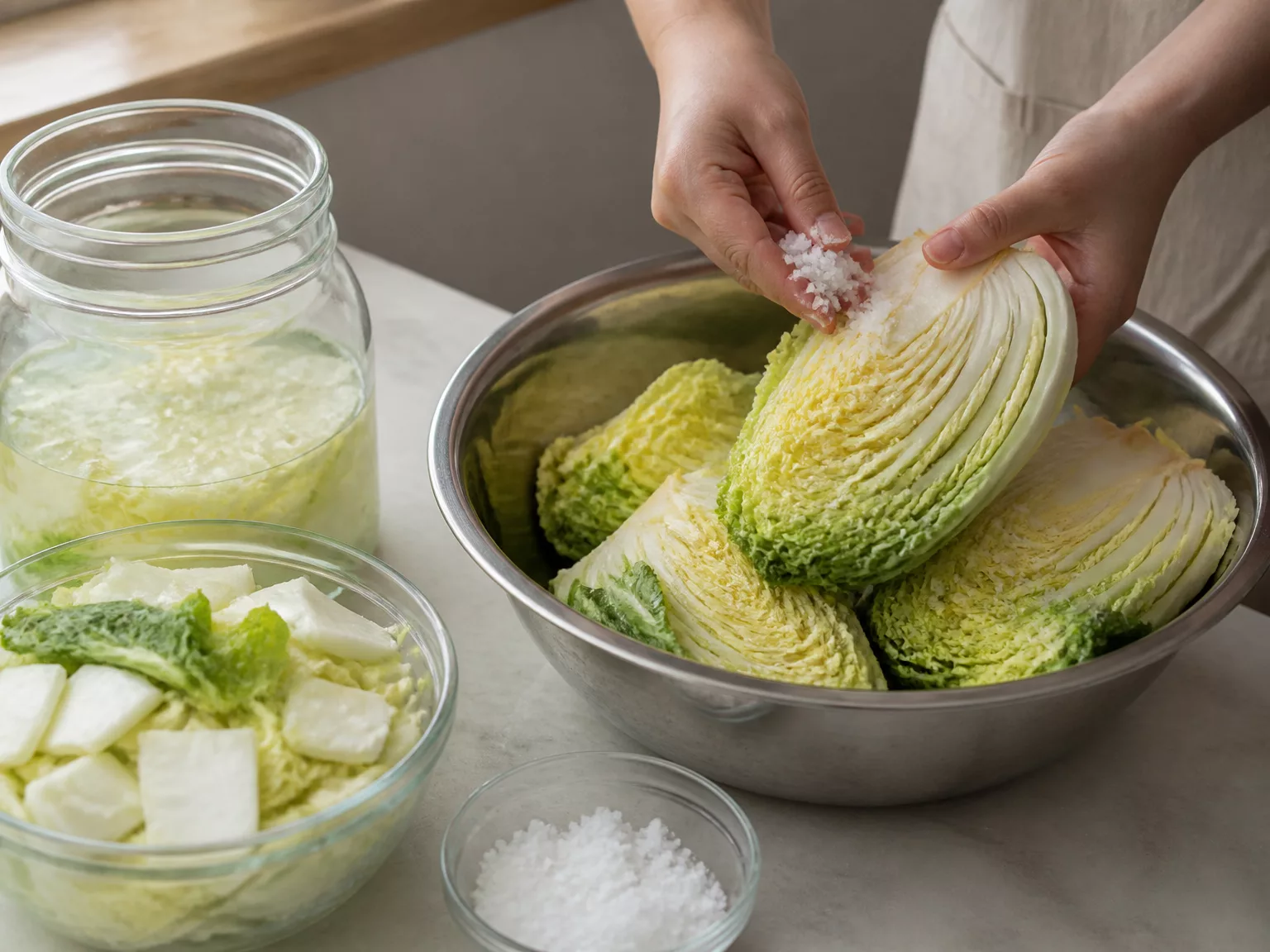 AI-generated photo
What it should look like — AI-generated image of this step, made from the recipe text — not a photo of our kitchen. 1Quarter the cabbage (or chop it into bite-size pieces for mak kimchi)…⏱ 6–8 hours -
2Cook the porridge: 2 cups water + 1/4 cup flour (rice or wheat)…⏱ 1–2 minutes🔥 medium-low heat
-
3Blend garlic (6–8 cloves), a thumb-size piece of ginger, onion, and…
-
4Mix in 1.5 cups gochugaru (Korean red pepper flakes), 1/4 cup anchovy…
-
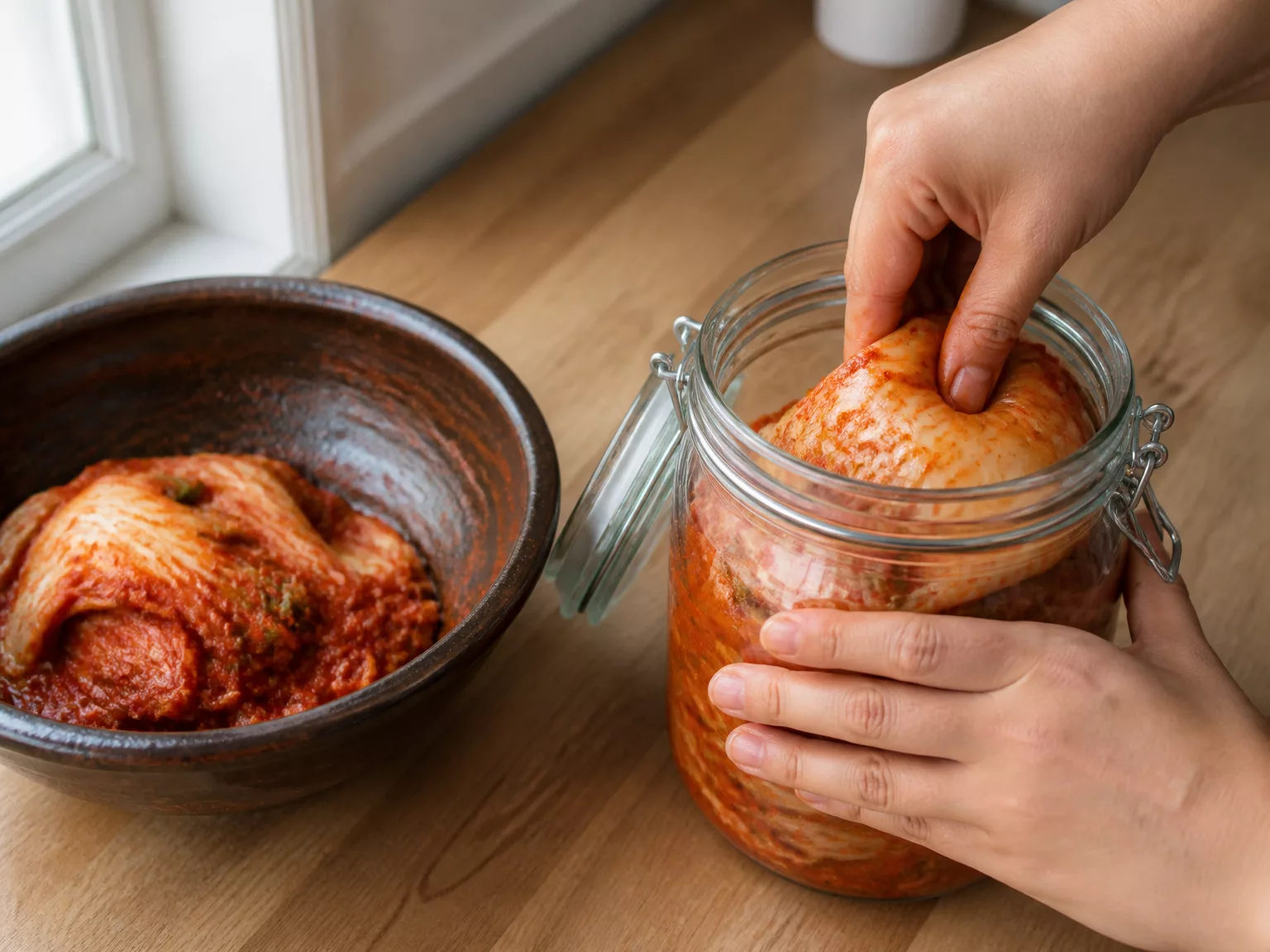 AI-generated photo
What it should look like — AI-generated image of this step, made from the recipe text — not a photo of our kitchen. 5Spread the paste between each leaf, wrap with the outermost leaf, and… -
6Leave the jar 10–12 hours at room temperature, then refrigerate at…⏱ 10–12 hours
Ingredient Amounts per 6 lb Cabbage (and What to Swap)
The seasoning paste for one 6 lb cabbage is 1.5 cups gochugaru, 1/4 cup anchovy fish sauce, 1 tbsp saeujeot, 1 tbsp plum extract, 1/3 cup beef broth, and 1/4 Asian pear, plus julienned daikon, carrot, and 4–5 green onion stalks.
That works out to about 0.25 cup of gochugaru per pound of cabbage (1.5 cups ÷ 6 lb).
| Ingredient | Amount per 6 lb cabbage | If you can’t find it |
|---|---|---|
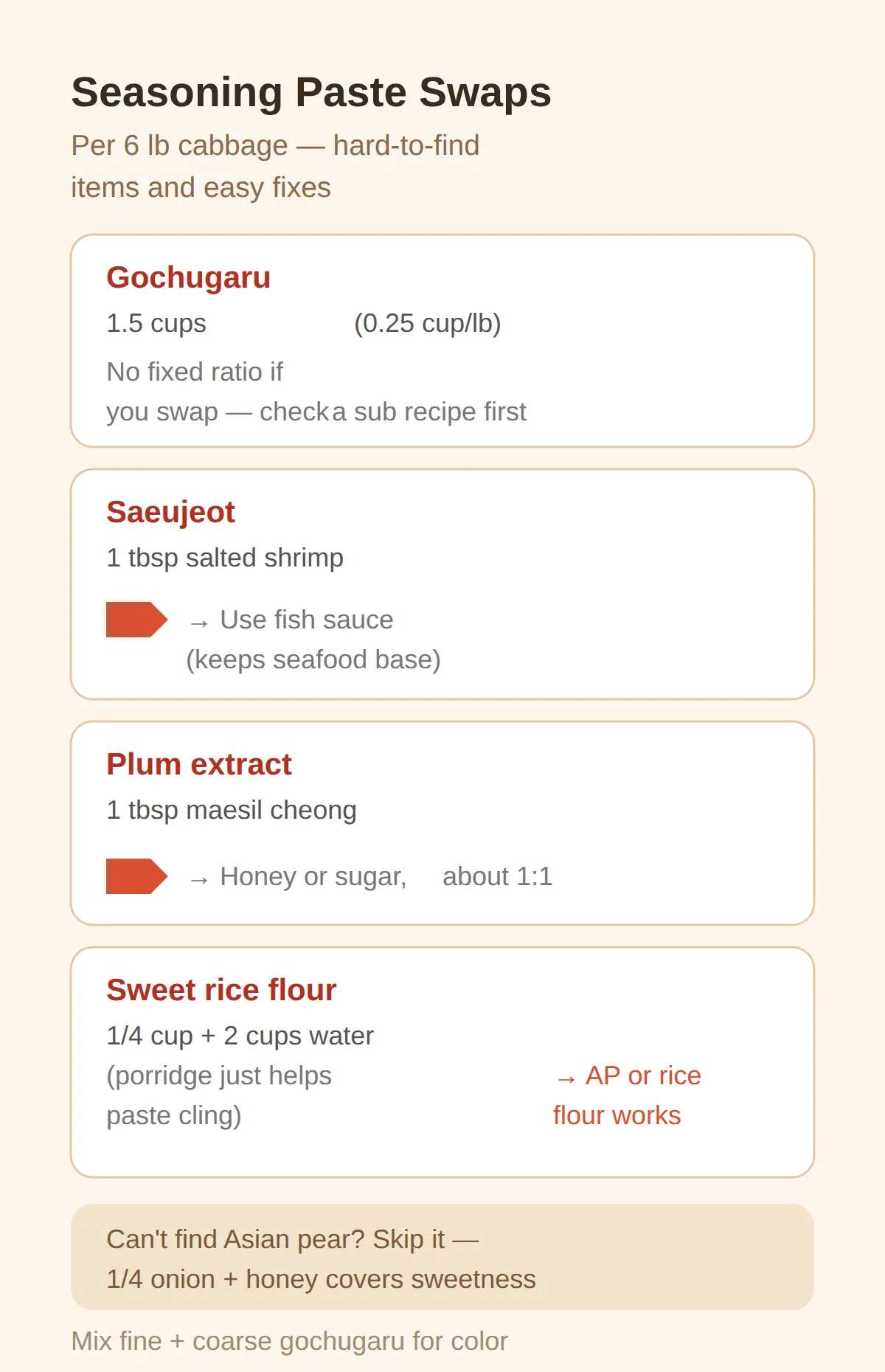
| Gochugaru (Korean red pepper flakes) | 1.5 cups (mix fine + coarse grind) | Substitutes exist, but no fixed ratio is standard — check a substitute recipe before using cayenne or paprika |
| Salted shrimp (saeujeot) | 1 tbsp | Fish sauce is the usual stand-in; it keeps the savory seafood base |
| Plum extract (maesil cheong) | 1 tbsp | Honey or sugar, roughly 1:1 by the spoonful |
| Asian pear | 1/4 pear, blended | Skip it; 1/4 onion in the blend plus honey covers part of the sweetness |
| Sweet rice flour (for the porridge) | 1/4 cup flour + 2 cups water | All-purpose flour or rice flour does the same job |
Mix the fine and coarse gochugaru together for better color and flavor, and work some gochugaru into the cut daikon first so the color blooms before you season the whole batch.
The porridge’s only job is to make the paste cling to the leaves and feed fermentation, so a wheat-flour version changes nothing about the taste.
Before anything else, check whether you can get the three hard-to-find items — gochugaru, fish sauce or saeujeot, and coarse sea salt — because everything else in this recipe swaps easily.
How Long Does Kimchi Take to Ferment?
Total time from salting to ripe kimchi is about 8–11 days: 6–8 hours salting, 10–12 hours at room temperature, then 1–2 weeks of fridge ripening at 0–5°C.
After that it keeps for months in the fridge.
Room temperature starts the fermentation; a full day out of the fridge makes it sour fast, because faster room-temp fermentation runs straight past the balanced stage.
If you want kimchi this week, plan the salting on day 1 and expect the first good-tasting jar around day 8; if you want it mild and fresh instead, the no-wait version in the section below skips both salting and fermenting.
The salting itself is mostly unattended — the hands-on work for one cabbage is roughly 1–1.5 hours, so start it in the morning and build the paste that evening.
Common Kimchi Mistakes (and How to Avoid Them)
Trapped air is the mistake that ruins jars: air left in the container causes uneven fermentation and spoilage, so pack the cabbage tightly, fill the jar only about 4/5 full, and press every layer down.
Wipe the container rim with a damp paper towel and press plastic wrap directly on the kimchi surface before sealing — that keeps air off the top layer, and the salted outer leaves laid on top protect it further.
Wear rubber gloves when you mix the paste by hand; the chili burns bare skin, and gloves keep the ferment clean.
Add extra gochugaru until the paste is bright red before folding in delicate mix-ins like oysters — fresh oysters are an optional classic winter addition, folded in at the very end, and their safety depends on the raw seafood where you live.
Use a dedicated glass, plastic, or ceramic container with a tight lid; a container that has held other strong-smelling food passes its smell straight into a fermenting jar.
Two Styles and a No-Wait Version: Tongbaechu, Mak Kimchi, Geotjeoli
Two common home styles use the same paste on the same cabbage: tongbaechu (whole-cabbage kimchi, quartered into 4 pieces) and mak kimchi (chopped into bite-size pieces before salting).
Both are everyday household versions, not regional specialties — chopped is easier to salt, mix, and pack, so it is the usual first-timer choice.
If two weeks is too long, make geotjeoli instead: mix 1/2 cup of the kimchi paste with 1/2 tbsp fish sauce and 1/2 tsp honey, toss with fresh unsalted cabbage, and eat it the same day.
Geotjeoli skips both salting and fermentation entirely, so it tastes like a fresh dressed cabbage rather than a fermented one — it is a side dish for tonight, not a jar for the month.
What Kimchi Is and When Koreans Eat It
Kimchi is a salted, fermented Korean vegetable dish, and the most common type is salted napa cabbage seasoned with gochugaru, scallions, and garlic.
| Type | Vegetable | When Koreans eat it |
|---|---|---|
| Baechu (napa cabbage) | Napa cabbage | The standard, year-round banchan at nearly every meal |
| Kkakdugi | Cubed radish | Alongside stews and braised dishes |
| Gat kimchi | Mustard leaves | A spring specialty, varying widely by region |
Korean kitchens also cook with it rather than only serving it: kimchi-jjigae (stew), kimchi fried rice, kimchi-jeon (pancake), kimchi-mandu (dumplings), kimchi ramyeon, and kimchi burgers.
If you are cooking your first Korean meal, this one jar covers the table twice — as the side dish, and as the base for a stew or fried rice two weeks later.
For the salting step, use coarse cheonilgum (sun-dried sea salt) instead of table salt — its richer minerals help fermentation along.
Related posts
📎 📅 Upcoming Dates — Release & Event Calendar
Sources
- Definition, regional variants, national-dish status, officia (ko.wikipedia.org)
- Korean home guide: 15% brine (1.5 kg cheonilgum per 10 L), 6 (lifebase.kr)
- Small-batch tutorial: 6 lb cabbage, 10-12h brine, 1.5 cups g (hemogry.com)
Summary: the four checks before you start
- Taste the paste before it goes on the leaves — saltier than you think it should be, since the cabbage is unsalted at that point.
- Let it sit at room temperature for 10–12 hours to start fermentation, then move it to the fridge.
- Open the jar over the sink for the first week: brine rises when you press the leaves down.
- Weigh the cabbage down under the brine with the outer leaves on top so nothing dries out during the 1–2 weeks of ripening.
FAQ
Q. How long does kimchi take to ferment?
About 8–11 days total: 6–8 hours salting, 10–12 hours at room temperature to start fermentation, then 1–2 weeks ripening in the fridge at 0–5°C. It keeps for months refrigerated.
Q. Can I use regular chili flakes instead of gochugaru?
Substitutes for gochugaru exist, but there is no single standard ratio for cayenne or paprika blends, and gochugaru is what gives kimchi its color and its flat, fruity heat. If you use a substitute, check a dedicated substitute recipe first and expect a different color and flavor.
Q. How much salt per liter of water for the kimchi brine?
150 g of coarse sea salt per 1 L of water — a 15% brine (1.5 kg salt in 10 L). Submerge the cabbage fully and flip it halfway through the 10–12 hours.
Q. Can I eat kimchi without fermenting it?
Yes — geotjeoli is the fresh version: toss unsalted raw cabbage with 1/2 cup kimchi paste, 1/2 tbsp fish sauce, and 1/2 tsp honey, and eat it the same day.
Q. How full should the kimchi jar be?
About 4/5 full. Press each layer down to push the air out, cover the top with the reserved salted outer leaves, and wipe the rim before sealing.
Mark day 8 on the calendar — that is when the first tasting spoonful is due.
Cover photo: Free gimjang kimchi, koreaan cuisine — CC0 1.0
#kimchirecipe #napacabbagekimchi #koreanrecipes #fermentation #gochugaru #homemadekimchi
📅Upcoming Schedule — this week 2 · D-2 Hangul DaySee all →