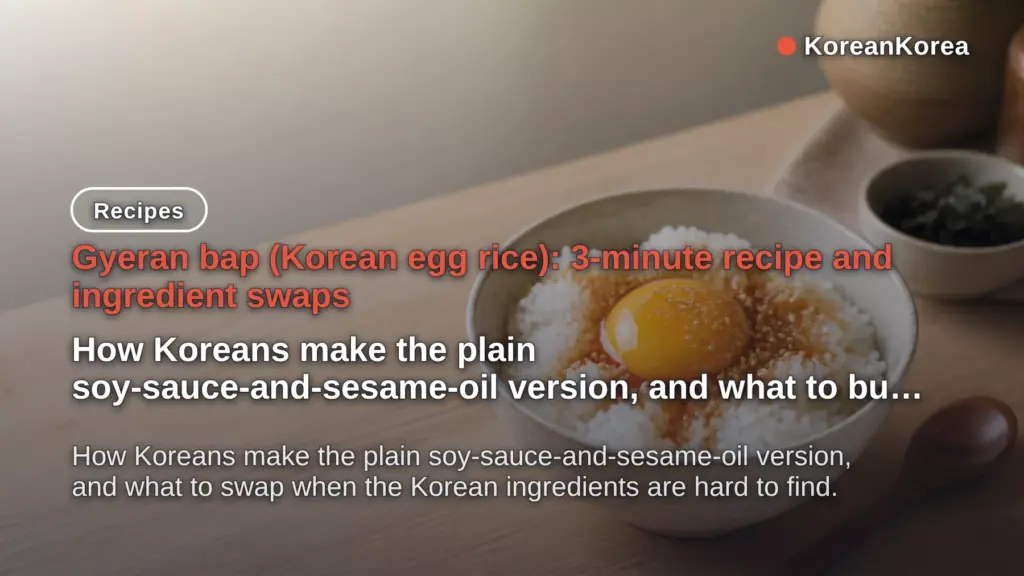
Gyeran bap is a bowl of hot short-grain rice topped with an egg, soy sauce and sesame oil — it takes about 3 minutes and is one of the first dishes Koreans learn to cook.
That matters if you are cooking outside Korea: the dish runs on pantry staples, and the two or three Korean garnishes it usually wears all have ordinary substitutes.
This post covers what gyeran bap is, the 7-step method, a 1-serving ingredient table, what to swap for gochugaru and saewoo-jeot, two variations with measured amounts, and the mistakes that flatten the taste.
What Is Korean Egg Rice (Gyeran Bap)?
| Hot cooked short-grain rice | 1 bowl (warm, freshly steamed) |
|---|---|
| Egg | 1 (fried, scrambled, or cracked raw) |
| Soy sauce | A light drizzle, to taste |
| Sesame oil | A light drizzle, to taste |
| Butter | Optional, a small pat |
| Garnish | Seaweed flakes, green onion, toasted sesame seeds |
Gyeran bap means "egg rice" — gyeran is egg and bap is cooked rice.
It is a bowl of warm steamed white rice topped with a fried egg, mixed with soy sauce and sesame oil.
Koreans eat it from childhood as a go-to breakfast, quick lunch, or late-night one-bowl meal when there are no side dishes at hand.
It is often the first dish Koreans learn to make, and for many it carries memories of family cooking.
That is also why it reads as home food, not restaurant food — a full Korean table (bapsang) means rice, soup, and banchan, and gyeran bap is the everyday shortcut inside that frame.
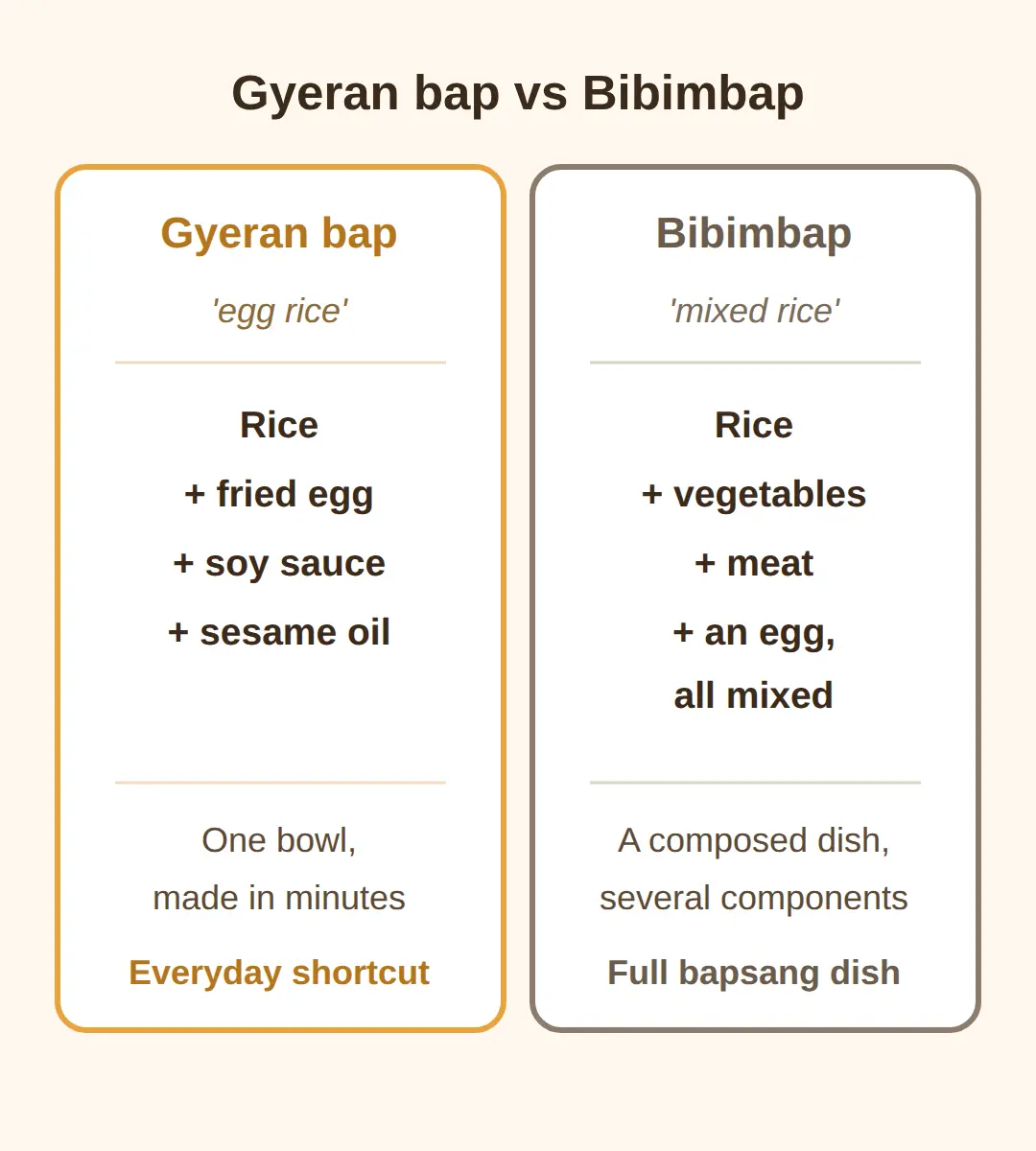
If you know bibimbap, keep the two apart: gyeran bap is literally egg rice, while bibimbap is rice with vegetables, meat, and an egg all mixed together.
When I look at a gyeran bap recipe, the first thing I check is whether it says to use steaming-hot rice — every good thing in this bowl (butter melting, egg just setting) depends on that heat.
| Gyeran bap vs bibimbap | Gyeran bap | Bibimbap |
|---|---|---|
| What it is | Rice + egg + soy sauce + sesame oil | Rice with vegetables, meat, and an egg, all mixed |
| Literal name | Egg rice | Mixed rice |
| Scale | One bowl, minutes | A composed dish with several components |
Ingredients
Main
- 1 bowl Hot cooked short-grain rice — freshly steamed, soft and sticky
- 1 Egg — sunny-side-up, scrambled, or raw
- Optional small pat Butter — the rice heat melts it
Sauce & seasoning
- Light drizzle Soy sauce — to taste
- Light drizzle Sesame oil — to taste
To finish
- Pinch Roasted seaweed flakes (gim-garu) — optional garnish
- Sprinkle Chopped green onion — optional garnish
- Sprinkle Toasted sesame seeds — optional garnish
Amounts are the ones used in this recipe; where the recipe gives no amount, adjust to taste.
How to Make Korean Egg Rice: 7 Steps in 3 Minutes
The traditional version takes 3 minutes from rice bowl to finished dish, which is why it is a go-to quick breakfast for many Koreans.
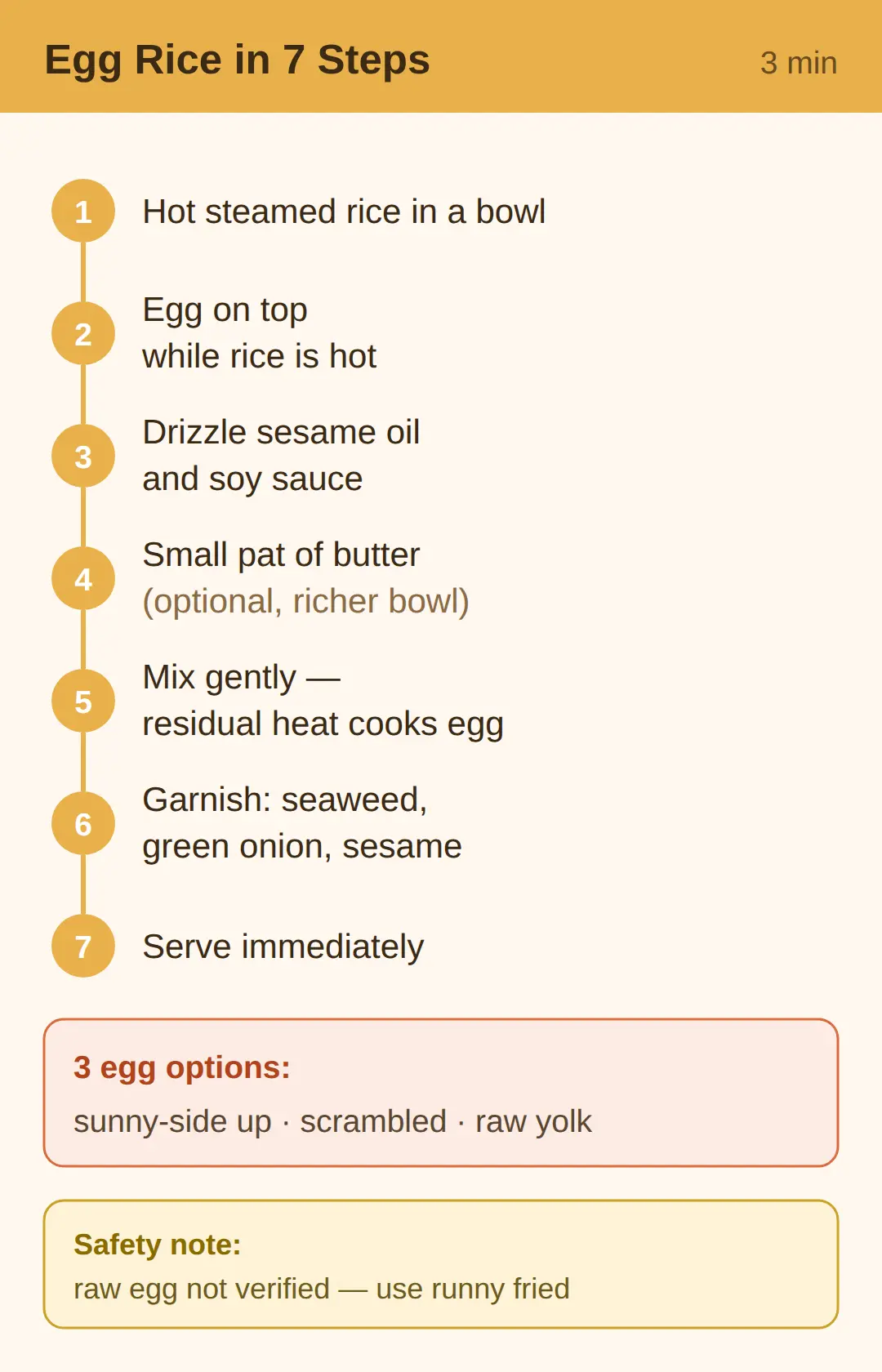
Eggs give you three choices: fried sunny-side-up, scrambled in, or cracked raw onto the hot rice so the yolk melts into the grains — a runny yolk gives the creamiest result.
Fry the egg in sesame oil and drizzle soy sauce while it cooks, and you get crispy, lacy edges and a silky yolk.
- Put hot, freshly steamed short-grain rice in a bowl.
- Place the egg on top while the rice is steaming hot.
- Drizzle sesame oil and soy sauce over the egg and rice.
- Add a small pat of butter if you want a richer bowl.
- Mix gently so the residual heat slightly cooks the egg.
- Garnish with seaweed flakes, green onion, and toasted sesame seeds.
- Serve immediately, while the rice is still hot.
The raw-egg option is traditional in Korean home cooking, but it has not been checked against non-Korean food-safety standards — use a runny fried egg if you are unsure.
Steps at a glance
-
1Put hot, freshly steamed short-grain rice in a bowl.
-
2Place the egg on top while the rice is steaming hot.
-
3Drizzle sesame oil and soy sauce over the egg and rice.
-
4Add a small pat of butter if you want a richer bowl.
-
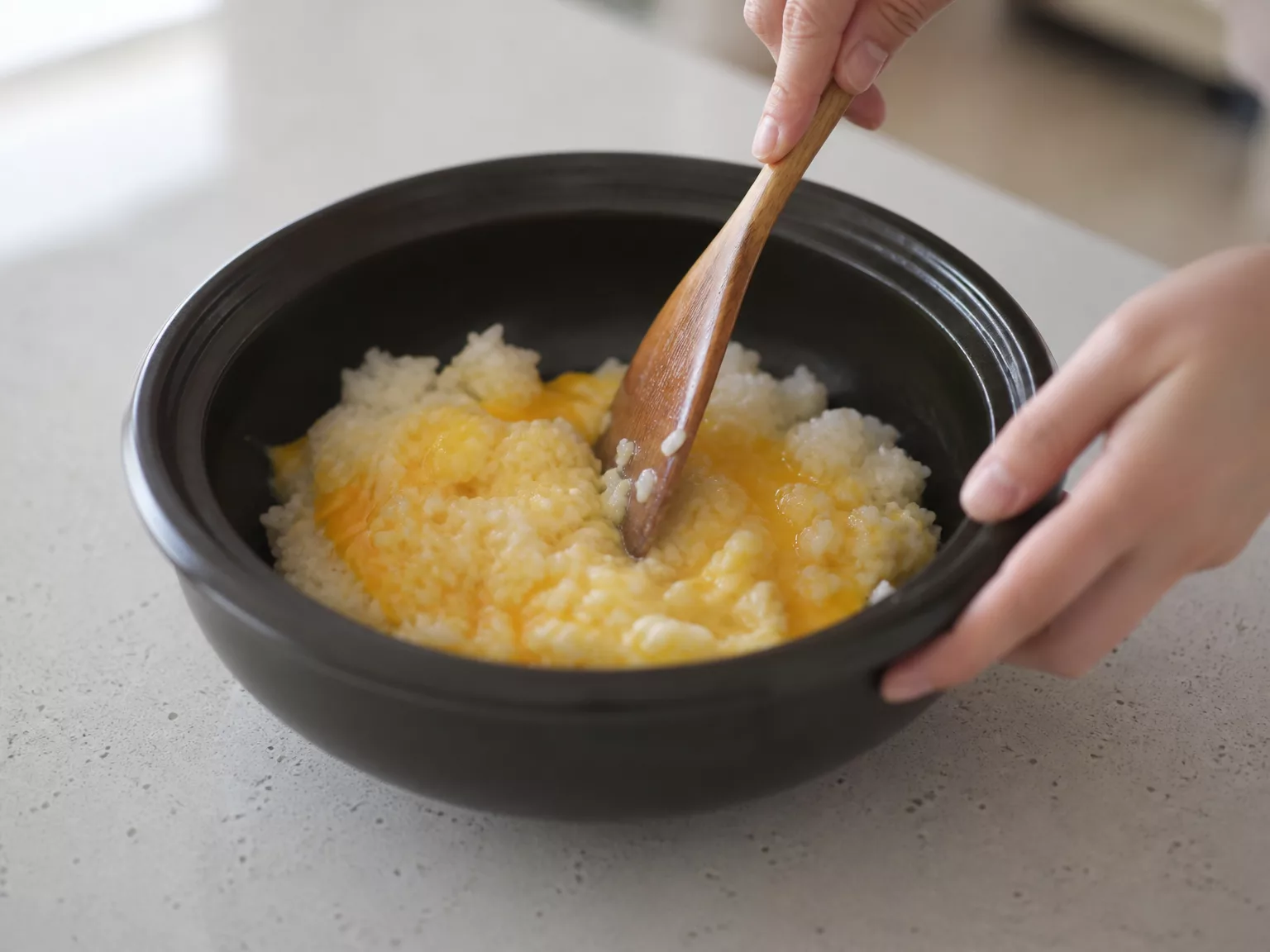 AI-generated photo
What it should look like — AI-generated image of this step, made from the recipe text — not a photo of our kitchen. 5Mix gently so the residual heat slightly cooks the egg. -
6Garnish with seaweed flakes, green onion, and toasted sesame seeds.
-
7Serve immediately, while the rice is still hot.
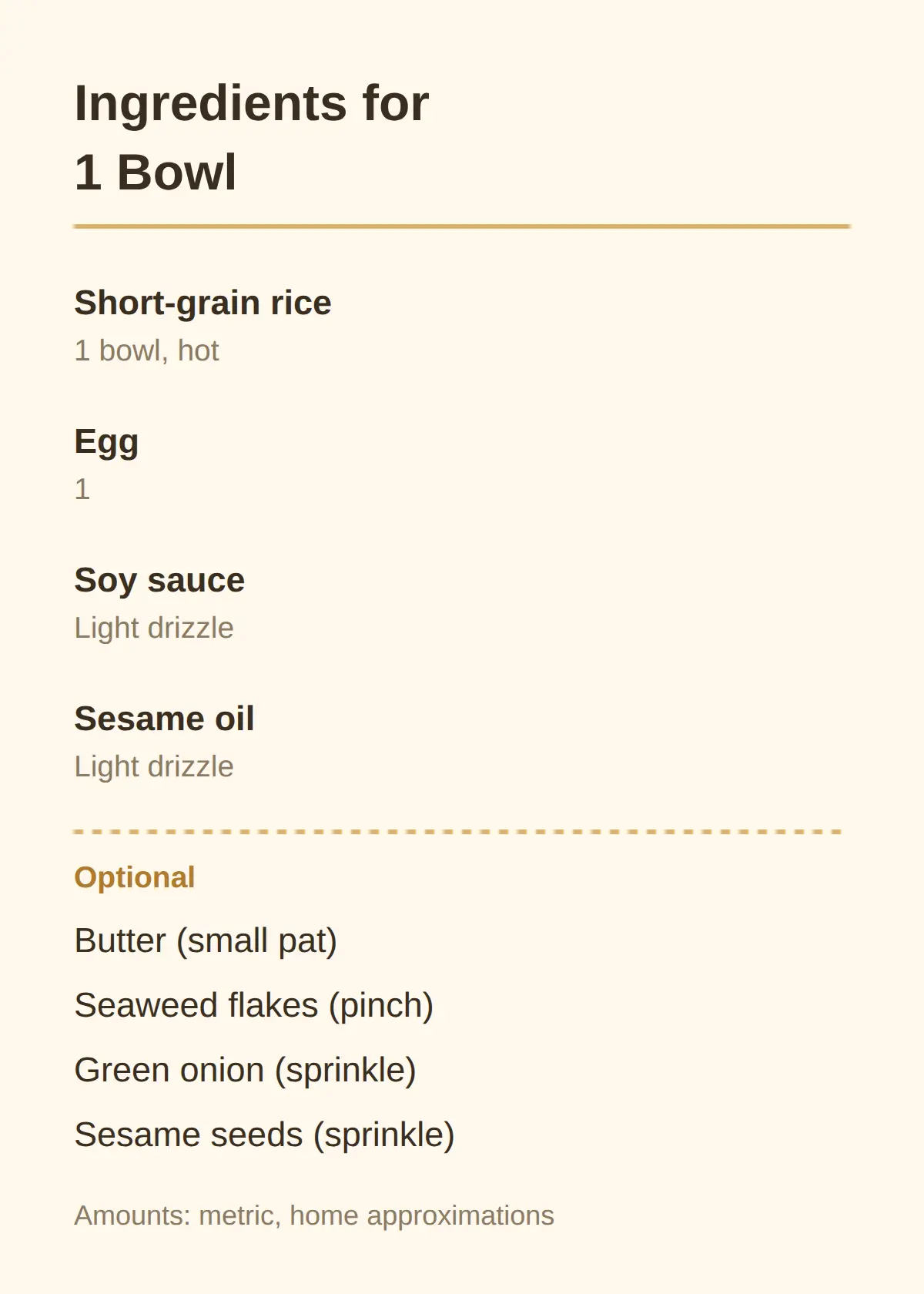
Ingredients for 1 Bowl (Metric, Home-Kitchen Approximations)
The core list is short: hot short-grain rice, 1 egg, soy sauce, sesame oil, and optional butter.
| Ingredient | Amount | Notes |
|---|---|---|
| Hot cooked short-grain rice | 1 bowl | Freshly steamed, soft and sticky |
| Egg | 1 | Sunny-side-up, scrambled, or raw |
| Soy sauce | Light drizzle | To taste |
| Sesame oil | Light drizzle | To taste |
| Butter | Optional small pat | The rice heat melts it |
| Roasted seaweed flakes (gim-garu) | Pinch | Optional garnish |
| Chopped green onion | Sprinkle | Optional garnish |
| Toasted sesame seeds | Sprinkle | Optional garnish |
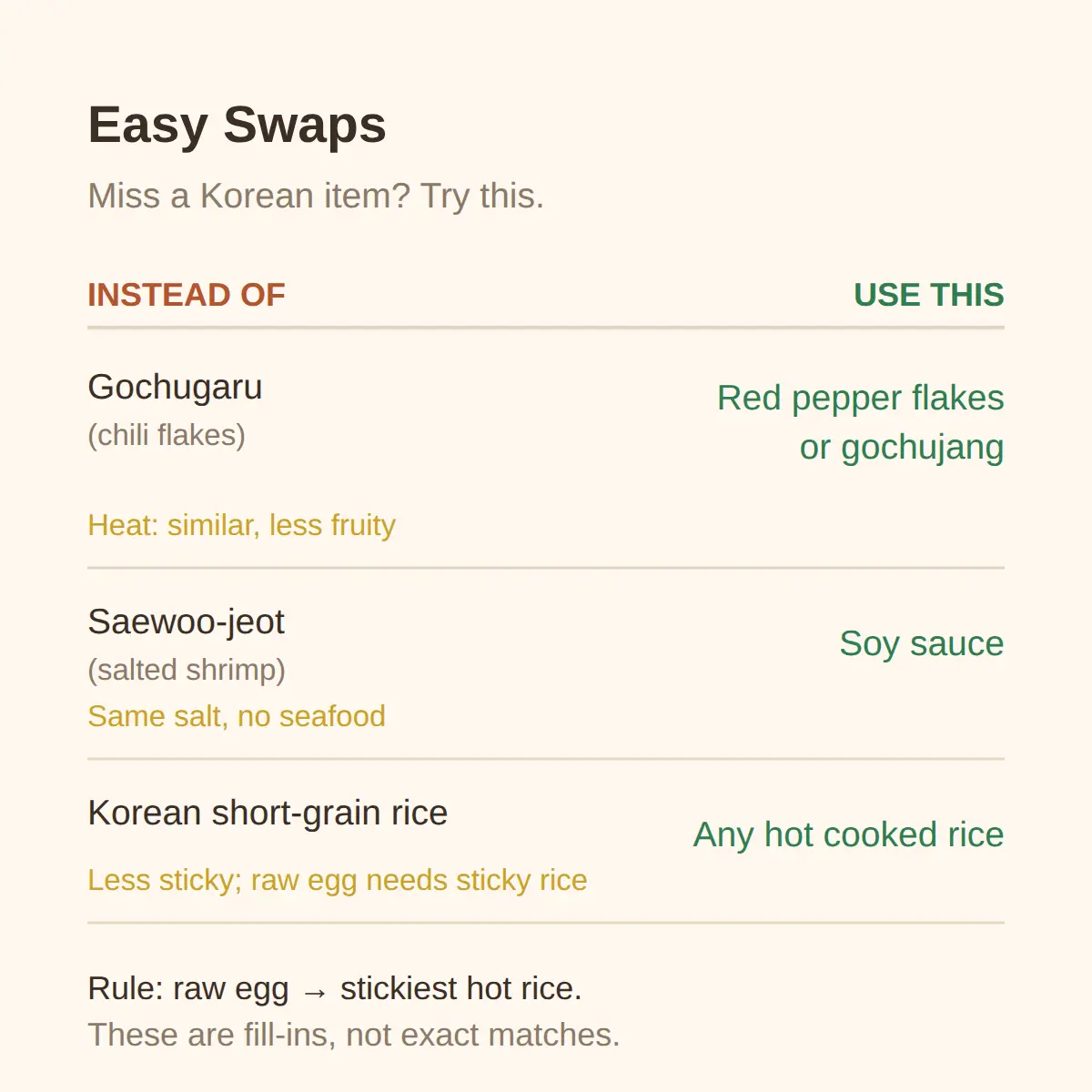
Substitutes When You Can’t Find Korean Ingredients
The dish survives on ordinary swaps, because its base is just rice, egg, soy sauce, and sesame oil.
For heat, Korean chili flakes (gochugaru) can be swapped with regular crushed red pepper flakes, or skipped entirely in favor of a dollop of gochujang.
For the steamed-egg version’s salted shrimp paste (saewoo-jeot), soy sauce fills the same role if the paste is hard to find.
| Instead of this | Use this | What changes in taste |
|---|---|---|
| Gochugaru (Korean chili flakes) | Regular red pepper flakes, or gochujang | Similar heat, less fruity depth |
| Saewoo-jeot (salted shrimp paste) | Soy sauce | Same savory salt, no seafood note |
| Korean short-grain rice | Any hot cooked rice | Less sticky; the raw-egg method needs the sticky kind |
These swaps are commonly suggested as fill-ins rather than verified equivalents — expect a slightly different bowl, not a wrong one.
On rice, the practical rule is: if you crack the egg raw, use the stickiest hot rice you can make, otherwise any hot rice works.
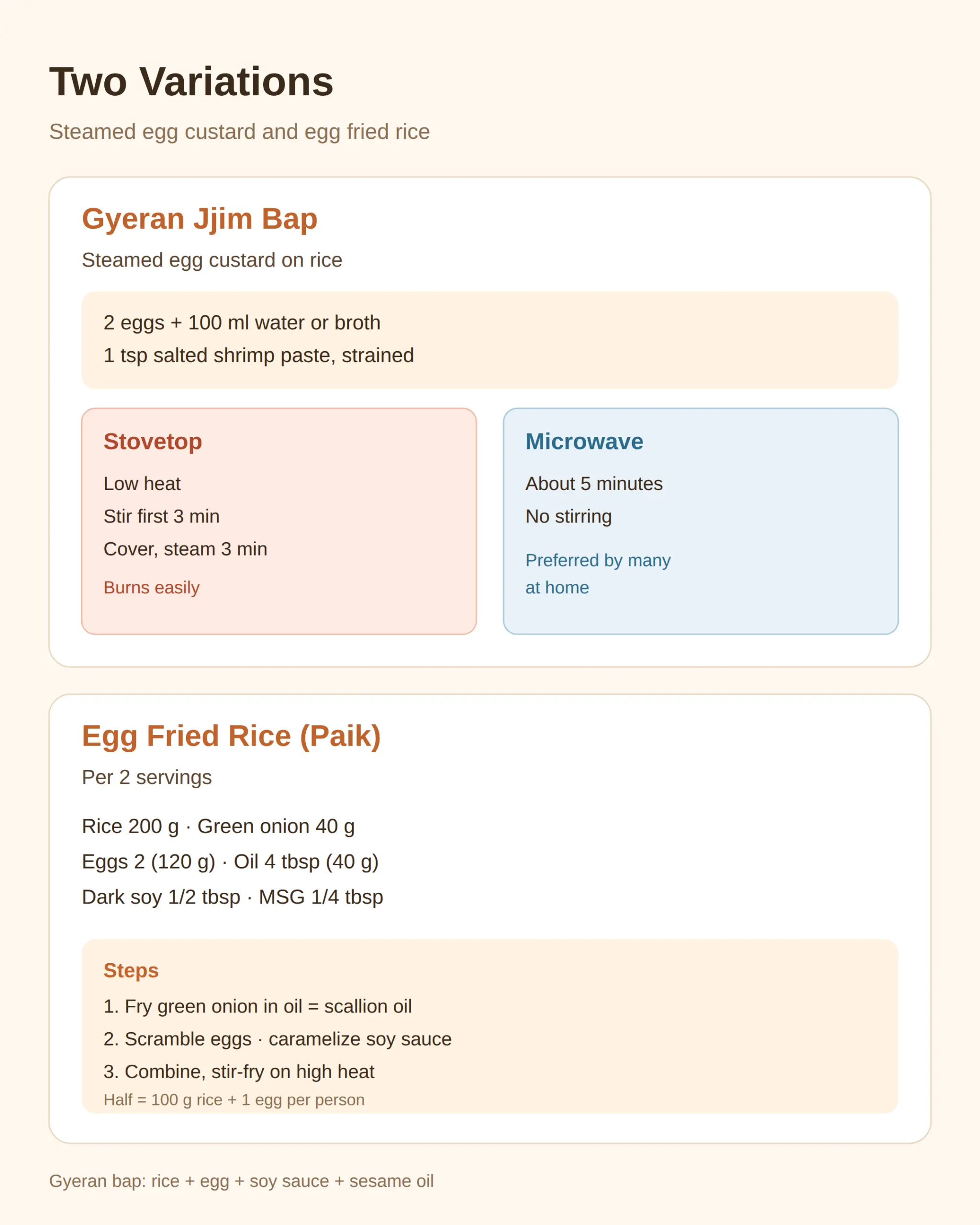
Two Variations: Steamed Egg (Gyeran Jjim Bap) and Egg Fried Rice
Gyeran jjim bap tops rice with soft steamed egg custard, and its ratio is confirmed: 2 eggs whisked with 100ml water or broth (1:1), seasoned with 1 tsp salted shrimp paste, strained, poured over hot rice, and finished with seaweed flakes and sesame oil.
A side sauce of 1 tsp soy sauce, 1 tsp sesame oil, chopped green onion, and toasted sesame seeds is mixed into the rice little by little.
There are three styles of this dish: steamed egg on rice, cooking rice and egg together in a ttukbaegi clay pot, and serving with the soy seasoning sauce.
Stovetop steaming works on low heat: stir for the first 3 minutes so the bottom doesn’t scorch, stop once the edges set, then cover and steam 3 more minutes until puffed.
The microwave version takes about 5 minutes with no stirring, and many Koreans prefer it at home because stovetop custard burns easily.
The fried-rice variation is Paik Jong Won’s egg bokkeumbap, with exact grams: 200g rice, 40g chopped green onion (1/2 cup), 2 eggs (120g), 4 tbsp cooking oil (40g), 1/2 tbsp dark soy sauce (5g), 1/4 tbsp MSG (2g), and 1g flavored salt.
The technique: fry the green onion in oil to make scallion oil, set it aside, scramble the eggs on the other side of the pan, add soy sauce to the empty spot so it caramelizes and slightly burns, then combine and stir-fry over high heat.
Paik’s note on the smoky restaurant taste: most Chinese street fried rice relies on MSG, and oyster sauce (which also contains MSG) is the closest substitute.
Halving his two-person recipe works out to roughly 100g rice and 1 egg per person.
If you want speed, make the plain bowl; if you want something closer to a BBQ-restaurant dish, try the steamed egg.
Common Mistakes and Related Korean Egg Dishes
The single technique that decides this dish is steaming-hot rice: freshly steamed, soft, and sticky, because that heat melts the butter and lightly cooks the egg into a silky texture.
The other common mistake is piling on extras — keep the plain soy sauce + sesame oil version first, since that classic bowl is the heart of the dish, then add gochujang or seaweed.
Storage and reheating guidance for leftovers could not be found in the recipe sources, so treat the bowl as a make-and-eat dish.
| Time comparison | Classic gyeran bap | One English recipe version |
|---|---|---|
| Total time | 3 minutes | 10 minutes |
| Why | Rice heat cooks the egg | Egg cooked separately |
Gyeran bap sits inside a family of Korean egg dishes: gilgeori toast (street toast with fluffy scrambled egg), mayak eggs (soy-marinated), gyeran mari (a savory, salt-seasoned egg roll, unlike sweet Japanese tamagoyaki), gyeran jjim (steamed egg, a Korean BBQ staple), and gyeran-jidan (a thin egg crepe garnish on tteokguk soup).
If gyeran jjim is the one you know from Korean BBQ restaurants, that same custard over rice is the variation in the section above.
Related posts
📎 📅 Upcoming Dates — Release & Event Calendar
Sources
- Full egg-only table concept (egg rice + egg soup + egg side) (blondekimchi.com)
- 3-minute bowl: hot rice + egg, soy sauce, sesame oil; garnis (silkyrecipes.com)
- 2 eggs : 100ml water (1:1), saewoo-jeot seasoning, soy+sesam (cookpick.kr)
Gyeran Bap in Short
- Steaming-hot, sticky short-grain rice is the one non-negotiable — it cooks the egg and melts the butter.
- Season with soy sauce and sesame oil first; add gochugaru or gochujang only after tasting the plain version.
- Crack a raw egg only if you trust it — a runny fried egg gives the same creamy result with no safety question.
- Out of gochugaru, use regular red pepper flakes; out of saewoo-jeot, use soy sauce in the steamed-egg version.
- Gyeran jjim bap ratio to remember: 2 eggs to 100ml water or broth, with 1 tsp salted shrimp paste.
FAQ
Q. What is Korean egg rice (gyeran bap)?
It is a bowl of warm steamed white rice topped with an egg and mixed with soy sauce and sesame oil — a 3-minute Korean home meal. The name literally means egg rice.
Q. How do I make gyeran bap at home?
Put hot short-grain rice in a bowl, top with an egg while hot, drizzle sesame oil and soy sauce, mix gently so the residual heat cooks the egg, garnish, and serve immediately — about 3 minutes total.
Q. What can I use instead of gochugaru and saewoo-jeot?
Regular crushed red pepper flakes stand in for gochugaru, and soy sauce stands in for saewoo-jeot (salted shrimp paste) in the steamed-egg version. Expect a slightly different taste, not an identical one.
Q. Can I crack a raw egg on hot rice for gyeran bap?
It is a traditional Korean home-style touch so the yolk melts into the grains. It has not been checked against non-Korean food-safety standards, so a runny fried egg is the safer choice if you are unsure.
Q. How long does gyeran jjim (steamed egg) take in the microwave?
About 5 minutes with no stirring. Stovetop steaming needs low heat, 3 minutes of stirring, then 3 more minutes covered — and it burns easily.
Related: how Korean soy-marinated eggs (mayak eggs) work, and what a full Korean home table (bapsang) looks like.
Cover photo: AI-generated illustration (korean rice bowl) — AI-generated image, illustrative only
#koreaneggrice #gyeranbap #koreanrecipes #easykoreanfood #eggrecipes #ricebowl
📅Upcoming Schedule — this week 4 · D-day Hangul DaySee all →How this article was made: written with AI assistance from the official and public sources cited here, checked automatically against those sources, and reviewed by the site operator after publishing. Last updated 2026-10-08. Editorial policy