
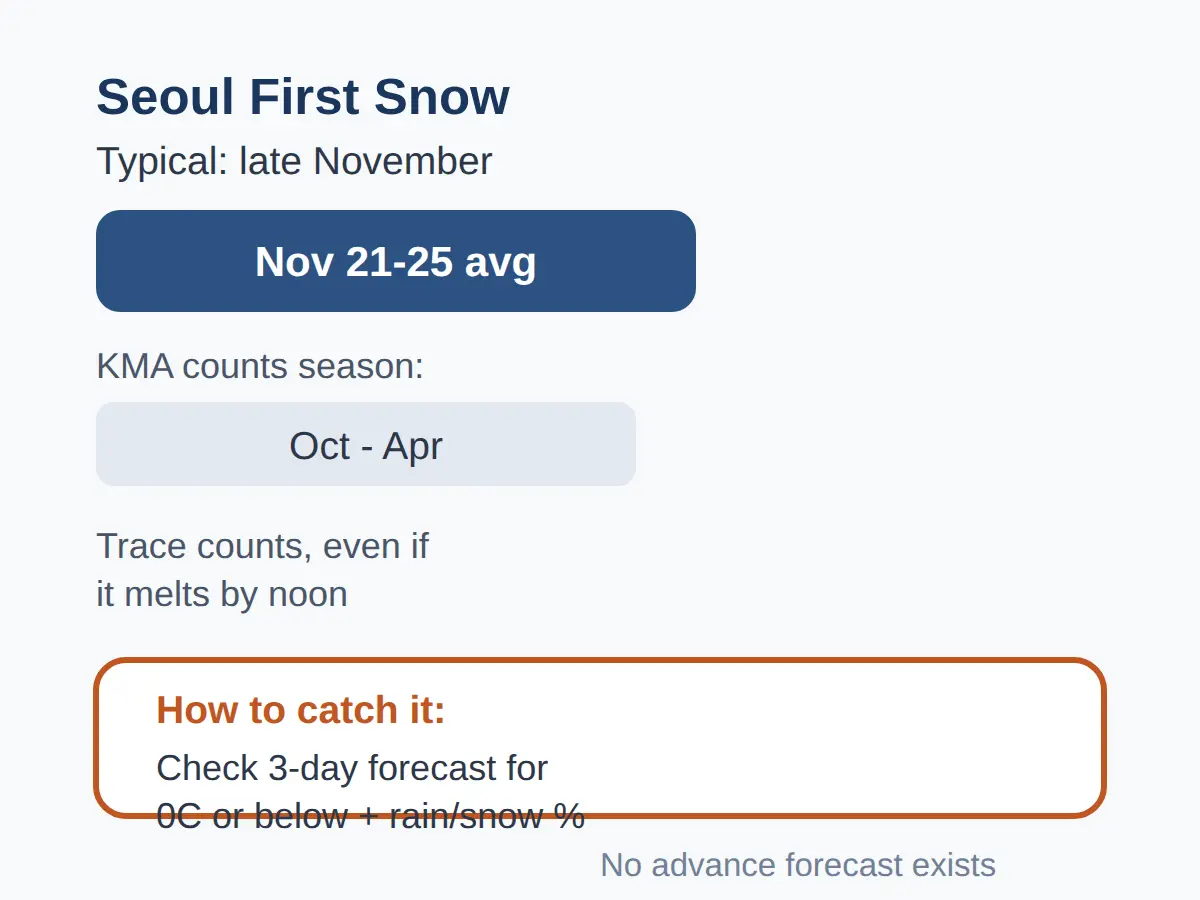
Seoul’s first snow usually falls in late November, with recent seasons averaging around November 21–25.
Because it often melts within hours, the day you go matters more than the date you circle.
This post covers when to expect it, whether November snow is worth chasing, where to go, and how to catch it on the right morning.
1. When Is the First Snow in Seoul?
Seoul’s first snow typically falls in late November, and the average in recent years has landed around November 21–25.
The Korea Meteorological Administration (KMA) counts ‘first snow’ as the first snowfall observed at a station during the cold season, October through April, and even a trace that melts right away counts.
So an early-season flurry you see at 7 a.m. and gone by lunch can already be the season’s official first snow.
There is no advance first-snow forecast anywhere.
KMA announces first snow per station only after it observes it, so no source can promise a date ahead of time.
The reliable trigger is the short-term forecast: the 3-day window is where a real snow chance shows up.
Before anything else, I check the KMA English forecast page for a day in the next 3 days that is forecast at 0°C or below with precipitation probability — that is the whole decision, because waiting for an official announcement means you already missed it.
Next for you
Also read: Halal Korean BBQ in Itaewon: ₩15,000–30,000 and Where to Go · Reopening of Dongdaemun History Museum Exhibition Hall: Free Entry
2. Does It Snow in Seoul in November?
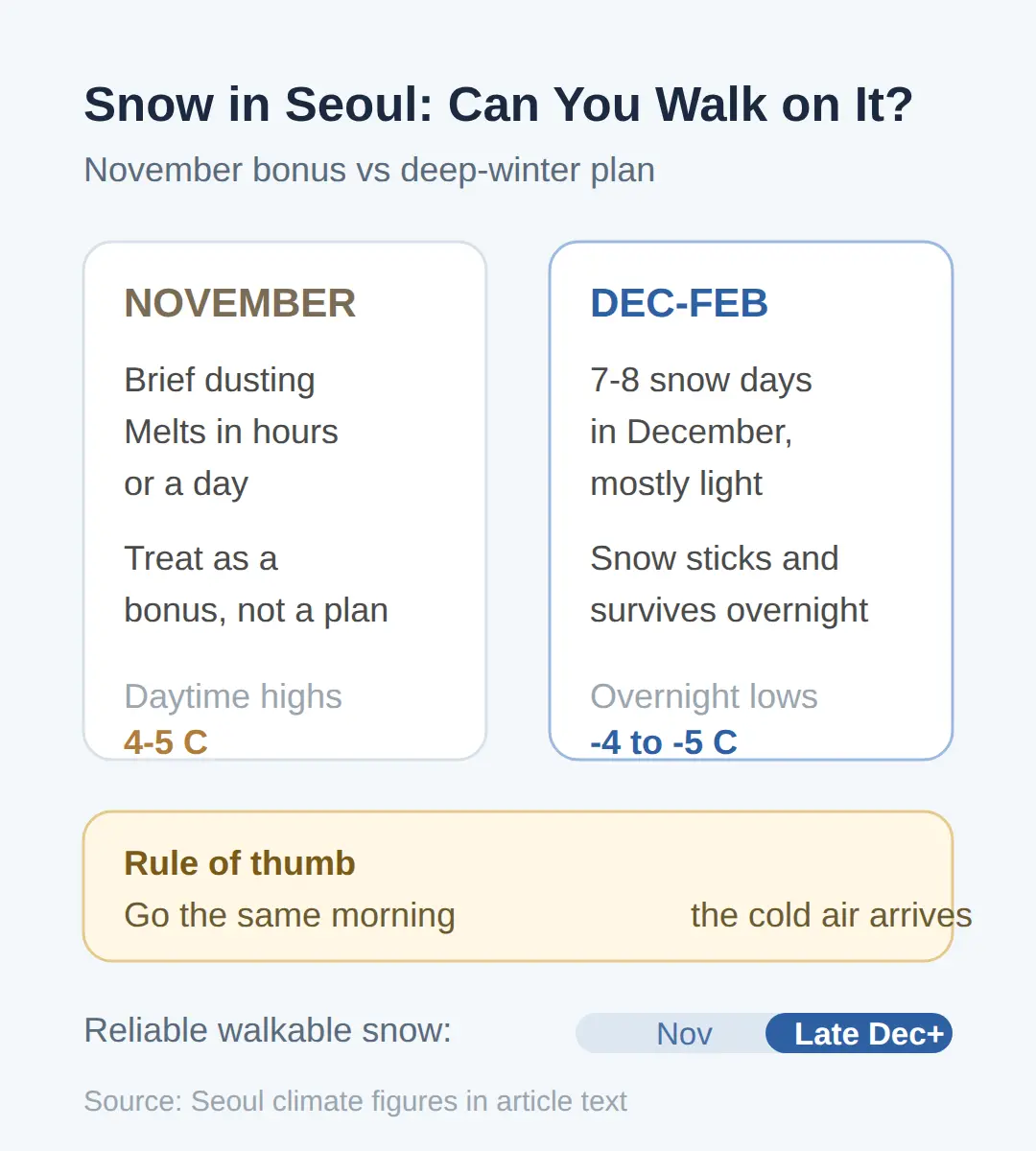
Yes, but a November first snow is usually a brief dusting that does not stick.
Daytime highs in December still run around 4–5°C, above freezing, so early-season snow melts fast — often within hours to a day.
That is why the practical rule is to go the same morning the cold air arrives, not the next day.
Snow you can actually walk on and photograph becomes reliable from late December through February.
December averages roughly 7–8 snowfall days, but most of those events are light and non-accumulating.
Overnight lows in December sit around -4 to -5°C, which is what lets snow survive once it falls in deep winter.
If your trip is in November, treat any snowfall as a bonus rather than a plan; if your trip is late December or later, a proper snow day is a realistic goal.
3. Where to See First Snow in Seoul
The classic first-snow photo spots cluster around the royal palaces and the old town north of the river, and several of them cost nothing.
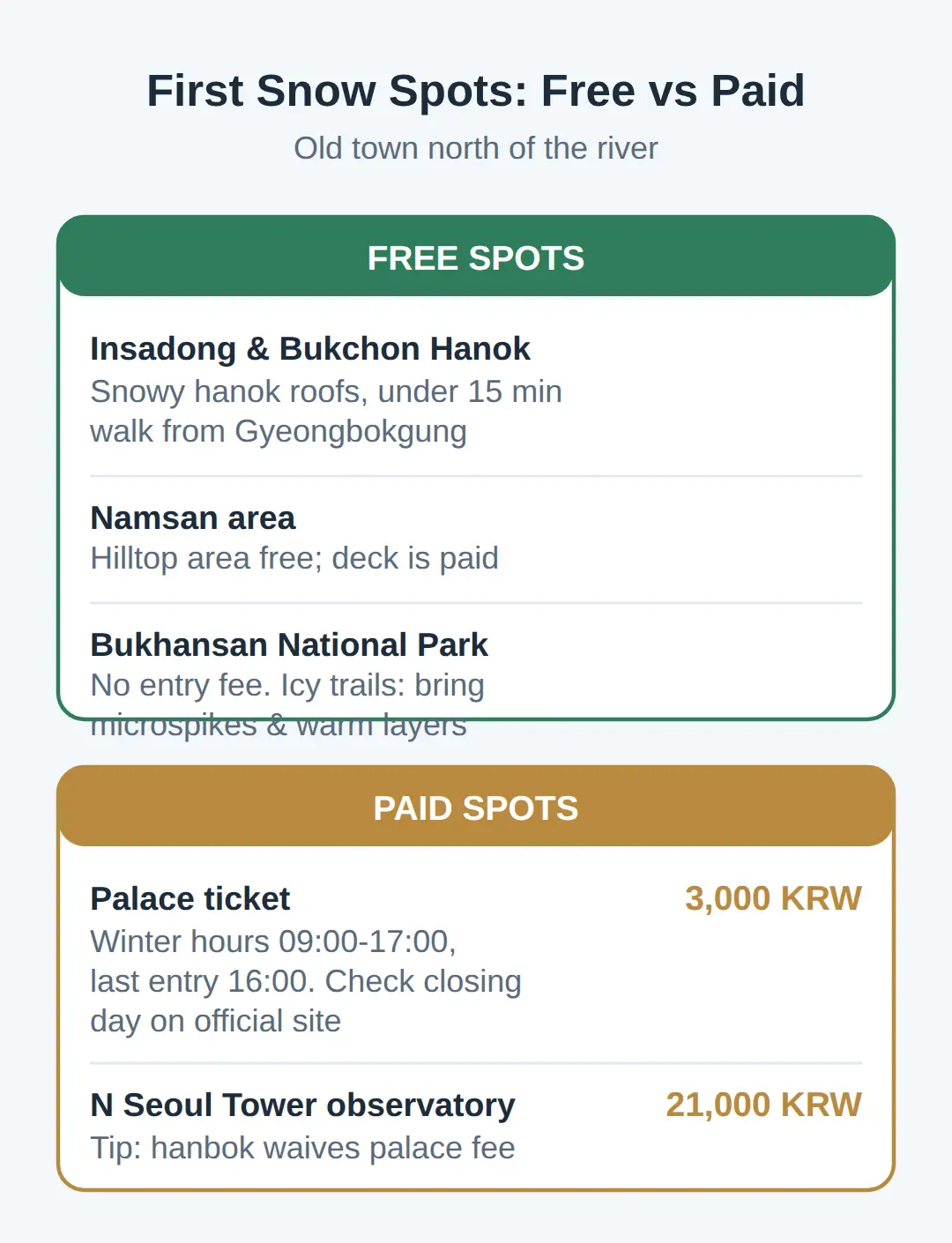
Gyeongbokgung runs winter hours from November to February, 09:00–17:00 with last entry at 16:00, and a ticket is required.
Changdeokgung is closed on Mondays, so a two-palace snow day needs its weekday checked against the calendar.
| Spot | Cost | Notes |
|---|---|---|
| Gyeongbokgung | Ticket required | Winter hours 09:00–17:00, last entry 16:00; check the official site for this season’s closing day |
| Changdeokgung | Ticket required | Closed Mondays; the Secret Garden tour is a separate add-on |
| Insadong and Bukchon Hanok Village | Free | Under 15 minutes on foot from Gyeongbokgung |
| Namsan area around N Seoul Tower | Free | The observatory deck is paid; the surrounding hilltop area is not |
| Bukhansan National Park | Free entry | Trails turn icy after snow — microspikes and warm layers are needed |
Gyeongbokgung’s closing day is not confirmed for this season here, so check the official palace site before you lock in a date.
If keeping the cost down matters, start with the free spots — Insadong and Bukchon give you snowy hanok roofs within a short walk of a palace, and wearing hanbok waives palace admission entirely.
4. How to Get Around Seoul on a Snow Day
A T-money card covers a subway or bus base fare of 1,400–1,500 KRW, so a same-day snow run across the city costs only a few dollars in transit.
When heavy snow hits, I plan the day around the subway lines and keep buses as backup, because buses share the road with slowed traffic.
Walkable clusters help too: Insadong and Bukchon sit under 15 minutes on foot from Gyeongbokgung, so one palace drop covers three spots.
For airport arrivals on a snow day, the airport rail into the city is the safer bet than a taxi or limousine bus, and it is worth padding your schedule that morning.
Snow-day road traffic slows noticeably, so do not book a fixed afternoon appointment off the plane.
If your day is palace-centered, skip the bus entirely — the subway plus your own feet covers Gyeongbokgung, Insadong and Bukchon in one loop.
5. How to Catch First Snow Without Wasting the Day
The one mistake that wastes the day is going on a forecast ‘snow possibility’ day — early-season flurries often never settle, and the KMA confirms first snow only after it happens.
Instead, let the 3-day forecast make the call for you.
- Check the KMA English forecast page at weather.en.kma.go.kr each evening.
- Look for a day within the next 3 days forecast at 0°C or below with precipitation probability.
- Go that same morning, at the 09:00 palace opening in winter hours.
- Shoot before about 16:00 — sunset in Seoul is around 17:10–17:20 in December and palace gates close earlier than that.
Snow melts by midday in the city because the ground and the 4–5°C daytime air stay above freezing.
So the morning is the only window you can count on, and an afternoon visit on a first-snow day usually finds wet pavement.
If I were setting the day, I would go the same morning the 3-day forecast turns cold and wet, at 09:00 opening, in hanbok — the snow is usually gone by midday and the hanbok covers the ticket anyway.
6. What to Bring for a Snow Photo Day in Seoul
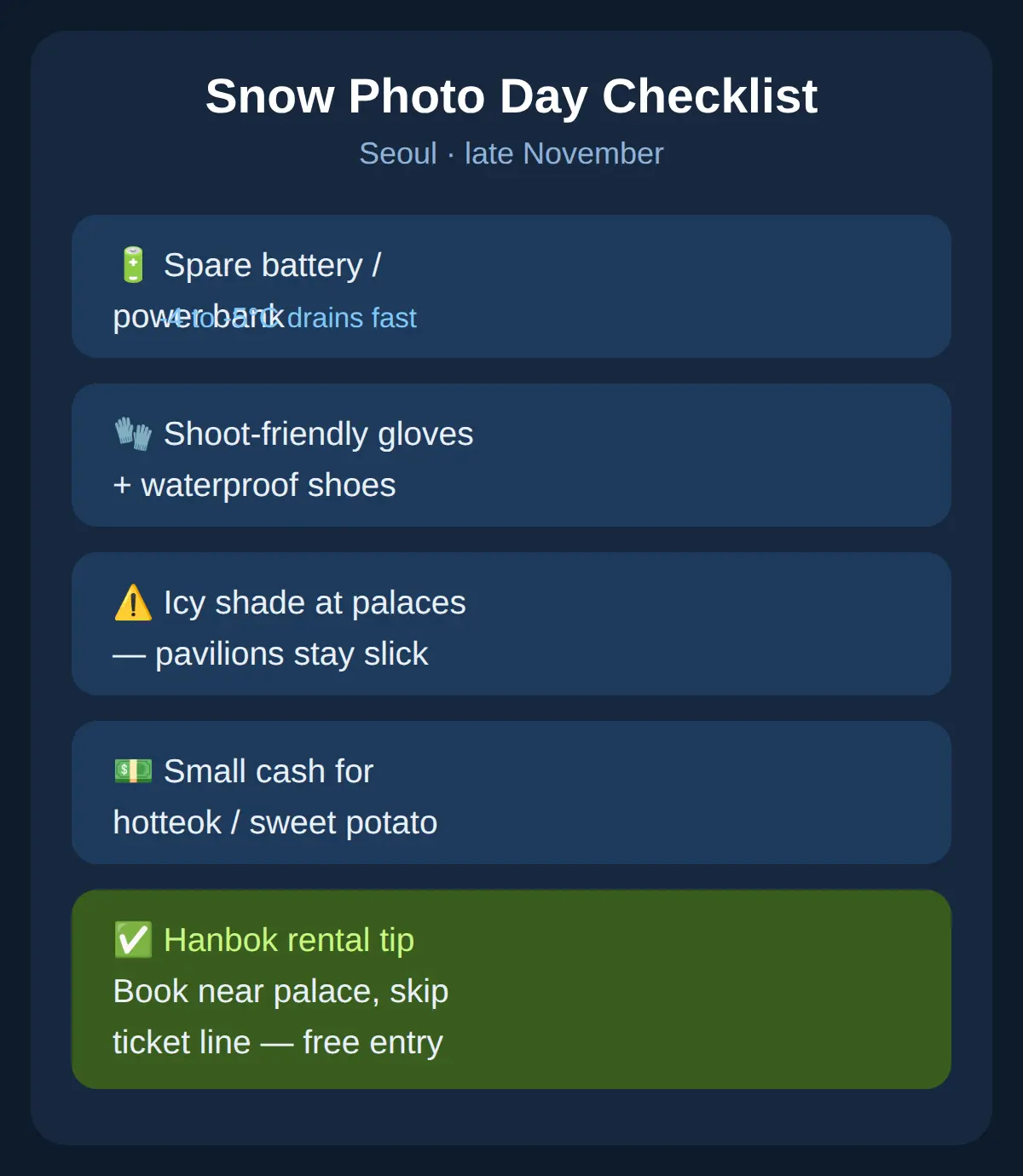
Pack a spare battery or power bank — with December lows around -4 to -5°C, phone and camera batteries drain noticeably below freezing, so it is standard kit rather than an extra.
Watch the shaded spots at the palaces: wooden pavilions and stone walkways hold icy patches all day even when open ground looks clear.
Budget small cash for warm street snacks such as hotteok or roasted sweet potato near the snow spots.
If you plan photos in hanbok, book the rental near the palace and skip the ticket line — wearing hanbok grants free admission to the royal palaces, so the rental replaces the entry fee altogether.
Bring gloves you can shoot in and waterproof shoes; standing still in -5°C air for photos is colder than walking between spots.
👉 Korea Meteorological Administration daily and weekly forecasts for catching the first snow
👉 Bukhansan National Park winter trail and gear information
👉 N Seoul Tower observatory tickets and Namsan snow photo info
👉 official palace hours and admission for a snow photo day
👉 Korea Trip Concierge transit route finder for foreign visitors
Related posts
📎 Seoul — everything we know
📎 📅 Upcoming Dates — Release & Event Calendar
Sources
- General climatology value around -4 to -5°C low, no 6-months (kma.go.kr)
- MCP server for foreign visitors: places, transit, payment in (github.com)
- Late November typical; recent years shifted later (weather.go.kr)
How to Catch First Snow Without Wasting the Day
- Watch the KMA short-term forecast (3 days out) — it is the reliable window for catching the first snow, not long-range guesses.
- Go early: snow on palaces photographs best around the 09:00 opening, and city snow usually melts by midday.
- Check closing days before you plan: Gyeongbokgung is closed Tuesdays and Changdeokgung is closed Mondays.
- Consider hanbok rental (10,000–20,000 KRW for 2–4 hours) — wearing hanbok grants free palace entry, replacing the 3,000 KRW ticket.
- Remember a November first snow is often a brief dusting; reliable accumulating snow is more likely late December through February.
FAQ
Q. When does Seoul usually get its first snow?
Historically Seoul’s climatological first snowfall falls in late November, with the average first snow date around Nov 21–25 in recent years. But in several recent years the first snow arrived in December or even January, so late November is a window, not a guarantee.
Q. Does the first snow in Seoul actually stick?
Usually not. KMA defines first snow as the first snowfall observed during the cold season, and it can be trace amounts that melt immediately. December daytime highs around 4–5°C mean snow usually melts by midday, so shoot early morning.
Q. Where is the best place to see first snow in Seoul?
Gyeongbokgung and Changdeokgung palaces for classic snow photos, Bukhansan and Bukak Skyway for viewpoints, and the free Namsan area around N Seoul Tower. Insadong and Bukchon Hanok Village are free walkable spots within 15 minutes of Gyeongbokgung.
Q. How do I get around Seoul on a snow day?
With a T-money card the Seoul subway and bus base fare is 1,400–1,500 KRW, so same-day snow viewing across the city costs only a few dollars in transit.
Check the Korea Meteorological Administration’s short-term forecast (3 days out) before you plan your snow day — that is the only window you can trust.
#firstsnowseoul #seoulwinter #seoulnovembersnow #gyeongbokgungsnow #seoultraveltips #koreaweather
📅Upcoming Schedule — this week 1 · D-5 MAMA 2026 ceremony (exact date/venue not yet confirmed in thSee all →Last updated 2026-11-20. Editorial policy