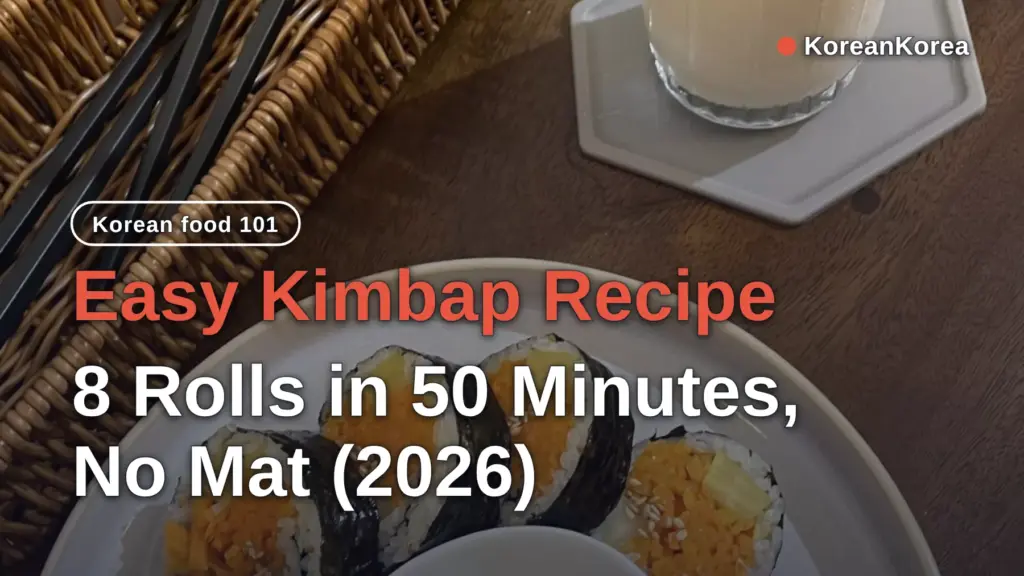
An easy kimbap batch makes 8 rolls in about 50 minutes — about 6 minutes per roll — from 4 sheets of roasted seaweed cut in half and 2 cups of short-grain rice seasoned with sesame oil and salt.
Kimbap (also spelled gimbap) is cooked rice and cooked or pickled fillings rolled in seaweed, and Koreans eat it cold, at room temperature, as a picnic, travel, and packed-lunch food — so it suits a lunchbox made the same morning and eaten that day.
This post covers what to buy for 8 rolls, how to season the rice, the 6 rolling steps without a bamboo mat, what to substitute abroad, and how kimbap differs from a sushi roll.
Kimbap Recipe Easy: What You Need for 8 Rolls
| Short-grain rice, cooked and cooled slightly | 2 cups uncooked measure (0.25 cup per roll) |
|---|---|
| Roasted seaweed (gim / laver) | 4 sheets, each cut in half = 8 halves |
| Sesame oil, salt, toasted sesame seeds | To season the warm rice |
| Carrot, julienned | 1 small, raw or briefly stir-fried |
| Spinach, blanched 30 seconds | A handful, squeezed dry, salt + sesame oil |
| Thin egg omelet (jidan), or ham / imitation crab | Cut into strips — cooked, never raw |
A working easy batch is 8 rolls from 4 sheets of roasted gim cut in half — 2 rolls per sheet — in about 50 minutes, or roughly 6 minutes per roll.
Rice is the quantity to get right: 2 cups uncooked measure for the batch works out to 0.25 cup per roll, which is about 70–80 g of seasoned rice pressed in a thin layer on each half sheet.
Fillings are simple — carrot, blanched spinach, pickled radish, thin egg omelet strips, and ham or imitation crab — and every one of them is cooked or pickled before it goes in.
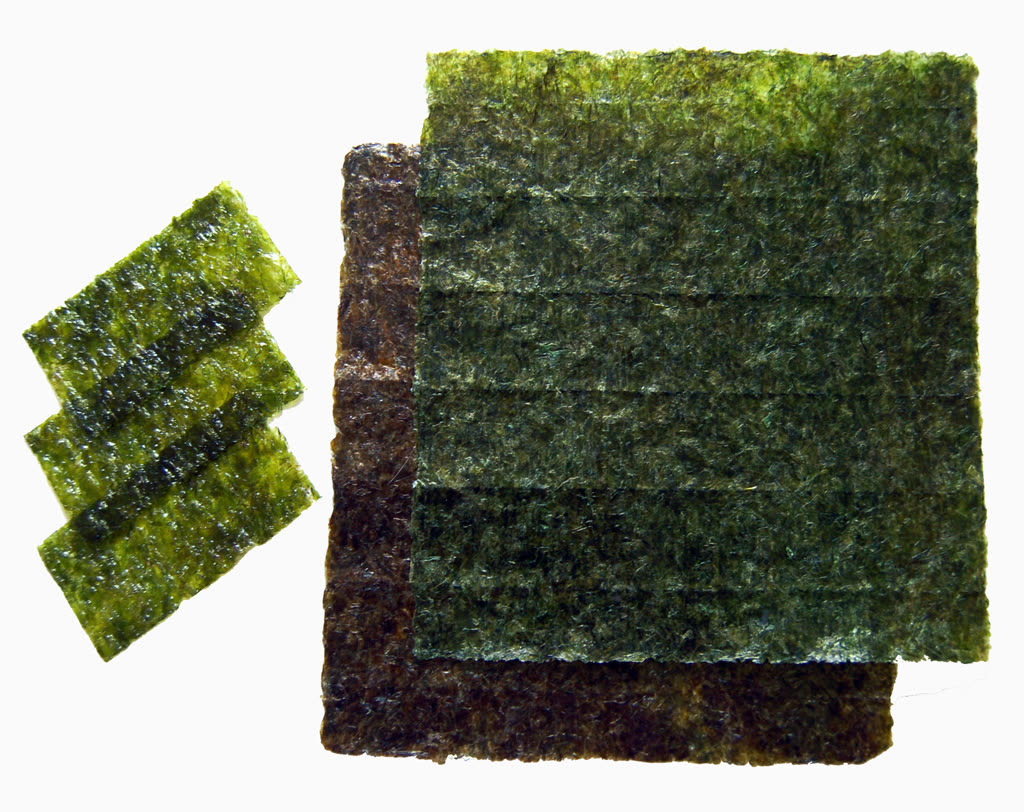
One point on sourcing: roasted gim is the same product sold overseas as sushi nori, so a Korean or Asian grocery carries it under that label.
I always check the gim before anything else — whether it is pre-roasted and snaps crisply — because stale seaweed is what ruins a roll.
Ingredients · Serves: 8 rolls (2–3 people)
Main
- 2 cups, uncooked measure Short-grain rice — cooked and cooled slightly; 1:1.1 rice-to-water ratio
- 4 sheets Roasted seaweed sheets (gim) — each cut in half to make 8 halves; labeled sushi nori abroad
- 1 small Carrot — julienned, raw or briefly stir-fried
- a handful Spinach — blanched 30 seconds, squeezed dry, seasoned with salt and sesame oil
- Pickled radish (danmuji) — 1 strip per roll
- Cucumber — julienned, salted and squeezed before rolling
- Thin egg omelet (jidan) — cut into strips
- Ham or imitation crab — one protein; cut into strips, cooked, never raw
Sauce & seasoning
- Sesame oil — for the rice and to brush the finished rolls
- Salt — for the rice and seasoning fillings
To finish
- Toasted sesame seeds — mixed into the rice and sprinkled on top
Amounts are the ones used in this recipe; where the recipe gives no amount, adjust to taste.
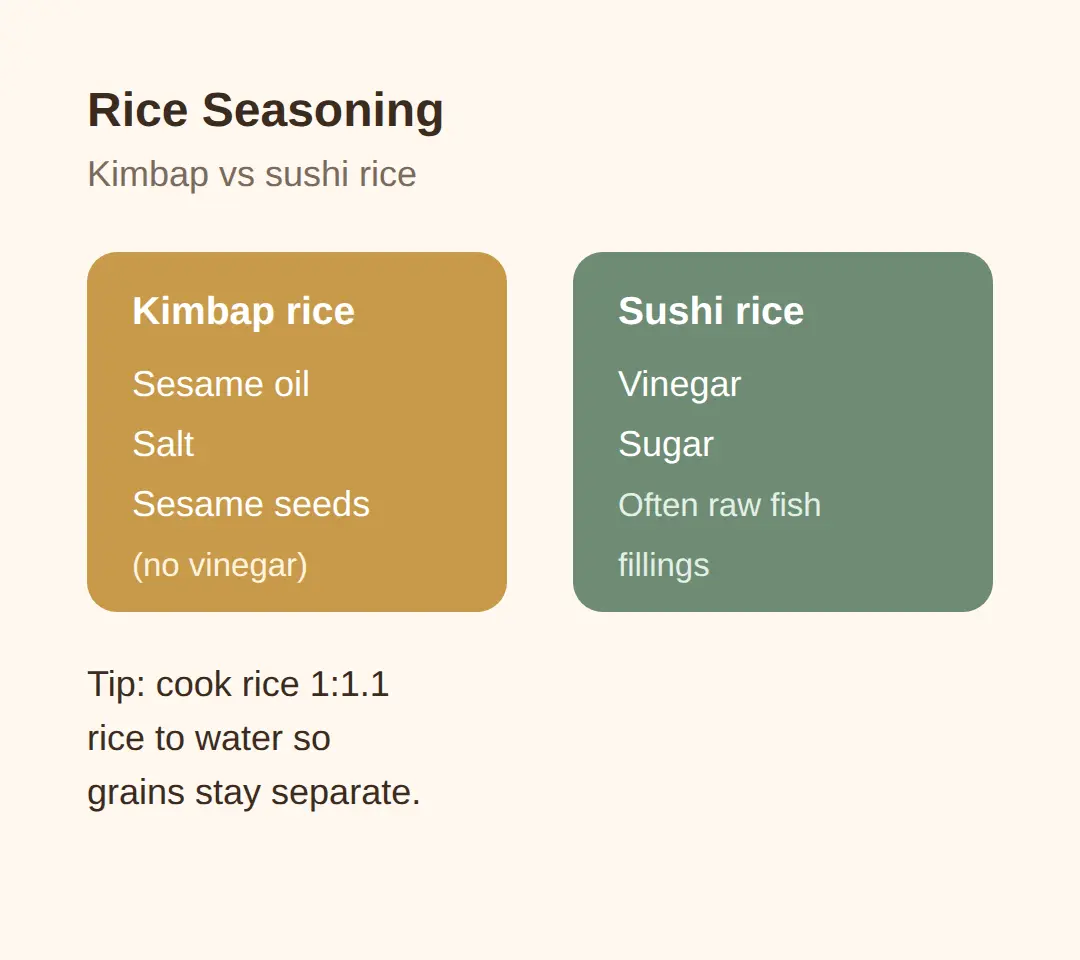
Sesame oil and salt season the rice — vinegar never goes in
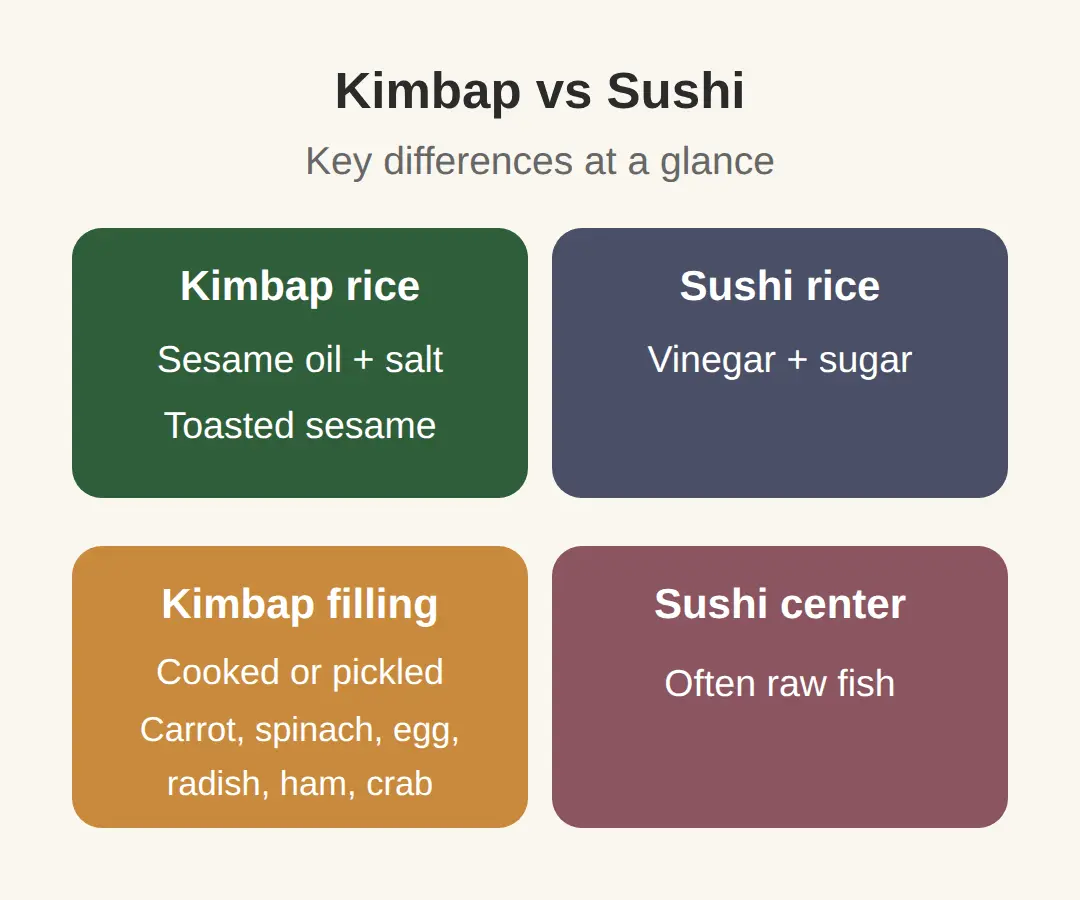
Kimbap rice is seasoned with sesame oil and salt (plus toasted sesame seeds); sushi rice uses vinegar and sugar — so no, kimbap rice does not need vinegar.
Cook the rice with slightly less water than usual, at about a 1:1.1 rice-to-water ratio, so the grains stay separate instead of mushing when you roll.
Some easy recipes do add a small splash of rice vinegar to the seasoning, and that drifts toward sushi-style; traditional versions skip it.
If you want kimbap that tastes like the store-bought kind in Korea, keep it to sesame oil, salt, and sesame seeds.
Roll Kimbap Without a Bamboo Mat: 6 Steps
A bamboo mat is optional — plastic wrap or your hands directly on the seaweed works fine for easy versions.
- Lay one half sheet of gim shiny-side down on a dry board or a sheet of plastic wrap.
- Spread about 70–80 g of seasoned rice over the lower two-thirds of the sheet in a thin layer.
- Line the fillings across the middle — carrot, spinach, danmuji, egg strips, one protein — in a single row.
- Roll tightly away from you, lifting the near edge over the fillings and pressing as you go.
- Seal the edge with a few grains of rice or a brush of sesame oil, then rest the roll seam-side down for a minute.
- Brush the finished rolls with sesame oil, sprinkle sesame seeds, and cut with a knife wiped with a damp or lightly oiled towel between slices.
Two prep details decide whether the roll holds: blanch the spinach about 30 seconds and squeeze the water out, and salt and squeeze cucumber the same way so excess water does not make the roll soggy.
If your fillings leak water or the seaweed feels chewy, fix those before rolling anything.
Steps at a glance
-
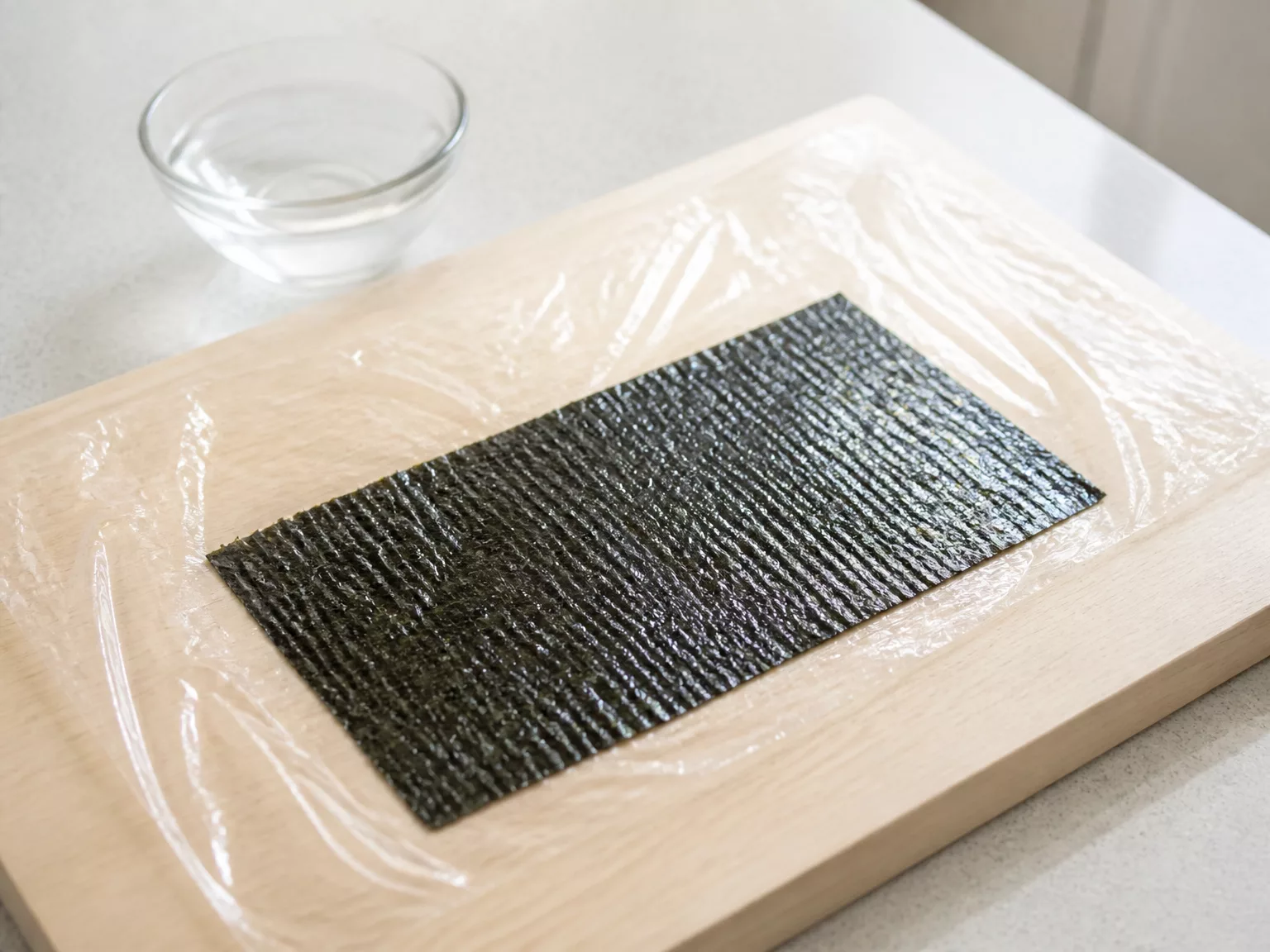 AI-generated photo
What it should look like — AI-generated image of this step, made from the recipe text — not a photo of our kitchen. 1Lay one half sheet of gim shiny-side down on a dry board or a sheet… -
2Spread about 70–80 g of seasoned rice over the lower two-thirds of…
-
3Line the fillings across the middle
-
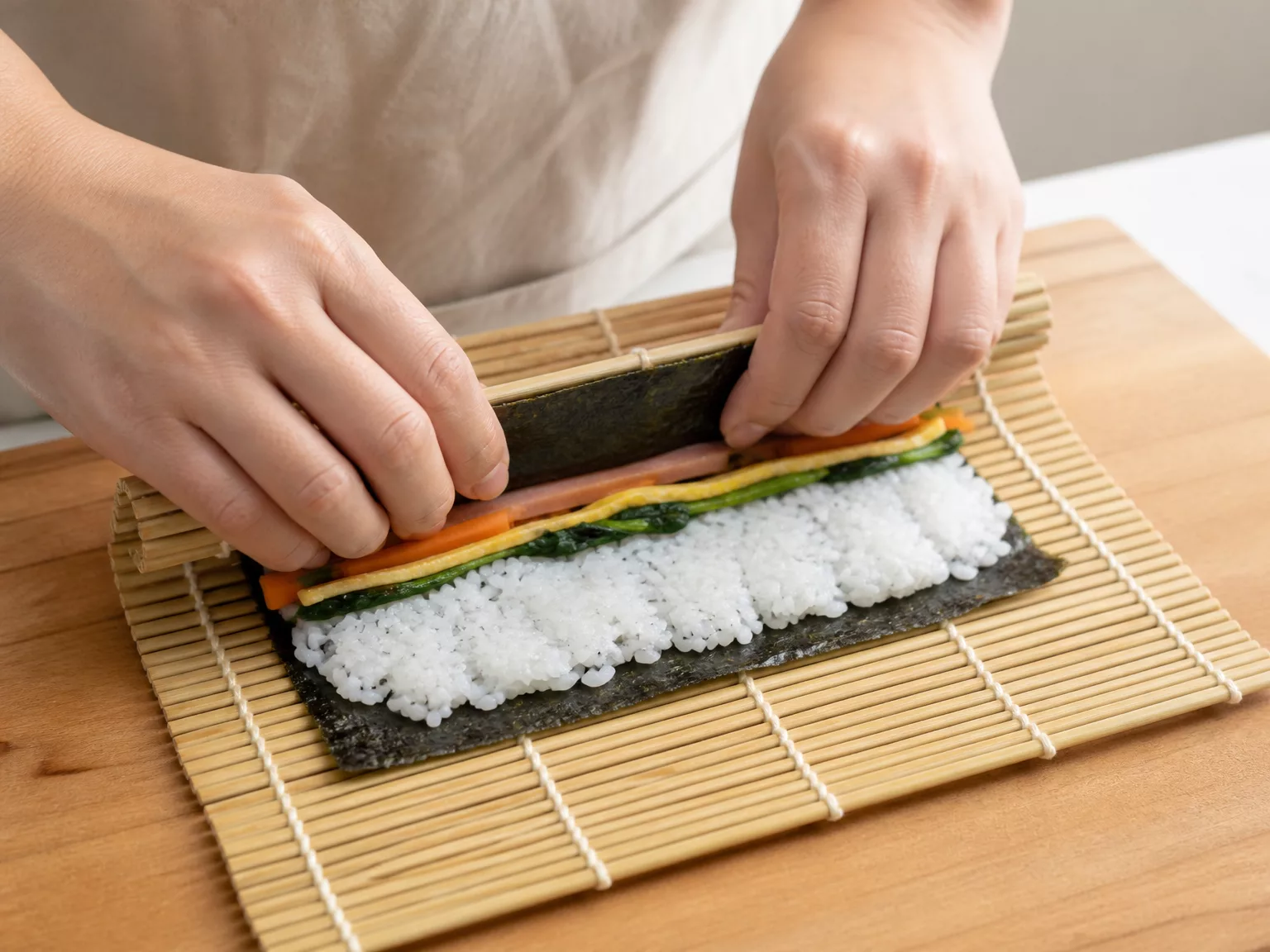 AI-generated photo
What it should look like — AI-generated image of this step, made from the recipe text — not a photo of our kitchen. 4Roll tightly away from you, lifting the near edge over the fillings… -
5Seal the edge with a few grains of rice or a brush of sesame oil,…
-
6Brush the finished rolls with sesame oil, sprinkle sesame seeds, and…
Substitutes for Danmuji and Other Fillings Abroad
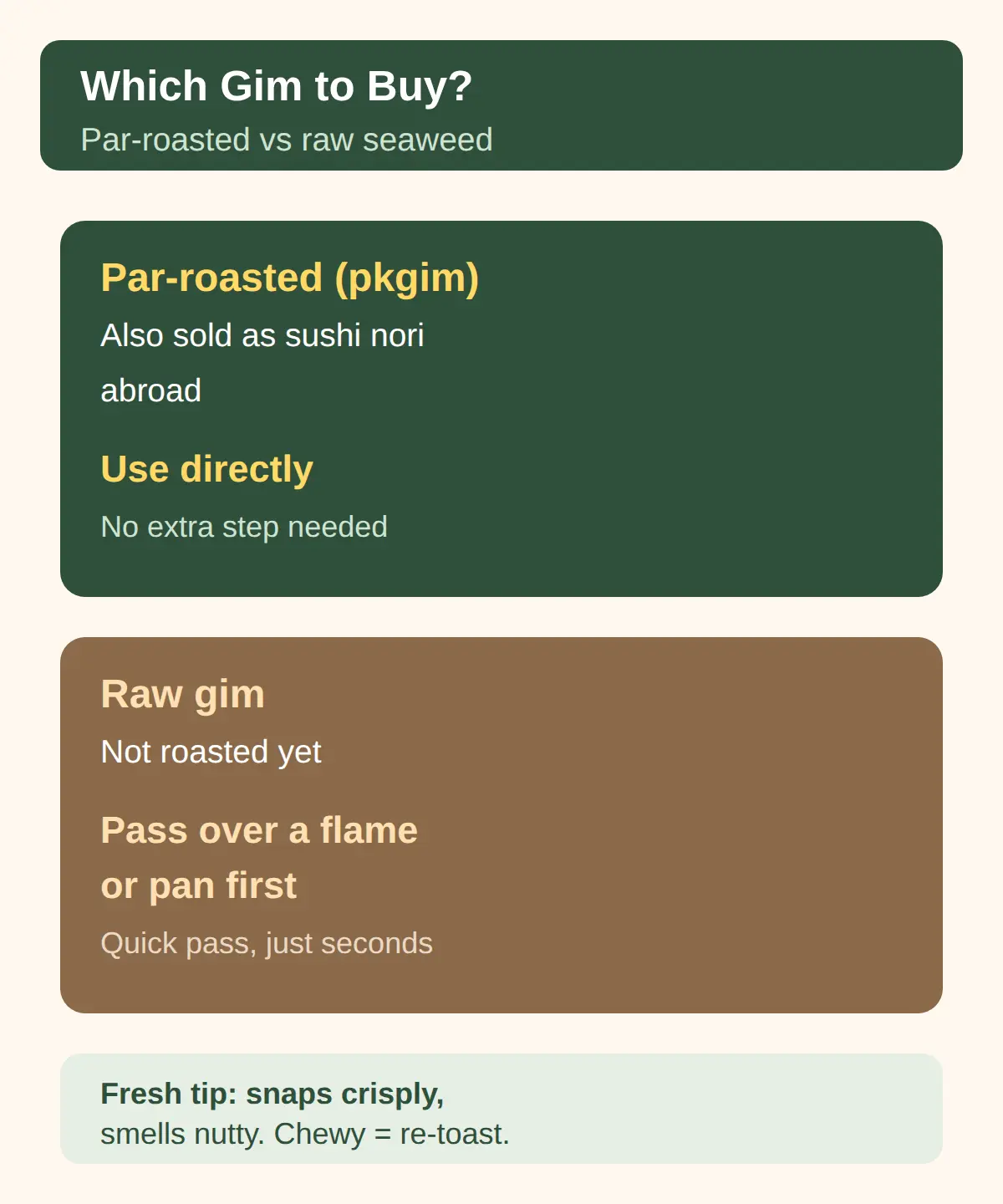
Pickled radish (danmuji) can be replaced with dill pickle, and perilla leaves with Swiss chard, when cooking kimbap outside Korea.
The dill pickle takes over the same job — sour, salty crunch in the middle — so the character of the roll stays close.
If Korean short-grain rice is unavailable, Calrose-type medium-grain rice is the closest workable substitute; rinse it well and keep the 1:1.1 water ratio.
Roasted gim, pickled radish, and sesame oil are all standard stock at Korean and Asian groceries abroad — danmuji is usually labeled pickled radish.
When the pickle aisle has neither, the roll still works without danmuji; just add a wetter, sharper element like the pickle instead of leaving the center dry.
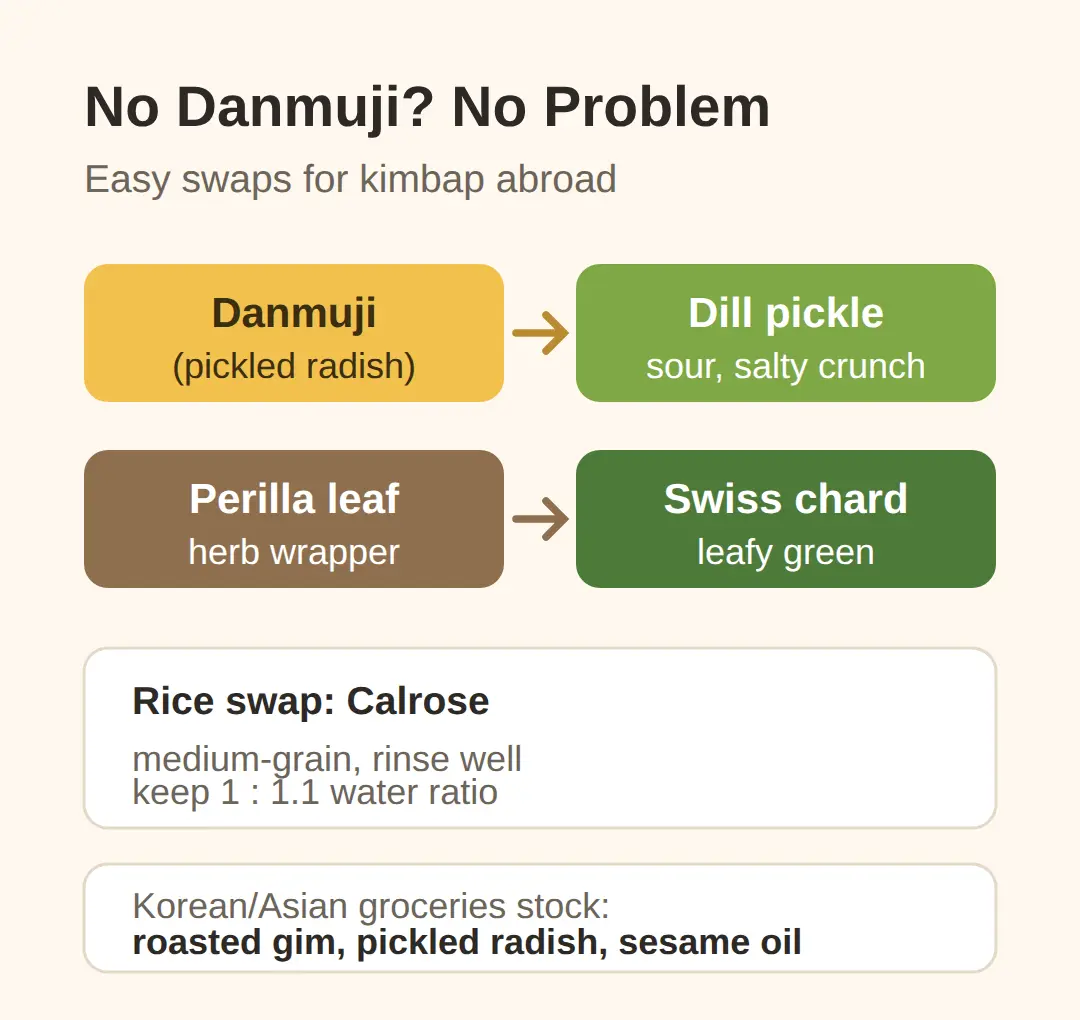
Which Gim to Buy and How to Tell It Is Fresh
Buy par-roasted seaweed (labeled pkgim in Korean shops, or sushi nori abroad) and use it directly; raw gim must be passed quickly over a flame or pan first.
Fresh roasted gim snaps crisply and smells nutty.
Chewy or stale-smelling sheets roll badly and tear — re-toast them 5 seconds per side over a flame or in a pan before using.
Shinier, oil-toasted gim also resists tearing better than plain-dried sheets.
If the package has been open for weeks, the 5-second re-toast is the difference between a roll that holds and one that cracks.
Variations, Storage, and Kimbap vs Sushi
Easy variations that are widely made: cheese kimbap, kimchi kimbap (stir-fried kimchi with a little pork or tuna), tuna-mayo, fish cake (eomuk) strips stir-fried with soy sauce and a little sugar, and a vegan version with tofu strips and plant-based mayo in place of egg and fish cake.
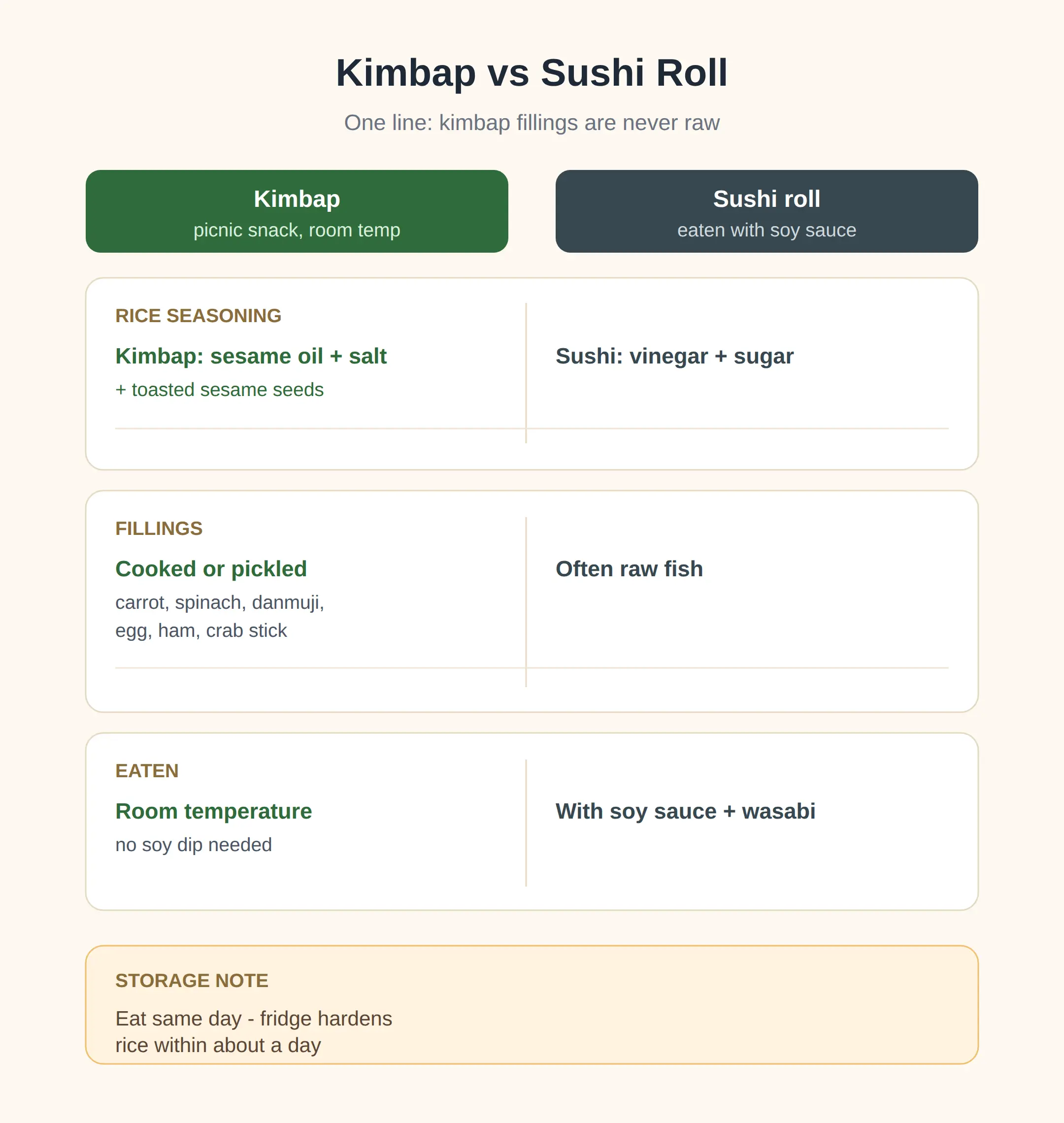
The one line that separates kimbap from sushi: kimbap fillings are always cooked or pickled — carrot, spinach, danmuji, egg, beef bulgogi, ham, imitation crab — while sushi centers are often raw fish.
| Kimbap | Sushi roll | |
|---|---|---|
| Rice seasoning | Sesame oil + salt (+ sesame seeds) | Vinegar + sugar |
| Fillings | Cooked or pickled, never raw | Often raw fish |
| Eaten | Room temperature, no soy dip needed | With soy sauce and wasabi |
Kimbap is served at room temperature as a picnic and travel snack, and 2–4 rolls per person is the standard light-meal serving, so one 8-roll batch serves 2–3.
Eat it the same day — refrigeration hardens the rice within about a day, so a fridge does not extend this roll, it shortens it.
If I were buying the seaweed today, I’d pick roasted gim labeled "sushi nori" at a Korean or Asian grocery, because it is pre-toasted and usable directly for kimbap without a pass over the flame.
What I check first on the package is whether it is oil-toasted gim, since the shinier sheets resist tearing while I roll.
Where to eat kimbap in Korea (김밥)
- Sooble Busan — Busan
- Jeonjuneunjeonju Jeonju — Jeonju
Restaurants from official tourism listings (city and national tourism organizations) that list kimbap as a signature dish — our guides to each, not a ranking.
Related posts
📎 📅 Upcoming Dates — Release & Event Calendar
Sources
- VisitKorea lists kimbap as a popular picnic/travel snack per (visitkorea.or.kr)
- Autocomplete anchor phrase confirmed as seed keyword (brief. (google.com)
- 1:1.1 ratio, rice slightly on the dry side (mykoreankitchen.com)
Three Things That Make or Break the Roll
- Check the gim first — it should snap crisply and smell nutty; re-toast stale sheets 5 seconds per side.
- Squeeze the water out of spinach and salt-and-squeeze cucumber before rolling; wet fillings make soggy rolls.
- Wipe the knife with a damp or lightly oiled towel between cuts so slices stay round instead of squished.
FAQ
Q. How much rice and gim do I need for 8 rolls of kimbap?
A common easy batch uses 2 cups (uncooked measure) of short-grain rice and 4 sheets of roasted gim cut in half — 0.25 cup of rice and about 70–80 g of seasoned rice per half sheet.
Q. Does kimbap rice need vinegar like sushi rice?
No. Kimbap rice is seasoned with sesame oil and salt; vinegar plus sugar is the sushi-style seasoning, and traditional kimbap skips it.
Q. What can I substitute for danmuji (pickled radish)?
Dill pickle is the working substitute — it fills the same sour-salty crunch role. Perilla leaves swap for Swiss chard when those are what you can find.
Q. Can I make kimbap without a bamboo mat?
Yes. Lay a half sheet on plastic wrap or roll directly with your hands; spread rice on the lower two-thirds, roll tightly away from you, and seal the edge with rice grains or sesame oil.
Make the batch the morning of a picnic, not the night before — the rice is at its best within the day.
Cover photo: Top-down view of kimbap rolls arranged around a small bowl of soy sauce topped with sesame seeds, with iced milk tea and chopsticks on a dark wooden table. by Tilak Bahadur Karki — CC0 1.0
#kimbaprecipeeasy #kimbapwithoutbamboomat #kimbapvssushi #danmujisubstitute #koreanfood101
📅Upcoming Schedule — this week 3 · D-1 documentary 'Always Lalisa' global theatrical release (Oct 1See all →Last updated 2026-10-10. Editorial policy