One-line answer: Sing 30–60 minutes a day (a fixed 20-minute block works if you keep it daily), take 2–3 vocal lessons a week, and build pitch accuracy to half-semitone level first, per Studio Nol’s idol vocal guide.
K-pop judges vocals on four things, and pitch sits at a stricter standard than other genres — being off by half of a semitone becomes audible when chorus layers stack on top of each other.
This post gives the daily routine, the sing-while-dancing method, the song-range rule, the studio cover session flow, and the 12-month training plan.
figure: figures/kpop-vocal-routine.svg
Contents
- How to get better at singing K-pop: what to train first
- The 20-minute daily routine
- How do I practice singing while dancing without losing breath?
- How do I choose a K-pop song that fits my range?
- Recording a cover: studio session flow
- Coach, lessons, and the 12-month roadmap
How to get better at singing K-pop: what to train first
Improve on four fronts at once: technical completion (pitch to half-semitone level, rhythm at 8th/16th-note precision, consistent tone), singing while performing, group harmony, and recording vocals.
K-pop demands higher pitch accuracy than other genres — being off by half of a semitone becomes audible in stacked chorus layers, and the goal is to sing accurately before relying on Auto-Tune (Studio Nol idol vocal guide).
Rhythm is judged at the level of 8th and 16th notes, so timing is as trainable and as checked as the notes themselves.
On top of that sit three more judged skills: holding pitch right after jumps and turns, unison and 2–3 part harmonies, and recording clean vocal tracks.
If you only practice one thing, practice pitch against the original track; if you have time for a second, practice rhythm by singing along to a metronome or the song’s drum line.
quote: K-pop demands higher pitch accuracy than other genres — being off by half of a semitone becomes audible in stacked chorus layers, and the goal is to sing accurately before relying on Auto-Tune (Studio Nol idol vocal guide).
| Daily singing practice | 30 minutes to 1 hour; a fixed 20-minute block is acceptable for beginners if kept daily |
|---|---|
| Vocal lessons | 2–3 per week with an external coach, sustained at 2+ weekly |
| First studio recording | 3–6 months after starting training |
| First-year goal | 3–5 songs of one genre performance-ready (Phase 1), 2–3 studio tracks (Phase 2) |
The 20-minute daily routine
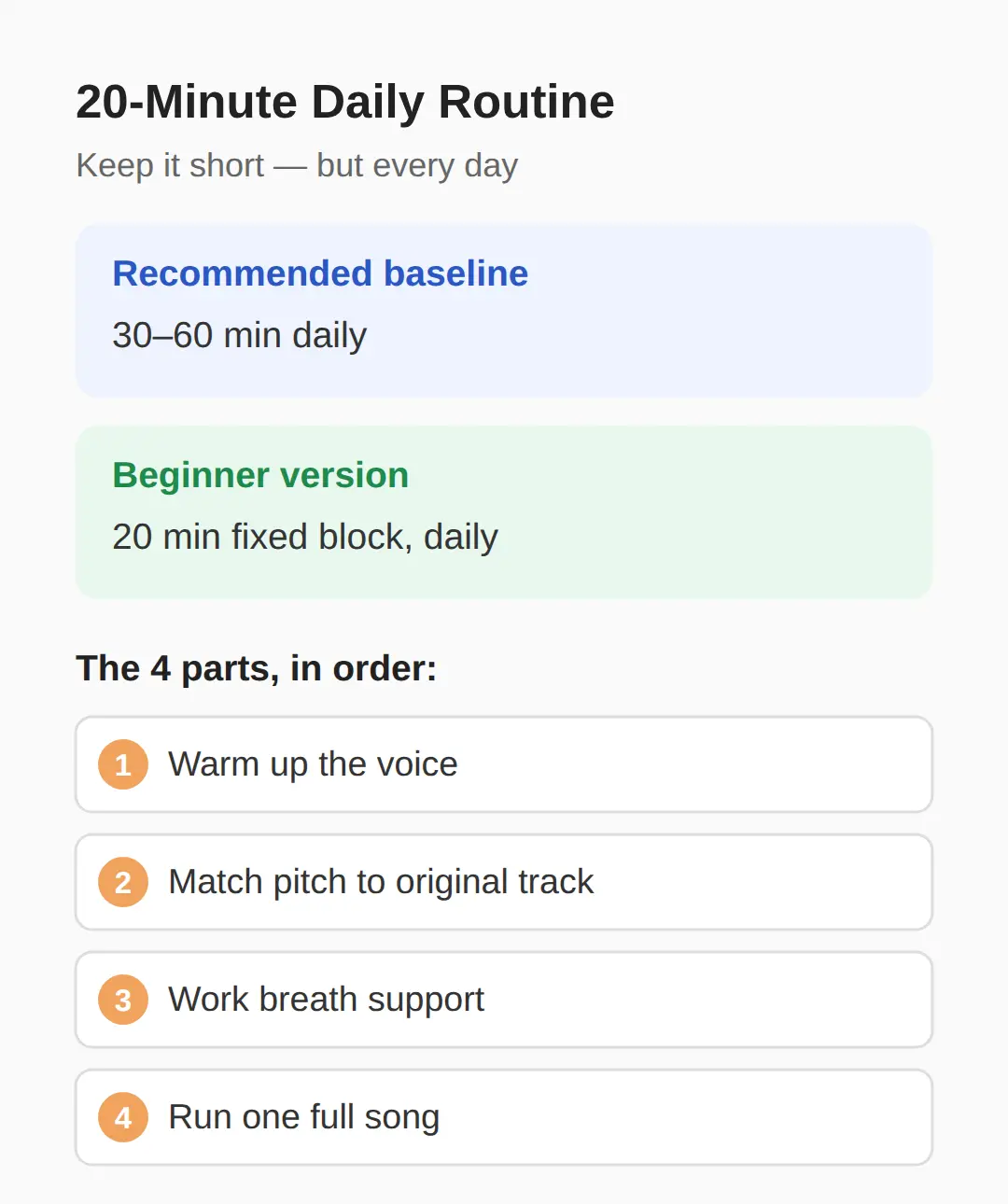
Sing every day: 30–60 minutes is the recommended baseline for aspiring singers, and a fixed 20-minute block works for beginners if you keep it consistent.
Each part below uses components confirmed in the studio guide — warm-up, pitch matching, breath support, and a song run-through — though no published standard fixes their order.
- Warm up the voice — a few minutes of light vocalizing before singing is a standard preparation item on the day you sing.
- Match pitch against the original track — this is where half-semitone accuracy is actually trained.
- Work breath support — keep the core engaged so the breath does not waver on fast or long lines.
- Run through one full song — start-to-finish, with the lyrics fully memorized.
If 20 minutes is all you have, protect that block daily rather than saving up for one long weekend session.
quote: 30 minutes to 1 hour of daily practice is the baseline routine recommended for aspiring singers; beginners building a habit can start with a shorter fixed daily block (e.g., 20 minutes) as long as it is consistent.
How do I practice singing while dancing without losing breath?
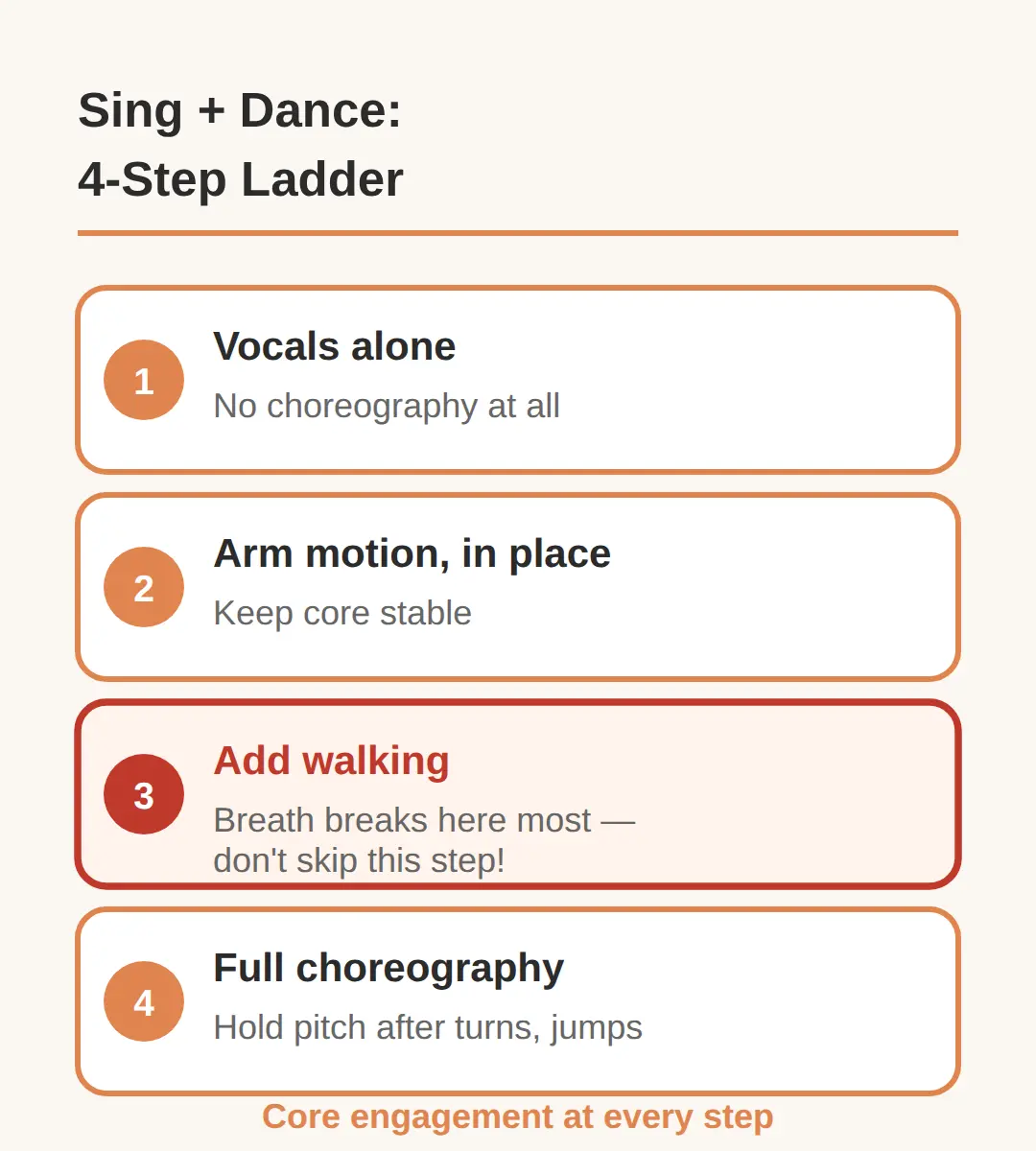
Use the 4-step integration method: vocals alone → arm movements in place → walking → full choreography.
- Complete the vocals alone, with no choreography at all.
- Add arm and upper-body movements in place while keeping the core stable.
- Add walking while singing, specifically managing your breath when your steps change.
- Move to full choreography, holding pitch right after intense sections, turns, and jumps.
The through-line of all four steps is core engagement — it is what keeps the breath from wavering as movement gets bigger.
If you are preparing a dance cover video, do not skip step 3 — most breath breaks happen when steps change, not during the biggest movements.
quote: Keep the core engaged so breath does not waver when adding arm/upper-body motion; progress from vocals alone → in-place motion → walking → full choreography.
How do I choose a K-pop song that fits my range?
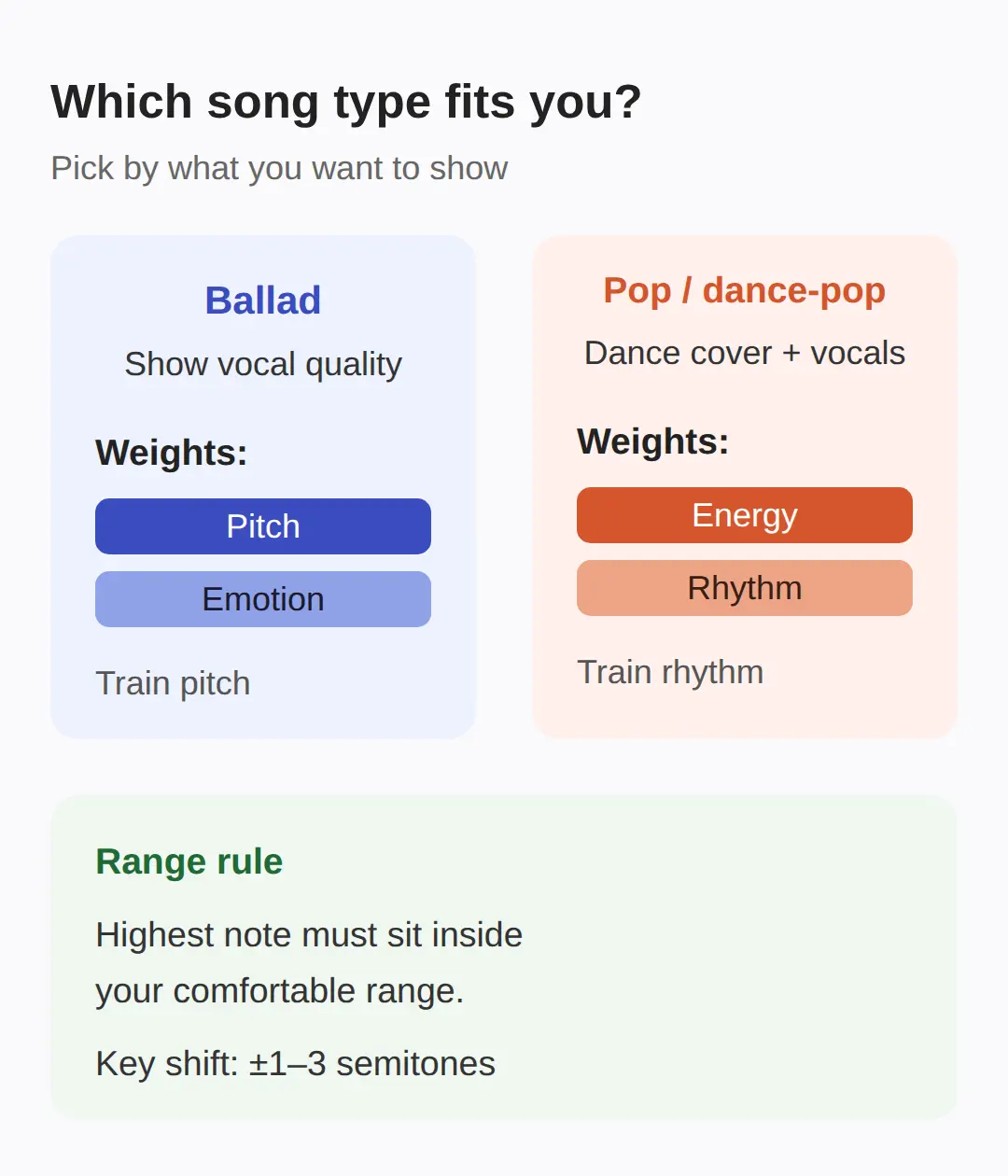
Pick a song whose highest note sits inside your comfortable range, and adjust the key by ±1–3 semitones from the original.
| Rule | Detail |
|---|---|
| Vocal range | Highest note must sit inside your comfortable range — a highest note that is too high backfires |
| Key | Adjustable ±1–3 semitones from the original |
| Ballad | Judged on pitch and emotion |
| Pop / dance-pop | Judged on energy and rhythm |
Two more conditions from the audition checklist: memorize the lyrics completely without paper, and plan your impact in the first 10 seconds plus a memorable final syllable.
If your goal is a dance cover with live vocals, pick a dance-pop track and train rhythm; if you want to show vocal quality, pick a ballad and train pitch.
quote: Choose songs in your comfortable vocal range — a highest note that is too high backfires; adjust the song key by ±1–3 semitones from the original to fit your voice.
Recording a cover: studio session flow
A first studio cover session runs in this order: arrive → hand the MR file (WAV or MP3) to the engineer → confirm key and tempo → warm up 5–10 minutes with monitor headphones → record takes → select the final take → optionally mix and master.
Record dry — no reverb or delay on your voice in the booth.
Reverb and delay are added later by the producer, and a ‘wet’ recording cannot be reversed.
Pop vocal recording uses a close mic at 20–25 cm with input levels kept in the −18 to −12 dBFS range; reverb and delay are added later by the producer and cannot be undone if you sing ‘wet’ in the booth.
Book this first session 3–6 months after starting vocal training: the playback reveals habits that are not audible in a practice room, and it sets the direction for the next six months of practice.
If your MR file is in MP3 only, ask the studio in advance whether that works, since WAV is the standard hand-off format.
quote: Pop vocal recording uses a close mic at 20–25 cm with input levels kept in the -18 to -12 dBFS range.
Coach, lessons, and the 12-month roadmap
Take 2–3 vocal lessons per week with an external coach, practice 30–60 minutes daily, aim for 3–5 performance-ready songs by month 6, and plan your first studio recording between months 3 and 6.
Self-study is possible, but an external coach’s immediate feedback is the most effective way to correct bad habits, so sustained lessons at least twice a week are recommended.
On those numbers, 2–3 lessons/week plus 30–60 minutes daily works out to about 3.5–7 hours of practice per week and 8–12 lessons a month (calculated, not quoted from a source).
Phase 2 is portfolio building: record 2–3 studio tracks, take high-resolution profile photos, and open Instagram and YouTube channels.
When I look at a vocal routine, I first check what I can actually do from outside Korea: a fixed daily block, a song in my range, and an MR file I can bring to a studio.
If I had 20 minutes, I would spend it on pitch matching against the original track first — K-pop shows even half a semitone off in stacked chorus layers, so accuracy before anything else.
quote: 2–3 vocal lessons per week with an external coach; sustained lessons at least 2x weekly are recommended over self-study.
Related posts
Sources
- 4-step integration method (vocals alone → upper-body → walki (studionol.co.kr)
- Phase 1 (0-6 months lessons + daily practice) and Phase 2 (6 (studionol.co.kr)
- Song selection, ±1-3 semitone key adjustment, MR file prep, (studionol.co.kr)
At a glance
- Daily practice: 30–60 min is the baseline; a fixed 20-minute block counts if you never skip it
- Lessons: 2–3 per week with a coach beats self-study for fixing bad habits
- Pitch standard: half a semitone off is audible in stacked chorus layers — accuracy before Auto-Tune
- Dance + vocals: progress vocals alone → arms in place → walking → full choreography
- Song choice: comfortable range, key adjustable ±1–3 semitones, lyrics fully memorized
FAQ
Q. How long does it take to get better at singing K-pop?
The published guide’s Phase 1 runs six months: 2–3 lessons a week plus 30–60 minutes of daily practice until 3–5 songs of one genre are performance-ready. Your first studio recording is timed 3–6 months in.
Q. How long does it take to hear objective feedback on my singing?
Plan your first studio session 3–6 months after you start training. The playback in the studio reveals habits you cannot hear in a practice room, and that feedback sets your practice direction for the next six months.
Q. How do I practice singing while dancing without losing breath?
Follow four steps: finish the vocals alone first, then add arm movements in place with your core engaged, then add walking while managing breath on step changes, and only then full choreography. Hold pitch right after intense sections, turns, and jumps.
Q. How do I choose a K-pop song that fits my range?
Choose a song whose highest note is inside your comfortable range, and shift the key by ±1–3 semitones from the original. Ballads are judged on pitch and emotion; pop and dance-pop on energy and rhythm.
Q. Do I need a vocal coach, or can I self-study?
Self-study is possible, but a coach’s immediate feedback is the most effective way to correct bad habits. The recommendation is sustained lessons at least twice a week.
Book your first studio session at the 3–6 month mark — the playback will tell you what to fix next.
Cover photo: Dynamic microphone recording studio — CC0 1.0
#kpopvocal #singingtips #coverrecording #vocalpractice #dancepractice
📅Upcoming Dates — 이번 주 32 · D-day Chuseok holiday period — rice cake interest peaks전체 보기 →