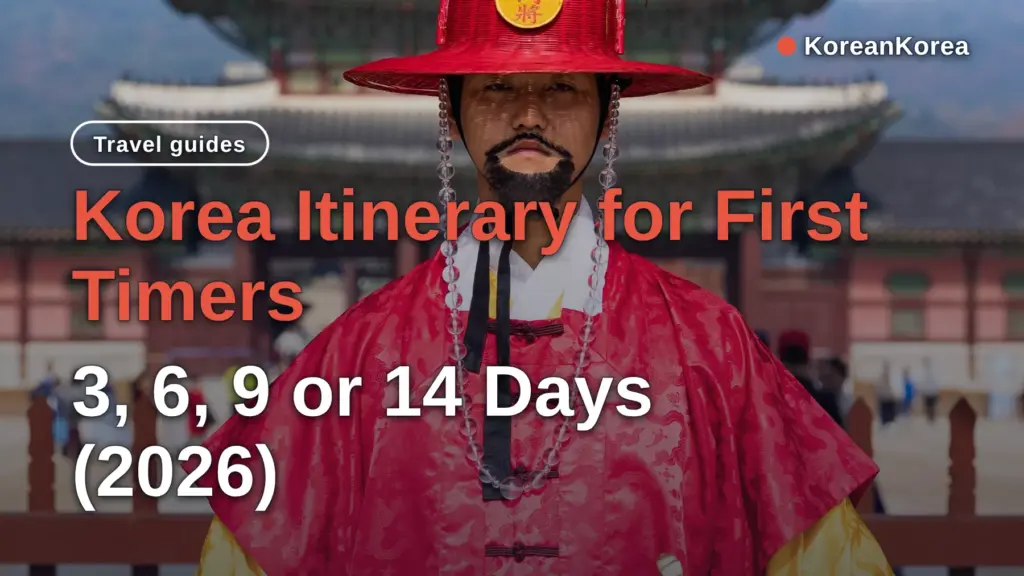
For a first trip to Korea, plan 6 to 9 days: the official 3-, 6-, 9- and 14-day itineraries from Korea’s tourism site give four ready lengths, and a week or more is what adds Jeju.
That length decides which cities fit — under 3 days you stay in Seoul, at 3–5 days you add one more city, and at 7 nights you can span Seoul, Gyeongju, Busan and Jeju.
This post walks through each length, a 5-day template with costs, what to book before you fly, getting around, and when to go.
Key facts — As of 2026-11-22
- VISITKOREA publishes official 3-, 6-, 9- and 14-day itineraries for first-time foreign visitors, and its guidance says a week or more is what unlocks Jeju (read 2026-11-22).
- KTX Seoul–Busan takes about 2h30m and standard class was about 54,400 KRW in 2026 — a second-hand figure to re-verify against Korail at booking time.
- As of November 2026, Google Maps still does not provide walking or driving directions in Korea, so first-timers use Naver Map or KakaoMap instead.
Korea Itinerary for First Timers: How Many Days Do You Need?
| 1–2 days | Seoul only — a second city costs about half a day door-to-door |
|---|---|
| 3–5 days | Seoul + Busan, Gyeongju or Gangneung |
| 6–7 days | About 3 days Seoul + Gyeongju or Busan |
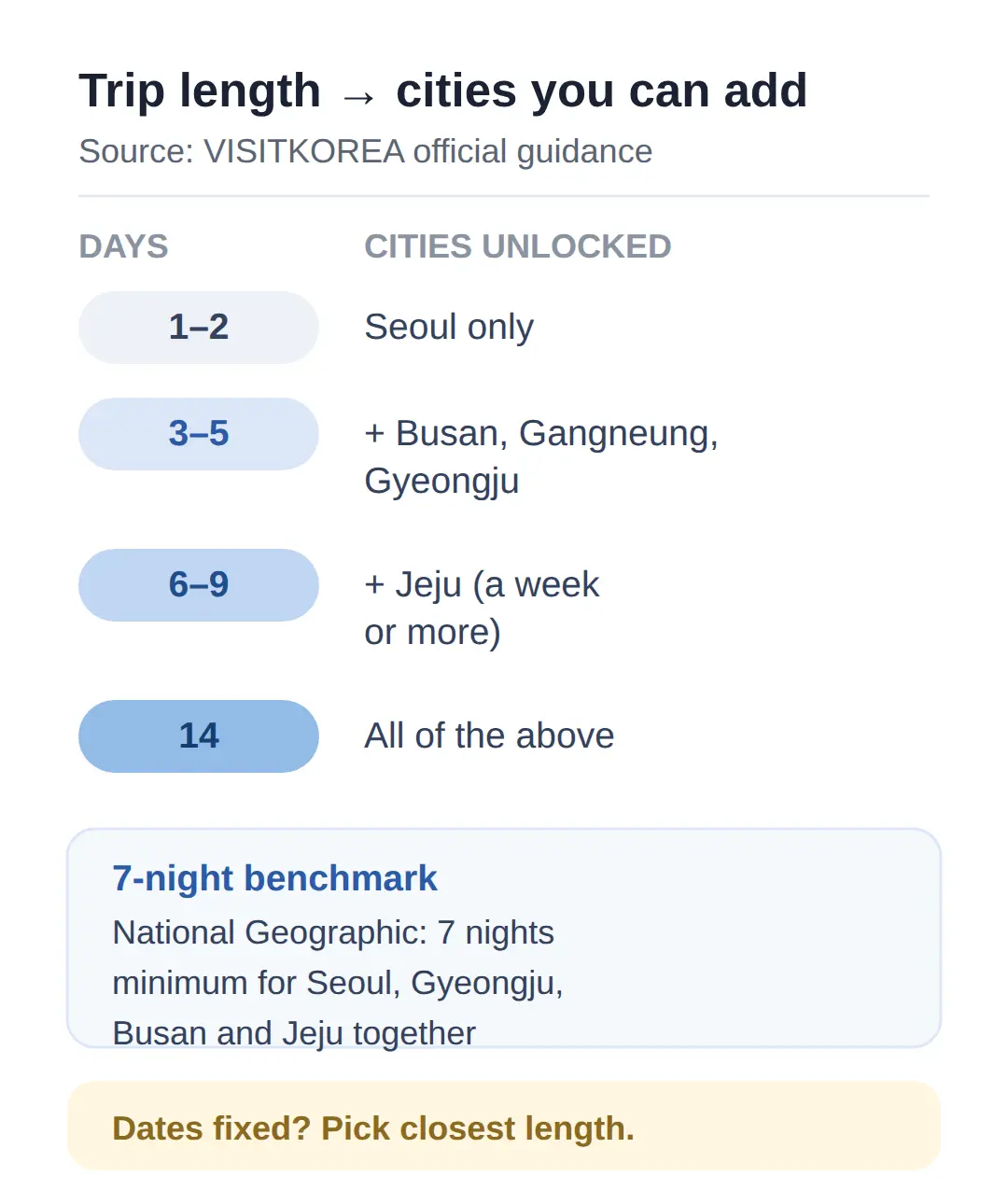
Six to nine days covers a first visit, and Korea’s tourism site (VISITKOREA) publishes official 3-, 6-, 9- and 14-day itineraries for first-time foreign visitors.
Its own guidance says 1–2 days is a Seoul-only trip, 3–5 days can add Busan, Gangneung or Gyeongju, and a week or more is what unlocks Jeju.
A one-week benchmark from National Geographic puts the minimum for Seoul, Gyeongju, Busan and Jeju at seven nights.
So the four official lengths are real trip shapes, not marketing tiers.
If your dates are fixed, pick the closest official length and read the matching city row below.
Next for you
Also read: Xem Phim the Remarried Empress: 0 Episodes to Watch, 100+ to Read · Phim Hoang Hau Tai Hon: No Drama yet — Webtoon, 187 Episodes
Which Cities Fit Each Trip Length
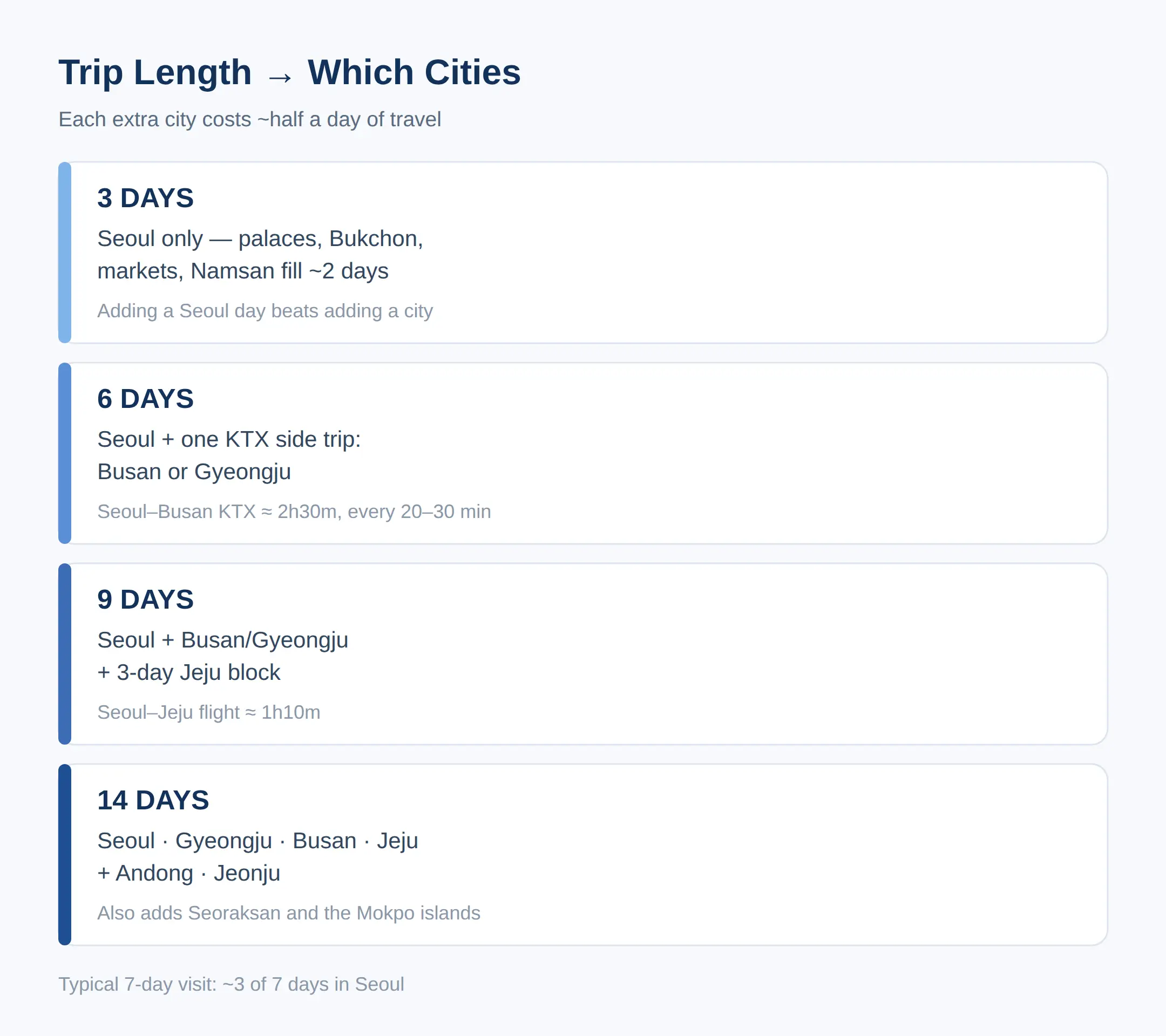
The city list grows with days, not evenly — each extra city costs about half a day of door-to-door travel.
KTX Seoul–Busan takes about 2h30m and trains leave roughly every 20–30 minutes, so a second city is easy but never free.
On short trips, adding a Seoul day beats adding a city: Seoul’s core sights (palaces, Bukchon, markets, Namsan) fill about 2 days on their own.
On a typical 7-day first visit, about 3 of 7 days stay in Seoul, with Gyeongju or Busan and Jeju sharing the rest.
With 9 days, the VISITKOREA guidance is that a week or more unlocks Jeju, so you have room to add a Jeju block even mid-trip.
With 14 days, the 7-night core of Seoul, Gyeongju, Busan and Jeju is joined by Seoraksan and the Mokpo islands.
The 5-Day First-Timer Template: Seoul Plus One More City
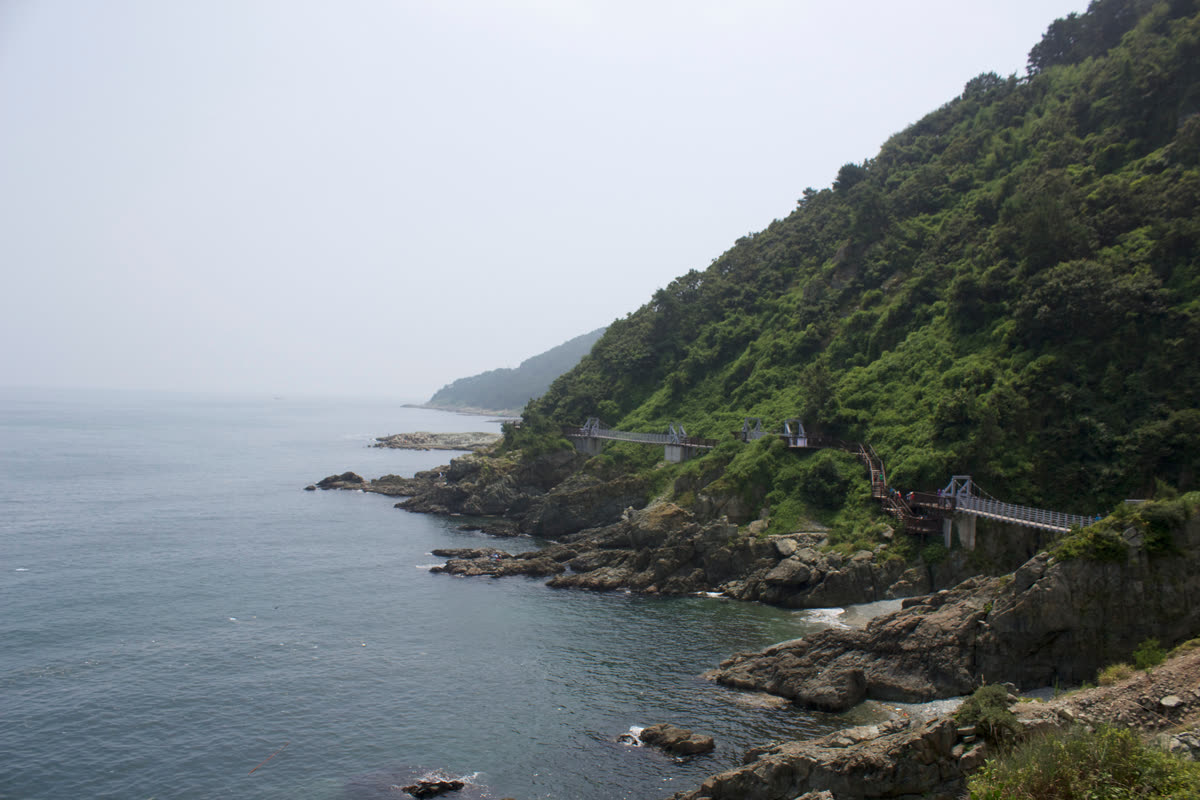
The standard 5-day split is 2 days Seoul, 1 day for a DMZ or Nami Island day trip, 1.5 days in Busan, with travel in between.
- Days 1–2: Seoul — palaces, Bukchon, markets, Namsan.
- Day 3: DMZ group tour, or ITX to Gapyeong for Nami Island (about 1 hour from Yongsan or Cheongnyangni).
- Day 4 morning: KTX to Busan, leaving by 9am to start Busan by noon — standard class was about ₩54,400 in 2026.
- Day 4–5: Busan Station, Seomyeon or Haeundae as base; Haeundae beach is quiet outside July–August.
A mid-range 5-day budget runs about ₩800,000–1,100,000 per person excluding flights, and a guesthouse-plus-market-food version lands around ₩500,000.
Korean hotels price per room, not per person, so solo travelers pay the full rate — that changes the budget math.
A tip that saves half a day: book an open-jaw flight — into Seoul, out of Busan — so you ride KTX once instead of doing a round trip.
What to Book Before You Fly
Book KTX weekend and holiday seats first, then JSA/Panmunjom DMZ tours — those sell out earliest, and most DMZ tours skip Mondays.
Group DMZ tours ran about ₩65,000–100,000 in 2026, and passport checks are mandatory on the day.
The first thing I check before locking any Seoul plan is which palace closes which day — Gyeongbokgung closes Tuesdays and Changdeokgung closes Mondays, so that decides which palace falls on which of my first three days.
Gyeongbokgung entry is about ₩3,000 (hanbok rental gets you free entry), and the Changdeokgung plus Rear Garden combo is about ₩15,000.
Changdeokgung garden tours sell out in spring and autumn, so book those online ahead.
One more pre-departure item: K-ETA and the e-Arrival Card are separate documents, and even if K-ETA is temporarily waived for your passport, the e-Arrival Card still must be submitted near departure.
Getting In and Getting Around
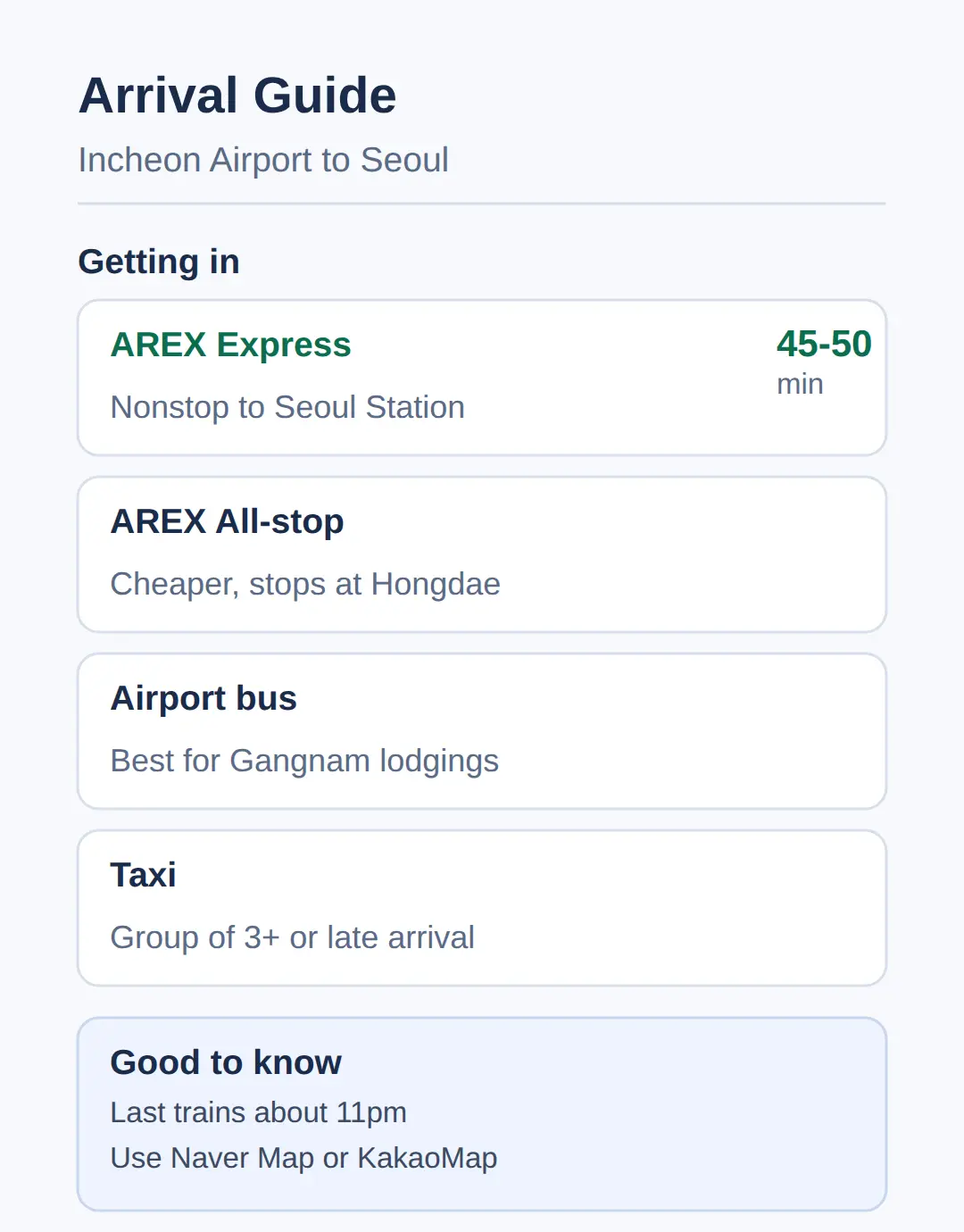
From Incheon Airport, the AREX express train is the fastest way into Seoul at about 45–50 minutes nonstop to Seoul Station, with a cheaper all-stop train that stops at Hongdae.
An airport bus goes direct to near your lodging and works best for Gangnam; take a taxi from the designated stands if you are three or more or arriving late at night.
Last trains run around 11pm and the express ends earlier, so count immigration plus baggage time before relying on the last train.
Buy a physical T-money card at an airport convenience store or subway station, top it up with won cash, and tap on boarding and alighting on buses to get transfer discounts.
Foreign cards cannot be tapped at subway gates directly, so small cash still matters.
As of November 2026, Google Maps still does not provide walking or driving directions in Korea — use Naver Map or KakaoMap, which show walking routes, subway exits and live bus arrivals.
Install the Kakao T taxi app and log in before departure, because its verification text goes to your home-country number.
When to Go — and When Not To
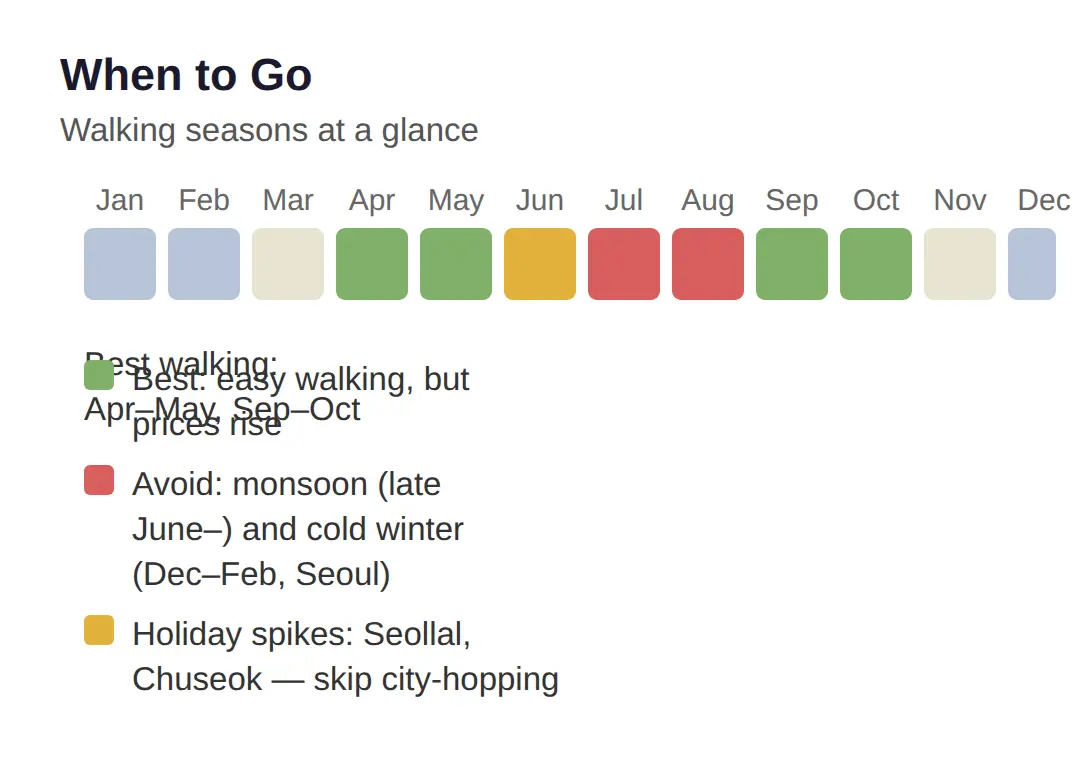
April–May and September–October are the easiest walking seasons, and fares and lodging rise in exactly those windows.
From late June the jangma monsoon brings humidity and frequent rain, and December–February in Seoul is cold — the worst windows for a walking-heavy first itinerary.
Cherry-blossom bloom dates shift every year, so a months-ahead itinerary cannot lock onto full bloom; shifting a trip a few days off peak blossom or foliage weekends lowers both price and crowding.
Avoid booking city-hopping during the Seollal and Chuseok holiday stretches, when intercity travel spikes and some shops close.
Winter trips can still work if you keep them to Seoul, Busan and palaces, but plan more indoor days and keep any Jeju block flexible.
If your only free window is winter or monsoon, plan more indoor days in Seoul and keep Jeju flexible or skip it.
Before anything else I check which palace is closed on which day — Gyeongbokgung shuts Tuesdays and Changdeokgung Mondays — and match that against days 1–3 of my itinerary.
My own rule: I’d rather travel shoulder season and lose the blossoms than pay peak prices to fight weekend crowds at every stop.
👉 detailed 5-day Seoul itinerary
👉 official VISITKOREA 3/6/9/14-day plans
👉 VISITKOREA trip-length guidance
👉 first-time-in-Korea practical guide (maps, T-money, arrivals)
👉 National Geographic: seven nights, four anchors
Related posts
📎 Seoul — everything we know
📎 📅 Upcoming Dates — Release & Event Calendar
Sources
- VISITKOREA official 3/6/9/14-day plan page, NatGeo 7-night b (english.visitkorea.or.kr)
- Two weeks adds Seoraksan and Mokpo islands beyond the 7-nigh (nationalgeographic.com)
- Winter Jeju prone to wind/rain; keep flexible (english.visitkorea.or.kr)
If This Were Your First Trip
- Pick the closest official length — 3, 6, 9 or 14 days — then choose cities from the table, not the other way around.
- Under 5 days, stay in Seoul and take one day trip; each extra city costs about half a day of travel.
- Check palace closure days (Gyeongbokgung Tue, Changdeokgung Mon) before assigning days 1–3 in Seoul.
FAQ
Q. How many days do I need for a first trip to Korea?
Plan 6–9 days. VISITKOREA publishes official 3-, 6-, 9- and 14-day itineraries, and a week or more is what adds Jeju.
Q. Is 7 days enough for Seoul, Gyeongju, Busan and Jeju?
Seven nights is the minimum that covers all four, with about 3 of the 7 days kept in Seoul.
Q. Which cities go in a 6–7 day first-time Korea trip?
Keep about 3 days in Seoul and split the rest between Gyeongju or Busan; Gangneung also works at 5–6 days.
Dates worth putting on a calendar: the jangma monsoon starts from late June, cherry-blossom season runs through April, and Seollal and Chuseok concentrate intercity travel.
All figures in this post are as of November 2026.
Cover photo: Royal Guard at Gwanghwamun Gate, Gyeongbokgung, Seoul by Frank Schulenburg — CC BY-SA 4.0
#koreaitineraryfirsttime #koreatriphowmanydays #seoulbusanjejuitinerary #korea5dayitinerary #firsttimekoreaguide
📅Upcoming Schedule — this week 5 · D-4 MAMA 2026 ceremony (exact date/venue not yet confirmed in thSee all →Last updated 2026-11-23. Editorial policy