Female K-pop idols build their training around three things: Pilates, daily dance practice, and short bodyweight sessions.
For a home version, that comes out to 20–40 minutes a day — no gym and no weights required.
This page breaks down what idols have said they do, the 20-minute session structure, beginner sets and reps, and a weekly plan you can run from a mat.
The Kpop Idol Workout Routine Female Idols Actually Use
| Pilates (reformer at a studio) | Mat Pilates moves on the floor |
|---|---|
| Daily dance practice (1–3 hours) | 4–6 songs of dance cardio, ~25–35 min |
| Conditioning with a trainer | Bodyweight circuit, 12–15 min |
| Full prep day, 2–3 hours | One 20–40 minute session |
The three practices named again and again by female idols are Pilates, dance practice, and bodyweight work.
Jennie of BLACKPINK has cited flying yoga and Pilates across several interviews, and Lisa has described daily dance practice as her main exercise since her trainee days.
Winter of aespa has credited a progression from reformer Pilates to mat Pilates — the home version of that is mat moves only.
BLACKPINK members have also publicly described training blocks on most days, mixing dance practice with bodyweight and conditioning work.
A key number: the at-home versions of these sessions run 20–40 minutes, while a full trainee prep day — dance practice plus conditioning — runs 2–3 hours.
If a plan you see online takes two hours from day one, it is the studio version, not the home version.
The 20-Minute Home Session Structure
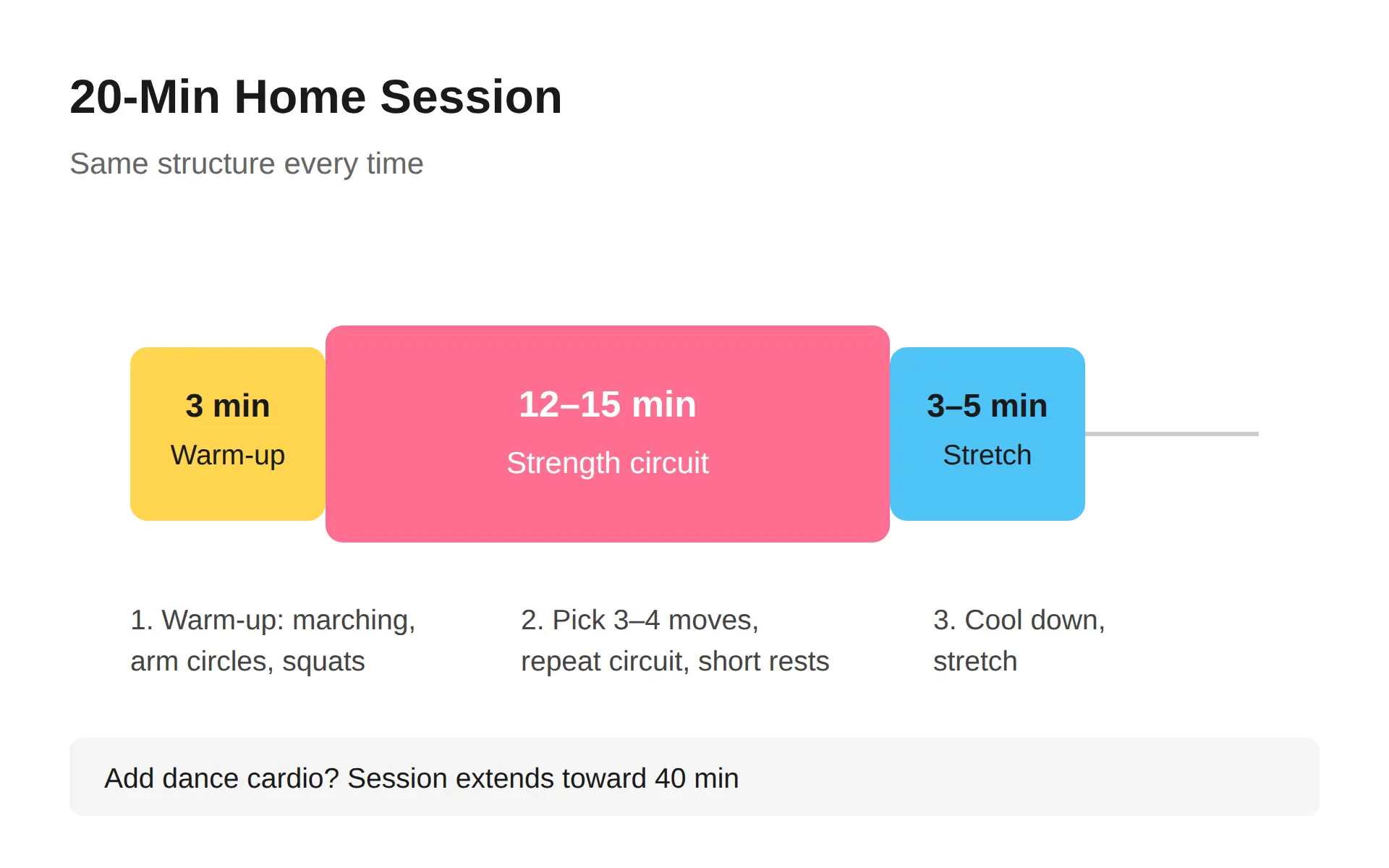
A 20-minute home version described on Korean fitness channels runs: 3 minutes warm-up, 12–15 minutes strength circuit, 3–5 minutes stretching, and Korean idol-trainer coverage pairs a 5-minute warm-up with a 5-minute cool-down around the strength block.
- Warm up for 3 minutes — marching in place, arm circles, easy squats.
- Run the strength circuit for 12–15 minutes, moving exercise to exercise with short rests.
- Stretch for 3–5 minutes to cool down.
Pick 3–4 moves per session and repeat the circuit, rather than loading ten moves into one round.
On the days you add dance cardio, the session stretches toward the 40-minute end of the range.
Sets, Reps and Rest for Beginners
The beginner standard for bodyweight strength work is 1–3 sets of 8–12 reps per move, resting 1–2 minutes between sets.
Standard guidance also puts resistance training at 2–3 days per week — that minimum already matches the structure idol-style plans use.
The moves that show up repeatedly in idol-style home coverage are squats, lunges, glute bridges, planks, side planks and jumping jacks.
Exact per-move counts that specific idol trainers give vary by source, so the counts above are the published beginner standards, not one idol’s personal numbers.
Progression is simple: add 1 set per exercise every 2 weeks before touching reps or tempo.
If you have only a mat, the plan works as written — a light resistance band is the listed optional upgrade, and no weights are required.
A Weekly Plan You Can Run at Home
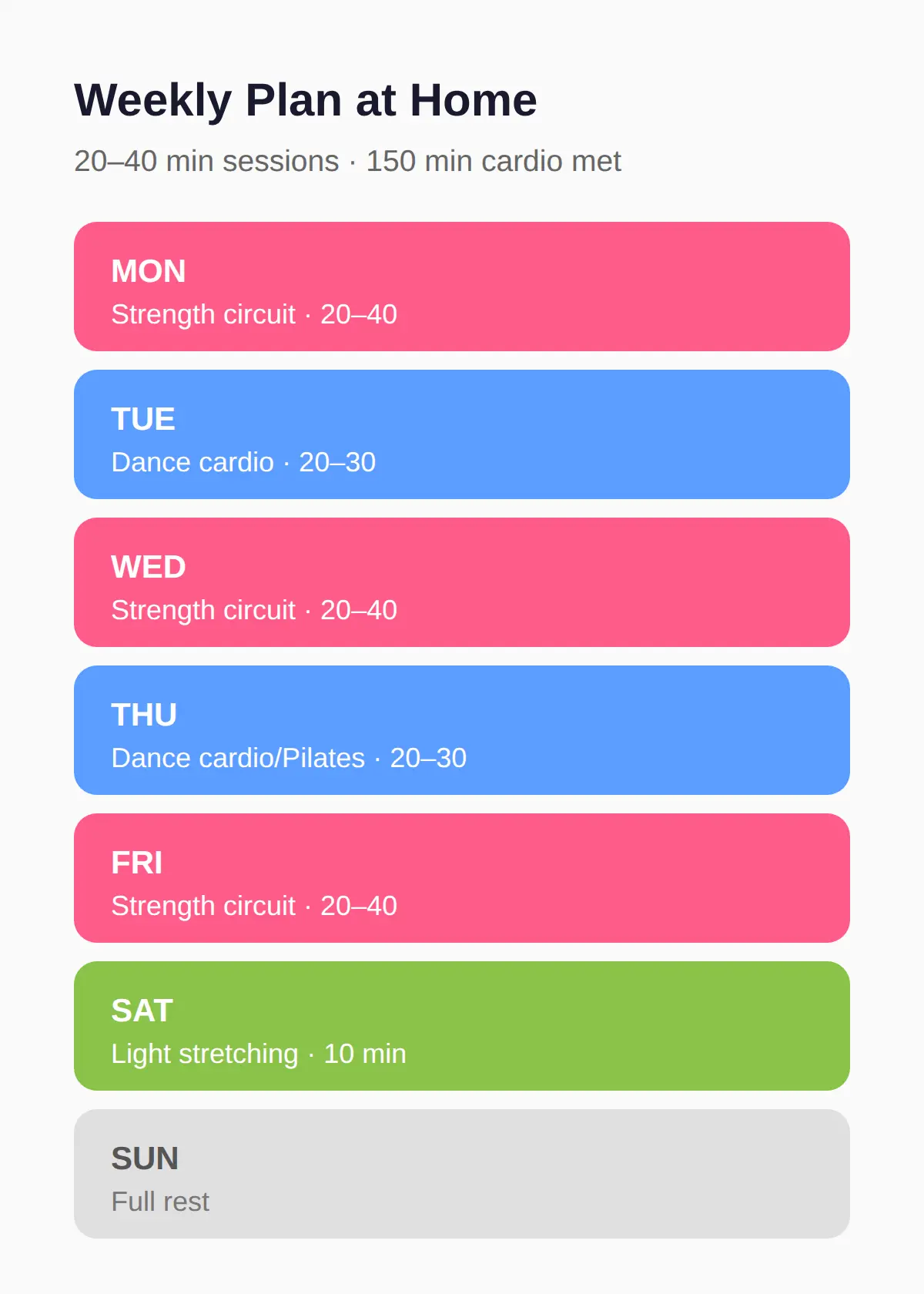
Run strength on Monday, Wednesday and Friday, dance cardio on Tuesday and Thursday, light stretching on Saturday, and a full rest day on Sunday.
It meets the standard 2–3 strength days a week, though with only two 20–30 minute dance-cardio sessions it falls short of the ACSM 150-minute weekly cardio target.
| Day | What to do | Length |
|---|---|---|
| Mon | Strength circuit (3–4 moves) | 20–40 min |
| Tue | Dance cardio | 20–30 min |
| Wed | Strength circuit | 20–40 min |
| Thu | Dance cardio or mat Pilates | 20–30 min |
| Fri | Strength circuit | 20–40 min |
| Sat | Light stretching only | 10 min |
| Sun | Full rest | — |
What I’d Watch Out For
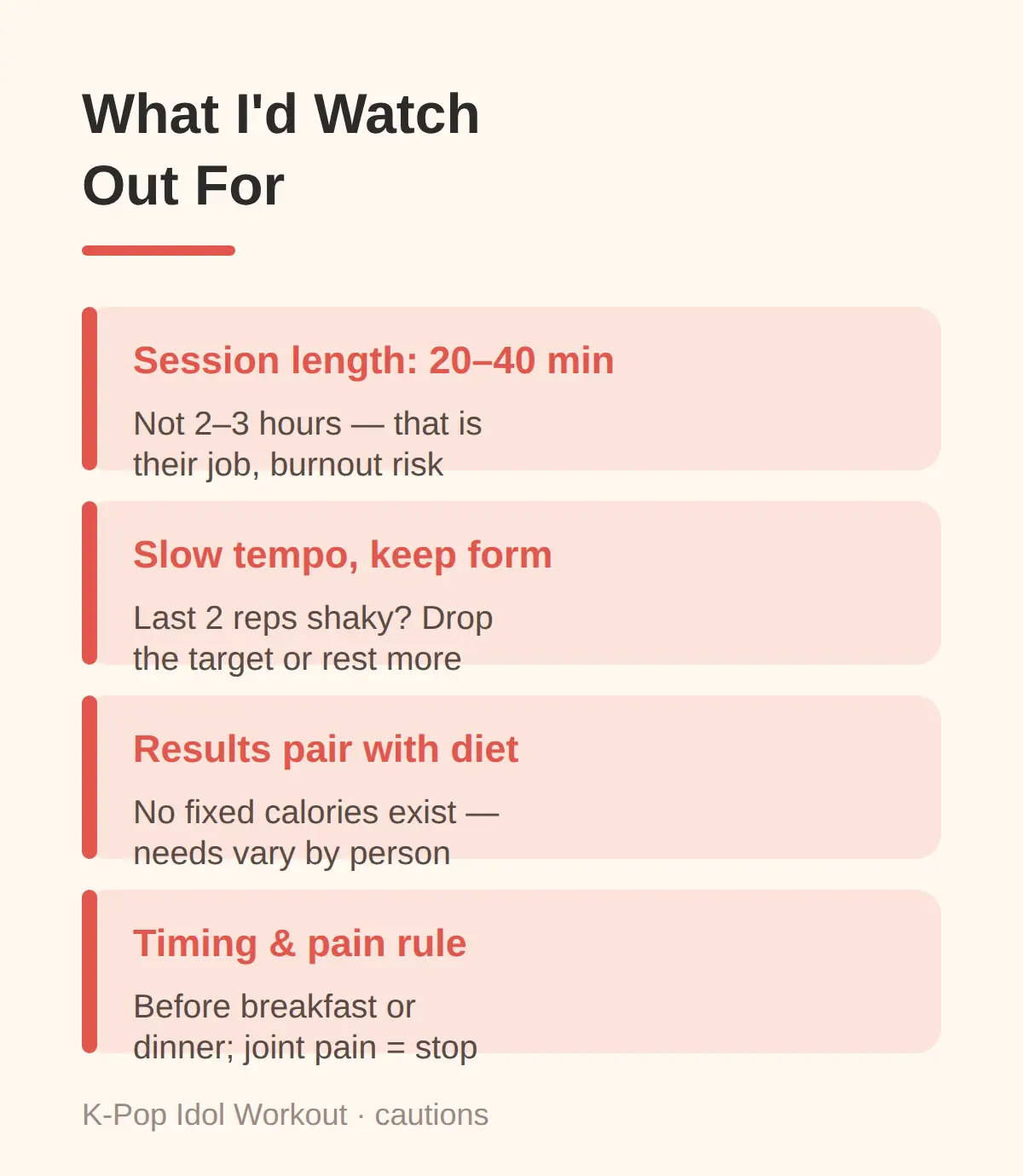
The number to respect is 20–40 minutes, not 2–3 hours.
Full idol prep sessions run 2–3 hours because dance practice is their job; copying that volume in week one is the fastest way to burn out or get hurt.
My second rule: keep the tempo slow enough that form holds through the last rep — if the last two reps of a set fall apart, drop the rep target or rest longer.
Third, the visible part is decided off the mat as much as on it; when I judge results from a routine like this, I read it together with what I eat, because no published idol plan I checked gave fixed calorie numbers — they vary by person.
Schedule the session before breakfast or before dinner rather than late at night, and stop the plan for the day if a move causes joint pain rather than muscle effort.
Related posts
📎 📅 Upcoming Dates — Release & Event Calendar
Sources
- typical_session_length (youtube.com)
- 150 min/week can be split into 20–30 min sessions (acsm.org)
- Competing Korean at-home routine plans reviewed for weekly a (youtube.com)
Three things to fix before you start
- Set the bar at 20–40 minutes a day — the 2–3 hour block is a trainee’s job, not a beginner’s plan.
- Write the three parts of every session in your calendar: 3 min warm-up, 12–15 min circuit, 3–5 min stretch.
- Add one set per exercise every 2 weeks, and not before — that is the whole progression rule.
FAQ
Q. Can I do a K-pop idol workout routine without equipment?
Yes — the minimal list used in these plans is an exercise mat plus an optional light resistance band, with no weights required.
Q. How long do K-pop idols work out per day?
The at-home versions of idol-style sessions run 20–40 minutes; a full trainee prep day, with dance practice and conditioning, runs 2–3 hours.
Q. How many days a week should I train on an idol-style plan?
2–3 strength days per week is the beginner standard, with dance cardio or Pilates on separate days and at least one full rest day.
Q. When should I add more sets or reps?
Add 1 set per exercise every 2 weeks, and only change reps or tempo after the full set count is in place.
Start with the 20-minute version this week — three sessions, one rest day, and you’ll know within two weeks whether this routine fits your schedule.
Cover photo: Fitness enthusiast performs plank exercise at home on yoga mat by Shixart1985 — CC BY 2.0
#K-popworkout #idolroutine #homeworkout #Pilates #dancecardio #beginnerplan
📅Upcoming Schedule — D-10 MAMA 2026 ceremony (exact date/venue not yet confirmed in thSee all →Last updated 2026-11-14. Editorial policy