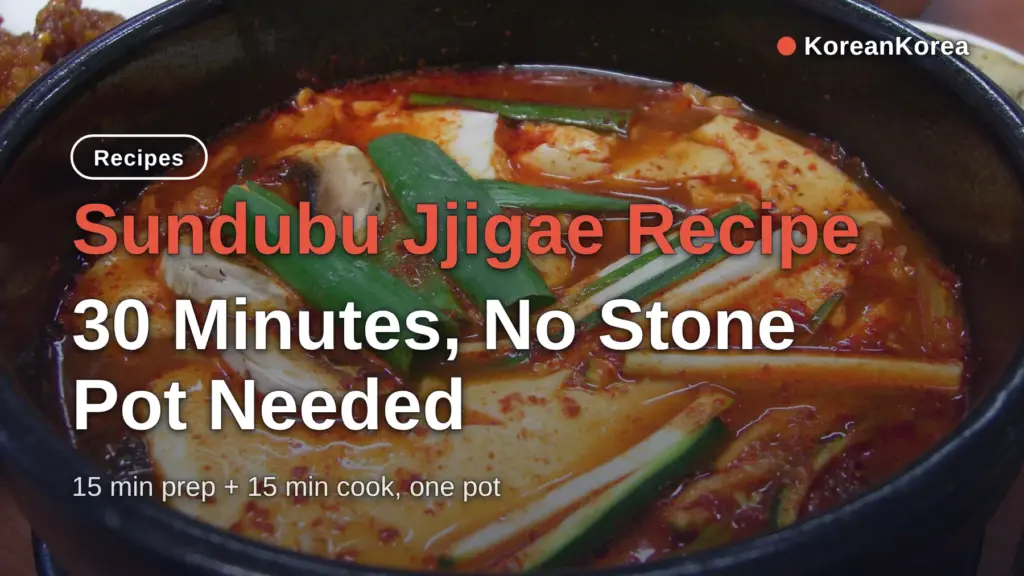
Yes — you can make sundubu jjigae in a regular pot in about 30 minutes: 15 minutes of prep and 15 minutes of cooking, no stone bowl required.
Sundubu jjigae (순두부찌개) is the Korean soft tofu stew made with unpressed, extra-soft tofu in an anchovy-kelp broth seasoned with gochugaru — the chili flakes that give the broth its clean red heat rather than a paste-based sweetness.
In Korea people eat it bubbling straight out of the pot, with rice and kimchi, and many break the raw egg yolk into the rice; this post gives the 30-minute steps, the seasoning and broth ratios, the substitutions for overseas kitchens, four common versions, and the mistakes that ruin the texture.
Sundubu Jjigae Recipe: What the Stew Is and When Koreans Eat It
| Bloom | Fry gochugaru + garlic in oil, 30 seconds |
|---|---|
| Boil | Add broth, bring to a rolling boil |
| Tofu | Add 400 g soft tofu in large spoonfuls |
| Simmer | 5 minutes, until tofu turns orange |
| Finish | Egg + scallion, 30-second rest off heat |
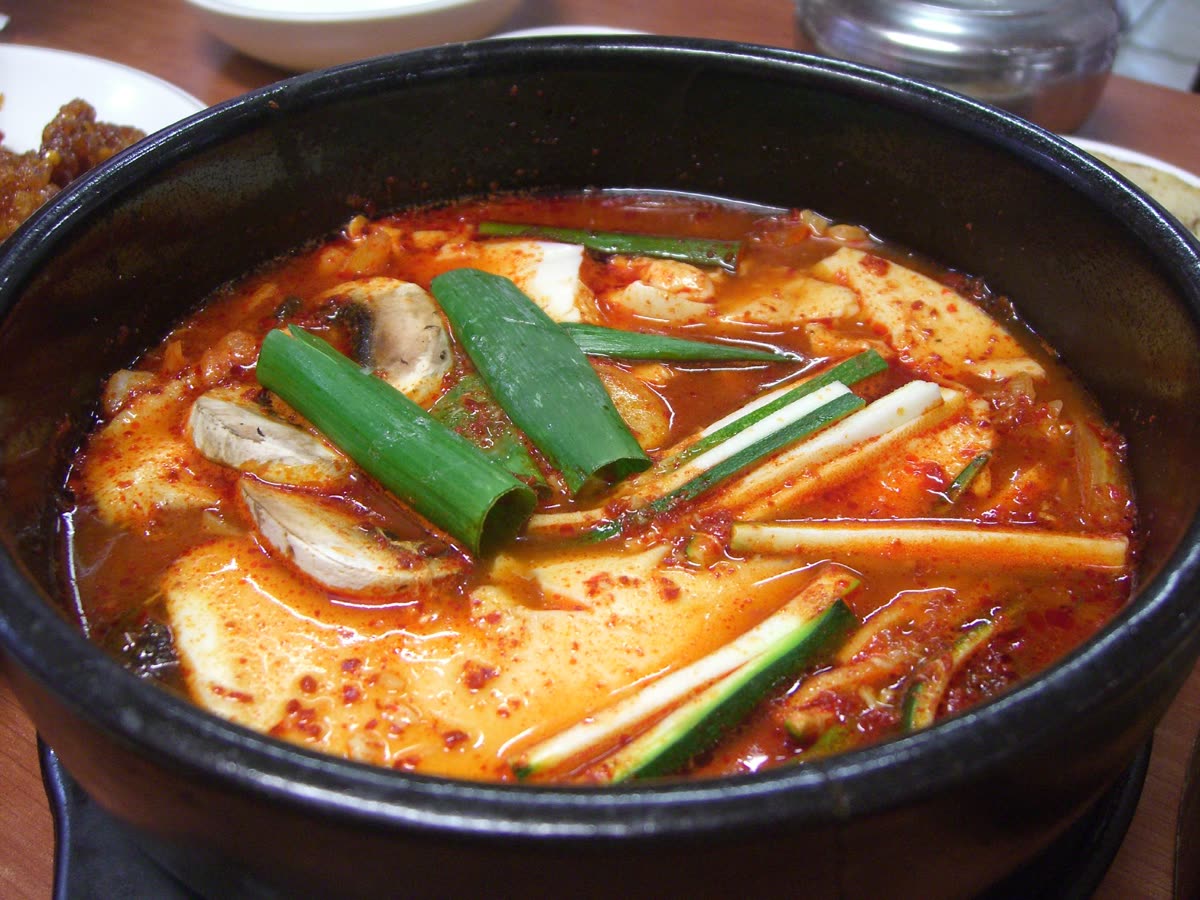
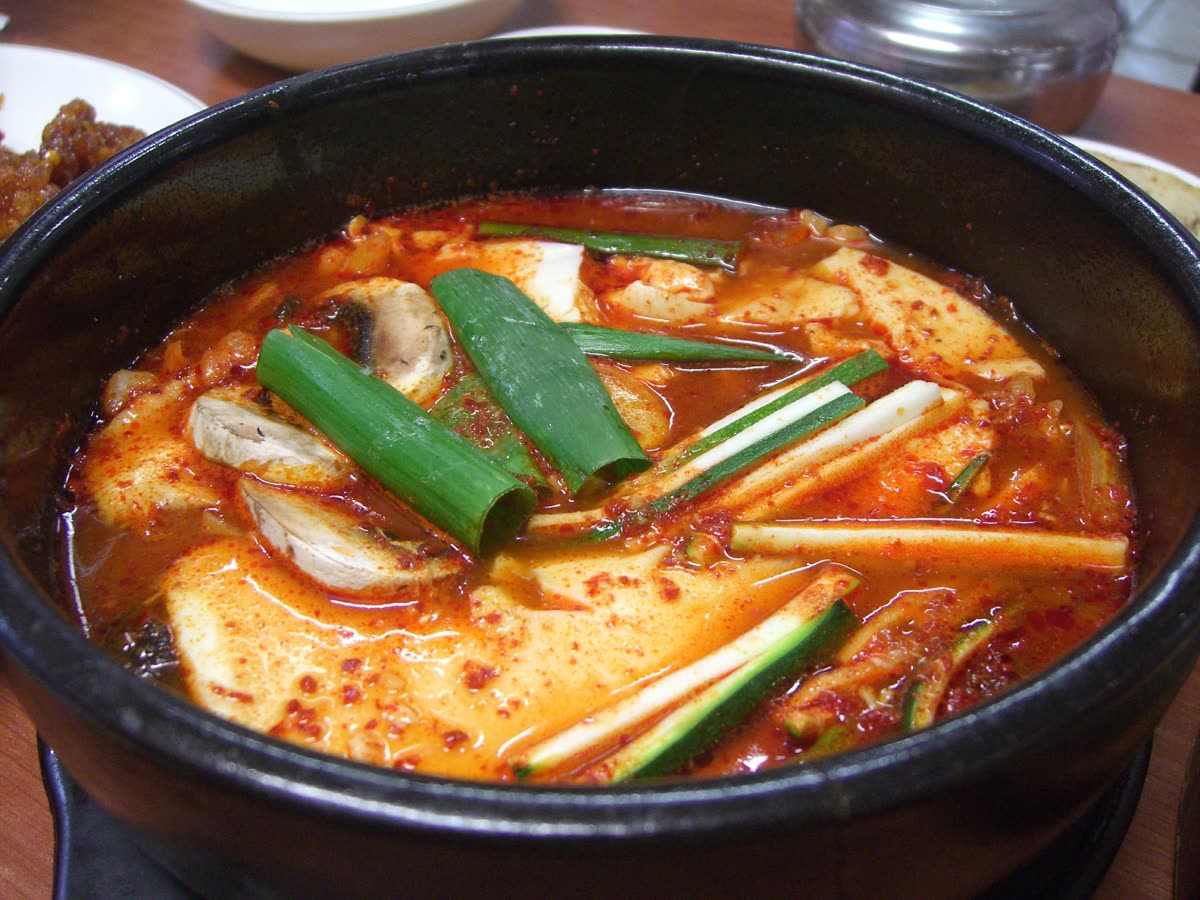
Sundubu jjigae is a stew built on unpressed soft tofu (sundubu, 純豆腐) — tofu so fresh it has not been pressed into blocks, so it stays custard-soft while it cooks.
The classic pot combines that tofu with an anchovy-kelp broth, gochugaru seasoning, an egg and scallions.
Koreans eat it as a one-person main dish, at any time of year, usually straight from its own small boiling pot at the table.
The name is also the menu label: if a restaurant says sundubu, you are getting this custard tofu, not cubed firm tofu.
That texture is exactly what you reproduce at home by buying the softest tofu on the shelf.
Ingredients for One Serving
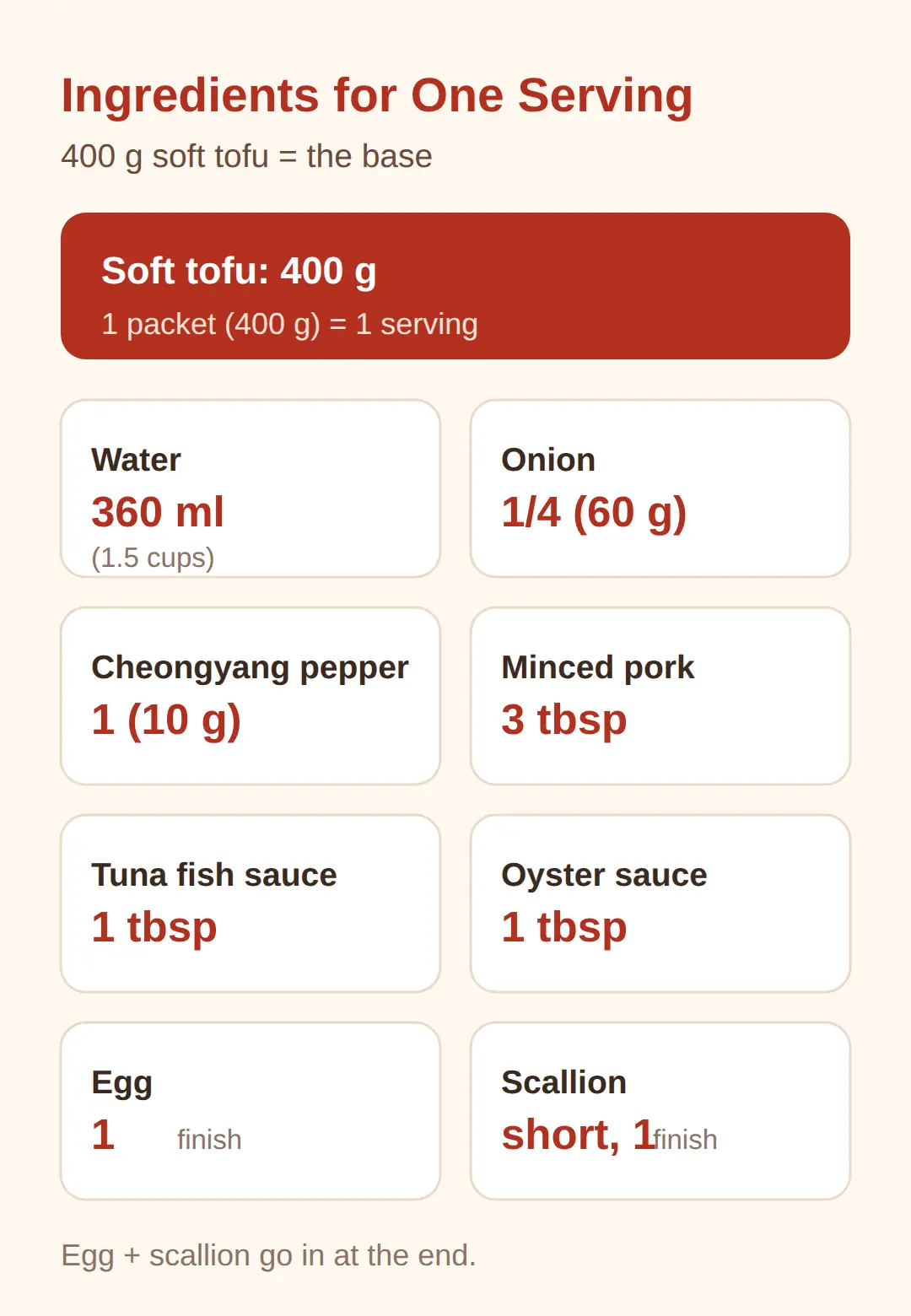
One packet of 400 g soft tofu is one serving, and everything below scales around it.
The quantities come from the meat version: water 360 ml (1.5 cups), onion 1/4 (60 g), cheongyang pepper 1 (10 g), minced pork 3 tbsp, tuna fish sauce 1 tbsp, oyster sauce 1 tbsp.
On top of that you need one egg and a short scallion for the finish, and the seasoning paste in the table in the next section.
If you cannot find cheongyang pepper, it is the hottest common Korean chili — leave it out rather than substitute more gochugaru.
Sundubu packets in Korean stores are typically 200 g or 400 g; one 400 g packet covers this recipe as written.
The 30-Minute Method in a Regular Pot
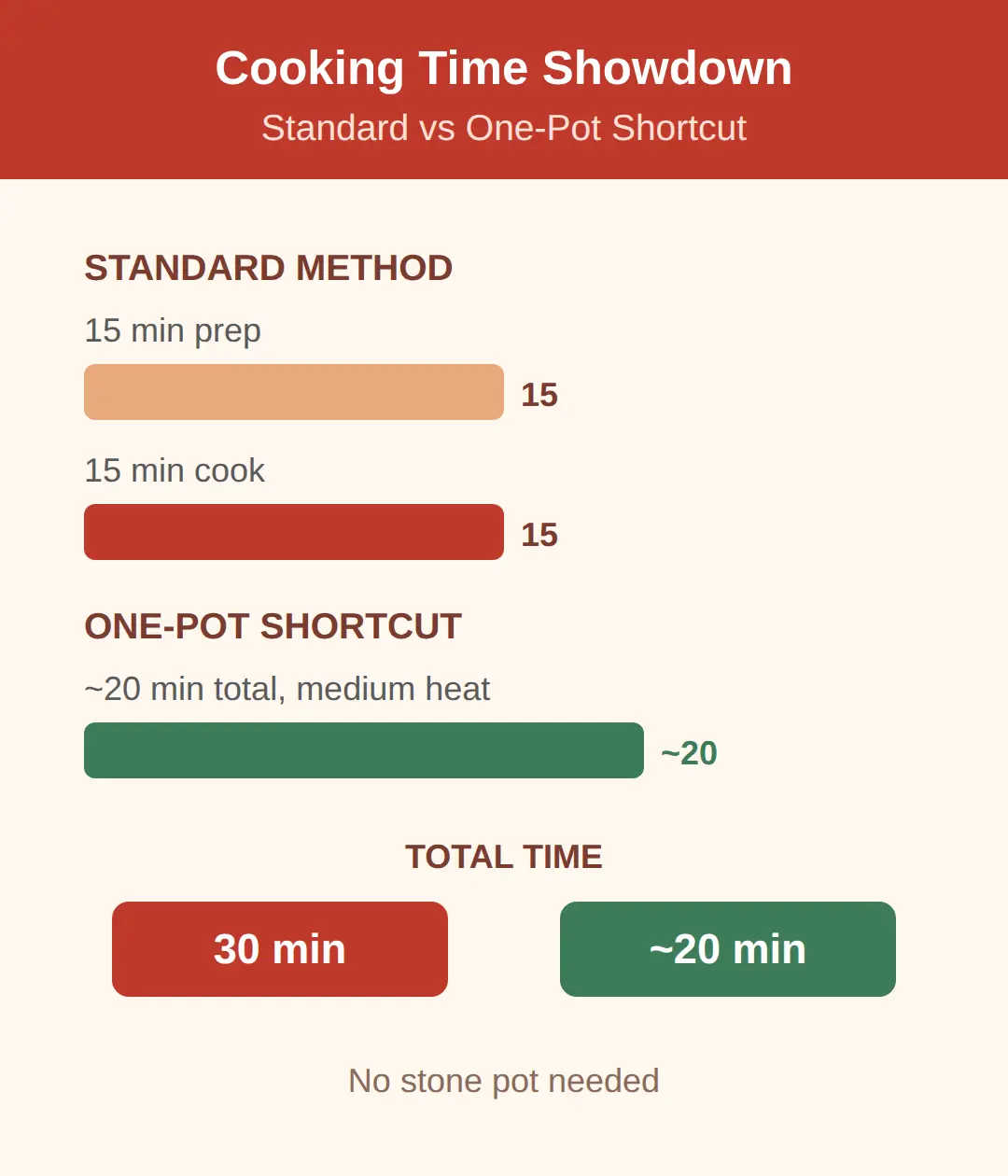
The standard split is 15 minutes of prep and 15 minutes of cooking — broth and vegetables first, the pot work after.
A regular pot does the job fine; only the holding of heat at the table changes, which is why Korean homes serve it in ttukbaegi (stone pot) that keeps the stew bubbling until the last spoonful.
- Simmer 800 ml water with dried anchovies and a piece of kelp; take the kelp out the moment the water boils and keep the anchovies going about 10 minutes, then strain — this makes about 2 pots’ worth of broth (360 ml each), so save the rest.
- Dice the onion and slice the scallion while the broth simmers.
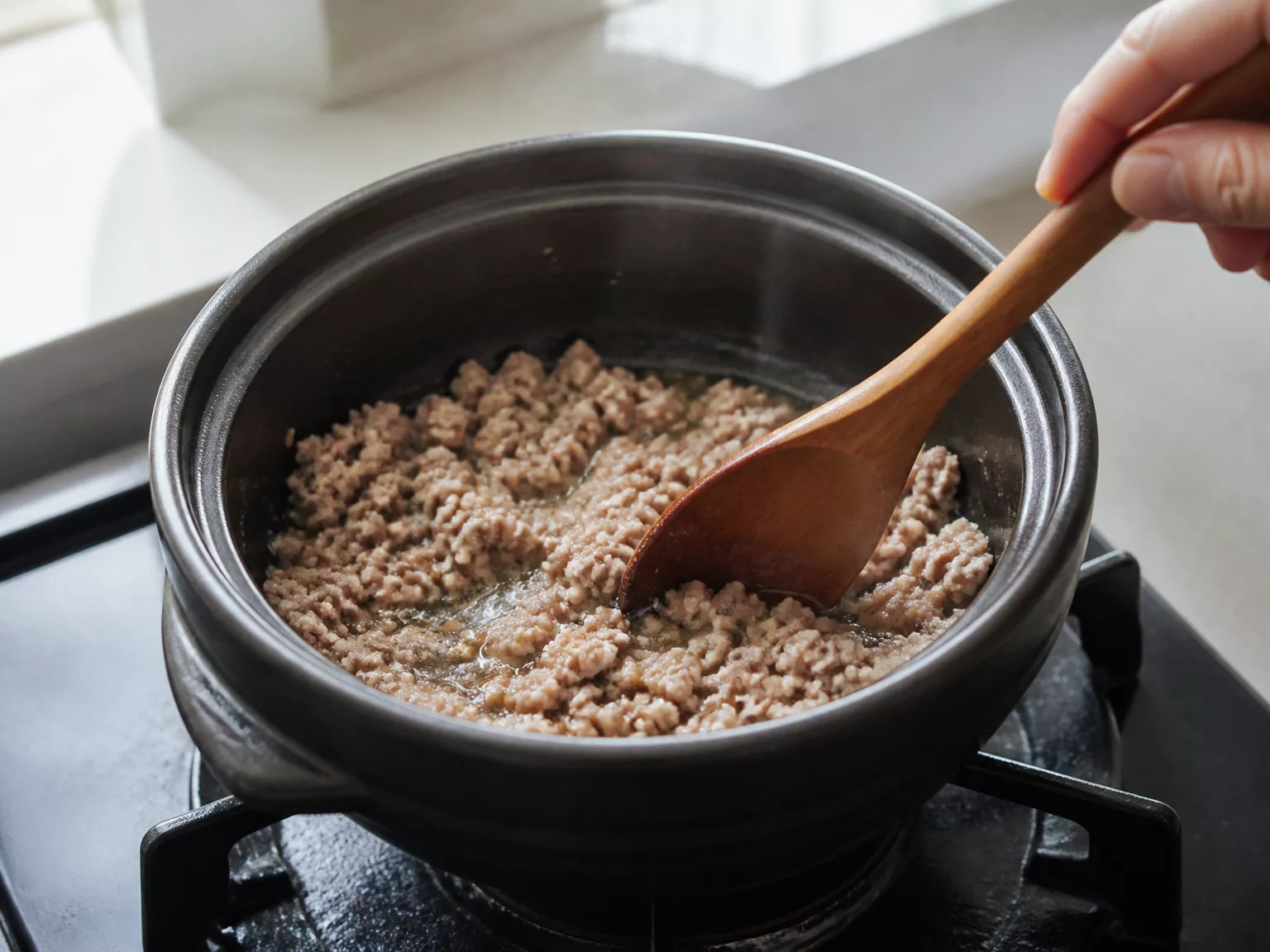
- Heat your pot on medium and, if using minced pork, brown it well and keep cooking until the fat renders — this longer fry is the restaurant-depth step.
- Add the seasoning paste (see next section) and fry the gochugaru and garlic in the oil for about 30 seconds, until fragrant and glossy.
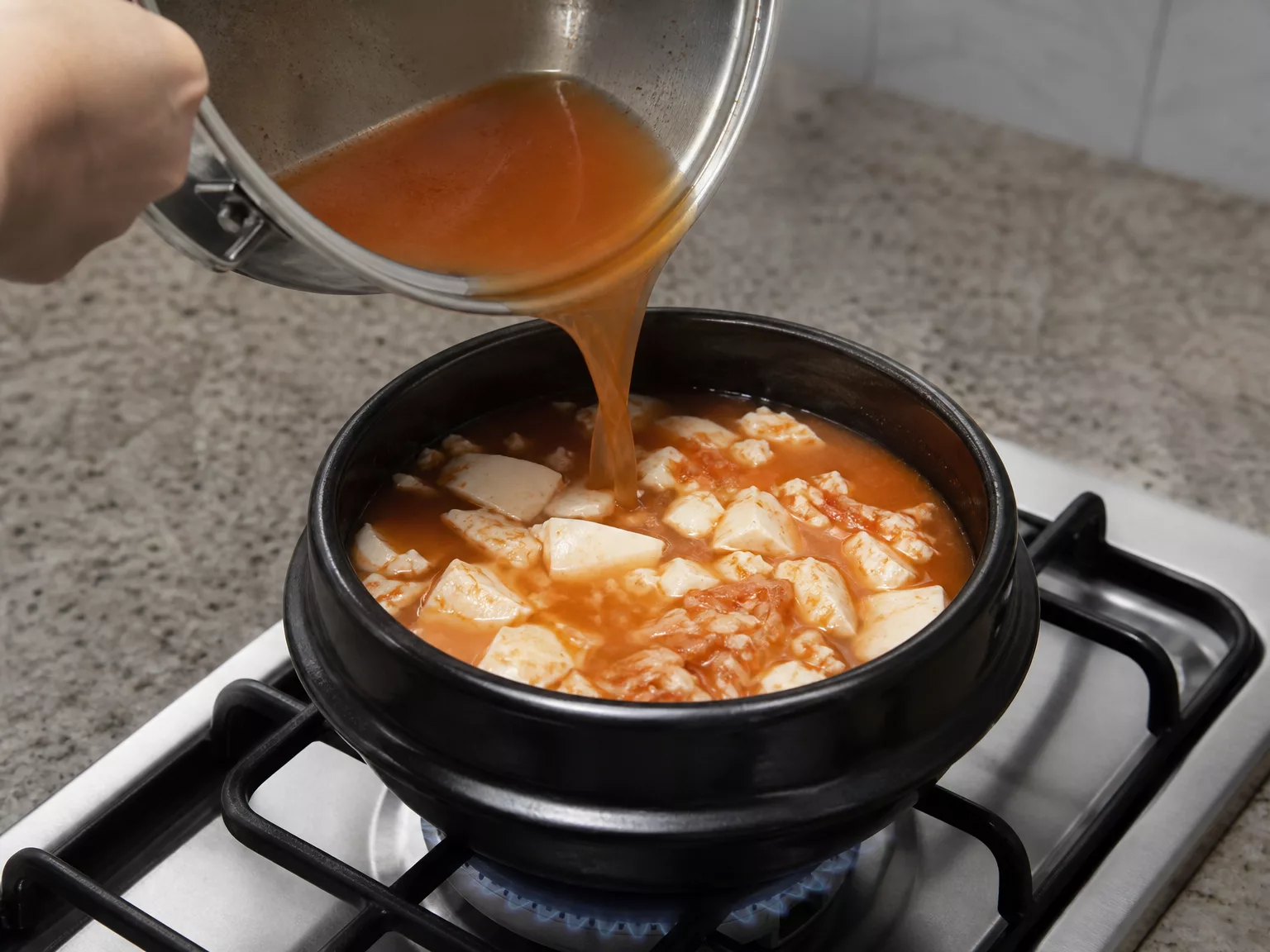
- Pour in 360 ml of the hot broth and bring it to a rolling boil on medium heat.
- Only once it boils, spoon the 400 g soft tofu in large chunks; barely stir, or the custard breaks apart.
- Simmer about 5 more minutes; when the tofu takes on the orange color of the broth, the seasoning has soaked through — that is the done signal.
- Crack in the egg just before turning off the heat, top with diagonally sliced scallion, and let it sit 30 seconds off the heat so the white sets while the yolk stays runny.
If you own a ttukbaegi, boiling everything in it in one go takes about 20 minutes total — roughly 10 minutes less than the two-stage method.
Steps at a glance
-
1Simmer 800 ml water with dried anchovies and a piece of kelp⏱ ~10 minutes🔥 simmer
-
2Dice the onion and slice the scallion while the broth simmers.
-
 AI-generated photo
What it should look like — AI-generated image of this step, made from the recipe text — not a photo of our kitchen. 3Heat your pot on medium and, if using minced pork, brown it well and… -
4Add the seasoning paste (see next section) and fry the gochugaru and…⏱ ~30 seconds
-
 AI-generated photo
What it should look like — AI-generated image of this step, made from the recipe text — not a photo of our kitchen. 5Pour in 360 ml of the hot broth and bring it to a rolling boil on…🔥 boil -
6Only once it boils, spoon the 400 g soft tofu in large chunks
-
7Simmer about 5 more minutes🔥 simmer
-
8Crack in the egg just before turning off the heat, top with…⏱ 30 seconds
The Seasoning Mix and Broth, Measured
| Ingredient | Amount |
|---|---|
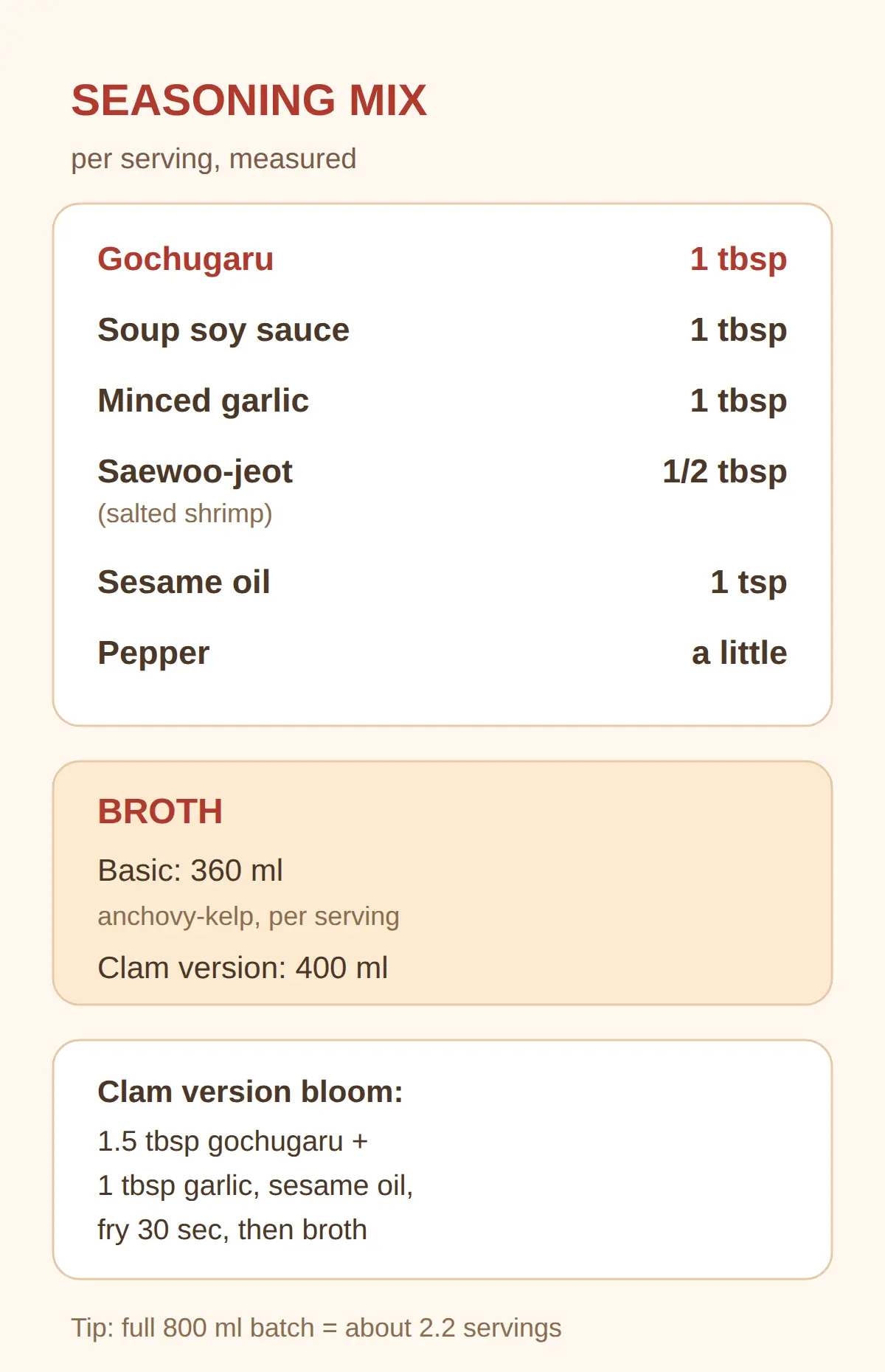
| Gochugaru | 1 tbsp |
| Soup soy sauce (guk-ganjang) | 1 tbsp |
| Minced garlic | 1 tbsp |
| Saewoo-jeot (salted shrimp) | 1/2 tbsp |
| Sesame oil | 1 tsp |
| Pepper | a little |
The saewoo-jeot is the piece that lifts the flavor — salted shrimp is what gives the broth the savory depth of a restaurant pot.
The broth side is 360 ml anchovy-kelp broth per serving, and the clam version uses 400 ml.
An alternate umami route, used in the one-pot method, is tuna fish sauce 1 tbsp + oyster sauce 1 tbsp instead of the salted shrimp.
For the clam version the blooming ratio changes slightly: 1.5 tbsp gochugaru + 1 tbsp garlic fried in sesame oil for 30 seconds before the broth goes in.
If you cook the whole 800 ml batch of broth once, it covers about 2.2 single servings — simmer once, cook twice.
Substitutions for Overseas Kitchens
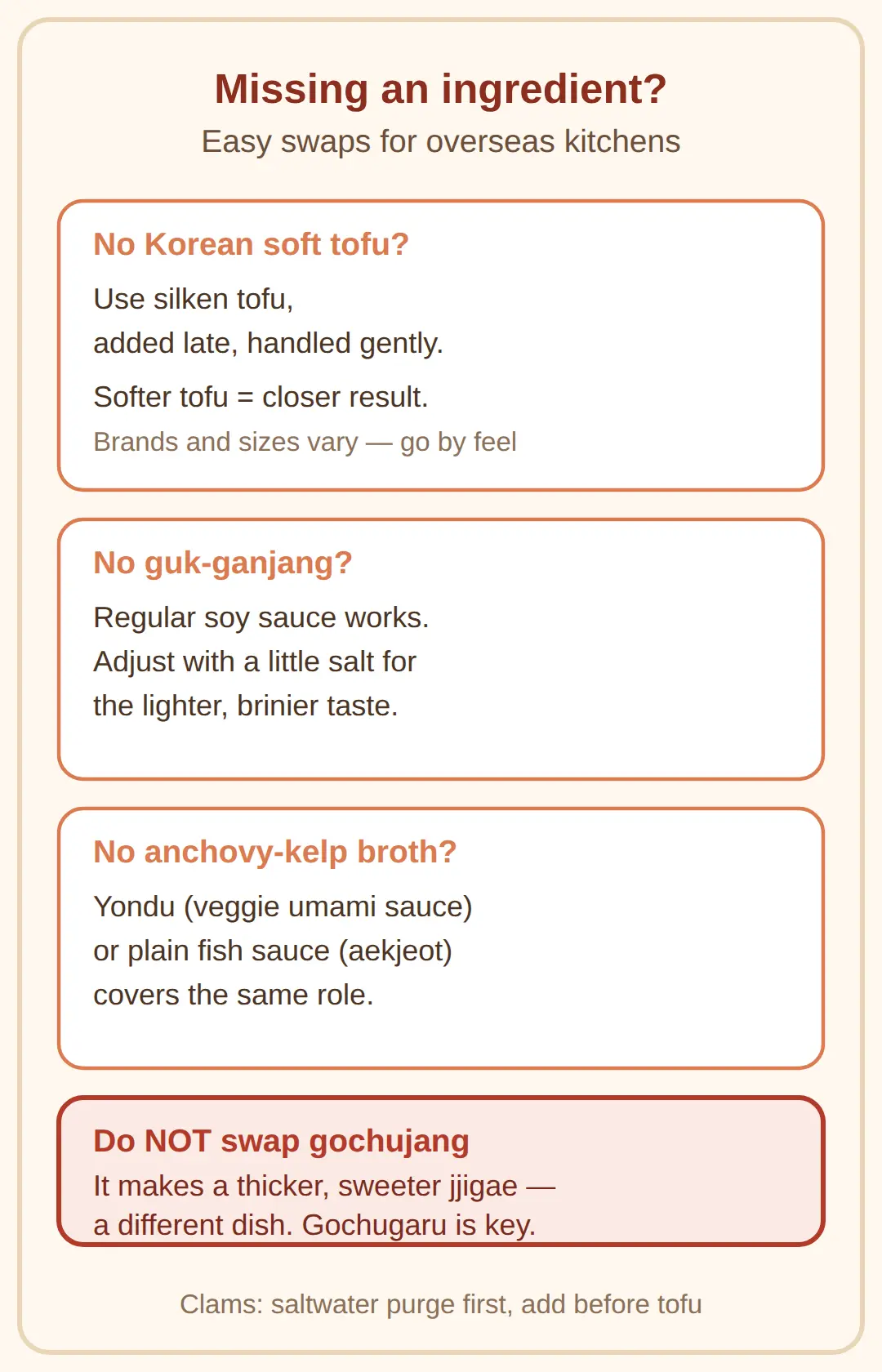
No Korean soft tofu?
Supermarket silken tofu stands in for sundubu, added late and handled gently.
No guk-ganjang (soup soy sauce)?
Regular soy sauce works, adjusted with a little salt to make up the lighter, brinier character of the soup sauce.
No anchovy-kelp broth ingredients?
Yondu (a Korean vegetable umami sauce) or plain fish sauce (aekjeot) covers the same role as the anchovy and salted-shrimp seasoning.
Do not swap gochujang in as the base: gochugaru gives the red, clean-spicy broth this dish is named for, while gochujang makes a thicker, sweeter jjigae — a different dish entirely.
Tofu brands and package sizes in non-Korean stores vary, so go by feel: the softer the tofu, the closer the result.
Clams, if you use them, need a saltwater purge first, and they go into the broth before the tofu — start adding tofu when the shells begin to open.
Four Versions and What Goes in Each
Four versions cover what Korean kitchens and restaurants actually cook: basic, seafood, clear, and mushroom.
| Version | What goes in | Who it is for |
|---|---|---|
| Basic (egg only) | egg on top, no meat | the fastest one, learn it first |
| Haemul (seafood) | clams (bajirak) and shrimp | briny, clean umami on top of the chili broth |
| Clear (white, non-spicy) | no gochugaru at all | spice-shy eaters |
| Mushroom (vegetarian) | no meat, mushrooms in for the animal depth | vegetarian route |
The seafood version (haemul sundubu) uses clams (bajirak) and shrimp for a clean, briny layer on top of the chili broth.
The clear version drops the gochugaru entirely for a non-spicy white broth — this is the order for spice-shy eaters, though soft tofu itself also tames heat in the red version.
The mushroom version is the vegetarian route: no meat, mushrooms standing in for the animal depth.
Clams and pork together give a layered broth rather than a one-note one — briny brightness from the clams, deep savory bass from the browned pork.
If I were cooking this at home, I would simmer the 800 ml anchovy-kelp broth once and use it for two portions, because the broth is the only step worth scaling up and everything else takes minutes.
What I check first before choosing a version is which umami anchor I have on hand — saewoo-jeot for the red version, clams for the seafood one — since that decides the depth more than the pot does.
Basic (egg only) is the fastest and the one to learn first.
Related posts
📎 📅 Upcoming Dates — Release & Event Calendar
Sources
- 30 min total, 360ml anchovy-kelp broth, ttukbaegi substitute (marcwiner.com)
- Anchovy-kelp broth: 800ml water, remove kelp at boil (shared (cookpick.kr)
- saewoojeot 1/2 tbsp in paste is the restaurant-taste key (cookpick.kr)
Common Mistakes and How You Know It Is Done
- Stirring the tofu too much: spoon it in large chunks and barely mix — over-mixing breaks up the custardy texture that makes this dish.
- Adding tofu before the boil: the chunks stay together and absorb better only when the broth is already at a rolling boil.
- Leaving the kelp in past the boil: take it out the moment the water boils or the broth turns bitter.
- Cracking the egg too early: it goes in just before the heat goes off, and 30 seconds of rest sets the white while the yolk stays runny.
- Judging doneness by the clock: the reliable cue is color — when the tofu turns orange, the seasoning has soaked in.
FAQ
Q. Can I make sundubu jjigae without a stone pot?
Yes — a regular pot works fine and takes about 30 minutes total (15 prep + 15 cook). A stone pot only keeps the stew hot at the table longer.
Q. What can I use instead of Korean anchovy-kelp broth?
Yondu (vegetable umami sauce) or fish sauce covers the same role as the anchovy and salted-shrimp seasoning.
Q. Can I use gochujang instead of gochugaru?
Not as the base — gochugaru gives the clean spicy broth; gochujang makes a thicker, sweeter jjigae that is a different dish.
Q. How do I know sundubu jjigae is done?
The soft tofu turns the orange color of the broth — that visual cue means the seasoning has soaked through.
Q. Can I store and reheat sundubu jjigae?
It is best eaten immediately rather than stored — this is not a make-ahead stew.
Making more jjigae at home? The same anchovy-kelp broth base drives kimchi jjigae and doenjang jjigae — one simmer, three stews.
Cover photo: File:Korean stew-Sundubu-07.jpg by Alpha — CC BY-SA 2.0
#sundubujjigae #koreansofttofustew #koreanjjigaerecipe #nostonepot #koreanfoodabroad
📅Upcoming Schedule — this week 23 · D-1 Autumn season = post-summer brightening demand window (UV drSee all →