Most napa cabbage kimchi has no gluten in its base recipe, but no product is guaranteed wheat-free.
The risk comes from additions — wheat-flour porridge, wheat-brewed soy sauce, or thick sauces — not from cabbage, chili, or salted seafood.
This post covers which kinds are safer, how to read a Korean label, what to do with free side kimchi at restaurants, and why kimchi stews are a different question.
Is Kimchi Gluten-Free — the Short Answer
| Baechu (napa cabbage) | Base is gluten-free — risk is the porridge, which may be wheat or rice flour |
|---|---|
| Baek (white) kimchi | No chili powder and usually no porridge — among the safer choices |
| Dongchimi (water kimchi) | Cabbage or radish in salted water with garlic and ginger — usually gluten-free |
| Kkakdugi / yeolmu | Base is gluten-free — some versions use flour porridge or thick sauces, so check first |
Most baechu (napa cabbage) kimchi is gluten-free in its core recipe, but it is not guaranteed.
The core is cabbage, gochugaru (Korean chili powder), garlic, ginger, scallions, and salted seafood — none of these are gluten grains.
Wheat enters in three ways: a flour porridge that some recipes use to kick-start fermentation, soy sauce brewed with wheat, and flour-based thickeners.
When the porridge is made from chapssal (glutinous rice) instead, it is gluten-free, and rice-based binders are common in commercial kimchi.
So the working rule is: usually yes, never guaranteed — every jar needs its own label check.
If a product contains wheat, Korean labeling rules force it to say so on the package.
Which Kimchi Kinds Are Safer — Compare Before You Order
| Kimchi kind | Gluten status | What to check |
|---|---|---|
| Baechu (napa cabbage) | Core recipe is gluten-free | Porridge base — glutinous rice is fine, wheat flour is not |
| Baek (white) kimchi | One of the safer picks | Skips gochugaru and usually skips the porridge too — still verify the jar |
| Dongchimi (water kimchi) | Usually gluten-free when homemade | Napa cabbage or radish in salted water with garlic, ginger, optional pear — no porridge or chili paste |
| Kkakdugi and yeolmu styles | Varies more | Some versions carry flour porridge or thick sauces — the jars to check first |
White kimchi and dongchimi are the safer picks, because both skip the chili-and-porridge step where wheat usually hides.
If gluten-free is a hard requirement, start with white kimchi or dongchimi and read the label on everything else.
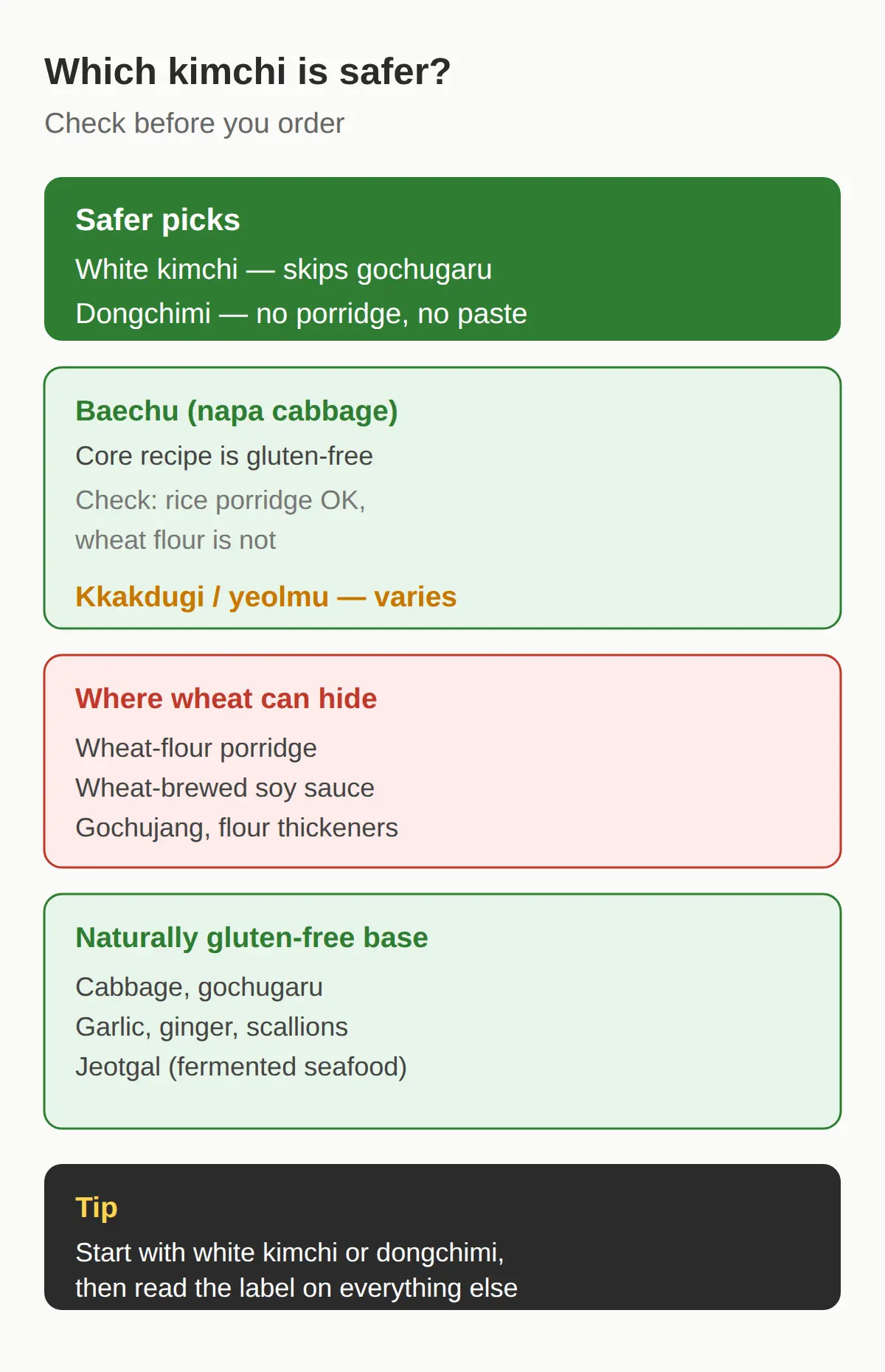
 — Which Kimchi Kinds Are Safer — Compare Before You Order](https://koreankorea.com/wp-content/uploads/2026/09/is-kimchi-gluten-free-safe-kinds-label-guide-2026-02.jpg)
How to Read a Korean Kimchi Label for Wheat
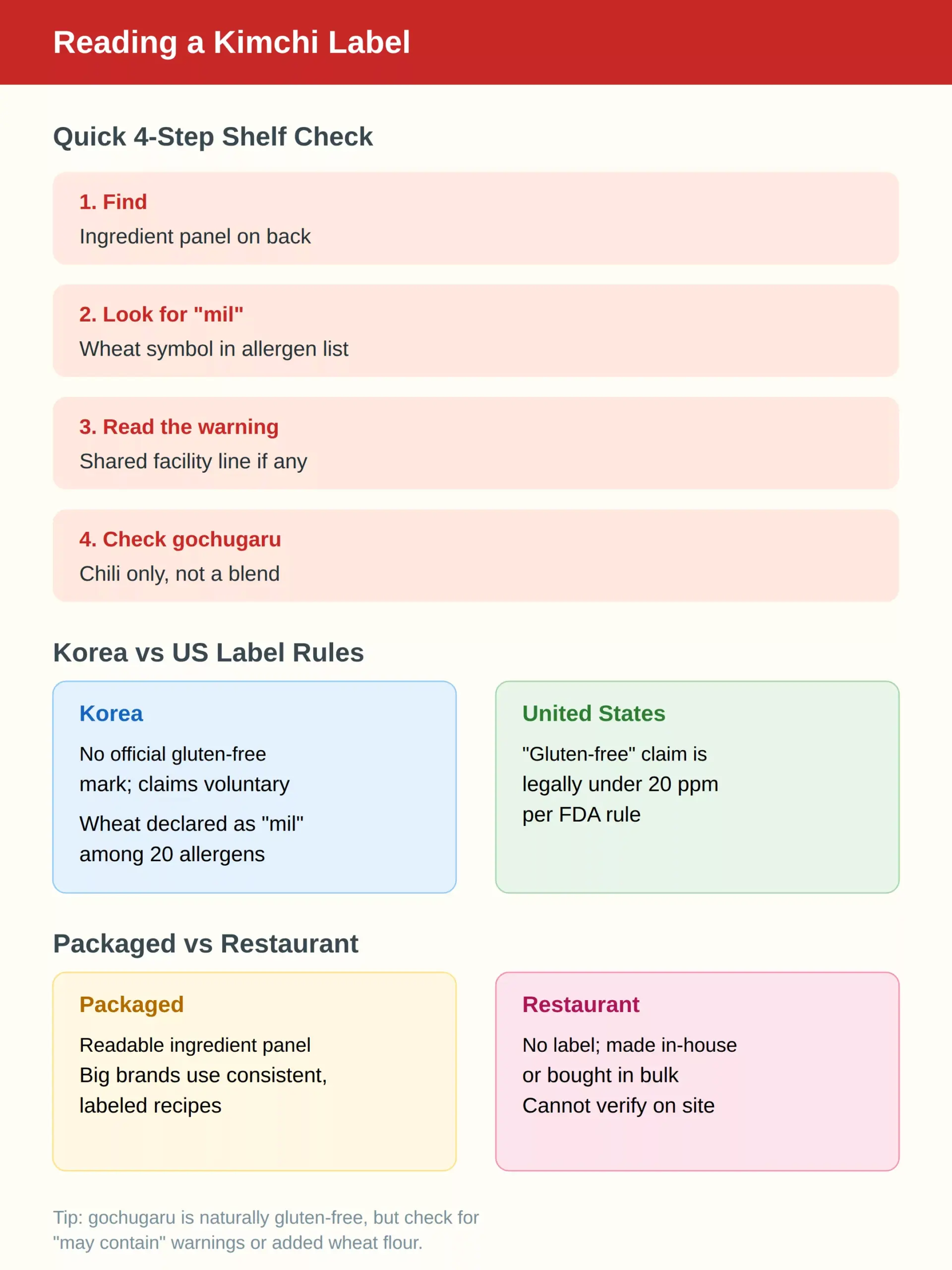
Korea’s Ministry of Food and Drug Safety requires wheat to be declared among the 20 mandatory labeled allergens, so any wheat-containing kimchi must list it on the package.
Look for the single Korean character for wheat — pronounced "mil" — on the ingredient panel of every pack.
Check for a shared-facility warning too: some labels state the product is made in a facility that also uses wheat, which matters for celiac readers.
Gochugaru deserves its own glance — it is naturally gluten-free as pure sun-dried pepper, but some packs carry "may contain" warnings, and some commercial packs add wheat flour to reduce clumping.
Steps for a quick check at the shelf:
- Find the ingredient panel on the back of the pack.
- Look for the Korean character for wheat ("mil") in the allergen section.
- Read any line about shared manufacturing facilities.
- Check the gochugaru is listed as chili only, not a seasoned blend.
Kimchi at Restaurants and Markets — What You Can and Cannot Verify
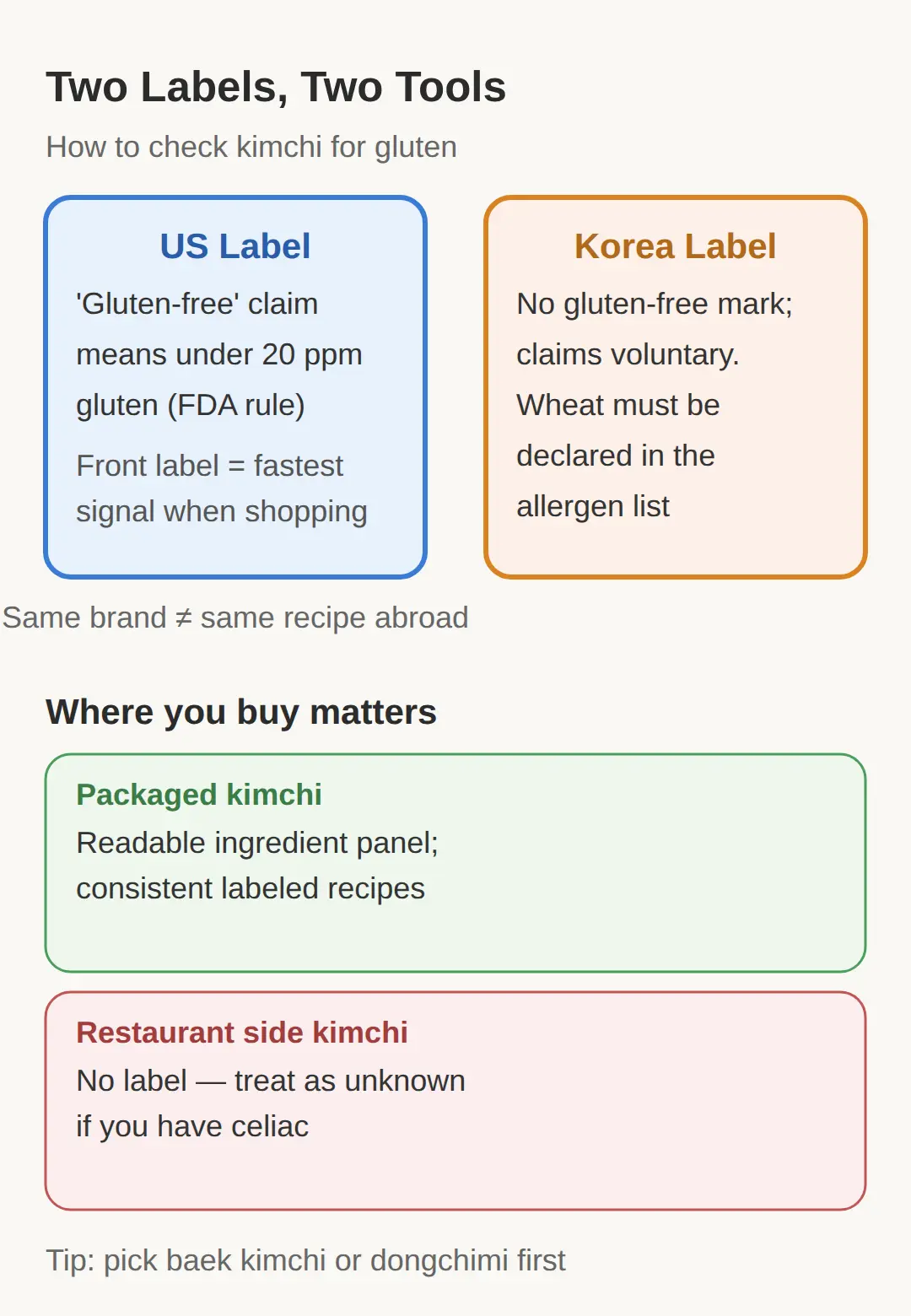
Side kimchi served free at restaurants has no label, because it is made in-house or bought in bulk — its gluten status cannot be verified on site.
The practical rule for celiac visitors is to treat restaurant side kimchi as unknown.
Asking is still worth one try: the phrase "geuluten eopseumnikka?"
(is there no gluten?) is the useful one, though staff at traditional markets often cannot confirm recipe details.
Fermentation does not break down gluten, so time in the jar does not make a wheat-containing kimchi safe.
If zero wheat is the requirement, a labeled packaged kimchi is the only option a restaurant meal cannot replace.
Kimchi Dishes Are a Different Question — Gochujang Usually Has Wheat
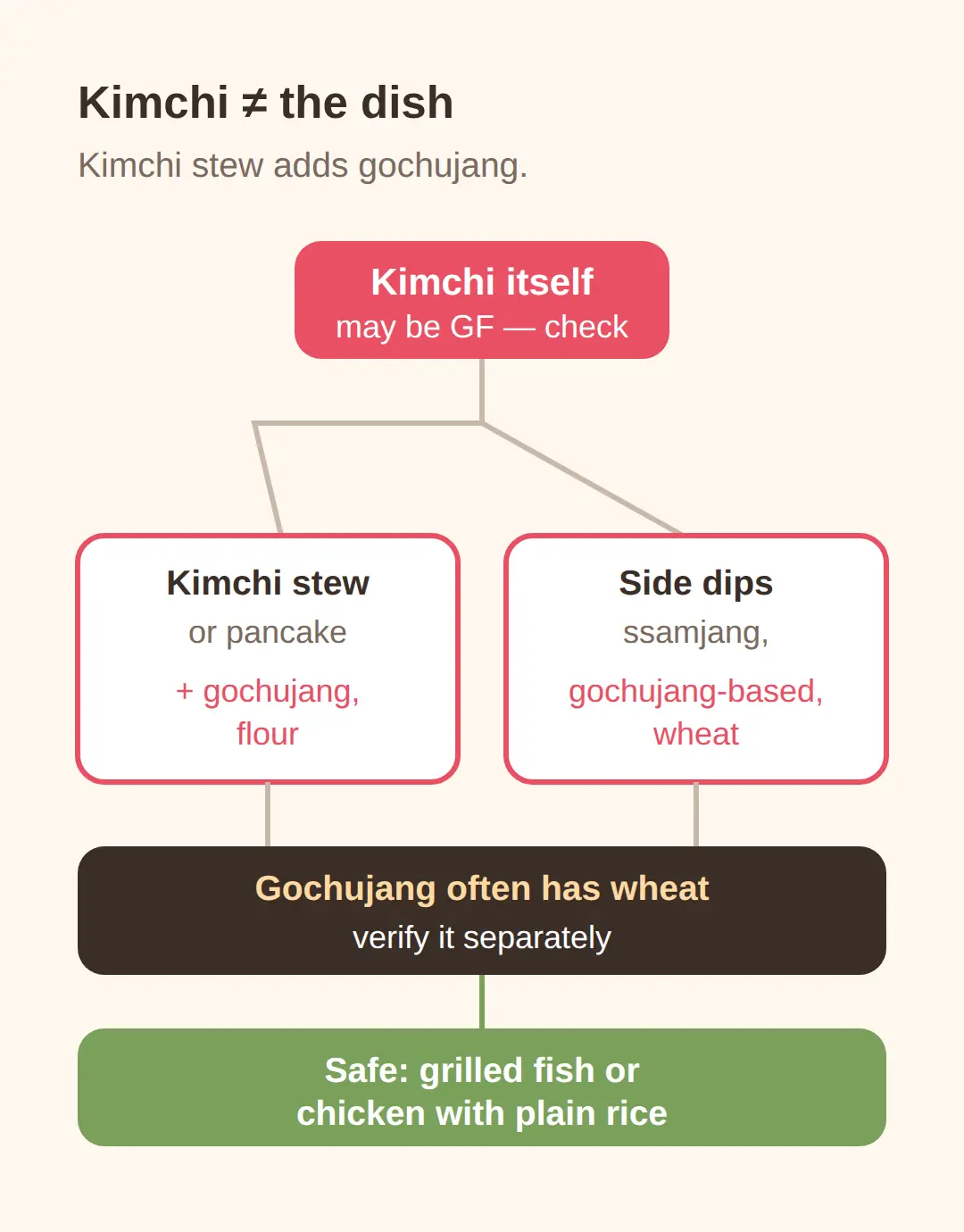
"Kimchi is gluten-free" does not extend to dishes made with kimchi.
Kimchi-jjigae (kimchi stew) and kimchi-jeon (kimchi pancake) add gochujang or flour, and standard gochujang recipes commonly include wheat.
Condiments served alongside — ssamjang and gochujang-based dips — also commonly contain wheat.
So verify gochujang separately from kimchi: a gluten-free kimchi in a stew does not make the stew gluten-free.
Grilled fish or chicken with rice, ordered plainly, skips the sauce chain entirely.

Buying Gluten-Free Kimchi — the US Label vs the Korean Label
The two countries give you two different tools, and it helps to know which one you are holding.
Under FDA rules, a "gluten-free" claim on packaged kimchi sold in the US means the product contains less than 20 ppm gluten — that is 20 divided by 1,000,000, or 0.002%.
Korean packages do not use that claim system the same way, so in Korea the tool is the mandatory allergen list instead: wheat must be declared if it is in the product.
Large commercial kimchi producers mostly use glutinous rice or sweetener-based porridge rather than wheat flour, which is why core baechu products often have no wheat ingredients — but each product still needs its own check.
When buying abroad, the "gluten-free" line on the front is the fastest signal; when buying in Korea, turn the pack over and read the allergen panel.
Recipes differ by export market, so the same brand name is not a guarantee from one country’s label to another’s.
If I had celiac disease and wanted zero risk, I would make kimchi at home with chapssal (glutinous rice) porridge and a gochugaru I had verified myself — because that is the only route where every ingredient gets checked by me, not by a label I have to interpret.
The first thing I look at is not the brand name but which variant it is, since separate ingredient panels mean the variant matters more than the brand.
Related posts
📎 📅 Upcoming Dates — Release & Event Calendar
Sources
- kimchi_base_ingredients (koreaexperience.com)
- short_answer_general (koreatravellab.com)
- kimchi_types_less_likely_gf (coreadesk.com)
Summary — the Rules in Six Lines
- Base kimchi ingredients are gluten-free; wheat arrives through flour porridge, soy sauce, or sauces.
- White kimchi and dongchimi are the safer kinds; sauce-heavy kkakdugi and yeolmu styles need a check.
- Korean law requires wheat to appear on the label as a mandatory allergen — look for "mil".
- Restaurant and market kimchi often runs on proprietary recipes, so asking staff is unreliable — treat the side dish as uncertain if you have celiac disease.
- Kimchi stew and kimchi pancake are separate questions: gochujang commonly contains wheat.
- The gluten-free seal on US-packaged kimchi is the fastest signal; in Korea, turn the pack over and read the allergen panel.
FAQ
Q. Is kimchi gluten-free?
Usually yes in the base recipe — cabbage, chili powder, garlic, ginger, and salted seafood. But flour porridge, soy sauce, or thickeners can add wheat, so check each product’s label.
Q. Does kimchi have wheat flour in it?
Some recipes do. Wheat-flour porridge is a traditional ferment booster; many commercial producers use glutinous rice porridge instead, which is gluten-free. The label tells you which.
Q. Is kimchi gluten-free for celiac disease?
Only if the package confirms no wheat and no shared-facility warning. Restaurant side kimchi has no label, so celiac travelers should treat it as unknown.
Q. Which kimchi brands are gluten-free?
No brand name is a guarantee — recipes differ by variant and by export market. The reliable check is the ingredient panel on the specific jar, wherever you buy it.
Q. Does gochujang have gluten?
Standard gochujang commonly contains wheat. Verify gochujang separately from kimchi, and remember kimchi stew and kimchi pancake both use it.
Note the date you buy: Korean recipes and export labels change by market, so re-check the panel on each new jar.
Cover photo: Seohaean-ro, Jeju-si, Jeju-do, South Korea – panoramio – song songroov (11) by song songroov — CC BY 3.0
#kimchi #glutenfree #celiactravel #Koreanfood101 #foodlabels #Koreatravelfood
📅Upcoming Schedule — this week 23 · D-day Autumn season = post-summer brightening demand window (UV drSee all →