Homemade jjajangmyeon turns bitter when the chunjang (black bean paste) was not fried long enough, and pasty when too much or under-cooked starch slurry went in.
The fix is one step most home cooks skip: about 10 minutes of frying the paste in generous oil, until it turns glossy and shiny.
This post gives the full step order, the visual cue to watch, a 1:1 substitute for chunjang abroad, and the sides that come with the dish.
Contents
- jjajangmyeon recipe: why yours turns out bitter and pasty
- How long to fry chunjang, and what glossy looks like
- Jjajangmyeon steps, in order, for a first-timer
- Thickening the sauce with starch slurry
- Chunjang substitutes abroad, and how the taste changes
- Sides, storage, and batch prep
jjajangmyeon recipe: why yours turns out bitter and pasty
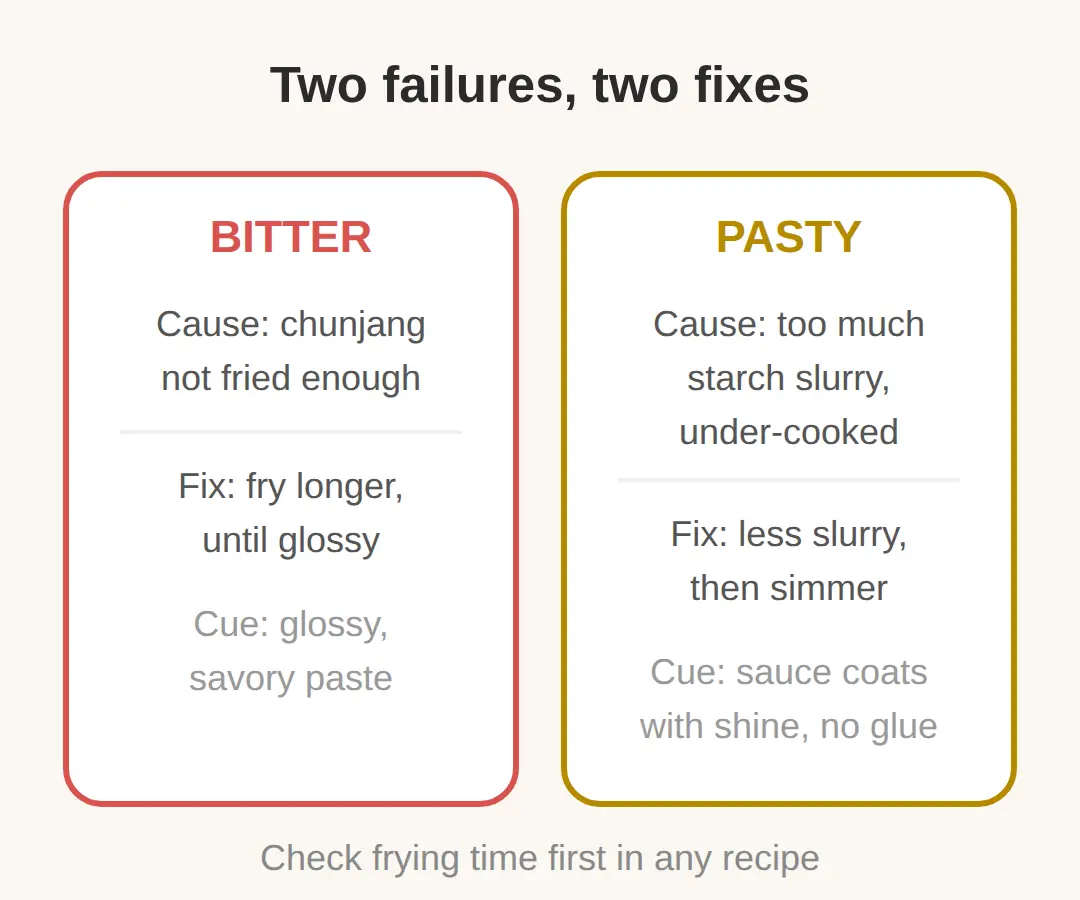
Bitterness comes from chunjang that was not fried long enough, and pastiness comes from under-cooked or excessive starch slurry.
Those are two separate failures with two separate fixes.
Raw chunjang tastes bitter and floury, and frying it in oil cooks that rawness out and turns the paste glossy and savory.
The starch problem goes the other way — the sauce needs just enough slurry, simmered briefly, so it coats the noodles with a shine instead of sitting on them like glue.
When I read a jjajang recipe, the first thing I look at is how long it says to fry the paste and whether it names the glossy cue, because that one step decides whether the dish is bitter.
If your sauce is bitter, fry the paste longer before touching anything else.
If it is pasty, use less slurry and let it simmer after adding.
| Tastes bitter, floury | Chunjang was under-fried — fry longer in more oil, until the paste turns glossy and shiny |
|---|---|
| Sauce is pasty or gummy | Too much starch slurry, or it was not simmered after adding — cut back and let it cook briefly until it just coats the noodles |
| You live abroad, no chunjang | Chinese tianmianjiang (sweet bean sauce) works 1:1 — add a little soy sauce or oyster sauce for depth |
| First time making the whole dish | Follow the standard order: fry chunjang → set aside → pork → vegetables → paste back in → water → slurry → serve |
| You make it on weeknights | Fry a batch of chunjang ahead; fried paste keeps refrigerated for several weeks |
How long to fry chunjang, and what glossy looks like
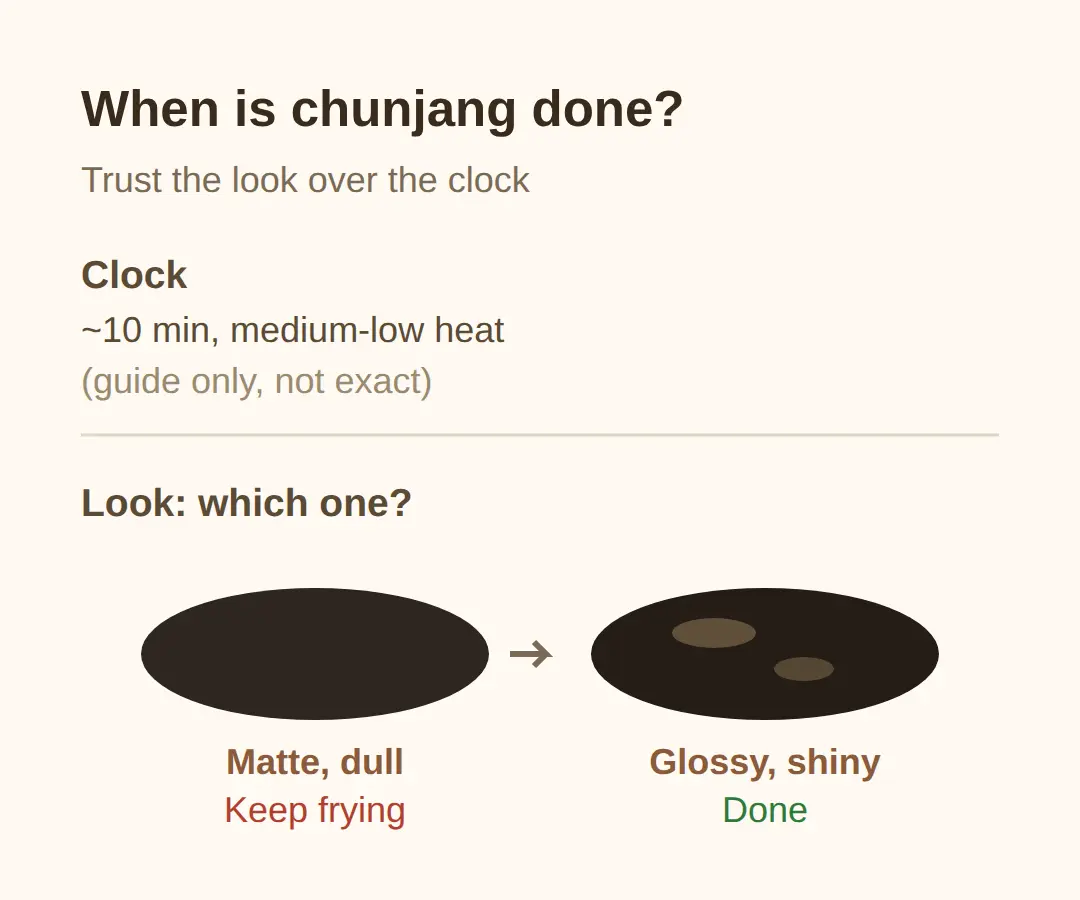
Fry the chunjang in generous oil over medium-low heat, stirring, for about 10 minutes — until it turns glossy and shiny.
The shine in the oil is the visual sign that the raw, floury taste is cooked out.
Use roughly equal parts oil to paste, because chunjang absorbs oil and skimping is a common cause of a dry, bitter result.
The clock and the look are two different guides for the same step: about 10 minutes is the common figure, while some Korean home-recipe guides describe the endpoint only visually — fry until the paste glistens, with no minute count.
Since no second dated source confirms the exact minutes, treat ‘about 10 minutes’ as a guide and trust the glossy look over the clock.
If the paste still looks matte and dull, keep frying; if it gleams in the oil, it is done.
👉 Easy Tteokbokki Recipe with Gochujang: 2 Tbsp per 500ml, 20 Minutes, One Pan
Jjajangmyeon steps, in order, for a first-timer
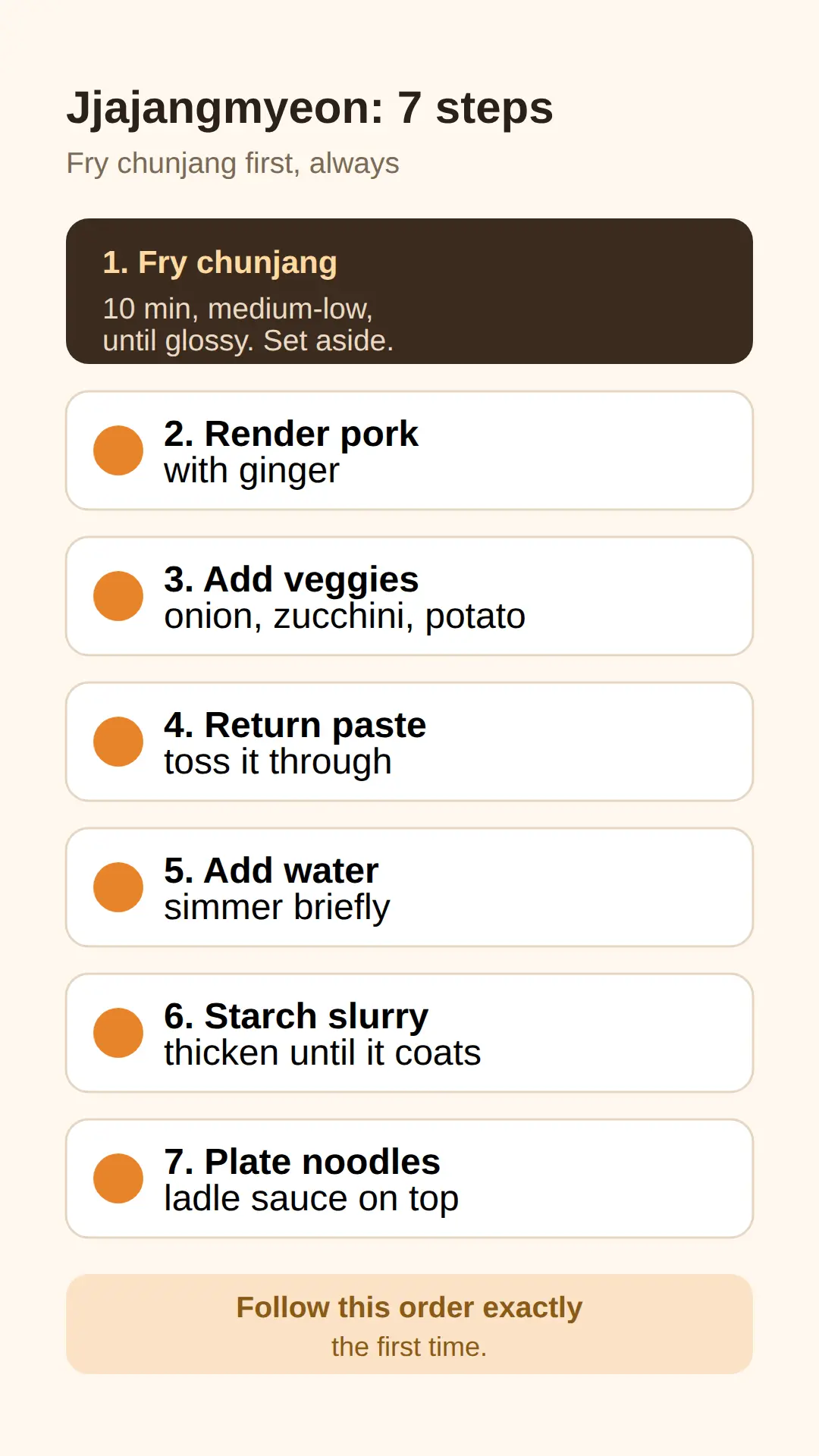
The standard order is: fry the chunjang first, set it aside, then build the rest — skipping the fry-first step is what produces raw-tasting sauce.
- Stir-fry the chunjang in oil over medium-low heat for about 10 minutes, until glossy, then set it aside.
- Render diced pork belly or shoulder in the pan, adding ginger.
- Add the vegetables — diced onion, zucchini, and potato are the common set.
- Return the fried paste and toss it through.
- Add water gradually and simmer briefly until the sauce comes together.
- Thicken with a small starch slurry, simmering briefly until it coats a spoon.
- Plate the noodles and ladle the sauce over the top — Korean home-recipe guides serve it over the noodles, not mixed in the pan.
Follow this order exactly the first time.
Once you know how each stage should look, adjusting is easy — but the fry-first order stays the same.
Thickening the sauce with starch slurry
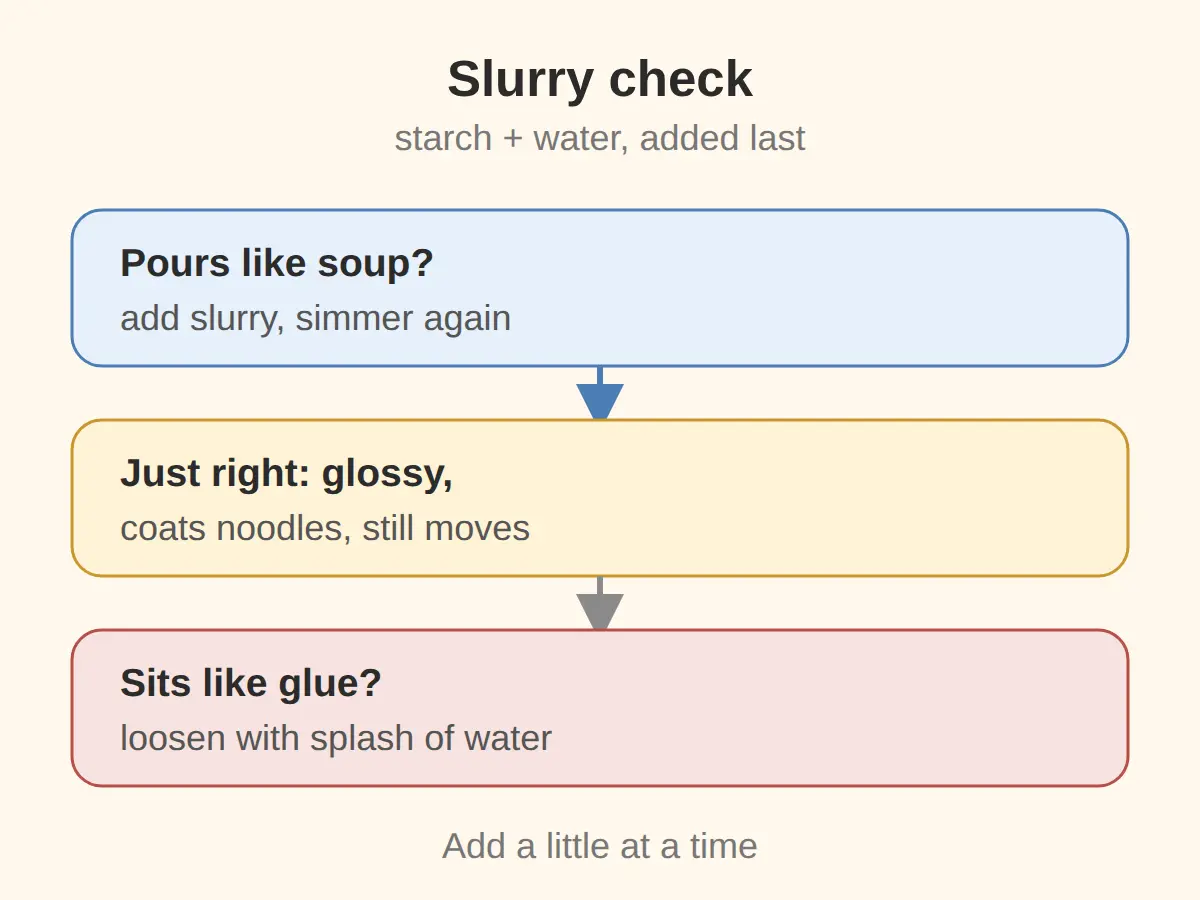
Finish the sauce with a small amount of potato or corn starch slurry, added at the end of simmering, until it coats the noodles with a glossy sheen.
The slurry is starch mixed with a little water, stirred in last.
Simmer the sauce briefly after adding the slurry — a sauce that is thickened but never simmered after is what reads as raw and gummy.
Water goes in gradually during the simmer stage, so you can stop when the sauce still moves but clings to the noodles.
No exact starch-to-water ratio was confirmed on a primary recipe page, so mix a thin slurry and add it a little at a time rather than all at once.
If the sauce pours like soup, add a bit more slurry and simmer again.
If it sits like glue, you went too far — loosen it with a splash of water.
Chunjang substitutes abroad, and how the taste changes
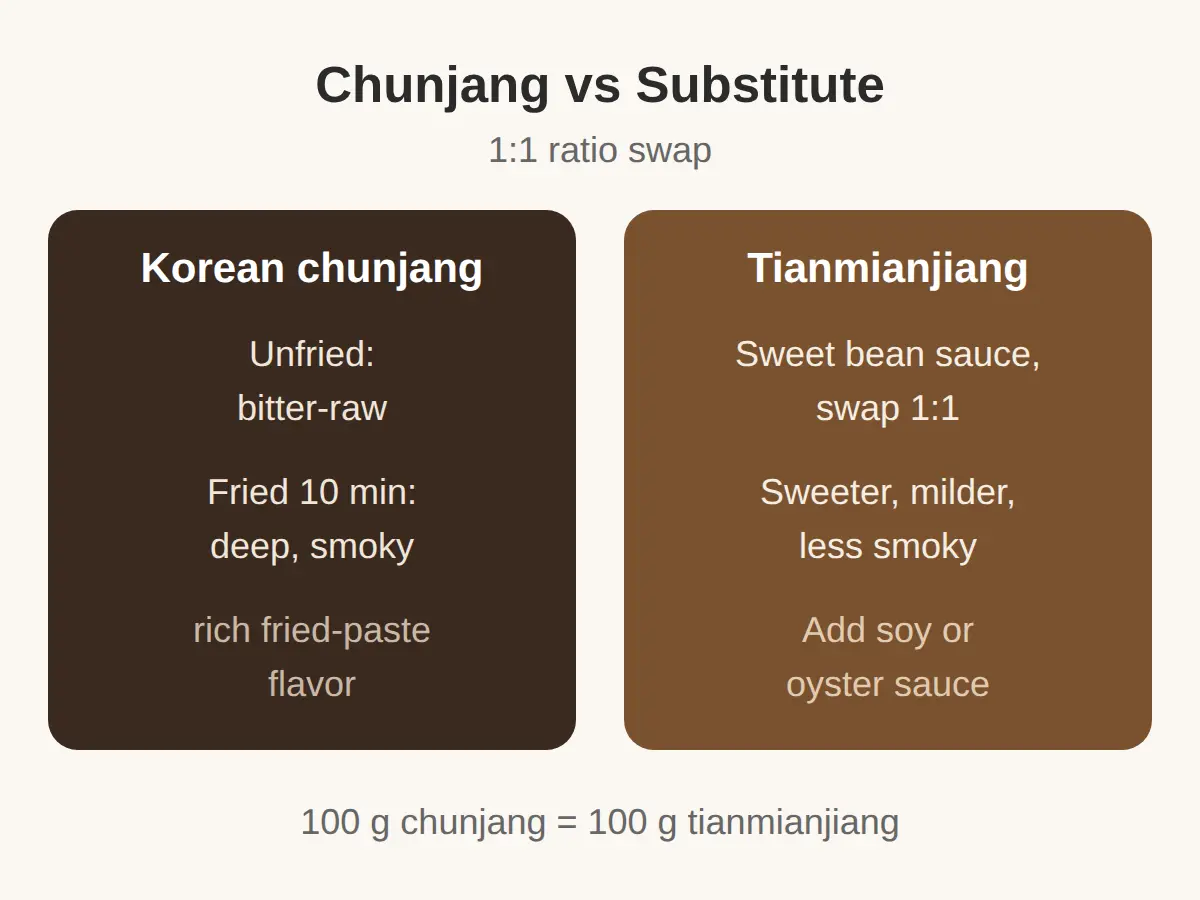
Where Korean chunjang is unavailable, Chinese tianmianjiang (sweet bean sauce) works as a substitute at a 1:1 ratio — a recipe calling for 100 g chunjang needs exactly 100 g tianmianjiang, with no adjustment.
Recipe sources describe the result as sweeter and milder than Korean chunjang, with less of the deep, smoky fried-paste flavor, so compensate with a small amount of soy sauce or oyster sauce.
For the noodles, fresh jjajangmyeon noodles (a chewy medium wheat noodle) are traditional; udon or thick wheat spaghetti are accepted substitutes when Korean noodles are unavailable.
Some recipes also rinse or briefly blanch the chunjang before frying to reduce excess salt, but that step is optional — a proper fry handles the raw taste on its own.
Brand-level availability of chunjang in US or European grocers was not verified, so check the Asian aisle of your local store or an online Korean grocer before settling for the substitute.
👉 Samgyetang Recipe: Fight Summer Heat With a Boiling Soup, Not Ice
Sides, storage, and batch prep
The classic service is julienned cucumber on top of the noodles, with danmuji (yellow pickled radish) and raw onion on the side.
The acidity of the danmuji cuts through the rich black-bean sauce, which is why the pairing is standard in Korea.
Fried chunjang keeps refrigerated for several weeks, so batch-frying a whole jar ahead is a common time-saver for weeknight jjajangmyeon.
If you cook jjajangmyeon often, frying the whole batch on the weekend means a weeknight dinner starts from paste that is already cooked through and glossy — the step most likely to go wrong on a busy evening.
My own habit would be to fry the whole jar of chunjang in one batch on the weekend and refrigerate it, because the 10-minute fry is the one stage I do not want to rush on a weeknight.
If I could only keep one side, I would keep the danmuji, not the cucumber — without something sharp on the side, the sauce gets heavy by the last few bites.
Related posts
📎 Galbijjim Recipe for Chuseok: Braised Short Ribs That Slump Off the Bone — A Galbijjim Recipe for First-Timers
📎 bibimbap recipe: season every vegetable separately, then mix — 4 servings
📎 📅 다가오는 일정 — 발매·개봉·발표 캘린더
Sources
- Cookpick covers calories as a topic but exact kcal figure no (cookpick.kr)
- Anchor page from brief.md is undated; used only as instituti (korean-culture.org)
- hashimotos_mcp_note (contents.premium.naver.com)
What to double-check before you start cooking
- Bitter or pasty sauce almost always means the chunjang was under-fried or under-oiled, not over-fried.
- Add the starch slurry only at the end of simmering, a little at a time, and stop once the sauce coats the noodles.
- Tianmianjiang swaps 1:1 for chunjang but comes out sweeter and milder, so restore depth with a little soy or oyster sauce.
- Udon or thick wheat spaghetti holds up well when fresh jjajangmyeon noodles are hard to find.
- Danmuji and raw onion on the side are not optional extras — their sharpness is what keeps the rich sauce from getting heavy by the last bites.
- Batch-fry the whole jar of chunjang on the weekend and a weeknight jjajangmyeon starts from paste that is already glossy and cooked through.
FAQ
Q. Why does my homemade jjajangmyeon taste bitter?
The bitterness almost always comes from chunjang that was not fried long enough. Fry it in generous oil over medium-low heat until the paste turns glossy and shiny — that is when the raw, floury taste is gone.
Q. How long should I fry chunjang for jjajangmyeon?
About 10 minutes over medium-low heat, stirring. Treat that as a guide and watch the paste instead of the clock: when it glistens in the oil, it is done.
Q. What can I substitute for Korean black bean paste (chunjang)?
Chinese tianmianjiang (sweet bean sauce) works at a 1:1 ratio — 100 g for 100 g. The result is described as sweeter and milder, so add a small amount of soy sauce or oyster sauce for depth.
Q. How do I thicken jjajangmyeon sauce with starch?
Stir a small amount of potato or corn starch slurry into the sauce at the end of simmering, then simmer briefly until it coats the noodles with a glossy sheen. Too much slurry, or no simmer after adding, is what makes the sauce pasty.
Q. What noodles and garnish go with jjajangmyeon?
Fresh chewy jjajangmyeon noodles are traditional; udon or thick wheat spaghetti are common substitutes abroad. Garnish with julienned cucumber and serve danmuji (yellow pickled radish) and raw onion on the side.
When buying chunjang, check the label for the word chunjang and pick a jar without added sweeteners — then fry the whole batch in one go, so every future bowl starts from paste that is already cooked through.
#jjajangmyeon #koreanrecipes #blackbeannoodles #chunjang #koreanfoodabroad
📅Upcoming Dates — 이번 주 16 · D-day 'The Scandal' global Netflix release전체 보기 →