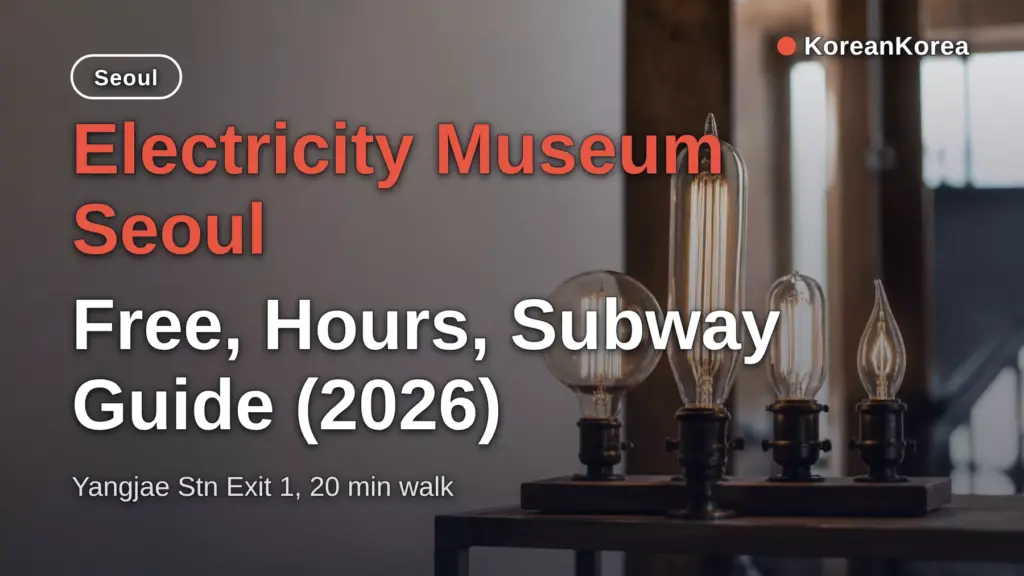
Electricity Museum Seoul is free to enter and sits inside the KEPCO Art Center in Seocho-gu, a 20-minute walk from Yangjae Station (Line 3 and Shinbundang Line) Exit 1.
KEPCO’s official page lists Tuesday–Saturday 10:00–17:30, closed Sundays, Mondays and public holidays, though the Seoul city listing shows different hours, so check before you go.
This post covers admission, the subway route, the two conflicting hour listings, what is on each of the three floors, and whether it works with kids.
What the Electricity Museum Seoul Is, and Who It Suits
| Admission | Free (visitseoul.net listing, checked October 2, 2026) |
|---|---|
| Where | Inside KEPCO Art Center, 60 Hyoryeong-ro 72-gil, Seocho-gu, Seoul (06732) |
| Subway | Yangjae Station, Line 3 & Shinbundang Line, Exit 1 — about 20 minutes on foot |
| Hours (KEPCO official) | Tuesday–Saturday 10:00–17:30 |
| Closed (KEPCO official) | Sundays, Mondays and public holidays |
| Reservation | Not needed for individuals or groups under 10 |
| Phone | +82-2-2105-8190 |
The Electricity Museum is Korea’s only museum dedicated to electricity, run by KEPCO, and admission is free per the visitseoul.net listing and KEPCO’s official page (checked October 2, 2026).
It opened on August 10, 2001, sits on three floors of the KEPCO Art Center in Seocho-gu, and reopened in February 2023 after a renewal that replaced item-listing displays with story-based exhibits organized around people, ideas, time and space.
One source counts roughly 80,000 visitors a year since opening; divided across 365 days that works out to about 220 per day, so it is rarely crowded.
It suits visitors who want a quiet, indoors stop in southern Seoul rather than a headline palace or market.
Because it is inside KEPCO Art Center, you can also pair it with a performance or a gallery show in the same building.
If your itinerary is already full of outdoor sights, this is the kind of place to slot in on a rainy or very hot afternoon.
How to Get to the Electricity Museum Seoul by Subway
Take Line 3 or the Shinbundang Line to Yangjae Station, leave by Exit 1, and walk about 20 minutes, per the visitseoul.net listing (checked October 2, 2026).
The museum’s full address is 60 Hyoryeong-ro 72-gil, Seocho-gu, Seoul (06732), inside the KEPCO Art Center compound.
From Exit 1, head toward Hyoryeong-ro 72-gil; the walk is uphill in places, so allow the full 20 minutes rather than cutting it close.
No parking information appeared in any source reviewed, and the Seocho-gu location suggests limited on-site parking, so plan to arrive by subway.
If your starting station is not on Line 3 or the Shinbundang Line, a route planner such as koreankorea.com’s Seoul subway route planner can map the transfer in one step.
Taxis are an option for the last stretch, but the walk from Yangjae is the route the official listing itself describes.
Electricity Museum Seoul Hours and Closed Days — Two Sources Disagree
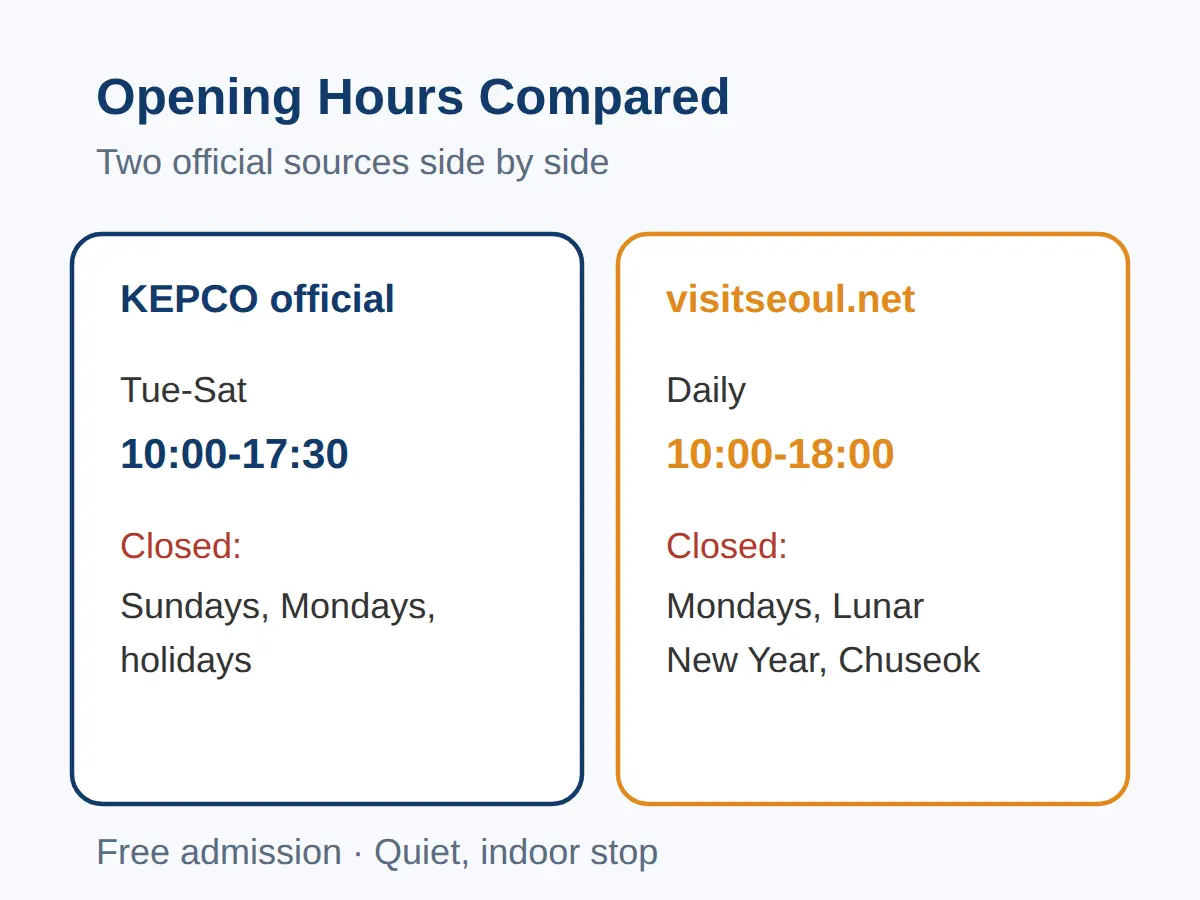
Per KEPCO’s official page, the museum opens Tuesday–Saturday 10:00–17:30 and closes on Sundays, Mondays and public holidays; visitseoul.net instead lists daily 10:00–18:00 with Monday closures, so the two sources conflict on both hours and closing days.
This post follows the KEPCO official page, which is the museum operator’s own listing, over the city tourism listing.
| Source | Hours | Closed |
|---|---|---|
| KEPCO official page | Tue–Sat 10:00–17:30 | Sundays, Mondays, public holidays |
| visitseoul.net | Daily 10:00–18:00 | Mondays, Lunar New Year & Chuseok |
The practical difference is a Sunday visit: KEPCO’s page says closed, the Seoul listing does not.
Before planning a weekend or Monday visit, call +82-2-2105-8190 and confirm the day’s schedule rather than trusting either listing alone.
If you can only go Tuesday–Saturday, both sources agree the museum is open, so no call is needed.
What’s Inside: the Arc Lamp, the Tram and the History Hall
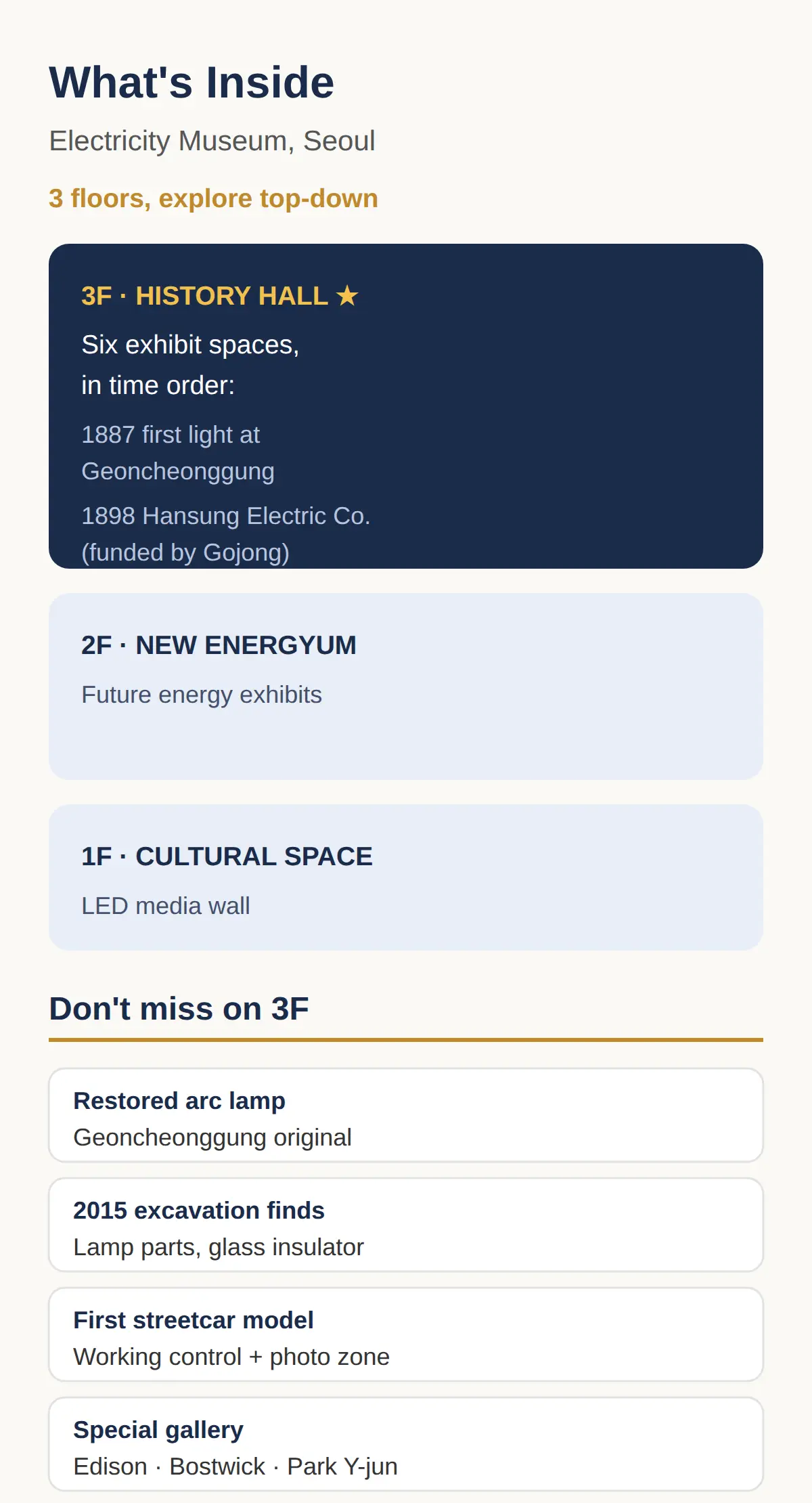
The museum has three floors: a 1F cultural space with an LED media wall, a 2F New Energyum about future energy, and a 3F Electricity History Hall split into six exhibit spaces.
The 3F hall covers Korea’s electric history in sequence, from the first electric light lit at Geoncheonggung in spring 1887, through Hansung Electric Company established January 26, 1898 with Emperor Gojong’s funding, to household scenes with black-and-white TVs.
Highlights include a restored Geoncheonggung arc lamp, arc-lamp parts and a glass insulator from the 2015 excavation of the original power house site, and a partial full-size model of Seoul’s first streetcar with a real operating control and a photo zone.
A special gallery is built around three figures — Thomas Edison, Harry Rice Bostwick, and Park Young-jun, first president of Korea Electric Company — with materials donated by descendants.
KEPCO also runs an ‘e-Museum’ online collection where you can browse the artifacts by theme before visiting.
If you only have time for one floor, the 3F history hall is the one that answers why Seoul got electric light earlier than Beijing’s Forbidden City or the Japanese imperial palace.
Is It Worth Visiting With Kids?
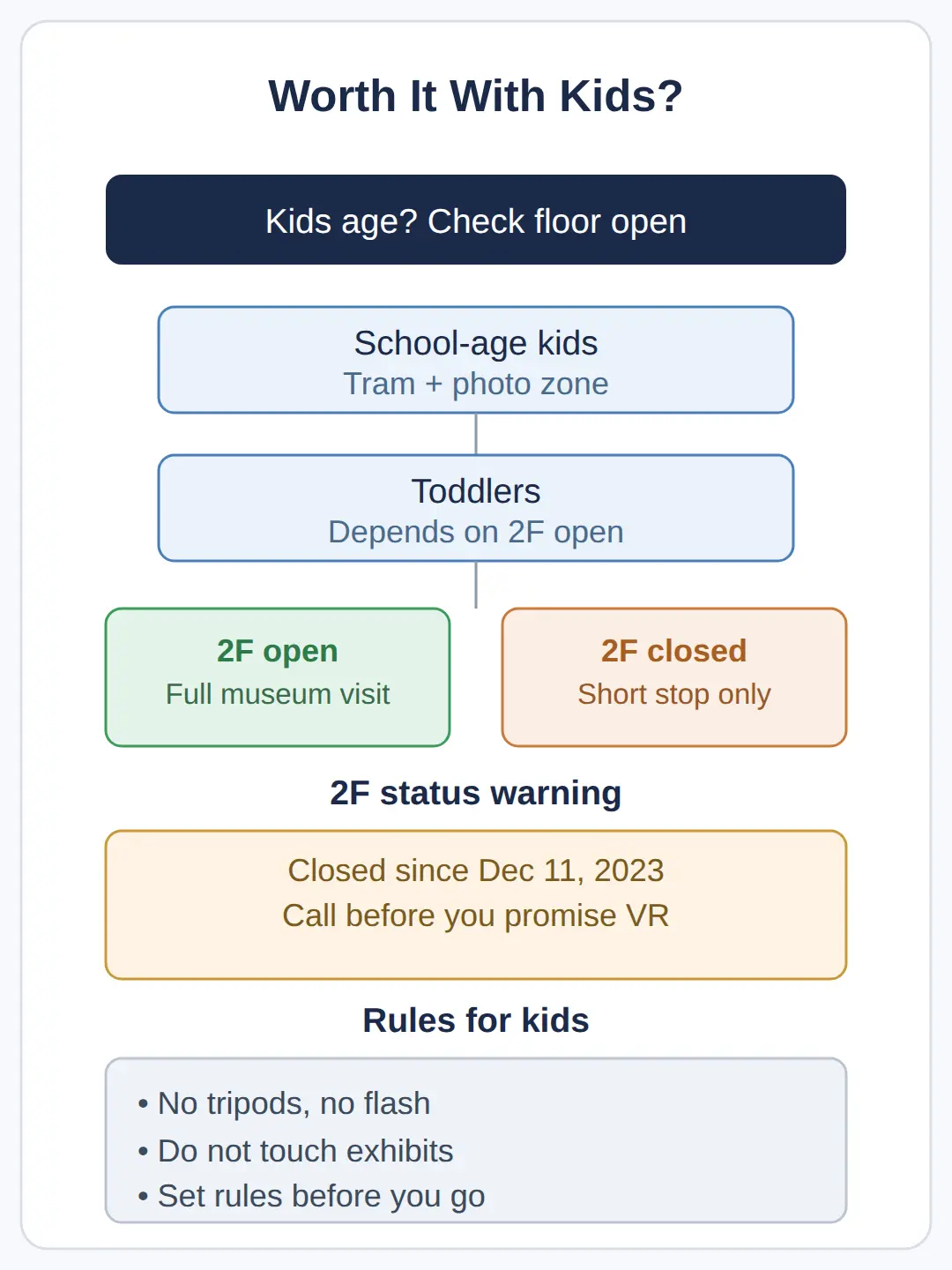
For school-age children, yes for the streetcar model and photo zone; for toddlers, it depends on what is open on 2F.
The visitseoul.net listing tags the museum as hands-on and educational, and the 3F tram exhibit lets kids operate a real control while sitting in a full-size partial streetcar.
The 2F New Energyum floor covers smart cities, EV charging, VR and smart home topics, which is where most interactive content would be.
However, the 2F was announced temporarily closed from December 11, 2023 for renovation ‘until further notice,’ and a reopening has not been confirmed since, so check the status by phone before promising children a VR experience.
Photos and video are allowed without tripods or flash, and exhibits should not be touched, which is worth setting out for kids in advance.
If the 2F is confirmed open, plan about a full museum visit; if only 1F and 3F are open, this is a shorter stop.
Before You Go: Reservations, Photography and Pairing the Visit
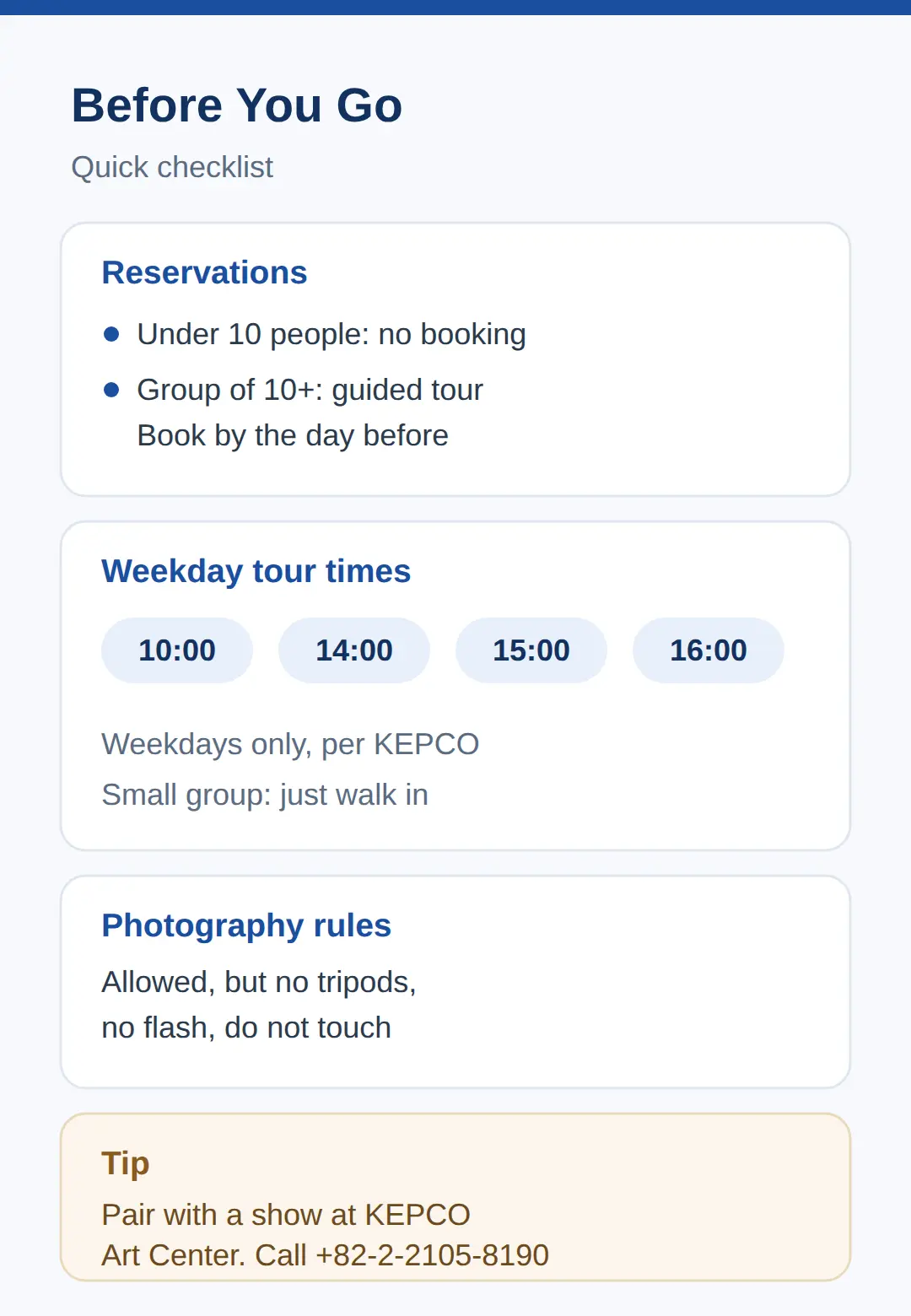
Individuals and groups under 10 need no reservation; groups of 10 or more can book a guided tour up to one day in advance, and tours run on weekdays at 10:00, 14:00, 15:00 and 16:00 per KEPCO’s page.
Photography and video are allowed, but no tripods or flash, and you should not touch the exhibits.
The museum sits inside KEPCO Art Center, which also houses a performance hall staging musicals and concerts plus a gallery, so a museum visit can be combined with a show or exhibition the same afternoon.
If you are going alone or with a small group, just turn up during the confirmed hours; if you want the guided tour for a group of 10 or more, book by the day before and target one of the four weekday slots.
Whether English-language guided tours or English signage are available is not stated in the sources, so call +82-2-2105-8190 if a tour in English matters to you.
If I were planning this visit, I would pick a weekday afternoon after a quick phone check on hours and the 2F floor, then look up what is on at the KEPCO Art Center hall that day and pair the two.
👉 Electricity Museum — official Seoul listing
👉 Electricity Museum — KEPCO official page
👉 National Meteorological Museum of Korea — hours guide
👉 Gyeonggyojang visiting guide — hours
Related posts
📎 Seoul — everything we know
📎 📅 Upcoming Dates — Release & Event Calendar
Sources
- visitseoul.net listing with address, phone, subway access, t (english.visitseoul.net)
- KEPCO official museum page with hours, admission, tour times (kepco.co.kr)
- 1F LED media wall, 2F New Energyum, 3F history hall; Geonche (home.kepco.co.kr)
Dates Worth Putting on the Calendar
- August 10, 2001 — the museum opened as Korea’s first museum dedicated to electricity.
- December 2001 — registered as a category-1 specialized museum.
- February 2023 — reopened after the ‘Connect On’ renewal.
- About 80,000 visitors a year since opening.
- This post’s numbers are as of the October 2, 2026 listing check — hours and the 2F status may have changed.
FAQ
Q. Is the Electricity Museum in Seoul free?
Yes. Admission is listed as free on both the visitseoul.net listing and KEPCO’s official page (checked October 2, 2026), so the cost of a visit is only transport and time.
Q. What are the opening hours and closed days?
KEPCO’s official page says Tuesday–Saturday 10:00–17:30, closed Sundays, Mondays and public holidays. visitseoul.net lists daily 10:00–18:00, closed Mondays. The two disagree, so call +82-2-2105-8190 before a weekend or Monday visit.
Q. How do I get to the Electricity Museum Seoul by subway?
Ride Line 3 or the Shinbundang Line to Yangjae Station, take Exit 1, and walk about 20 minutes to the KEPCO Art Center at 60 Hyoryeong-ro 72-gil, Seocho-gu.
Q. What can I see at the Electricity Museum Seoul?
Three floors: a 1F media-wall cultural space, a 2F New Energyum on future energy (closed for renovation since December 11, 2023, reopening unconfirmed), and a 3F history hall with the Geoncheonggung arc lamp, an Edison-era story line, and a full-size partial model of Seoul’s first streetcar.
Q. Where was Korea’s first electric light lit?
In spring 1887 at Geoncheonggung, a rear garden of Gyeongbokgung — about two years before electric light reached China’s Forbidden City or the Japanese imperial palace, and eight years after Edison’s carbon-filament bulb.
Check the KEPCO official page for the latest hours and the 2F reopening status before you go, then pair the museum with a show at the KEPCO Art Center.
Cover photo: AI-generated illustration (vintage light bulbs) — AI-generated image, illustrative only
#Seoul #ElectricityMuseum #KEPCO #YangjaeStation #freemuseumSeoul #museumwithkids #Gangnam
📅Upcoming Schedule — this week 4 · D-day Series launch at stores nationwide + 25% NH Nonghyup card diSee all →