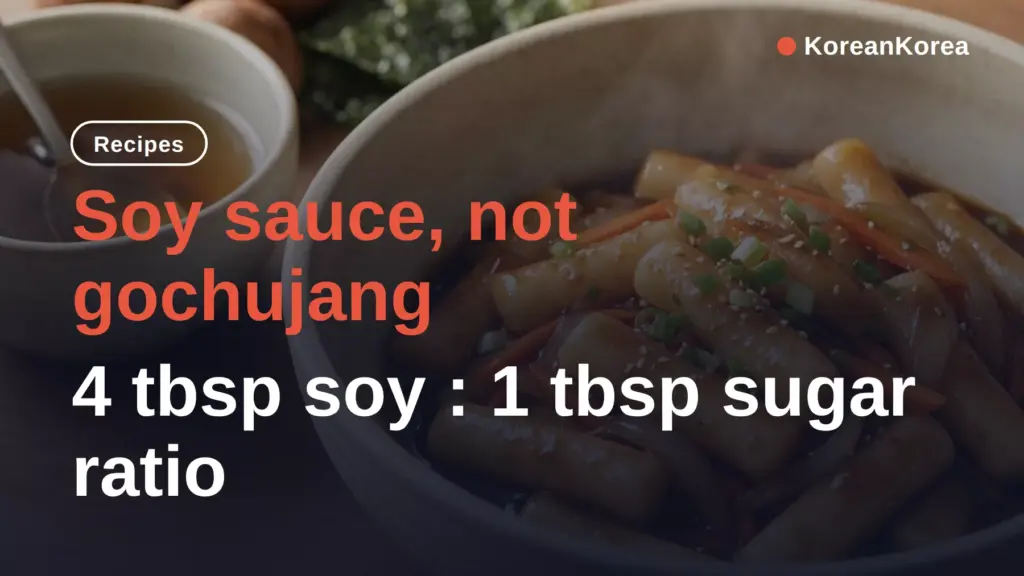
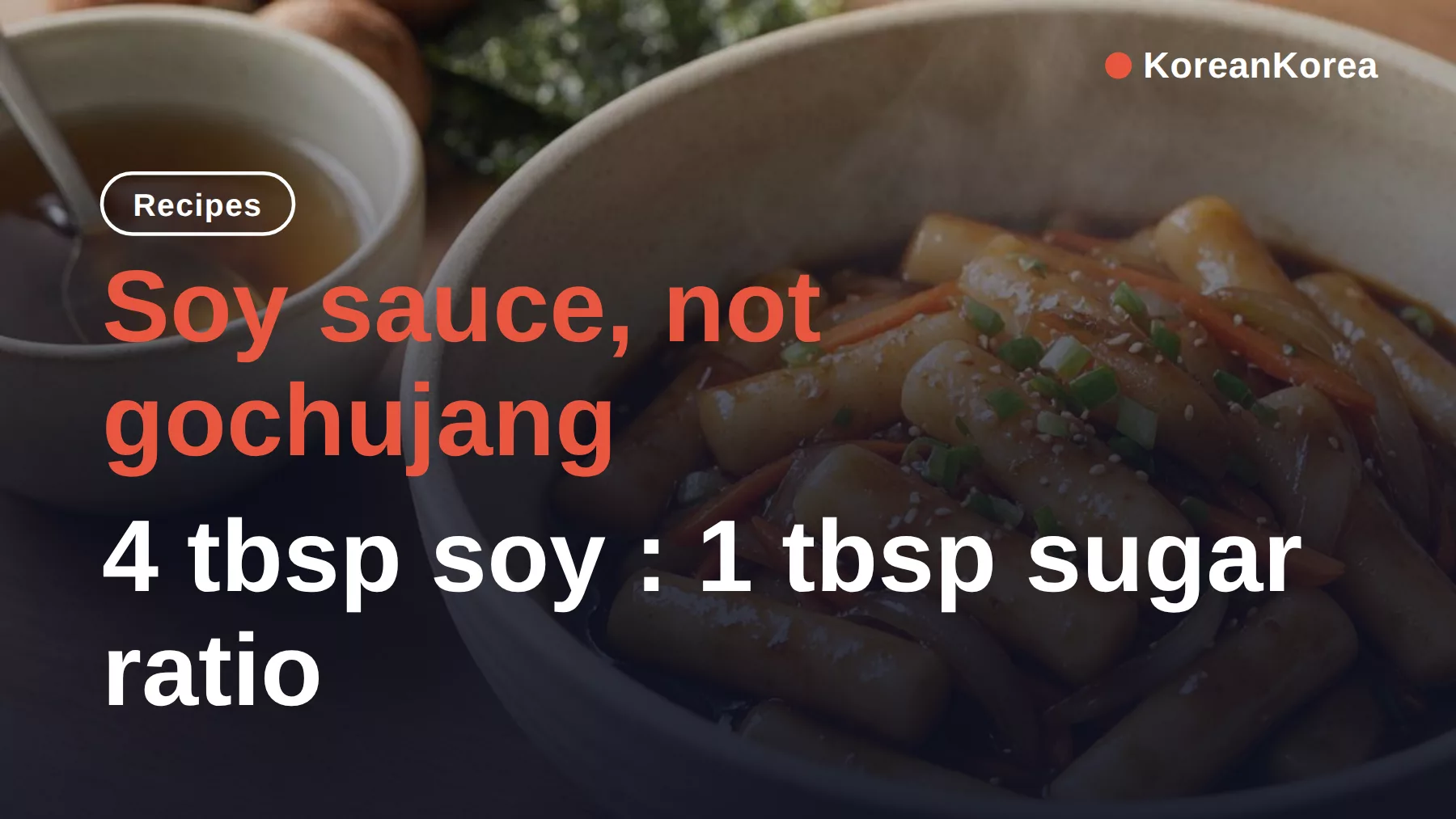
For tteokbokki that is not spicy, make the soy-based (ganjang) version: simmer rice cakes in anchovy-kelp broth with 4 tbsp soy sauce, 1 tbsp sugar, and 1 tbsp corn syrup — no gochujang anywhere.
That base contains zero chili ingredients, so the dish works for kids and for anyone who reads a gochujang label and stops.
The recipe below, the exact sauce ratio, swaps for fish cakes and hard-to-find tteok, and storage times are all answered in this post.
Contents
- Easy tteokbokki recipe not spicy: the 25-minute soy version, step by step
- Soy sauce tteokbokki sauce ratio (no gochujang)
- Is tteokbokki supposed to be spicy or sweet?
- Tteokbokki without fish cakes — and other swaps
- Making it kid-friendly: cut size, cheese, zero-chili check
- Storage, reheating, and timing by tteok type
Easy tteokbokki recipe not spicy: the 25-minute soy version, step by step
Skip gochujang entirely and season the rice cakes with soy sauce, sugar, and corn syrup in anchovy-kelp broth.
- Make the broth: 4 cups water, 5–6 dried anchovies, and 1 piece of kelp (dasima).
Simmer 10 minutes, then remove the anchovies and kelp.
- Soak 1.5 cups of rice cakes in cold water for 10 minutes while the broth simmers.
- Add the rice cakes plus a mix of 4 tbsp soy sauce and 1 tbsp sugar to 2.5 cups of the broth.
- Simmer uncovered 8–10 minutes, until the sauce coats a spoon.
- Add 1 tbsp corn syrup, let it reduce a little more, and finish with chopped green onion and toasted sesame seeds.
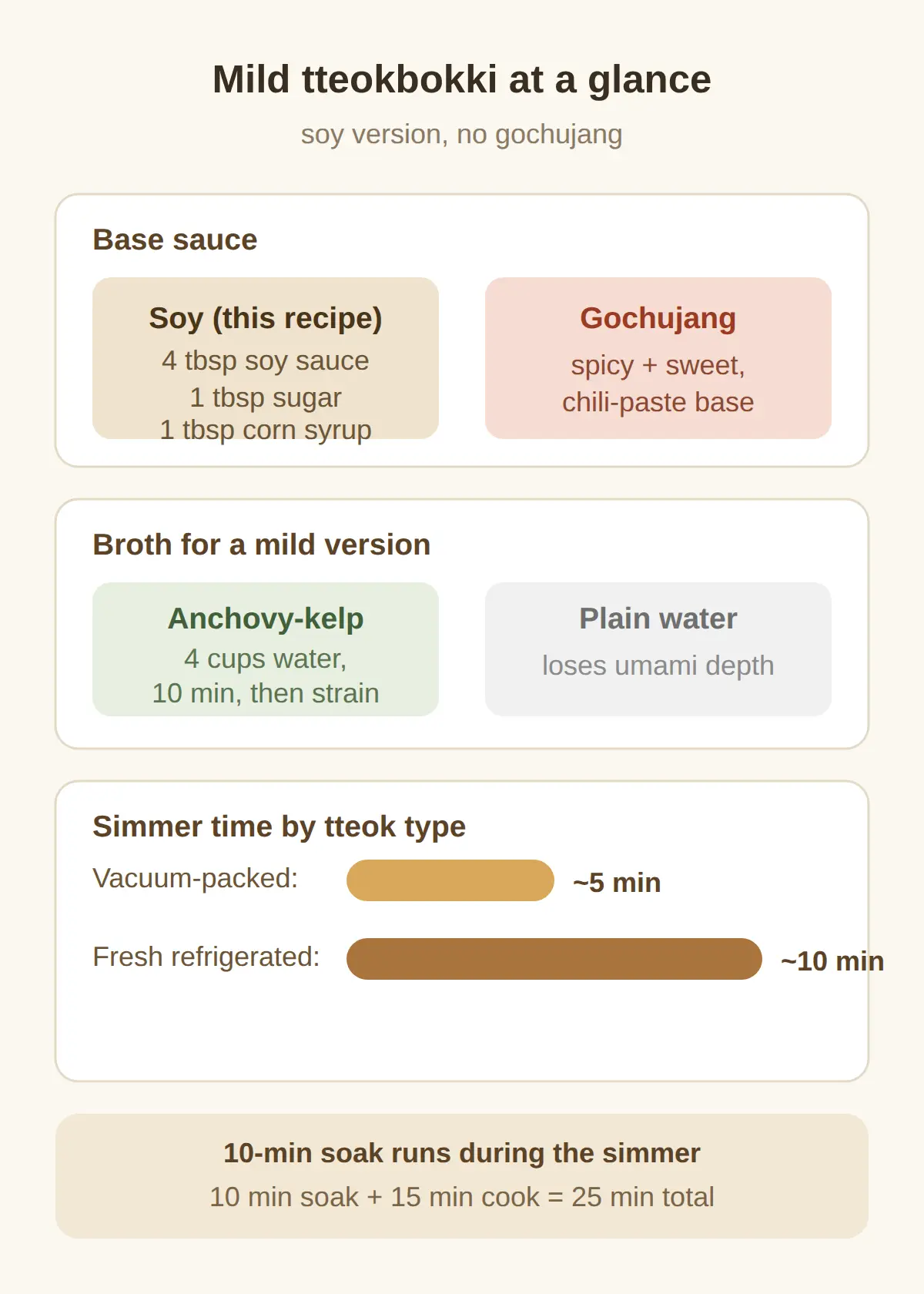
The 10-minute soak runs while the broth simmers, so the two steps cost 10 minutes, not 20.
From starting the broth to serving, it takes about 25 minutes in total — 10 minutes for the broth (with the 10-minute soak running alongside), then 8–10 minutes of simmering, plus a few minutes to reduce with the syrup and garnish.
When picking a mild tteokbokki recipe to follow, the first thing to check is which rice cakes it assumes — the vacuum-packed kind sold abroad usually needs a shorter simmer than the fresh refrigerated kind, and that changes the timing.
| You want tteokbokki with zero heat for kids | Use the soy (ganjang) base — it contains no chili ingredients at all |
|---|---|
| You don’t want fish cakes in it | Skip the eomuk and fill the pot with boiled eggs, onion, or green onion instead |
| Your rice cakes are frozen or refrigerated | Soak them in cold water 10 minutes first — or drop frozen ones straight into boiling broth and simmer a few minutes longer |
| You can’t find tteok where you live | Udon noodles or mochi with the same sauce is one option recipes allow — not a standard swap |
| A kid can’t bite through long rice cakes | Slice garae-tteok into 2–3 cm pieces before cooking |
| Someone in the house avoids gluten | Tamari instead of regular soy sauce is a common swap — the rice cakes themselves are rice-based |
Soy sauce tteokbokki sauce ratio (no gochujang)
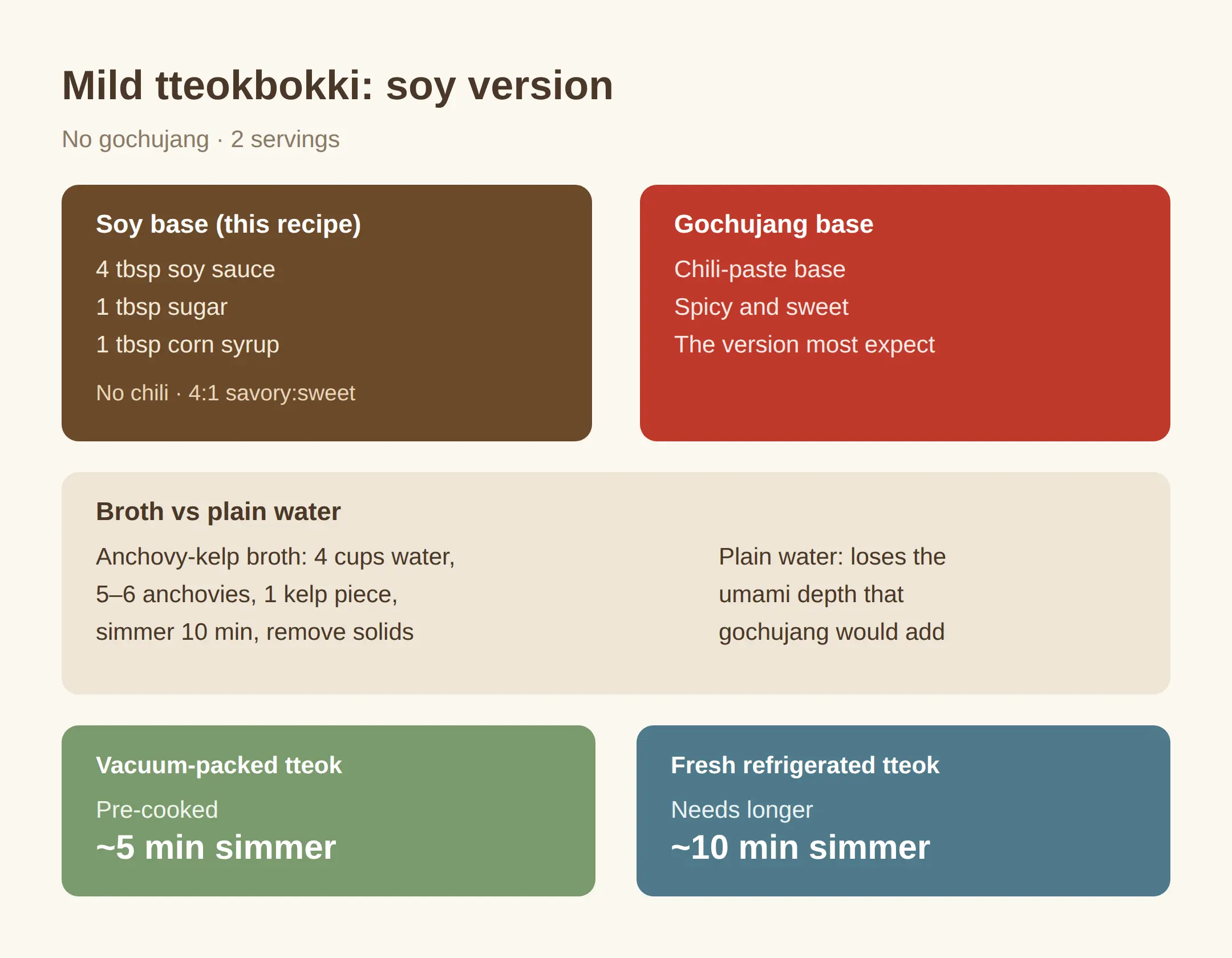
Soy-based tteokbokki uses 4 tbsp soy sauce, 1 tbsp sugar, and 1 tbsp corn syrup per 2 servings — a 4:1 sauce-to-sweetener ratio with zero chili ingredients.
The anchovy-kelp broth — 4 cups water, 5–6 dried anchovies, 1 piece kelp, simmered 10 minutes then removed — replaces plain water so the soy version keeps the savory depth that gochujang would normally add.
| Ingredient | Amount |
|---|---|
| Rice cakes (tteokbokki-tteok or sliced garae-tteok) | 1.5 cups |
| Soy sauce (regular brewed, jin ganjang) | 4 tbsp |
| Sugar | 1 tbsp |
| Corn syrup | 1 tbsp |
| Anchovy-kelp broth | 2.5 cups |
| Minced garlic | about 1 tsp |
| Green onion + toasted sesame seeds | to finish |
| Boiled eggs (optional) | 2 |
Regular brewed soy sauce (jin ganjang) is the recommended pick over dark soup soy sauce (guk ganjang), which makes the dish darker and changes the flavor.

Is tteokbokki supposed to be spicy or sweet?
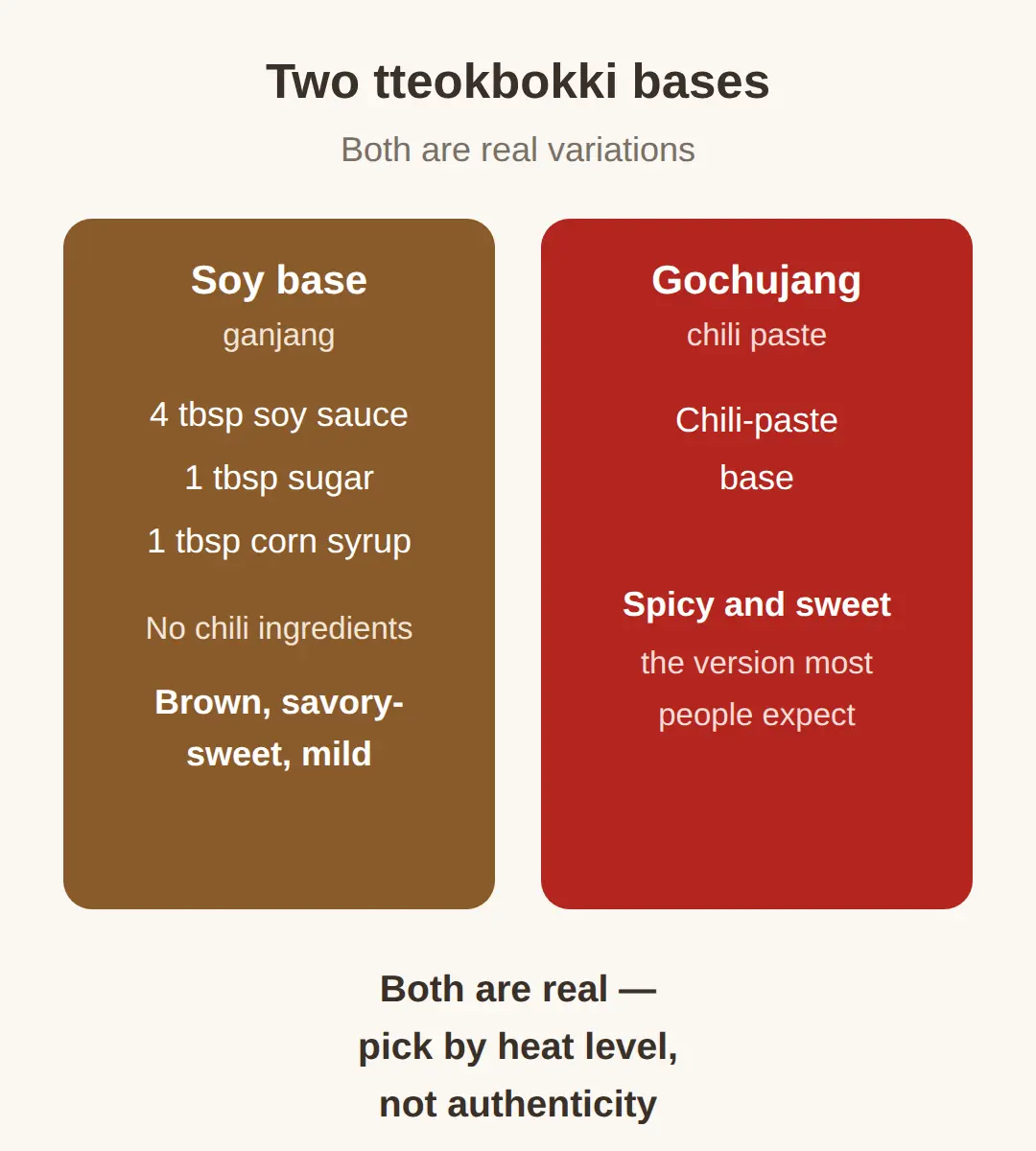
The gochujang version most people know is spicy and sweet at the same time, and soy-sauce tteokbokki is a separate, recognized variation built on a different seasoning base.
Korean food references document gochujang and ganjang (soy sauce) as two distinct seasoning bases for tteokbokki, so the mild version is not a lesser copy — it is a documented variation.
A question on r/KoreanFood asked on September 23, 2026 — "is tteokbokki supposed to be sweet" — shows how often the two versions get mixed up.
Removing gochujang changes more than heat: the soy version turns brown and savory-sweet, which is why soy recipes lean on extra sweetener and a real broth to fill the gap.
If the question is "which one is the real tteokbokki," the answer is both — order or cook by the heat level wanted, not by authenticity.
Tteokbokki without fish cakes — and other swaps
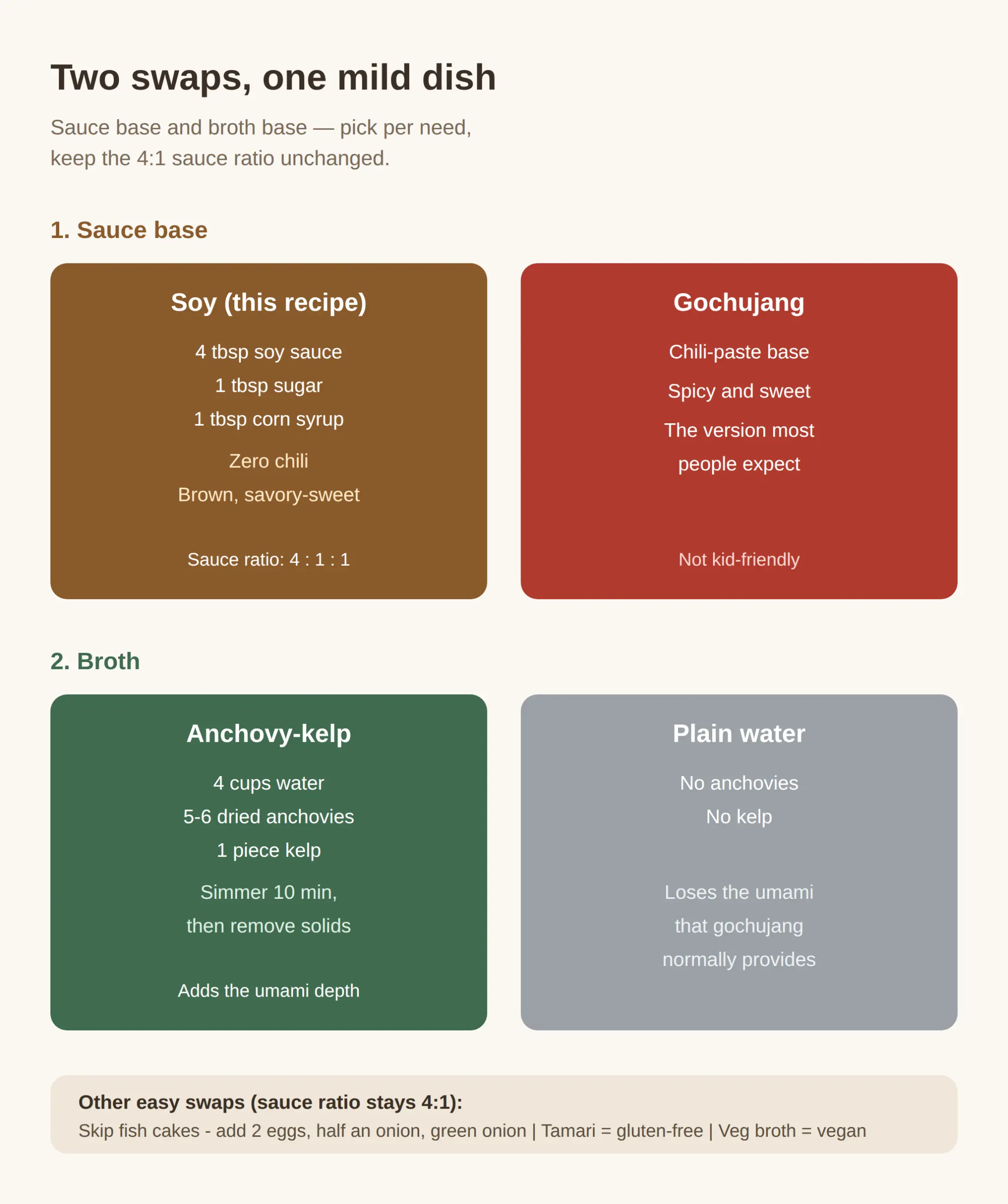
Fish cakes (eomuk) can be left out of mild soy tteokbokki; recipes that skip them commonly use 2 boiled eggs, half an onion, and green onion as fillers instead.
The eomuk mainly adds depth to the broth, and in the soy version that job belongs to the anchovy-kelp broth rather than the fish cake.
Additions that keep the dish mild and kid-friendly are standard in Korean home cooking: hard-boiled egg, mozzarella cheese, cabbage, and onion.
When fresh or frozen tteok is not available where you live, some recipes allow Japanese mochi or udon noodles with the same sauce — treat that as one option to try, not a standard replacement, because substitute suggestions vary widely between recipes.
Two further adaptations come up often in recipes: tamari instead of regular soy sauce for a gluten-free version, and kelp-only or vegetable broth instead of anchovy broth for a vegan one.
Pick the swap that matches the restriction in the house, and keep the sauce ratio unchanged — every one of these changes the fillers or the broth, not the 4:1 base.
Making it kid-friendly: cut size, cheese, zero-chili check
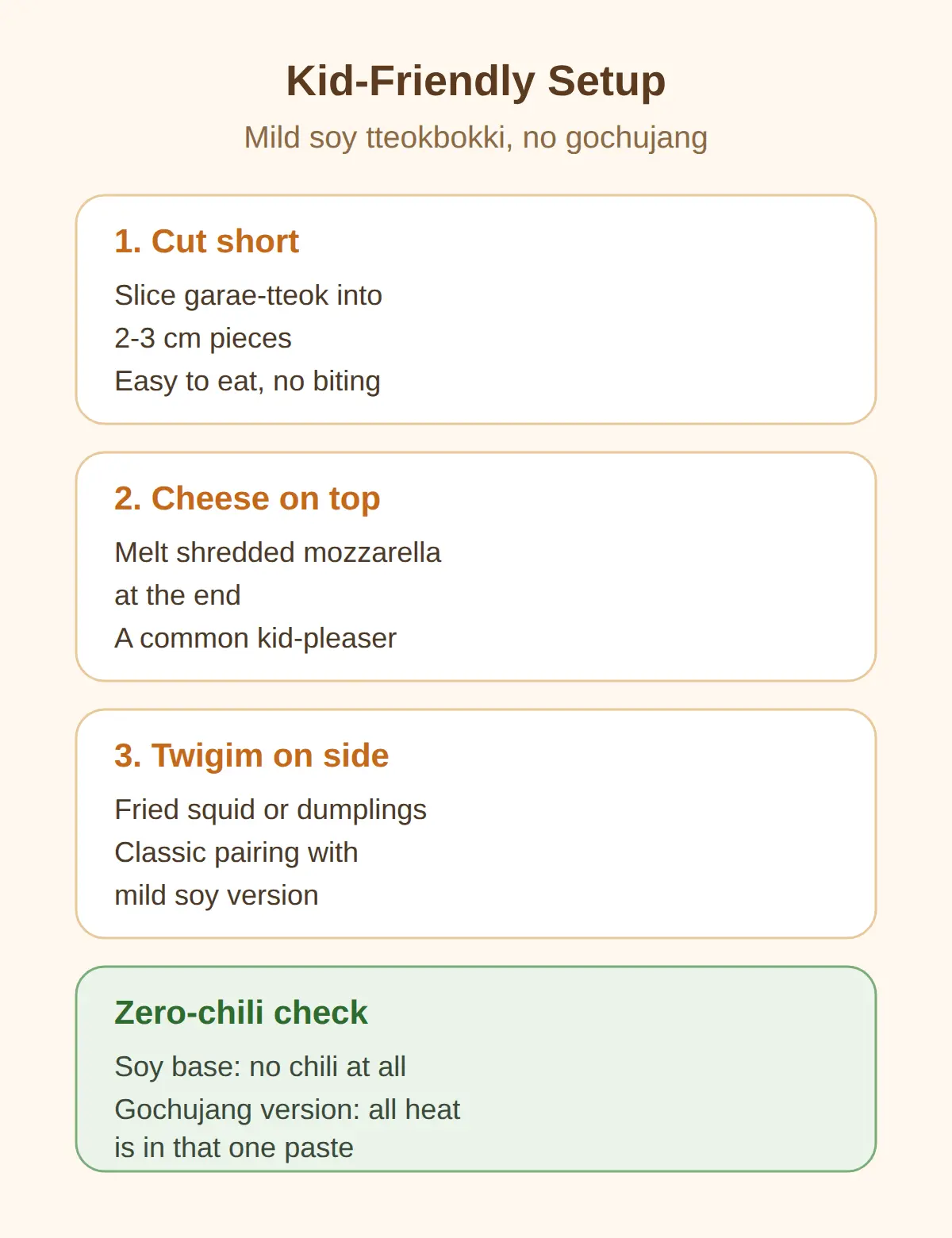
For kids, slice long garae-tteok into 2–3 cm pieces so they can eat each piece without biting through a long cylinder.
Refrigerated or frozen rice cakes should be soaked in cold water for 10 minutes before cooking to avoid a chewy center; recipes also allow a no-thaw shortcut where frozen tteok goes straight into boiling broth with a few extra minutes of simmering.
A handful of shredded mozzarella melted on top at the end is a common kid-pleaser finish for mild tteokbokki.
The heat check is simple: the soy base contains no chili ingredients at all, while the gochujang version carries all of its heat in that one paste.
On the table, tteokbokki is traditionally served with fried foods (twigim) such as fried squid or dumplings — a pairing that suits a mild soy version well.
If the eater is a small child, cut short + cheese on top + twigim on the side covers the whole kid-friendly setup without touching the sauce.
Storage, reheating, and timing by tteok type
Cooked soy tteokbokki keeps 2–3 days refrigerated in an airtight container; reheat in a pan with 2–3 tbsp of water to loosen the sauce.
The reheating splash of water matters because the sauce thickens in the fridge, and loosening it in a pan beats microwaving for texture.
Timing depends on the rice cake, not the recipe: vacuum-packed tteok sold abroad is usually pre-cooked and recipes call for a shorter simmer (around 5 minutes) than fresh refrigerated tteok (around 10 minutes) — treat those numbers as a starting point and check softness, since the exact difference is not confirmed on a primary source.
For a first pot, simmer 8–10 minutes uncovered, bite one rice cake, and judge from there rather than from the clock.
One caution on numbers: per-serving calorie figures for soy tteokbokki (roughly 400–500 kcal) come from recipe-site formats, not a nutrition authority, so they should not be quoted as a verified value.
If I were making this for kids, I’d build the anchovy-kelp broth first — it carries the savory depth that gochujang would otherwise supply, so the mild version doesn’t taste flat.
The first thing I check before anything else is the rice cake itself: whether it’s frozen, refrigerated, or vacuum-packed decides the soak and the simmer time.
Related posts
Sources
- Traditional pairing of tteokbokki with fried snacks document (korean-culture.org)
- 4 cups water + 5-6 anchovies + kelp, 10-min simmer as mild u (marcwiner.com)
- Standard stovetop cook time for tteokbokki is 15 minutes tot (programming-tree.tistory.com)
In short
- Soy (ganjang) tteokbokki = 4 tbsp soy sauce + 1 tbsp sugar + 1 tbsp corn syrup per 2 servings — zero chili ingredients.
- Build the anchovy-kelp broth instead of using plain water; that is where the savory depth returns once gochujang is gone.
- 25 minutes total: 10-minute soak (overlapping) + 15 minutes of cooking.
- Kids: cut rice cakes to 2–3 cm, finish with mozzarella, no gochujang at any step.
- Leftovers: 2–3 days refrigerated; reheat in a pan with a splash of water.
FAQ
Q. How do I make tteokbokki not spicy?
Use the soy (ganjang) base instead of gochujang: 4 tbsp soy sauce, 1 tbsp sugar, and 1 tbsp corn syrup per 2 servings, simmered in anchovy-kelp broth for about 10 minutes. The soy version contains no chili ingredients at all.
Q. Is tteokbokki supposed to be sweet or spicy?
The gochujang version most people expect is spicy and sweet; soy-sauce tteokbokki is a separate, documented variation that is savory-sweet and not spicy. Korean food references list gochujang and ganjang as two distinct seasoning bases.
Q. Can I make tteokbokki without fish cakes?
Yes. Skip the eomuk and use 2 boiled eggs, half an onion, and green onion as fillers — the anchovy-kelp broth, not the fish cake, carries the savory depth in the soy version.
Q. What can I use instead of gochujang in tteokbokki?
Soy sauce with sugar and corn syrup at a 4:1 ratio (4 tbsp soy sauce to 1 tbsp sugar) replaces gochujang entirely; honey or oligosaccharide can swap for the sugar by volume.
Q. How long does soy tteokbokki last in the fridge?
Cooked soy tteokbokki keeps 2–3 days refrigerated in an airtight container. Reheat it in a pan with 2–3 tbsp of water to loosen the sauce.
Next on the calendar: none — this is an evergreen recipe; pair it with the earlier easy tteokbokki with gochujang post to cook both bases side by side.
Cover photo: AI-generated illustration (rice cakes bowl) — AI-generated image, illustrative only
#tteokbokki #soysaucetteokbokki #notspicykoreanfood #kid-friendlykoreanrecipes #koreanricecakes
📅Upcoming Dates — 이번 주 32 · D-day Chuseok holiday period — rice cake interest peaks전체 보기 →