Neither Korean nor American skincare is uniformly better — in 2026 the deciding rule is the ingredient label, not the country.
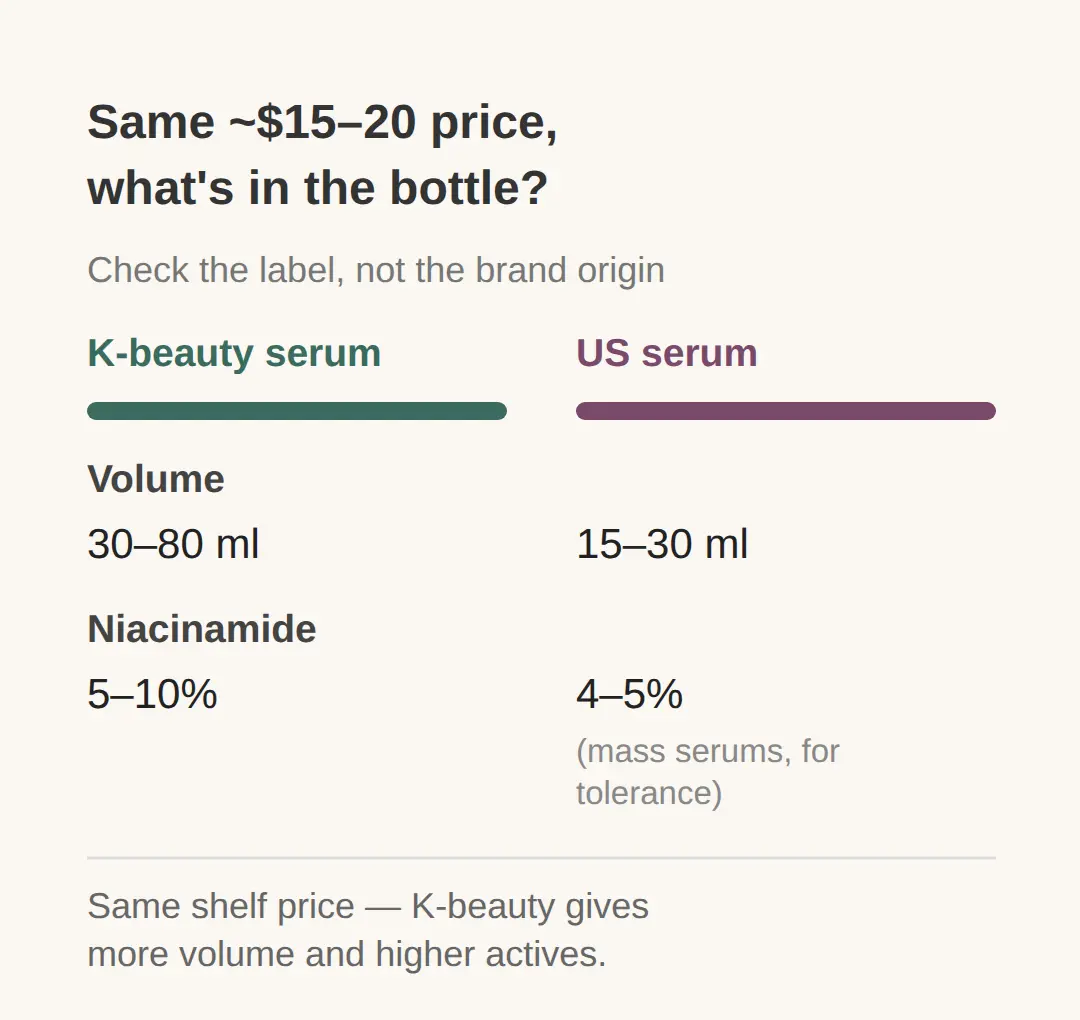
That matters now because both sit on the same shelf at the same $15–20 price, so picking by brand origin costs you either texture or tested strength.
This post answers the comparison question, gives a same-price checklist, explains the sunscreen rule behind the texture gap, and lists the Korean ingredients actually worth looking up.
Contents
- Is Korean skincare better than American? The 2026 verdict
- How to compare a K-beauty serum vs a US serum at the same price
- Why Korean sunscreens feel better — the regulation difference
- Which Korean ingredients are worth it
- Why US shoppers buy K-beauty — and what holds them back
- What to watch next
Is Korean skincare better than American? The 2026 verdict
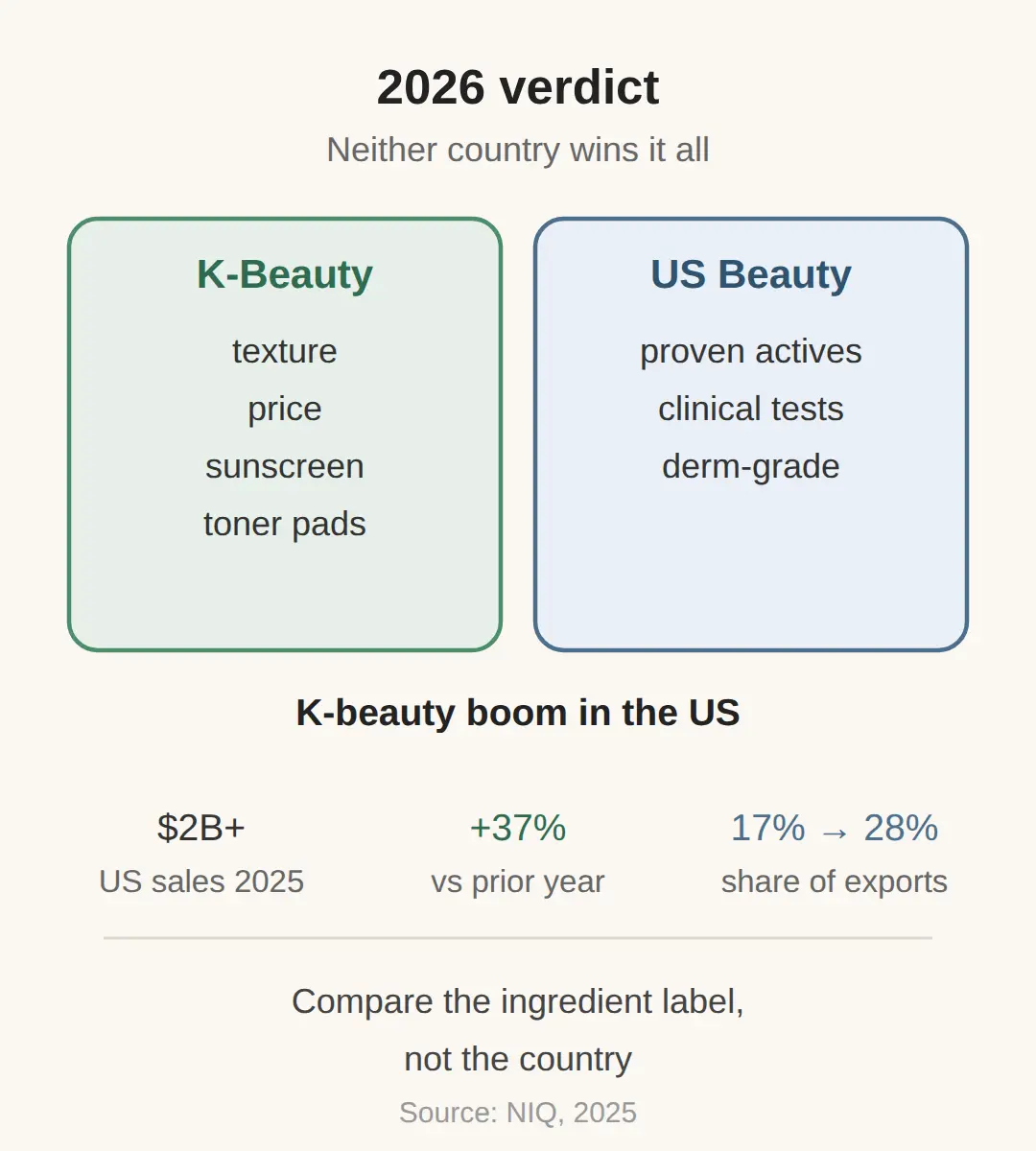
No — neither country wins on every product, and in 2026 shoppers compare the ingredient label instead of the country.
Korean products win on texture and price in formats like sunscreen and toner pads, while US products lead on actives with clinical testing behind them.
US sales of Korean cosmetics exceeded $2B in 2025, up 37% from the year before, and the US share of Korea’s cosmetics exports rose from 17% to 28% in two years (NIQ).
Both countries’ brands now compete at the same shelf price, so loyalty to either side buys you less than it used to.
If you care mostly about how a product feels and what it costs, Korean lines have the edge; if you care mostly about proven actives, US derm-grade labels are the safer start.
| A daily sunscreen with a light, non-greasy finish | Korean — the US treats sunscreen as a drug, which limits texture work |
|---|---|
| A strong, clinically tested active (retinol, acid treatment) | US derm-grade brands |
| Spot care or toner pads for trouble spots and scars | Korean — spot care and toner pads are the US growth categories |
| Same $15–20 shelf price, deciding on the label | Run the checklist in the next section — active %, ingredient order, testing |
| Brand values and social responsibility matter to you | US brands — US buyers weigh these more heavily than Korean buyers |
How to compare a K-beauty serum vs a US serum at the same price
Fix the price first, then compare four things on the label — the origin of the brand never enters the checklist.
- Active ingredient and its percentage — the ingredient that does the work, and how much is in it (shoppers in 2026 compare names like niacinamide 10% or tranexamic acid 4%).
- Ingredient order — the active should sit above the preservative in the list, which tells you it is not a dusting.
- Formulation for your skin type — texture, hydrating base, and whether it fits your routine.
- Irritation and redness testing — quantitative claims (for example, redness down 36% over 8 weeks) match how US shoppers verify a product.
When I look at any serum now, I check the ingredient name and its percentage first, before I even notice which country the brand is from.
If two products sit at the same ~$15–20 price, compare those four points — and I would wait to buy until at least the testing box is ticked, because that is the cheapest way to rule out a bad pick.
Why Korean sunscreens feel better — the regulation difference
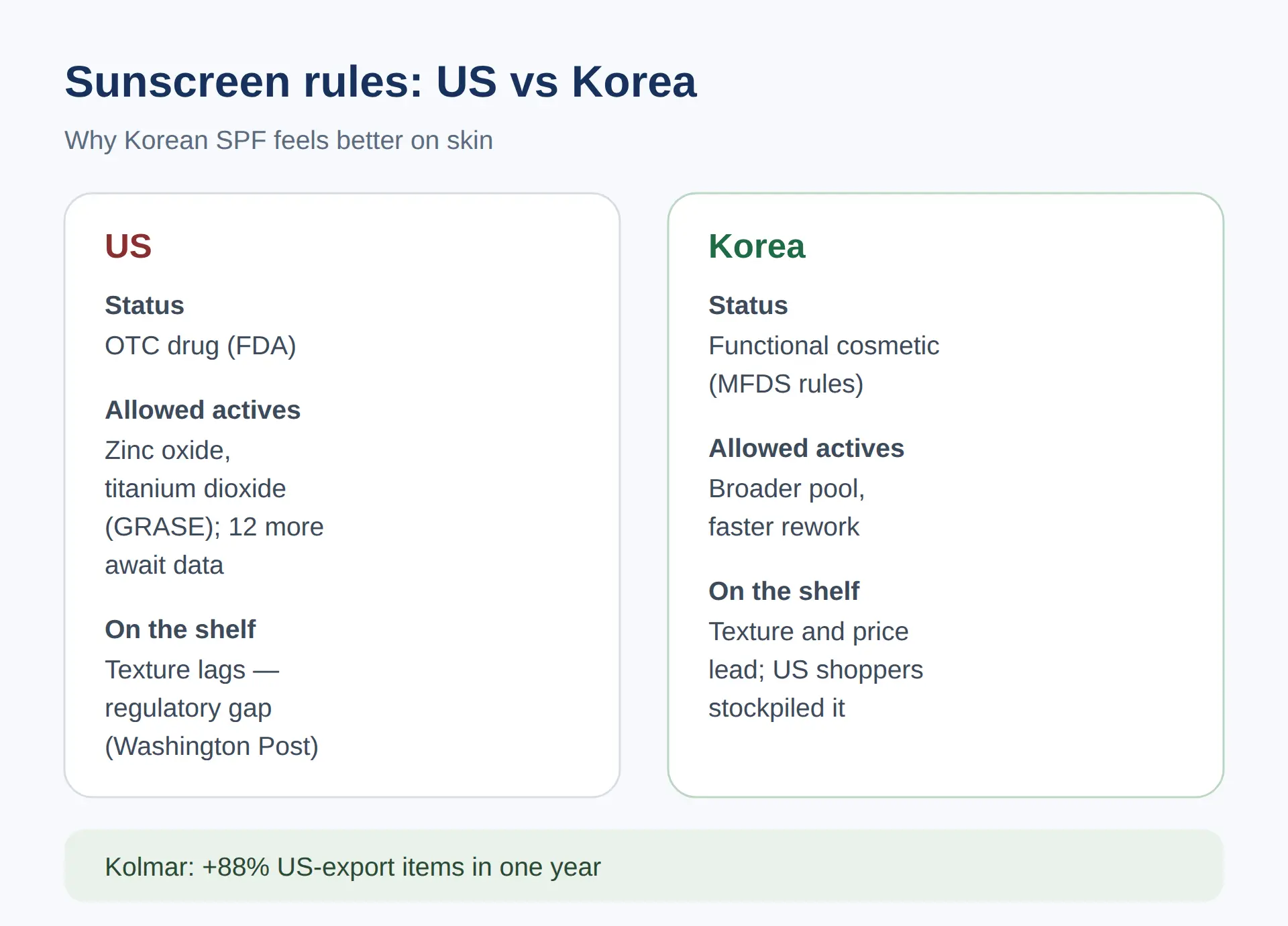
Korean sunscreens lead on texture and price because the two countries regulate them differently.
| Item | US | Korea |
|---|---|---|
| Regulatory status | Over-the-counter drug | Functional cosmetic (MFDS rules) |
| Recognized active ingredients | Only zinc oxide and titanium dioxide (FDA 2019 proposed rule); 12 others still await more data | Broader ingredient pool, formulas reworked faster |
| Result on the shelf | Texture lags — the Washington Post cited the regulatory gap as the reason | Texture and price lead; US shoppers stockpiled Korean SPF |
Korean manufacturers are also scaling up for US demand: Kolmar produced 88% more OTC-certified sunscreen items for US export in one year, and Cosmax is tripling sunscreen SKUs at its New Jersey plant (2026).
If texture decides your sunscreen, the Korean shelf is where the options are; if you need a formula your dermatologist already trusts under US rules, zinc oxide and titanium dioxide products are the safe shortlist.
Which Korean ingredients are worth it
Snail mucin, centella, heartleaf, PDRN, niacinamide, ceramide, propolis, mugwort, and rice extract are the ingredient names US shoppers actually search in 2026.
Snail mucin is the most-searched of the set, with COSRX Snail 96 Essence as the benchmark product; reporting puts it around $25.
Beauty of Joseon Relief Sun and Anua Heartleaf 77 Toner, cited around $18 and $21, show the same pattern — prestige-level actives at mass prices.
Note those prices come from press coverage, not retailer pages, so treat them as a ballpark and check the current price where you buy.
Anua Heartleaf 77 and Medicube PDRN lines each sold out on Amazon, Sephora, and Ulta at the same time within 12 weeks of TikTok virality (2026, CNBC/NIQ), so popular items go fast.
If you are in your 20s–30s working on trouble spots or acne scars, spot care and toner pads are where US demand is growing — that is where to start from this list.
Why US shoppers buy K-beauty — and what holds them back
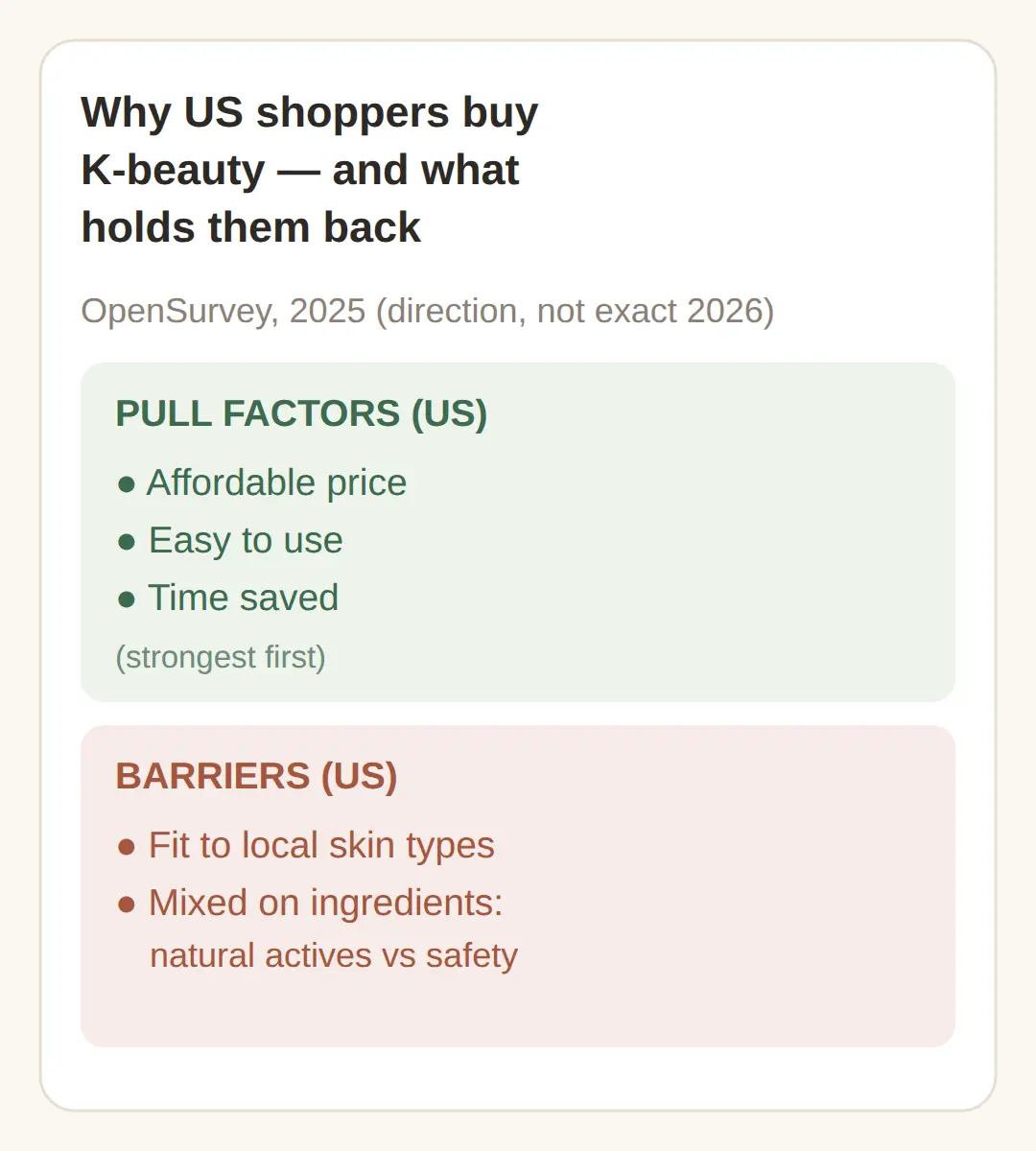
Affordable price is the strongest pull factor for K-beauty among US consumers, along with easy use and time saved.
The main barriers are doubts about whether it fits local skin types, plus mixed feelings on ingredients — interest in natural-derived actives sits next to safety concerns (OpenSurvey, 2025).
US buyers rank ease of use and time saved first, while Korean buyers rank efficacy first, and US consumers weigh brand values and social responsibility more heavily than Korean consumers do.
The driver numbers are from a 2025 survey, not 2026 — the direction is useful, but the exact figures may have moved.
If your priority is a short routine that saves time, K-beauty fits that well; if you buy on brand values, US labels align better with how that priority is weighted.
What to watch next
Two things will decide how this comparison looks by the end of 2026: whether the FDA adds sunscreen ingredients to its safe list, and how far ingredient-first shopping spreads.
The FDA list is still the 2019 proposal — zinc oxide and titanium dioxide only, with 12 ingredients waiting on data — and any change there widens or narrows the sunscreen texture gap directly.
On the shopping side, foreign companies are already borrowing Korean ingredients, textures, and concepts, and retinol, niacinamide, and peptide content are now cited as the main purchase criteria for Korean cosmetics.
US production capacity is catching up too: Kolmar’s North America output is heading from about 180M to 300M units.
One figure circulating — that roughly 60% of shoppers use ingredient-analysis apps — comes from a single column and is an anecdote, not a verified stat, so I would not build a decision on it.
Watch the FDA ingredient list and the label on your next serum; those two tell you more than any trend report.
Related posts
📎 Olive Young — everything we know
📎 📅 다가오는 일정 — 발매·개봉·발표 캘린더
Sources
- Ingredient-first shopping trend confirmed by Eztto column 20 (eztto.com)
- K-beauty ingredients, textures, concepts adopted by foreign (kagit.kr)
- Ease of use and time savings beat ingredient focus for US bu (blog.opensurvey.co.kr)
Summary
- Compare the ingredient label, not the country — active percentage, ingredient order, skin-type fit, testing.
- Before buying sunscreen or toner pads, check the retailer’s current price and stock — benchmark SKUs like Beauty of Joseon Relief Sun (~$18) and Anua Heartleaf 77 (~$21) sell out fast after TikTok virality.
- Check the sunscreen label for zinc oxide or titanium dioxide if you want a formula already recognized under US rules.
- Match the ingredient to your concern: spot care for trouble and scars through your 30s, or hydration via toner pads.
- Prices quoted around $18–25 for benchmark K-beauty SKUs are press figures — confirm at the retailer before buying.
FAQ
Q. Is Korean skincare actually better than American skincare?
Neither is uniformly better. Korean products lead on sunscreen and toner pad texture and price; US products lead on clinically tested actives. In 2026 the deciding rule is the ingredient label, not the country.
Q. Which Korean ingredients are worth it?
The names US shoppers search most are snail mucin (COSRX Snail 96 is the benchmark), centella, heartleaf, PDRN, niacinamide, ceramide, propolis, mugwort, and rice extract.
Q. Why do Korean sunscreens feel better than American ones?
The US treats sunscreen as an over-the-counter drug and the FDA’s 2019 proposed rule recognizes only zinc oxide and titanium dioxide as known-safe actives; Korea treats it as a functional cosmetic, so formulas iterate faster.
Q. How do I compare a K-beauty serum and a US serum at the same price?
Fix the price, then compare the active ingredient and its percentage, whether the active sits above the preservative in the ingredient list, the formulation for your skin type, and irritation or redness testing.
Q. How big is K-beauty in the US market?
US sales of Korean cosmetics exceeded $2B in 2025, up 37% in one year, and the US share of Korea’s cosmetics exports rose from 17% to 28% in two years (NIQ). About 70% of those sales happen online.
Dates to check next: the FDA’s proposed sunscreen ingredient rule (2019, still the current framework) and the 2026 Kolmar and Cosmax US production ramp-ups — both will move the sunscreen comparison.
퇴사한아빠 — 진짜 일잘하는 사람의 GPT 프로젝트 & 구글 잼스 세팅법! (시장조사→데이터분석→보고서 실무 프로젝트 세팅 프롬프트 무료공개)
Cover photo: AI-generated illustration (sunscreen tubes) — AI-generated image, illustrative only
#koreanskincare #k-beauty #sunscreen #skincarecomparison #oliveyoungalternatives #niacinamide
📅Upcoming Dates — 이번 주 32 · D-day Chuseok holiday period — rice cake interest peaks전체 보기 →