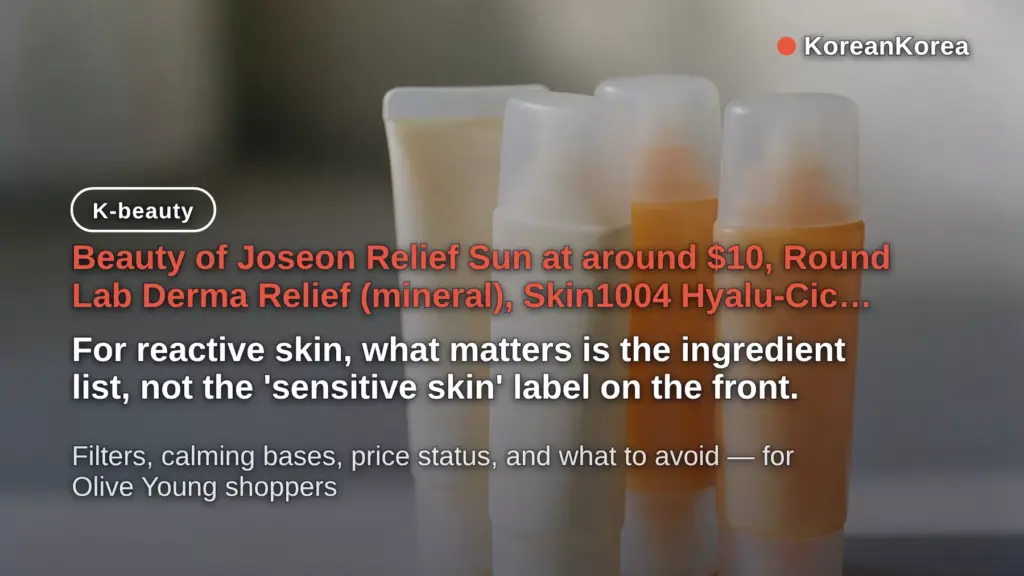
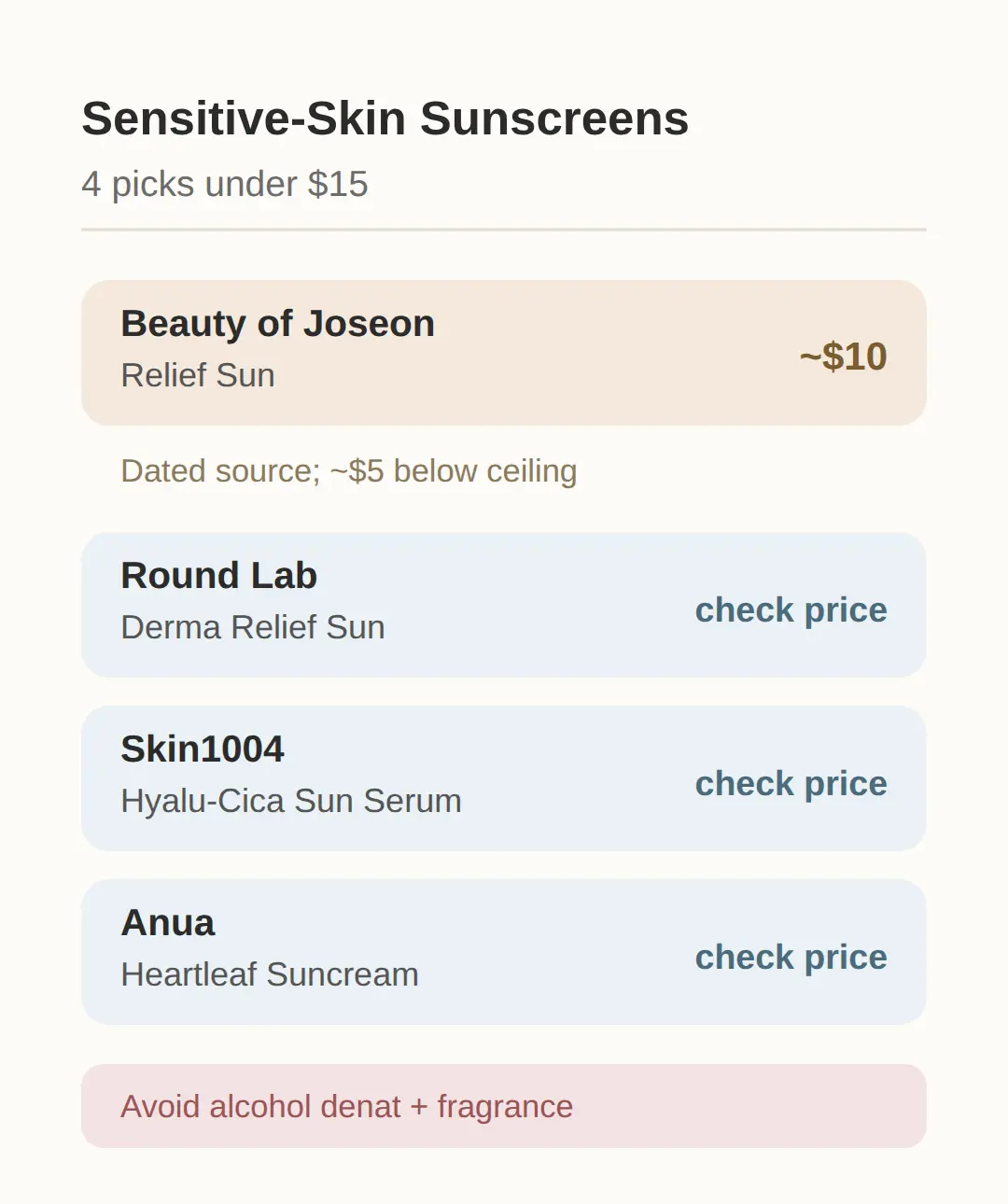
The sensitive-skin picks under $15 at Olive Young Global are Beauty of Joseon Relief Sun at around $10, Round Lab Derma Relief Sun, Skin1004 Hyalu-Cica Water-Fit Sun Serum, and Anua Heartleaf Soothing Suncream — with heartleaf, cica, and panthenol as the calming bases to look for.
Olive Young Global lets shoppers filter sunscreens by ‘sensitive’ skin type, so the four names above are the ones you will actually see at the top of that shelf.
This post covers which of those are mineral versus chemical filters, whether Beauty of Joseon or Anua fits redness better, what to avoid on the ingredient list, and how much to apply.
Korean Sunscreen for Sensitive Skin: the Picks Under $15
| Beauty of Joseon Relief Sun | Chemical, SPF50+ PA++++ | Soothing humectants; no added fragrance | ≈$10 at Olive Young (2026 buying guide); exact current USD price: check Olive Young Global |
|---|---|
| Round Lab Derma Relief Sun | Mineral (inorganic), positioned for sensitive skin | Panthenol listed in the formula’s INCI; no added fragrance | Exact USD price: check Olive Young Global |
| Skin1004 Hyalu-Cica Water-Fit Sun Serum | Chemical, SPF50+ PA++++ | Centella (cica) extract | Exact USD price: check Olive Young Global |
| Anua Heartleaf Soothing Suncream | Chemical, SPF50+ PA++++ | Heartleaf (houttuynia cordata) extract, the 77% line is marketed for sensitive skin | Exact USD price: check Olive Young Global |
Four names cover the sensitive-skin shelf under $15: Beauty of Joseon Relief Sun at around $10, Round Lab Derma Relief Sun, Skin1004 Hyalu-Cica Water-Fit Sun Serum, and Anua Heartleaf Soothing Suncream.
Beauty of Joseon Relief Sun lists at around $10 as a top tourist SPF buy at Olive Young (a 2026 Olive Young buying guide), which is about $5 under this guide’s $15 ceiling — enough headroom for a second tube or a calming toner.
Olive Young Global’s sunscreen bestsellers are dominated by exactly these four brands, and the site lets you filter sunscreens by ‘sensitive’ skin type before you buy.
The calming ingredient lines to look for are heartleaf (Anua), cica or centella (Skin1004), and panthenol — vitamin B5, which draws in moisture and shows up in several 2025–2026 Korean sunscreen formulas such as Round Lab and Torriden.
When I screen a sunscreen for reactive skin, I check the ingredient list for alcohol denat and fragrance first — not the ‘sensitive skin’ label on the front.
Exact current USD prices for the Round Lab, Skin1004, and Anua tubes could not be confirmed on a first-party price page, so check Olive Young Global for those before checkout; only the Beauty of Joseon figure above carries a dated source.
If your skin stings with lightweight ‘fresh’ formulas, filter by ‘sensitive’ on Olive Young Global and open the ingredient list of each candidate before adding anything to the cart.
Physical vs Chemical Korean SPF: Which Fits Reactive Skin?
For reactive skin, mineral (physical) sunscreens are generally the safer starting point, and Round Lab Derma Relief Sun is the mineral pick in this list.
Physical sunscreens sit on the skin and deflect UV using zinc oxide or titanium dioxide, while chemical filters absorb UV — that distinction comes from dermatology guidance for sensitive skin (American Academy of Dermatology, June 2025).
Round Lab Derma Relief Sun is marketed as an inorganic-filter sunscreen for sensitive skin, part of the Derma Relief line built around calming ingredients.
The other three picks are chemical-filter formulas: Anua Heartleaf Soothing Suncream and Skin1004 Hyalu-Cica are both SPF50+ PA++++ chemical sunscreens, which typically feel lighter but more often carry the lightweight-formula extras to watch for.
Mineral formulas can leave more of a white cast than chemical ones, and many Korean sunscreens mix both filter types — so read the INCI list per product rather than assuming a tube is purely one or the other.
If your skin reacts easily or flares with redness, start with the mineral option; if white cast matters more to you than the calmer formula, the chemical picks with heartleaf or cica bases are the alternative.
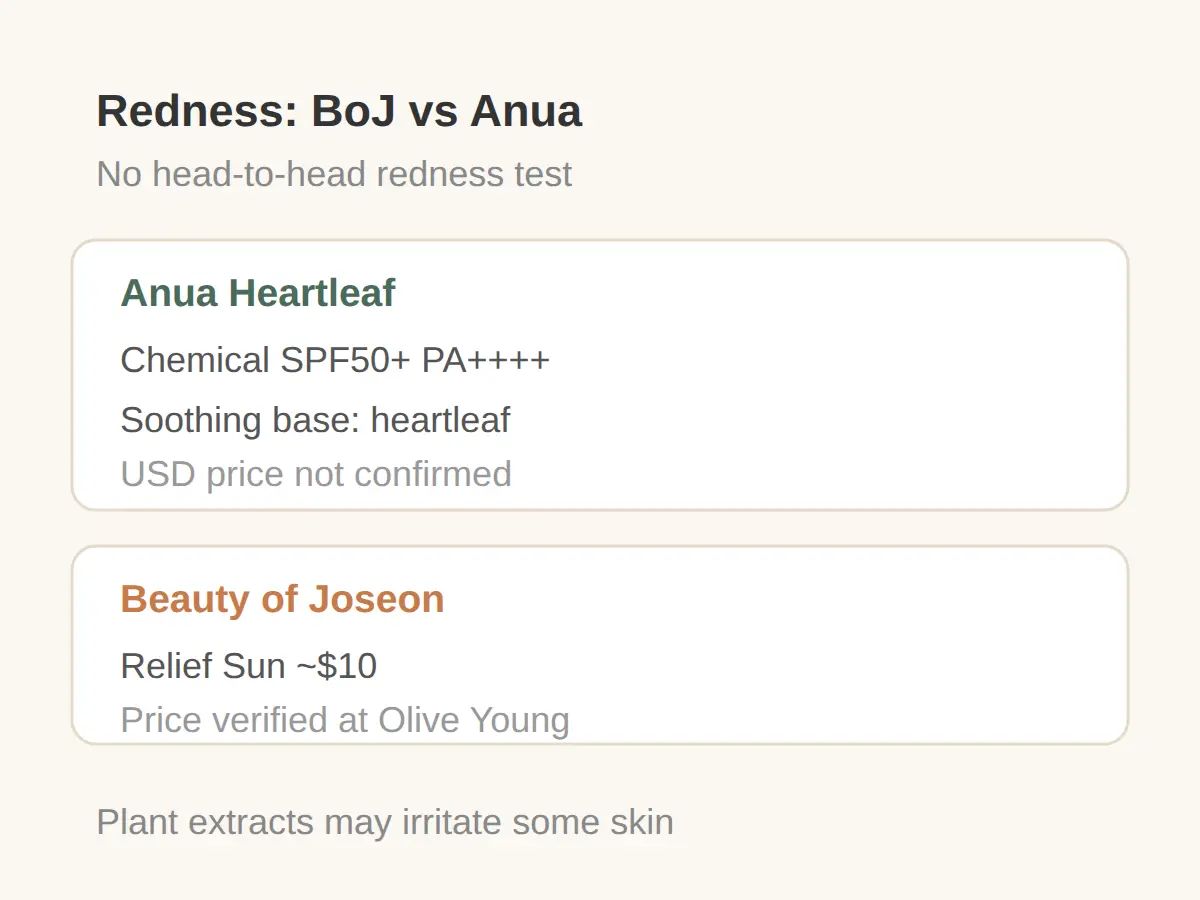
Beauty of Joseon vs Anua for Redness: What the Labels Actually Say
There is no confirmed head-to-head comparison of Beauty of Joseon Relief Sun versus Anua Heartleaf Soothing Suncream specifically on redness, so the choice rests on filter type and ingredient facts alone.
Anua Heartleaf Soothing Suncream is a chemical-filter SPF50+ PA++++ with heartleaf (houttuynia cordata) extract as the soothing base, and Anua markets the Heartleaf 77% line for sensitive, reactive skin.
What you can check yourself is the price position and the label: Anua’s exact USD price was not confirmed on a first-party page, while Beauty of Joseon Relief Sun sits at around $10 — so if budget is the deciding factor, the price difference is the part you can verify at Olive Young Global today.
If your skin reacts to plant extracts, heartleaf will not automatically suit you, and neither will cica; if you want a soothing plant base and prefer chemical filters, Anua is the pick to compare against Beauty of Joseon.
What to Avoid on the Ingredient List — the COSRX Aloe Example
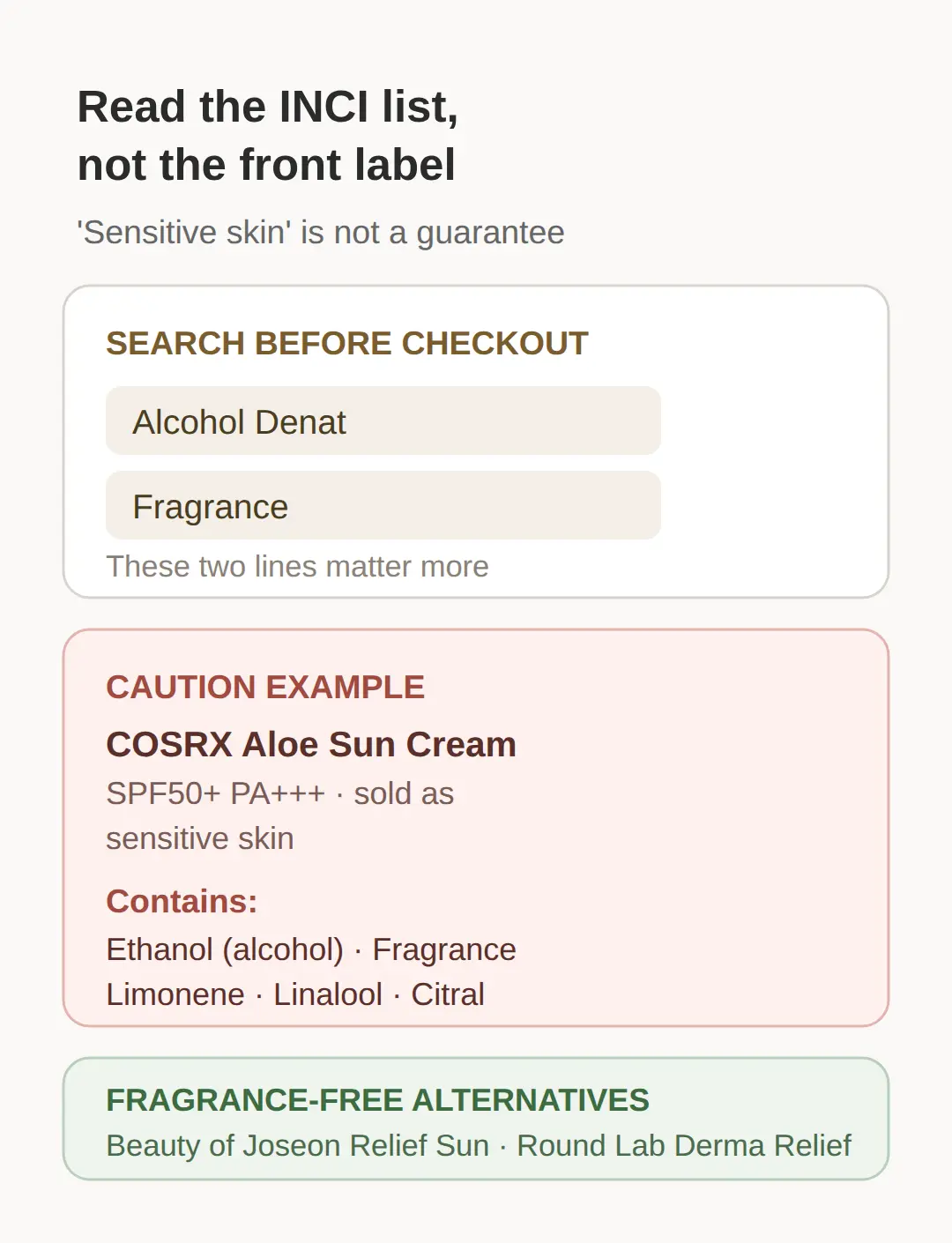
Before buying anything sold as ‘for sensitive skin’, check the ingredient list for alcohol denat, fragrance, and citrus-derived allergens — the COSRX Aloe Soothing Sun Cream is the worked example.
COSRX Aloe Soothing Sun Cream SPF50+ PA+++ is registered in Korea as a UV-blocking functional cosmetic and specified for sensitive skin, yet its full ingredient list includes ethanol (alcohol), fragrance, and the citrus allergens limonene, linalool, and citral (official COSRX mall page, October 2026).
That same tube lists at ₩12,800, shown discounted to ₩8,900 on the official COSRX mall — primary-page prices, though the page carries no date, so treat the figure as indicative rather than a current promotion.
By contrast, Beauty of Joseon Relief Sun and Round Lab Derma Relief are formulated without added fragrance, a spec you can verify on each brand’s ingredient list.
The ‘sensitive skin’ label is not a guarantee: the alcohol and fragrance in a formula matter more to reactive skin than the front-of-tube claim.
If your skin stings with lightweight ‘fresh’ sunscreens, open the INCI list and search it for ‘Alcohol Denat’ and ‘Fragrance’ before checkout — those two lines tell you more than any marketing copy.
How Much to Apply and How to Test a New Sunscreen
Use two-finger length of sunscreen (about a quarter teaspoon) for the face, and reapply every 2 hours of sun exposure — the standard dose applies to sensitive-skin formulas too (American Academy of Dermatology, June 2025).
Two-finger length per application, reapplied every 2 hours of sun exposure, means a standard 50ml tube lasts roughly 5 weeks with one daily application — far less with proper reapplication.
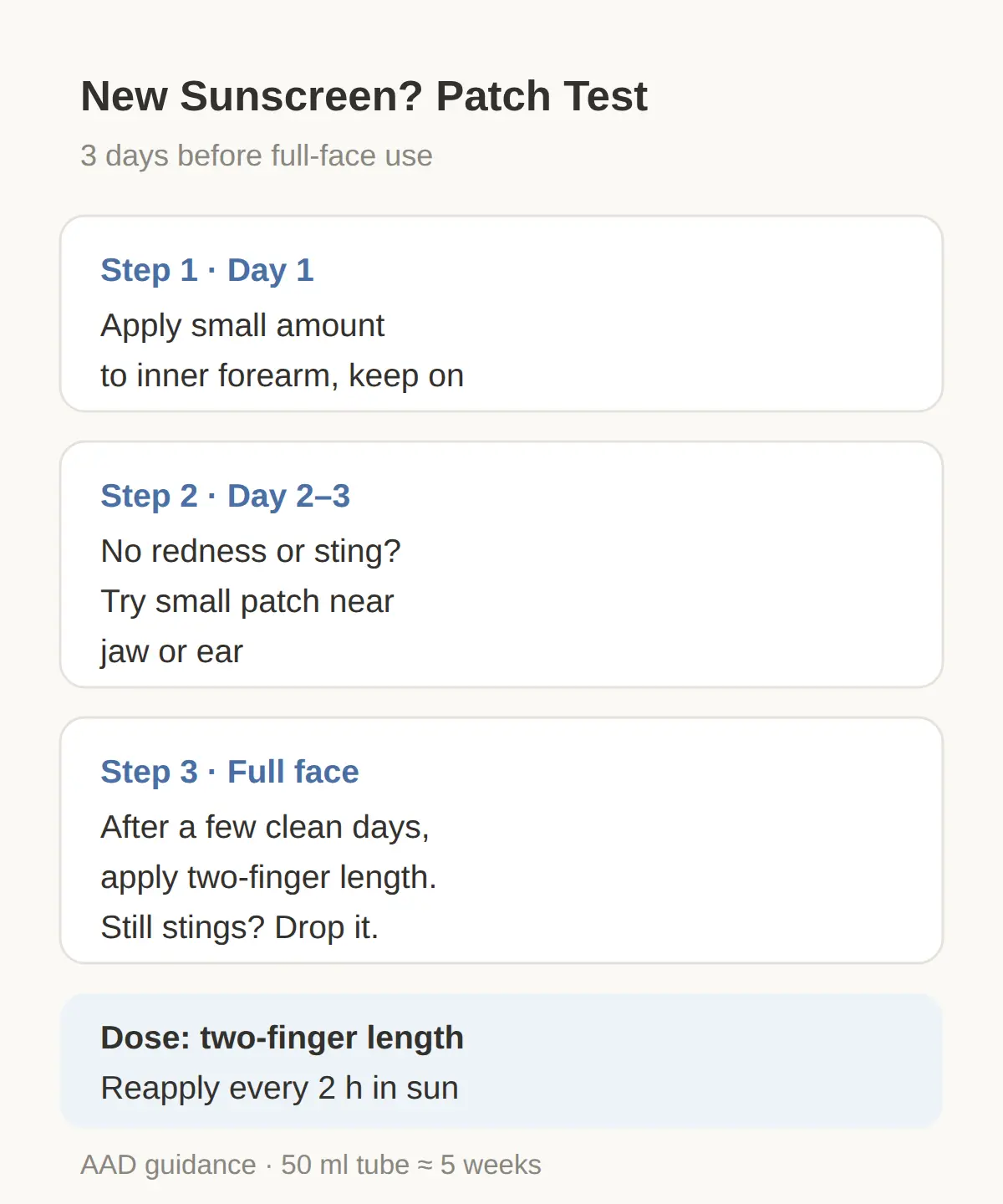
Dermatology guidance for reactive skin is to test a new sunscreen on a small patch of the face or the inner forearm for a few days before applying it to the whole face.
How you do it:
- On day one, apply a small amount to the inner forearm and leave it unwashed for several hours.
- If the forearm shows no redness or stinging, try a small patch near the jaw or ear on day two or three.
- Only after a few clean days apply it full-face, at two-finger length, and set a reminder to reapply every 2 hours you spend in the sun.
If a formula passes the patch test but still stings on application days, drop it and move to the mineral pick rather than thinning the dose out — the dose and the reapplication interval stay the same either way.
If I were choosing one for reactive skin, I would start with Round Lab Derma Relief Sun, because it is the only mineral option in this list and mineral filters are the safest bet when a formula’s sting trigger is unclear.
Related posts
📎 Olive Young — everything we know
📎 📅 Upcoming Dates — Release & Event Calendar
Sources
- ~$10 at Olive Young, already captured as fact 1 from koreama (koreamadeeasy.com)
- Olive Young Global ‘sensitive’ skin-type filter — structure (korealived.com)
- physical_vs_chemical_definition (aad.org)
If You Are Choosing One Today
- Check the price at Olive Young Global before buying — BOJ Relief Sun sits around $10, but seasonal sale prices shift.
- Read the full ingredient list for alcohol denat, even when the label says ‘for sensitive skin’ — it is the most-cited sting trigger in community threads.
- Confirm the filter type yourself: mineral (Round Lab Derma Relief) vs chemical (BOJ, Skin1004, Anua) decides the white-cast tradeoff.
- Patch-test on the inner forearm for a few days before any full-face use, whichever pick you settle on.
FAQ
Q. Which Korean sunscreen won’t break out sensitive skin?
The under-$15 picks are Beauty of Joseon Relief Sun (≈$10, chemical, no added fragrance), Round Lab Derma Relief Sun (mineral), Skin1004 Hyalu-Cica (chemical, cica base), and Anua Heartleaf Soothing Suncream (chemical, heartleaf base). There is no single guaranteed winner — patch-test on the inner forearm for a few days before full-face use.
Q. Is Beauty of Joseon or Anua better for redness?
No confirmed head-to-head comparison on redness exists for these two. What you can verify: Anua Heartleaf Soothing Suncream is a chemical SPF50+ PA++++ with heartleaf extract, and Beauty of Joseon Relief Sun is a chemical SPF50+ PA++++ at around $10 — so the comparison rests on filter type and ingredient facts, not test results.
Q. What’s the difference between physical and chemical Korean SPF?
Physical (mineral) sunscreens sit on the skin and deflect UV with zinc oxide or titanium dioxide; chemical filters absorb UV. Mineral is generally preferred for reactive skin, though mineral formulas can leave more of a white cast, and many Korean sunscreens mix both filter types.
Q. Is the COSRX Aloe Soothing Sun Cream good for sensitive skin?
It is labeled and certified for sensitive skin (SPF50+ PA+++), but its ingredient list includes ethanol, fragrance, and the citrus allergens limonene, linalool, and citral (official COSRX page, October 2026). If your skin stings with alcohol-containing lightweight formulas, read the full list before buying.
Q. How much Korean sunscreen should I apply to my face?
Two-finger length, about a quarter teaspoon, for the face — reapplied every 2 hours of sun exposure. At one daily application that uses a standard 50ml tube in roughly 5 weeks; reapplying properly uses it far faster.
Check Olive Young Global for current USD prices on the Anua, Round Lab, and Skin1004 tubes before checkout — only the Beauty of Joseon figure above carries a dated source.
Cover photo: AI-generated illustration (sunscreen tubes) — AI-generated image, illustrative only
#koreansunscreenforsensitiveskin #oliveyoungsunscreen #beautyofjoseonreliefsun #roundlabdermarelief #anuaheartleafsuncream #skin1004hyalu-cica #physicalvschemicalsunscreen #k-beautyspf
📅Upcoming Schedule — this week 4 · D-day Series launch at stores nationwide + 25% NH Nonghyup card diSee all →