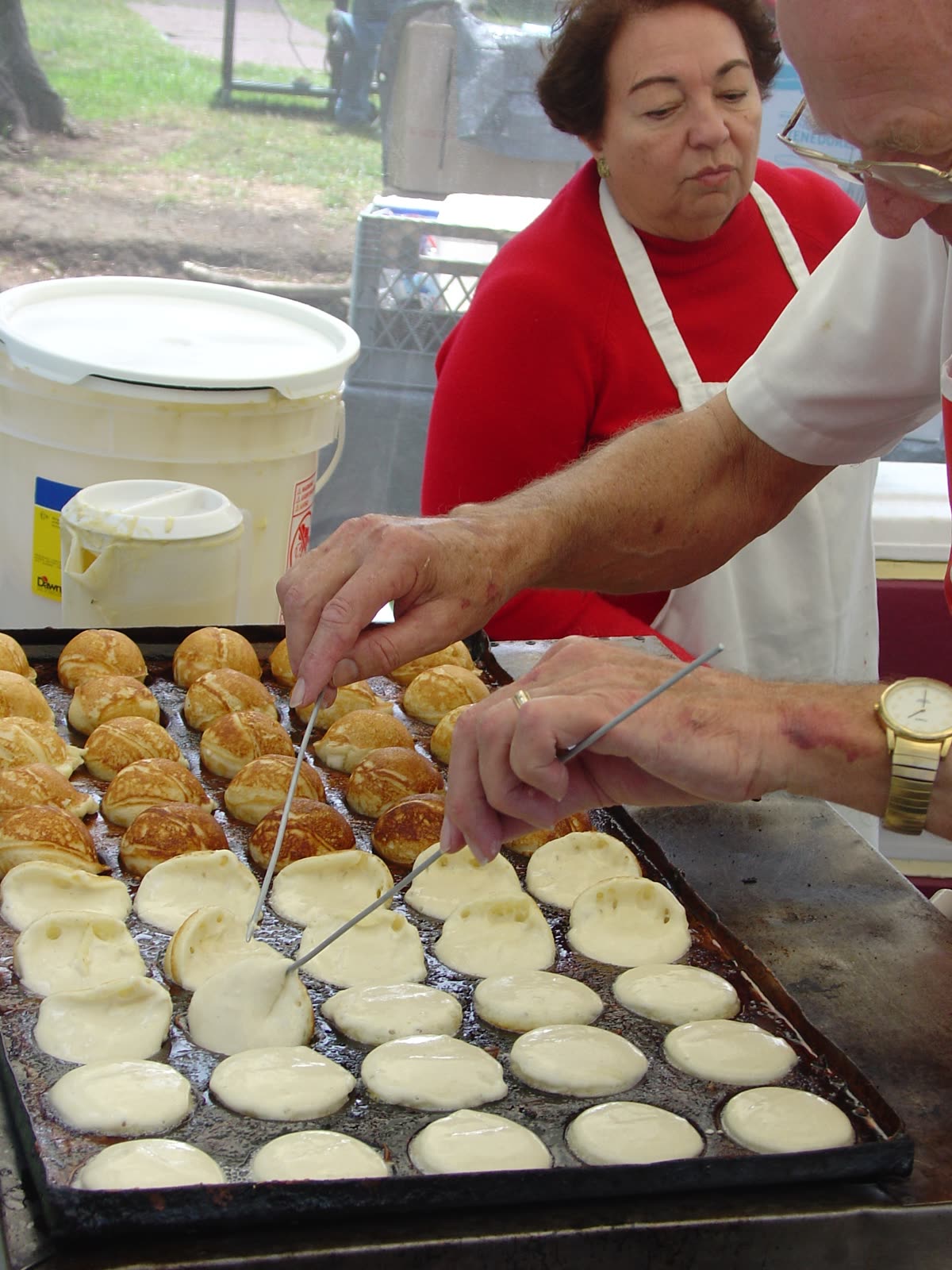
Yes — a poffertjes pan or aebleskiver pan works instead of a fish-shaped mold: grease it well, preheat it to 350-375°F (175-190°C), and you get round mini versions instead of fish shapes.
Bungeoppang is Korea’s winter street snack — a fish-shaped shell of thin batter around sweet red bean paste — and carts appear on Korean streets as soon as the weather cools, from late September onward.
This guide covers the pan question, two tested batter recipes (one dairy-free), the filling and cooking steps, and what the name means.
Can I Make Bungeoppang Without a Fish-Shaped Pan?
| Cake flour | 150 g |
|---|---|
| Sweet rice flour (chapssal-garu) | 40 g |
| Baking powder | 4 g (1 tsp) |
| Sugar | 18 g (1.5 tbsp) |
| Salt | 1.5 g (1/4 tsp) |
| Milk | 300 ml |
| Melted butter | 28 g (2 tbsp) |
Yes — a poffertjes pan or aebleskiver pan is the documented substitute: grease it well, preheat it to 350-375°F (175-190°C), and cook round mini versions with the same batter and filling.
A poffertjes pan (small round Dutch pancake pan) and an aebleskiver pan (Danish filled pancake pan) both hold thin batter and a spoonful of filling the same way the fish mold does.
The result is round minis, not fish — the taste and the crispy edges carry over.
What the pan decides is the shape, not the recipe.
Whether a regular sandwich press or waffle iron can stand in has not been confirmed, so for the fish shape itself the options are a stovetop cast-iron hinged mold, an electric appliance, or a taiyaki pan, which works identically.
When I look at a bungeoppang recipe, the first thing I check is whether I actually need the fish-shaped pan — and if I had none, I would reach for an aebleskiver pan and accept round versions, because the batter and filling work the same.
Bungeoppang Batter: Two Tested Recipes
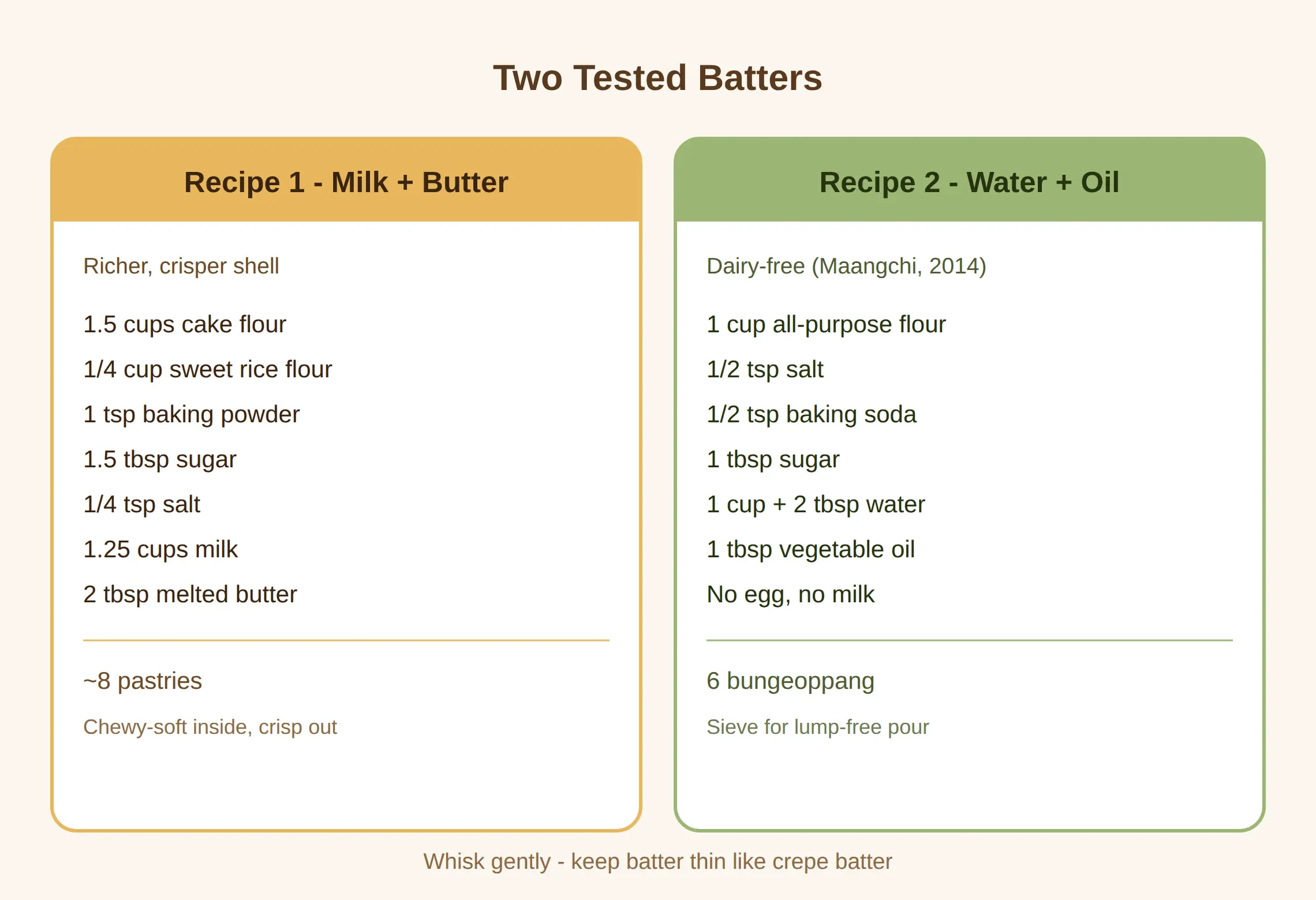
Two recipes work, and they split on one choice: milk-and-butter for a richer shell, or water-and-oil if you need it dairy-free.
| Recipe | Ingredients | Yield |
|---|---|---|
| Recipe 1 | 1.5 cups cake flour, 1/4 cup sweet rice flour (chapssal-garu), 1 tsp baking powder, 1.5 tbsp sugar, 1/4 tsp salt, 1.25 cups milk, 2 tbsp melted butter | about 10 pastries |
| Recipe 2 (Maangchi, 2014) | 1 cup all-purpose flour, 1/2 tsp salt, 1/2 tsp baking soda, 1 tbsp sugar, 1 cup plus 2 tbsp water, 1 tbsp vegetable oil | 6 bungeoppang |
The second recipe, from Maangchi’s 2014 page, makes 6 bungeoppang with 1 cup all-purpose flour, 1/2 tsp salt, 1/2 tsp baking soda, 1 tbsp sugar, 1 cup plus 2 tbsp water, and 1 tbsp vegetable oil — no egg, no milk, so it adapts to a dairy-free or vegan-friendly version.
Both batters should end up thin and pourable, like crepe batter; overmixing makes the shell chewy and dense, so whisk gently or use an immersion blender, and sieve the batter for a lump-free pour.
The sweet rice flour in Recipe 1 is what keeps the inside chewy-soft while the outside crisps.
If you want a lighter, less sweet shell closer to the street version, Recipe 1’s thinner batter is the closer match to how Korean carts make it.
How to Cook Bungeoppang, Step by Step
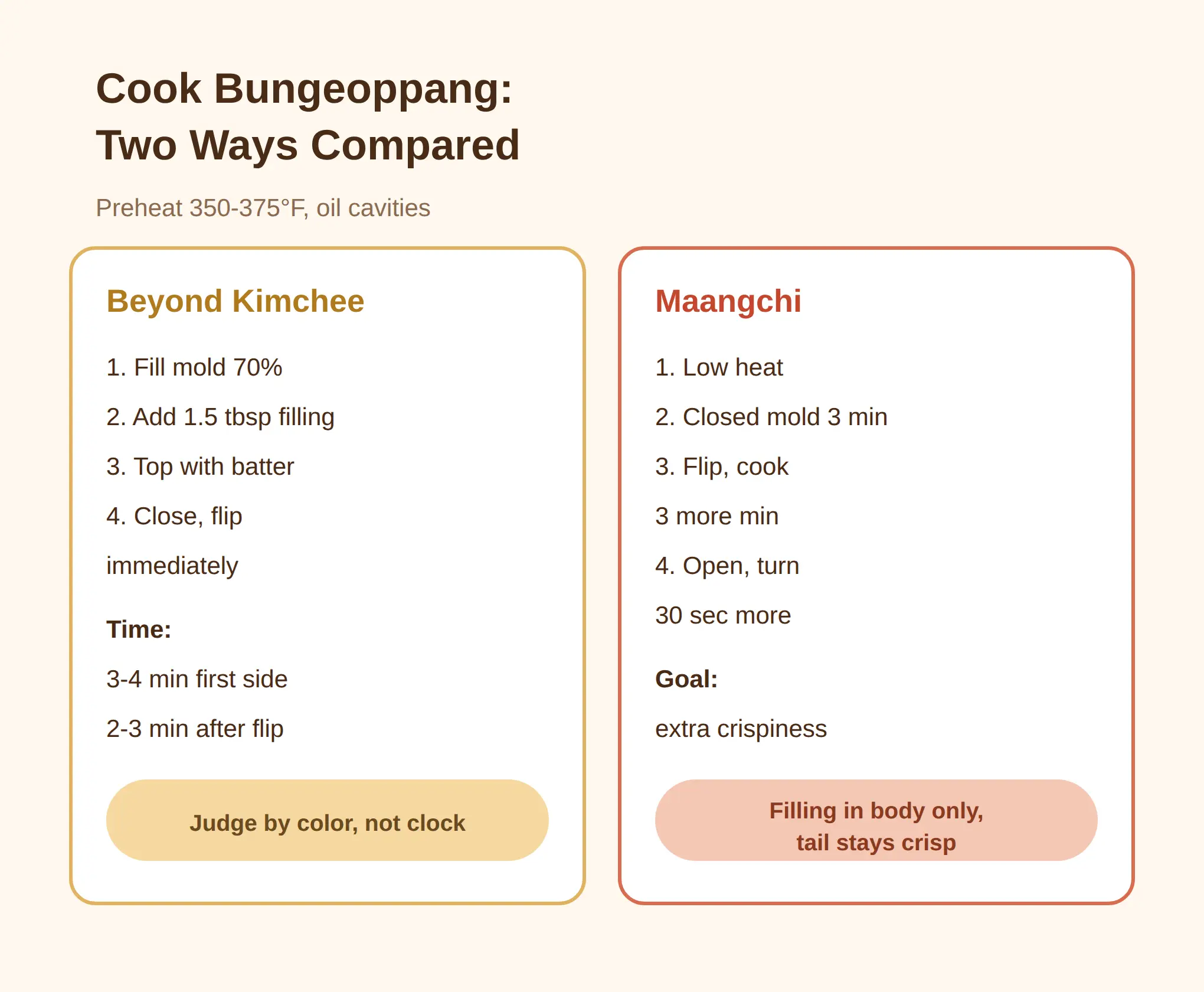
Preheat the mold hot and oiled — around 350-375°F (175-190°C) is one recipe’s estimate — because a cold pan steams the shell soft instead of crisping it.
Then follow this sequence:
- Preheat the mold over medium-low heat and brush every cavity lightly with oil.
- Fill each fish 1/3 to 70% with batter.
- Add 1 to 1.5 tbsp of red bean paste to the body only, never the tail.
- Cover the filling with more batter to seal it, then close the mold.
- Flip the pan immediately after closing so the batter coats both halves.
- Cook 3-4 minutes on the first side and 2-3 minutes after flipping, turning as needed until deep golden brown.
One recipe’s timing runs slightly different — low heat, closed mold 3 minutes, flip and cook 3 more minutes, then open and turn 30 seconds more for extra crispiness — so treat the minutes as a range and judge by color.
Keep the filling in the body so the tail bakes into plain crisp bread, and serve immediately while hot; the thin overflow batter that crisps at the edges is considered the best part, though you can trim it for a neater look.
Steps at a glance
-
1Preheat the mold over medium-low heat and brush every cavity lightly…🔥 medium-low heat
-
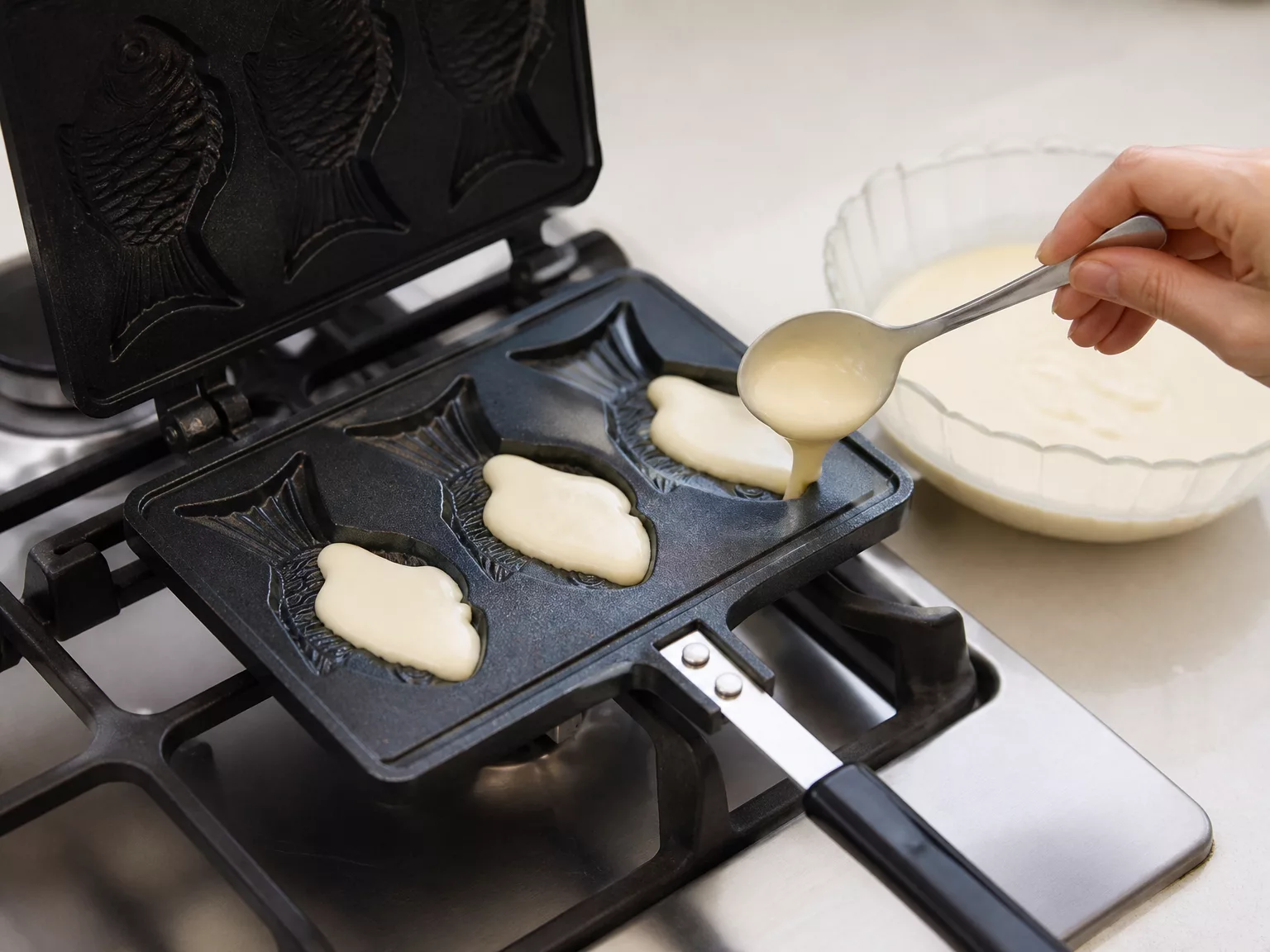 AI-generated photo
What it should look like — AI-generated image of this step, made from the recipe text — not a photo of our kitchen. 2Fill each fish 1/3 to 70% with batter. -
3Add 1 to 1.5 tbsp of red bean paste to the body only, never the tail.
-
4Cover the filling with more batter to seal it, then close the mold.
-
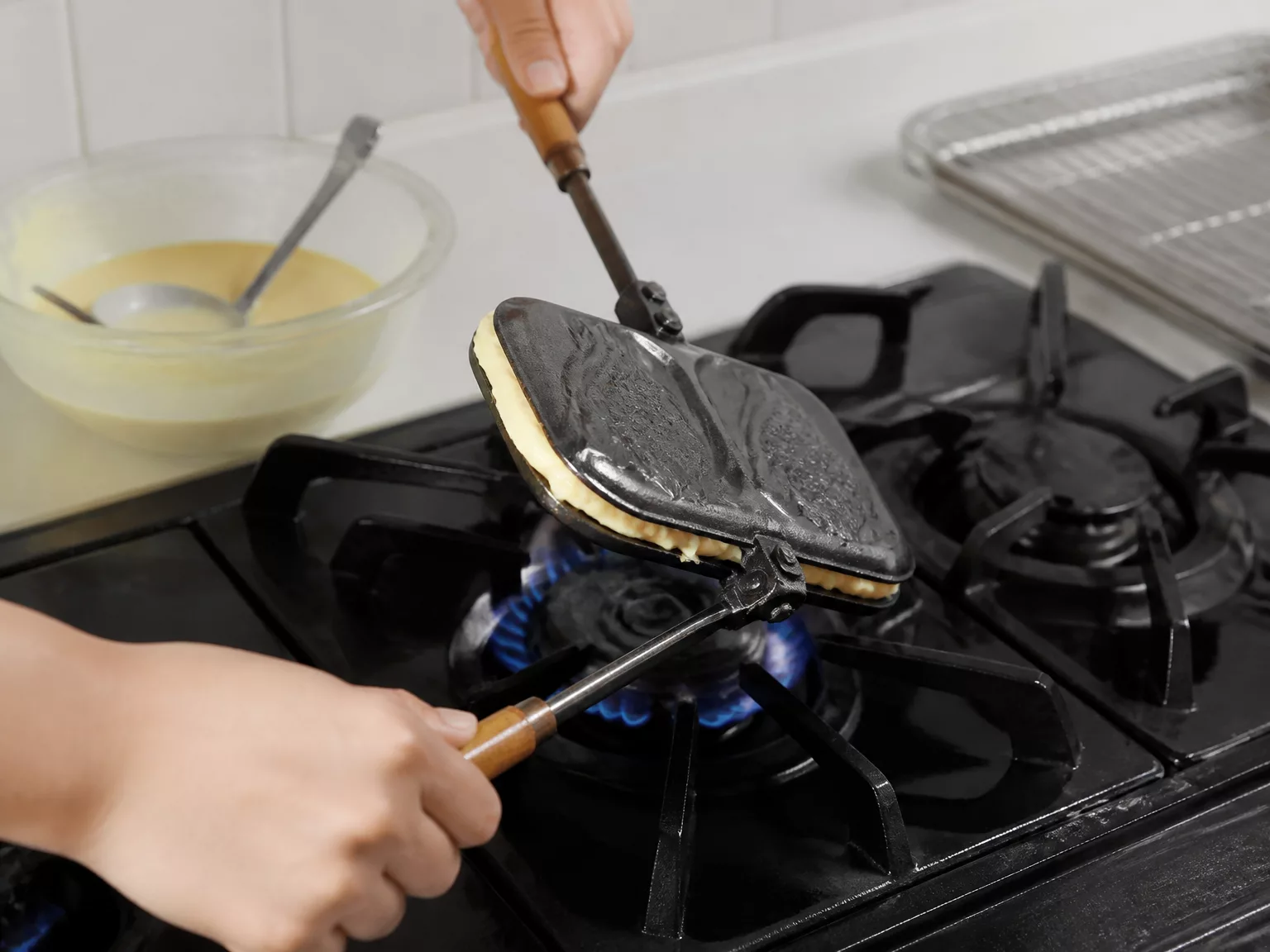 AI-generated photo
What it should look like — AI-generated image of this step, made from the recipe text — not a photo of our kitchen. 5Flip the pan immediately after closing so the batter coats both… -
6Cook 3-4 minutes on the first side and 2-3 minutes after flipping,…⏱ 3-4 minutes
Red Bean Paste: Which One to Buy
Use sweet red bean paste (danpat), sold canned or in tubes at Korean and Asian groceries, sometimes labeled with the Japanese word anko — Recipe 1 uses 300 g (10 oz) for about 10 pastries, which is 30 g per pastry.
It comes in two styles: silky smooth, or chunky tongpat with whole azuki beans left in for texture.
When buying a can, check the ingredient list and pick one where beans come first.
Homemade paste works too, and you can make it up to 3 days in advance.
If only chunky tongpat is on the shelf, it works fine — the texture inside the fish just changes from smooth to bean-y.
Fillings Beyond Red Bean
Red bean is the classic, but the street version now comes with choux cream — sold as ‘choux-bung’ — plus custard, chocolate, sweet potato, pizza toppings, and kimchi.
Savory ham-and-cheese versions exist alongside the sweet ones.
Related pastries if you want to compare: taiyaki, the Japanese original; gukhwa-ppang, the same batter pressed into a chrysanthemum shape; and hotteok, the filled sweet pancake.
Any filling that spoons thickly and holds its shape works in a mold; runny ones leak, so chill choux cream before filling.
The Korean version differs from taiyaki in the shell, not the filling — thinner, less sugary batter with crackly edges.
What Bungeoppang Means and Why It Is Winter Food
Bungeoppang means ‘carp bread’ — bungeo is the Korean crucian carp and ppang is bread — and it contains no fish; the name refers only to the shape.
It arrived in Korea in the 1930s, descended from Japanese taiyaki, whose sea bream shape became a crucian carp in Korea; per the 2011 book ‘Bungeoppang Has a Family Tree’, taiyaki itself was a Japanese adaptation of Western waffles introduced to Japan in the 18th century.
It is one of South Korea’s most popular winter street foods, sold at stalls as the weather cools from late September.
Popularity dipped after that first wave, then returned in the 1990s with South Korea’s retro craze.
The batter also runs thinner and less sweet than taiyaki’s thicker dough, which is the difference you notice when you try both.
Related posts
📎 📅 Upcoming Dates — Release & Event Calendar
Sources
- Poffertjes or aebleskiver pan as substitute; mold preheat 35 (tastekoreanfood.com)
- Beyond Kimchee: 150g cake flour + 40g sweet rice flour + mil (beyondkimchee.com)
- Korean Wikipedia: ~1,000 KRW for 2-3 pieces (2023); batter = (ko.wikipedia.org)
If You Are Deciding Between the Two Recipes
- Round minis instead of fish: a poffertjes or aebleskiver pan, greased well, is the only documented substitute for the fish mold.
- Want the fish shape: buy a stovetop cast-iron hinged mold, or a taiyaki pan, which works identically.
- Dairy-free or vegan: use the water-based batter — all-purpose flour, baking soda, sugar, salt, water, vegetable oil — no milk, no egg.
- Worried about texture: keep the batter thin like crepe batter, do not overmix, and preheat the pan hot so the outside crisps.
FAQ
Q. Can I make bungeoppang without a fish-shaped pan?
Yes. A poffertjes pan or aebleskiver pan, greased and preheated to 350-375°F (175-190°C), makes round mini versions with the same batter and filling.
Q. What is bungeoppang filling made of?
The classic filling is sweet red bean paste — about 1 to 1.5 tbsp per fish, kept in the body. Street stalls also sell custard, chocolate, sweet potato, pizza, and kimchi versions.
Q. Is bungeoppang the same as taiyaki?
No. Bungeoppang is descended from taiyaki but uses a thinner, less sugary batter with crackly edges, while taiyaki’s shell is thicker and sweeter.
Q. Is there a dairy-free bungeoppang batter?
Yes. Maangchi’s version uses water and vegetable oil with no egg and no milk, and makes 6 bungeoppang.
Q. How long does homemade bungeoppang take?
About 30 minutes total — 20 minutes prep and 10 minutes cook for about 8 pastries.
Bungeoppang carts return to Korean streets from late September, each year.
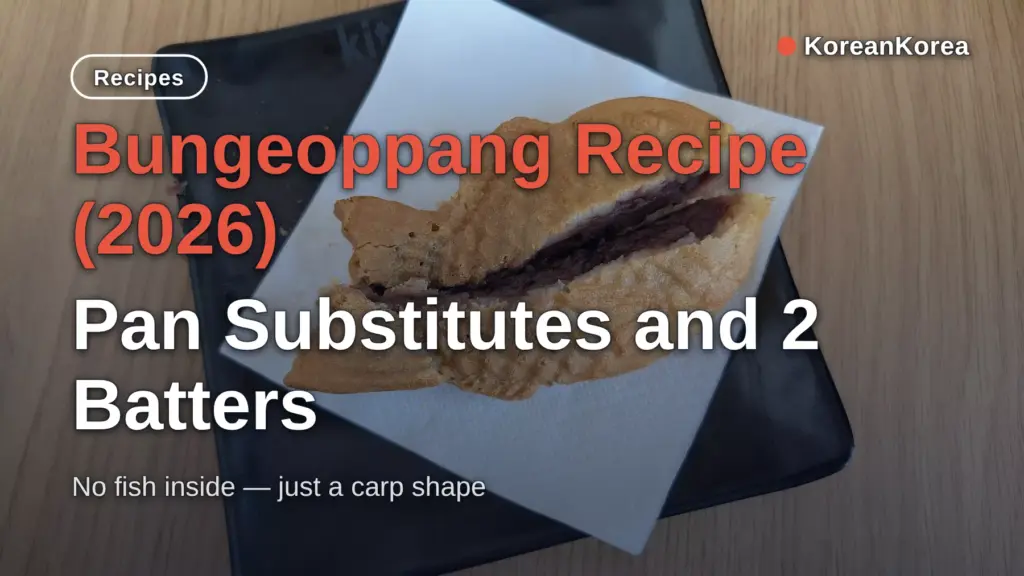
Cover photo: Taiyaki Japanese Fish-shaped Cake (cut in half) – Kitokito 2025-09-23 by Andy Li — CC0
#bungeoppang #koreanstreetfood #wintersnack #redbeanpaste #koreanrecipe
📅Upcoming Schedule — this week 23 · D-1 Autumn season = post-summer brightening demand window (UV drSee all →