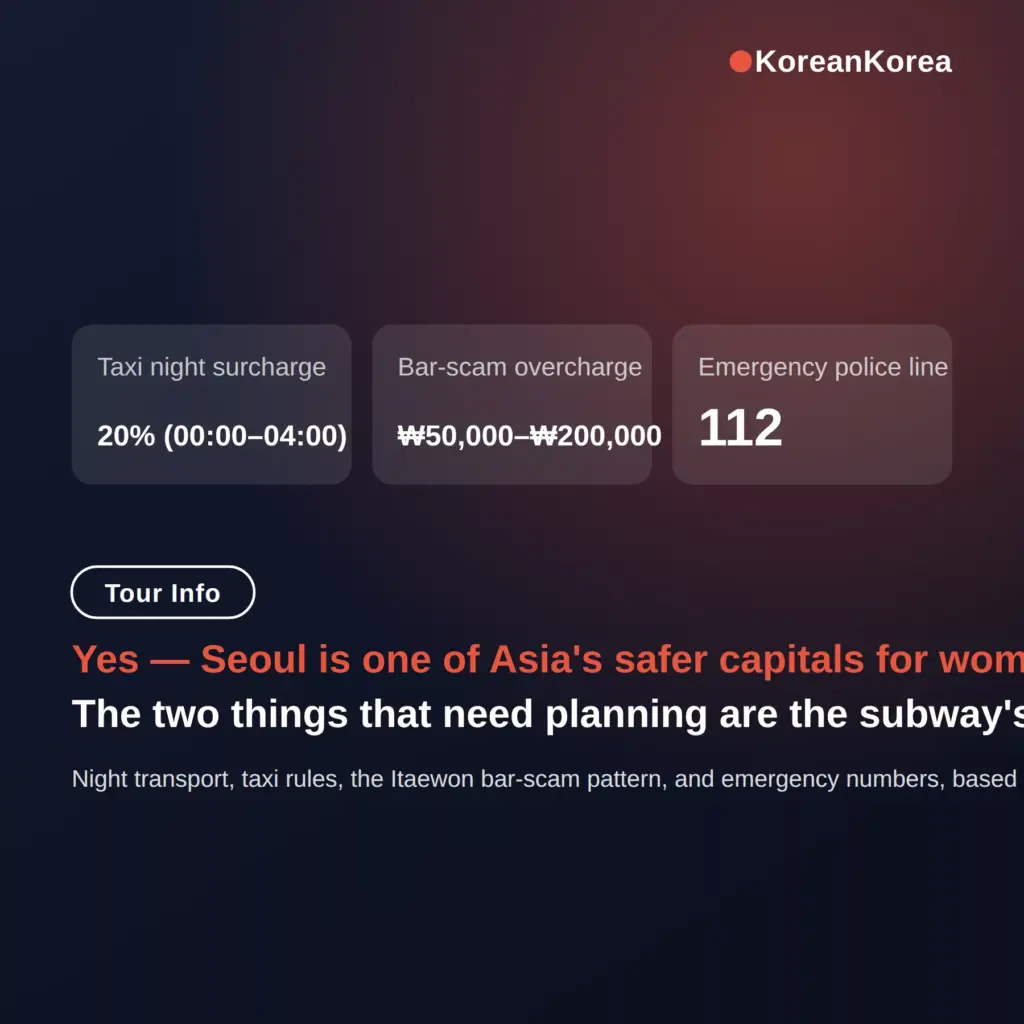
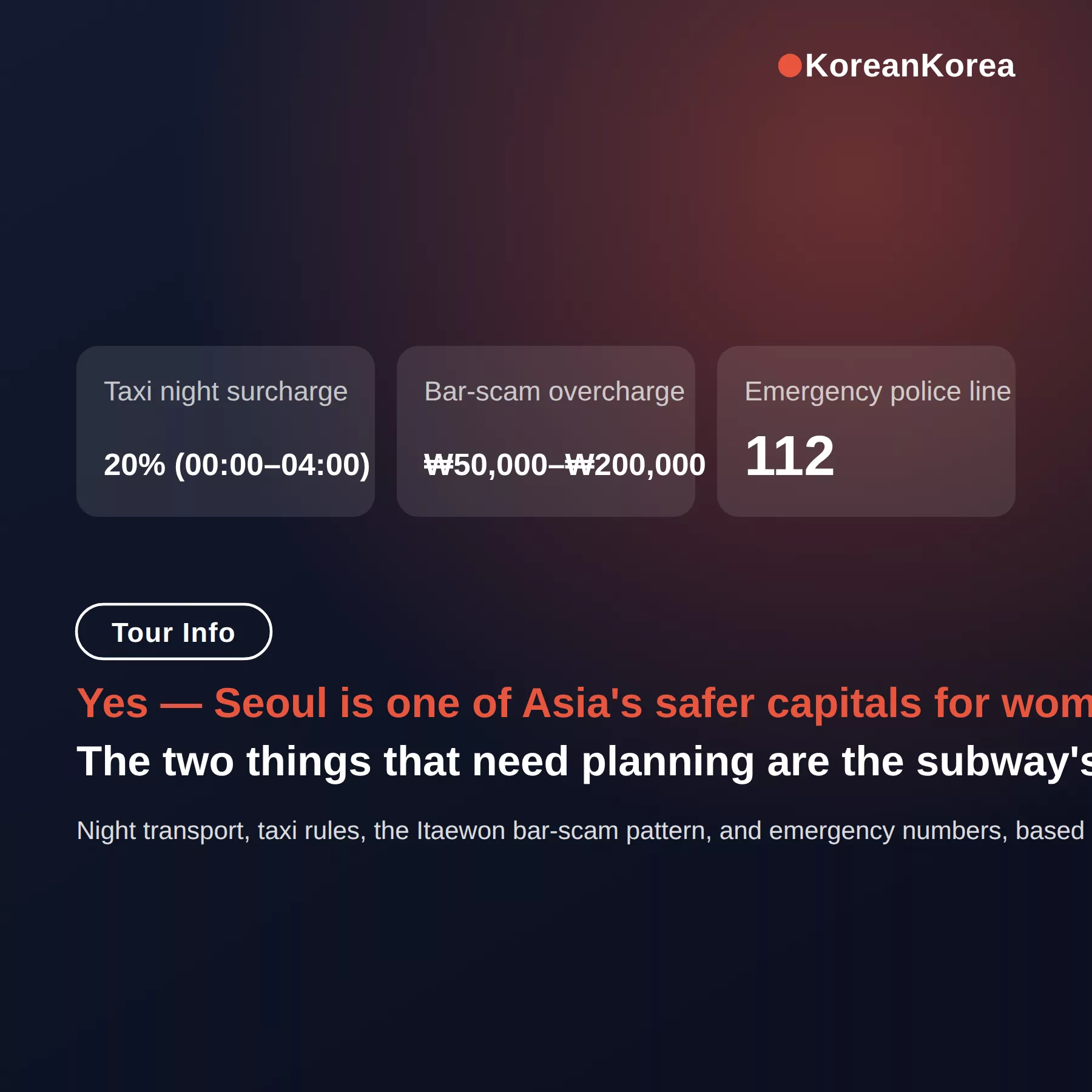
Yes — Seoul is one of Asia’s safer capitals for women walking alone at night, and female visitors commonly report low risk.
What actually needs planning is the last subway train, the legal 20% taxi surcharge from midnight to 4:00 AM, and the bar-scam pattern in Itaewon and Hongdae.
This post covers night transport options, what taxis may and may not do, the scam steps and defenses, emergency numbers, and the official police crime map.
Contents
- Is Seoul safe at night for women: walking alone, last trains, taxis
- Getting home after the subway closes
- Taxi at night: what is legal and what is not
- The bar scam pattern in Itaewon and Hongdae
- What to do if you feel unsafe: 112, 119, 1330
- Checking your area with official police data
Is Seoul safe at night for women: walking alone, last trains, taxis
South Korea ranks in the upper tier of global personal-safety indices, and violent crime against visitors is very rare — travel guides rate the overall risk as low to medium.
Female visitors commonly report night walking alone as low-risk, especially in Seoul’s well-lit commercial nightlife districts such as Hongdae’s main street and the Gangnam station area.
Korea is also a country where most traps are avoidable with basic preparation, because the apps and consumer-protection systems work in practice.
The two things that decide whether a night out stays smooth are transit timing and the taxi surcharge, so those get their own sections.
If the evening stays inside a busy district before midnight, walking is normal; the last leg to lodging after transit closes is the part to plan.
| Walking alone in a busy nightlife district early evening (Hongdae, Gangnam station) | Common and generally low-risk — streets are lit and crowded; watch your bag and ignore ‘promoter discount’ offers |
|---|---|
| Getting home after the subway closes | Book through Kakao T — the full fare including the night surcharge shows before booking |
| Taxi between midnight and 4:00 AM | Expect the 20% night surcharge — it is legal, not a scam |
| A stranger recommends a specific bar in Itaewon or Hongdae | Decline — pick bars from reviews and check the bill item by item |
| You feel unsafe and cannot speak Korean | Call 112 (police) or 119 (fire/ambulance) — both route to interpretation; 1330 runs 24/7 |
| Checking a neighborhood before booking a hotel | View the Women’s Night Security map at safemap.go.kr — no login needed |
Getting home after the subway closes
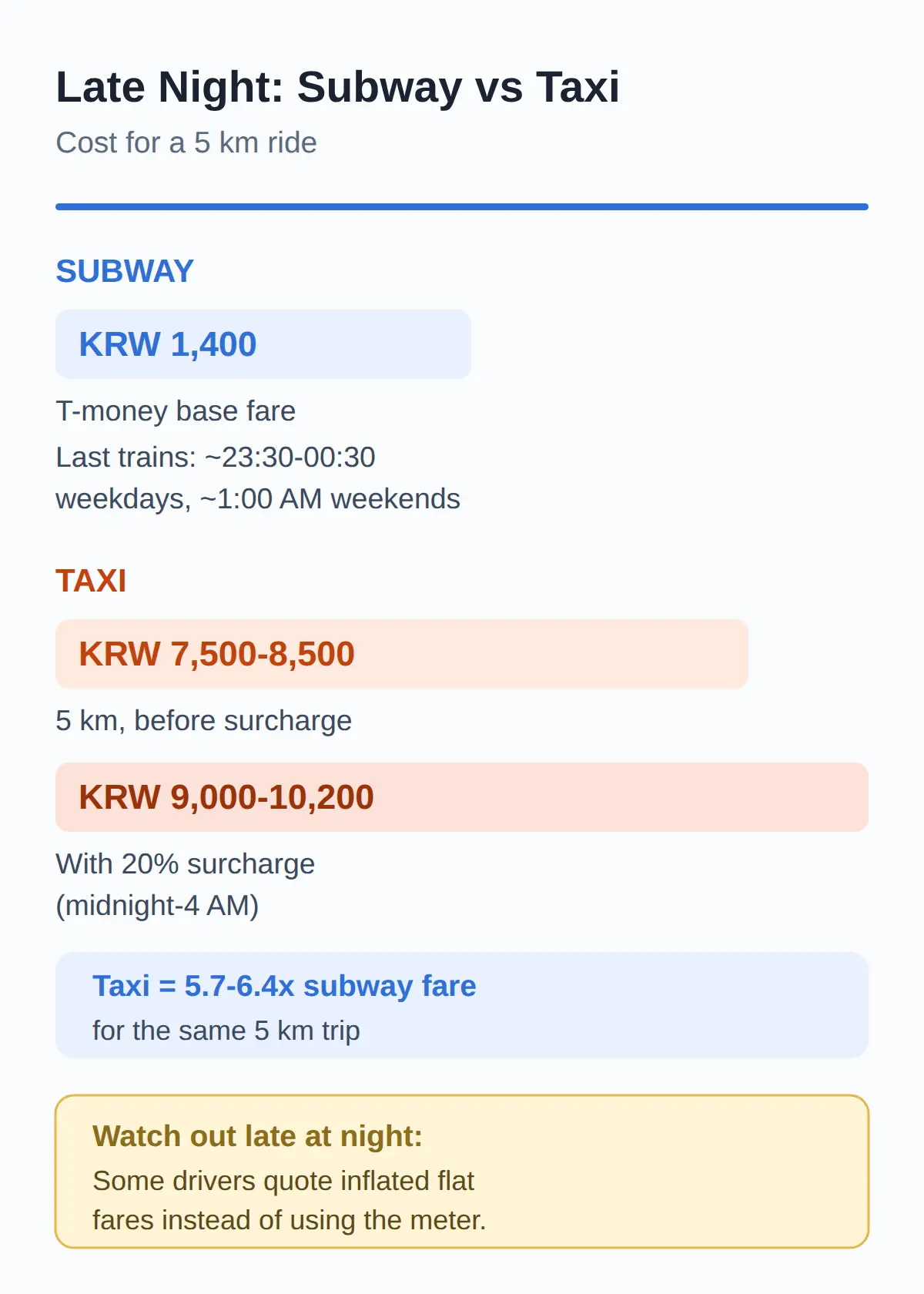
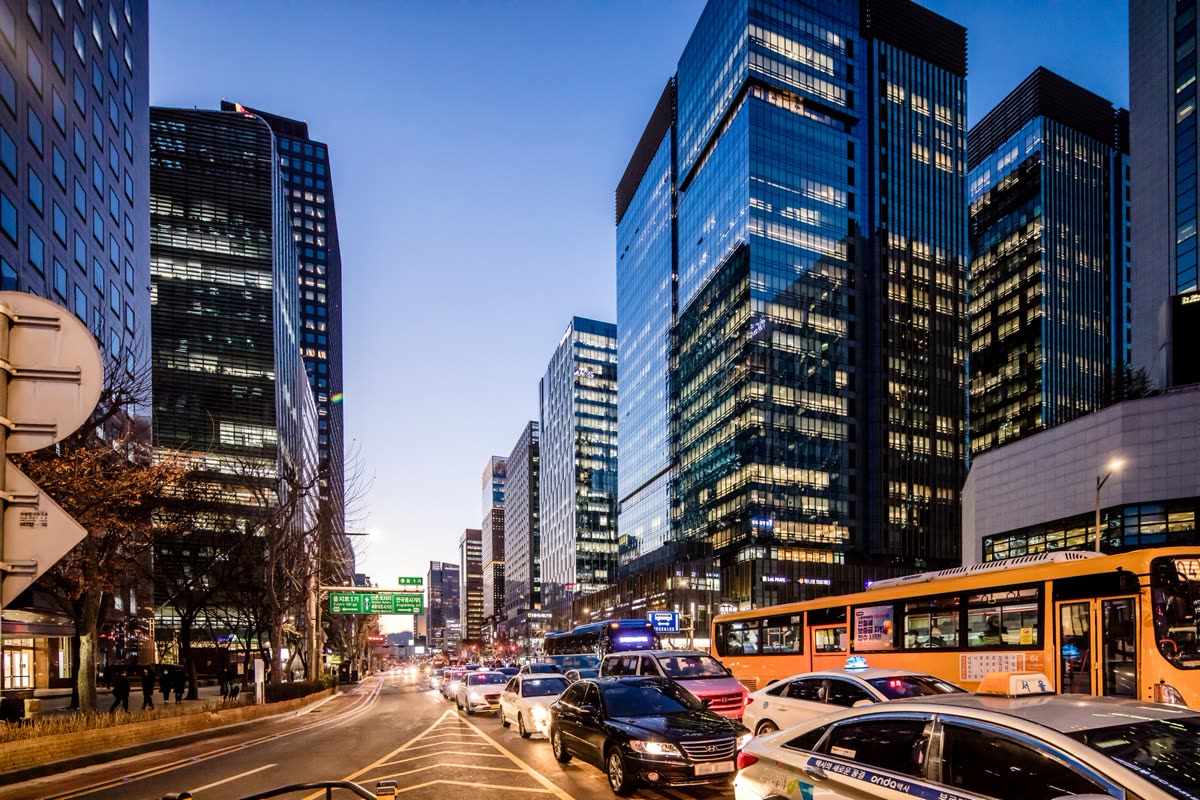
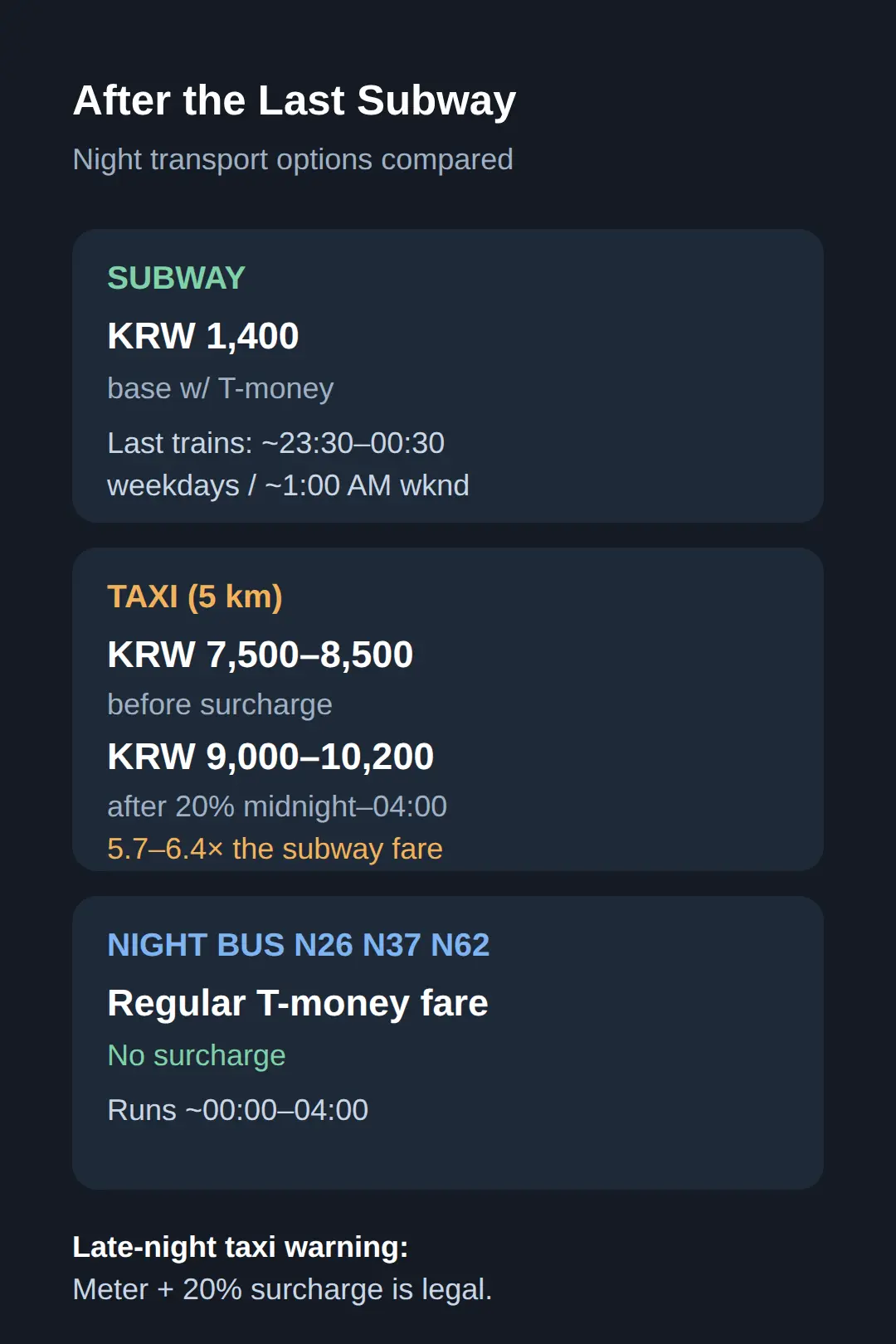
Seoul’s subway does not run all night — on weekends service runs until approximately 1:00 AM, and last trains differ by line and direction.
The practical result is that a night out often outlasts the last train, so the return trip needs a taxi or a night bus.
Kakao T is Korea’s dominant ride-hailing app, free to download, and it supports foreign payment cards and an English interface.
The app shows the estimated fare — including the night surcharge — before booking, which is the main reason to use it for late-night rides.
Night buses N26, N37, and N62 run roughly 00:00–04:00 at the regular T-money bus fare, with no surcharge, though exact per-route minutes are not published in the sources used here.
If the fare matters, the night bus is the no-surcharge option; if the hour is late or the route unfamiliar, book the ride in the app instead of hailing from the street.
👉 Is Seoul Tap Water Safe to Drink? The Official Numbers and Where to Refill
Taxi at night: what is legal and what is not
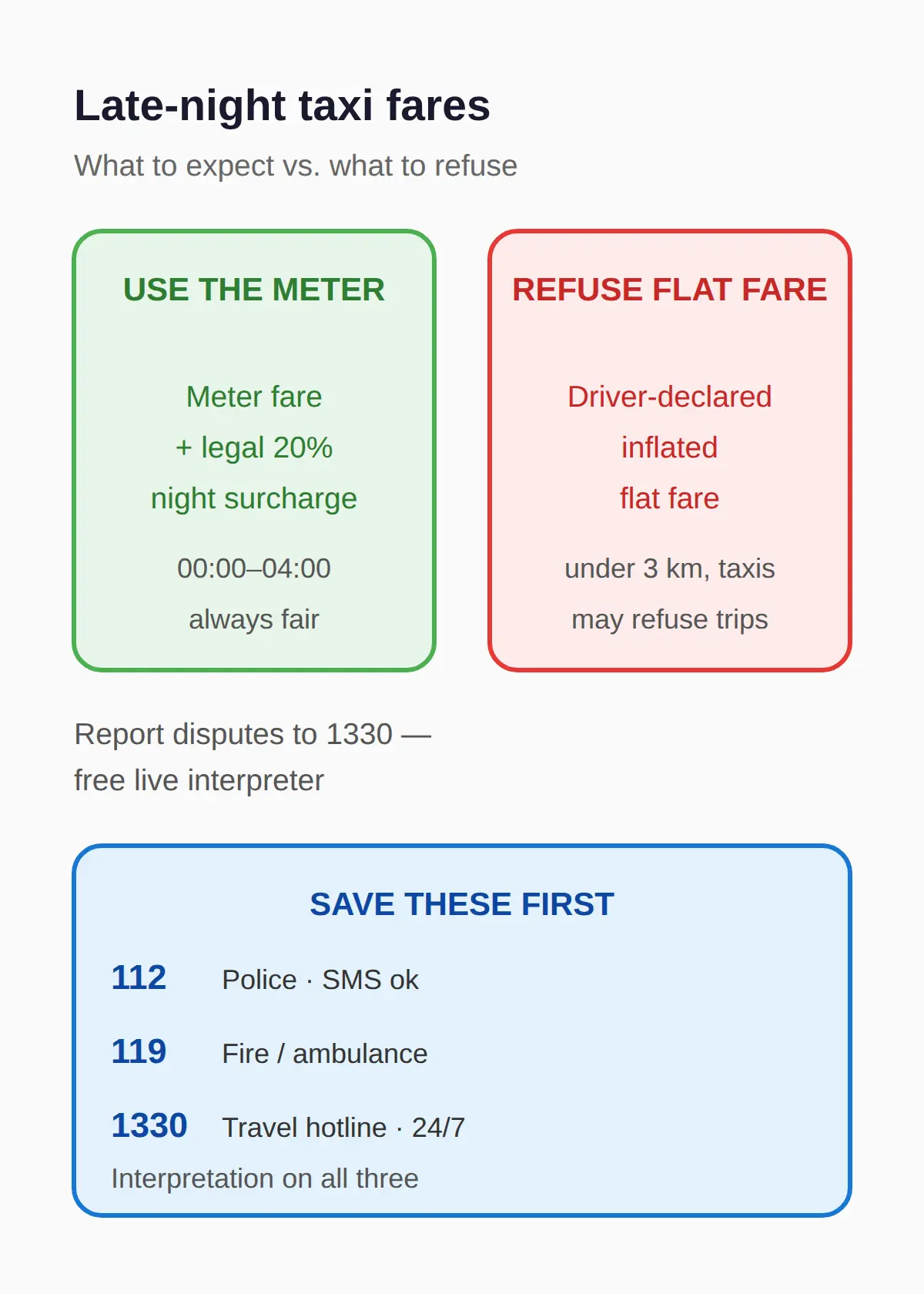
Seoul taxis apply a legal 20% night surcharge from midnight to 4:00 AM on top of the meter — a KRW 10,000 daytime ride becomes KRW 12,000.
The Seoul city government lists the meter itself as KRW 4,800 for the first 1.6 km, then KRW 132 per 132 m, as of April 10, 2026.
Taxis may legally refuse trips under 3 km at the driver’s discretion during peak times.
The red flag is a driver using that rule to push a declared flat fare instead of the meter — the check against this is the up-front fare in Kakao T.
If the meter is running and the hour is within 00:00–04:00, a 20% higher total is correct; if a flat fare much above the app’s estimate is demanded, pay by the estimate or take a different cab.
The bar scam pattern in Itaewon and Hongdae
| Step | What happens |
|---|---|
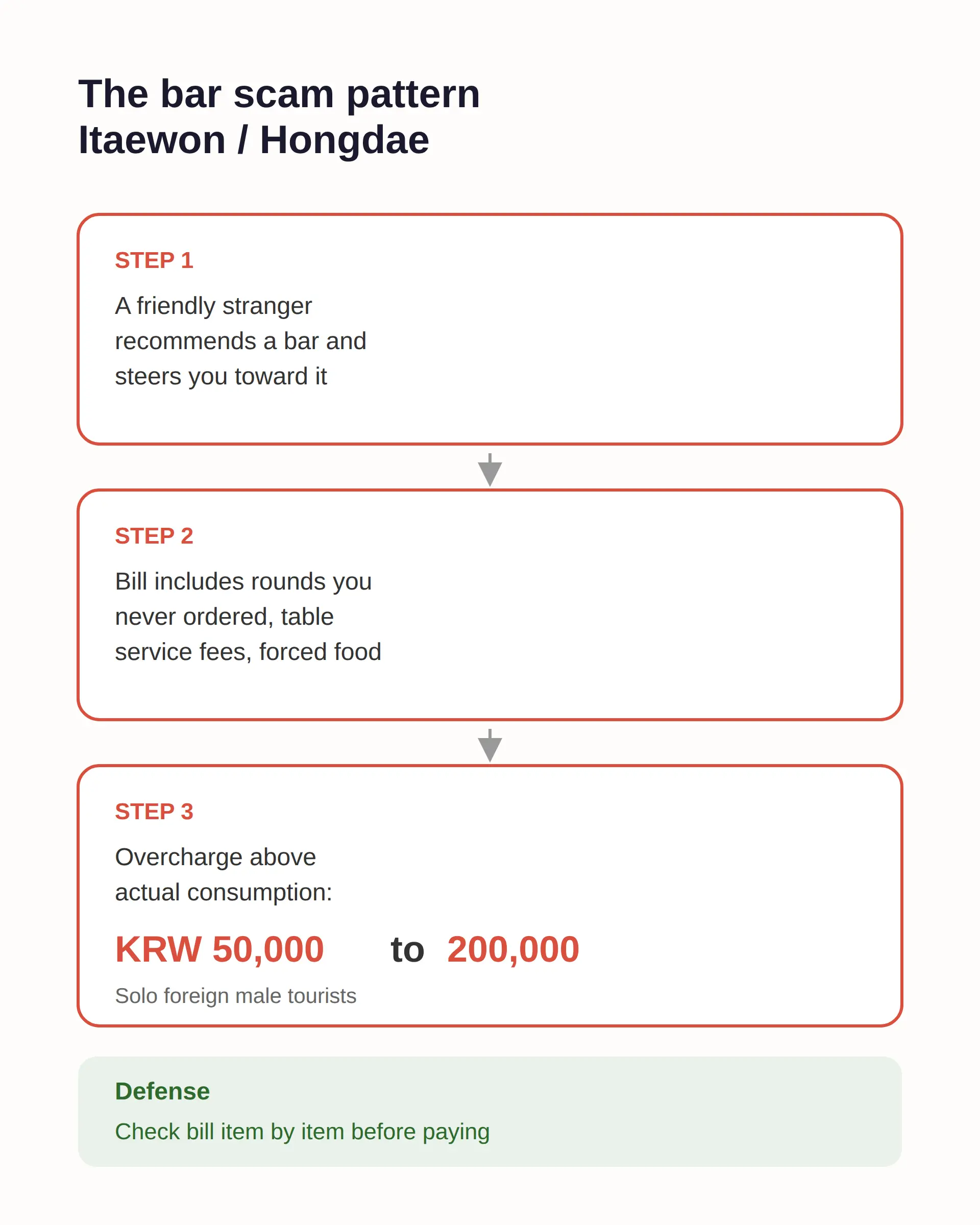
| 1 | A friendly stranger recommends a bar and steers you toward it |
| 2 | The bill arrives with rounds you never ordered, ‘table service’ fees, or mandatory food items |
| 3 | The overcharge typically lands at KRW 50,000–200,000 above actual consumption, with solo foreign male tourists the most frequent targets |
2026 scam guides flag Myeongdong, Itaewon, and Hongdae in Seoul — plus the Jagalchi fish market area in Busan and Jeju rental-car operators — as the main low-intensity scam zones.
The defenses are three: find bars through reviews rather than stranger recommendations, check for table minimums before sitting, and verify the bill item by item before paying.
A bar that a stranger on the street steers you toward is the one to skip; a bar with a visible review history is the one to try.
What to do if you feel unsafe: 112, 119, 1330
Police (112) and fire/ambulance (119) both route foreign callers to interpretation, and the 1330 Korea Travel Hotline provides 24/7 English support including real-time interpretation during police or hospital interactions.
1330 is also the line for reporting a taxi that refuses to use the meter or for other disputes where a live interpreter helps.
112 accepts reports by SMS text, and foreign-language interpretation is routed through the same line, so harassment or stalking can be reported without speaking on a call.
Save all three numbers before the trip starts, because looking them up during an incident is the wrong moment.
If the situation is immediate, 112 goes to police; if anyone is injured, 119 goes to fire and ambulance.
👉 Seoul taekwondo performance: free weekend shows at Namsangol until Oct 18
Checking your area with official police data
The National Police Agency’s Safe Map (safemap.go.kr) publishes a Women’s Night Security crime-density map, publicly viewable without login and refreshed on a 1-year cycle (most recent update 2025-12-29).
The dataset covers density analysis by administrative district, time of day, crime type, and victim profile, and is managed by the police agency’s crime analysis division.
The map data is public-domain type 4, meaning attribution is required while commercial use and changes are prohibited.
It works as a booking check: open safemap.go.kr, view the district around a candidate hotel, and see the density by hour before committing.
Standard advice for solo women centers on timing, district choice, and ride-hailing rather than on segregated transit options.
If it were me, I’d build the night around the subway’s last train and switch to a Kakao T ride once the clock passes it, because that keeps the schedule fixed and the fare visible before I book.
What I’d check first is the Safe Map density by hour for the district I’m staying in, since it takes two minutes and turns a vague worry into a concrete number.
Related posts
📎 Seoul — everything we know
📎 Gyeongbokgung night tour 2026: 3,000 won, Sept 2-Oct 2, and how booking works
📎 Hanseong Baekje Cultural Festival 2026: Sept 26–28 at Olympic Park — end-of-month Seoul plan
📎 📅 다가오는 일정 — 발매·개봉·발표 캘린더
Sources
- 112 police / 119 fire, 1330 tourist helpline in standard che (comeonkorea.com)
- Myeongdong, Itaewon, Jagalchi, Jeju rental cars (atlas-guide.com)
- Police crime data availability (safemap.go.kr)
Before the night out
- Build the night around the subway’s last train and book a Kakao T ride for the final leg to lodging — a night taxi runs about 5.7–6.4× the subway base fare, so the timing choice saves money, not just worry.
- Treat a 20% fare increase between 00:00 and 04:00 as normal, and treat a driver-declared flat fare above the Kakao T estimate as the thing to refuse.
- Decline bar recommendations from strangers in Itaewon, Hongdae, and Myeongdong, and check the bill item by item.
FAQ
Q. Is Seoul safe at night for women walking alone?
Yes — South Korea ranks in the upper tier of global personal-safety indices, violent crime against visitors is very rare, and female visitors commonly report low-risk night walking in busy districts like Hongdae and Gangnam.
Q. How do I get home after the subway closes?
Book through Kakao T, which shows the full fare including the night surcharge before booking, or take night buses N26, N37, and N62, which run roughly 00:00–04:00 at the regular bus fare.
Q. How much does a taxi cost after midnight in Seoul?
A legal 20% surcharge applies from 00:00 to 04:00, so a KRW 10,000 daytime ride becomes KRW 12,000; the meter starts at KRW 4,800 for the first 1.6 km as of April 10, 2026.
Q. What is the bar scam in Itaewon and Hongdae?
A friendly stranger recommends a bar, and the bill arrives with un-ordered rounds, ‘table service’ fees, or mandatory food — typically KRW 50,000–200,000 over actual consumption. Pick bars from reviews and check the bill item by item.
Q. What do I do if I feel unsafe and cannot speak Korean?
Call 112 for police or 119 for fire and ambulance — both route foreign callers to interpretation — or use the 1330 Korea Travel Hotline, which provides 24/7 interpretation. 112 also accepts SMS reports.
Save 112, 119, and 1330 in your phone before the first night out, and check the safemap.go.kr Women’s Night Security map for your hotel district.
#seoulsafety #solofemaletravelkorea #koreatravelsafety #seoultaxinightsurcharge #itaewonbarscam #kakaot
📅Upcoming Dates — 이번 주 16 · D-day 'The Scandal' global Netflix release전체 보기 →