Start with a K-pop routine built on a slow 8-count and one repeated point move — that is the shape of a beginner dance you will actually finish.
K-pop choreography lands every hand, foot and eye movement on an exact count, so you can check yourself against the beat without a teacher.
This post covers what makes a routine easy, how to practice it, how big the beginner tier is, and which routines to save for later.
Contents
- Easiest kpop dances for beginners: what to pick first
- What makes a K-pop dance easy to learn
- Beginner K-pop practice with mirrored videos
- How big the beginner dance data actually is
- Which K-pop choreography is not for beginners yet
- How to check a routine is really beginner-friendly
Easiest kpop dances for beginners: what to pick first
A beginner-friendly K-pop routine has two things: a slow 8-count base and one point move that repeats.
Pick a song like that, and practice the point-move section first.
That is the honest answer to the phrase you typed, before any song list.
K-pop choreography is designed around a memorable ‘point move’ — the key dance moment choreographers assign to each song, like the emphasized gestures in (G)I-DLE ‘TOMBOY’ or Taemin ‘MOVE’.
These repeated hooks are the segments fans already copy at concerts, which tells you they are the parts a first-timer can finish.
If you have never learned any choreography, choose a routine with a slow count and a repeated point move and drill that section before the verses.
One caution: this post does not name a ranked 5-song list, because no authoritative ranking of ‘easiest K-pop dances’ exists — check a current YouTube search for ‘easiest kpop dances for beginners’ and treat any named list you find as common beginner recommendations, not a ranking.
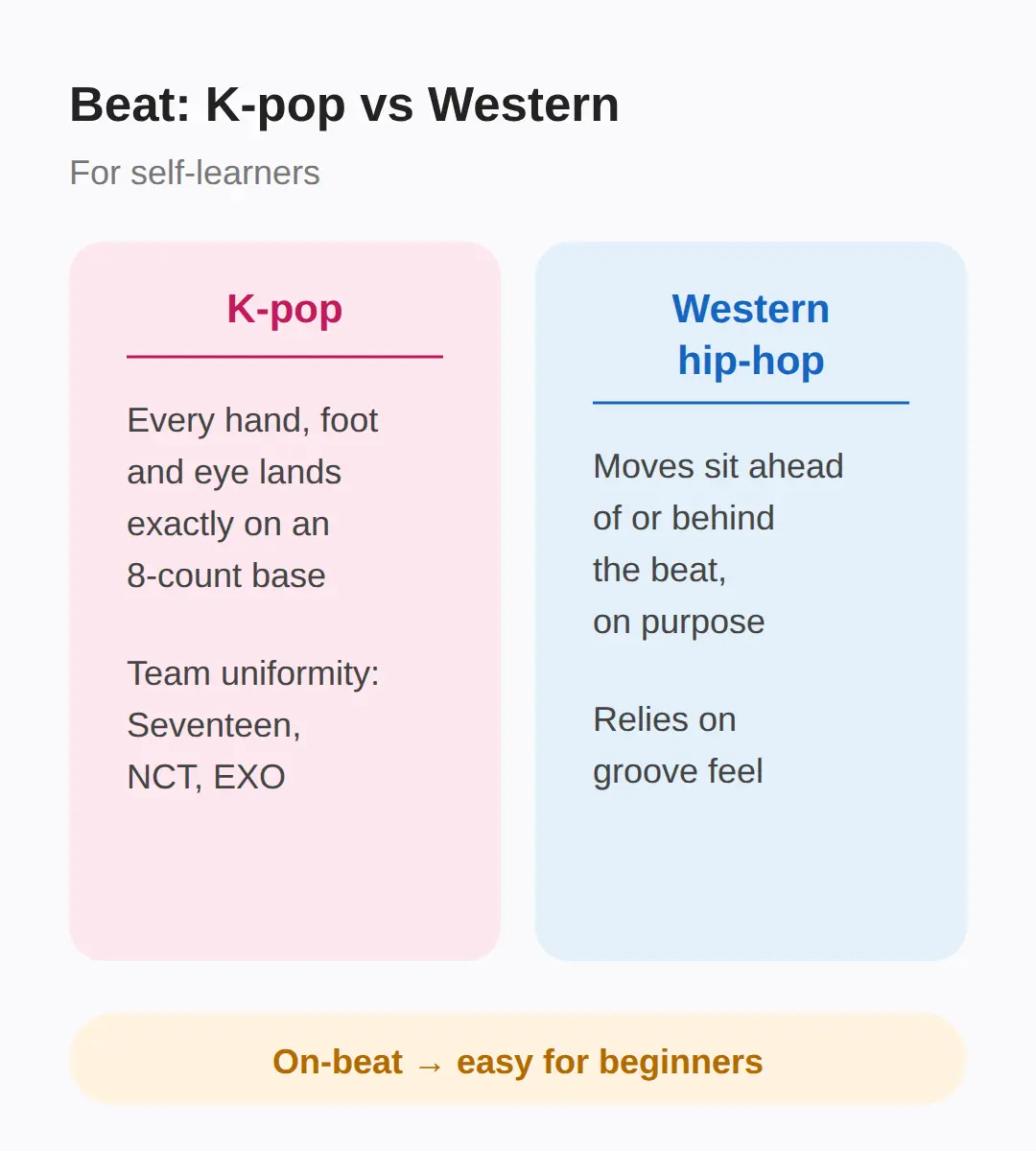
| Beat | Every hand, foot and eye movement lands exactly on an 8-count base | Moves intentionally sit ahead of or behind the beat |
|---|---|
| Main skill | Count precision and team uniformity | Groove feel |
| Self-check alone | Easy — compare each move against the count | Hard — timing depends on feel, not a fixed count |
| For a first routine | Better fit for learning solo | Better once you already keep time |
What makes a K-pop dance easy to learn
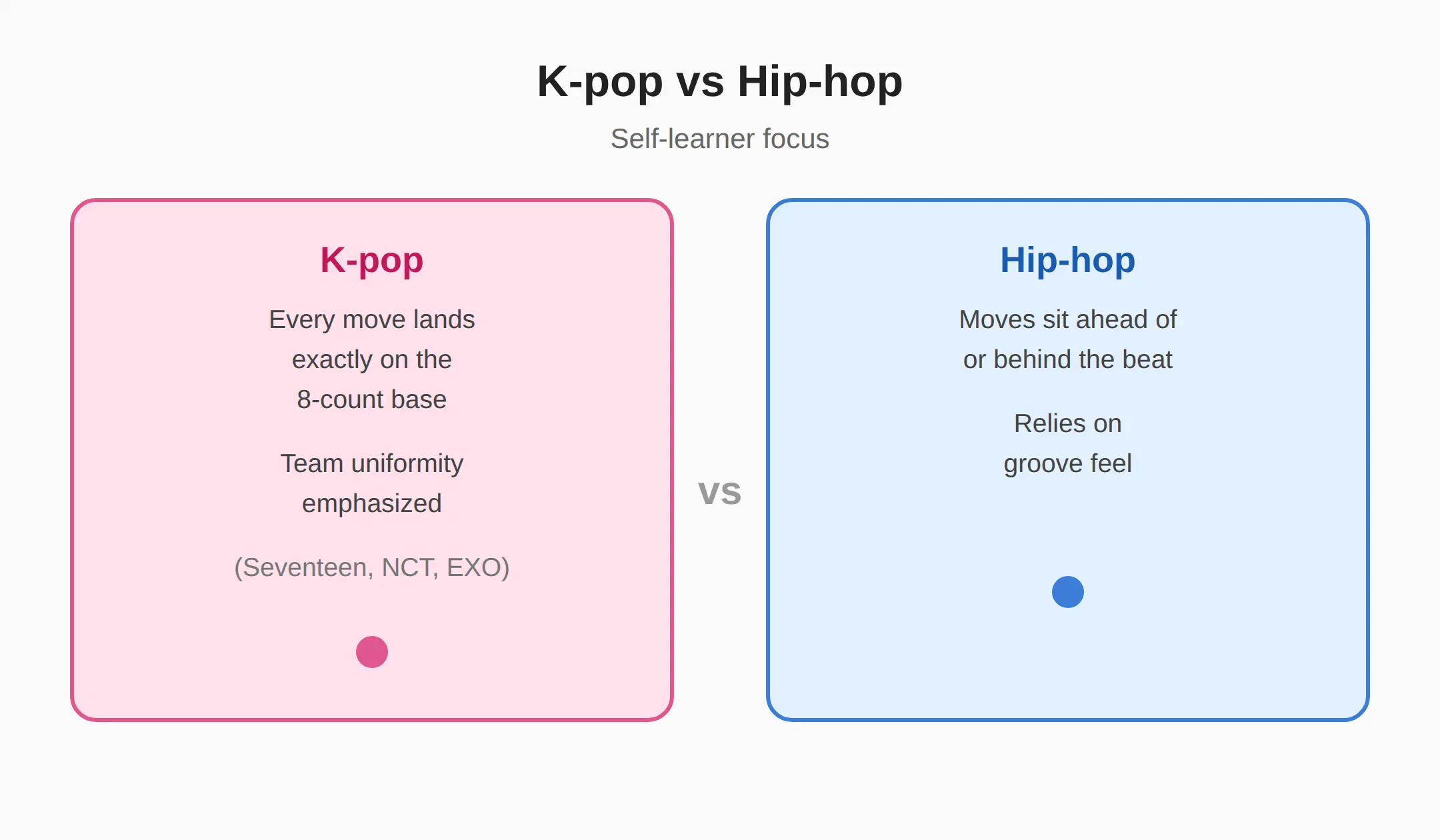
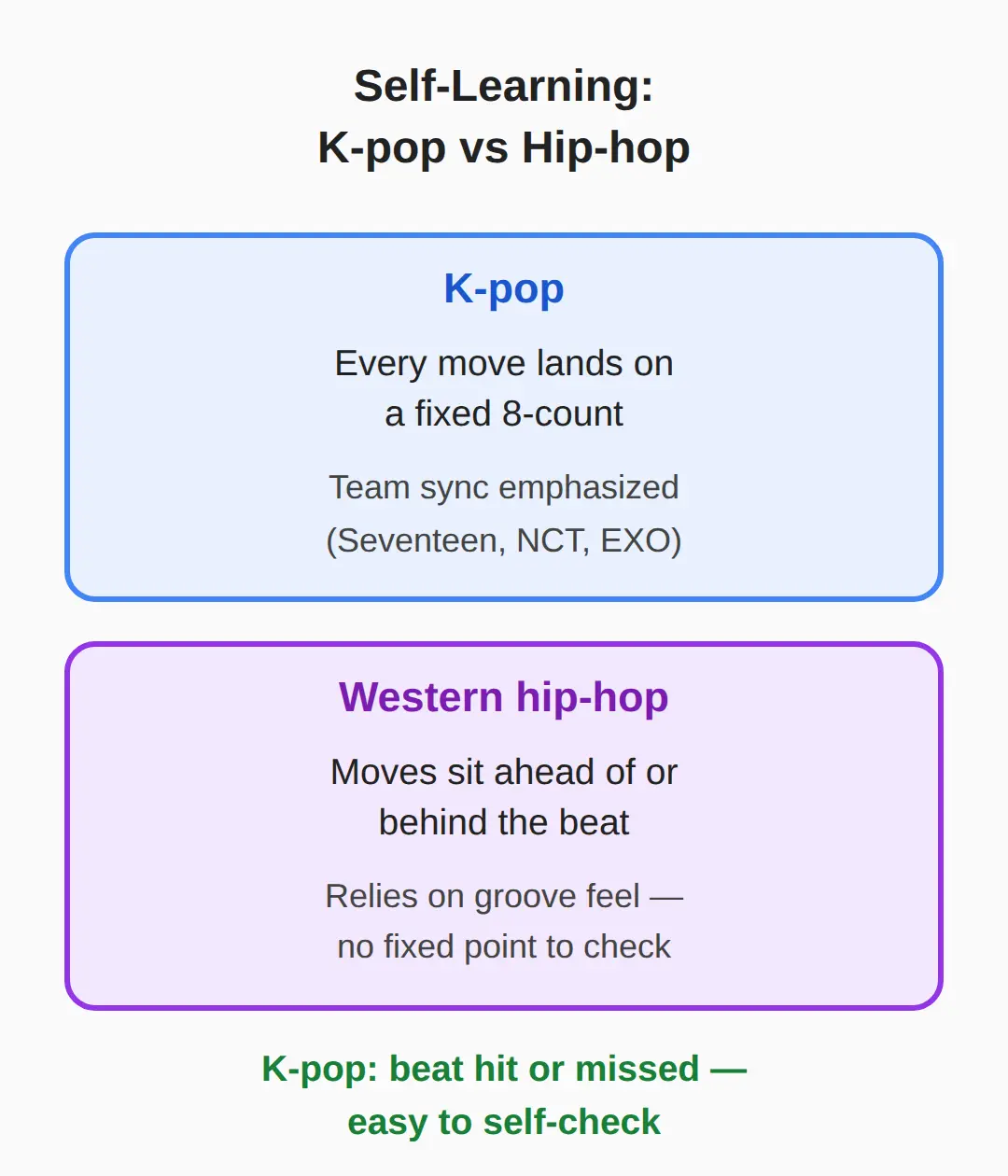
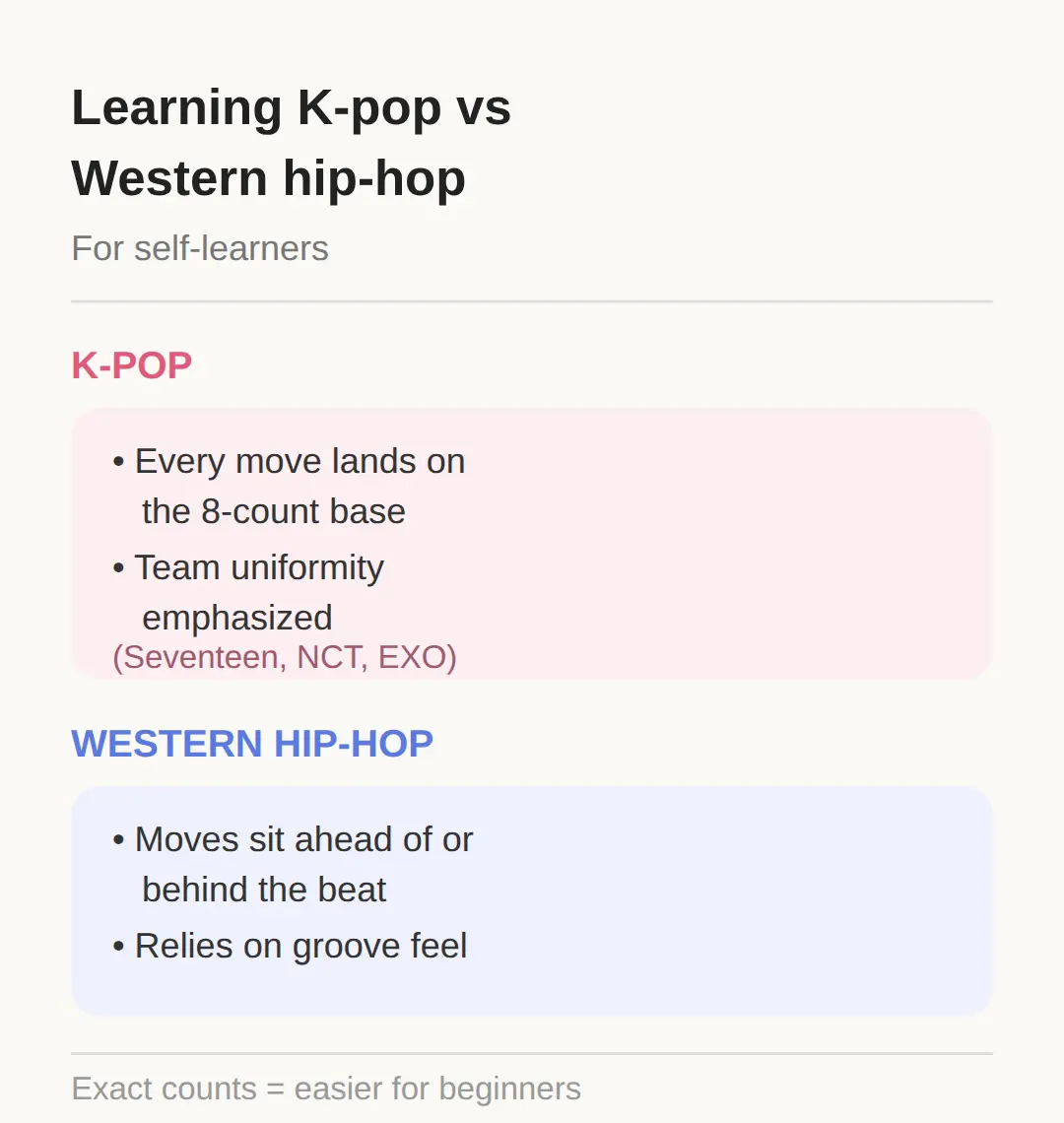
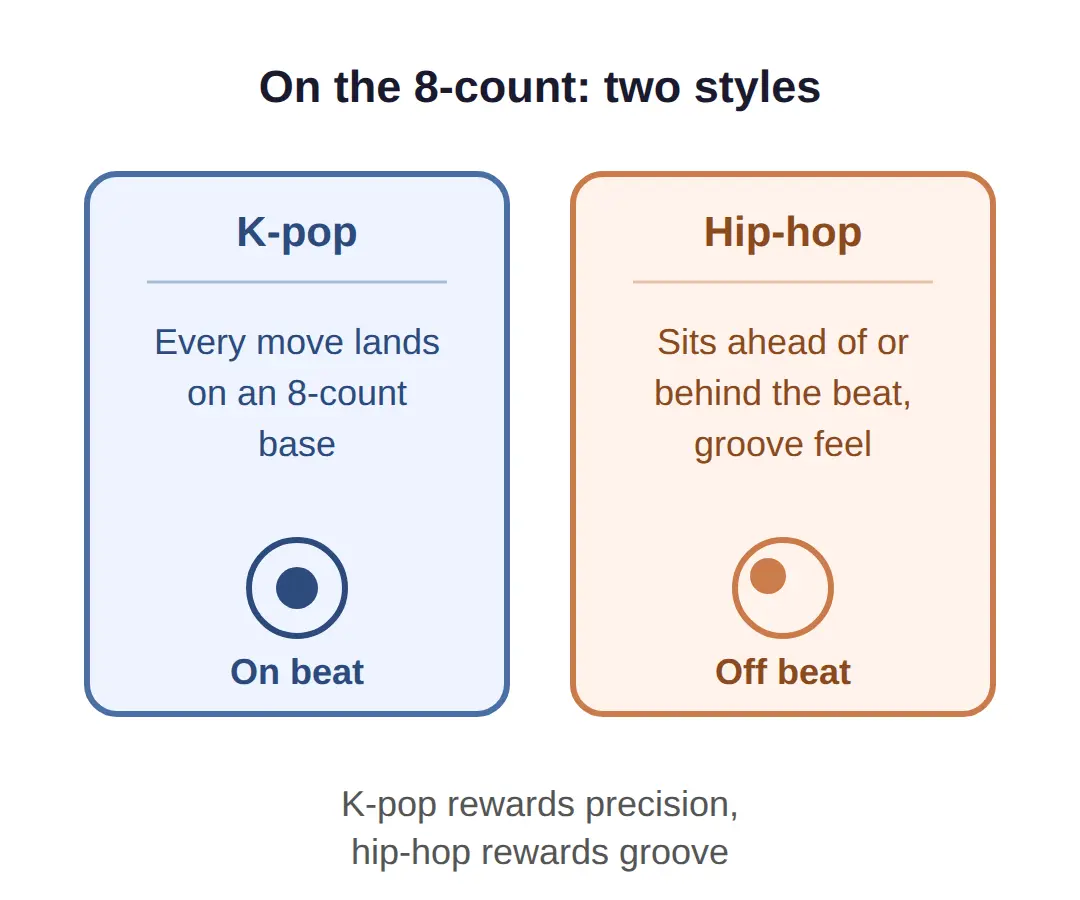
K-pop routines are easier to self-check than hip-hop because every movement is mapped to a fixed 8-count.
Most K-pop choreography is built so hand, foot and eye movements land exactly on each beat, with whole-team synchronization emphasized — Seventeen, NCT and EXO are the cited examples of this count-precise style.
Western hip-hop performance works differently: moves intentionally sit ahead of or behind the beat and rely on groove feel.
That is a real skill, but it gives a self-learner nothing fixed to measure against.
K-pop’s structure does — if your hand lands on count 5, you either hit the beat or you did not.
So if you keep losing the beat and wondering whether you are on time, use the count structure to your advantage: check that each move lands exactly on its 8-count.
If you already keep time naturally, either style works for you.
👉 kpop dance tutorial for beginners bts: songs to start with
Beginner K-pop practice with mirrored videos
Practice with a mirrored video, and start from the point-move section.
Mirrored practice videos — tutorials flipped so the dancer moves in the same direction as you — are the standard learning method for K-pop beginners, because you can copy left-for-left instead of translating left and right in your head.
- Pick the point-move section of the routine and learn it first.
- Follow a mirrored practice video so your left matches their left.
- If you want step-by-step comparison, use a pose-based practice app — these apps compare your joints against the choreography automatically.
The pose-comparison idea is not a gimmick: South Korea’s AI-Hub built its K-pop dance dataset specifically to train pose-estimation models, and a 2D pose model trained on it scored mAP 75.9% against a 66.8% baseline — accuracy high enough that automatic pose comparison works in practice.
If a mirrored video is enough for you, stop there; if you want machine feedback, a pose-based app is what to look for.
How big the beginner dance data actually is
The beginner tier is a formal category in K-pop dance practice, not just a fan label.
| Measure | Beginner tier | Full dataset |
|---|---|---|
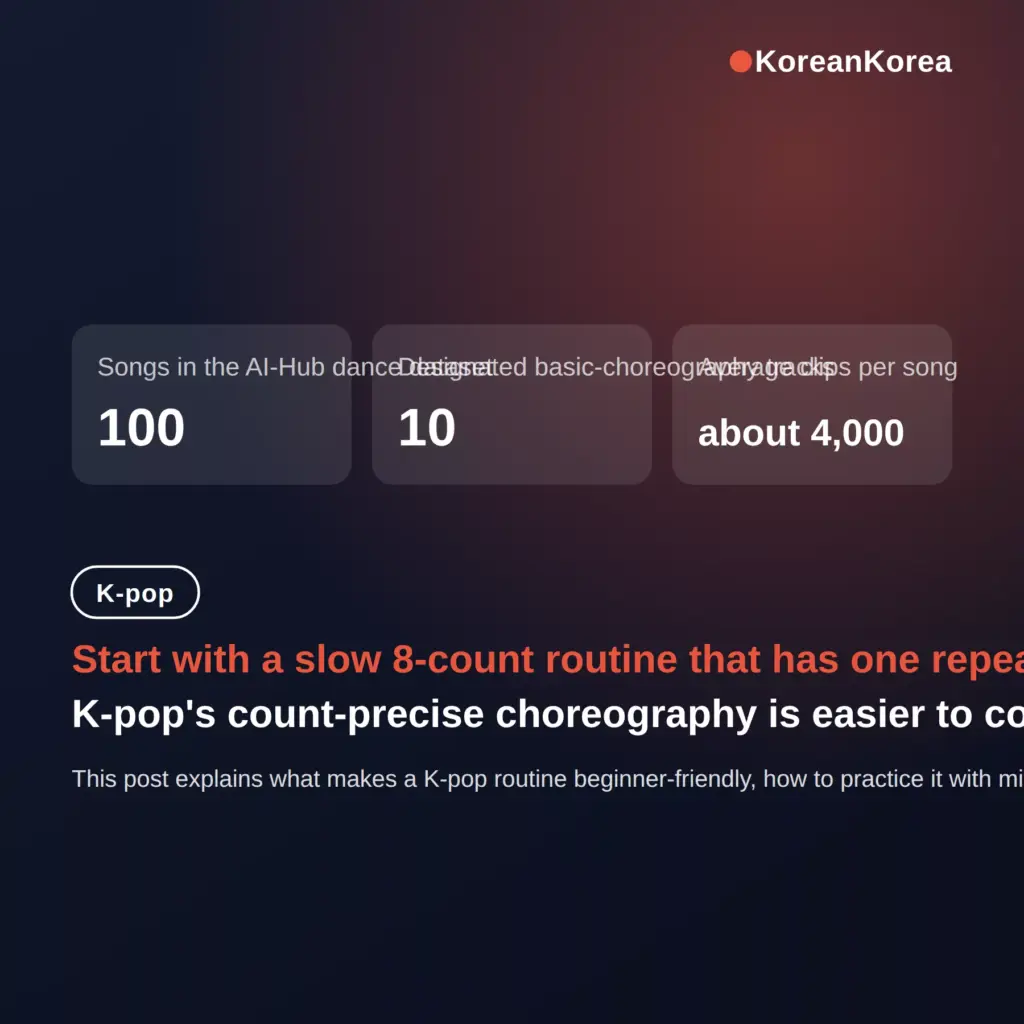
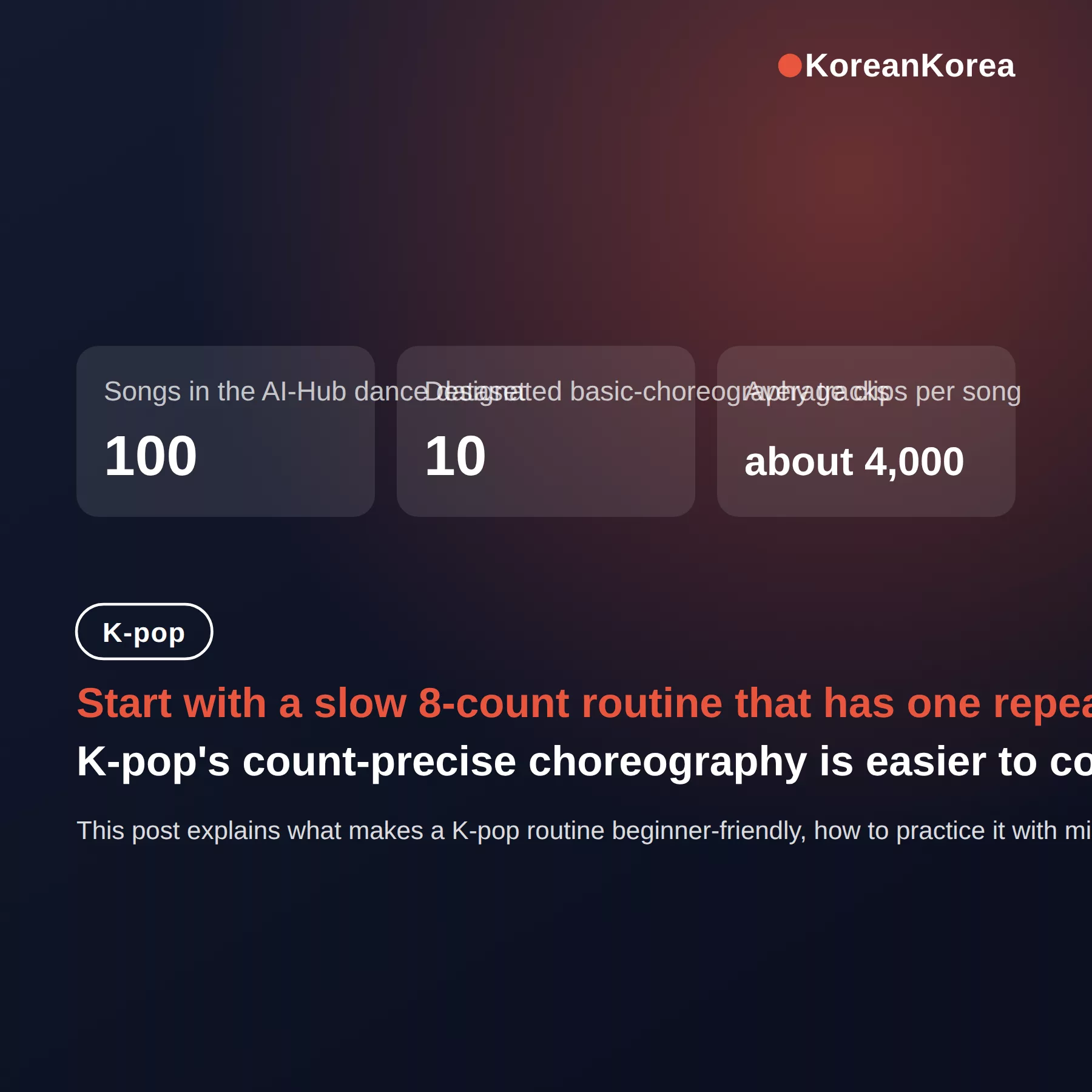
| Songs | 10 designated ‘basic choreography’ tracks | 100 K-pop songs |
| Clip videos | basic-routine song list as a formal category | about 400,000 clips |
| 2D keypoint records | same pipeline | 400,000 |
| 3D joint records | same pipeline | 100,000 |
| Capture setting | motion-capture studio | professional and amateur dancers |
The 2D versus 3D split matters if you wonder how practice apps see you: 3D coverage is 25% of the 2D count (100,000 ÷ 400,000).
Both come from the same motion-capture pipeline, cleaned and annotated for pose-estimation training.
For you this means one thing: beginner routines are a recognized tier with dedicated data behind the tools, so a pose-based practice app is a real option, not a toy.
If you prefer a plain mirrored video, that is still the standard method.
Which K-pop choreography is not for beginners yet
Save concept-driven routines — storytelling choreography — for later.
BTS ‘Black Swan’ (contemporary style), (G)I-DLE ‘TOMBOY’ (strong eye contact and self-esteem gestures) and Taemin ‘MOVE’ (soft, sensual lines) are the cited examples of choreography built to express a song’s story, and they demand an expression layer on top of the steps.
That expression layer is standard in K-pop teaching: choreographers direct ‘expression training,’ gaze lines and energy control as part of routine instruction.
So even an easy routine has a second layer you add after the moves are down.
If you are deciding between a storytelling routine and a simple one, treat the storytelling ones as your not-yet list and start simple.
If you have the moves down but still look stiff on camera, work on expression, gaze lines and energy control as a second pass — not by relearning the steps.
👉 BTS ARIRANG cinema screening: tour dates, 75 countries and how to find your showtime
How to check a routine is really beginner-friendly
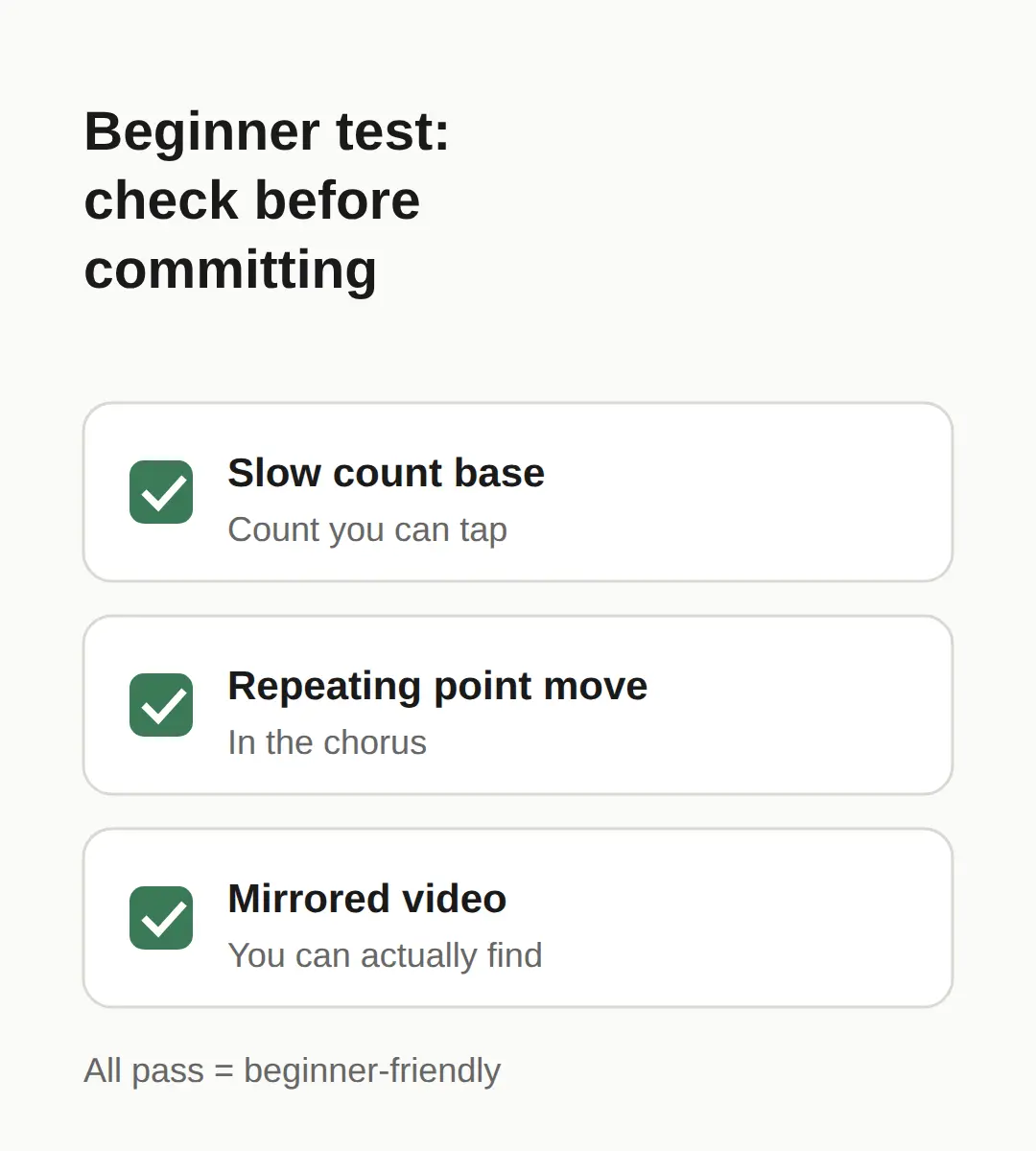
Check three things before committing to a routine: a slow count base, one point move that repeats, and a mirrored video you can actually find.
The dataset even tags key-move sections with a dance_mainpoint field — the ‘point move’ is a formally recognized per-song element, which is why drilling it first works.
One caution on tempo: no BPM figures for specific candidate songs could be confirmed for this post, so do not assume a named song is slow-tempo without playing it and counting.
There is also no reliable source on how many hours a beginner needs to learn a routine, so any ‘learn it in X hours’ promise is someone’s guess.
If a routine’s chorus holds one repeated point move and the verses stay on a steady count you can tap, it passes the beginner test.
If you cannot keep the count while tapping along to the song, pick a slower track first.
If I were starting from zero, I would learn only the point move of one slow track first, because it is the section fans actually copy and it gives you a finished moment fast.
Related posts
Sources
- 8-count precision sync K-pop vs groove-based Western; concep (wlstjs.com)
- 100 K-pop songs, 10 basic-choreography tracks, 400k clips, H (aihub.or.kr)
- Rhythmic entrainment / shared-choreography synchronization c (sports.khan.co.kr)
Summary: your first K-pop routine
- Pick a slow 8-count routine with one repeated point move — that is what beginners finish.
- Learn the point-move section first with a mirrored practice video.
- Self-check by tapping the 8-count; K-pop’s count-precise structure makes this possible alone.
- Add expression, gaze lines and energy control only after the steps are down.
- Save concept-driven routines like BTS ‘Black Swan’ for when the basics hold.
FAQ
Q. What’s the easiest K-pop dance to learn first?
A slow 8-count routine with one repeated point move. No authoritative ranking of specific songs exists, so check a current YouTube search for ‘easiest kpop dances for beginners’ and treat any list as common recommendations.
Q. Which K-pop dance should I learn first as a total beginner?
Start with the point-move section of a slow routine, using a mirrored video so your left matches the dancer’s left. Drill that hook before the verses.
Q. Which K-pop choreography is built on simple 8-counts?
Most K-pop routines sit on an 8-count base with hand, foot and eye movements synced per beat — Seventeen, NCT and EXO are the cited examples of the count-precise style.
Q. What does ‘point dance’ / ‘key choreography’ mean in K-pop?
It is the signature move or section choreographers assign to each song — the hook fans copy at concerts. Korea’s AI-Hub dataset even tags these sections with a dance_mainpoint field.
Q. Are pose-based dance practice apps accurate enough to use?
A 2D pose model trained on the AI-Hub K-pop dance dataset scored mAP 75.9% against a 66.8% baseline, so automatic pose comparison works at a practical level for beginners.
No calendar dates apply to this topic — it is evergreen. When you are ready for a specific song, search ‘easiest kpop dances for beginners’ on YouTube and check which mirrored tutorials are current.
#kpopdance #kpopdancetutorialforbeginners #easiestkpopdances #8-count #mirroredpracticevideo #pointmove
📅Upcoming Dates — 이번 주 16 · D-day 'The Scandal' global Netflix release전체 보기 →