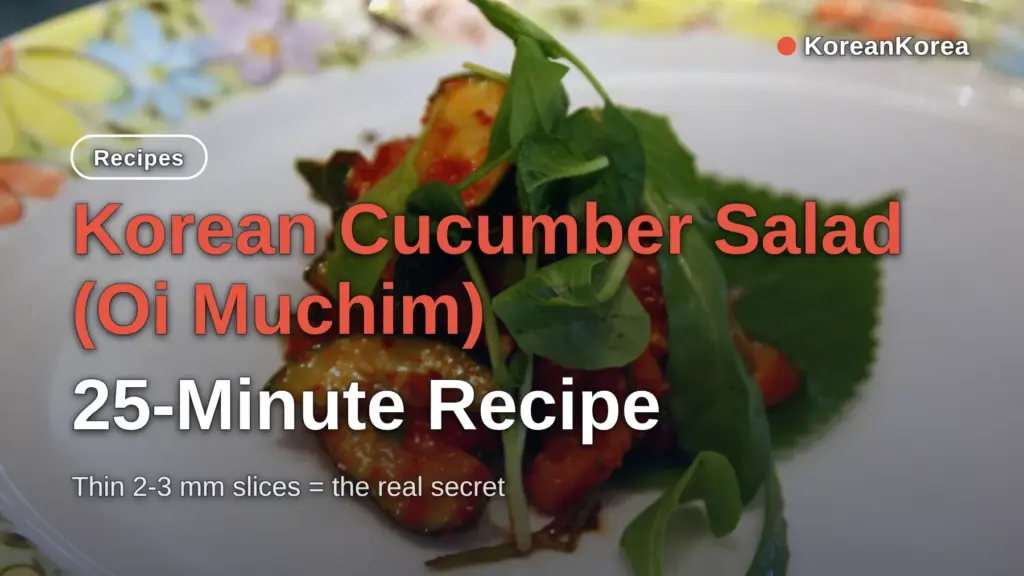
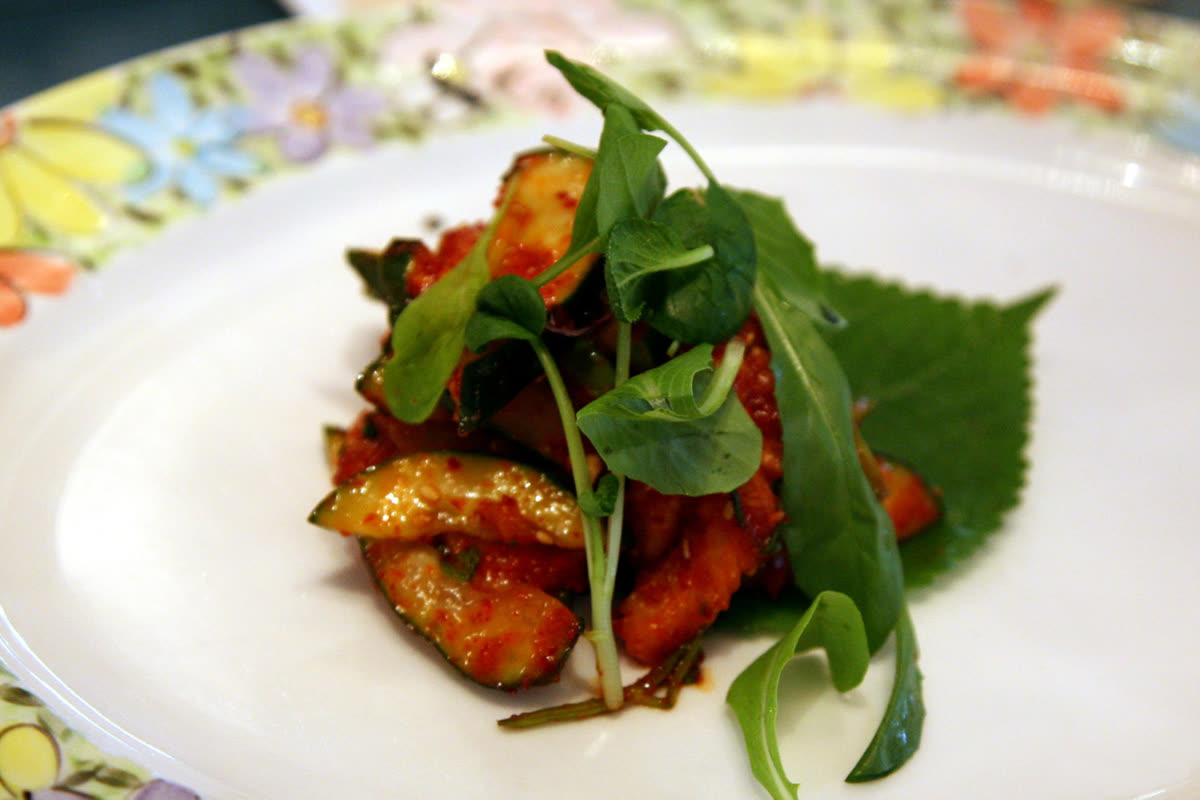
Korean cucumber salad — oi muchim — is 2 cucumbers sliced thin, salted for 15-20 minutes, squeezed, and tossed with gochugaru, soy sauce, vinegar, sugar and garlic.
There is no cooking, so the whole thing takes about 25-30 minutes, and roughly 60-70% of that is hands-off salting time.
This post gives the amounts in metric, the steps in order, the substitutes when gochugaru is hard to find, and the fixes for the most common failure: a watery salad.
How to Make Korean Cucumber Salad at Home
| Persian or English cucumbers | 2 medium, ~400 g (14 oz) |
|---|---|
| Coarse salt (for salting) | 1 tsp (~6 g) |
| Gochugaru (Korean chili flakes) | 1-2 tbsp |
| Soy sauce | 1 tbsp |
| Rice vinegar | 1 tbsp |
| Sugar | 1-2 tsp |
| Minced garlic | 1 tsp (1 small clove) — optional for a kid-friendly side |
The method is one sequence: slice, salt, squeeze, dress.
Thin half-moon slices about 2-3 mm thick are what make it work — thick rounds stay raw-tasting and watery.
The salt-and-wait step is the whole dish; the first thing worth checking in any cucumber salad recipe is whether it tells you to salt, wait and squeeze, because without it the salad runs watery no matter what the dressing says.
- Slice 2 medium cucumbers (~400 g) into thin half-moons, 2-3 mm.
- Toss with 1 tsp coarse salt and let sit 15-20 minutes.
- Squeeze gently by hand or press with a paper towel.
- Mix 1-2 tbsp gochugaru, 1 tbsp soy sauce, 1 tbsp rice vinegar, 1-2 tsp sugar and 1 tsp minced garlic.
- Toss the cucumbers with the dressing.
- Finish with 1 tsp toasted sesame oil, 1 tsp toasted sesame seeds, and chopped scallion if you have it.
No special equipment is needed: one bowl for salting, one for the dressing, hands or a paper towel for the squeeze.
About 10 minutes of the total time is hands-on; the rest is the cucumbers draining while you mix the dressing.
If serving guests, the safer play is to salt and drain the day before and dress at the table — the crunch survives that way, and not otherwise.
Steps at a glance
-
1Slice 2 medium cucumbers (~400 g) into thin half-moons, 2-3 mm.
-
2Toss with 1 tsp coarse salt and let sit 15-20 minutes.⏱ 15-20 minutes
-
3Squeeze gently by hand or press with a paper towel.
-
4Mix 1-2 tbsp gochugaru, 1 tbsp soy sauce, 1 tbsp rice vinegar, 1-2…
-
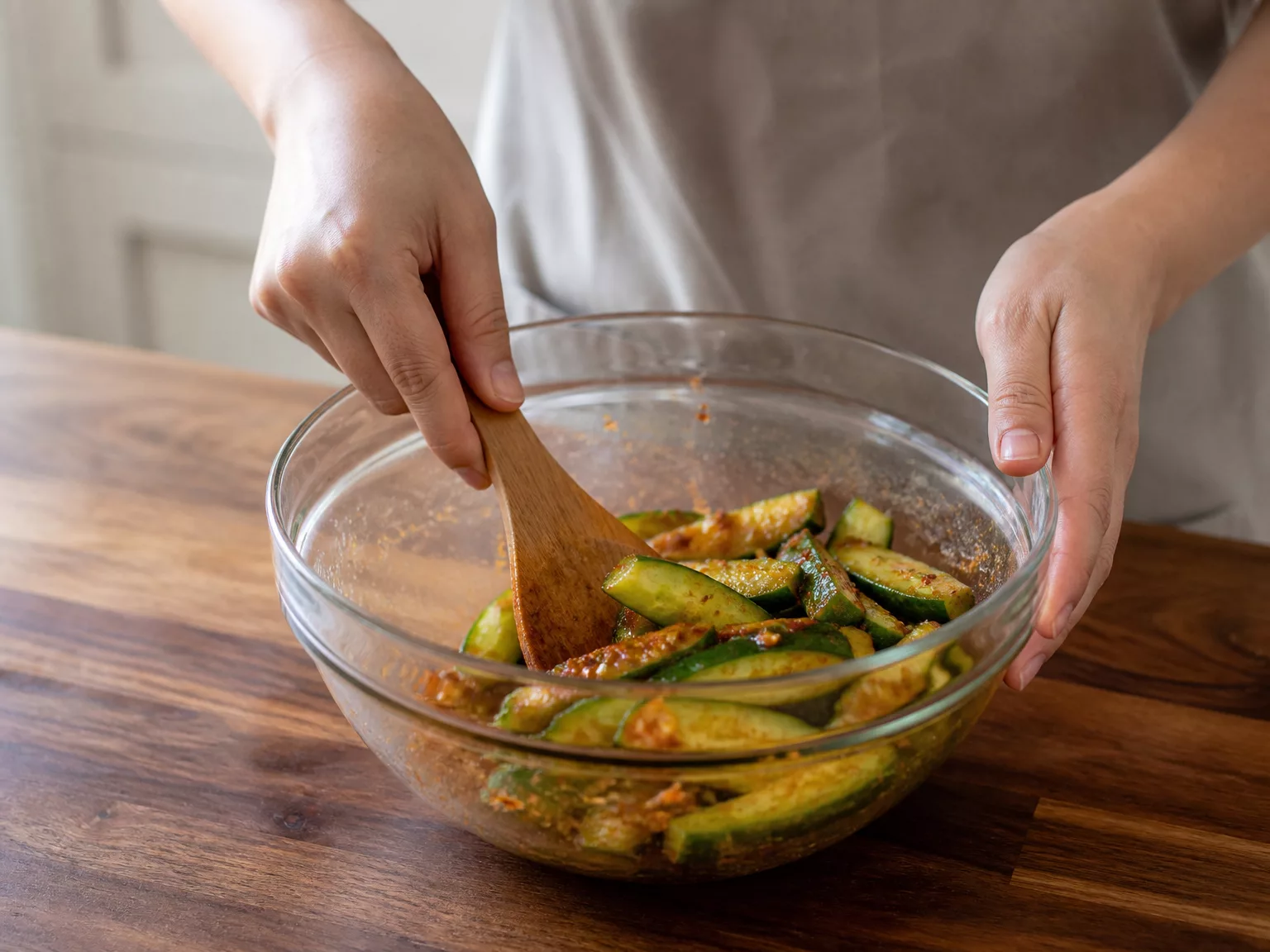 AI-generated photo
What it should look like — AI-generated image of this step, made from the recipe text — not a photo of our kitchen. 5Toss the cucumbers with the dressing. -
6Finish with 1 tsp toasted sesame oil, 1 tsp toasted sesame seeds, and…
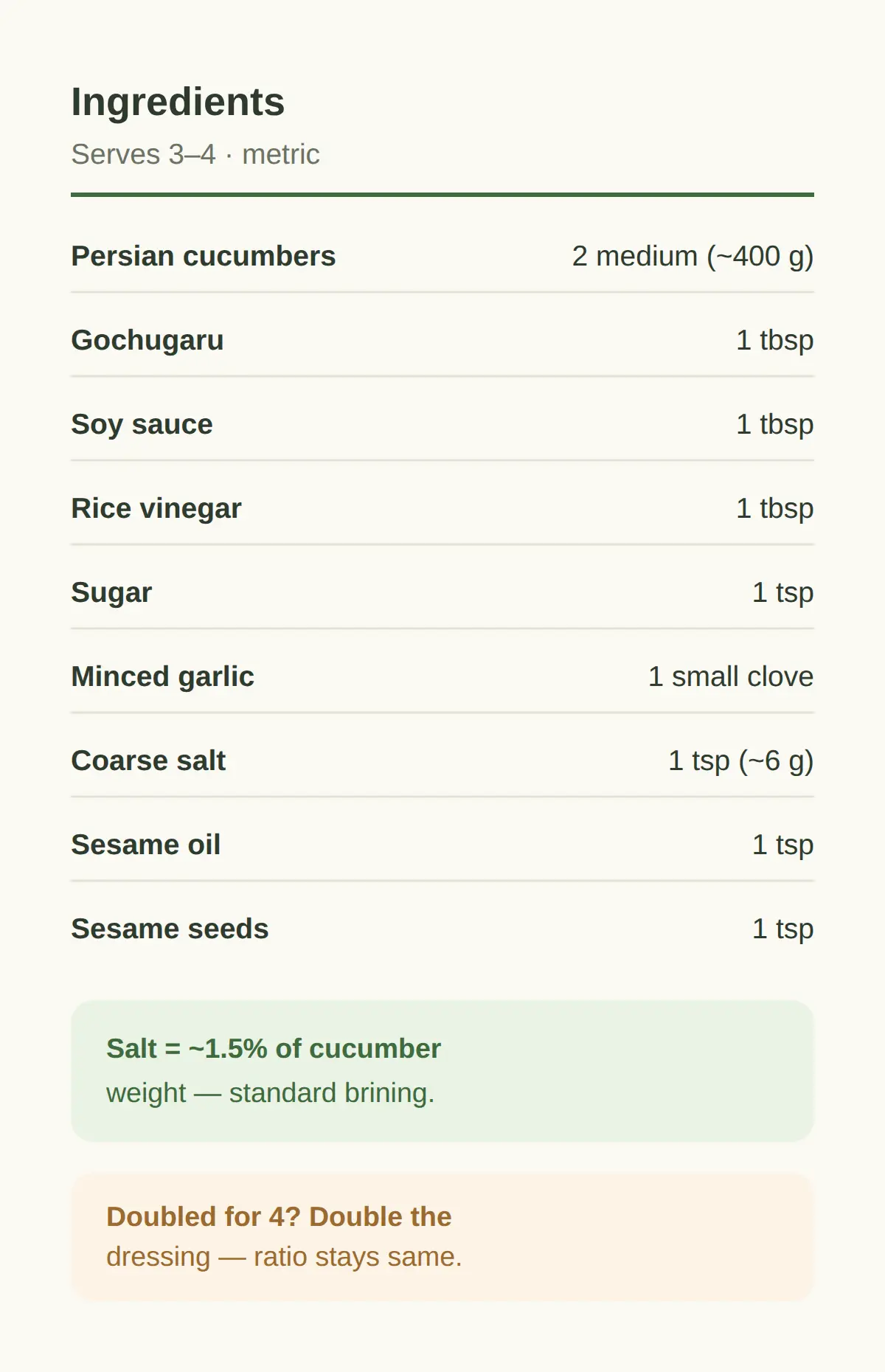
Ingredients and Amounts, Metric, Serves 3-4
Two medium Persian cucumbers, about 400 g (14 oz), serve 3-4 as a side dish — roughly 100-130 g per person, about a third of a cucumber each.
| Ingredient | Amount |
|---|---|
| Persian cucumbers | 2 medium (~400 g / 14 oz) |
| Gochugaru | 1 tbsp (up to 2 tbsp+ for spicy) |
| Soy sauce | 1 tbsp |
| Rice vinegar | 1 tbsp |
| Sugar | 1 tsp (or rice syrup) |
| Minced garlic | 1 small clove (~1 tsp) |
| Coarse salt | 1 tsp (~6 g) for salting |
| Toasted sesame oil | 1 tsp |
| Toasted sesame seeds | 1 tsp |
Garlic is 1 small clove, minced, and some versions leave it out for a kid-friendly side.
The 1 tsp (~6 g) of coarse salt against 400 g of cucumber works out to roughly 1.5% salt by weight, in line with standard brining ratios.
If the recipe is doubled for 4 servings, the dressing doubles with it — the ratio stays the same.
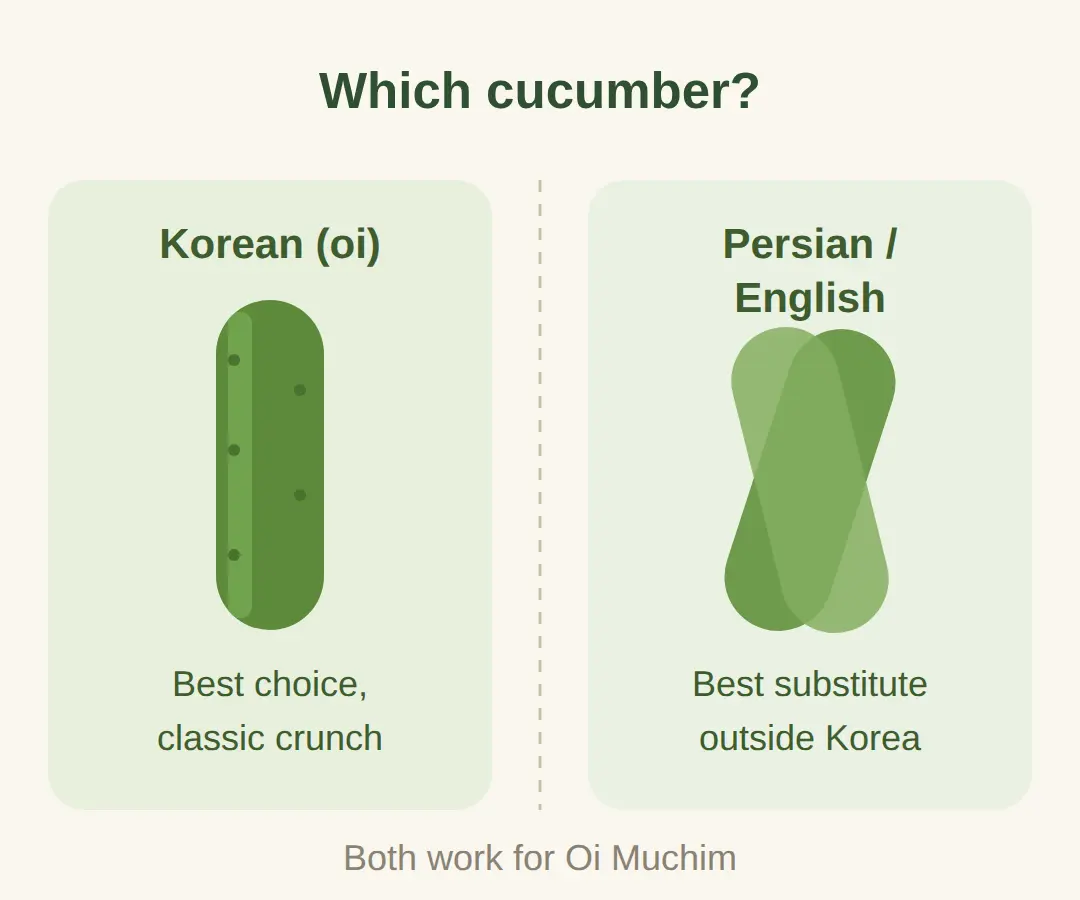
Choose cucumbers by skin first: thin skin and few seeds beat size.
Standard field cucumbers can be used only after peeling partly, halving lengthwise, scooping the seeds and slicing very thin, because they are watery and seedy.
Gochugaru Substitute: What to Use Abroad
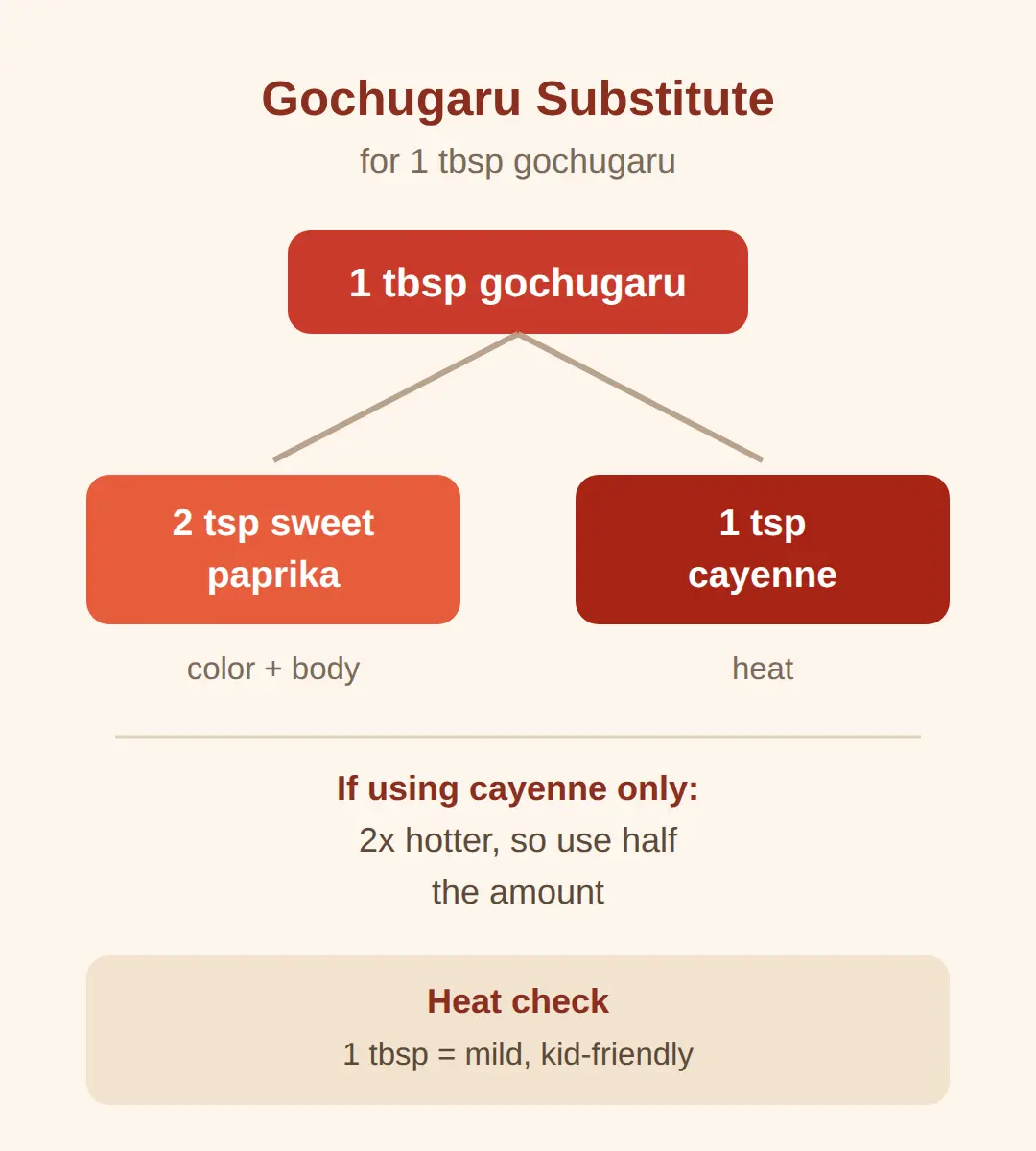
For 1 tbsp gochugaru, use about 2 tsp sweet paprika plus 1 tsp cayenne — paprika gives color and body, cayenne gives heat.
Straight cayenne tastes roughly twice as hot as gochugaru, which is coarser and milder, so use half the amount if swapping on its own.
Do not substitute gochujang 1:1; it turns the salad wet and much sweeter.
The rest of the dressing swaps cleanly.
Rice vinegar can be replaced with apple cider vinegar or distilled white vinegar plus a pinch of extra sugar to soften the sharpness.
For gluten-free eaters, tamari replaces the soy sauce — the dish is otherwise naturally vegan and dairy-free, as long as soy sauce and not fish sauce goes in.
Toasted sesame oil can be skipped or replaced with a neutral oil plus extra toasted sesame seeds; the flavor changes but the salad holds.
Gochugaru itself is stocked at Korean grocers such as H Mart, Asian markets, or online on Amazon, and medium-grind is the standard for muchim.
Sun-dried Korean gochugaru differs from Chinese chili flakes in color and sweetness, so check the label if a general Asian market is the only option.
These substitute ratios are community tips passed between home cooks rather than rules from a Korean cooking authority — taste as you go.
Why Is My Oi Muchim Watery?
Watery oi muchim comes from one of four things: slices too thick, the squeeze skipped, salting dragged past 30 minutes, or dressing mixed too early.
Salting draws the water out, so skipping the squeeze leaves a pool of diluted liquid at the bottom of the bowl within minutes.
The clock matters as much as the squeeze.
At 10-15 minutes of salting the cucumber stays crunchy; past 30 minutes it moves toward a softer, pickled texture, and the excess salt should be rinsed off if the wait runs long.
The standard is 15-20 minutes, then squeeze.
Removing the seeds — halve lengthwise and scoop with a spoon — cuts excess liquid further on watery cucumbers.
For a picnic or lunch box, salt and drain up to a day ahead, refrigerate undressed, and dress right before eating, packed separately from rice.
It softens and sours as it sits, and the brine wets rice in a packed box, so an inner divider earns its place.
What Is Oi Muchim and When Do Koreans Eat It?
Oi muchim literally means ‘mixed cucumber’ — oi (cucumber) plus muchim (mixed with seasoning) — and it is a no-cook side dish.
It is served chilled or at room temperature, never warm, which is what makes it a standard summer banchan (side dish) in Korean home cooking.
On the table it sits alongside rice, Korean BBQ such as samgyeopsal or galbi, bibimbap, or cold noodles in summer, and it travels into lunch boxes and picnics as a no-cook side.
Alongside gamja salad (potato salad) and kongnamul muchim (seasoned soybean sprouts), it is one of the most common summer banchan in Korean home-cooking guides.
Cucumber salad recipes went viral on TikTok in 2024 — the ‘cucumber guy’ trend — which pushed Korean cucumber salad high among the Korean dishes searched in English.
Do not confuse it with Thai cucumber salad (ajad): ajad is a mild, sweet-pickled thing built on rice vinegar, sugar syrup and fish sauce, while oi muchim leans on gochugaru, garlic and sesame — spicy and savory.
If the reader wants the fiery one at a barbecue table, it is this one.
Oi sobaegi, a mild version, and which of three cuts to use
The closest relative is oi sobaegi — whole small cucumbers stuffed with the same chili-garlic seasoning, worth knowing because restaurant and store versions of the stuffed style show up under a different name.
The spice level is fully adjustable: start with 1 tbsp gochugaru for a mild, kid-friendly bowl, or skip chili entirely and add extra sugar and vinegar, as the non-spicy versions do.
Three cuts cover most recipes: thin half-moons (the classic), matchsticks for mixing into bibimbap, and smash-and-tear, which absorbs dressing best.
Thin-sliced raw onion or scallion is a common add-in, about a quarter of a small onion per 2 cucumbers for extra crunch.
Two mixing styles are both valid — toss everything together just before serving for a wetter salad, or pool the dressing under the cucumbers so the crunch lasts longer; pick by when the salad will be eaten.
Leftovers keep 2-3 days in an airtight container in the fridge, but texture and color are best within 24 hours.
It gets softer and more sour as it sits.
If I were serving guests, I’d salt and drain the cucumbers the day before and dress them only at the table, because that squeeze of water is what separates crunchy oi muchim from a watery one.
👉 Spicy Korean cucumber salad (Maangchi)
👉 Korean cucumber salad (My Korean Kitchen)
👉 Gochugaru ingredient guide (Maangchi)
Related posts
📎 📅 Upcoming Dates — Release & Event Calendar
Sources
- vegan_status (koreantable.com)
- Korean-language recipes confirm same dressing ratios and mak (10000recipe.com)
- salting_time_vs_texture (beyondkimchee.com)
Summary: The Rules That Keep It Crunchy
- Slice 2-3 mm thin, salt 15-20 minutes, squeeze — in that order, every time.
- No gochugaru? 2 tsp paprika + 1 tsp cayenne per 1 tbsp; never gochujang 1:1.
- Gluten-free: swap in tamari; the dish is naturally vegan otherwise.
- Making it ahead: drain a day early, dress at the table, keep away from the rice.
- Best within 24 hours, even though it keeps 2-3 days.
FAQ
Q. Can I make Korean cucumber salad without gochugaru?
Yes. Use about 2 tsp paprika plus 1 tsp cayenne for each 1 tbsp gochugaru, and use half the amount if substituting with cayenne alone because it runs roughly twice as hot. Gochujang is not a 1:1 swap — it makes the salad wet and much sweeter.
Q. Why is my oi muchim watery?
Usually the squeeze was skipped, the slices are too thick, or the salad was dressed too early. Salt 15-20 minutes, squeeze gently, slice 2-3 mm thin, and remove seeds on watery cucumbers.
Q. How do I make Korean cucumber salad at home, and what can I use if I can’t find the Korean ingredients?
Salt 2 sliced cucumbers (~400 g) with 1 tsp coarse salt for 15-20 minutes, squeeze, then toss with 1-2 tbsp gochugaru, 1 tbsp soy sauce, 1 tbsp rice vinegar, 1-2 tsp sugar and 1 tsp garlic. Paprika plus cayenne, apple cider vinegar, and tamari all stand in for the Korean originals.
Q. How long does oi muchim keep in the fridge?
2-3 days in an airtight container, but the texture and color are best within 24 hours, and it softens and sours as it sits.
Q. Is oi muchim spicy?
It depends on the gochugaru: 1 tbsp makes a mild, kid-friendly bowl, 2 tbsp or more makes it spicy, and the sugar and sesame oil balance the chili.
Next on the calendar: make the dressing first the next time it appears on a BBQ menu — the cucumbers can salt while it mixes.
Cover photo: File:Korean cucumber salad-Hongeohoe chomuchim.jpg by by Junho Jung at Flickr from South Korea — CC BY-SA 3.0
#koreancucumbersalad #oimuchim #koreansidedish #banchan #gochugarusubstitute #no-cookrecipe
📅Upcoming Schedule — this week 23 · D-1 Autumn season = post-summer brightening demand window (UV drSee all →