In Korean restaurants there is no tipping, no one eats before the most senior person lifts a spoon, chopsticks never stand upright in rice, and the rice bowl stays on the table — and side-dish refills remain free in 2026.
For a first-time visitor this means the hardest part of a Korean meal is not the food but five or six small habits that locals notice immediately.
This post lists the eight things not to do, the order-and-pay steps with the phrases that work, the rules for drinking and shared dishes, solo-dining options with prices, and floor-seating basics.
Korea Dining Etiquette: What Should You Not Do at the Table?
| You are wondering about a tip | Do not tip — say "jal meogeotseumnida" on the way out instead |
|---|---|
| You sit down with Koreans | Wait for the most senior person to pick up a spoon before you touch anything |
| Someone pours your drink | Receive with both hands, turn your head slightly as you drink, pour for others — never your own glass |
| You eat from shared dishes | Take the piece closest to you with serving chopsticks; do not pick through |
| You are alone and hungry | Pick gukbap, kalguksu, gimbap or rice bowls; skip BBQ and weekday 12:00–13:00 |
| It is time to pay | Pay at the counter on the way out, or say "gyesanhalgeyo" — cards work almost everywhere |
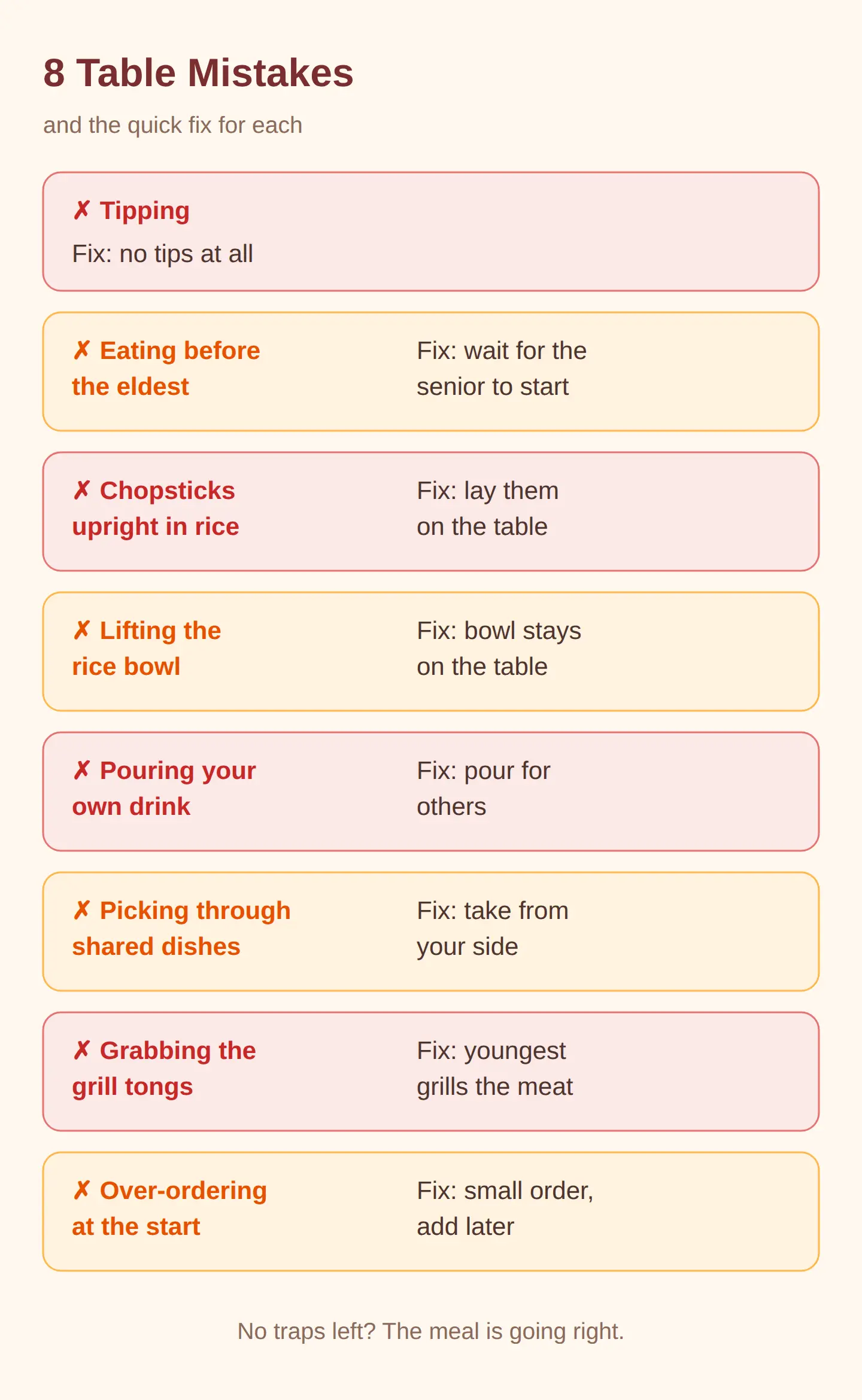
The eight wrongs are: tipping, eating before the eldest, standing chopsticks upright in rice, lifting the rice bowl, pouring your own drink, picking through shared dishes, grabbing the grill tongs, and over-ordering at the start.
Each one is a single action, and each has a plain fix.
Stick chopsticks upright into rice and Koreans will notice — it mimics incense offerings at ancestral memorial rites and is associated with death.
Start eating before the most senior person lifts a spoon and it is a genuine breach of manners, not a small slip.
Lift the rice bowl to your mouth and it can read as rude; the spoon is for rice and soup, chopsticks for everything else, and the bowl stays on the table.
Order a mountain of food at the start and the table flow breaks — the normal sequence is a basic order first, then "gonggibap chugayo" (extra rice), "sari chugayo" (extra noodles), or one more serving of meat.
At samgyeopsal the youngest at the table manages the grill and cuts with scissors, so leave the tongs alone unless you are invited to take them.
If your table has none of these traps left, the meal is already going right — the rest is phrases, covered below.
Do You Tip in Korean Restaurants?
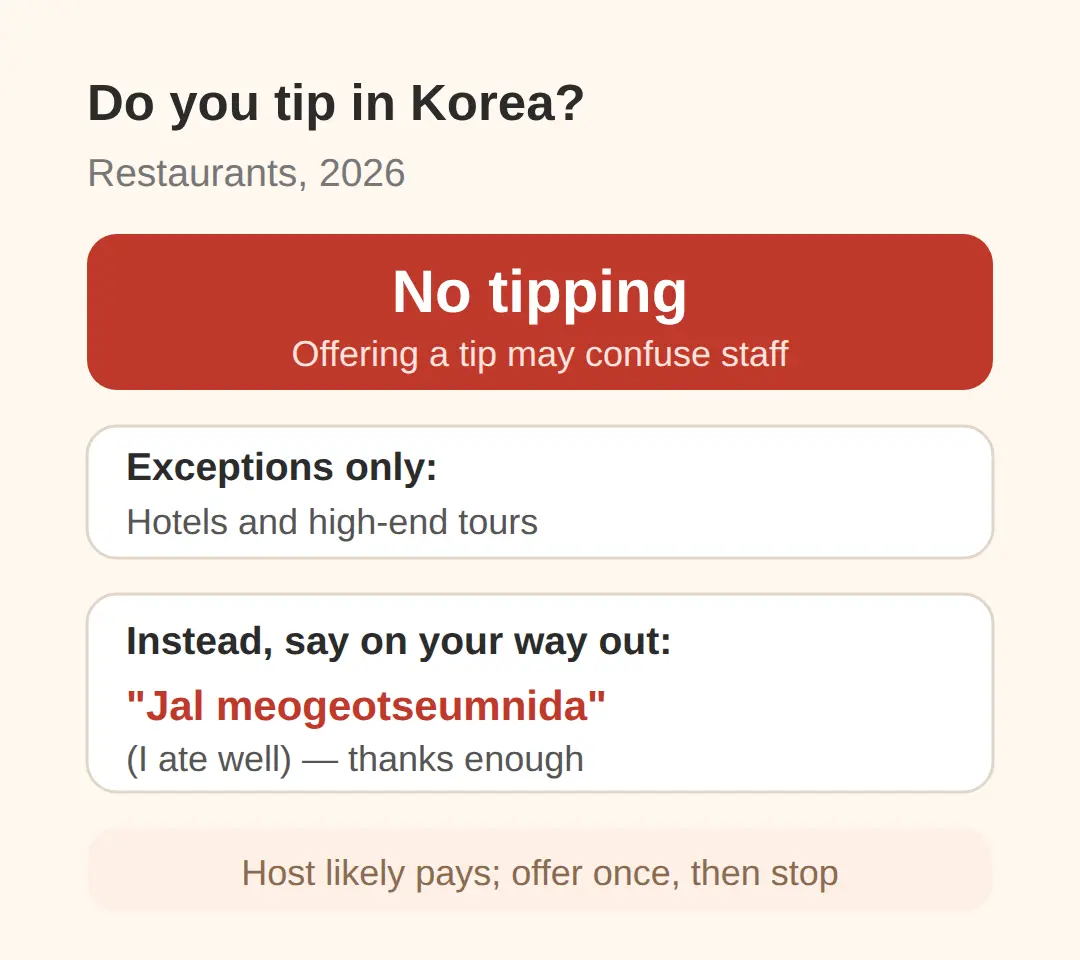
No — tipping is not practiced in Korea in 2026, and offering it can confuse staff or be refused outright.
The exceptions are hotels and high-end tours; everywhere else a tip is unnecessary.
What replaces the tip is a parting word: "jal meogeotseumnida," meaning I ate well, said on your way out to whoever cooked or paid.
One 2026 travel guide describes this greeting as the standard exit line and enough thanks on its own.
If you are hosted by a Korean or at a professional dinner, expect the host to insist on paying — offer to contribute once or twice, then stop, because arguing over the bill is the actual mistake.
How Do You Order, Call Staff and Pay?
Check the entrance sign first, because it tells you whether to sit freely, prepay at the counter, or order at a kiosk.
| Step | What to do |
|---|---|
| Read the entrance sign | Four entry types: staff-seated, free seating, prepay at the counter, kiosk order — check the sign first |
| Call staff | Press the table call button if present; otherwise raise a hand lightly and say "jeogiyo" — no waving or shouting |
| Water and plates | Water, cups, side-dish refills and front plates are often at a self-serve corner; asking "apjeosi jom juseyo" for a personal plate is routine in 2026 |
| Pay | Say "gyesanseo juseyo" for table payment or pay at the counter on the way out — counter payment is the most common; "gakja gyesanhalgeyo" splits the bill |
| Cards | Cards are accepted at nearly every restaurant; only market stalls may be cash-only |
The first thing worth doing at the door is reading that sign, because standing and waiting for a server in a self-serve or kiosk restaurant is the most common beginner mistake.
How Do You Eat With Koreans — Seniors, Pouring and Shared Dishes?
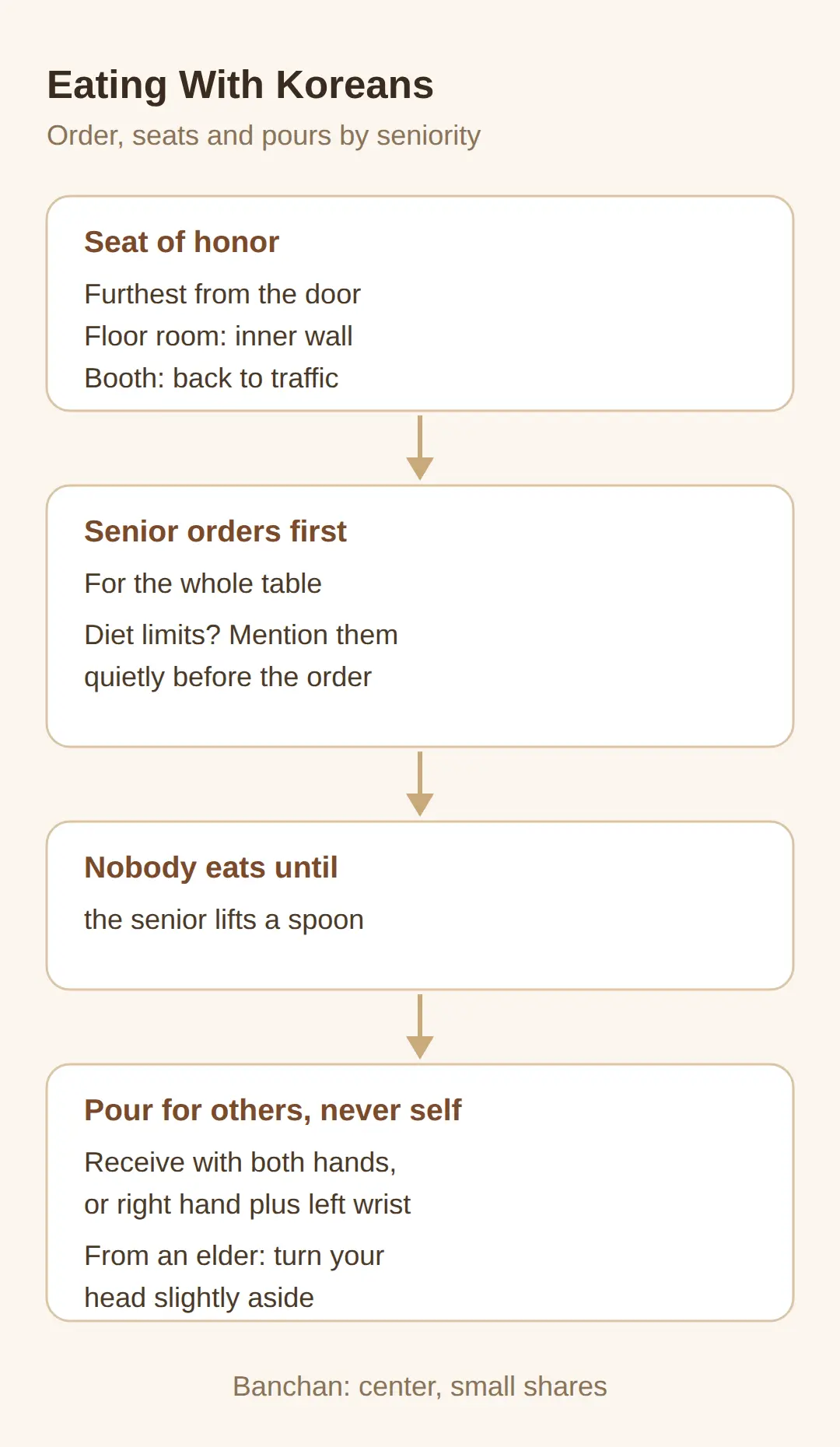
The seat of honor is furthest from the door, the most senior person orders first for the whole table, and nobody touches food until that person lifts a spoon.
In floor-seating rooms the honored spot is the inner wall; in booth seating it is the seat with its back to the main traffic.
Korea’s table rules carry weight on age and seniority, so the sequence matters more than the food itself.
At drinking tables you never pour your own glass — watch others’ glasses and pour for them, and receive a pour of soju, makgeolli or beer with both hands, or the right hand supported by the left wrist.
When an elder pours for you, turn your head slightly to the side as you drink.
Banchan sit in the center for everyone, so take small portions with the serving chopsticks many restaurants now provide, and take what is closest to you rather than hunting for the best piece.
Piling your own bowl high from a shared dish in one go, or finishing noticeably earlier than the table, both read as off — pace yourself, since conversation and refills stretch the meal.
Mention dietary restrictions quietly before the order goes in, because the senior person is often ordering for everyone.
Can You Eat Alone in Korea?
Yes for stew and noodle places, no for most Korean BBQ — BBQ tables usually require a two-serving minimum.
| Solo-friendly menus | Hard for one |
|---|---|
| Gukbap, haejangguk, seolleongtang, kalguksu, ramyeon, gimbap, rice bowls, bunsikjip, franchise kiosks | Korean BBQ (two-serving minimum), gamjatang, budae jjigae, dakhanmari |
Look for "1-person servings OK" or "solo diners welcome" on the sign, and skip weekday 12:00–13:00 and weekend 18:00–20:00, when a single seat is hardest to place.
Prices make the split clear, per 2026 travel-guide ranges rather than confirmed menu pricing.
Floor Seating, Shoes and the Before/After Phrases
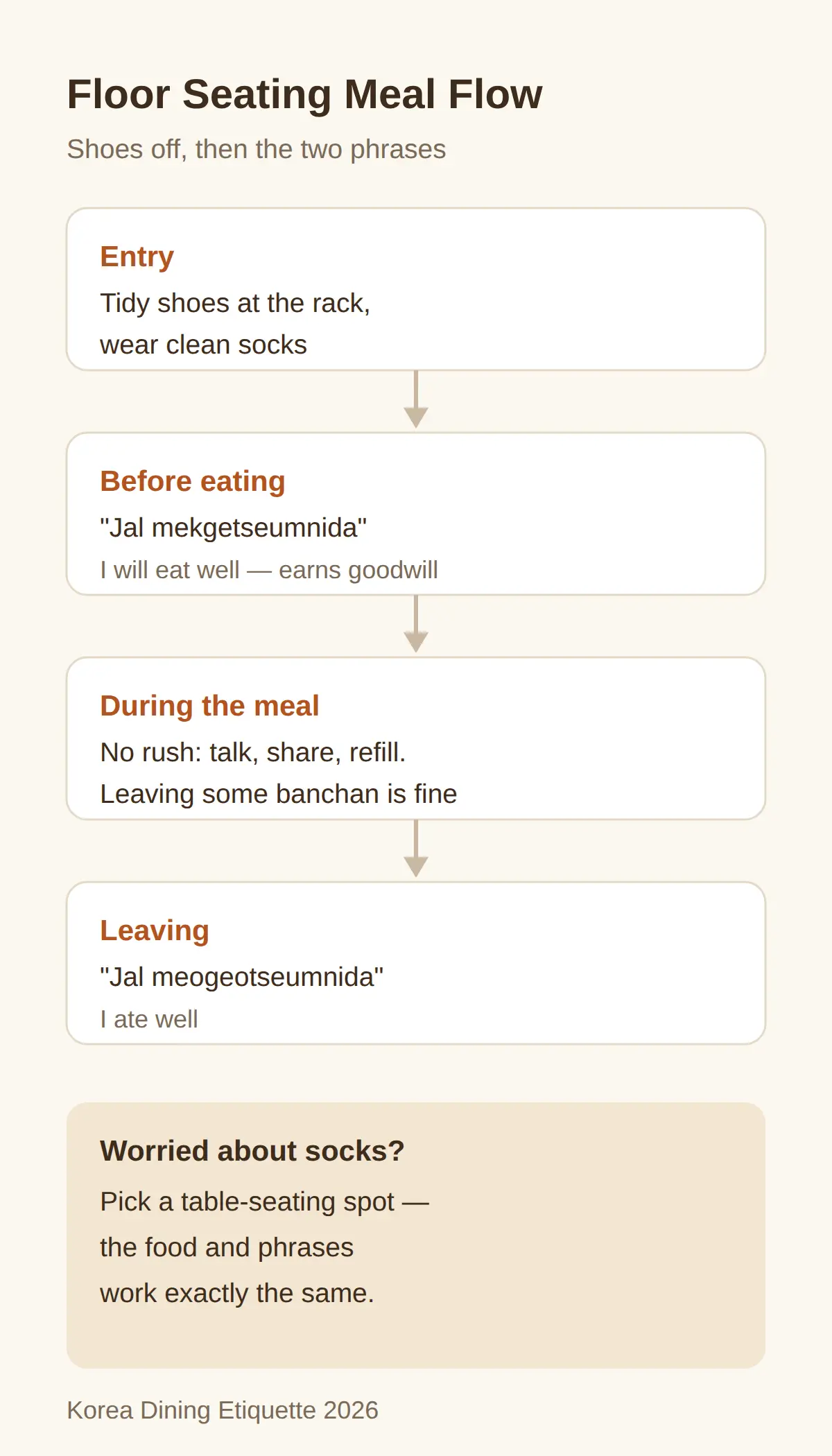
Some hanjeongjeok and gukbap restaurants have shoe-off floor seating, so tidy your shoes at the rack on entry and wear clean socks.
The two phrases bracket the meal: "jal meokgetseumnida" (I will eat well) before eating, which earns immediate goodwill at any Korean table, and "jal meogeotseumnida" (I ate well) on the way out.
Leaving a small amount in the banchan dishes is fine — emptying every plate completely can suggest the food was not enough.
Meals here are not a race, because conversation, shared dishes and refills naturally extend them.
If your socks are a worry, pick a table-seating restaurant instead; the food and the phrases work exactly the same.
If it were me, I would read the entrance sign first and head straight for the self-serve corner to pour my own water — the time spent standing and waiting for a server is what I would rather skip, and it is the one habit that changes the whole meal from the first minute.
👉 a full guide to Korean restaurant etiquette — seating, calling staff and self-serve water
👉 essential Korean dining customs, from waiting for the eldest to paying culture
Related posts
📎 📅 Upcoming Dates — Release & Event Calendar
Sources
- Full 2026 guide: call bell, seating types, banchan refills, (mywebring.com)
- Confucian seniority rules, never pour your own drink, dachib (koreajourneys.com)
- Rice bowl not lifted, turn head when drinking, elder pays tr (genuine-korean.com)
The Short Version
- No tip — "jal meogeotseumnida" at the door is the thank-you.
- Nobody eats before the eldest at the table lifts a spoon — starting first is a real breach of manners.
- Chopsticks never stand upright in rice; the rice bowl stays on the table.
- Pour for others, never for yourself; receive with both hands.
- Read the entrance sign first — self-serve, prepay or kiosk changes your whole route.
FAQ
Q. Do I tip in Korean restaurants?
No. Tipping is not practiced in Korea in 2026, and offering it can confuse or be refused by staff — the exception is hotels and high-end tours. Say "jal meogeotseumnida" on the way out instead.
Q. What should I not do when eating in Korea?
Do not tip, eat before the eldest, stand chopsticks in rice, lift the rice bowl, pour your own drink, pick through shared dishes, grab the grill tongs, or order everything at once.
Q. Can I eat alone in Korea?
Yes at gukbap, kalguksu, gimbap and rice-bowl places; most Korean BBQ requires two servings. Look for "1-person servings OK" or "solo diners welcome" signage and avoid weekday 12:00–13:00.
Q. Why don’t Koreans lift their rice bowls?
The bowl stays on the table, and rice is eaten with the spoon — lifting the bowl to your mouth can be seen as rude in Korea, the reverse of the custom in Japan or China.
Q. What manners should I know for samgyeopsal with Korean friends?
The youngest at the table manages the grill and cuts the meat with scissors — accept the service rather than taking the tongs, and add meat or rice with "1 more serving of meat, please" instead of ordering it all up front.
Before your next Korean meal, memorize just two phrases — "jal mekgetseumnida" before, "jal meogeotseumnida" after — and the entrance sign at the door.
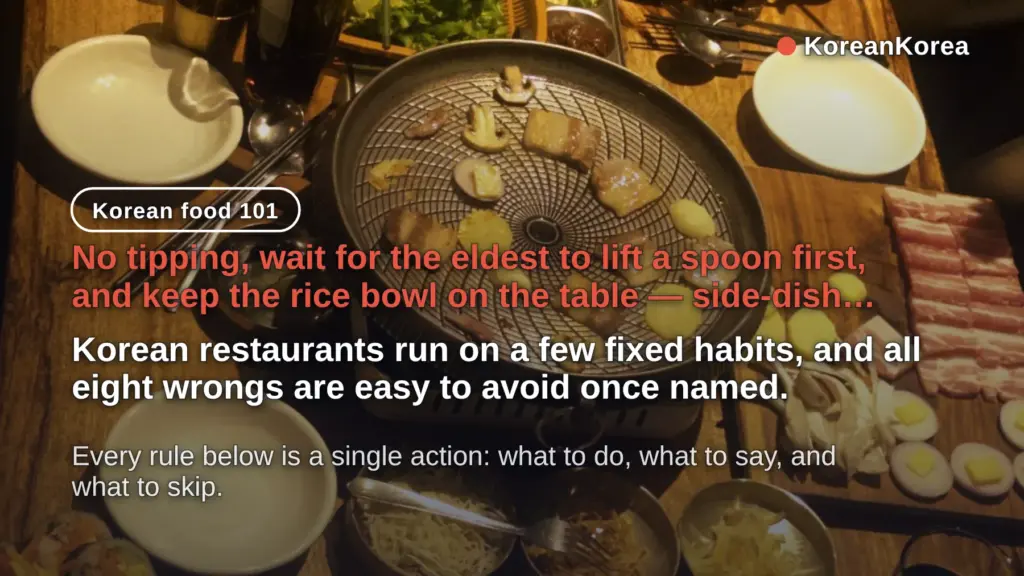
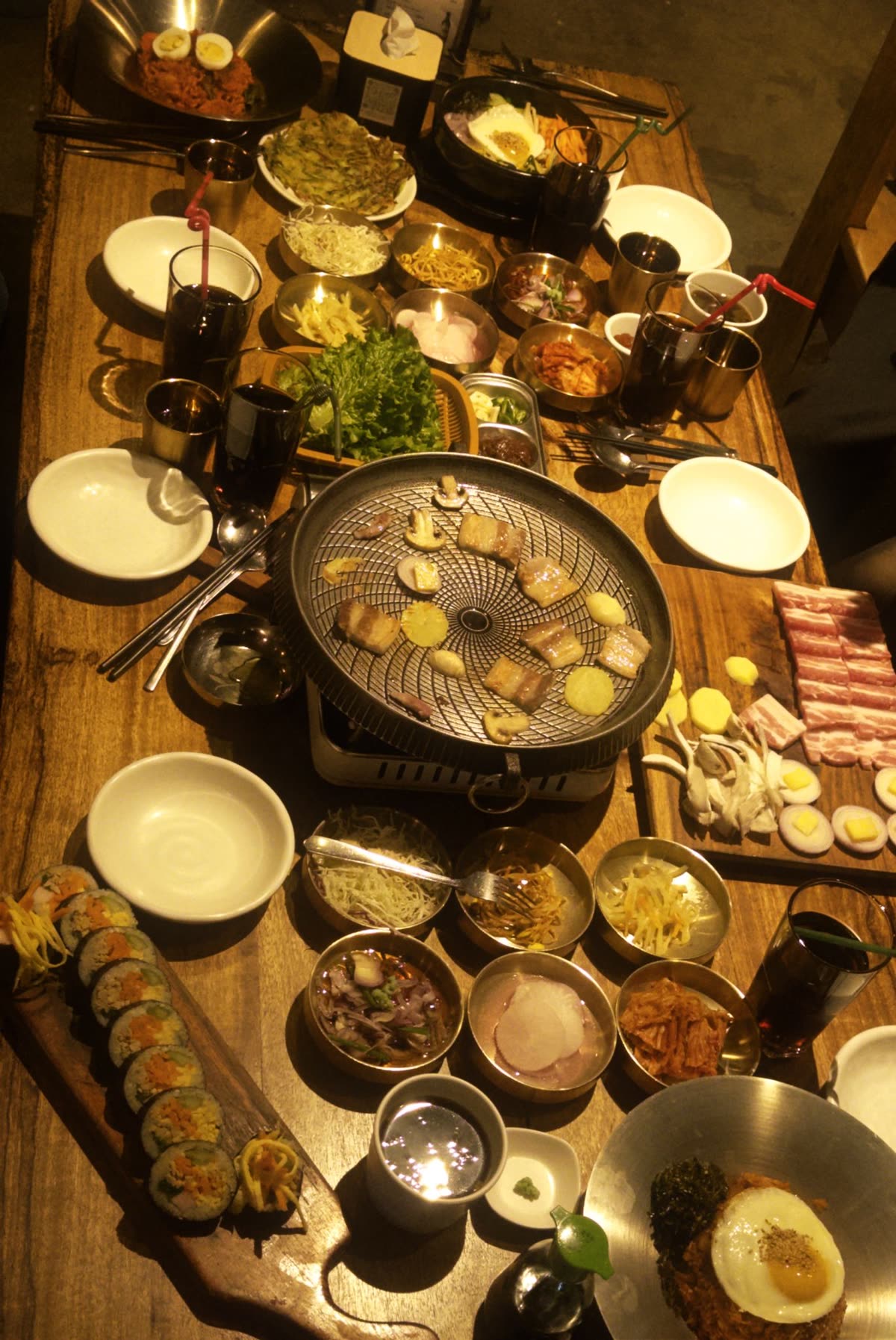
Cover photo: An overhead view of a full Korean BBQ spread on a wooden table featuring a round charcoal grill with meat and mushrooms cooking, raw pork belly slices, multiple banchan side dishes, kimbap rolls, bibimbap and dark drinks. by Manjil Aryal — CC0 1.0
#koreandiningetiquette #doyoutipinkorea #koreanbbqmanners #solodininginkorea #koreanrestaurantphrases #koreatravel2026
📅Upcoming Schedule — this week 23 · D-day Autumn season = post-summer brightening demand window (UV drSee all →