Beginner tutorial channels land on the same numbers: 20–40 minutes of practice a day, 3–5 days a week.
Short daily sessions beat one long weekly session, so the day you skip matters less than the shape of each session.
This post gives the 30-minute session order, the 8-count breakdown method, a weekly calendar, warm-up rules, first songs, and how to follow Korean tutorials from outside Korea.
Contents
- kpop daily routine: how long a beginner should practice each day
- How to break down K-pop choreography into 8-counts
- A weekly schedule you can keep (and how to check progress)
- Warm-up and injury rules for beginners
- Which songs to start with and where to practice
- Following Korean tutorials from outside Korea
kpop daily routine: how long a beginner should practice each day
Beginner tutorials commonly recommend 20–40 minutes a day, and that range works out to roughly 60–200 minutes a week (20 × 3 to 40 × 5).
The commonly taught session order is warm-up, one new 8-count block, review, then a 5-minute cooldown.
Over a month that is about 13–22 sessions, which is why frequency matters more than any single long day.
Beginner tutorial channels converge on the same 30-minute shape: 5–10 minutes of warm-up, 15–20 minutes on one new 8-count block, and 5–10 minutes reviewing what you already learned.
Some guides instead describe the split by proportion — roughly 70% review and 30% new material — rather than by fixed minutes, so treat the 5–10 minute review block above as one common template and the 70/30 ratio as another way beginners pace the same session.
Keeping the daily count at 20–40 minutes matches the 3–5 day weekly guideline with rest built in.
The 20–40 minute figure is a common tutorial range, not a confirmed rule from a dance academy, so treat it as a starting point.
If you only have 30 minutes, run the template as written; if a session runs long, cut the new material, not the warm-up.
| Warm-up | 5–10 min |
|---|---|
| New 8-count block | 15–20 min |
| Review of old sections | 5–10 min |
| Cooldown stretching | 5 min |
How to break down K-pop choreography into 8-counts
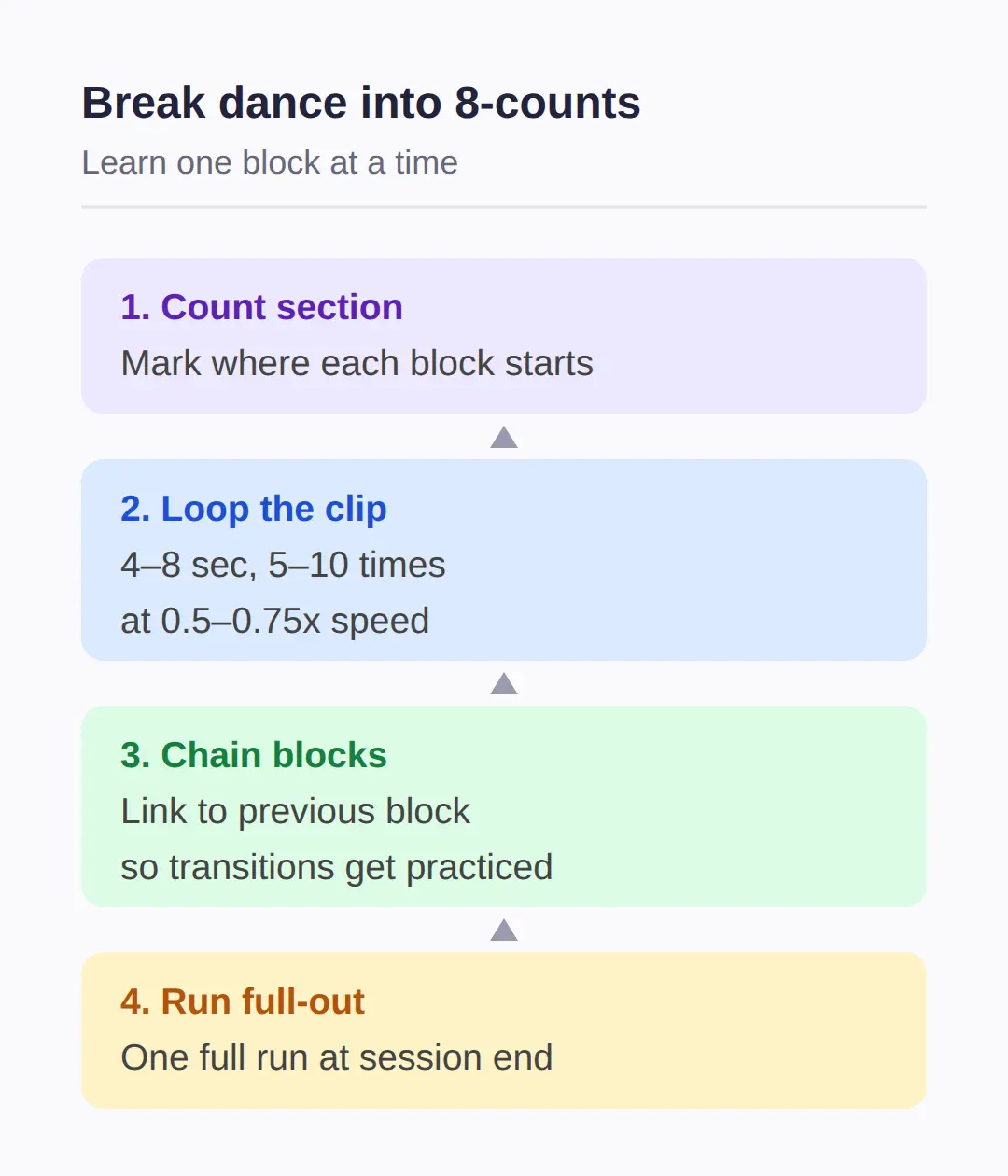
K-pop choreography is counted in 8-counts, and the standard teaching method is to learn one 8-count at a time, repeat it until smooth, then chain it to the previous one.
This is the counting people mean when a tutorial says "1 through 8" and restarts.
- Count the section in 8-counts and mark where each block starts.
- Loop 4–8 seconds of the clip 5–10 times at 0.5–0.75x speed (YouTube playback settings) before moving on.
- Mark new sections at low energy first, then do one full-out run at the end of the session.
- Chain each block to the previous one so the transitions get practiced too.
The chorus first is the common teaching order: it repeats 2–3 times in the song, so one memorized section covers roughly a third of the choreography and gives you an early finish line.
Learn verse blocks in 8-count units after it, and transitions last.
If a section keeps falling apart, drop the playback speed before adding repetitions.
A weekly schedule you can keep (and how to check progress)
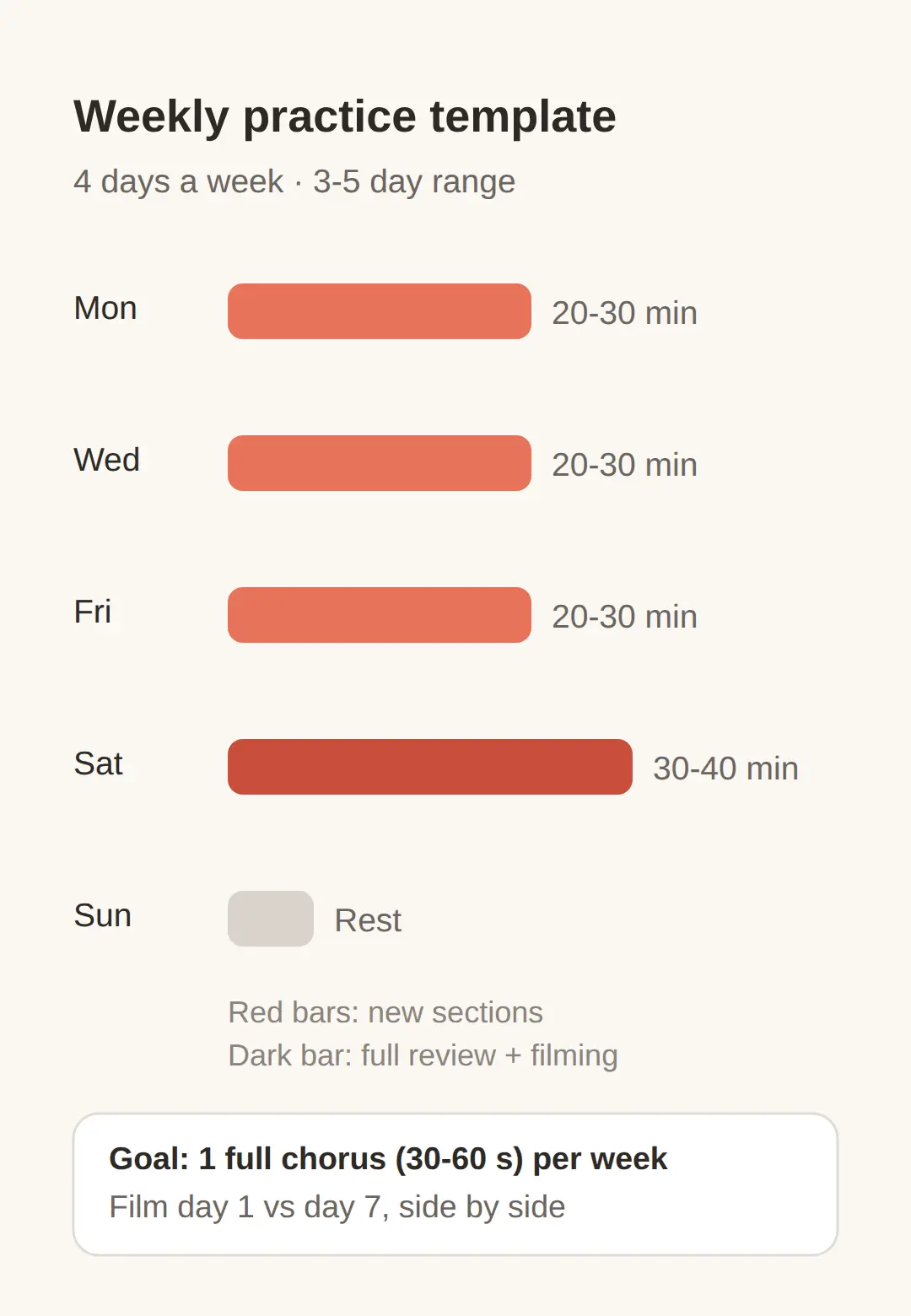
A weekly template from tutorial creators: Monday, Wednesday, and Friday 20–30 minutes of new-section work, Saturday 30–40 minutes of full review run with filming, Sunday off.
That is 4 practice days, which sits inside the 3–5 day guideline with at least 1–2 rest days.
Weekly goal setting is a common beginner pacing guide: one full chorus, about 30–60 seconds of choreography, per week.
The self-check that replaces guessing is filming the same chorus on day 1 and day 7 side-by-side.
Set the phone 2–3 meters back at chest-to-eye height so the full body stays in frame.
Two habits recur across guides: 5–10 minutes of visualizing the choreography without moving, often before sleep, and reviewing the next morning after a night’s sleep.
Both are commonly cited learning tactics rather than validated doses.
If Saturday is the only day you can film, that is enough — one comparison a week tracks progress.
Warm-up and injury rules for beginners
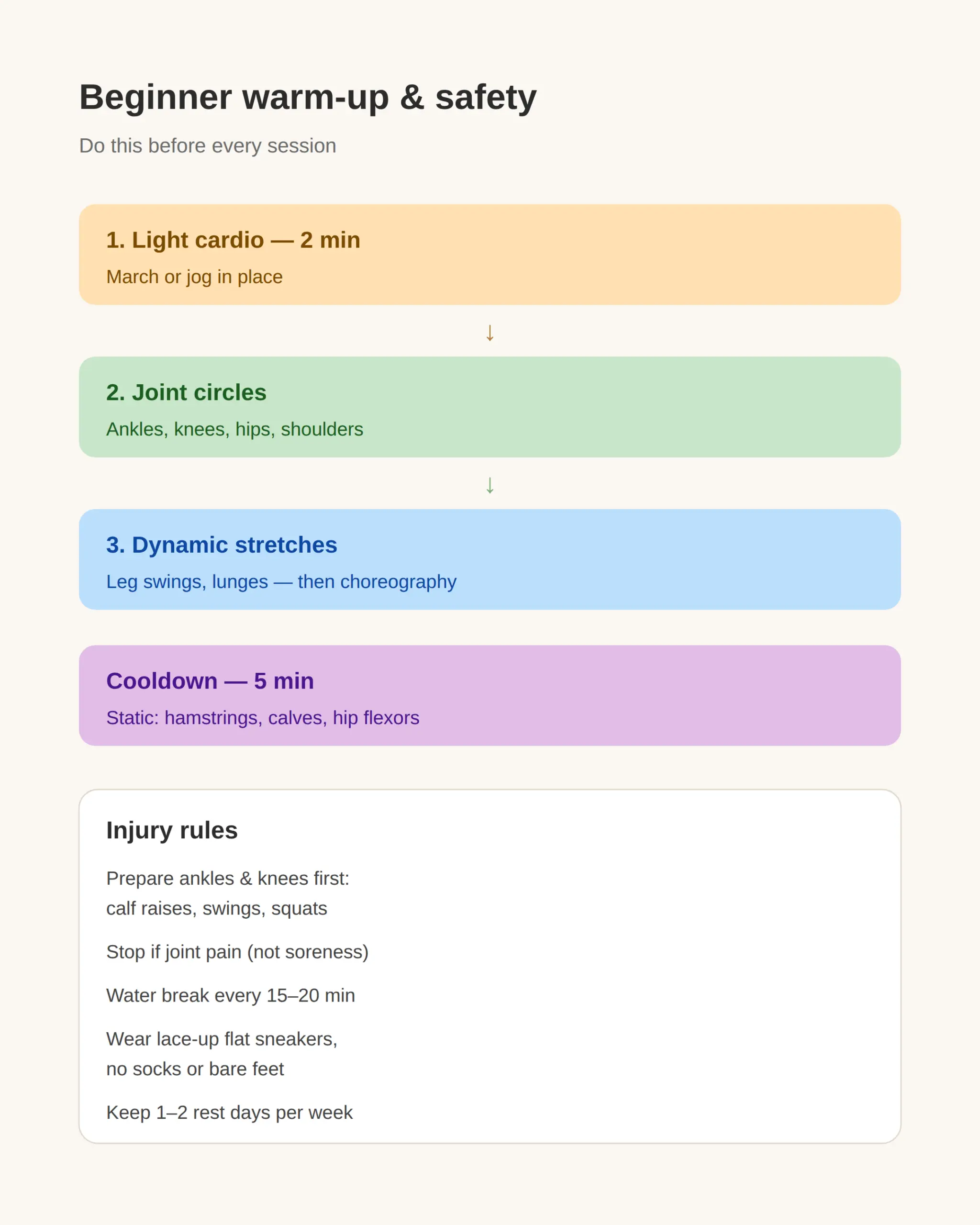
The commonly taught warm-up order is 2 minutes of light cardio (march or jog in place), joint circles (ankles, knees, hips, shoulders), then dynamic stretches such as leg swings and lunges — in that order, before touching choreography.
After practice, static stretching of the hamstrings, calves, and hip flexors for about 5 minutes is the standard cooldown.
Dance-medicine guidance emphasizes ankle and knee preparation (calf raises, leg swings, squats or lunges) before jumping-style choreography, because lower-limb sprains are the most common dance injury.
The load rule is a gradual weekly increase, and the stop rule is simple: when joint pain appears — not muscle soreness — stop learning new choreography while it lasts.
A 1–2 minute water break every 15–20 minutes is the common tutorial suggestion.
Wear lace-up flat sneakers on a smooth floor rather than socks or bare feet, and keep 1–2 rest days in the week.
If your knees or ankles start hurting mid-practice, that is the day to end on review only.
Which songs to start with and where to practice
Beginner song lists most often name NewJeans ‘Hype Boy’ and ‘OMG’, (G)I-DLE ‘Queencard’ chorus, and SEVENTEEN ‘Very Nice’ chorus as low-tempo, repetitive 8-count starting points.
These labels are community consensus, not an official ranking, and specific lists differ by creator.
For home practice, clear a floor area of roughly 2m × 2m, and routines that travel side to side need at least 4 steps of lateral space.
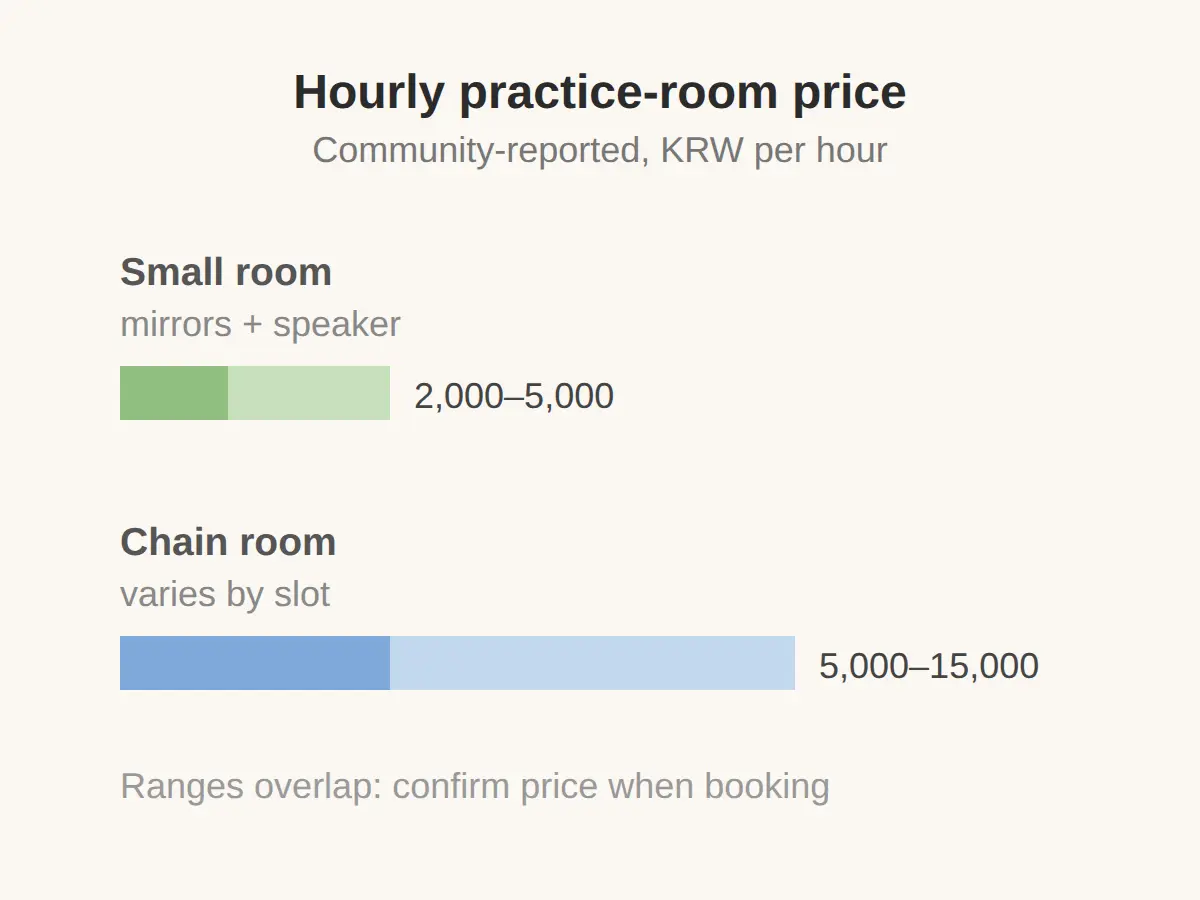
If that is not enough, hourly dance practice rooms in Korea are widely listed at about 2,000–5,000 KRW per hour for a small room with mirrors and Bluetooth audio, and around 5,000–15,000 KRW per hour for chains — the two ranges cover different rooms and time slots, so confirm the price when you book rather than expecting one figure.
If you are picking your first song, start with an easy chorus and learn the chorus first.
If your room is too small for a full run, that is the day an hourly room earns its price.
Following Korean tutorials from outside Korea
Searching the tutorial title plus ‘mirrored’ or the Korean word ‘거울모드’ returns flipped versions that match your mirror image — a standard habit in Korean cover-dance communities.
Learn from the back view first, then self-check with the front view.
Korean tutorials count 8-counts in Korean — ‘hana, dul, set, net…’ — which is a small listening hurdle, but the counting pattern is regular and repeats every 8 beats, so it becomes recognizable within one session.
If a Korean-language tutorial is the only one for your song, the loop method at 0.5–0.75x speed carries most of the work.
If picking one path: start with the back view of a mirrored video of an easy chorus like ‘Hype Boy’, loop 4–8 seconds of it 10 times at 0.5–0.75x speed, and film yourself on day 1 and day 7 to compare instead of judging by feel.
I would start with the back view of a mirrored video, because matching the dancer’s movements like a dance game is far less confusing for a first chorus than decoding reversed directions.
The blog’s earlier BTS beginner tutorial and easiest K-pop dances posts pair with this routine as follow-up reading.
Related posts
Sources
- daily_practice_structure (youtube.com)
- blog_internal_link (contents.premium.naver.com)
- PubMed listing confirms the research area exists; specific p (pubmed.ncbi.nlm.nih.gov)
Summary
- 20–40 minutes a day, 3–5 days a week, with 1–2 rest days.
- One 30-minute session: 5–10 min warm-up, 15–20 min new 8-counts, 5–10 min review, 5 min stretching.
- Loop 4–8 seconds 5–10 times at 0.5–0.75x speed; learn the chorus first.
- Mark new sections, then one full-out run at the end; film day 1 vs day 7.
- Joint pain stops new choreography; flat sneakers, smooth floor, water every 15–20 minutes.
FAQ
Q. How long should a beginner practice K-pop dance each day?
Beginner tutorials commonly recommend 20–40 minutes a day — a common tutorial range rather than a confirmed rule from an academy.
Q. How do you break down K-pop choreography into 8-counts?
Count the section in 8-counts, loop one 4–8 second clip 5–10 times at 0.5–0.75x speed until smooth, then chain it to the previous block.
Q. How many days a week should a beginner dance?
3–5 practice days with 1–2 rest days, for example Monday, Wednesday, Friday for new sections, Saturday for a full review run, Sunday off.
Q. Is 30 minutes a day enough for K-pop dance practice?
Yes for one chorus a week — a 30-minute session covers warm-up, one new 8-count block, review, and stretching.
Q. Should I practice K-pop dance every day?
Short daily sessions help retention more than one long weekly session, but keep at least 1–2 rest days a week to protect knees and ankles.
Read next: the blog’s beginner BTS dance tutorial and the easiest K-pop dances list — both pair with this weekly schedule.
Cover photo: AI-generated illustration (dance practice room) — AI-generated image, illustrative only
#kpopdailyroutine #kpopdancetutorialforbeginners #8-countchoreography #kpoppracticeschedule #beginnerkpopdance
📅Upcoming Dates — 이번 주 19 · D-2 Final two episodes drop on Disney+/Hulu전체 보기 →