Korean skincare as a category is safe in pregnancy; the problem sits in a short list of ingredients, not in K-beauty itself.
Contents
- Can I use Korean skincare while pregnant? What to skip and what to swap
- Ingredients to skip, and what replaces them
- Acid percentages: the exact numbers
- How to check a product at Olive Young
- A routine by trimester
- When to see a dermatologist
Can I use Korean skincare while pregnant? What to skip and what to swap
Yes.
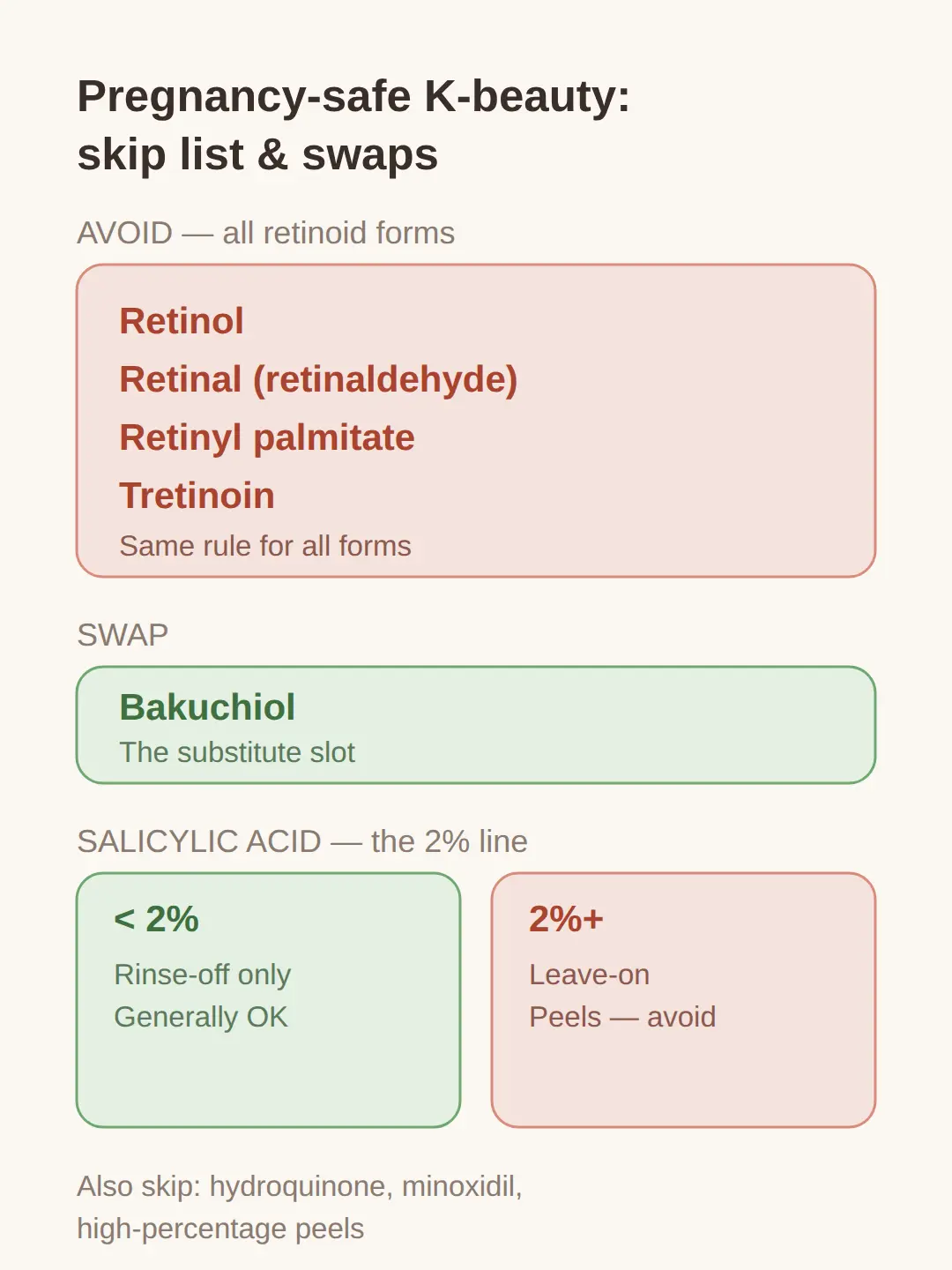
The category is fine — what you skip is specific ingredients: all vitamin-A derivatives (retinol, retinal, retinyl palmitate), hydroquinone, minoxidil, salicylic acid at 2% or more, and high-percentage peels.
The American College of Obstetricians and Gynecologists does not recommend retinoids in pregnancy, prescription or cosmetic-grade, and retinal and retinyl palmitate follow the same rule as retinol.
Doctors also flag minoxidil for hair loss and hydroquinone for brightening.
Salicylic acid is chemically related to aspirin, which is why the concentration matters more than its presence.
If you used a retinol cream a few times before finding out, stopping now and switching products is the move — the avoid lists rest mostly on animal studies and precaution, not proven human harm.
| Acne | Azelaic acid · niacinamide · low-% glycolic |
|---|---|
| Pigmentation | Vitamin C · niacinamide · azelaic acid · alpha arbutin |
| Anti-aging | Bakuchiol · peptides · vitamin C |
| Dryness | Hyaluronic acid · ceramides · squalane · glycerin |
| Sunscreen | Zinc oxide · titanium dioxide |
Ingredients to skip, and what replaces them
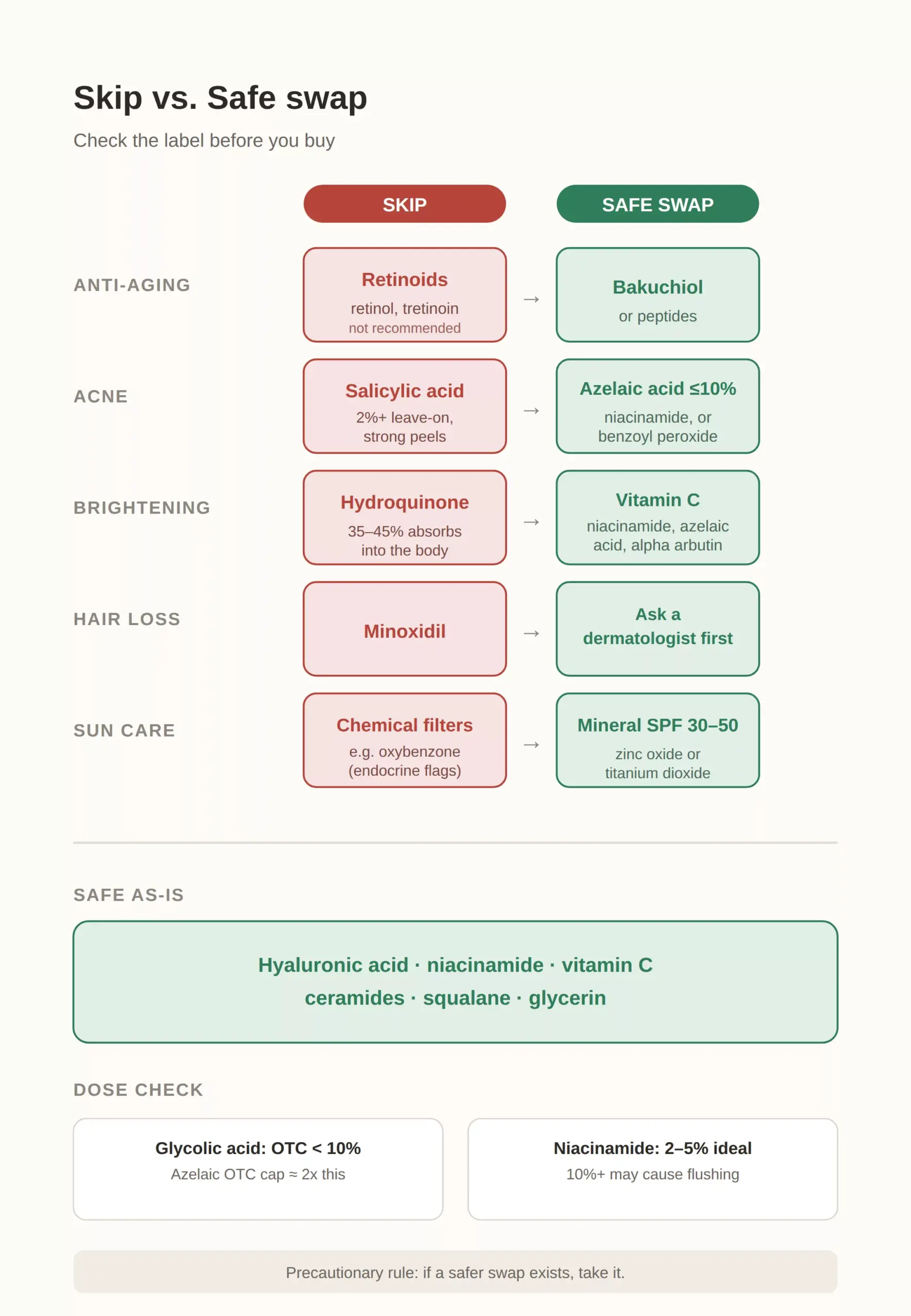
One skip list covers almost every situation: retinoids, hydroquinone, minoxidil, salicylic acid at 2%+ in leave-on products, and professional-strength chemical peels.
Everything else on the shelf — hyaluronic acid, niacinamide, vitamin C, ceramides, squalane, glycerin — is considered safe throughout pregnancy.
| Concern | Skip | Safe swap |
|---|---|---|
| Anti-aging | Retinoids (retinol, retinaldehyde, tretinoin) — ACOG does not recommend them, prescription or cosmetic-grade | Bakuchiol, peptides |
| Acne | Salicylic acid at 2%+ in leave-on products, professional-strength chemical peels | Azelaic acid at 10% or less, niacinamide, benzoyl peroxide (ACOG-listed) |
| Brightening / melasma | Hydroquinone — 35–45% systemic absorption | Vitamin C, niacinamide, azelaic acid, alpha arbutin |
| Hair loss | Minoxidil | Consult a dermatologist before substituting |
| Sun protection | Chemical filters like oxybenzone, flagged for endocrine activity in animal studies | Mineral SPF 30–50 with zinc oxide or titanium dioxide |
The safety logic here is the precautionary principle: many ‘avoid’ lists rest on animal studies or theoretical concerns, not proven human harm — but when a safer alternative exists, the swap costs you nothing.
If you want one swap, start with bakuchiol in the retinol slot; if breakouts are the issue, azelaic acid treats acne and pigmentation at the same time.
Acid percentages: the exact numbers
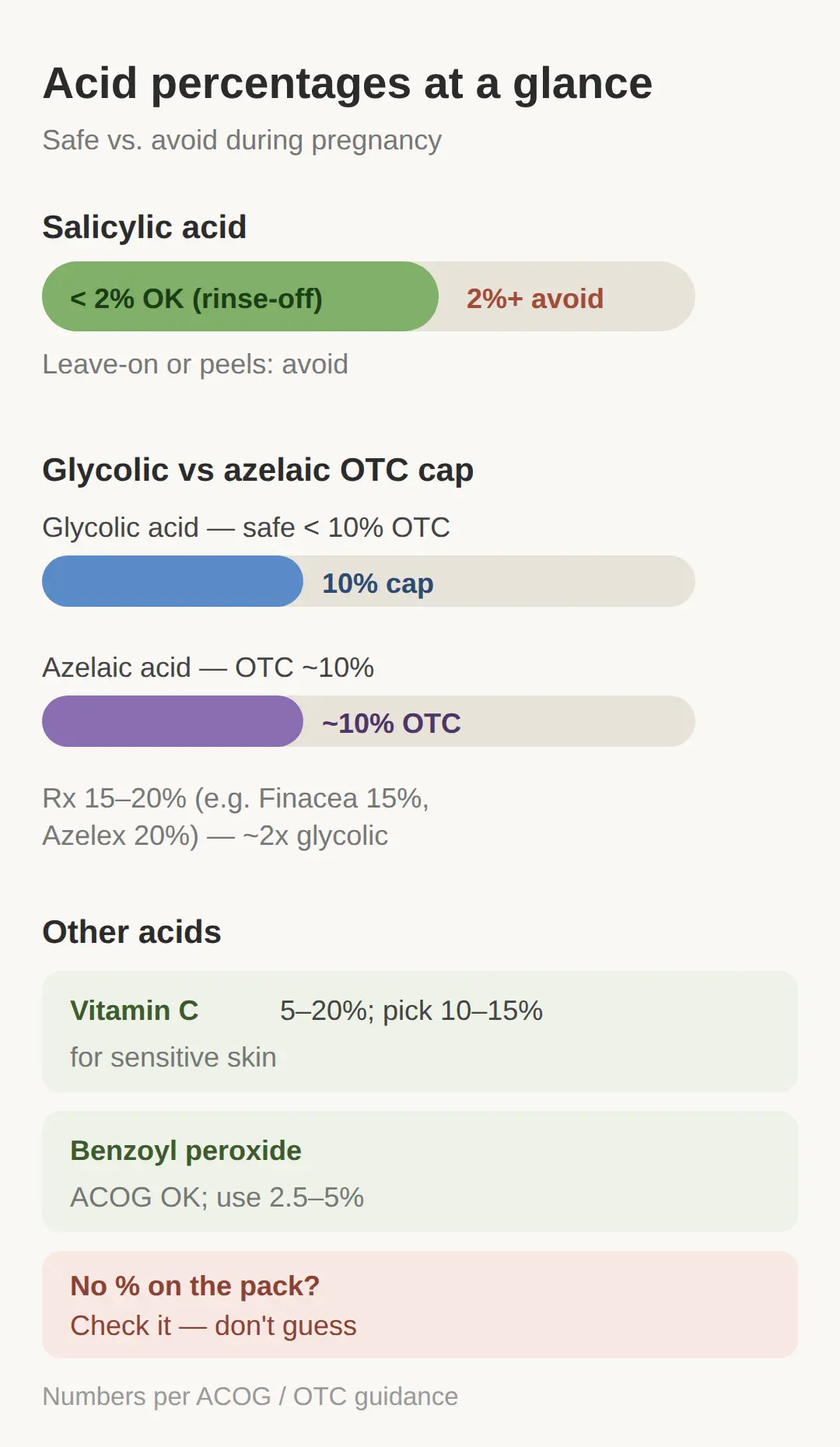
Salicylic acid below 2% in rinse-off products is generally considered safe; at 2% and above, and in leave-on products, it moves to the avoid list.
So check the percentage, not just whether it appears.
Glycolic acid is considered safe at over-the-counter concentrations below 10%, and azelaic acid is on the ACOG’s usable list alongside glycolic acid and benzoyl peroxide.
Vitamin C runs at roughly 5–20% in cosmetics, with 10–15% formulas suggested as first picks for pregnancy-sensitive skin.
For benzoyl peroxide, ACOG permits use when needed, and community guidance usually points to lower concentrations around 2.5–5% because higher-percentage washes mainly add irritation.
If a product lists an acid without a percentage anywhere on the pack, that is a reason to run it through the checks below, not to guess.
How to check a product at Olive Young
The front of the box tells you nothing — the full ingredient list is what decides it.
Start with these steps:
- Look for the caution statement on retinol packaging.
Korean rules require a fixed warning on products when retinol-type ingredients exceed set levels, which is the fastest way to spot retinol on the shelf.
- Read the full INCI list, top to bottom.
Ingredients under 1% can be listed in any order, so a risky ingredient at the end is not automatically low-dose.
- Ignore ‘clean’ and ‘maternity’ claims.
Korean anti-wrinkle functional products may legally contain retinol, so the functional label is not a safety label.
- Run the product through the Hwahae app’s pregnancy mode (added in its 2024 update) for Korean products, or EWG’s Healthy Living app for overseas purchases, where a score of 3 or below is the advised line.
- Patch-test behind the ear for 24 hours, and start new products on the inner arm — pregnant skin reacts more easily.
When checking a shelf product, the first thing to read is the INCI list and the retinol warning text; the front claim is marketing.
A routine by trimester
Korean OB/GYN guidance recommends cutting a 10-step routine to 4 basics — cleanse, tone, moisturize, sunscreen — which means 6 products fewer per routine, a 60% reduction.
Here is what the trimmed routine looks like.
Morning: gentle fragrance-free cleanser → niacinamide serum → light moisturizer → mineral SPF 30–50.
Evening: oil cleanser if you wore SPF or makeup → gentle cleanser → azelaic acid if acne is the issue → moisturizer.
Later in pregnancy, skin tends toward dryness and melasma, so the changes are richer ceramide and hyaluronic acid moisturizers, a vitamin C serum for pigmentation, and mineral SPF 30+ every day.
Sheet masks are fine if the ampoule is a simple fragrance-free hydrating formula — the sheet material never mattered; the ampoule ingredients do.
If morning sickness makes scents a trigger, switch everything to fragrance-free; if breakouts cluster along the jawline, that is hormonal and azelaic acid is the first-line swap.
When to see a dermatologist
See a dermatologist for severe acne, rashes, or melasma rather than stacking more products on top.
Don’t pick pregnancy breakouts — the pigmentation risk is higher during pregnancy.
And if a routine question isn’t covered here, an OB-GYN, GP, or pharmacist can check the specific product with you.
On specific Olive Young picks: stock, product names, and prices change, so this post names ingredient criteria instead of SKUs.
If I were buying for someone pregnant at Olive Young, I’d pick by ingredient rather than by ‘maternity’ branding — the label means less than the INCI list printed on the box.
My first checks would be bakuchiol or peptides for anti-aging, azelaic acid or niacinamide for acne, and a zinc oxide SPF 30–50, because those swaps sit on the strongest evidence instead of marketing claims.
A dermatologist handles the cases a shopping list can’t; the ingredient checks handle the rest.
👉 why doctors advise against retinol and retinoids during pregnancy, with the ACOG position
👉 a trimester-by-trimester pregnancy-safe skincare routine with morning and evening steps
👉 the full list of ingredients to avoid during pregnancy, with absorption numbers
👉 how to judge sheet, hydrogel, and clay masks by their ampoule formula
👉 why ceramides are judged safe in pregnancy and how to apply them
Related posts
📎 Olive Young — everything we know
📎 📅 다가오는 일정 — 발매·개봉·발표 캘린더
Sources
- ACOG discourages all retinoids; MotherSafe allows low-% OTC (weeklykoreanz.com)
- VeriMom trimester guide + avoid-list guide confirm ingredien (verimom.com)
- Precautionary principle framing, safe ingredient list, INCI (verimom.com)
Quick recap
- Skip all vitamin-A derivatives — retinol, retinal, retinyl palmitate — plus hydroquinone, minoxidil, and salicylic acid at 2%+ leave-on.
- Safe throughout pregnancy: hyaluronic acid, niacinamide, vitamin C, azelaic acid, glycolic acid under 10%, ceramides, squalane, glycerin, alpha arbutin, mineral SPF.
- Read the full INCI list and the retinol warning label; under-1% ingredients can appear in any order, so the end of the list is not a safe zone.
- Cut the routine to 4 basics and patch-test new products for 24 hours before regular use.
- ‘Clean’ and ‘maternity’ claims don’t replace the ingredient list — Korean anti-wrinkle products may legally contain retinol.
FAQ
Q. Can I use Korean skincare while breastfeeding?
The pregnancy skip list is the general baseline, and the main added caution is keeping products off areas a baby’s mouth may touch. Confirm specifics with your doctor.
Q. Is azelaic acid safe during pregnancy?
Yes — ACOG lists it among the OTC acne ingredients usable in pregnancy, and it also treats pigmentation.
Q. I used a retinol cream before I knew I was pregnant — should I worry?
Stop using it and mention it at your next appointment; single-source reassurance says a few uses are not a panic situation because topical absorption is very low.
Q. Is bakuchiol safe during pregnancy?
It is the commonly recommended retinol substitute for anti-aging, used alongside peptides, vitamin C, or niacinamide.
Q. Which sunscreen should I buy at Olive Young while pregnant?
A mineral sunscreen with zinc oxide or titanium dioxide, SPF 30–50; skip filters like oxybenzone and octinoxate, which showed endocrine effects in animal studies.
Check the INCI list before paying — the front label won’t tell you.
Cover photo: Skincare bottles, Location unknown, Aug — CC0 1.0
#Koreanskincare #pregnancy-safeskincare #OliveYoung #retinol #azelaicacid #K-beauty
📅Upcoming Dates — 이번 주 19 · D-2 Final two episodes drop on Disney+/Hulu전체 보기 →