Yes — retinol can be layered with Korean skincare, but only at night, in the right order, and never on the same night as AHA or BHA.
Vitamin C goes on in the morning, niacinamide and hyaluronic acid can stay on retinol nights, and SPF 30+ the next morning is mandatory for the whole period of use.
This post gives the 4-step evening order, a weekly schedule that separates the ingredients, the concentration to start at, and the bakuchiol swap available at Olive Young.
Contents
- can i use retinol with korean skincare — yes, on three conditions
- The 4-step night order for retinol
- Vitamin C, AHA and benzoyl peroxide: which days they go on
- What to buffer with: niacinamide, hyaluronic acid, sandwich method
- Which retinol concentration to start at — and when to step up
- Bakuchiol instead of retinol: the Olive Young swap
can i use retinol with korean skincare — yes, on three conditions
Yes, retinol works with Korean skincare, on three conditions: night-only use, the correct layering order, and no acids on the same night.
Retinol breaks down under UV and stops working in daylight, so night application is the basic rule, with SPF 30+ every next morning as part of the deal.
AHA layered on the same night raises the skin irritation index 2.4 times, per the British Journal of Dermatology (2021).
If your routine is already heavy on acids, retinol does not add a night — it replaces one.
| 1. Cleanse | Gentle cleanser, pat dry |
|---|---|
| 2. Wait | 5–10 minutes on dry skin — damp skin absorbs faster and stings more |
| 3. Toner or essence | Hydrating Korean toner or essence |
| 4. Retinol serum | Pea-sized amount, face only — no eye area, no lips |
| 5. Moisturizer | Ceramide or barrier cream on top; niacinamide serum is optional before it |
The 4-step night order for retinol
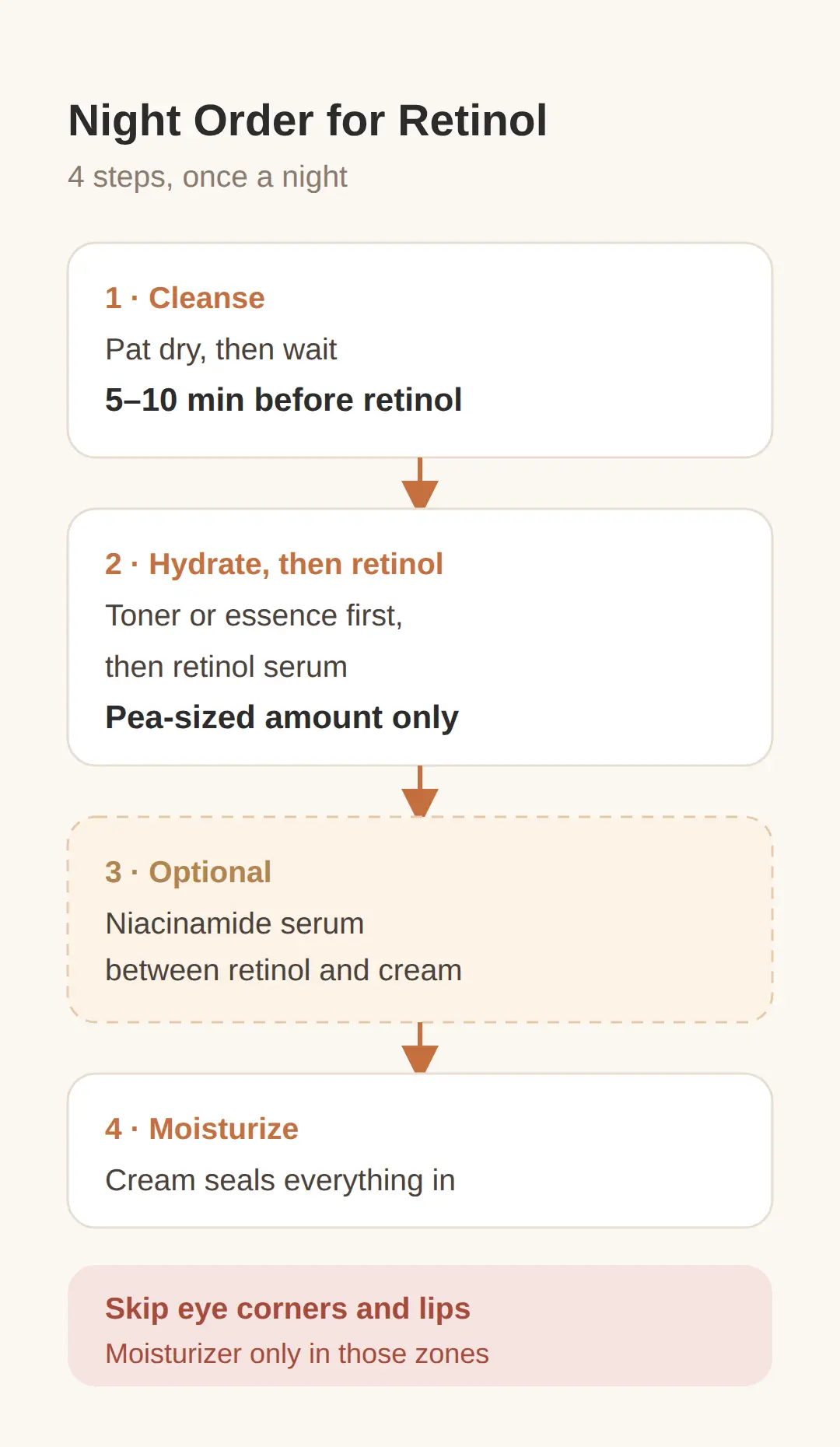
- Cleanse and pat dry, then wait 5–10 minutes before retinol — applying it on damp skin speeds absorption and increases irritation.
- Apply your hydrating toner or essence first, then the retinol serum in a pea-sized amount.
- Finish with moisturizer; a niacinamide serum between retinol and cream is optional.
Keep retinol away from the eye corners and lips entirely — those zones get moisturizer only, because they react first.
Cream or oil-blend retinol textures are gentler than runny water-based serums, which penetrate faster but sting more, so beginners should pick the heavier texture.
Opaque, air-blocking packaging (pump or airless tube) beats clear glass bottles, because retinol oxidizes easily once exposed to air and light.
Vitamin C, AHA and benzoyl peroxide: which days they go on
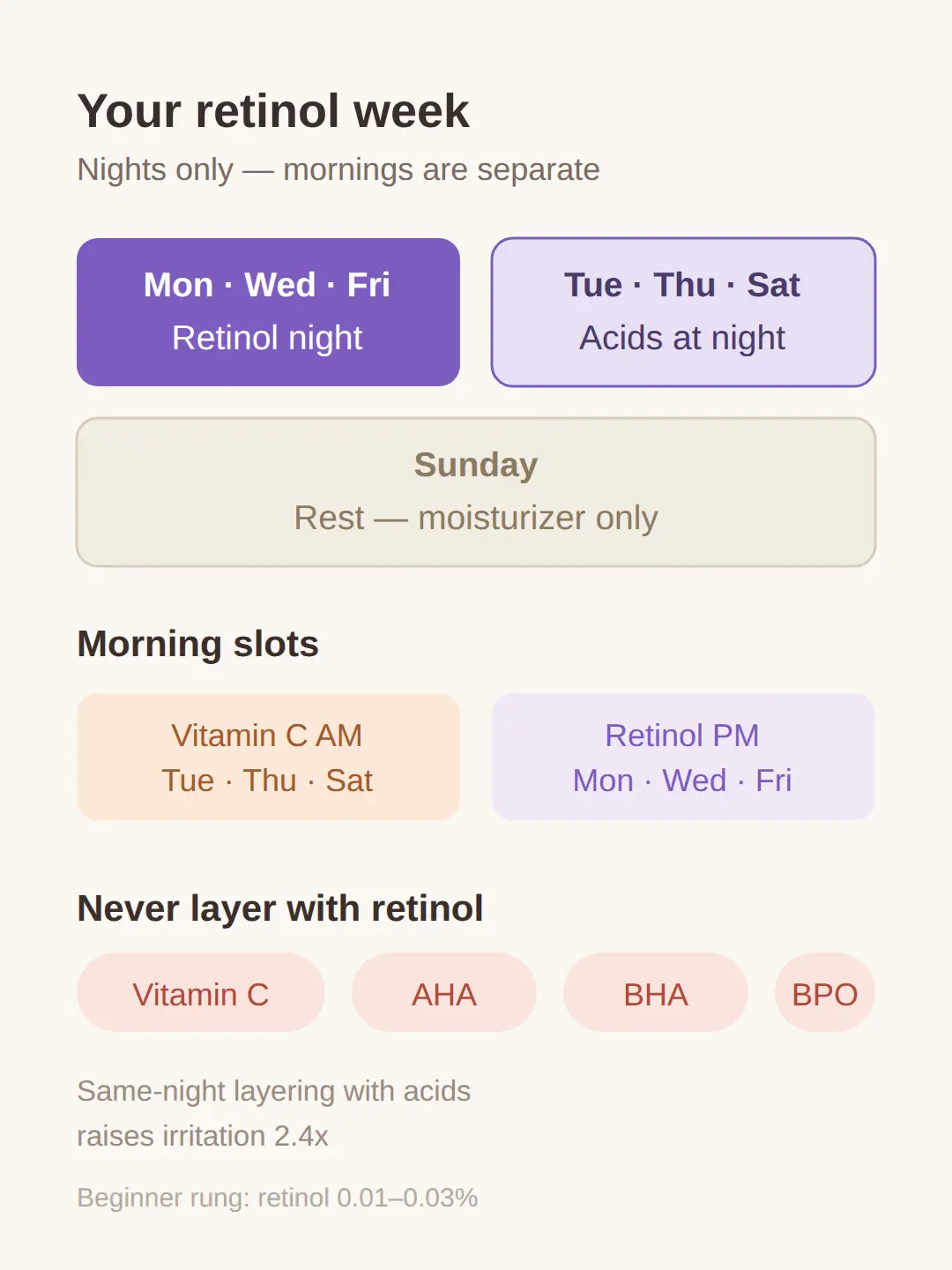
Vitamin C goes on in the morning and retinol at night — that is the split dermatologists recommend most.
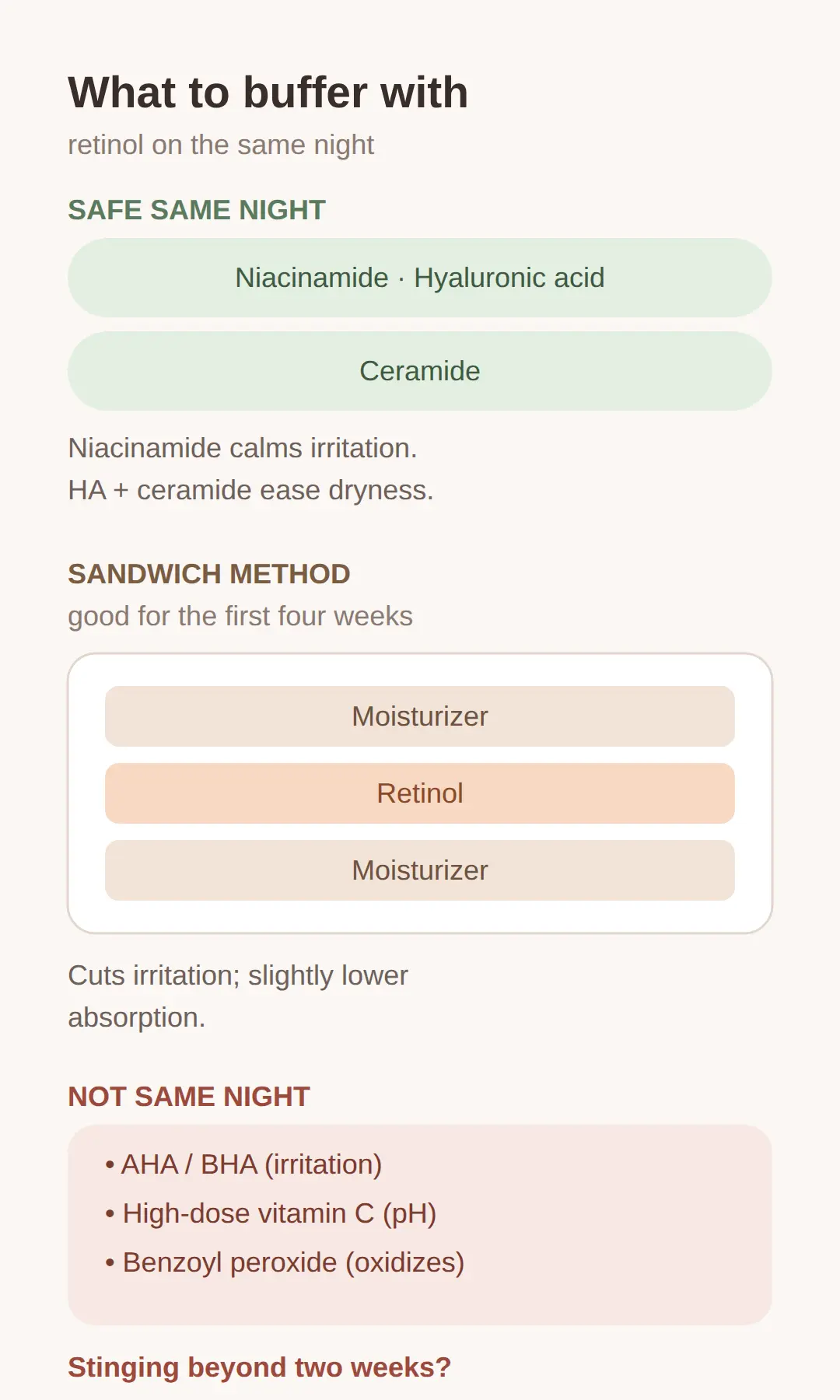
High-dose vitamin C clashes with retinol on pH, and benzoyl peroxide oxidizes retinol and deactivates it, so both stay out of the retinol routine.
AHA and BHA move to non-retinol nights, because same-night layering raises irritation 2.4 times.
For sensitive skin and beginners, the working week looks like this:
- Monday, Wednesday, Friday — retinol at night.
- Tuesday, Thursday, Saturday — vitamin C in the morning, acids on these nights if you use them.
- Sunday — rest, moisturizer only.
What to buffer with: niacinamide, hyaluronic acid, sandwich method
Niacinamide, hyaluronic acid and ceramide can all be layered with retinol on the same night.
Niacinamide calms retinol irritation and supports the skin barrier, while hyaluronic acid and ceramide soften the dry, tight retinoid reaction.
The sandwich method — moisturizer first, then retinol, then moisturizer again — cuts irritation while keeping most of the effect.
The trade-off is slightly lower absorption, so it suits the first four weeks more than a routine you keep forever.
If a reaction lasts more than two weeks anyway, drop one concentration step and cut back to twice a week.
Severe pain or blistering is a stop signal and a dermatologist visit, not something to push through.
Which retinol concentration to start at — and when to step up
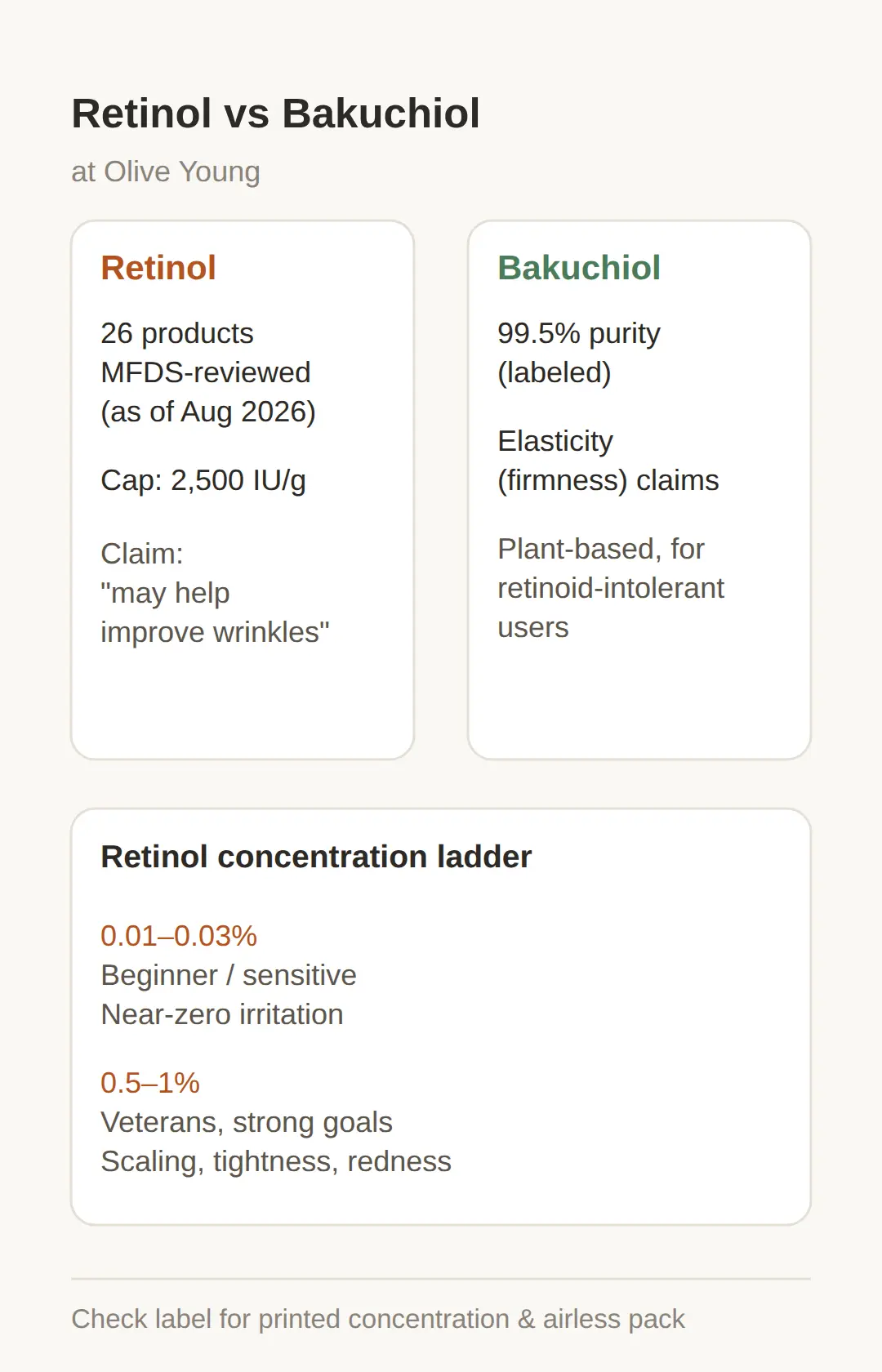
Start at 0.025–0.1% every other night — that is the entry standard per the AAD guideline (2023) and the Korean Dermatological Association’s revised protocol (November 2023).
The ladder then runs 0.05–0.1% after 2–3 months of experience, 0.3–0.5% once tolerance is built, and 0.5–1% for long-time users with pronounced anti-aging goals, where scaling and redness are likely.
Skin adaptation takes about 4–6 weeks, and each step up should come only after tolerance is confirmed, roughly every 2–3 months.
Texture improvement appears at 4–6 weeks, while wrinkle and pigment results need 12+ weeks of consistent use.
In one 2022 clinical study (PMID 36102847), 0.3% retinol over 12 weeks significantly increased collagen density in photoaged skin — but only in skin that had already built tolerance.
Plan for 57% of retinol users getting dryness or redness in the first four weeks (AAD consumer survey, 2022); typical symptoms subside in 2–6 weeks.
Bakuchiol instead of retinol: the Olive Young swap
All retinoids are discontinued during pregnancy and breastfeeding, and bakuchiol is the plant-based alternative suggested for people who must avoid retinol.
Bakuchiol on Olive Young shelves is labeled 99.5% purity with elasticity (firmness) efficacy claims, and it suits users who cannot tolerate retinoids.
CJ Olive Young has expanded its ingredient-focused ‘Advanced Derma’ shelf to 650 stores as of September 17, 2026, with 70% of that revenue coming from foreign customers — the retinol-alternative section is stocked for exactly this demand.
Verified in-store prices for specific bakuchiol products could not be confirmed, so check the shelf or the Olive Young Global site for the current price before buying.
Two packaging checks apply to bakuchiol as well: opaque, airless containers, and a label that states the concentration.
If it were me, I would start at 0.025–0.1% every other night in a cream or oil-blend, because the richer buffer keeps the retinoid reaction down while the effect stays.
The first thing I look at is the stated concentration on the label — if a bakuchiol product does not print it, I put it back on the shelf.
Related posts
📎 Olive Young — everything we know
📎 📅 다가오는 일정 — 발매·개봉·발표 캘린더
Sources
- Night-only retinol rule due to photodegradation; SPF 30+ man (wp1health.com)
- Yes — with time-split (vitamin C AM / retinol PM), alternate (healthnotekorea.com)
- Concentration table by experience level, sandwich technique, (chillingsource.com)
Summary: the three rules that keep retinol and K-beauty compatible
- Retinol at night only, SPF 30+ every morning — for as long as you use retinol, not just the first weeks.
- One pea-sized amount, never on the eye area or lips, after a 5–10 minute dry-down wait.
- Niacinamide, hyaluronic acid and ceramide stay on retinol nights; vitamin C moves to mornings; AHA, BHA and benzoyl peroxide move to other days.
- Start at 0.025–0.1% every other night in a cream or oil-blend formula, and use the sandwich method during the first four weeks.
- If you are pregnant, breastfeeding, or retinoid-intolerant, bakuchiol at Olive Young is the named substitute — prices vary by product, so check the shelf.
FAQ
Q. Can I use retinol with Korean skincare?
Yes. Keep retinol to nights only, follow the order cleanser → toner/essence → retinol → moisturizer, and keep AHA and BHA on different nights.
Q. Can I use retinol with vitamin C?
Yes, in a split: vitamin C in the morning as an antioxidant shield, retinol at night. On the same night they conflict on pH.
Q. Can I use retinol with niacinamide?
Yes. Niacinamide calms retinol irritation and strengthens the barrier, so it can be layered the same night, between retinol and moisturizer.
Q. Can I use retinol with Korean sunscreen?
SPF 30+ every morning is required for the entire period of retinol use. Specific Korean sunscreens have not been formally tested alongside retinol, so treat pairing as general advice.
Q. Can I use retinol while pregnant?
No — all retinoids are stopped during pregnancy and breastfeeding due to fetal risk. Bakuchiol is the suggested alternative to discuss with a dermatologist.
Save this night-order schedule and check your current shelf tonight — start at 0.025–0.1% every other night, and move vitamin C and acids to their own days.
Cover photo: Retinol-2023-03-24 by Vauia Rex — CC BY-SA 4.0
#retinol #Koreanskincare #OliveYoung #bakuchiol #vitaminC #niacinamide #K-beautyroutine
📅Upcoming Dates — 이번 주 20 · D-1 Final two episodes drop on Disney+/Hulu전체 보기 →