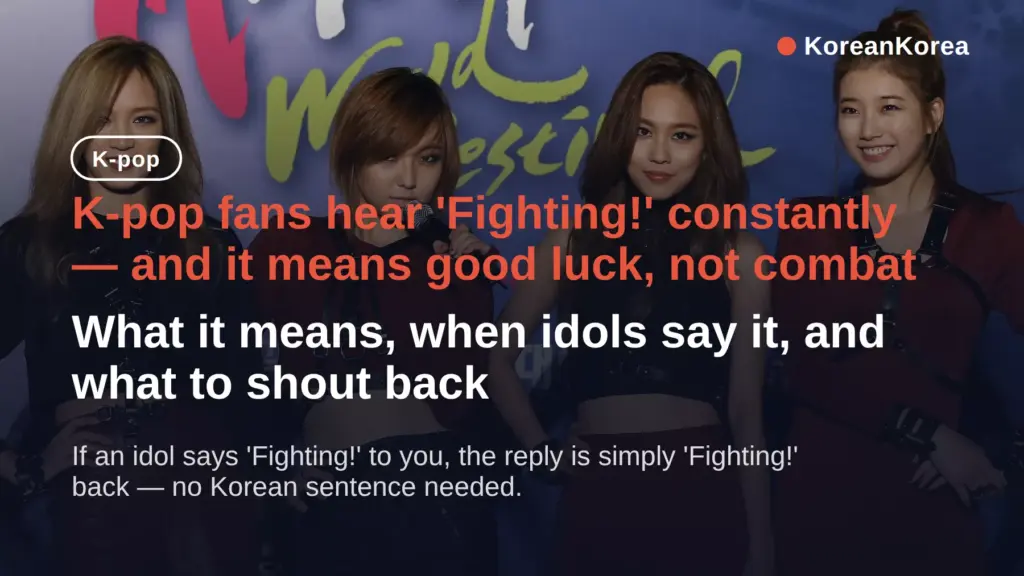
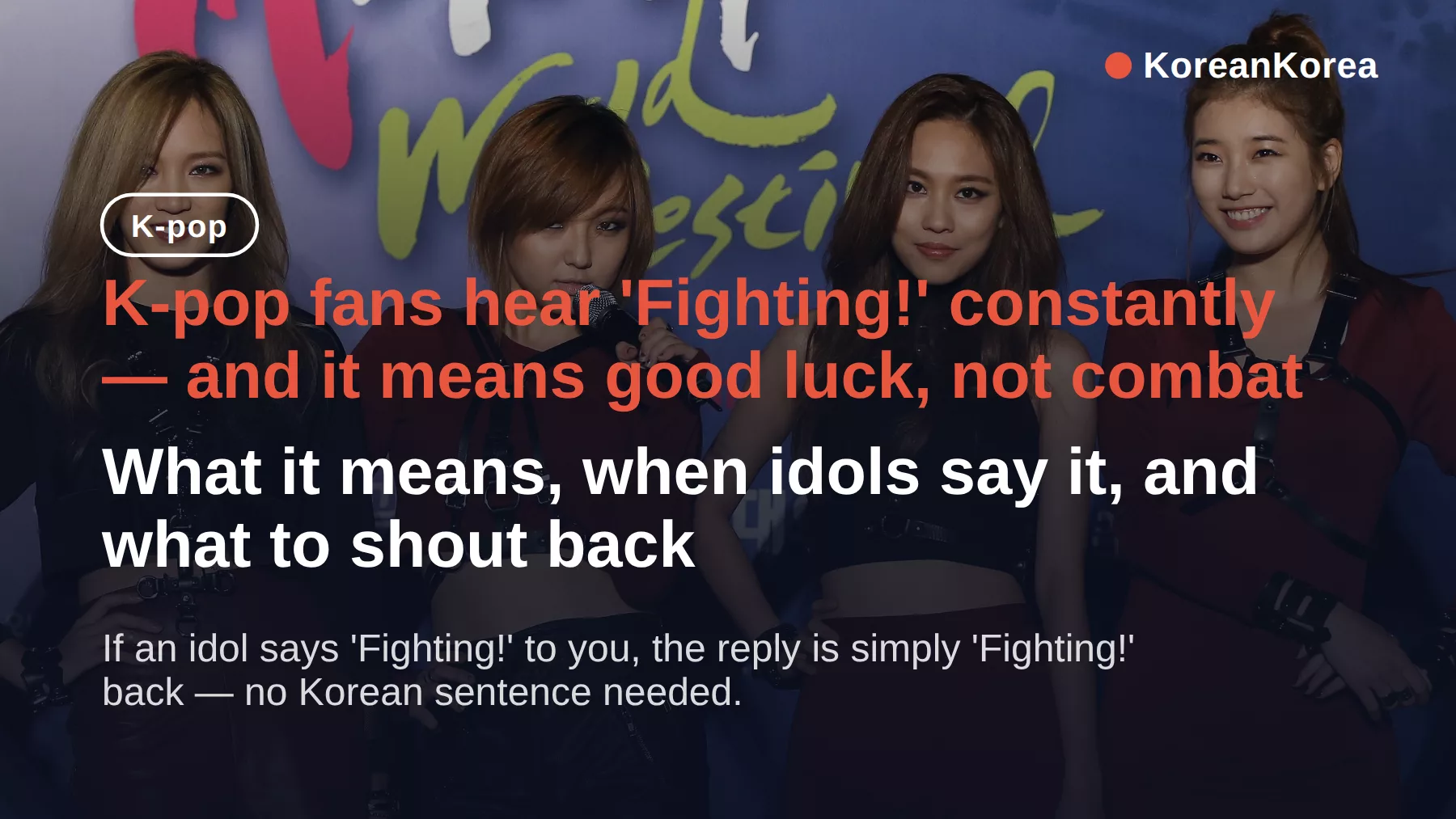
When a K-pop idol says ‘Fighting!’ (Korean 화이팅 or 파이팅), it means ‘good luck, go for it’ — never an actual fight.
It is a cheer, not a question, so echoing ‘Fighting!’ back is a complete answer.
This post covers what it means, where it came from, which spelling is standard, and what to say back at concerts, fansigns, and live chats.
Contents
- What does it mean when K-pop idols say fighting? — the short answer
- Where ‘Fighting’ comes from — and why it isn’t English
- 화이팅 vs 파이팅 — which spelling is correct?
- When idols say ‘Fighting’ — the moments to expect it
- What to shout back — concert, fansign, and live chat
- Other Korean cheers you can use instead
What does it mean when K-pop idols say fighting? — the short answer
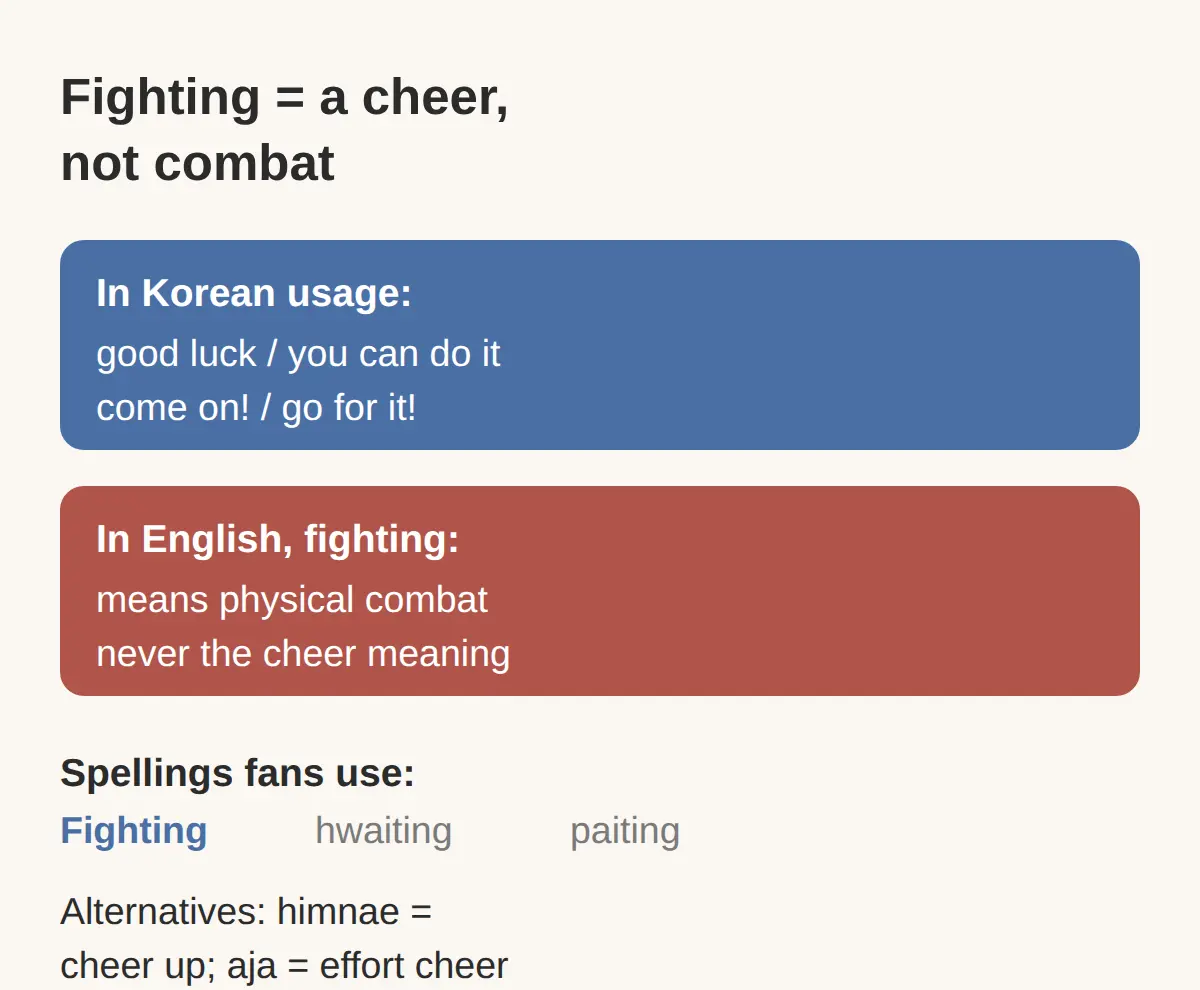
It means ‘good luck’, ‘you can do it’, or ‘go for it’ — the English Wiktionary entry for 파이팅 defines it as an exclamation meaning ‘come on!’ and ‘go for it!’.
The word is borrowed from English ‘fighting’, but in Korean it never refers to physical combat.
It is an encouragement cheer used before performances, at fan meetings, on live streams, and in fansign comments.
In English it maps closest to ‘Let’s go!’ or ‘You got this!’, not to the literal meaning of the word ‘fighting’.
If you hear it from an idol, treat it as encouragement aimed at you — the group, the fans, or the day ahead — and answer it as a cheer, not as a question.
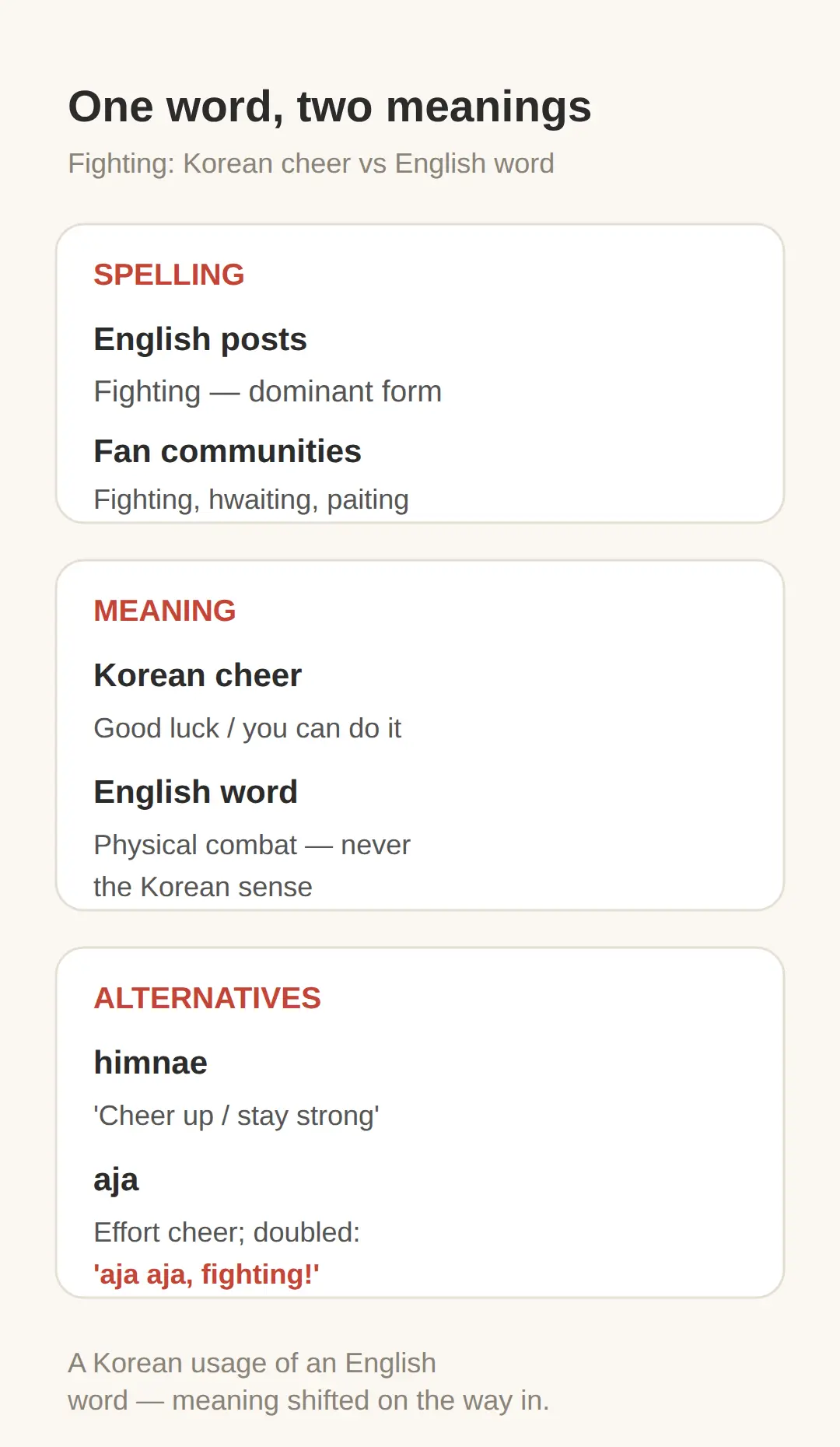
| Fighting (English spelling) | Dominant form in English fan posts; means ‘good luck’, never physical combat |
|---|---|
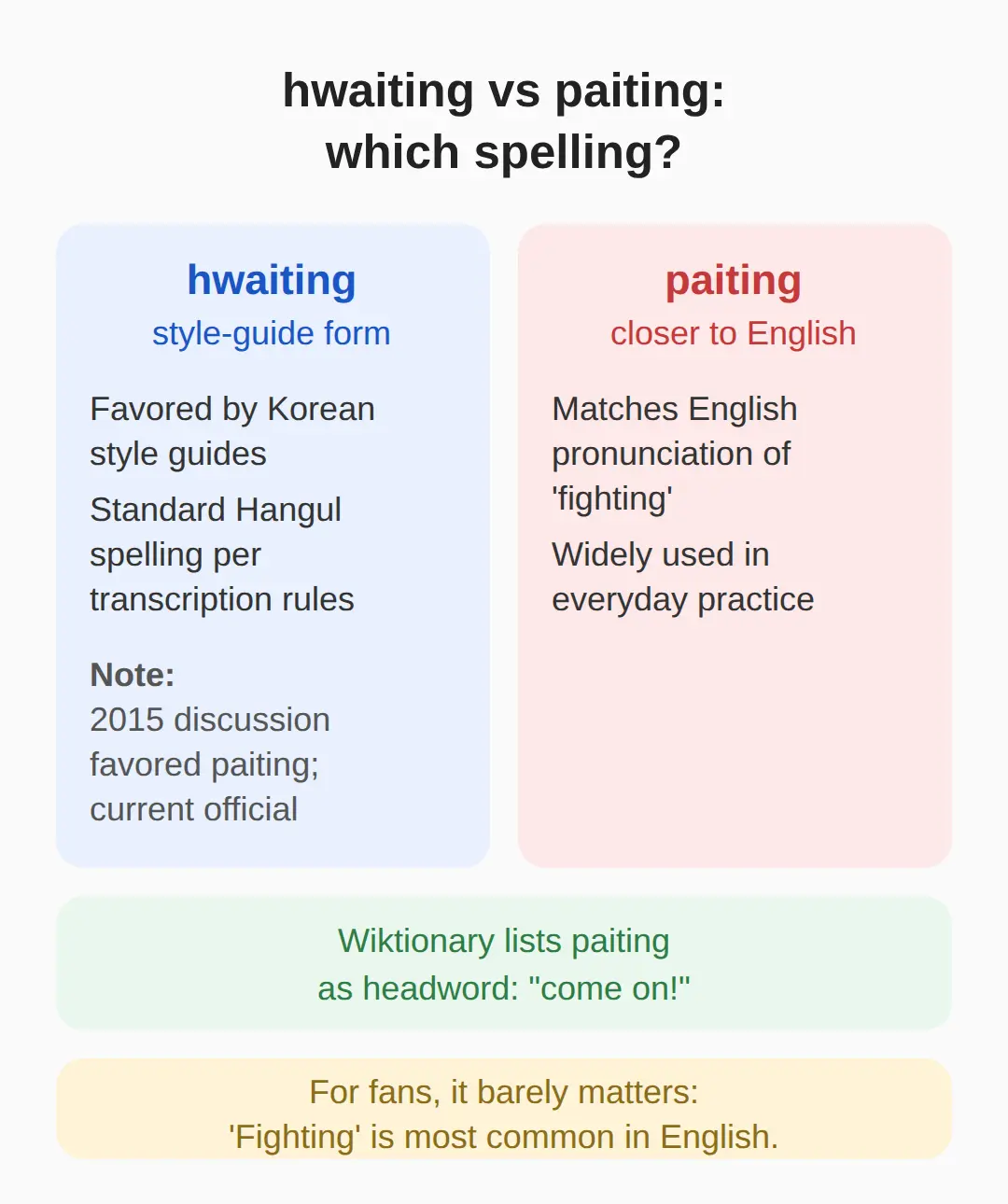
| 화이팅 (hwaiting) | Hangul spelling favored by Korean style guides, per transcription rules; some sources note a 2015 discussion favored 파이팅 — the National Institute’s current position could not be confirmed |
| 파이팅 (paiting) | Closer to the English pronunciation and widely used in practice; Wiktionary lists it as the headword: ‘come on!’, ‘go for it!’ |
| 힘내 / 힘내요 (himnae) | Native Korean alternative: ‘cheer up / stay strong’; 힘내요 is the polite form |
| 아자 (aja) | Another effort cheer; ‘aja aja fighting!’ is a recognized doubled, stronger form |
Where ‘Fighting’ comes from — and why it isn’t English
The cheer entered Korean usage in the late 20th century as an English loanword taken back with a shifted meaning — ‘persevere, support’ instead of brawling.
It spread widely as a mass stadium chant during the 2002 FIFA World Cup co-hosted by Korea and Japan, carried by phrases like ‘대한민국 화이팅’ (‘Go, Korea!’).
That was 24 years before 2026, and the cheer was already standard in Korean sports broadcasts and school sports days before K-pop idol culture adopted it.
So if it sounds odd to a native English speaker, that is expected — it is a Korean usage of an English word, and the meaning changed on the way in.
화이팅 vs 파이팅 — which spelling is correct?
Both spellings are in use, and Korean style guides have favored 화이팅 (hwaiting) as the standard Hangul spelling, per transcription rules.
파이팅 (paiting) sits closer to the English pronunciation and is common in everyday use; the English Wiktionary lists 파이팅 as its headword.
The two conflict on history — some sources note that a 2015 style-guide discussion favored 파이팅, and this post could not confirm the National Institute of Korean Language’s current published position from a primary page.
For an international fan, the choice barely matters: all three forms — Fighting, hwaiting, paiting — are understood in fan communities, and ‘Fighting’ is the most common in English posts.
When idols say ‘Fighting’ — the moments to expect it
Expect ‘Fighting!’ at a fixed set of moments:
- Right before the group goes on stage, and at the start of a concert or before the encore.
- At the start of a live broadcast on a Weverse-type platform.
- During comeback season, as a slogan like ‘[Album name] fighting!’.
- In fanmeeting game segments and send-off messages before exams or a tour start.
- At the end of the group’s official greeting — groups commonly attach ‘Fighting’ to the intro, and fans answering with the group name plus ‘Fighting’ is the standard call-and-response.
It sits outside the songs themselves: K-pop fan chants (응원법) place members’ names between lyric lines, while ‘Fighting’ cheers come before or after the performance.
The register is casual — fine between fans and idols at events, but it is not the phrasing used in formal Korean, where official texts prefer constructions like 힘내시기 바랍니다 (‘we hope you stay strong’).
What to shout back — concert, fansign, and live chat
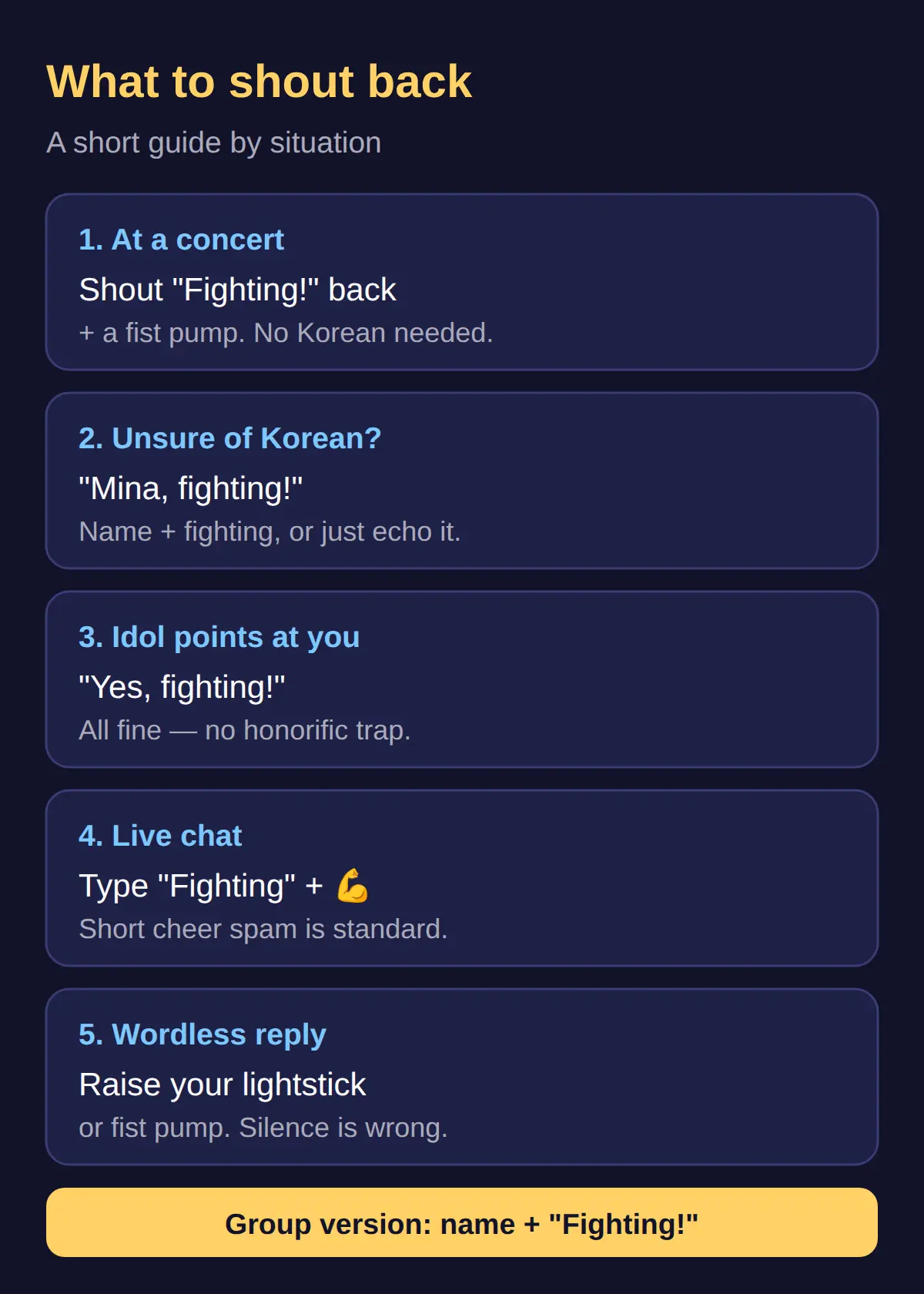
The expected reply is the cheer returned:
- At a concert: shout ‘Fighting!’ (or ‘화이팅!’) back, usually with a fist pump — no Korean sentence is needed.
- Unsure of your Korean: shout the idol’s name plus ‘Fighting!’, e.g. ‘Mina, fighting!’ — or simply echo ‘Fighting!’.
- If an idol points at you directly: ‘화이팅!’, ‘네, 화이팅!’, or ‘감사합니다, 화이팅!’ (‘thank you, fighting!’) are all accepted — there is no honorific trap.
- In a live-stream chat: type ‘화이팅’ or ‘Fighting’, often with 💪 — short cheer spam is standard chat etiquette, and idols often read these aloud.
- A raised lightstick or a fist pump alone also counts; silence or a literal answer is not expected.
If you want the group’s own version, answer the official greeting with the group name plus ‘Fighting!’ — that is the beat the crowd is waiting for.
Other Korean cheers you can use instead
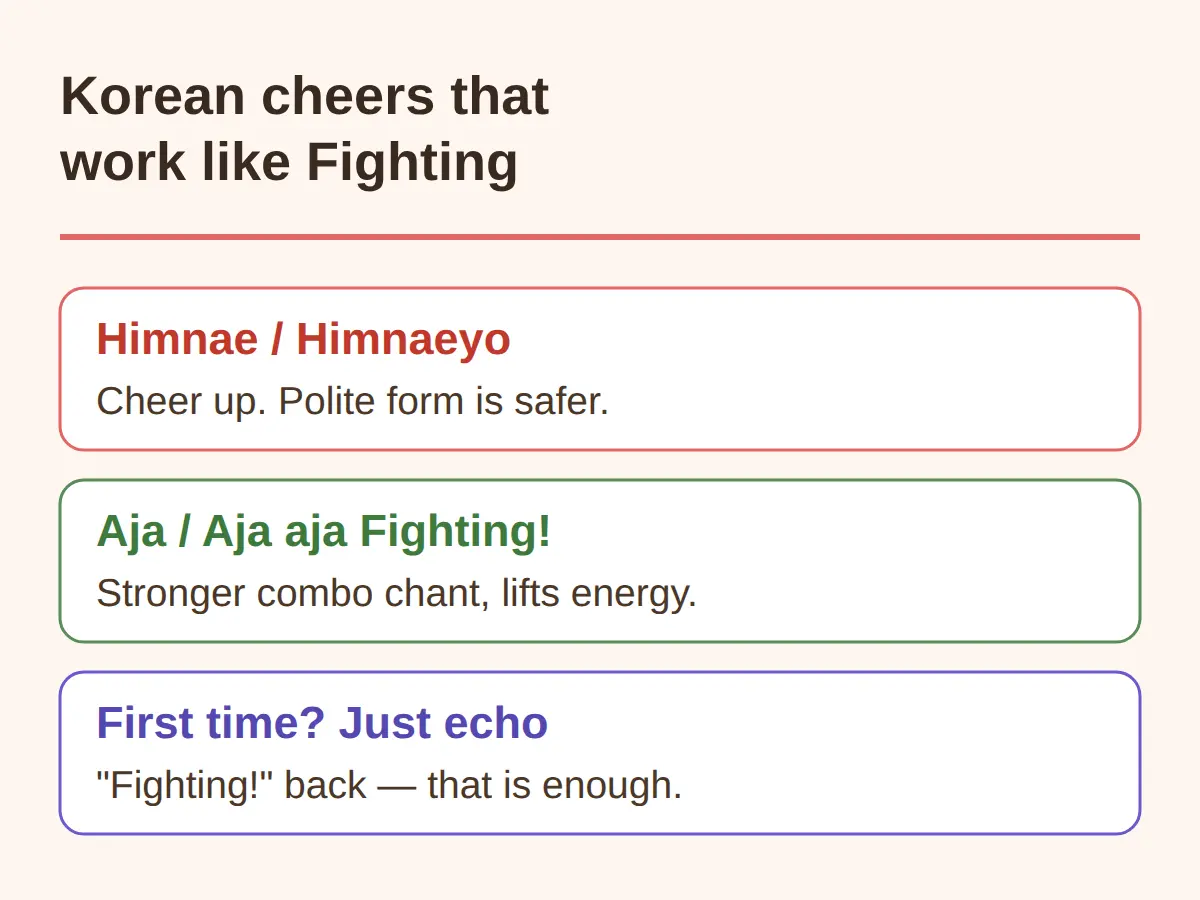
Two native cheers do the same job. 힘내 (himnae) means ‘cheer up / stay strong’, and 힘내요 is its polite form — the safer choice when speaking to someone older or unfamiliar.
아자 (aja) is another effort exclamation, and the doubled form ‘아자아자 화이팅!’ (aja aja fighting) is a recognized, stronger cheer that combines the two and lifts chant energy.
If you want to vary what you shout, mix 힘내 or 아자 in with ‘Fighting’ — all of them signal the same thing: keep going.
If I were guiding a first-time concertgoer, I’d tell them to just echo ‘Fighting!’ back, because matching the cheer is the expected response and no longer sentence is needed.
👉 Wikipedia’s ‘Paiting’ entry — origin and usage of the Korean cheer
👉 Wiktionary’s definition of 파이팅 — ‘come on, go for it’
👉 Naver Korean dictionary entry listing 파이팅/화이팅 as an interjection of encouragement
👉 Weverse — idol live streams where fans type ‘Fighting’ as a support reply
Related posts
Sources
- Standard Korean dictionary entry (ko.dict.naver.com)
- Live-stream chat usage (weverse.io)
- Doubled form emphasis (en.wiktionary.org)
Quick recap
- ‘Fighting!’ means ‘good luck, go for it’ — it is a cheer, never a question, and never an actual fight.
- The safe reply in any setting: echo ‘Fighting!’ back, optionally with a fist pump — no Korean sentence needed.
- Safe all-purpose formula for a first-time concertgoer: the idol’s name plus ‘Fighting!’, e.g. ‘Mina, fighting!’
- In live chats, type ‘화이팅’ or ‘Fighting’ (often with 💪); a lightstick wave also counts as a reply.
- Both 화이팅 and 파이팅 are used; ‘Fighting’ in English letters is the most common form in international fan posts.
FAQ
Q. Is ‘Fighting’ a question?
No. It is a cheer, not a question or a greeting, so it does not require an informative answer — echoing it back is enough.
Q. Do you need to reply when a K-pop idol says ‘Fighting’?
You do not need a sentence. A returning shout of ‘Fighting!’, a fist pump, or waving a lightstick are all accepted replies.
Q. Can international fans just shout ‘Fighting!’ back?
Yes — echoing ‘Fighting!’ is the expected crowd response, and ‘name + Fighting!’ (e.g. ‘Mina, fighting!’) is a safe formula if you want something more personal.
Q. What does ‘aja aja fighting’ mean?
‘아자아자 화이팅’ (aja aja fighting) is a doubled, stronger form of the cheer — ‘aja’ is itself a Korean exclamation of effort, and doubling it raises the energy.
Q. Is 화이팅 or 파이팅 the correct spelling?
Both are used in practice. Korean style guides have favored 화이팅 as the standard Hangul spelling, while 파이팅 is closer to the English sound; the National Institute’s current position on the two could not be confirmed.
Save this for your next concert or live stream — when ‘Fighting!’ comes your way, the whole answer is one word back.
Cover photo: Miss A at the Korea KPOP World Festival 2013 by https://www.flickr.com/people/koreanet — CC BY-SA 2.0
#K-pop #Fightingmeaning #hwaiting #paiting #K-popfanchants #concertetiquette #Weverselive
📅Upcoming Dates — 이번 주 23 · D-day Final two episodes drop on Disney+/Hulu전체 보기 →